Ontario, Canada
Grade 12 - Reflecting, Responding and Analyzing - The Critical Analysis Process
21 units • 7 professional development courses aligned to B.1.1 - use the critical analysis process to reflect on and justify or revise decisions in creating drama works
B.1.1 use the critical analysis process to reflect on and justify or revise decisions in creating drama works
This page lists 21 units and 7 professional development courses aligned to B.1.1 from the Ontario, Canada. Designed for drama teachers, these resources directly address B.1.1 - use the critical analysis process to reflect on and justify or revise decisions in creating drama works
While the Drama Two Curriculum has a focus on acting, it’s always important to include a unit on the technical theatre skills that are necessary to any production. Students will also be able to use what they’ve learned in this unit in their upcoming devising project.
Students will begin by exploring design for the stage by experimenting with line, shape, texture, size, and color. They will expand their understanding of stage properties and scenic flats. They will then apply their knowledge of these building blocks of design to create a high-concept design for a miniature “stage.”
In this unit, students will be introduced to the musical theatre form by asking and answering the question “What is a musical?” They will learn and demonstrate knowledge of musical theatre vocabulary terms. They will be introduced to two foundational songs in the musical form: the “I want” song and the “I am” song and analyze an example of each song. They will also start to think about their own voices and reflect on their skill set and confidence level with regard to singing in front of others. Students will learn the musical theatre warm-up that will be used throughout the curriculum. This set of exercises will help students prepare to perform through a physical and voice warm-up. Finally, students will watch, discuss and analyze one or two musicals (depending on your time and access to materials).
In this unit, students will incorporate character development into their musical theatre preparation. Students will explore internal and external tools that they can use to express emotion in their singing. Students will then take everything they have learned and apply it to a song which they will then perform (solo or in groups).
In this unit, students will combine knowledge of the previous two units: singing and movement. Students will review singing technique and terminology and work on a song together. They will build on their vocabulary of simple dance moves. Then, students will work in groups to learn and rehearse a section of a musical theatre song by choreographing movement that expresses the song’s meaning and characters, presenting their work to the class, and working on curriculum goals of risk taking, endurance, confidence, commitment, character, and emotion.
In this unit, students will look at the real world of musical theatre. They will learn about roles that keep professional musical theatre shows running (such as swings and understudies). They will reflect on advice from musical theatre professionals on how to make it to Broadway, and for a culminating project, they will research and present on the career of a musical theatre performer.
Students will show what they have learned throughout the curriculum by writing and performing a musical. They will add modern songs to a traditional fairy tale story. In this way, students do not have to create their story from scratch—the structure and characters are already in place.
In this unit, students learn how to write their own scripts using correct formatting. These scripts will be more detailed than the contentless scenes. Students will learn how to write dialogue that provide information about relationships, conflicting objectives, and setting.
They’ll also learn how to correctly add expression and movement directions into the script itself. The unit will end with a partner script writing assignment which is performed in front of the class.
Teacher Angel Borths developed this unit when she was looking for lessons to teach the basics of pantomime in the classroom.
This unit culminates in a finished product for performance, either for peers, or for theatre festivals. The rubrics and written work for this unit take planning and preparation for performance into account. The exercises can be pulled out and used independently, but work best when used to build toward a finished product. You can also pull the ground plan and stage directions lesson plans to use with playwriting or directing lessons.
This unit on Ancient Greek theatre focuses on the function of the chorus, the choral ode, and the details of the theatre space. It touches on plays and playwrights of the era, culminating in a final project of a modern version of Medea that includes a choral ode.
Students will discover, analyze, and explore the history, characters, and style of commedia dell’arte.
Commedia dell’arte is a theatre history unit mixed with improvisation, physicalization, and exploring specific characters. In this unit, we’re going to focus on three main aspects:
1. Causes and Effects of Commedia (History)
2. Stock Characters
3. Commedia Performance Practices
Join Matt Banaszynski in this dynamic unit designed to introduce students to the process of starting, drafting, polishing, and performing a self-created, stand-alone monologue.
This unit introduces students to writing their own stand-alone monologues. Students will learn the steps involved in going from a simple idea to a written piece to performing that piece. They will also provide feedback to others and give themselves a self-assessment.
This unit has been prepared for a middle school drama class but could be adapted for high school. It was designed as a way to get non-theatre students more involved in theatre.
This unit on Puppetry is designed for middle school and up, to introduce students to the material and get them comfortable with performing in a safe and low exposure environment.
This is a unit that builds to a culminating experience for your students. Each lesson is designed to explore techniques, provide opportunities for creative collaboration among your students, and give them opportunities to perform. Some of the lessons require materials to build or create puppets. Puppetry can be as easy as drawing a face on your finger for finger puppets, to actually purchasing your own finger puppets for students to use.
While the focus of this unit is puppetry, your students will explore other skills as well. There’s the obvious ones of creative thinking, teamwork, and problem solving. They are also going to explore storytelling, performing skills, and playwriting.
WARNING: This unit is ABSURD. However, instructor Lea Marshall decided to do something really ABSURD with the unit, which was make it a bit more predictable. First, the unit takes two lessons to go over the Historical and Philosophical background of Theatre of the Absurd. It starts with just a visual exercise to really bring students into the emotional bleakness of the landscape and then group work to look at some of the other foundational elements that will drive the Absurdist movement into the Theatres.
Next, students break down absurd scripts into some “recognizable” elements of language, plot structure, acting choices, and storyline. With each lesson that introduces an Absurdist Element, there is an opportunity for students to “play” with the element. Then, students explore the element through an Absurdist text. This will help familiarize the students with the 4 Absurdist scripts used in the unit. These bite sized forays into the scripts will help students to choose a script to fully immerse themselves in for the final project.
As a final project, students will choose one script to work with, and choose the format of their project (performance, costume or set design, or playwright).
The Drama Two Curriculum has been developed to expand and deepen students’ skills as artists. In this unit, students will explore character analysis, which is key to developing three-dimensional characters in monologues, scenes, and plays. In Part 1, they will start with Uta Hagen’s nine questions for character analysis.
Instructor Laramie Dean uses this unit as the final project for his Drama 2 students. Drawing upon any of the skills students have developed throughout, they create a product that could be used within a new piece of musical theatre.
Students start by analyzing three musicals, study guides included, and practice creating musical elements. They are then given class time to prepare in groups as many elements as they can for a new musical using devised theatre techniques.
There are 24 lessons in this unit which culminates in a final assessed performance.
We included this unit in our Distance Learning Curriculum because if any group of students would understand how the world turned upside down and then apply it to theatre, it would be the students dealing with a global pandemic.
First, we take two lessons to go over the historical and philosophical background of Theatre of the Absurd. We start with a visual exercise to bring students into the emotional bleakness of the landscape and then group work to look at some of the other foundational elements that will drive the absurdist movement into the theatres. Next, we break down absurd scripts into some “recognizable” elements of language, plot structure, acting choices, and storyline. In each lesson that introduces an absurdist element, there is an opportunity for students to “play” with the element.
In this unit, students will create and perform an abstract theatre scene. Abstract is a genre that does not rely on realism and deliberately breaks the rules of a given form. In the case of theatre, this refers to the commonly presented rules of performance, acting, and the relationship with the audience. Movement is often stylized and symbolic. Ideas and themes are expressed visually and aurally with little dialogue using music, lights, costumes, and props.
In this unit, students will learn about Antonin Artaud and how his ideas influenced avant-garde theatre in the 20th and 21st centuries. They will also learn how Jerzy Grotowski took Artaud’s theories into new directions. This is done through direct instruction. A culminating presentation will ask students to take common stories and reimagine them using some of these ideas. They will present a “pitch” of an avant-garde version of their story. In the second lesson, students learn about some of the ideas of Augusto Boal and try a session of Forum Theatre.
The Dilemma Project is based on a situation that requires a decision: push a button and get a great reward, but there’s also a great consequence. Don’t push the button and there’s no reward.
This unit will lead to a group performance including characters, costumes, set, acting theory, acting tools, and a student written script. The final script will be about ten pages in length which means roughly ten minutes of stage time.
A monologue unit is an excellent way for students to demonstrate learned skills: vocal skills, movement skills, memorization skills, and character development. It also touches on soft skills such as communication, confidence, and attitude. That being said, monologues are not easy. A typical monologue is two minutes long. That is a lot of text to memorize, block, and develop into an engaging presentation. How often have you sat through a bad monologue performance with little to no characterization, wandering blocking, and a tenuous grasp of the lines?
Performing a monologue is a learned skill. And the best way to learn a skill is in steps. Instead of starting with the end goal—that two-minute piece—start at the beginning. This four-lesson unit will take students up the ladder toward the goal of a longer monologue.
In most units that cover the Theatre of the Absurd, the number of playwrights addressed are few and the time period is limited. While it is certainly true that the era identified as “The Theatre of the Absurd” was a reaction to the distorted reality of life after World War II, there are many environments that create distorted realities and many playwrights who use those realities as catalysts for absurdist plays.
In this unit, we will start with a traditional look at the Theatre of the Absurd and then expand our exploration beyond its origins.
Close reading is an activity that puts curriculum standards into practice and it can be easily applied to the drama classroom.
Close reading asks a lot of your students. They have to read and think at the same time.
This course teaches drama teachers how the close reading process works, and gives them exercises and tools to apply it in the classroom.
Allison Williams leads the course: 21st Century Skills Through Devising. This course covers what devising is, why to do it, how to do it, and how your students can master the 21st Century Skills of collaborations and cooperation, critical thinking, creative thinking through devising.
High school is a great place to try devising with your students. But it’s not something you want to throw at your students without any preparation. Framework is important and this course takes you through a number of exercises you can take into the classroom tomorrow to help build a place of physical safety, a place where students work at making a lot of choices instead of waiting for the perfect choice, and a place where students feel comfortable making creative choices. The material also reviews the process of putting together a show from the idea/research stage to editing, to giving feedback.
Your students have what it takes to create their own material, collaborate with each other, and have a unique theatrical experience!
Directing youth theatre can be one of the most thrilling, rewarding, and exhausting jobs there is – because it’s not just about staging a play. It’s about creating an environment that fosters hard work, dedication, trust, and the willingness to take chances, to “play without fear.”
As a writer/teacher/director of youth theatre for over 15 years, I have developed tools and strategies that enable my students and me to focus on the process of creating theatre while fostering an environment that leads to creative freedom and a cohesive groups that doesn't act as individual “stars,” but as a community of one.
In this course, I will share with you these tips and strategies, along with the ways to implement them in your theatre environment.
Holly Beardsley is a do-it-all director. She started directing middle and high school students in her early college years and since then has written over ten shows and directed twice as many.
Do-it-all directors are responsible for everything it seems – the direction, the costuming, the choreography and of course, the set too. And though directors are ready to direct, to costume and even dance, there is something intimidating about designing and building a set.
The Do-it-All Director’s Introduction to Set Design will give you the director, who must do-it-all, the confidence and skills to not only direct but build your own set as well - no matter your experience or budget. This course will teach you set design basics, construction tips, budget tricks, and how to tackle your precious performance space armed with a hammer, and most importantly, without fear.
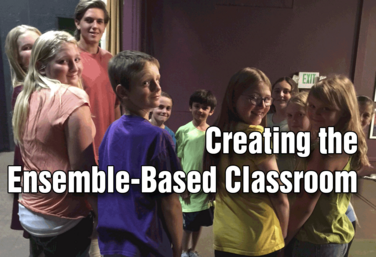
Gai Jones will help you establish an ensemble-based environment from the first day of class or rehearsal.
Learn how to set up your ensemble-based classroom from day one, get students to set classroom norms, and find the balance between creative activity and structure. You’ll learn how to give your students creative freedom through structure and classroom management. The cornerstone of this course are the detailed ensemble experiences from large group to small group and even individual experiences.
This course culminates in a devising model that you can use with your students, and takes you through process, product, performance and an evaluation.
You too can create the ensemble-based classroom.
The focus of the teacher-director should be not only on the quality of the show, but on the value of the experience offered to student actors. This course takes you on this journey through practical rehearsal strategies that apply an ensemble approach.
This course starts with those all important first rehearsals, explores warm ups, and looks at character development. We examine specific types of plays, like classical texts and comedy, and conclude with strategies to solve common rehearsal problems.
Go beyond the basics!
Moral dilemmas are not only faced by characters in gripping plays, but are also faced by our students. The project outlined in this course will help students develop their critical thinking skills through the use of one of the dilemma questions to shape a student written production.
If you had the choice to press a button and earn $25,000,000... but a species (not of your choosing) would become extinct, what would you do? More importantly, what would your character do?
Join drama teacher and playwright Claire Broome through this course which includes role-playing, Stanislavski’s Magic If, character creation, playwriting and staging.
Our parent company Theatrefolk offers a fantastic selection of plays written specifically for high school and middle school students.
Whether for performances or class study, there's something for everyone: relevant & relatable themes, simple sets & costumes, flexible casting options and much more - a perfect addition to any drama program!
Please note:
Plays are offered separately from your membership and can be purchased through Theatrefolk.