Facebook Pixel Skip to main content

📣SCRIPT SALE! Treat yourself to an easier Fall. Save 30% on 5+ perusal scripts with code SPRING30 before May 3 and head into summer stress-free.

How to Teach Iambic Pentameter: Free Drama Lesson

What Drama Teachers Need to Know (+ A Free Classroom Exercise)

Iambic pentameter is a style of poetry, which refers to a certain number of syllables in a line and the emphasis placed on the syllables. While he did not invent it, William Shakespeare frequently used iambic pentameter in his plays and sonnets. Here are some examples that you’ll probably be familiar with. Read them out loud:

  • If music be the food of love, play on. (Twelfth Night)
  • O that this too too solid flesh would melt! (Hamlet)
  • But, soft! what light through yonder window breaks? (Romeo and Juliet)

They flow nicely when read aloud, don’t they? So what makes them examples of iambic pentameter? Let’s quickly break down the term itself.

In poetry, two syllables together are called a foot. So in a line of poetry, the cat would be considered one foot. If you say the words, and the is unstressed and cat is stressed (i.e. the CAT), it can be represented as *da DUM. * An unstressed/stressed foot is known as an iamb, which is where the term iambic comes from.

In poetry, meter refers to the pattern of syllables in a line. Penta means five (think “pentagram,” a five-sided figure in math, or “Pentatonix,” a super-popular a cappella group with five members). Therefore, iambic pentameter refers to a line of poetry that has five feet of iambs (an unstressed syllable followed by a stressed syllable). So, going back to one of Shakespeare’s examples above, it would sound like:

but SOFT | what LIGHT | through YON | der WIN | dow BREAKS

da DUM | da DUM | da DUM | da DUM | da DUM

Great! Go back and read the original examples above and think about the unstressed/stressed syllables.

Some more modern sentences that use iambic pentameter might be:

  • I ate my sister’s soup, and it was good.
  • I can’t make rhymes when I am fast asleep.
  • I wish that you and I were in Japan.
  • Why do we have to go on Tuesday night?
  • She likes to drink her tea with jam and bread. (Shoutout to Maria von Trapp!)

Now it’s time for students to try creating their own pieces using iambic pentameter. The following exercise has two parts – an individual warmup and a group writing portion. *See below * for a worksheet to guide students through the process of the exercise.

Part One

Part One consists of an iambic pentameter warmup. Students do this individually.

  • Students will find and write out four examples of iambic pentameter in Shakespeare’s plays and sonnets (be sure students cite which play or sonnet the examples are from).
  • Then, students will write four original lines of verse in iambic pentameter, on any topics they wish. The lines do not need to relate to each other – this is the practice portion, where they can experiment with finding the right number of syllables and making the emphasis work. Remember that an iamb is an unstressed syllable followed by a stressed syllable.
Part Two

Part Two consists of a group writing exercise.

  • Have students get into groups of four. Each group will choose one topic that all four members will write about.
  • Each individual group member will write four original lines of verse in iambic pentameter on that topic. The lines do not have to rhyme.
  • Once each group member has created their four lines, they will work together to combine and rearrange the lines to create a monologue using all sixteen lines. Students may arrange the lines in any order that makes an interesting narrative, then adjust and edit lines as necessary.
  • Once the monologue is created, students will read their monologues out loud, listening for the correct emphasis of syllables and narrative flow. Then each group will present their monologue to the class. Even though the piece is a monologue, have each group member present a portion of the piece.


People Also Ask

What is an iambic pentameter example?

  • If music be the food of love, play on. (Twelfth Night)
  • O that this too too solid flesh would melt! (Hamlet)
  • But, soft! what light through yonder window breaks? (Romeo and Juliet)

Is iambic pentameter just 10 syllables?

Not quite - it's more specific than that. Iambic pentameter is 10 syllables arranged in a particular stress pattern: five pairs (feet) of unstressed + stressed syllables. The pattern is da-DUM da-DUM da-DUM da-DUM da-DUM.

So "Shall I compare thee to a summer's day" is iambic pentameter. It has 10 syllables, but they also fall into that alternating weak-strong pattern.

By contrast, "January February March" has 10 syllables but is not iambic pentameter -- the stresses don't follow the pattern.

The 10-syllable part is necessary but not sufficient.

How to tell if a poem is written in iambic pentameter?

You check two things:

  1. Count the syllables per line. Each line should have 10 (occasionally 11 if it ends on an unstressed syllable, called a "feminine ending").
  2. Check the stress pattern. Read the line aloud naturally and mark which syllables you'd emphasize. It should fall into five da-DUM pairs. For example, take "So long as men can breathe, or eyes can see":

so-LONG / as-MEN / can-BREATHE / or-EYES / can-SEE
Five pairs, alternating unstressed/stressed. That's iambic pentameter.

What is the most famous iambic pentameter?
For a textbook-perfect example, Romeo and Juliet gives you:

But soft, what light through yonder window breaks?

Click here for a worksheet to guide students through the process of the exercise, as well as an evaluation rubric.
Download For Free

Related Articles

Exercise: Shakespearean Insults
Classroom Exercise

Exercise: Shakespearean Insults

If you have a Shakespeare unit or play study planned for your class, start with this exercise; it’s a great doorway to engaging with the Bard. The key to Shakespeare is to get students up and performing. Shakespeare was never meant to be read or studied. His actors didn’t read and study their lines, they acted them. They breathed life into the words. That is what you need to get your students to do. Click below to download the Shakespeare Insults Handout. It has this exercise in PDF form as well as an Insults Table your students can use to create their own. Instruction• Start off with some vocal warm-up exercises. Tongue twisters are a good choice! • Divide your students into pairs. Each pair will work together to create a 30-second scene. For example: A: Hey! B: Hello there. A: Let me by, I have to cross this bridge. B: You can’t. A: Why not? B: Because. A: Cause why? B: Cause there’s a bear on the other side. A: Why didn’t you say so? • Have pairs present their scene. • Share with students that people often think of Shakespeare as dull or dreary because of the language barrier. But Shakespeare was dramatic and his characters are larger than life. Nowhere is that more evident than in the insults Shakespeare gave his characters. • Give students this insult and have them all say it at the same time. Repeat the insult so that everyone has the words down: • “Thou dankish, guts-gripping, maggot pie!” • Highlight to students that “thou” means you. Simple as that. • Give students the Shakespeare Insult Table (you can download it below), which has a simple formula for creating an insult: Thou A+B+C! • Gather in a circle. Have students pick phrases from each column and combine them to create a Shakespearean insult that starts with “Thou.” Have everyone “insult” each other. • Get students back in their pairs and review their scene. To make it Shakespearean, they are going to add an insult, following the formula Thou A+B+C! to at least five lines. So, the sample scene from above might look like: A: Hey thou gorbellied, motley-minded hugger-mugger! B: Hello there thou yeasty, clapper-clawed strumpet! A: Let me by, thou frothy, dizzy-eyed maggot pie! I have to cross this bridge. B: You can’t. A: Why not? B: Because, thou surly, guts-gripping harpy! A: Cause why, thou dankish, sheep-biting pignut? B: Cause there’s a bear on the other side, thou spleeny, fly-bitten varlet! A: Why didn’t you say so, thou mewling, swagbellied footlicker? • Everyone will present the new version of their scene. It’s silly, it’s fun and yes, it’s Shakespeare. Want More? Head on over to the Free Resources section of the Theatrefolk site for more Shakespeare help, including: • Directing Shakespeare for the First Time • Romeo and Juliet Word Search • Iambic Pentameter
Using Improv to Address Fear of Failure
Classroom Exercise

Using Improv to Address Fear of Failure

Fear of failure is a huge concern in drama class. Nobody wants to fail – it’s not a good feeling, and students are hyper-aware of not only their own feelings, but their perceptions of what others in the class think of them. Making a mistake can be paralyzing because students are afraid of looking foolish, unintelligent, or unaware in front of others – so they often won’t even try a task without a huge amount of anxiety. However, the following improvisation game, The Alphabet Improv Game, is great to try with your students because it’s a pretty challenging one. It is inevitable that your students are going to make mistakes and “fail” while playing it, because even the most seasoned improv performers find this one difficult. The point is to try the game, make mistakes, and see that making mistakes is not the huge deal that students can make it out to be. The goal is that your drama students will realize that everyone makes mistakes – it’s not just them, stuck in their own heads. And at the same time, they get to have a lot of fun! InstructionThe Alphabet Improv Game is played as a full class. • Have students sit in a circle. • Select three to four students to start the scene. • Have the rest of the group choose a location (e.g. supermarket, classroom, movie set, theatre rehearsal, corporate office, desert, jungle). • The first group of students will start the scene. However, each sentence spoken by a new person must start with the next letter of the alphabet, from A to Z. (Each word in the sentence doesn’t have to start with that letter.) • Students need to listen carefully and remember what letter they are currently on! • For example, if the scene is taking place on a movie set: 1. Student 1: “Annnnnnd…action!” 2. Student 2: “But soft, what light through yonder window breaks?” 3. Student 1: “Cut, cut! Can you do that again, please? We can’t hear you!” 4. Student 3: “Don’t speak so quietly.” 5. Student 2: “Everyone else on this set can hear me…can’t you guys?” …and so on. • If a student starts their sentence on the wrong letter or repeats a letter that was already used, then they have to sit down and the next student in the circle replaces them. The scene continues on, with the new student either taking on the same role or coming in as a different person. The location remains the same. • If there is a long pause and none of the students can think of the next sentence, all of the current students have to sit down and the next three to four students in the circle replace them. They pick up from the last letter used. So if the last line was “Man, it’s so hot out here!” then the next sentence must start with N. • The scene must be completed by the time the students get to the letter Z. Then the scene may start again with three to four new students in a new location until the full class has had the opportunity to play. • If your students find this game too easy, have them go through the alphabet backwards, from Z to A! If your students ask, there is no prize or reward for one person/group being able to complete the game in one try. This is not a competitive game and that’s not the point of it. After each student has had a chance to participate, have a debrief conversation with the class. How do they think they did? What were the easiest and most challenging parts of the game? How did your students feel if they made a mistake? If you notice students are getting overly critical of themselves, acknowledge that there is always room for improvement but that everyone makes mistakes and it’s completely normal to do so. Then ask them to discuss positive moments that arose while playing the game. They will explore their thoughts further while completing an individual Reflection. Distance Learning AdaptationsAlphabet Warm-Up (Full Class) • The goal is for students to recite the alphabet out loud, from A to Z, one person at a time. One student says “A”, another student says “B”, another student says “C”, and so on, without following an assigned running order. • If two students say the next letter at the same time, or a letter is skipped, the group starts over at A. Students cannot cue or coach each other, or give visible hints. • Ask students: What is the purpose of this exercise? What are the benefits to students of doing this warm-up? Alphabet Storytelling (Full Class) • Determine a running order of students. • Students will tell a story, one sentence at a time, starting with the letter A. The next student will start their sentence with the letter B, and so on, from A to Z. (Each word in the sentence doesn’t have to start with that letter. See the example in the article above.) Students must focus on starting with the correct sequential letter, as well as ensuring their sentence has a specific beginning and ending, and that it makes sense with the story topic. • If a student starts their sentence on the wrong letter or repeats a letter that was already used, they are out. The story continues on until the students reach Z. • Once students are able to tell a story with an assigned running order, try the exercise again without a running order. Students will need to listen that much more carefully to avoid interrupting each other. Virtual Alphabet Improv Game (Full Class) • This game can be played using a video conferencing program, pretty much exactly the same way as the in-person version. Assign 3-4 students to create an improv scene, and have the rest of the students ready to jump in if a letter is missed or a long pause occurs. If you wish, determine a running order for participating students in advance, so students know when they are “on deck.”
Shakespeare Exercise: Reframe the play
Classroom Exercise

Shakespeare Exercise: Reframe the play

This is a great classroom exercise to not only have fun with Shakespeare but to also see how well students can re-frame which ever Shakespeare play they are studying. Take a character from one genre (a Shakespearean play) and re-frame that character by way of a second genre (e.g. Science Fiction movie) through the medium of poster design. Both genres should be clear on the poster. Follow the template of the below example for your project. • Choose a Shakespearean character. (Macbeth) • Choose a Science Fiction movie. What sci-fi movie could your Shakespearean character star in? (The Terminator) • Re-frame the title of the Science Fiction movie so that it fits your character. (The Kinginator) • Create a visual that incorporates elements from both the Shakespeare character and the sci-fi movie. (The character looks like the Terminator but wears a king’s crown.) • Create a tagline for this new movie that helps describe who the Shakespearean character is and what they do in the play. (He’s going to be King. Or else.)

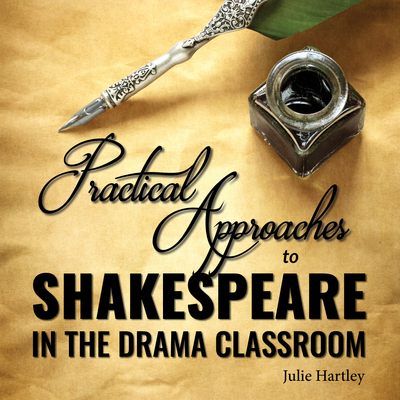
Practical Approaches to Shakespeare in the Drama Classroom

by Julie Hartley

Shakespeare is one of the greatest resources a drama teacher can have. But teaching it can be a challenge. Practical Approaches to Shakespeare in the Drama Classroom helps drama teachers break down the Bard to make his themes, language and characters accessible to all.

Script Bundle - Shakespeare plays

A selection of 10 Shakespeare perusal scripts. Whether it's a cutting that uses the original text, a monologue or scene book, or a parody that spoofs the story, these plays offer a great window into Shakespeare's world.