Show Notes
Episode Transcript
Welcome to TFP, The Theatrefolk Podcast. I am Lindsay Price, resident playwright for Theatrefolk. Hello, I hope you’re well. Thanks for listening.
This is Episode 84. You can catch the links for this episode at theatrefolk.com/episode84.
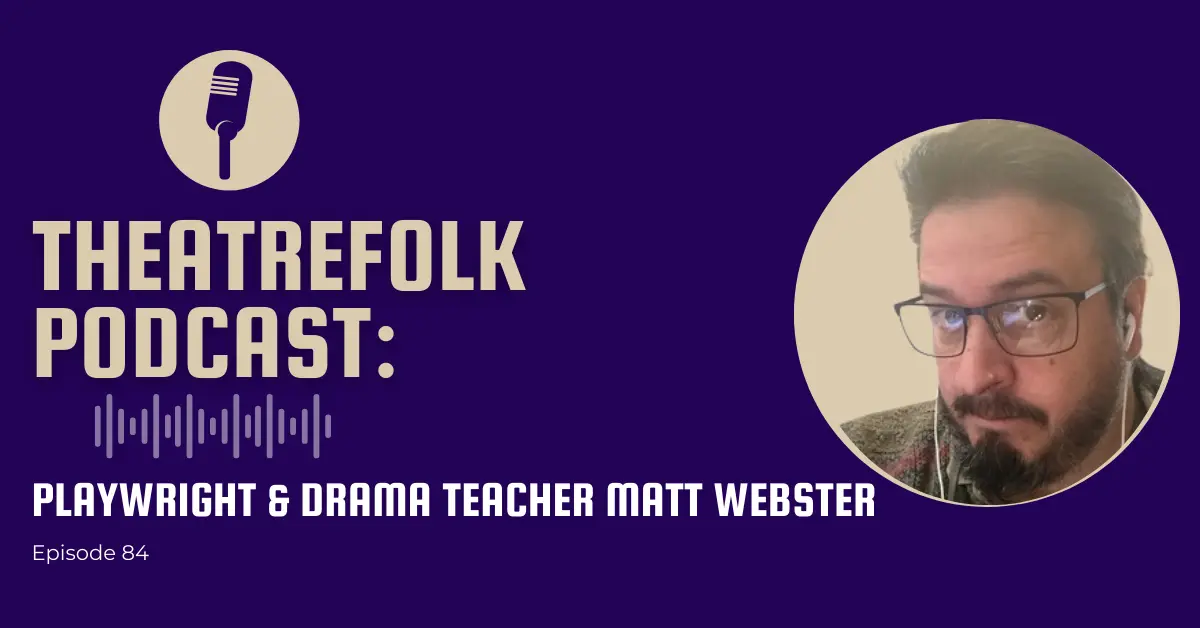
So, today is a great mix of teaching talk about play talk. Drama teacher Matt Webster spent many years teaching folks how to become drama teachers before heading back to high school where he now teaches in North Carolina. He has lots to share, it’s a great interview, so let’s get to it.
Lindsay: Hello everybody! Thank you for tuning in. I am pleased to introduce you all to Matt Webster.
Hello, Matt!
Matt: Hello!
Lindsay: Matt is one of our new playwrights. He has with us The Myths at the Edge of the World which we will get into, but he is also… You’ve had a couple of different theatre education careers.
Matt: Yes, I have, yes.
Lindsay: Where are you in the world?
Matt: Currently, I’m outside of Charlotte, North Carolina. I teach at a school that’s in Mint Hill which is a suburb of Charlotte, North Carolina, and I’m the chair of the fine arts department and theatre teacher at Rocky River High School.
Lindsay: Awesome, and I also saw that you used to teach theatre teachers.
Matt: Yes, I am a former – I like to say “recovering” – I’m a recovering theatre education associate professor. I was professor for fourteen years at the University of North Carolina and taught teachers how to teach theatre.
Lindsay: Now, why do you say recovering?
Matt: Let’s just say I am happy to be out of that particular situation and very happy to be where I am now.
Lindsay: But I did want to start to just sort of get you to talk a bit about what it was like to teach theatre teachers. What was the thing that surprised you most about these newbies coming in who wanted to teach theatre?
Matt: Well, every person who came into my office, the first question that I’ve asked them is, “Why do you want to be a theatre teacher?” and, if they didn’t say that they were dying to be a theatre teacher, I said, “Don’t. It’s too much work. It’s not enough respect. It has to be a passion,” and there were people who’d come in and say, “Well, you know, I want to teach until something better comes along.” “Well, you know, I want to be an actor but my parents want me to get a job so I want to teach.”
What I tell them is, “Ultimately, my responsibility isn’t to you and my responsibility isn’t to this university or even to your future school you might get hired by. My responsibility is to your future students and, if you go into a classroom unprepared or without passion, and you bail out in six weeks because it’s too hard or you didn’t like it or whatever the case may be, you’ve left this group of students high and dry and they’re going to have a bad taste in their mouth about theatre and you’re doing a disservice to all these kids and to the profession itself.”
So, I really push to make sure that people who taught theatre and who became teachers understood what that meant and understood the importance and the impact of that.
Lindsay: I love that. I love that the focus is on the students as it always should be!
Matt: Absolutely.
Lindsay: Sometimes, they get caught up in some of the red tape and stuff which is why I’m not in the classroom. I like to parachute in and just do my little song, my little dog and pony show, and then get out very quickly. But that’s another story for another day.
So, did you often come across, particularly I think it happens with theatre, my theatre teacher in high school was an actor who tried to make it happen and then it just didn’t. I’ve come across numerous actors who’ve sort of made teaching their second profession. Did you have to have to deal with some of that where there were students who wanted to be performers and it didn’t work out for them? So, they went, “Oh, I’ll go teach.”
Matt: Absolutely, and same thing. What often happens with those individuals is that they may have had some initial impact that worked for them but, over time, they were unprepared to be teachers. There’s a huge difference between trying to run a little mini rep company in a school and actually teaching this group of students that comes in and, depending on your placement, depending on the demographics of the school that you’re in, there’s some real challenges and issues.
And, above all, you need that training of how do you do classroom management? How do you have discipline in your classroom? How do you follow a curriculum and maintain the kind of learning that is going to build one on top of the other and keep these students moving forward? And, when people thinking, “Oh, you know what? I took classes,” or “I have a degree in acting or theatre,” it’s just a matter of going in and being myself.
It really is a shock to a lot of those people and a lot of them didn’t make it. I’m impressed with some of the ones who have but they learned it very quickly that there’s a big difference between acting and teaching.
Lindsay: Here’s a really great thing. You mentioned classroom management. The chaos that comes with a drama classroom is a natural chaos but it can also be overwhelming. When you were teaching these students, how did you teach them to balance? To find that balance between the chaos that comes with being in the activities that come with the drama classroom but not let it get out of control?
Matt: Structure is a big part of it and one of the things that I worked towards is you can learn – within this art form, you can learn from being on-stage and from sitting off the stage watching – and, if you engage the students who are watching what’s happening – their fellow student presenting a monologue or running scenes – but thinking as directors, and thinking as actors, and watching the choices that their classmates are making, and taking notes and being involved and being aware of what’s going on. And then, commenting on and feeding back to their peers about what they saw, what might work better, how they might approach something differently, and always keeping it positive.
But, certainly, there’s no reason why they can’t, as an observer, as an educated observer, watch what’s going on and create feedback for their peers in a way that’s educational for both – for the people who are on-stage doing the work and for the people who are sitting out in the audience. So, that’s one way to do it. Just keep everyone connected in the action.
But also know, as you said, there is going to be some glorious chaos that goes on from time to time. And simply being aware of that and being involved and active in that chaos.
There are times when I’ll bring one of my classes into the auditorium. There are five different groups who are working on five different scenes simultaneously and I’m constantly in motion. And then, what I will also do is I’ll place them in the four corners and then one group will be up on stage, and every fifteen minutes, I’ll rotate them and they’ll all move one direction to the right so the next group gets to be on stage.
But you really have to be active and involved in what’s going on and I read a term years ago in one of the education books that I was using, it’s the term of “with-it-ness” – that, as a teacher, the eyes in the back of the head, being aware, having that radar on that says, “This group’s a little louder than they should be for this particular scene,” or “This group has gone quiet,” or “I notice there’s supposed to be six people in this group and I only see four,” and you go and address those things. But, as a theater teacher, since it is such a much more active environment, you, as a teacher, have to be much more active. Very rarely do you just get to sit at your desk and let things happen around you. It’s not how we operate successfully.
Lindsay: What’s your favorite thing about being a theatre teacher?
Matt: Oh, my lord. When the light bulb goes off, it’s a brilliant, wonderful thing. When you see a flame of passion, when you see success from a student, I’ve had the opportunity more than once and I’m very blessed to have had it that I’ve watched the light bulb go off for a student and seen the passion – not just for theatre but maybe even for school – get ignited because of what we do in my classroom.
And one of the things that you had mentioned earlier about modern classrooms and things like that, the current state of teaching and education with assessment-driven and test-driven and standardized this and standardized that, thankfully, within the arts, it hasn’t made it to us yet. They’re working on it but it hasn’t made it to us yet.
Lindsay: I know of a group in Florida who has sort of taken it on to find a way to standardize it because they were basically told, if theatre teachers don’t do it, we’re going to do it for you and just the horror of that.
Matt: I’ve actually sat on committees in Charlotte and in the state of North Carolina over the past three years that are attempting to create a standardized test in theatre and what we’ve pushed them towards – and it sounds like they are going to try to go in this direction – is the idea of portfolio-driven work so that we see progress over time which is how we, as a theatre teachers, assess our students that someone may have come in at a very high level and on film, on video, they look fantastic, but they don’t do any work and we know this even though someone from the outside would look, “Wow! They’re really talented,” “Yeah, but they’re lazy.”
By the same token, someone could have come in and to say two words in front of the class without breaking down into tears as a major accomplishment and to have them three years later be able to do a monologue that might not be great theatre but it is huge progress for them as individuals, that’s how we measure success in our classrooms. And, to be able to say, “Here’s how we would like to standardize that measurement by saying let us video students over time and show the progression of understand,” that can work for us. We hope it keeps going in that direction.
Lindsay: Are you able to do that in your school? Do you have some positive feedback from administration?
Matt: Yes, and the other thing – for good or for bad – because we are not on the hit-list of the big three of Math, Science, and English, we are at times – and it’s a double-edged sword – we’re at times considered not as important.
Lindsay: Yeah.
Matt: And, as long as, you know, we keep our classes under control and we contribute to different aspects of the curriculum, it’s kind of hands-off. On the one hand, we want to be fully integrated and be seen as important as we are. On the other hand, you don’t want to stand up in the crosshairs of some of this stuff and it changes so much, it’s really frustrating at times.
In the four years that I’ve been at this school, the changes and how they want to view assessment from the district level to the county level to the state level has changed over, I think, three or four times in the past three or four years. It’s maddening at times.
Lindsay: And maddening for students. Like, how do they figure out how they’re supposed to – perform is not the right word but you know what I mean.
Matt: Right, and that’s where we keep trying to push it back to trust the teacher because the people in the state legislature, the people in the county don’t understand what happens in the theatre classroom and so it’s up to us to say and to be very clear, “We do have standards! We do have methods for assessment! And, if you’d like us to try to standardize then we’ll come up with a way to do that. But trust us that we are not a check-the-box kind of profession any more than music is, or dance is, or visual arts are.” These are a very different kind of learning in a very different kind of matrix so don’t try to cram it into the one-size-fits-all because it doesn’t and it won’t, and it’s actually disheartening to the students to think that they have to fit their creativity in a box with everyone else.
Lindsay: It just becomes a circle because they get pushed into these standardized ways and yet, you know, there’s all these things coming out about, “What do companies look for?” “They want creativity.” “Well, why isn’t this being addressed at the school level?” “Well, because we need numbers and the one place where a student can find their own way of expressing themselves and success in expressing themselves is the one place where there is no number.” Like, there’s no test number to say, “Hey, this kid is doing well.”
Matt: Going back to the idea that you mentioned that’s so spot-on of what businesses are looking for, when you talk about the things where students are lacking, it’s “Can you work well with others? Can you work independently? Are you a good communicator? Are you a creative thinker? Can you creatively problem solve?” Where else in the curriculum do they get those skills except for the arts? And so, to simultaneously say, ‘These are the important things that the business world needs in the 21st Century,” and, “Oh, by the way, the arts are an extra add-on. They’re not what’s important,” is so disconnected, it’s maddening at times.
Lindsay: Yeah, it’s one of those things where I go, “It’s there, it’s on paper, it seems very logical, and it’s not happening,” and it’s one of those mysteries of life to me.
Matt: Yes.
Lindsay: Which is why I’m not in a classroom.
So, everything you just mentioned is sort of like basically being in a play in a nutshell, isn’t it?
Matt: Yes!
Lindsay: Working together and communication and expression. You direct at your school?
Matt: Yes, I do, yeah.
Lindsay: Your process for putting a show up, do you focus on that product? Do you just try to get kids through the process? What’s your goal?
Matt: One of the things that also is a mindset that I bring into the work that I do and have since the university days and beyond is that this is educational theatre. It’s not professional theatre, it’s not community theatre; it’s educational theatre which means that, ultimately, what we’re doing is teaching these children about theatre and whether that teaching occurs in the classroom, on stage, in the booth, backstage, it’s still my responsibility to make sure they’re learning.
It’s my responsibility to say, “The choices that you made on stage weren’t as strong as they could be. What are other choices that you make?” or, “As the stage manager, you need to be prepared to be organized in this way and present these kinds of material and do these kinds of things as opposed to an expectation that you need to walk in the door and you need to have everything worked out and ready to go.” Well, if that were the case, you wouldn’t need to be with me. I’m here to teach you those things and so there’s a level of patience that occurs in that.
And so, the process that I have, I certainly have higher expectations from my students who’ve been with me for three or four years because they should have learned by now my basic expectations and now I get to push them a little bit. But the students that come in, first and second year, they’re going to make mistakes and, going back to the previous part of the conversation, one of real frustrating things about assessment-driven education is there’s this feeling that, if you fail, it’s all over. You’re a failure. Whereas we say, “No, if you fail, go back and try it again.” I expect you to fail because you’re trying new things, you’re taking chances, and part of taking chances is that they’re not all going to work. If they worked every time, you’d be on Broadway and have a whole lot more money than me. But, at this point, you’re here to learn. So, make mistakes, I’ll pick you up and dust you off and send you off to the next thing. So, that’s a mindset that I approach directing with when I’m dealing with students.
Lindsay: I love that it’s that you put it in its own category, right? Not professional, not community, this is educational theatre, because when you think of it in those terms, it’s so easy to know what your job is, I think, as a director.
Matt: And to allow students to learn. Even as I’m directing, I’m teaching. You know, you wear those hats simultaneously when you do educational theatre – at least you should.
Lindsay: I love it. So, let’s talk about The Myth at the Edge of the World. Are you a long-time playwright?
Matt: I have been writing plays. You know, I wrote short pieces. When I was in college, I was part of a troop in my undergraduate called The Imagination Players and we did story theatre type work and toured out to elementary schools and that’s what lit the fire for me and get about for children’s theatre and theatre for youth and working with children because, as you know, I’m sure there is no more honest audience than a child audience. If they like your work, they will be dead silent, completely attentive, laugh and do everything else. If you lose their interest, they don’t mind telling you. They’ll tell you in a myriad of ways. They’ll shift, they’ll talk, they’ll wiggle, they’ll do whatever, you know, and that’s great for me. And so, I wrote short things in and I’ve always kind of been interested in writing and, every now and again, you know, I get a good idea for a story or a play and start to work it out and this is one where, when I began at the university, I knew that I wanted to collaborate with the dance education professor and art education professor. At the time, the music educator position was open and so there wasn’t someone to work with there. But the three of us knew we wanted to work together and so we hit up on the idea of creating a piece based on creation myths and shaped some ideas around of where we want to go and then they turned to me and said, “Go write it,” and off I went.
Lindsay: What I quite like about this piece is that they are just not your standard myths. Like, they’re not Greek. The native myth was one that I’ve never heard, you know? So, what was the process in choosing and finding such wonderful stories?
Matt: Well, as I said, we knew we wanted to do creation myths and the training that I had had both in undergraduate and in my master’s work exposed me to a lot of different cultural mythology and folktales and I knew that I wanted to find pieces that weren’t well-known but that had really good possibilities for theatricality to make them interesting to be on stage and just started looking up getting anthologies of mythology and knowing that, when you narrow it down to creation myths, it does level the field up a little bit so you’re not going through reams and reams of paper. But then, once I found the pieces like the Chinese piece, it fit a lot of different categories. There were great characters and the four dragons plus the dragon emperor that appears, the inner play between them, the fact that there could be this great arguing and bickering that goes on could be a lot of fun. So, finding those particular items and knowing that this’ll translate nicely on to the stage helped make the choices.
Lindsay: What is your writing process like? Do you get everything down? Do you do a lot of changes in rehearsal?
Matt: I’m very start-and-stop when it’s an original idea. The writing muse will hit me and I’ll sit down and I’ll kind of make out a couple – five, six, ten – pages and then suddenly it’s gone again and I may put a script aside for a month or two months or a year if I don’t feel the itch on it again.
But, when I’ve got a piece like Myths where I have some material in front of me to work from and it’s a matter of then adapting the ideas, giving voice to these characters, and finding a way to shape it into a workable script, I work a little faster that way. You know, in the case of The Girl Who Scattered the Stars – the Native American piece – I knew that I wanted to do it in rhyme. Part of it is a challenge for myself and part of it because that kind of choral vocal work sounds fantastic on stage. So, the big challenge for that one was taking this story that I loved as well – that’s one of my favorite stories of all time.
Lindsay: Me too.
Matt: It’s so beautiful and sad and it’s a fantastic story. And then, to find a way to put it in rhyme just kind of as a challenge to me as a writer, I’m very pleased with how that particular one came out.
Lindsay: And then, what was it like to see this realized?
Matt: It’s kind of interesting because I also directed the piece the first time it was done and it’s a challenge because, as the writer, you have in your head, “Well, this is how this sounds and this is how these things should look.” And then, when you put the director’s hat on and put it on stage, you’re like, “Who is the idiot who put this on paper? That’s never going to happen!”
Lindsay: When I started out, I did a lot of fringe work and small theatre work. When I would write it, I would also direct, and I was really able to separate and I would literally call myself, I would call her the writer. I’m like, “What is the writer thinking? What is happening here?” and did the same thing.
Matt: Exactly. But that gives you a really nice opportunity to then say, “You know, this scene isn’t working,” “This is too wordy,” or “There’s not action going on here,” “Let’s go back and change it.” So, to have the opportunity to simultaneously see it and then make changes and then don’t underestimate the power of the actor sometimes either. My actors would say, “What can I say?” or “How about if I do it?” It’s like, “Absolutely, let’s put that in, let’s make it happen,” and kind of that process allows the refinement of paring it down and tightening it up and getting it to the point where it’s a show worth putting on the stage.
Lindsay: A lot of the playwrights at Theatrefolk come to us as teachers who have written and developed stuff for their own students because they had specific groups or they didn’t like what they read. What advice would you give to a teacher who might be listening to this that’s in the same boat? They can’t find the right play for their specific group so they’re thinking about writing one and that process just terrifies them.
Matt: I think where you need to start is the idea of trusting yourself and trusting your kids and don’t discount the idea of letting some of their ideas influence you. I’m always kind of amazed when I have conversations with my students where we’re kicking around ideas and kind of lay the groundwork for something and suddenly they come up with ideas that, in turn, get me excited and get my imagination flowing. “What if?” There’s no two stronger words in all of creation than “what if” and this idea of, well, what if we try this and what if they do this and just open the doors to that and then your job is not necessarily to create from zero as the writer, as the teacher and playwright; your job is to then begin to shape these ideas and put them in a way where you can begin to see the function of putting it on stage.
I tell my students all the time that writing is rewriting. The first time you do it, it’s not going to be perfect and ready. Even the best playwrights say that all the time. You go back and you tweak and you have readings where you can hear it out loud at the very least so you can say, “Oh, boy, that’s kind of clunky and I don’t see how that’s going to work,” and you go back and you rewrite. It’s hard, especially for beginning writers – I know because I was there for a long, long time. It’s hard not to fall in love with your own stuff and to say, “No, you can’t. None of it can go away.” Ultimately, is it working towards making it the best play it can be or even consider where it’s there? But don’t feel that the burden is all on your shoulders to create everything from zero, especially in educational theatre.
Open the door to your students. Allow them to be part of the process.
And the other great thing about that is that they begin to have ownership of the story and of the play. That also leads to fantastic work and pride on their parts.
Lindsay: Yeah, that’s fantastic. I really do believe that, if you’re in that classroom, to not separate yourself from your students, you know? Be part of the experience with your students.
I just talked to another teacher playwright and he started writing because he had been saddled with a One Act Play Festival, didn’t like the plays that were available, and just as an encouragement to get his students writing, he said, “I’m going to write with you,” and that was his very first experience of writing. I’m like, “What a great way to sort of encourage and show that you are in the same boat.”
Matt: Right, and that you’re all learning together, and the fact that he can make mistakes, and they can learn from his mistakes, and he can learn from theirs, that is a dynamic educational environment.
Lindsay: Love it. Ah! Matt, this has been such a wonderful talk and, really, thank you for taking time out of your Saturday and just sharing your words and, again, we are going to make sure that we put links to The Myths at the Edge of the World in our show notes so that everybody can look at those sample pages of your great work.
Matt: Thank you. It has been a distinct pleasure. Thank you so much!
Lindsay: Ah, thanks, Matt!
Awesome. Thank you, Matt.
Before we go, let’s do some THEATREFOLK NEWS.
So, I absolutely love Craig’s recent in-depth blog post on growing your drama program through outreach. He talks about growing your program with your students, your school, and out in the community. You’re going to hit them on all sides and it’s a great companion to last week’s podcast on the healthy arts community. It is possible! So, check out the post at theatrefolk.com/episode84.
Finally, where, oh, where can you find this podcast? We post new episodes every Wednesday at theatrefolk.com and on our Facebook page and Twitter. You can find us on YouTube.com/Theatrefolk. You can find us on the Stitcher app and you can subscribe to TFP on iTunes. All you have to do is search on the word “Theatrefolk.”
And that’s where we’re going to end. Take care, my friends. Take care.
Music credit: ”Ave” by Alex (feat. Morusque) is licensed under a Creative Commons license.