Facebook Pixel Skip to main content

📣SCRIPT SALE! Treat yourself to an easier Fall. Save 30% on 5+ perusal scripts with code SPRING30 before May 3 and head into summer stress-free.

Bullying

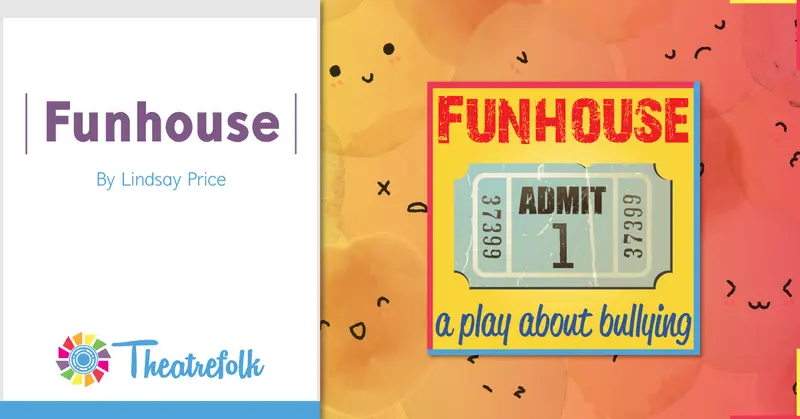
Theatrefolk Featured Play – Funhouse by Lindsay Price
Featured Plays

Theatrefolk Featured Play – Funhouse by Lindsay Price

*Welcome to our Featured Play Spotlight. * Funhouse by Lindsay Price is an incredibly unique and challenging vignette-style play that is an excellent catalyst for conversations around bullying. This play looks at the bullied, the bully, and the bystander through mostly non-verbal vignettes. Life for the bullied is like a funhouse, but the funhouse is anything but fun. How can you stand your ground when you’re on a falling floor? How can you move forward when you’re caught like a mouse in a maze? How can you win Whac-A-Mole when you’re the mole? How can you like yourself while standing in a distorted hall of mirrors? There are no cotton candy answers here. Why did we publish this play? A lot of our plays come from listening to customers. A piece of feedback from middle school teachers we received is that they loved our non-verbal play _Emotional Baggage _but the concept was a little beyond their students. Could we provide one specifically for middle school? With a larger cast? _ _ Funhouse looks at the bullied, the bully and the bystander through mostly non-verbal vignettes. When looking at other plays on the topic, there wasn’t a lot we liked – many end with a bully-bullied confrontation in which the bully instantly sees the error of their ways and promises to be a better person. And they all lived happily ever after. This never happens in real life. Can bullies change? Of course! But not in one moment on stage. It’s so destructive to show such a fairy tale ending because there will be students in the audience watching the show, being bullied, knowing their situation is not being represented. And therein lies a huge problem. Issue plays are tricky because they deal with issues that are happening right then, right now to someone watching the play. It’s not therapy, it’s not an informational brochure and theatricality must always preside, but the issue play does have some responsibility to address the reality of the issue. Having said that, just as you can’t show the sitcom “everyone loves each other” happy ending, you can’t go to the other extreme and show flat out no-win annihilation. Because then that student sitting in the audience, being bullied, has the very terrifying thought of, “Well there’s no hope, is there?” And that is something we’re not prepared to sit on the shoulders of a 10- or 11-year-old. _Funhouse _has the right balance between the extremes, in a theatrical context and that’s why it’s in our catalogue. It’s unique and a great catalyst for post show discussion on the issue of bullying. It’s a challenging piece, but by no means is it beyond the middle school scope. Let’s hear from the author!1. Why did you write this play? I heard from middle school teachers that they loved the non-verbal elements in Emotional Baggage but were looking for a middle school specific play, and could it have a larger cast? Done and done! I had seen a number of plays that addressed the topic of bullying and wasn’t happy with what I saw – a lot of bullies seeing the error of their ways. I wanted to write something different. 2. Describe the theme in one or two sentences. The funhouse aims to turn reality upside-down – it shows you a distorted version of yourself in a mirror. It tilts the floor away when you least expect it. It jumps out at you from the shadows. It distorts the truth. It’s a vivid image for what life is like for the bullied. 3. What’s the most important visual for you in this play? Sometimes the bullies win. That’s important to show. These acts are vital to the reality of the play, for indeed they are vital to showing the reality of what a bullied student must face. 4. If you could give one piece of advice for those producing the play, what would it be? It’s a play that relies primarily on action rather than dialogue, so that’s going to be your focus. How does action tell the story in each moment? It’s a challenging play but by no means beyond the middle school performer scope. 5. Why is this play great for student performers? The scope of bullying is pretty far reaching these days, from physical to verbal, to the different ways boys bully than girls, to the insidiousness of cyberbullying. This play offers a opportunity for students, in the play and watching the play to engage in conversations on this, unfortunately, extremely relevant issue. Get your copy of Funhouse_ _right here, right now!Not right for your group right now? Search our play catalogue to find one that your performers will love!
Safety Concerns in Distance Learning
Distance Learning

Safety Concerns in Distance Learning

Our world has become increasingly dependent on digital means to work, play, and learn, and school is no exception. More and more students are participating in distance learning for their classes. This comes not only with new ways of approaching teaching, testing, and creating experiences for students, but also with new safety concerns for students and teachers. Let’s look at three different safety concerns in distance learning. PrivacyA big safety concern in distance learning is privacy. When students attend school, there is a natural separation between school life and home life. Distance learning using video conferencing programs blurs those lines. Unless participants have a dedicated space for online learning or use a digital background, others are going to see some of their surroundings. It can feel awkward and invasive for both students and teachers to have part of their residence visible during class. It can be particularly difficult for students who are dealing with personal concerns such as an unstable family situation, poverty, or homelessness to have their living situations visible to others. It’s easy to say something like “pin up a sheet on the wall to cover your personal items!” when you have your own walls to pin things on, and an extra sheet that’s not being currently used. Students and teachers alike may worry that their home has distinguishing features that will allow people to find out where they live. They may worry about footage from class leaking and someone being able to find it online. They may also feel embarrassed about their living situation and worry that they are leaving themselves open to teasing, judgment, or bullying. Bullying BehaviourBullying behaviour unfortunately still exists, and this has not changed during the transition to online learning. There have been reports of students using a second device (usually their smartphone) to record videos or take photos of teachers and peers during virtual classes and posting the footage online, often freeze-framing unflattering images or adding negative comments. It can be hard to track down the original source of the recording (the bully might have had their video screen closed so others couldn’t see them recording, and then posted it with an anonymous social media account, like Snapchat, TikTok, or an Instagram “spam” account) and other students might feel scared to report the culprit. Students might worry that they will get teased or bullied for their living situation, embarrassing incidents that may occur in the background, or possessions or décor that may have been cool in younger grades but not in high school. They may also be afraid to participate in class projects for fear of saying something “wrong” or because they think someone will record them and post it online. In drama class, teachers give students the opportunity to let loose and be silly, experiment with different acting styles, voices, facial expressions, and body language, take risks, fail, and try again. However, there is a big difference between taking risks in the physical drama classroom, where everyone is visible and on equal footing, and taking risks during a virtual class, where you can’t immediately see what students are doing. Mental Health ConcernsA third safety concern in distance learning is dealing with mental health. Teachers and students alike are frequently feeling burnt out, stressed, overwhelmed, fatigued, foggy, or unable to focus. As mentioned above, they may be worried about privacy or bullying issues, or a myriad of other concerns (parental job loss, not being able to see their family or friends, getting sick, not knowing when the pandemic will be over, not being able to keep up with the pace of online learning, etc.). It’s a lot to deal with mentally, and it’s exhausting. These issues compound on each other. Students might worry about other students seeing their homes, so they keep their cameras off, which results in teachers trying to teach to a bunch of black screens, and having to work that much harder to ensure that their students are learning, participating, or even just attending (raise your hand if you’ve had a student simply vanish during a virtual class!). Then, since students don’t have the immediate pressure of someone having their eyes on them in class, they may goof off, get distracted, or leave the room, which results in the students missing out on information and falling behind. Then it takes more time and effort for the teacher to re-teach the material and deal with poor homework and projects, if they’re submitted at all. All of this can create a vicious circle of frustration and stress! Unfortunately there are no easy or one-size-fits-all solutions to any of these concerns. We are all doing the best we can with the information and technology available to us, with the best effort we can muster from day to day. When dealing with difficult situations that concern a student’s virtual safety, it’s necessary to approach each situation individually, while still protecting your own personal safety and mental health. Reach out to your school’s administration and your colleagues for assistance and support as needed. Included below is a reflection with various scenarios concerning student safety. Read them over and consider how you might respond to the different situations. As well, check out the following articles for some additional tips and ideas on the topic of virtual boundaries and self-care: • Separating School Life and Home Life • Coping with Social Distancing for Students and Teachers • Addressing Distance Learning Concerns • Drama Teacher Self-Care • For students who can’t/won’t turn on their cameras: No See Scenes
Theatrefolk Featured Play – The Redemption of Gertie Greene by Taryn Temple
Featured Plays

Theatrefolk Featured Play – The Redemption of Gertie Greene by Taryn Temple

Welcome to our Featured Play Spotlight. _ The Redemption of Gertie Greene_ by Taryn Temple takes an upside-down look at bullying and the importance of standing up for those who can’t do it for themselves. This play is a not-to-be-missed dramedy for middle school students. New student Gertie Greene is a bully. Gossip spreads like wildfire that she attacks kids in the bathroom, knocks down football players, and gets suspended all the time. Even teachers are afraid of her. Everyone’s talking about it so it must be true. But is she really a terrifying monster? In The Redemption of Gertie Greene the truth comes out in the most unexpected ways. Is Gertie really what everyone calls her: a freak, strange, stupid, clumsy, and mean? Or can Mrs. Fillmore’s quirky drama students see past the scuttlebutt to discover the real person behind the rumors? As they separate fact from fiction, Gertie and her fellow drama students bring to light the transforming power of kindness, and the importance of standing up for people who can’t defend themselves. Why did we publish this play? Plays about bullying can leave a sour aftertaste, especially if the message has the bully stand up and accept the error of their ways. It just doesn’t happen that way in real life. And it’s not fair to say “bullying doesn’t happen” because it does happen. Every day. Bullying is a relevant topic in every school at every level. That’s why the backwards look at bullying in this play presents a refreshing change. It opens the door to conversation about the topic, which is what all issue plays should do. It’s not about solving the issue in 30 minutes. It’s about prompting the conversation to continue after the curtain goes down. Check it out. Let’s hear from the author! 1. Why did you write this play? Middle school is tough. Kids are exploring the kind of person they want to be, who is “in” and who is “out” of their friend groups, and how they should treat others. I wanted kids to see their own struggles reflected in the characters in this play, and help them start conversations with other kids and with adults about what they are going through. 2. Describe the theme in one or two sentences. It’s important to include people and stand up for others, especially those who can’t stand up for themselves. 3. What’s the most important visual for you in this play? When each student in drama class stands up and gathers around Gertie one by one, recognizing her gifts and making her a part of the group. She’s been an outcast up until that point. It’s a lovely image of inclusion when the other students are finally the ones that stand up for her. 4. If you could give one piece of advice for those producing the play, what would it be? Use this play as a springboard to start conversations with your actors and crew about times they’ve felt like an outsider, how someone made them feel included, and how they can (appropriately) step in and help people when someone is being bullied. 5. Why is this play great for student performers? The situations in the play feel relatable and real to the actors so they buy in, plus it has some serious scenes to give young actors a chance to widen their range.
Spread the Love: A Box of Puppies by Billy Houck
Featured Plays

Spread the Love: A Box of Puppies by Billy Houck

This week we Spread the love for A Box of Puppies by Billy Houck.