Facebook Pixel Skip to main content

📣SCRIPT SALE! Treat yourself to an easier Fall. Save 30% on 5+ perusal scripts with code SPRING30 before May 3 and head into summer stress-free.

Critical Thinking

Top 5 Takeaways on Developing Critical Thinking Skills for Theatre
Teaching Drama

Top 5 Takeaways on Developing Critical Thinking Skills for Theatre

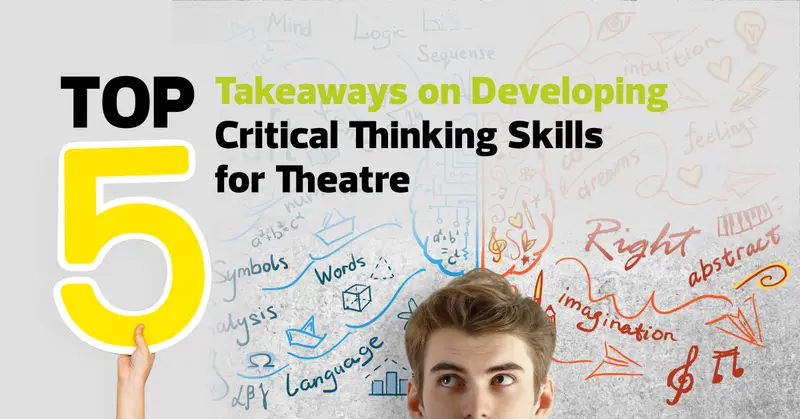
Do your students know how to form their own artistic opinions without being swayed by others? Can they confidently stand by their perspective, even if they disagree with a show that has received glowing reviews? Critical thinking is essential for students, especially in theatre, where responses are inherently subjective and there’s rarely a “right” or “wrong” answer. Here are our top five takeaways to help students develop these skills. What would you add to the list? 1. Form your own artistic opinion.When you see a show, it’s easy to be swayed by critics, big names, or awards. But forming your own opinion is essential. Don’t assume a play is “good” just because it’s by a talented playwright or has famous actors. If something doesn’t connect with you, that’s valid! Just be ready to explain why. 2. Separate performance from play.Even in productions where the script doesn’t resonate, you can still appreciate exceptional performances. Observing how actors inhabit their character through emotional connection, focus, and physicality can deepen your understanding of craft and character work. 3. Define your “theatrical experience.”Theatre is hard to define because it means something different for every person who watches it. Where one person loves realism, another will live for musicals and another will only watch gritty abstract absurdism. This is what makes the live experience unique. When evaluating a play, ask: “What was my theatrical experience?” Did it engage you emotionally, intellectually, or visually? And why? 4. Question consensus and reviews.When a show receives glowing reviews but leaves you cold, don’t dismiss your reaction. Critics view productions through their own lenses; what seems “fresh” to them may feel flat to you. Critical thinking means considering perspective, bias, and timing. 5. Understand the reality of the industry.Behind every production are years of work, countless collaborators, and high stakes. Success and failure often hinge on timing, money, and creative compromise. Hearing professionals reflect honestly on their careers reminds us that perseverance, passion, and adaptability matter as much as talent.
Small Group Exercise: The 20-Step Process
Classroom Exercise

Small Group Exercise: The 20-Step Process

This exercise is inspired by the theatre game The Machine, where students work together to create parts of a factory machine with repeated movements and sound. In The 20-Step Process, we take this a step further by making a simple task comically complicated. This exercise challenges small groups of students to think critically, problem solve, and create and execute a plan. It’s also a creative challenge — students can present their process in a variety of performance styles. Instructions: 1. Divide students into small groups of 3–4. 2. Assign each group an everyday task, such as making a peanut butter sandwich, brushing their teeth, or filling up the car with gasoline. If you need some help with tasks, our outdoor prompt and food-related prompt lists are full of action ideas. 3. In their groups, have students write out a list of 20 steps — no more and no less — to complete the task. For example, making a peanut butter sandwich isn’t simply opening a jar of peanut butter and using a knife to spread it on bread. It might involve locating a magical pig to sniff out a peanut plant, digging up the peanuts, selecting only the peanuts with a particular set of measurements, washing the peanuts with special soap, extracting the peanuts from their shells, crushing the peanuts into a paste, adding salt to the paste, heating the mixture over a fire that is exactly 348 degrees… and so on for 20 steps, with the 20th step being the completion of the sandwich. The steps can be as silly and fanciful as the students wish, as long as there are 20 steps — no more, no less. If students have difficulty figuring out the steps, they might want to try working backwards from the final step, or breaking down each part of the task into ridiculously small micro-tasks. 4. Once they have created the list, students will figure out a way to present it as a performance. Some ideas might include: • Create a series of 20 tableau scenes (one for each step). • Mime the 20 steps. • Do an interpretive dance of the 20 steps while a narrator describes the action. • Present the list in the style of a step-by-step instructional video. • Turn the list into a poem or song. • Create a comedy scene in which a teacher shows their students how to do the task using the 20 steps, or a group tries to follow the instructions written on a piece of paper for the first time. Students may also pitch their own ideas on how they’d present their group’s list. All the movements and voices (as applicable) should be big and exaggerated. 5. Give students time in class to plan and rehearse their performances. If you want this exercise to be a larger project, you may assign part of the task as homework and have students practice at home and present the next day. 6. Students will present their scenes for the rest of the class. 7. After each group presents, students will complete and submit an individual reflection.
Script Analysis for Actors – Five Steps to Building Your Foundation
Acting

Script Analysis for Actors – Five Steps to Building Your Foundation

Do your students know how to annotate a script for analysis? Script analysis gives every actor a foundation to build on for character development. Teach these steps to your students and they’ll begin rehearsals with confidence. Where do we start? Give students a sample text to work with. We’re going to go through five steps any student can use to analyze a text. This activity uses monologues, but you can do the exact same work with dialogue. Then make sure students make any annotations in pencil. Why pencil? Because nothing we do with script analysis should be set in stone. We change our minds, we rethink things over and over as we familiarize ourselves with the material. And once you get into rehearsal you never know how the director’s vision will change your approach to the text once again. Think of this type of script analysis as your starting point. Click below for a lesson plan version of this activity along with annotated examples of two monologues. Step One: Cross out stage directions.Stage directions in a script can come from a variety of places. Sometimes they’re added by the playwright to give you a sense of their intentions, sometimes they’re based on the blocking of the original production, other times they’re added by the publisher/editor to help clarify something for the reader. Don’t ignore them completely, especially if they are connected to a line of dialogue (if a character says “sit down” and the stage direction says “BRENDA sits” then that’s something you probably shouldn’t ignore), but for the purposes of script analysis, tell students to cross them out. They can always restore them later because they’re using pencils, right? Task: Read through your monologue/scene and cross out any stage directions. Step Two: Mark any significant shifts in tone or character development.Tell students that they are going to identify moments where a character changes, either internally or strategically, and use these changes to create a dynamic performance. Use a symbol or mark to identify this change, like a slash (/) or even a double slash for emphasis (//). DARCY: Maybe I’m special, ever think of that? Huh? Maybe he likes me. // Me. These marks go any place in the text where there is a change. For example: • A change in mood or emotion • A change in language • A change in tactic • A change in status • An entrance or exit Look at the following line. Ask students: Where is the change in tone or character development? FRANK: I can’t believe you keyed my car. Why would you do something like that? Frank goes from reflecting on the damage to the car to demanding information. First he’s in disbelief. Now he wants answers. So we identify the change between the two thoughts. FRANK: I can’t believe you keyed my car. // Why would you do something like that? The reason for the change would be explored in rehearsal, but during the analysis stage, have students make choices based on what they read. You may find that students struggle to find the changes or shifts in their dialogue. Have students practice with two random sentences in their text and put the change marks between the two sentences. DARCY: Moving too fast? // You bet I am. Have students ask themselves: What shift does the character make between these two sentences? If they can come up with a clear answer, then the marks stay, if not they go. With the above example, it doesn’t seem like there’s a change. The two sentences reference the same thing (moving too fast) so the marks do not belong. Take them out! Emphasize to students that there is no one right or wrong way to do this kind of work. This isn’t science, it’s art. Two actors preparing for the same role may mark their scripts up completely differently. And they’re both right! They’re both bringing their own interpretation to the role. Task: Read your monologue (or scene) and identify the shifts in mood, emotions, language, tactics, status, and entrances/exits with a specific mark. When your students eventually stage the text, these markings will serve as guideposts. They will help make their character dynamic. They’ll help with line interpretations and blocking choices. They’ll lead students toward an interesting well-rounded performance. Step Three: Mark significant words.Ask students: What are the most important words in a text? What would be the purpose of identifying important words? Highlight that we want to identify the most important words that carry meaning, intention, and energy. Use a symbol to identify significant words in the text, for example a “>” on top of the word.
21st Century Skills In the Drama Classroom
Teaching Drama

21st Century Skills In the Drama Classroom

Drama is one of the few classes that teachers real world skills. This is something that every drama teacher knows well. You know this. Despite resistance you may receive from parents, administrators, or even other teachers – the drama class is a vital and necessary component to a well rounded education. It’s not computers or television that ruins the lives of students. It’s the square peg in the round hole. It’s testing. It’s the methodology that every single student must conform to one way. Students do not need to learn how to parrot back facts. That is the sole purpose of a test. Teenagers know everything is at the swipe of a finger, so why bother? How soon will it be before today’s visual learners rebel? Students do need to know how to think on their feet in the 21st century. We have given them information at their fingertips, how do we take them to the next level? They need to know how to use their brain to create, to communicate, to innovate, to collaborate. These are the real world skills of the modern world, the 21st century skills. And they are happening in every drama classroom right now. Are you shouting that from the rooftops?The drama class is a microcosm for 21st century skills.Throw that on a poster and slap it on your classroom door. Make it your mantra. If you want parents, administrators, other teachers to take you seriously and to take your program use this sentence on a constant basis. My class promotes 21st century skills.The skills of the 21st century are not about technology, even though every teenager is fully wired. It’s about teaching students to think in a new way. Click on each link for classroom exercises and articles on these important skills. • Critical Thinking • Creative Thinking • Communication • Collaboration ** ** The act of being in a play promotes all of these skills. Critical Thinking:• We apply close reading to the script • We analyze our characters and make inferences • Weask and answer questions based on the script Creativity:• We interpret the script • We develop choices for our characters • We design the costumes, sets, and props based on the script Communication:• We construct a vision both visual and thematic • We offer feedback and suggestions during therehearsal process • We receive and process feedback from the audience Collaboration:• We work together onstage and off • We develop a community • We problem solve You may be thinking – Hold on. This is not why I teach drama. I teach drama not for the administrators. I am there for the students. I am there to create the only safe space they have in a day. I am here to bring theatre to life. I am not a spouter of buzzwords. You don’t have to be. In the classroom it’s just you and your kids. But how are you advocating for your program outside the classroom? Is your administrator in your corner? Are the parents? What are you doing to keep your program alive? What language do you use to make administrators sit up and take notice? Click here to download a brainstorming activity that asks: How does my class promote 21st Century Skills?
How to Write a Play Review
Production

How to Write a Play Review

We’ve all seen those reviews. The ones that rip the theatre production up one side and down the other. They criticize the scenery and the script. They suggest that the leads take up basket weaving, since acting isn’t their thing. It’s enjoyable because we’re not the one being criticized. But it can also make you feel queasy, like you ate too much fried food. It’s not that nice to read about the total destruction of others. When it comes to writing a theatrical review, that kind of lambasting isn’t necessary. Cruelty is not something we want to teach students when it comes to analyzing a piece of theatre. There is a difference between being critical and being cruel. How To Write a Play ReviewFollow these steps with your students. Step One Start by discussing the definition, purpose, and objective of a review in a professional theatre context. • What is a review? A review is a subjective but educated response to a piece of theatre. The professional reviewer should have a strong background in theatre so that their opinion is informed, objective, and credible. • What is the purpose of a review? A review gives a potential audience member context for a production. Most people want to know if they should spend their hard-earned money on a ticket. Is this show any good? If it is, what makes it good? If it’s not, what makes it falter? • What should we learn from a review? A review should describe the situation of a play without giving too much information about the plot. It should address the production elements individually and how they work together as a whole. It should express an opinion supported by thoughtful analysis. Step Two Ask students: What’s the difference between a well-written review and a poorly-written one? Highlight the following: • Is the reviewer able to discern the vision of the production and the execution of that vision? • Is the reviewer able to analyze the production in terms other than like/dislike? • Is the reviewer able to see the production’s value and/or appeal despite their subjective response? • Does the reviewer support their views with examples? If they don’t like an actress’ performance do they explain why? Do they offer evidence to support their opinions? • Does the reviewer let their personal opinion of a play colour their review? • Does the reviewer acknowledge the audience’s reaction, particularly if it differs from their own? Step Three Have students compare and contrast three reviews of the same show by different reviewers. A Broadway production would give you a wide variety. Look for different types of reviews as well (e.g., YouTube video, longstanding newspaper review, blog post). Decide if you’ll have students research and choose their own reviews (if devices are allowed or you have access to computers) or if you’ll choose the reviews and share them on a screen. Note: If you have a class with little theatre experience and want more buy-in, use a movie as your source material. Go through the reviews and have students reflect on the following in their journals or on a separate piece of paper: • Is the review positive or negative? How do you know? • Is the reviewer objective or subjective with their review? How do you know? • How did this reviewer use (or not use) their expertise to share their experience of the play? • Did they explain why they liked or didn’t like something? • Do you like when a review is overly critical? Why or why not? • What does each review tell you about the reviewer? Step Four Now it’s time to practice! Have students use a specific play review formula like this one. Click below for a Play Review Worksheet with the same categories. • Introduction: Set up the play. Who is the playwright? What company is putting on this play? What is the context of the production (school show, community theatre, touring show, Broadway)? • Execution: How is the play executed? What is the director’s vision? What is unique about the interpretation? What’s the style? How do the individual parts fit together to make a whole? • Specifics: Is there anything unique about this production? Who is the director? What else have they done? Who are the leads? Is this a premiere or a remount? • Opinion: Is the production successful in its execution? Why or why not? Is there something out of place within the individual parts (lighting, sound, set, costuming, vision, acting)? What stands out? Does the acting bring the play to life? Does the vision suit the intention of the play? • Recommendation: Is this play worth seeing? Why or why not? What about when you’re going to see a show? How do you approach a show knowing you’re going to write a review? You can have students practice with school shows, shows from other schools, recorded versions of professional plays. The more they practice, the more comfortable they will be with expressing criticism in a constructive manner. How should students prepare before, during, and after the show?
The Drama Survey
Teaching Drama

The Drama Survey

It’s the first day of semester. You have a Grade Nine / Drama One class or a group of students you haven’t worked with before. They stare at you, you stare at them. How can you determine what they think about drama, what they think about your class and how they might perform for the weeks ahead? Should you plunge into the deep end or ease slowly into the water? The first week of drama class will set the tone for the rest of the year. Use a Drama SurveyThe Drama Survey is a tangible way to assess your students’ thoughts and feelings. It will highlight the students in your class who are uncomfortable with self-expression. Self-expression is key to success in the drama classroom. Students need to share their opinions on scenes and performances. Students express themselves in their journals, monologue writing, and character creation. Your classroom may be the one place students feel at ease to display their true personality. Students can make the survey the first entry in their drama journals. There’s a sample survey at the end of this article, but you can create your own with questions specific to your classroom. Questions to AskMake the survey easy to answer. Aim for something that can be completed in 15 minutes. The time limit is important – encourage students to write quickly. Their answers will be more instinctual. Don’t bombard students with “tell me everything” questions and yet, don’t make it so vague you learn nothing. The survey should give you a roadmap for your semester (e.g. if none of your students have been on stage before, your lesson plans might need adjustment). Start out the survey with some multiple choice questions: • I am looking forward to drama class. Yes. No. Maybe. • I am good at drama. Yes. No. Maybe. • I have acted before. Yes. No. • Does performing in front of others scare you? Yes. No. Maybe. Include open-ended questions that will illuminate their thoughts on the class: • What is drama? • Why did you take drama? • What do you hope to learn? And end with questions that illuminate the individual student: • How do you express yourself? • What is your favourite food? Music? Article of clothing? • List three words that express how you’re feeling today. • Do you often tell the truth? If not, why do you hold back? These answers will demonstrate how students will write in their journals, how they’ll act during a peer evaluation and even how they’ll handle criticism. Follow upAssess the success of the class and give your students a follow up survey at the end of the year. First have students look back and reflect on their first survey. • How have their answers changed? • Do they have a different opinion of drama? • Do they have a different opinion of their abilities? Some multiple choice questions: • I look forward to coming to drama class. Always. Sometimes. Not really. • I have learned something new about drama. Yes. No. • I feel comfortable performing and sharing my ideas in drama class. Yes. Not Really. No. Ask questions that relate specifically to the class: 1. My favourite unit this year was… because… 2. My least favour unit this year was… because… 3. My favourite activity this year was… because… 4. My least favourite activity this year was… because… And end with questions that relate specifically to the individual: • I feel more confident about performing in front of others. Yes. No. • I feel more confident expressing my opinion. Yes. No. • Explain your answers. Use specific class activities as examples. The Drama Survey can help you communicate with your students. It can highlight which activities are most and least successful. The Drama Survey is a useful, insightful classroom tool.
Student Self Assessment
Teaching Drama

Student Self Assessment

Not only is it important for students to reflect on and evaluate the work of others, they also need to build self evaluation skills. But self assessment can be tricky. It takes a lot of practice to evaluate one’s own performance. You have to divide personal feelings from critical thinking. That’s hard for even adults to do! How do we move a student beyond saying I was good or I sucked when evaluating their work? How do we encourage students to apply critical thinking skills to their own acting? Ask questionsSelf assessment should remain in the realm of analysis rather than emotions. Instead of generalizing with a How did you feel? type question, ask specific questions: • Did you effectively use class time to rehearse? Give some examples. • Did you rehearse out of class time? Why or why not? • Was the rehearsal time sufficient to prepare your scene? Why or why not? • Describe what it was like to work with your group. Did you get along with them? Why or why not? • How prepared were you for each rehearsal? Give examples. (Eg: I learned my lines before rehearsal; I always had a pencil to record blocking; I arrived at class on time.) • In what ways did you participate during rehearsals? Give examples. (Eg: I had ideas for blocking; I was enthusiastic during rehearsals; I stayed on task.) A rubric is easy to follow with this type of self assessment. The more specific and detailed the answer, the higher the mark. Divide the rehearsal and performance experienceIn the classroom, a performance is only one piece of the puzzle. Instead of a general How did you feel, you may wish to divide up student response between rehearsal and performance. Ask students to describe their rehearsal experience: • Describe how you participated during the rehearsal process. • Describe how you listened to others in your group during rehearsals. • Describe your attitude toward the assignment during rehearsals. • Describe how you took any criticism during rehearsals. • Describe how you gave criticism during rehearsals. You’ll be able to get a good sense of how much a student was an active member of their group through this type of self assessment. And then ask students to describe their performance experience: • Describe what it was like to perform your scene. Did you feel prepared? Did you feel nervous? • Describe the audience response to your acting. Were you surprised? Did the responses happen as expected? • Describe what worked well for you during the performance. • Describe what you wish went differently during the performance. ReflectionIf you ask students to reflect on the experience as a whole, have them identify what worked during the process and what they would change for future assignments. Get them to focus on technique: how have they improved their acting skills or where do they need to improve? Stay away from what they liked or didn’t like. Emotional thinking can lead to students feeling badly about themselves instead of thinking critically their acting. Stay in the realm of what worked and what didn’t work. If students can identify something that they can improve upon or that they’d like to change, you can use this as an assessment tool later on. Did they actually attempt to change or improve that aspect in a different scene? How detailed should this assessment be?It depends on the age of the student. You can do a checklist where students grade themselves based off of statements. You can do informal journal entries or something more formal. The point of the self assessment is that students learn to look back at what they’ve done and apply this knowledge to future work.
Peer Evaluation (or “No, you can’t say Jimmy sucks.”)
Teaching Drama

Peer Evaluation (or “No, you can’t say Jimmy sucks.”)

Peer evaluation is a process whereby learners give feedback to other learners. It is key to the learning process for a number of reasons. Curriculum Understanding In order to assess an activity, learners have to understand the desired objective. What is this activity, and what represents a good example of this activity? Assessment Understanding Peer evaluation gives learners insight into the assessment process. Assessment Control Learners have more control over the grade they receive because they are playing an active part in the assessment process.They can apply the assessment criteria to their own work. The assessment duties are balanced between teachers and peers – it’s not just the teacher opaquely providing a mark. Critical Thinking Peer evaluation encourages learners to delve into further detail with their responses. It’s not enough to say “I like this” or “I don’t like this.” Learners develop their critical thinking skills to determine the “why” of their response. Personal Responsibility Peer evaluation encourages learners to engage in the process. If they expect to be marked fairly by their peers, then they have to return the same fairness. Assessing their peers against a set criteria encourages learners to take responsibility for their own work. They know what to look for in the work of others, and hold their own efforts to the same criteria. Peer evaluation also encourages learners to engage; in order to fully assess a product or performance they have to watch and listen with full attention. Classroom Management When teachers find themselves with an overly large class, individual presentations can take weeks. This slows the learning process to a crawl. In these situations, peer evaluation can be a useful classroom management tool. Have learners work in pairs or groups then present to and evaluate one another. Peer Evaluation IssuesAll of the above are excellent and worthwhile reasons to incorporate peer evaluation into the classroom. But not every classroom is an idyllic and respectful oasis. Several issues can crop up when using peer evaluation. Personal Dynamics For some learners, evaluations are tainted by personal opinion: If I say something bad about Jane maybe she won’t like me. I hate John, I’ll never say anything good. It’s hard for learners to separate “good/bad work” and “good/bad person.” The opposite is also true: Why did they give me a bad evaluation? Don’t they like me? It’s easy to feel judged by one’s peers. This can lead to dubious evaluations – will learners be truthful in their responses? I Don’t Get It Some learners will shut down rather than work toward comprehension. It’s easier to say, “I don’t get it” instead of identifying the issue and figuring out the solution. Lack of Maturity Peer evaluation requires a certain level of maturity from learners. It’s not inconceivable for some learners to resort to personal attacks, to not try, to provide a shallow assessment. These actions can undermine any peer evaluation attempt. Addressing the IssuesHow do we address peer evaluation issues so that assessment remains a worthwhile part of the learning experience? Clear Criteria Learners thrive when they know what they’re supposed to do. Learners often falter with peer evaluation because they have no idea how to properly evaluate anyone, let alone their peers. Establish a clear set of criteria for peer evaluation. What are the rules? What should learners look for? Decide whether to present an established set of criteria to learners (highly recommended for younger or unfamiliar learners) or to include learners in the process of establishing the criteria (i.e. come up with a list of evaluation guidelines together). Once you either review or create the evaluation criteria, make it visible. Learners should be able to see the criteria at all times either on a large poster, a bulletin board, or corner of the blackboard. If anyone says, “I don’t know what to do” point them to the rules. Include this in your criteria: • Evaluators should always provide a next step. What could the learner try next time? What next step could they take to improve their work? This feedback is the most important part of the evaluation process. • Be clear with evaluators that overly positive and overly negative comments must be backed up with explanations and examples. Evaluation is more than “I like / I don’t like.” Evaluators have to explain their answers. Modelling Giving effective feedback is a skill. The best way to make sure learners understand the process is to show them the difference between a good evaluation and a bad evaluation. Model examples of both. Teach learners the appropriate language to be used in an assessment. A model of a good evaluation gives learners something to reach for. Modelling a bad assessment is a great opportunity to incorporate levity into the proceedings – how bad is really bad? Peer Evaluation Sheets with learner assessment examples to use for modelling are available as a downloadable PDF at the end of the article. Rehearse Effective feedback takes practice. Rehearse evaluations with learners until they are able to demonstrate skill and understanding. Give the learners a “pressure free zone” to gain comfort and confidence. Start the process by having learners assess anonymously. Let them get comfortable evaluating a stranger’s work before evaluating one another. Exercises: 1. Divide learners into groups. Each group is given a piece of anonymous work and the learners evaluate together. Learners discuss the work, what they would say, what language they would use to suggest improvement. Groups present their evaluations, then compare them with the teacher’s evaluation. 2. Use the buddy system. Every learner is assigned the name of another learner. During the regular proceedings of class, their job is to watch that learner: What do they contribute to the class? What’s their attitude? Their effort? Emphasize that this evaluation is anonymous so they shouldn’t be obvious about their observation. At the end of class each learner writes out a brief evaluation of their assigned learner: one good thing they did in class and one idea for improvement, something they could try for next class. Next class hold a discussion where learners read their evaluations and talk about how it makes them feel. This is an opportunity to discuss how assessments should be objective and not personal. Take It Slow Effective feedback takes time to learn. Find opportunities within your class schedule to practice. Get learners used to the idea that they will be expected to give feedback. After a presentation or group work session, ask learners how confident they would feel assessing the work they just completed. Start with non-verbal responses, move to one word responses, then to full evaluations. Start with checklist evaluations, move to sentence starters to complete, then to freeform feedback. Start with anonymous reflections and work up to peer evaluation. Be Encouraging Be encouraging with this process. It will take time and learners will resist. But evaluation is a skill that will serve learners for the rest of their lives. The ability to effectively evaluate the work of their peers in a constructive manner is invaluable.
The Most Interesting Person Exercise
Classroom Exercise

The Most Interesting Person Exercise

Who is the most interesting person you know? Who is the most interesting person your dad knows? Who is the most interesting person your boss knows? It could be a specific story, a whole history or a certain personality trait. That’s the interesting thing about being interesting – it’s never going to be the same quality across the board. This exercise takes a look at the question “What makes a person interesting?” and explores it in a theatrical context. After your students question someone about their most interesting person, they’re going to dramatize that person in a monologue. The more students can hone in on the specifics of “being interesting”, the easier it will be for them to write interesting characters. Exercise1. First, pick a person. The only rule is that it can’t be a classmate or someone your own age. Consider talking to a parent, a relative, a teacher, your boss, a neighbour, a family friend. 2. Ask that person the question: ‘Who is the most interesting person you know?’ The answer could be someone they know currently, or someone they knew growing up. 3. Get the basic details on this person: What do they look like? What did they sound like? The more you know, the more you’ll be able to visualize this person. 4. Get the details on what makes this person interesting: is there a specific story related to this person? Is it their everyday behaviour? Make sure you write it down. 5. Based on what you know, write a monologue in the voice of this person. 1. Decide who they’re talking to. 2. Decide where they are when they give their monologue. 3. Decide the one thing they want to share with the person they’re talking to. 4. Decide their emotional state. 6. Once the monologues are complete, divide students into small groups and have them read the monologues aloud. 7. Afterward, have students write a reflection on the exercise. What was it like to learn about an “interesting person?” Do you think the person was interesting? Why or why not? What was it like to try and write a monologue for this person? What was it like to hear other monologues on this topic? Which one did you like best and why? Bonus After everyone writes their monologue, have them prepare a presentation. They have to perform their monologue, in character with full costume and props.
Script Analysis for Actors
Acting

Script Analysis for Actors

Whether you’re performing your first role or your fortieth, Theatrefolk has a great roundup of guides to help you prepare for your role, to analyze the script from a few different angles, and to really make the most of the part you’ve earned! We start with basic foundations of script analysis, and work through activities to help develop your character, understand their relationships, and fill in the gaps. 5 Steps to Building a Foundation• Script analysis gives you a foundation to build on for character development. Follow this guide and you can begin rehearsal with confidence, ready to take on whatever challenge comes your way. Get familiar with your character, get familiar with the text. It’s time to explore. Exploring Your Script with Action Words• In this guide we’re going to look at exploring your script through action words (“verbs” for you English majors.) The idea is to find the “action” in your dialogue. We’re talking about visualizing action, injecting movement and life into your performance. Try a Relationship Activity• This activity will help you uncover a great amount of detail on your character and their relationship with the other characters in the play. Six Ways to Fill the Gaps• The first few Script Analysis guides focused on finding the information that the playwright has left for you in the script. But sometimes there is little to no information about your character. This when you, as an actor, really get to stretch your creative muscles. This guide provides tools and techniques to fill in the gaps about your character. Each guide comes with a free PDF download for easy reference – or to use in your classroom!
Character Analysis Exercise
Classroom Exercise

Character Analysis Exercise

Character analysis can be done in many forms: • You can analyze a character in a play you’re studying. • You can analyze a character you’re playing in a production. • You can analyze a character in a play you’re writing. This Character Analysis Exercise will work in all three circumstances: Analyze a character students are studying, playing, or writing about! Have students do this exercise once they’ve either read the play at least once or they’ve written a first draft and are ready to dive deeper into character development. The goal of the exercise is for students to learn about a character through the eyes of others. Instruction1. Entry Prompt • Students enter and respond to the prompt in drama journals or on a separate piece of paper. • Describe yourself (both your public self and your private self) using the five senses. What is your look, sound, texture/feel, smell? Have them identify a specific food for taste. 2. Activity: Mirror Monologue • This is a nonverbal exercise. It is suggested that everyone goes at the same time, so that no one is singled out. You can have students facing in different directions so that they are in their own space and not looking at others or being looked at. • Say to students, Imagine you are standing in front of a mirror. When do you look in the mirror? What do you do when you look in the mirror? The goal is to get students to start a simple action. You may want to give some suggestions: Do you brush your teeth? Do you check what your clothes look like? Do you wash your face? Do you wear contacts? What are you doing? • Say to students: How do you see yourself? When you look in the mirror, what do you see? Do you see yourself as confident? Make a pose or gesture that shows that. Do you see yourself as insecure? Make a pose or gesture that shows that. • Say to students: How do you think others see you? When others look at you, what do they see? Make a pose or gesture that shows how others see you. • Bring students back to neutral, and change the tone of the moment with an upbeat game or improv. • Afterward, discuss the exercise. What was their experience? 3. Character Analysis • In the same way that we can reflect on how we see ourselves and how others see us, we can do with characters. What can we learn about a character through the eyes of others? • The first step is for everyone to choose the character they’re going to analyze. Students who are doing this as a rehearsal exercise should choose their own character. • Divide students into small groups. Have each person in the group share their opinion of their chosen character. What do they think of them? Why did they choose them? What do they like about this character? What don’t they like about this character? • Now that students have had a chance to verbalize their thoughts, have them write them down. Give students the Character Worksheet (download below) and have them record their thoughts on their chosen character. • Next, students will choose a second character. They will now go through the script and identify everything this second character says about the chosen character. • • What words do they use? • What attitude is behind the words? • What is the emotional context behind the words? • Have your students highlight in their script how the second character responds to the chosen character. Again, have them focus on the words they use, the attitude behind the words, and the emotional context of those words. • Bring the students back into groups. Have each person share what they’ve learned about their character from analyzing the second character. Are they surprised? How does this second character see their character? • Now that students have had a chance to verbalize their thoughts, have them write them down. On the Character Worksheet students will answer the question, “How does this second character see your character?” They are to use the text to support their answers. • Bring everyone together and discuss the exercise.
Reality vs Illusion Exercise
Classroom Exercise

Reality vs Illusion Exercise

How do people create illusion out of harsh reality? In the play A Streetcar Named Desire, Blanche Dubois works hard at creating an illusion. She tells lies about her past so that others see her in a specific light. She tells lies to herself to soften her own memories. She puts a shade on the bare bulb so that no one can see her as she truly is. Many people try to soften a harsh reality. It may be that is the only way they can cope. Characters who choose illusion as a coping mechanism are always going to be interesting to write about. Exercise1. Journal Prompt: Ask students to reflect on how they cope with bad news. What is your coping mechanism? 2. As a class ask students their opinion on dealing with bad news or sad events. What is the best coping mechanism? What is their point of view on people who soften the truth of a sad situation? 3. Choose a tragic event from the news or history. A real event, not fictional. Choose a past event rather than something happening currently. Assign students to research the event for homework either individually or in groups. They have to come up with a list of details and a list of individuals involved in the event. 4. As a class compile the details and individuals. Put the information on large pads, on a whiteboard, or blackboard so everyone can see them. 5. Divide the class into pairs. Each pair creates a two character, one location scene based on the event. In the scene, the two characters are doing an activity – give the characters something to do as they talk. For example: they are preparing the room to paint, they are both waiters preparing for service before the restaurant is open, they are working on a class project, they are folding laundry. 6. In the scene Character A represents the reality of the event; they are there to state the facts. Character B represents an illusion of the event; they shroud the tragedy in a softer light as coping mechanism. How do they shed positive light on the event? How do they change the details to make it less harsh? For example, if the tragedy is about a horrible murder, perhaps Character B believes the murderer is innocent. How does Character A deal with Character B? 7. Present the scenes.
Song Analysis and Singing in Character
Acting

Song Analysis and Singing in Character

Have you ever listened to a singer who hits all the right notes but there’s still something missing? When you sing, especially in a musical, there are necessary elements. Having proper technique. Being able to breathe is immensely important. But the best singer is not always the one with the most polished technique. The best musical theatre performer is the one who finds the heart of the song. The heart of the character. The one who makes the song mean something. Makes it personal. Audiences connect to heart. They connect to personal stories. And if the person singing does this, that’s far more meaningful than a note held till next Tuesday. It’s not just about the notes. So, how do singers connect to the song beyond the notes? Ask questions!Analyze what you’re singing. Ask and answer questions about the character and the song. The more you know, the more you can draw from, the more depth you can create. A held note becomes an emotional connection if you can relate it directly back to the character. Start with these questions: Where is the character physically?And this doesn’t necessarily mean are they in the hall or the kitchen. This could mean: • Where are they in their life? • Where are they in relation to the other characters? • Where are they right before they open their mouths to sing this song? Example: ‘No One is Alone’ from Into the Woods. The baker has just lost his wife and must deal with raising his child alone. In ‘Close Every Door’ from Joseph and the Amazing Technicolour Dreamcoat Joseph has just been thrown into prison, with no hope of getting out. Where is the character emotionally?Musicals happen because they take characters to a point where they can’t do anything else but sing. So what is the emotional ‘why’ for the character that they have to break out into song? Example: ‘I Feel Pretty’ from West Side Story. Maria has no choice but to burst out in song because she’s so happy and so in love. And even in something as frothy as “You Can’t Stop the Beat’ from Hairspray each character has an emotional standpoint. Also ask yourself this: Does the character change their physical and emotional state by the end of the song? What does the character want?Is your character they trying to make a decision? Do they want to share their feelings about another character? Do they want happiness? A new life? Their old life back? This goes hand in hand with knowing the physical and emotional state of the character. Knowing what the character wants and communicating that in the song is the easiest way to connect to an audience. Example: After a boy runs away from her, Elphaba in Wicked sings ‘I’m not that Girl’ (as in the girl that boys like) but what she wants more than anything is to BE that girl. In ‘I could have danced all night’ from My Fair Lady Eliza wants her spectacular night (and her new turn in life) to go on and on and on. In ‘Music of the Night’ The Phantom (The Phantom of the Opera) wants Christine to love his music and love him. It’s so important to sing the want in the song, not just the notes that make up the song. What’s going on in the song?What is the story of the song? Make sure you understand what’s being said. What’s happening in the story up to this point. Sometimes musical numbers rely on metaphor and it’s easy to catch someone who is only spouting words without any thought behind them. Can you write a one line description of the song? Who is the character singing to?Is it a specific person? Is it to the audience? If it’s the audience that’s fine, but think about what the character is trying to communicate to the audience, or get the audience to do. Be specific, and ‘no one’ is not an answer. Example: When Annie sings ‘Tomorrow’ she is singing to her dog, but also to herself. She is convincing herself and the audience not to give up, there’s always tomorrow. Song Analysis‘Somewhere That’s Green’ from Little Shop of Horrors is a song that has some very funny lyrics and traditionally Audrey has a very funny voice so it’s easy to get trapped into focusing on those aspects when singing the song. It’s easy to play Audrey simply as a dope. But that’s pretty boring for you, and certainly boring for the audience. There is a lot of character in the song, and more importantly a lot of heart. There is a lot for a singer to connect to, and in turn bring that connection to the audience. At this point in the musical, we know Audrey works at Mushnik’s Skid Row flower shop and have met her abusive motorcycle riding dentist boyfriend Oren. Right before the song, Audrey reveals she might have feelings for the main character Seymour. Seymour is the completely opposite of her boyfriend. Click here to read the lyrics to the song. Based on what you read how would you answer the following questions? • Where is the character physically? • Where is the character emotionally? • Does the character change their physical or emotional state? • What does the character want? • What’s going on in the song? • Who are you singing to? Where is the character physically?: Audrey lives in the city, in ‘Skid Row.’ She is as far away from somewhere that’s green as humanly possible. She is in the middle of an abusive relationship (black eye, arm in a cast) She reveals that she likes Seymour and dreams about being with him in an ideal place. She’s never shared these thoughts before. Where is the character emotionally? Audrey is unhappy but doesn’t think she deserves better. (She sings about this in ‘Suddenly Seymour’ – Nobody ever treated me kindly, daddy left early, mama was poor. I’d meet a man and I’d follow him blindly…) coupled with this is a belief of how happy she’d be in her dream. Pure unhappiness and pure happiness all at the same time, that’s what makes her sing. Does the character change their physical and emotional state? Yes. She goes from the reality of her situation, to the dream of the white picket fence and then back to the reality of her situation. At this point in her journey, she can’t believe that she’ll ever escape. What does the character want? Audrey wants the white picket fence. She wants the suburb, the green grass, the TV dinner, and most importantly, the guy who will treat her right. What’s going on in the song? Audrey describes her ideal life. It highly contrasts her real life. Who is the character singing to? Crystal, Ronnette and Chiffon are in the moment with Audrey as are her audience. Audrey is also singing to herself. She needs to convince herself to keep up this dream of hers, despite her reality. Do this exercise with your students
I Would Never…. A Pre-Study Romeo and Juliet Exercise
Classroom Exercise

I Would Never…. A Pre-Study Romeo and Juliet Exercise

“Shakespeare is too hard… Shakespeare is too old… I can’t relate to Shakespeare….” It’s one thing to tell students that they should study Shakespeare, it’s another thing to get them engaged in the plays. The language barrier alone is a tough barrier to overcome. Try this Pre-Study exercise with your students. It’s for Romeo and Juliet, but you could follow the template for any Shakespeare work. Before you even say the word “Shakespeare” give students the I would never… exercise. I would never….1. Give students the I would never…. Action Sheet. Download the sheet at the end of this post. 2. Ask students to rank the actions from worst to least with #1 being the worst. Some of the actions are: • Kill someone purposefully • Love someone who doesn’t love me back • disobey my parents • crash a party So if “kill someone purposefully” is something a student would absolutely never do, (one would hope!) it’s the worst action and therefore is #1. 1. After students rank the actions on their own, divide them into groups and have them discuss their answers. Where do they agree? Where do they disagree? Why might they disagree? I did this exercise with a class in which many of the students were Muslim. For them disobeying their parents ranked 1 or 2. This astonished the Caucasian students and made for a great discussion 4. Bring the class together to discuss the actions. Ask students what they would think of a play that has every one of these actions in it. Have them brainstorm what type of play it would be, who the characters would be, where and when it would take place 5. End the discussion by telling students that the play in which all of these actions occur is a Shakespeare. See if anyone can guess the play 6. If they don’t get Romeo and Juliet, reveal this to students. Ask students how they view Shakespeare based on these actions? 7. Have students write a reflection about the exercise and their view of Shakespeare after learning about the actions that take place in one of his plays.
Eavesdropping Exercise: Where do ideas come from?
Classroom Exercise

Eavesdropping Exercise: Where do ideas come from?

Ideas are not magical ponies. They don’t appear instantly. Writers know they have to look for ideas. The more they look for them, the more ideas they have. The key with ideas is not to focus on the great idea but to write down every idea. You never know what will spark your interest until you get that pen moving. One way to look for ideas is to create a habit of observation. To observe is to look specifically at people, places and things. If you observe on a daily basis, if you’re always looking, you will come up with ideas on a daily basis. And of course, once you make an observation, you have to write it down and then try it out in a theatrical context. That’s how you’ll know if the observation is something that can turn into a play. Here’s an exercise to put this into practice Eavesdropping is a great exercise to get students in the habit of observing, writing, and trying out. Here’s what you do1. Sit somewhere inconspicuous. A food court in a mall or a cafeteria. Make sure you’re eavesdropping on strangers – don’t listen to a friends conversation as you’re going to be creating characters for this conversation later on. 2. Listen to a conversation behind you, off to the side. Don’t look at the conversation, just listen. It could be a fragment of conversation, it could be one side of a phone call, it could be something intense or funny. Write it down as much of what you hear, as close to word for word as you can. Write in all the mistakes you hear in the conversation, write in the pauses, the sounds you hear, the unfinished sentences. Don’t worry if you don’t get it all. You’re not making a documentary. You can use your imagination to fill in the blanks. 3. Be subtle. Don’t make it obvious you’re eavesdropping and worse still writing down what you observe. Don’t make noises or comment on what you hear. 4. Once you’ve written down a page you can stop. Look at what you’ve written down. Brainstorm on the characters who could be involved in this conversation. Remember you didn’t watch the conversation so you don’t know what they look like. 5. Come up with two character names, a relationship between the two characters and a location. Make it a different location than the one you’re currently in. 6. Turn this conversation into a scene. Write out the conversation in proper play form. Write what happens next. Including the conversation you’ve overheard, write a two page scene. ** ** Bonus Repeat this exercise, only focus on a conversation you can see but can’t hear. As you observe the conversation, decide what they are talking about based on their body language. Turn the conversation into a scene.
Where do Ideas Come From?
Playwriting

Where do Ideas Come From?

The biggest obstacle to writing a play often comes before the first word. It happens in the idea stage. I want to write, but my ideas are stupid. I know I could write something great but where do I start? How do I know my idea is a good one? These are the thoughts that lead directly to writers block. When it comes to play ideas there are three things you should teach your students: 1. Ideas don’t grow on trees – you have to look for them. 2. The more ideas you have, the less you have to worry about good or bad. 3. Ideas are a place to start. Sometimes they are just a fragment, a sentence or a question. Ideas are not finished products. There is this misconception that writers just magically think of things to write about. And that every idea is a gem right out of the gate. It’s just not true. Writers look for things to write about. They create a habit of observation. To observe is to look specifically at people, places and things. If you observe on a daily basis, if you’re always looking, you will come up with ideas on a daily basis. Writers learn to write down what they see and hear, what they experience. They write down their observations. It’s not enough to leave an idea in your head. That’s when ideas get lost. Writers know that an idea is something to play around with, to try out. An idea is not a finished product. An idea is a place to start. And sometimes the idea will work, sometimes it won’t. That’s important to know. Ideas don’t always become finished products. When a student writers falters with an idea, their response is to assume they can’t write. Instead, remind students that not all ideas develop fully. This process of idea creation put a lot less pressure on a student writer. You don’t have to magically come with a wonderful thing to write about. You simply: • Observe the world around you • Write it down • Try it out ReflectionWhen starting a playwriting unit, it’s important to get idea misconceptions out in the open and then out of the way. Discuss with students – What is an idea? Where do they come from? Have students reflect on their abilities to turn an idea into a play. Practice the act of observation with your students and get them in the habit of writing their observations down. And lastly instil in your students the fact that an idea is not a finished product. An idea is just a place to start.
What’s in Your Bag?
Classroom Exercise

What’s in Your Bag?

Characters come alive in the smallest details: a favourite food, a favourite type of music, a fear of spiders, an allergy to plums, a scar from a fall at two years of age, a love of reality television. These details make a character three dimensional and human. They make a character specific. The details may seem mundane, but think about what defines you as a person. Is it the grand events in your life, or the day to day? Small details add a layered richness beyond the world of the story. Sometimes you’ll find a place to work them into your writing, and sometimes you won’t. But coming up with details have to be a part of your character development process when working on a play. The more you know about your characters, the deeper the well you have to draw from, the more specifically you can write for them. This character development exercise will allow you to create the details of the small for your characters. What’s In Your Bag?Empty out the bag you use most regularly, whatever you take with you when you go out. If you don’t carry a bag, think about how you carry what’s necessary – what’s in your pockets? First, look at the bag itself. • Write a short paragraph about the bag. Why did you choose it? How long have you had it? Do you need a new one? Secondly take out all the items and lay them out on a table. Write down everything in your bag and then analyze the items as a group: • What’s your opinion on the amount of things you carry every day? • Is everything functional in your bag? • Is there anything in your bag that shouldn’t be there? • Do you carry anything that comes with a memory or an emotional attachment? Lastly, analyze three items in your bag. • Why do you carry this item? • What purpose does it hold in your life? • Is there any emotional feeling or memory attached to this item? Why or why not? Once you’ve answered all the questions, look back at what you’ve written. What does your bag say about you? Are you surprised by any of your answers? Why or why not? Apply this exercise to a character Now, apply the same process to the main character. It could be a character in a play you’re studying, or a character in a play you’re writing. 1. Give this character a bag. • Describe the bag. What does the bag look like? How old is it? • Why does the character carry this bag? Is this character the type of person who can’t leave the house without a huge bag? • If the character definitely wouldn’t carry a bag, create the reason why. 2. Once you’ve established the bag itself, make a point for list of the items in the bag. • What does this character carry on a regular basis? • Is there anything job related in the bag? • Based on what you know of the character, what items are expected? • Think of one unexpected item that would be in the bag. 3. Take three items and analyze them. • What does the item say about the character? • Why is it in the bag? • Is it functional for the character? Why or why not? • Does it have an emotion or a memory attached to it? 4. Look at what you’ve written. What does this bag tell you about this character? Bonus If you want to go further, write a monologue or scene that takes place in the world of your story involving this character and their bag. Exploring the world of the small in your characters is always going to give you a wealth of material to work with.
Connect to Critical Thinking
Teaching Drama

Connect to Critical Thinking

Critical Thinking is a buzzword. It’s one of the keystone 21st century skills. How do we incorporate critical thinking into the drama classroom? Provide steps not buzzwordsCritical thinking is a necessary skill. But it’s one thing to know this and another thing to to say to someone “You must be a critical thinker in order to survive the 21st century!” Students don’t need to know that. They don’t even need to hear the word. Besides, the word critical is a little too close to criticize. If a student hears they’re supposed to be critical, it’s a short step from critical thinking to negative thinking. Critical thinking when properly applied, has little to do with being negative. What do you do instead? Reframe the term and provide action steps. What is a critical thinker? A critical thinker is specific. A critical thinker likes to learn about something they don’t know. A critical thinker has a point of view but can see value in the opinions of others. A critical thinker is able to draw conclusions. A critical thinker asks questions. A critical thinker challenges. A critical thinker reflects. A critical thinker is engaged. And in my mind, that’s what we want for our students – we want engaged thinkers. That’s something you can say to your students: I want you to be an engaged thinker. Because a student who is engaged, is going to be specific, is going to reach out to learn new things, is going to work to draw conclusions, is going to ask questions, is going to reflect. After you reframe the word, give your students steps to follow. What does an engaged thinker do? • They ask questions • They answer questions specifically • They draw conclusions • They have a point of view • They are open to the opinions of others How do I do this in the drama classroom? Start with one step at a time. Your class is preparing scenes in groups. During the post presentation discussion, have each student ask a question about the scene. That’s it. Get them in the habit of asking questions after every scene they present, after every play they watch, even after every new topic you present. Questions alone will improve your students critical thinking skills. Make your class a welcome space for students to give their point of view. Students hate being wrong and hate being laughed at. Because of that, giving their point of view on a topic or a scene could be terrifying. Maybe they’re reading a play like Waiting For Godot and they just don’t understand it. Start at the beginning of the year by modeling not only what it’s like to give a point of view but to respect the point of view of others. Get your students in the habit of saying the words I respect your point of view. Get in the habit of saying that it’s okay if students don’t like a play you’re studying (if they can then go on to get specific about their dislike). One tip: Instead of saying I respect your point of view but.. get in the habit of saying I respect your point of view and… That “but” signals students that their point of view is probably wrong. The thing is that a point of view is never wrong. It’s what somebody believes. Visualize and Dramatize the ConceptToday’s students are visual learners. They want to visualize concepts, not just hear them through instruction. What do you do instead? Get your students to visualize and dramatize what it means to be an engaged thinker. It’s drama class, so get your students on their feet and involved in a theatrical way. Discuss with students the opposite first. What is a trivial thinker? What are the characteristics of a trivial thinker? What do they look like? How do you see them? How do they sound? How do they move How do they approach class? Get students up on their feet and embody the trivial thinker. Focus on the character aspects of this person: Their physicality, the volume and pitch of their voice. Come up with a name and three personal details for this person: Tammy Trivial (Or Tim Trivial) who slouches, has goldfish (because cats are too much trouble) and microwaves all her meals. She never questions anything, she doesn’t care about anything and she doesn’t like to learn. Have students embody this character, move about the room in character, and interact with each other in character. Now have students pretend that Tammy Trivial is in their class. Ask for a group of volunteers to improvise a moment in which they are rehearsing a scene assignment. One of the students plays Tammy Trivial. Coach this student to “be” trivial and to dis-engage with the whole process. Discuss afterwards what it’s like to work with Tammy Trivial and what someone like Tammy Trivial does to class work. Once you’ve modelled someone who is dis-engaged, get students to visualized what an engaged thinker looks like. What does it mean to be an engaged thinker? How do you see them? What do they sound like? How do they move? What’s their name and what are three personal details: Eli Engaged (or Emmy Engaged) is always trying something new: he loves Ethiopian food, wants to visit the arctic and has tried stand-up, even though it didn’t go so well he wants to do it again. Get students to physicalize and vocalize this type of person. Encourage them to embody this character, move about the room in character, and interact with each other in character. Coach them to ask each other questions, in character. To share their point of view on something. To receive that point of view respectfully. You are having your students try out the aspects of the engaged thinker through character. At the end, prompt each student to ask a question about the exercise. Get into the habit of ending exercises with a question round. You may get a flurry of “Why did we have to do this?” And that’s ok. In this case, ask the question back, “Why might it be helpful to have a visualization of an engaged thinker?” Ask them to draw their own conclusion about the exercise. What inferences do they make based on the exercise? ExerciseStudents write a two person, one location scene between Tammy Trivial and Eli Engaged. They find themselves in a stuck elevator or maybe they’re on a first date, or they work side by side in two cubicles in an office. Remind students to keep the characteristics of each character in mind as they write. Focus on how each character moves, and sounds. Focus on how each character approaches situations – Would Eli ever be sarcastic with Tammy? Probably not. The point of the exercise is less about the scene itself and more about helping students solidify these two concepts (the dis-engaged thinker and the engaged thinker) as characters. It gives the concepts grounding. ReflectionStudents reflect on the exercise and explain what it means to be an engaged thinker in their own words. Reflect on how they approach classwork currently and how they can incorporate engaged thinking into their future work.
Expression Exercise: Instagram Journaling
Classroom Exercise

Expression Exercise: Instagram Journaling

Today’s students are visual learners. They look at screens all day long, it makes sense that they are going to be grabbed by a picture instead of something they hear or read. So why not bring the visual experience into the drama classroom? Exercise: Journal with Instagram.• Students take three pictures of themselves every day for a week. The pictures must be taken at different times in the day and in different locations. • When they come to class, their job is to look at their pictures (if your class is at the beginning of the day, they look at yesterday’s pictures) and reflect on what they see. Take it further: Do this only if your students feel comfortable sharing their photos. Divide your students into groups. Each student picks one of their photos. Each student gives their phone to the person on their left. Each student now has a new picture in front of them. They write a inner monologue (what is the person thinking?) for that picture. At the end of the week student must submit their pictures in a new format. Here are some examples: • Print out the pictures and create a physical collage. • Download the pictures to a photo editing site likepicmonkey.comand create a jpg image to send you. • Turn the stills into a video with music, or voice over. • Write a scene in which different pictures represent different characters. What happens when six versions of the student get together? What if I have students who don’t have smart phones? What if my school doesn’t allow phones during school hours? These questions are going to come up. The use of technology in the classroom is not universal. You can have students look for pictures in magazines or online that reflect how they’re feeling. You can have them take their self portraits outside of class time and reflect as homework.
Copyright For Drama Teachers
Teaching Drama

Copyright For Drama Teachers

Copyright Law affects all Drama teachers, students and educators. Anyone who has anything to do with a play – be it photocopying the text for class, performing it in front of an audience, or wanting to change the language. All of these actions fall under copyright law. What is copyright?Copyright is a bundle of intellectual property rights that protect works of artistic expression such as art, music, and plays. To qualify for protection, the work has to originate with an author, be original and not a copy. The work must be the product of creative effort, and the author must use skill. That means the play you’re doing is probably protected by copyright. What does copyright protect?Reproduction, public performances, publication, adaptation/editing/modification (i.e. derivative works), and translation. You can’t do any of the above without permission. This includes photocopying, performance, cuts for time, gender changes, changes to the text. When does copyright expire?70 years (USA) or 50 (Canada) after the death of the author. George Bernard Shaw is free from copyright in Canada but not in the US. What’s the Public Domain?Works in the domain of the public. That’s you! Public Domain works are not protected by copyright. You can reproduce them, perform them, adapt and translate them. Download free Public Domain plays on Project Gutenberg. What aspects of a play are protected by copyright?The script, the set design, the choreography and sometimes the lighting design. The choreography you saw in another production is protected by copyright, so create your own. I don’t have to pay for royalties if I’m not charging admission, right?Wrong. The script is protected from public performances. This includes any public performance: a free show, an invited dress, a preview, a competition. I’m safe if I’m parodying a script aren’t I?Only if you’re creating an original work of your own. If you’re using text from the original, you could be considered to be creating a derivative work. And that belongs to the original creator.