Facebook Pixel Skip to main content

📣SCRIPT SALE! Treat yourself to an easier Fall. Save 30% on 5+ perusal scripts with code SPRING30 before May 3 and head into summer stress-free.

Drama Teacher Academy

Why You Need The Drama Teacher Academy
Teaching Drama

Why You Need the Drama Teacher Academy

Are you looking for top-notch curriculum materials, valuable teaching resources, professional learning, and a supportive community for your drama classroom? Whether you're a new drama teacher, new to teaching drama, or looking to freshen up your theatre classroom materials, the DTA is for you. A Drama Teacher Academy membership helps you be the best you can be in the drama classroom. Join the online community that provides classroom materials, educational resources, and professional development just for middle school and high school drama teachers. What's Included?• Full-year curriculum plans for middle school and high school • Professional Development courses just for drama teachers • Sub plans and stand alone units at your fingertips • Resources to support your students • A community of support for you How Much Does it Cost?• A monthly membership is $37/month, no minimum time commitment, stay as long or as short a period as you like, or come and go as you please. • An annual membership is $444 with options for your school or district to pay. Click here to get a quote for your admin. What If I’m Not Sure?• Try out DTA risk-free! New memberships come with a 30-day money-back guarantee, no questions asked. How Can I Get More Information?• Click here for the full details, including sample lessons, a sneak peek into our materials, and information to share with your administration. Still Have Questions?• Contact us: help@dramateacheracademy.com or, • Use the live chat feature on this page to connect with a real person who will be happy to assist you.
5 Reasons Your Theatre Program Needs a Mission Statement
Teaching Drama

5 Reasons Your Theatre Program Needs a Mission Statement

Why create a Mission Statement for your theatre program? Aren’t things like ‘mission’ and ‘vision’ better suited for corporations? Amy Pugh Patel, Theatre Teacher, Director, and DTA Instructor, shares her experience in this post. To learn more about creating a mission and vision for your drama program, check out Amy’s course Mission Possible found on the Drama Teacher Academy website. Reason #1: A Mission Creates a CultureDeveloping a mission creates a unified culture for you and your students. Before creating a mission statement, I knew why I did theatre but did not know why the students did it. After creating a mission statement for our program, we understood each other better. Reason #2: A Mission Inspires and MotivatesThe mission statement helps to motivate and inspire students to dig deeper than their initial reasons for taking drama. We had our program’s mission statement printed on the back of t-shirts, as a visual reminder and inspiration for students and teachers. Reason #3: A Mission Determines the Aim of Your Theatre ProgramThe mission statement creates the path that your program is going to be on. It also creates checks and balances. You can evaluate every group decision, procedure, and activity by asking: “Does this directly support our mission or should we do something different?” Reason #4: A Mission is ValidatingSome people view drama as a frivolous, unnecessary school department. A mission statement communicates the significance and strength of your theatre program to sponsors, parents, prospective students, and your school administration. It shows the rest of the world what you do, why you do it, and how you do it. A theater program with a clear mission statement will draw more people to support and advance its cause. Reason #5: A Mission Defines PurposeCrafting a mission statement forces you to determine the underlying reasons for doing what you do. With my theatre program, I realized that I needed to incorporate students’ voices into the program’s mission. I couldn’t dictate what was important to them. Writing a mission statement is a joint effort between teachers and students that will unify your program. If you’re ready to dive in and develop a mission with your students, check out the DTA course [Mission Possible](/dtacourses/mission-possible-creating-a-mission-and-unified-vision-for-your-theatre-program)_. The course takes you through each step of the process: how to ask the right questions, examine your school’s culture and traditions, write and revise your program’s statement, and shout your statement from the rooftops. Find out more about the course by clicking on the video below:
The Importance of Student Stage Managers
Production

The Importance of Student Stage Managers

Do you use student stage managers? Introduce your students to a skillset that not only benefits your productions but will also strengthen their analytical thinking, organization, teamwork, and problem solving skills. Why student stage managers? You may think that’s a lot of responsibility to place on young people. But they’re definitely up for the challenge. You may have students who don’t necessarily want to be on the stage but long to be a part of the process and the community. Why are student stage managers important? • Student stage managers set the tone. • We create our environment with our attitudes, as well as how we interact with our fellow artists. Student stage managers can be very successful in creating that positive and efficient environment. We all know as teachers that our kids tend to listen to each other more than they do adults. So how great would it be to have a student who’s setting the tone for your rehearsal and performances? • Student stage managers are leaders. • Student stage managers can get kids to buy into the rehearsal and performance process more than any adult could. So, as a director, your student stage manager is your ally as well as your right hand. • Student stage managers are team players. • Within your stage management staff, there’s often a stage manager, an assistant stage manager, and production assistants. This is a great structure to work with when you’re training your student stage managers. Students can start as production assistants, move up to assistant stage managers, and end up as a seasoned stage manager. • During a show your stage manager calls the cues, assistant stage managers run the backstage, and production assistants help out during rehearsals and become part of the run crew for the show. Click below for a detailed setup for your stage management team. How do I know which of my students would make good stage managers? Take a moment and think about your current students. Which of them tend to be organized, communicate clearly, and would really enjoy being a part of the show? These students just might be your next stage management team: a group that will learn about leadership, organization, teamwork, and problem solving, with the added bonus of keeping your production running like a well-oiled machine!
Projecting Your Voice Without Yelling
Classroom Exercise

Projecting Your Voice Without Yelling

Breath Control and Projection are critical skills for an actor, but they’re just as critical for drama teachers. The trick is to speak loudly and project without yelling. We often tell our students to project, but what about us? Think about how many times you have to raise your voice in a day. Do you project or do you yell? Why do we need to project instead of yell?Yelling uses vocal cords, which can get damaged if overused. Projection uses breath from the diaphragm and uses air to create the volume you want. How do I know if I’m yelling or projecting?If your diaphragm is not doing the work of creating volume, your vocal cords are – something has to do the work. If you keep yelling, your throat will start to feel sore. Projection has a depth to the sound. It tends to have a slightly deeper pitch and a rounder, more complex sound. Yelling sounds flat with a higher pitch. How do I learn to project my voice?Breathing from the diaphragm is key to learning how to project. The ‘ha’ exercise is one that works very well to practice. You take a big breath in – expanding your lungs down and your abdomen out – and then you force all that air out on a “ha.” This exercise is built for projection. You are using all your air at once on one sound so you can force that sound out and be really loud with it. Using that much air sends your sound out far and that’s what you’re trying to do. Exercise: Visualization TechniqueWe can also use visualization to improve our projection. Since we are trying to get our sound to travel away from us, it can help to pick a spot on the wall opposite us and visualize your sound hitting that spot on the wall. It will let you focus on how far you want your sound to go. 1. Find several different-sized spaces. It might be a large room in which you can stand close, and then further away from a wall. 2. Find something to say. It might be a random sentence or you can use the list in the PDF download (see below) for ideas. 3. Stand close to the wall (or in a small space) and speak. Ask yourself: • Does the sound echo back? You should hear some echo, but not too much – enough to ensure you are being heard but not overly loud. 4. Once you have determined how loud you need to be in the space you’re in, look at how much air you use to speak at that volume. Keep track of how big of a breath you take in and how much air you let out. 5. Practice saying your phrase over and over until you’re sure you know how much air you need to be heard in the size space that you’re in. 6. Then, you move to a bigger space and repeat the exercise. Soon yelling will be a thing of the past! If you want to learn more about Breath Control and Projection – be sure to check out my course on the Drama Teacher Academy: The course covers what breath control and projection are, how to breathe from your diaphragm and speak loudly without yelling, and how to teach these skills to your students.
The Eight Efforts: Laban Movement
Teaching Drama

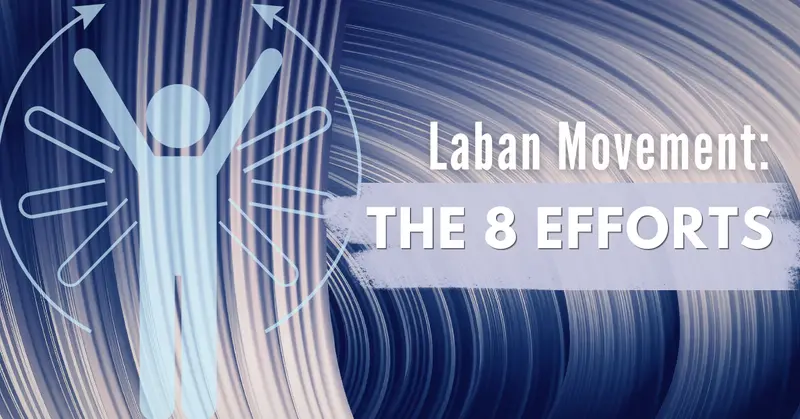
The Eight Efforts: Laban Movement

If you want your students to take their character development to the next level, introduce them to Laban Movement. Laban Movement will provide them with a clear and understandable tool set that will enable them to grow their own movement vocabulary and discover new ways to physicalize character. This work is not just technical but spends time teaching the students to recognise and act upon creative impulse in the body. What is Laban Movement?For a long time Laban movement was primarily used for dancers and dance choreography to discover new ways to move. In the 80s and 90s, it began being used to help actors and improve performances. I first encountered Laban work while I was training at the Dell’Arte International School of Physical Theatre. While the Laban work comes out of modern dance exploration, at Dell’Arte they were using Laban’s Eight Efforts to explore character in the body. They used it as a way to extend an actor’s movement vocabulary and ability to play characters physically. The Eight Efforts became a cornerstone of my work as an actor. They help an actor both physically and emotionally identify and play characters who are different from themselves. This embodied work helps the actor in understanding internal impulse and in developing an expressive body that can make clean, precise choices. It also helps the actor create and maintain a strong physical instrument that will serve them throughout their training and future professional work. Who is Laban?Laban is named after Rudolf Laban , who was a movement theorist, a choreographer and a dancer. He is considered a pioneer of modern dance. Laban categorized human movement into four component parts: • Direction • Weight • Speed • Flow Each of those parts has two elements: • Direction is either direct or indirect. • Weight is either heavy or light. • Speed is either quick or sustained. • Flow is either bound or free. So, for example, if you’re looking at Flow and the movement is bound, then it’s very tight. It’s very held in. Think uptight businessman or administrator. Whereas someone who moves freely is the opposite of bound. Think of children. They are always running, always free. And if you’re looking at direction, you’re either moving toward something directly or you’re meandering toward it. Laban then combined these parts together to create The Eight Efforts: • Wring • Press • Flick • Dab • Glide • Float • Punch • Slash For each effort, Laban identified which component parts were to be used. For example: For WRING • The Direction is Indirect • The Weight is Heavy • The Speed is Sustained • The Flow is Bound How can you use Laban in the drama classroom?Student actors have a hard time moving outside their own body. Every character they play, moves like they do. Introduce a process to students that gets them thinking about different ways to move. Then with every character they play, they have a vocabulary to draw from: Does this character move with a flicking movement? What weight does this character have? Am I bound or free? There are many different ways an actor can begin to employ these efforts into their work. Observational work: The actor can take time observing individuals and creatures in the world around them with an eye towards identifying the Eight Efforts within the movement and behaviour of the observed subjects. After careful observation and replication of the efforts, the actor can begin to apply what they observed to the creation of a character, borrowing elements of what they observed and rehearsed. Text work: The actor can carefully analyze the text and look for speech patterns that are similar to the Eight Efforts. Our language is a representation of our inner lives. By looking at what and how the character expresses themselves, the actor can find clues for which one of the Eight Efforts to explore. For example – in A Midsummer Night’s Dream, the character of Peter Quince speaks in monosyllables. QUINCE “Here is the scroll of every man’s name, which is thought fit, through all Athens, to play in our interlude before the duke and the duchess, on his wedding-day at night.” His text is made up of short quick words. This could be a clue to the actor to try vocally playing Dab in the voice and seeing how vocally playing the Effort affects the body and the physicality of the character. Playing off this same idea of using the text to find the Effort, Oberon (in A Midsummer Night’s Dream) talks a lot about aggressive hairy animals and seems to be aligned to the animal world. Many of the animals he speaks of have Alpha Males in their social hierarchy, which tend to be Heavy, Direct, Free and Quick. This might be a clue to the actor playing Oberon to play around with a Slashing quality in the voice. Emotional work: One can look at the personality of the character and the emotional makeup of the character to look for what kind of Effort to experiment with. We can look at a character’s personality and think of them in terms of the Efforts. On the TV show South Park, the character of Carman is pushy and aggressive with his friends. He tends to try to dominate any situation he is in and is quick to anger. You could think of his personality as a Punch. Eeyore from Winnie-the-Pooh is light and indirect in his personality and the way he interacts with the world. He could be described as a Float or a Glide. Ask your actors to look at their characters’ emotions or how they react to the world around them. This can help them find an effort to play. Costuming: Finally, we can play around with costuming. What kind of costume is the actor called upon to wear or how does the period clothing inform the actor as to what effort to play? If we think of Gwendolen from The Importance of Being Earnest She is usually costumed in light dainty fabrics that tend to have a great deal of lace on them. How can the actor translate the delicate nature of the fabrics and lace into an Effort? It is light and free – so could the actor play Glide? Or does the actor find the clothing light but binding and play Dab? By experimenting with the Laban Efforts and ways to interpret them, you can create a language to give your students to get them out of their bodies, out of their shells and into a new physicalization. What do the Eight Efforts look like?If you’ve never used Laban before it is definitely like learning a new language. What does it mean to Punch or Glide?
Copyright For Drama Teachers
Teaching Drama

Copyright For Drama Teachers

Copyright Law affects all Drama teachers, students and educators. Anyone who has anything to do with a play – be it photocopying the text for class, performing it in front of an audience, or wanting to change the language. All of these actions fall under copyright law. What is copyright?Copyright is a bundle of intellectual property rights that protect works of artistic expression such as art, music, and plays. To qualify for protection, the work has to originate with an author, be original and not a copy. The work must be the product of creative effort, and the author must use skill. That means the play you’re doing is probably protected by copyright. What does copyright protect?Reproduction, public performances, publication, adaptation/editing/modification (i.e. derivative works), and translation. You can’t do any of the above without permission. This includes photocopying, performance, cuts for time, gender changes, changes to the text. When does copyright expire?70 years (USA) or 50 (Canada) after the death of the author. George Bernard Shaw is free from copyright in Canada but not in the US. What’s the Public Domain?Works in the domain of the public. That’s you! Public Domain works are not protected by copyright. You can reproduce them, perform them, adapt and translate them. Download free Public Domain plays on Project Gutenberg. What aspects of a play are protected by copyright?The script, the set design, the choreography and sometimes the lighting design. The choreography you saw in another production is protected by copyright, so create your own. I don’t have to pay for royalties if I’m not charging admission, right?Wrong. The script is protected from public performances. This includes any public performance: a free show, an invited dress, a preview, a competition. I’m safe if I’m parodying a script aren’t I?Only if you’re creating an original work of your own. If you’re using text from the original, you could be considered to be creating a derivative work. And that belongs to the original creator.