đŁSCRIPT SALE! Treat yourself to an easier Fall. Save 30% on 5+ perusal scripts with code SPRING30 before May 3 and head into summer stress-free.
Black Comedy
Featured Plays
Theatrefolk Featured Play - The Plucky Pie Murder
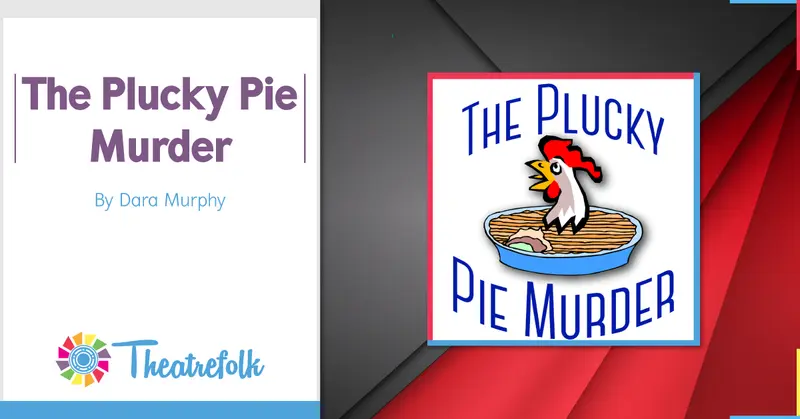
Welcome to our Featured Play Spotlight! The Plucky Pie Murder by Dara Murphy is an incredible way to challenge perspectives and find humour in unexpected places. A black comedy extraordinaire!
The star quarterback of Riverview High School has been charged with murder most fowl! Rooster, to be precise.
Plucky the mascot has been done in and all fingers point to the football player - even his own.
A farce of a trial ensues featuring an inept judge, an unprepared defence lawyer, and an Egg-Girl.
The audience plays the jury in this hilarious black comedy. Two possible endings!
Why did we publish this play?
The Plucky Pie Murder is a black comedy extraordinaire. It's the play to choose if you're in the rare position of having a lot of guys in your drama class or club. We love how Dara writes plays. Some may call it weird, which I would consider a compliment. She's said that she likes "finding humour in unexpected places." She also likes that humour can be used "to challenge people's perspectives." It's important to us to have plays that challenge people's perspectives! Sit back and enjoy the ride with this play.
Fun fact: When we accepted The Plucky Pie Murder Dara was the youngest playwright in our catalogue. She had written the play for a high school assignment and her teacher submitted it to us.
Letâs hear from the author!1. Why did you write this play?
I wrote The Plucky Pie Murder when I was in grade 12. It was a drama class assignment that asked us to write a one-act play. I don't remember how I got the idea for the script, but at the time I enjoyed TV shows like Murder She Wrote and Matlock. My teacher liked my play, and at the end of the school year, she recommended that I submit it to Theatrefolk. I was very excited when Theatrefolk said they were interested in publishing it! My mom even flew us to California so we could watch the first performance. That experience cemented my love for writing and theatre.
2. Describe the theme in one or two sentences.
This play is a courtroom drama and a football game rolled into one. I would say the theme is the importance of getting to know a person beyond simply looking at their mascot costume, job, reputation, or appearance.
3. Whatâs the most important visual for you in this play?
My favorite visual is the waterboy keeping the defense team hydrated during the court proceedings.
4. If you could give one piece of advice for those producing the play, what would it be?
If you produce this play, I would recommend keeping the pace of the dialogue very snappy. This will help the jokes land, and it will keep the energy high. People could even talk over one another.
5. Why is this play great for student performers?
This play is great for student actors because it's a lot of fun. It's goofy and silly, and it would be perfect for an energetic group. The jokes come and go quickly, and there's never a dull moment.
6. Who is your favourite character in the play?
If I were in this play, I would want to be Ms. Duncan because she's a serious lawyer who gets to pepper everyone with important questions.
7. What is your favourite line in the play?
It's hard to pick my favorite line. I like the section when Mr. Teedle is questioning the forensic specialist on whether the mascot costume is a rooster or a chicken. I also like Mr. Teedle's hopeless opening statement: MR. TEEDLE: Okay, to begin I would like to say that my client is innocent. Very⌠innocent. So innocent, you could throw him into a lake and he would sink⌠Ha ha, little witch joke there. So, to close my opening statement I would like to repeat that the innocence of my client is very⌠ah⌠very big. Thank you.
Distance Learning
Theatrefolk Featured Play â The Virtual Support Group from Hell by Jeffrey Harr
*Welcome to our Featured Play Spotlight. * The Virtual Support Group from Hell by Jeffrey Harr is a perfect play for an online environment â a hilarious virtual adaptation with fun, vivid characters.
Wendy joins an online teen support group. However, she quickly discovers that the others are anything but typical.
Who is Vladimir and why does he speak with a Transylvanian accent? Why does Lucy only speak one word (braiiinnnnssss)? And why does Janet think sheâs Batman?
Why did we publish this play?
Weâre still in the weeds of virtual productions, so why not produce something you can put together RIGHT NOW. Jeffrey Harr has adapted his play âThe Support Group From Hellâ so that it can be done virtually. He was inspired to do so after a school last spring did their own adaptation and it worked so well. Vivid characters that are so fun to play, and a story that makes total sense in a virtual environment.
1. Why did you write this play?
Iâve always been a huge fan of old-school movie monstersâDracula, the Wolfman, Frankensteinâs creatureâand wondered what they would be like in group therapy. And Iâve always been just as interested in throwing shade at Dr. Phil, so I figured, how about a wackadoodle therapist obsessed with Dr. Phil and a perfectly normal teen girl who unknowingly wanders into a group full of monsters? I loved the idea of taking characters who have such incredibly rich backstories and making them teens. Letâs face itâbeing a vampire is hard, adolescence is harder.
2. Describe the theme in one or two sentences.
Every kidâs got problems, undead or not, and talking them out with a licensed therapist canât hurt.
3. Whatâs the most important visual for you in this play?
Because the playâs meant to be performed virtually, the appearance of the âmonsterâ characters is really importantâtheyâll be on screen throughout the entire show. Plus, itâs a lot of fun to interpret them visuallyâDracula, Frankensteinâs monster, a witch, a zombie. It gives the kids a chance to be creative in putting together what theyâd look like as teens, not to mention what to do with the background. Like, what would a teen witch have in her room that would add to her character? Itâs something that wouldnât have to be considered on stage, but in this medium, itâs an extra dimension that could really add something to the character.
4. If you could give one piece of advice for those producing the play, what would it be?
Iâd suggest having the actors playing the monsters to do a little research to have somewhere to start with their characters. What kind of vampire do you want to be? What would Frankensteinâs monsterâs kid act like? How do you inflect the word âbrainsâ to suggest a variety of different tones? Which Batman voice feels right? Getting a bunch of pop culture references can be a great place to start for ideas.
5. Why is this play great for student performers?
The play gives the kids a chance to play some pretty outlandish characters, which is always fun. And they have a lot of room for creativity in how they interpret them, as iconic as they are. The virtual aspect is really powerful, tooâso much of a play in this format is up close and personal, making facial expressions and voice so important. Things that wouldnât be seen or heard quite so crisply are impossible to hide on screen, and thatâs a good thing. So much can be said with a great facial expression or a sarcastic whisper.
6. Do you have any tips for those who are performing this play online?
Iâd suggest that the actors think carefully about what will be in the background of their screen so they can be deliberate in helping to create a humorous tone. And now that theyâve been spending so much of their lives online, they probably have some wonderfully creative ideas for how to best use the medium to help tell the story. Video tricks. Little things that happen while in one of those Zoom calls that would add something funny. Iâd let them do what they do bestâbe creative, try different things, make it as relevant as possible.
Get your copy of The Virtual Support Group from Hell right here, right now!Not right for your group right now? Search our play catalogue to find one that your performers will love!
Featured Plays
A Powerful Production: Clowns with Guns
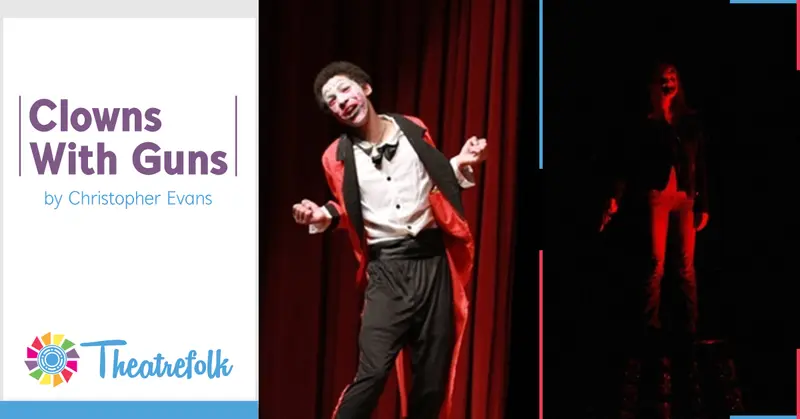
Clowns with Guns (A Vaudeville) by Christopher Evans takes a theatrical and absurd look at the repeated and seemingly endless cycle of school violence.
Step right up! Step right up! Itâs the SCHOOL-SHOOT-O-RAMA! And the question everyoneâs asking is âAm I walking out alive today?â
Clowns with Guns takes a theatrical and absurd look at the repeated and seemingly endless cycle of school violence. It happens, everyone is terribly upset, things continue on as normal, it happens again.
This story is mean. There are guns. The play puts school shooting violence out in the open and forces all of us to do the same. Read the play with this knowledge.
Director Lisa Rowlands was eager to share the powerful experience that the student performers at Neath Little Theatre in Neath, United Kingdom had with their production of Clowns with Guns (A Vaudeville):
âA fantastic piece. It was such a powerful play that genuinely had the entire audience thinking and even more importantly talking about the subject matter afterwards. Even though the play takes place in the USA it has implications in the UK that were definitely understood by the audience.
TIP: Definitely include the cast as much as possible. The production evolved throughout rehearsals with youth members becoming more and more engaged as their understanding of the play grew.â
Great job, Neath Little Theatre!
Featured Plays
Strong Subject, Stronger Performance: Clowns With Guns
If youâre looking for a play that takes a stand and gets people talking, Clowns with Guns by Christoper Evans is a play that both audiences and students will never forget.
Step right up! Step right up! Itâs the SCHOOL-SHOOT-O-RAMA! And the question everyoneâs asking is âAm I walking out alive today?â
Clowns with Guns takes a theatrical and absurd look at the repeated and seemingly endless cycle of school violence. It happens, everyone is terribly upset, things continue on as normal, it happens again.
This story is mean. There are guns. The play puts school shooting violence out in the open and forces all of us to do the same. Read the play with this knowledge.
Lori Zyla and the talented students at Parkersburg High School in Parkersburg, West Virginia were not afraid of the serious subject matter and proved that when students connect with and believe in the material, great things can happen:
âIt is always great to direct a play that your students are 100% behind. This issue matters to them, and that shows in their performance. Great choice for a competition piece!â
Featured Plays
Theatrefolk Featured Play â Lose Not Thy Head by Gary Rodgers
Welcome to our Featured Play Spotlight. If you like Shakespeare, Monty Python, a little love, a little death, a lot of laughs and lunch at the pub, you must read Lose Not Thy Head by Gary Rodgers!
The Viscountess is in a funk. Sheâs lost her passion for her job as lead executioner. This may or may not help the next victim.
Joan has been sentenced to lose her head for impersonating her famous brother William Shakespeare. Heâs disappeared with all his earnings and Joan has been trying to finish his latest play about Henry VIII. Joan pleads for her life, Death waits for Joan to die, a severed Head says beheading isnât so bad, a Sigmund Freud-type doctor tries to convince everyone that you canât sew a head back on a body, and then things get weird.
Why did we publish this play?
If you love comedy, but like your comedy left of centre rather than the pie in the face variety â this is your play. If youâre looking for interesting parts for girls â this is your play. If youâre looking for gender flexible roles â this is your play. If you like Monty Python, Shakespeare, Freud, talking chopped off heads, a little love, a little death, and a lot of laughs all in one package â then this your play!
Letâs hear from the author!
1. Why did you write this play?
I wanted a write a comedy that took an extremely unsavoury topic, such as medieval beheading in dank dungeons, and make total light of it. I feel that that is truly the source of this playâs magic. Such contrast is certainly not something that I invented but is common to many great comedies.
2. Describe the theme in one or two sentences.
I always felt the theme of this play is oneâs struggle for power, control and self-preservation in an increasingly unsteady environment. This play is predicated on a constant struggle between several characters for command of the situation throughout the entire play. Even the supporting characters get to vie for status and control.
3. Whatâs the most important visual for you in this play?
One has to love the guillotine as a centre piece for the whole production. We are presented with a rather nasty image when ANNE is placed on the rack/stretcher and laid on the guillotine bed, beneath the blade, pleading for her life. The unpleasantness of this visual is smashed to pieces shortly thereafter when everyone is jumping on the guillotine vying for control, in a manner reminiscent of the childrenâs game Iâm the King of the Castle.
4. If you could give one piece of advice for those producing the play, what would it be?
Donât feel daunted by having to build a guillotine. It really isnât as difficult as it might look and Iâd be happy to explain how it was done for the original production. It is also possible to use other means of execution, for instance, CHROMWELL or WOLSEY could always carry a large axe for the purpose of beheading.
5. Why is this play great for student performers?
For many high school performers, Lose Not Thy Head is an introduction to macabre humour, which is a wonderful genre to explore. Also, most high school thespians will have had some experience with Shakespeare in English class, however, it is less likely that they would have encountered Henry VIII or his sister JOAN for that matter. The troupe that presented the original performance had a wonderful time rehearsing and preparing their production and, ultimately, it was an extremely entertaining experience for both the company and audience.
Featured Plays
Theatrefolk Featured Play â To Kill A Mocking Birdie by Clint Snyder
Welcome to our Featured Play Spotlight. If youâre a fan of the classics but have wondered it would be like to tell the story through the lens of the absurd, youâll love To Kill A Mocking Birdie by Clint Snyder.
Birdie would like you to meet her parents: a goldfish and a moldy piece of bread. Donât mind the yelling, she didnât get a pony as a child. And she certainly didnât burn down an owl farm.
But sheâs willing to feed you. And there may be egg rolls and chocolate cake! That is, if Carol the ex-maid brings it and doesnât hold a grudge against Birdie for being fired. You may also meet What, When, Alexa (whoâs hiding in the bathroom) and Birdieâs sister Scoot, who thinks sheâs a glazed Virginia Ham.
Itâs a perfectly crazy dinner party. Consider this your invitation.
Why did we publish this play?
This play is perfectly crazy. But thereâs no wink to the audience, itâs a great example of characters committing to the world of the play. A fantastic world where your parents are a goldfish and a moldy piece of bread. You have students who donât want to do kitchen sink dramas. You have students who donât want to fit into boxes. Give them this play to show them how far they can go.
Letâs hear from the author!1. Why did you write this play?
I wrote this play because To Kill a Mocking Bird always really spoke to me as a child, but I wanted to retell some of the themes through a lens of my own brand of bizarre dark humor.
2. Describe the theme in one or two sentences.
A child throws a dinner party to draw attention to her upbringing and the strange effects it has had on her psyche in hopes it will bring some peace.
3. Whatâs the most important visual for you in this play?
Anytime they are treating the piece of toast and goldfish like people.
4. If you could give one piece of advice for those producing the play, what would it be?
Have fun with it. Donât be afraid to let yourself lose and give into the absurdity of the themes.
5. Why is this play great for student performers?
It gives the students a chance to relate to themes that affect them and bring the humor to life. The comedy keeps it engaging, while the characters are interesting enough to make it a good opportunity to teach character development.
Featured Plays
Theatrefolk Featured Play â The Art of Rejection: Two One-Act Plays by Christian Kiley
Welcome to our Featured Play Spotlight. The Art of Rejection: Two One-Act Plays by Christian Kiley consists of two one-act plays that expertly combine realism with the abstract, and include characters that high school students can really relate to.
R is the only letter in a sea of numbers. Potential sits in a chair. These two one acts â Art of Rejection and Chaired can be performed separately or together.
The Art of Rejection: R is the only letter in a sea of numbers. Always picked last for kickball, never part of the âinâ crowd, never gets the girl. What is a letter to do to get through life? An avant-garde look at the price of popularity.
Chaired: Potential sits centre stage in a chair. At times Potential is forced to remain seated by family, teachers and friends. At other times Potential will do anything not to stand. Itâs better to stay in place, not move, not reach out. Sometimes the hardest thing to do is just stand upâŚ
Why did we publish this play?There are two one acts in this fabulous collection. It could be something that you easily divide up in a large class. What I like about the plays is their tone â the dialogue is definitely realistic but the situations sway to absurd. If youâre looking for a transition piece for your students before they do something outside the realism box, pick up The Art of Rejection. Easy to stage, costume and both have little to no set! Who doesnât love that?
Letâs hear from the author!
1. Why did you write this play?This goes back to my junior high days when the school yard was the primary location for bullying. I wanted to capture the feeling of being bullied and rejected for the audience and then give the protagonist the opportunity to get a unique kind of revenge or have an epiphany (which I think R and Potential both experience in different ways). This is truly how I felt in junior high and parts of high school. It is an exaggerated version of it. But the plays grew from seeds of truth.
2. Describe the theme in one or two sentences.Is popularity worth it or is it just conformity with a prettier paint job? When you dig deeper, there is a special kind of courage it takes to be yourself, to discover your full potential and grow into it.
3. Whatâs the most important visual for you in this play?Definitely when R turns into a tree. It is so unexpected and outside the realm of anything I would have thought of normally. That physical transformation at the end of âThe Art of Rejectionâ is shocking and stunning.
4. If you could give one piece of advice for those producing the play, what would it be?Let the entire production spring forth from the actors. Let the actors represent as much of the world as you think they can. Turn it over to them. The piece is a celebration of minimalism in that way.
5. Why is this play great for student performers?It taps into an energy that I still feel today and I see and feel with the students I teach. Most Theatre students have been R or Potential for at least parts of their lives. And they have been around people like the other characters for so long that they have already engaged in the character study (everyday). I asked one of the actors who played a bully in both plays how he was able to do it (he is such a nice person) and he said, âthere are people like this everywhere, you donât even have to look for them, they are part of your daily life.â
Featured Plays
Theatrefolk Featured Play â Camel Dung and Cloves by Dara Murphy
Welcome to our Featured Play Spotlight. Camel Dung and Cloves by Dara Murphy is not your average tea party. With rich, eccentric parts for girls, the twists and turns in this high school play are definitely worth checking out.
Sara enjoys the ritual of making and drinking tea. Maybe she enjoys it a little too much.
Sara pays Empy to join her at a tea party. Empy is eager to make a quick buck. But what are Saraâs motives? What about the bones in the black box? And what exactly is in the tea?
Why did we publish this play?
Dara Murphy started sending us plays when she was a student and the first thing that struck us was her black sense of humour. We love it. (Donât believe me? Check out Magic Fairy in the Microwave.) Now Dara is a drama teacher with less time to write but weâre thrilled to be able to share her work with you, including this dark and twisted gem.
Do you have girls who are tired of being stereotyped and enjoy dark and twisted? Camel Dung and Cloves has got rich and eccentric roles for girls with plot turns that never stop coming.
Letâs hear from the author!
1. Why did you write this play?
I was inspired by an email from Theatrefolk that said they needed more plays with female characters. I didnât have a story in mind, but I suddenly had an image of a tough girl poking around in a girly-girl room. I was curious to write the play and explore the girlsâ characters and dynamics. It was a fun play to write!
2. Describe the theme in one or two sentences.
The theme of this play is how easily people can deceive others by taking advantage of their assumptions and expectations.
3. Whatâs the most important visual for you in this play?
I think of two contrasting visuals. The beginning image is of a tough female character overpowering a sweet girl in her own room. The final image is that same tough character, now totally subdued, in a room that has suddenly overpowered her.
4. If you could give one piece of advice for those producing the play, what would it be?
You might want to make some of the props âlarger than lifeâ so they are easy to see. If everything doesnât fit in one box, the girls can also take props out from under the bed.
5. Why is this play great for student performers?
I think this is a fun play to act because the characters are so mysterious and devious. The ending is also surprising and unexpected. Oh, and they get to say words like âpig fetusâ.
Featured Plays
Theatrefolk Featured Play: Clowns with Guns by Christopher Evans
Welcome to our Featured Play Spotlight. If youâre looking for a play that takes a stand and gets people talking, then read on. This month weâre featuring Clowns with Guns by Christoper Evans â a play that both audiences and performers will never forget.
Step right up! Step right up! Itâs the SCHOOL-SHOOT-O-RAMA! And the question everyoneâs asking is âAm I walking out alive today?â
Clowns with Guns takes a theatrical and absurd look at the repeated and seemingly endless cycle of school violence. It happens, everyone is terribly upset, things continue on as normal, it happens again.
This story is mean. There are guns. The play puts school shooting violence out in the open and forces all of us to do the same. Read the play with this knowledge.
Why did we publish this play?
Clowns with Guns takes a theatrical and absurd look at the repeated and seemingly endless cycle of school violence. It happens, everyone is terribly upset, things continue on as normal, and it happens again. We wanted to publish this play because it puts school shooting violence out in the open and forces us to do the same. Itâs not a gentle play, itâs mean. And we wanted a play out there on the topic that makes a stand.
Letâs hear from the author!
1. Why did you write this play?
This was my comment on the seeming acceptance of school and mass shootings. I was angry and wanted to be an angry voice that said âThis is not okay. I do not accept this.â
2. Describe the theme in one or two sentences.
A cycle of violence will not stop unless we do something to stop it.
3. Whatâs the most important visual for you in this play?
The introduction of the silent clowns, Thoughts and Prayers, at the end of every stylized shooting. This was my comment that after every event all we would do is send Thoughts and Prayers. Nothing else. Nothing changed.
4. If you could give one piece of advice for those producing the play, what would it be?
Embrace the absurdity and the message. This isnât a play to be enjoyed. Itâs social satire and itâs going to make your audience very engaged, possibly angry. Some folks donât like to be seen in a negative light.
5. Why is this play great for student performers?
It adds Absurd Theatre to their resume. Itâs unlike any play theyâve done. Itâs not safe. Itâs mean and if you go as far with these characters as the script demands, youâll never forget this play. Neither will your audience. Thatâs what theatre should be.
Featured Plays
Theatrefolk Featured Play: Horror Movie 101: Failing Can Be Deadly by Steven Stack
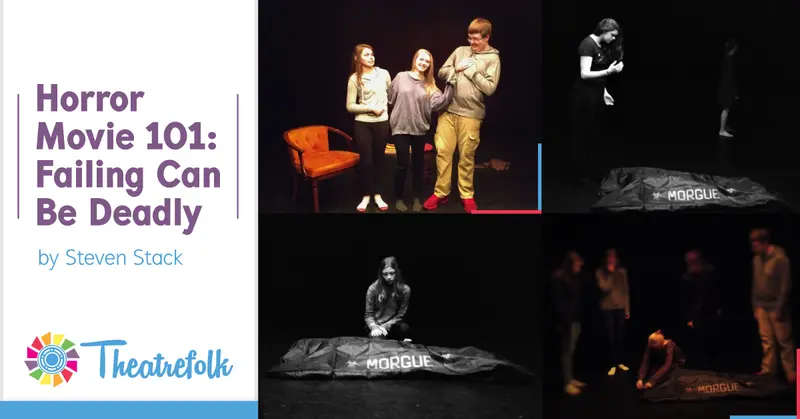
Welcome to our Featured Play Spotlight. Today weâve got horror. Thatâs right horror theatre. We love this genre and love being able to offer it to you with Steven Stackâs new play Horror Movie 101: Failing Can Be Deadly.
Surviving your teenage years is difficult enough. But in St Claire, where teens continually violate the rules of Horror Movie 101, itâs practically impossible.
You know the rules: never open a door if someone knocks after the lights go out. If your car runs out of gas and a girl on the side of the road asks you to take her home to mother â donât. Haunted houses are never a good idea, and neither are cabins in the middle of the woods. And if you use an ancient burial ground to bring some back, theyâll come back wrong. Everyone knows that.
This collection of haunting, horrifying, harrowing AND humourous scenes will keep you laughing as you keep your eyes covered.
Why did we publish this play?
Horror Theatre is a genre that we just donât often see on the stage. Itâs the realm of movies with their scary music, their jump scares, and their ability to create buckets of blood.
But that doesnât stop playwright Steven Stack. Steven loves exploring this genre (have you read his Ashland Falls? The Bottom of the Lake?) and weâre thrilled to add Horror Movie 101 to our catalogue. Anything can happen on the stage and you donât need a camera to create a jump scare.
Plan this play for October right now!
Letâs hear from the author!
1. Why did you write this play?
Two reasons. One, we were doing a Halloween Show at the studio I work for and I needed something for it. But the main reason was that I love writing plays that mix horror, comedy, tragedy and strong characters and once the idea came to me about creating a one-act that featured scenes that took place in the same town and were connected, I was super excited about diving into the bizarre happenings of St. Claire, Minnesota.
2. Describe the theme in one or two sentences.
The path that our life takes comes down to the decisions that we make or donât make. And all of those decisions come to an end: one that is happy or one that is not.
3. Whatâs the most important visual for you in this play?
Sarah looking at the body bag at the end of The One. That it, in some ways, sums up the themes of all the plays, even the comedies.
4. If you could give one piece of advice for those producing the play, what would it be?
Play the truth of each scene and characters and really push to internalize the stories. This holds especially true for the comedies. I think thereâs often a tendency for actors to play the âjokesâ in comedies instead of playing the truth of the characters, who often donât find their situations funny. And I think that, in the end, is what makes it funny.
5. Why is this play great for student performers?
One reason is because itâs a mix of horror, humor, and tragedy which I believe anyone, especially teens, can get on board with. I think another reason is because this play forces actors to internalize deeply to create the truth of the various moments in order to have them work on stage.
Featured Plays
Theatrefolk Featured Play: The Baloney, the Pickle, the Zombies, and Other Things I Hide From My Mother by Bradley Walton
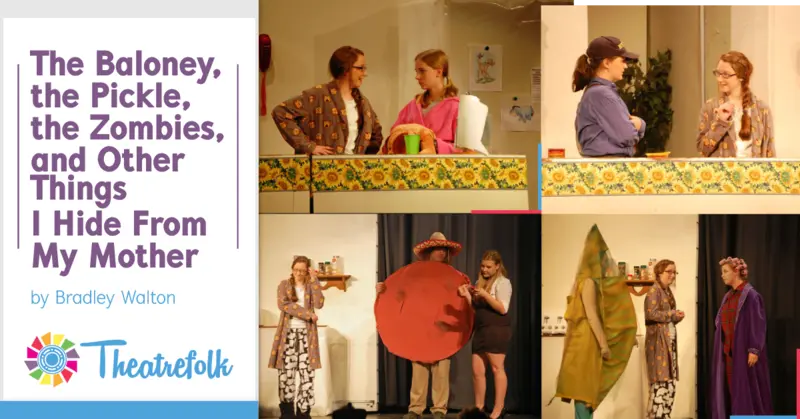
Welcome to our Featured Play Spotlight. Today we look at The Baloney, the Pickle, the Zombies, and Other Things I Hide From My Mother, a comedy for high schools and middle schools where Trevor is in the basement experimenting. He wants to build an army of zombies⌠by bringing baloney to life. Will his plan work before the expiry date?
âWhat are you doing with the baloney?â Thatâs the question Emma asks her big brother Trevor when she finds him in the kitchen at 2 A.M.
But Trevor is up to much more than a late night snack â heâs bringing food to life with experiments he hopes will lead to the creation of zombies he can sell as cheap laborers.
Together with his living baloney-minon, Meyer, Trevor is about to embark on a night in which he will face an angry neighbor, be questioned by police, bring a pickle to life, and discover that his food may actually be smarter than he is⌠all while trying to keep everything secret from his mother and little sister.
Why did we publish this play?
This play uses my favourite theatrical device â personification. Why not have characters such as life-sized baloney? It also has a wonderfully descriptive title that includes baloney, zombies, pickles and moms. Titles are the doorway into a theatrical world and with this play Bradley has the door wide open, and is standing with a plate of sandwiches welcoming you in. This is a play that welcomes you to laugh and enjoy yourself, and thatâs why itâs in our catalogue.
Letâs hear from the author!
*1. Why did you write this play? *
One night I was in the kitchen getting some baloney out of the fridge. My daughter walked into the room and asked, âWhat are you doing with the baloney, daddy?â Which prompted me to wonder what I might possibly be doing with the baloney besides eating it. The gears in my head started turning.
*2. Describe the theme in one or two sentences. *
Donât play with your foodâespecially if itâs smarter than you are.
*3. What is the most important visual for you in this play? *
The baloney costumeâit sets the audience up for all of the weirdness that follows.
*4. If you could give one piece of advice for those producing the play, what would it be? *
Iâm normally a fan of minimal and suggestive costuming, but It think this show really benefits from having strong baloney and pickle costumes, so I would advise trying to make those look as good as possible.
*5. Why is this play great for student performers? *
At some point in their lives, just about all young people have kept something hidden from their parents or siblings. This play takes that universally familiar situation and goes absolutely bonkers with it.
Featured Plays
Seriously Stylized Comedy: No Horse Town
No Horse Town by Lindsay Price is all about styleâstyle in the language with the specific manner in which the characters speak, style in the action with the numerous character âposesâ and the very stylized telling of what happened in the town of Heywood. Together with Heather Mortimer, the talented student performers at Carleton Place High School in Carleton Place, Ontario took a comedic journey through this no car, no horse, no street town and found that crossing the street in this small town is as daring and dangerous as it getsâŚ
âCarleton Place High Schoolâs production of No Horse Town (shown here in rehearsal) won Outstanding Production at the Kingston and St. Lawrence District Sears Drama Festival! This was our first time competing. We will go on to compete at the Regionals in a month. Director, Peyton McClelland, also won an Award of Excellence for her hard work.â
Congratulations, Carleton Place High School!


.png)