Facebook Pixel Skip to main content

📣SCRIPT SALE! Treat yourself to an easier Fall. Save 30% on 5+ perusal scripts with code SPRING30 before May 3 and head into summer stress-free.

Budget

Creative Ways to Stage Theatre on a Tight Budget
Directing

Creative Ways to Stage Theatre on a Tight Budget

It’s a struggle to stage a production with little or no funds, but it’s not impossible! If your program is new or small, chances are you’re dealing with a tight budget. So how do you stage a show when funds aren’t available? Here are some creative ways to stage theatre on a tight budget. Devised ScriptIf you’re looking to save money, a good place to start could be the script. Depending on the show, scripts can cost hundreds of dollars to produce. This is a real challenge with a tight budget, because between royalties and rights, you could easily spend your entire budget before you ever start rehearsals. If you don’t have the money to buy both the rights AND the technical elements for a show, work with your students to create a new one! With guidance and supervision, your students can generate a script as a group and then perform it for an audience. Start by having a group of students brainstorm ideas they might want to explore through dialogue and scenes. Then, through a process of peer feedback and focused re-writing, they can eventually build those scenes up into a devised script. As an added bonus, because you know the scenic limitations of your program, you can steer your students toward creating their work with your particular stage in mind, and only include scenic elements already available to you. That will help keep your production costs in check as well. Check out these Theatrefolk blog posts on devising: • Devising Exercises for the Drama Classroom • Devising in the Drama Classroom • Devising Exercise: Playing with Change • Devising Challenge: One Minute Word Association Theatrefolk also has this Resource on creating a vignette play with your students. Block Set or Implied SetIf you have rehearsal blocks, consider designing your show to utilize these objects instead of more traditional, realistic scenic elements. You can use blocks for everything from couches to beds to walls, and almost anything else you (and your audience) can imagine. Oftentimes, you don’t even need to build complete “objects” for blocks to be effective. You can use blocks to imply objects such as walls, doorways, furniture, and landscaping, giving shape to your space and boundaries to your performers. Utilizing these kinds of generic objects provides a couple of benefits: First off, you’re not spending any money on a set. Second, and more importantly, you can engage your audience’s imagination by minimising scenic elements and allowing them to concentrate on the actors’ performance. Light-Based Set DesignAnother low-cost option is to eliminate physical scenic elements altogether and only design your sets using light. Lighting is an eloquent way to define space and create mood, and clever directors can utilize it to great effect. Better still, lights can create an even more dramatic landscape when combined with hanging or flowing fabrics. This type of “soft” scenic design can create a dreamlike or ethereal feel to your stage, and allows for scene changes with each new lighting cue. So ditch the lumber and let lights do the heavy lifting! Here are some tips for first-time lighting designers. Living SceneryFinally, consider using “people power” to create your sets. Instead of building scenery, bring your sets to life by incorporating performers as scenic elements. Having performers sit, stand, or pose in strategic locations gives you a wide range of options with regards to scenery. Performers arranged throughout the stage on different levels can represent everything from the members of a royal court to the haunted trees in a cursed forest. Even performers simply standing with their backs to the audience can clearly delineate the boundaries of a specific location, even without a specific location in mind. Again, this type of scenic magic is limited only by the imagination of the audience. Let your artistic inspiration run wild, and stage your show on a shoestring budget that is tied to the power of creativity and imagination!
10 Quick Tips for Low- or No-Budget School Shows
Production

10 Quick Tips for Low- or No-Budget School Shows

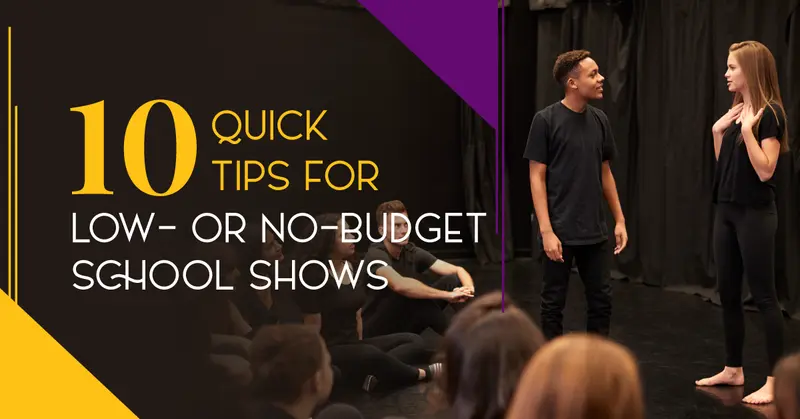
When you’re expected to produce a show with a shoestring (or less) budget, you have to make smart choices about everything to make your money stretch as much as possible. But don’t despair! It’s absolutely possible to stage an incredible school show on a low or zero budget. Read on for 10 quick and practical tips to get your show on its feet without breaking the bank. 1. Start by figuring out your budget so you know how much you have to work with. Then, start fundraising as early as possible. 2. Choose a straight play to produce, rather than a musical. Musicals are more expensive in general, as the performance rights cost more (since you’re buying both scripts and scores), they require additional staff (musical director and choreographer, at minimum), and you’ll need either a set of performance tracks or a live band, both of which cost even more money. 3. Choose a play with a small cast. Larger casts mean more of everything: more copies of the scripts, more costumes, more makeup and hair supplies, more more more. Of course, we would love to do huge cast shows with lots of students involved. But when you have a tight budget, you should start small. 4. If you can’t afford to purchase the rights to an existing play, write your own original play or produce a student-written play. If you don’t have the ability or time to write a full-length play, you could present a showcase of student-written monologues or have students write a series of scenes about a single topic and present them vignette-style. 5. For your set, focus on one signature piece or try using a curtain as a backdrop. Don’t worry about what the sets looked like in another production; come up with your own, simple yet unique set concept. 6. Forgo extensive costumes and have all your students wear rehearsal blacks (but they needn’t be boring). Choose multi-purpose accessories. Have students build costumes out of found materials. Or, choose a title where the students are playing students and can simply wear costumes from their own closets. 7. Go through your props list and determine the items that are absolutely essential, and cut the rest. Repurpose items you already have in your stocks. Borrow prop items from families, other classes, other schools, or local community theatre companies before purchasing items. 8. Work with your students on projecting their voices and maintaining good vocal hygiene so you don’t have to purchase or rent microphones. 9. Use found resources to create lighting, sound, and special effects. Go even simpler and use acting and performance techniques instead of special effects. Or, challenge your students to come up with low-tech and low-budget ways of creating special effects themselves. 10. Ask for help. Reach out to parent volunteers, other teachers at your school, local community theatres, and online resources for advice, extra hands to help, and requests to borrow items. Take advantage of free resources, such as Theatrefolk’s Production Design on a Budget Toolkit as well.
Calling All Theatre Teachers: Why are musicals so expensive?
Teaching Drama

Calling All Theatre Teachers: Why are musicals so expensive?

Welcome to our video series, Calling All Theatre Teachers! In this series we’re going to answer questions that drama teachers have about stepping into a theatre program. QUESTION: Why are musicals so expensive? Watch the video of our discussion of this question — Laramie shares exactly why he chooses to do musicals and why they are worth it! Click the link below for a worksheet to use when you need to apply for rights for a show. Do YOU put up musicals as part of your program? Why?
Calling All Theatre Teachers: How do I Put On Shows Without a Budget?
New Drama Teachers

Calling All Theatre Teachers: How do I Put On Shows Without a Budget?

Welcome to our video series, Calling All Theatre Teachers! In this series we’re going to answer questions that drama teachers have about stepping into a theatre program. QUESTION: How do I put on shows without a budget? Watch the video of our discussion of this question — Laramie shares his favourite thing about his students when it comes to putting on shows on a budget. Click the link below for brainstorm sheets to help you clarify your program’s mission statement for productions, determine what you have to make those productions a reality, and then identify what you need to fill in the gaps. How do YOU budget for your shows?
Production Design on a Budget Toolkit
Teaching Drama

Production Design on a Budget Toolkit

There is a lot of thought and preparation that goes into mounting a production, not least of which is a budget! The budget needs to be one of the first considerations when thinking about a show, but what if your budget is on a budget? How do you produce a professional looking show without professional amounts of money? With the Production Design on a Budget Toolkit, of course! This toolkit is designed to give you a new way to think about productions with a tight budget in mind. From how you choose your script, to rethinking the design process, to tips on where to find show materials for little or no money, this toolkit will help you get a show on its feet without bringing your budget to its knees.
Calling All Theatre Teachers: How do I get admin to see we need money?
New Drama Teachers

Calling All Theatre Teachers: How do I get admin to see that we need money?

Welcome to our video series, Calling All Theatre Teachers! In this series we’re going to answer questions that drama teachers have about stepping into a theatre program. QUESTION: How do I get admin to see that we need money? Watch the video of our discussion of this question. We have three ways to answer this question! Click the button below for a worksheet to help organize your thoughts on ways to be seen by your admin. How do YOU get your admin to see your program as important, and in need of money to thrive?
Sets on a Budget: One Signature Piece
Technical Theatre

Sets on a Budget: One Signature Piece

There’s nothing like a big, beautiful set to really create the mood and tone of a theatrical piece. With a little creativity, big and beautiful can also mean striking and singular. Sometimes the most interesting sets focus on one signature set piece. A singular set piece can be simple or elaborate, highly detailed or quite plain, and it doesn’t have to be expensive. Selecting one signature set piece can be challenging. Since there is only one piece, it has to be chosen with care and consideration. What story are you trying to tell with this set piece? How much of the stage does it take up? How does it contribute to the overall look of the piece? How much is it going to cost in terms of money, time, and effort to assemble it? These are all valid questions no matter what type of set you choose. First, let’s think about what signature set piece you might select. What you choose will depend on the show title, your budget, the story you wish to portray onstage, and the tone or mood you wish to suggest. Here are some ideas you might consider: • A single painted flat or curtain. This can portray anything from the sky to a cityscape to a house to a landscape. If it’s double-sided and can be turned around or covered up for certain scenes, that would be a bonus. • A periaktos, which is a revolving, three-sided prism, usually made of wood. A different scene is painted on each side and it’s turned by actors or stagehands so the appropriate side is facing the audience. • An item such as a shelving unit or a trunk, which is mounted onto a platform with casters and wheeled about. If it can be opened and/or used for storage, even better. You might also consider a flat object mounted on casters, such as a wall unit, blackboard, or costume rack that could be moved around, hidden behind, or have smaller items attached to it. • A single, large statement piece, such as a throne, tree, statue, sofa, or piano. A statement piece is generally stationary but still interacted with, such as by leaning against it or hiding behind it. • Good ol’ reliable rehearsal blocks. These can be painted or left plain, used individually or stacked together, and can be moved (or removed) to create pretty much whatever you need onstage. Always keep in mind that whatever set piece you choose, it should enhance the overall look, mood, and tone that you’re trying to portray onstage with your students. Once you have considered what the piece might be, you’ll need to think about how it is going to be used onstage. Is it meant to be looked at, or will it be interacted with? Will it be stationary or moved around? If students will interact with it, how will they do that specifically? Will actors or stagehands move it, or both? Does it need to move with a student on top of it, in it, or beside it? Does it need to hold or conceal smaller items? Does it need to perform an effect, such as light up, display shadows, glow in the dark, or play music? How can the piece be used differently in different scenes? Could it be lit differently, turned around, used by a different actor? Then, all these things considered, how much is it going to cost? Keeping these needs and desires in mind, the next step is to design and build the piece. (You can use the worksheet below to help with this.) Is it a piece that you already own and can modify, or does it need to be built from scratch? If it needs to be built from scratch, can the materials be donated, discounted, or sponsored to keep costs down? Once it’s built, use the piece as much as you can! Feature it in photoshoots for headshots and social media posts. Use images of it for the show poster and programme. If you can reuse it for class work or store it for future use, do it. You might also want to consider renting it out or selling it to another school or company for their upcoming production, and using the money towards creating a new signature set piece for your next show. You can use the worksheet below with your students. Have them come up with different ideas for a signature set piece for the play you’re currently studying. Have them describe and/or sketch out their piece and list three different ways it can be used for the show. Additional Resources: Set Design: How to cut a big musical down to size Full Class Project: Complete Show Design Creative Fundraising Ideas for Your Upcoming Production
Creative Fundraising Ideas for Your Production
Production

Creative Fundraising Ideas for Your Upcoming Production

Drama teachers are skilled at making theatre magic from little more than a hot glue gun, tape, and ingenuity. But sometimes you need cold, hard cash to get your show off the ground. Below, you’ll find 20 ideas for fundraising for your upcoming theatrical production. If you have other creative ideas, we’d love to hear them — please share them with us so we can share them with our Theatrefolk community! Keep a close eye on any potential expenditures related to your fundraiser, and make smart decisions when it comes to setting prices and fees for fundraising events. You don’t want the fundraiser to end up costing you money! And the most important tip for running fundraisers is not to be afraid to reach out and ask for help. Many hands make light work! Be sure to get student cast and crew members, teachers from other departments, school administrators, and especially parent and/or family member volunteers to help out. See the giveaway below for a fundraising mini exercise worksheet for your students, if you’d like to get them involved in proposing their own ideas for a fundraiser. Fundraising Ideas for Your Upcoming Production1. Sell program ads. Contact local businesses and offer various prices for full page, half page, or quarter page ads. 2. Sell program shout-outs. Friends and family members can purchase space in the program to leave a message of encouragement, a congratulatory message, or a photo for a cast or crew member. 3. Sell candy grams with a personalized note attached. 4. Sell flowers to give to cast and crew members after each performance. 5. Sell concession items (chocolate, chips, water, juice, pop, etc.) at intermission at the show. 6. Apply for grants and bursaries. 7. If you do show shirts, order some extras and sell them at the box office or the concession stand at the show. Consider other forms of show merchandise as well: hats, mugs, stickers, and so on. 8. Host a silent auction. Reach out to local businesses for donations of prizes. 9. Auction off show-related props or costume items that won’t get reused, or other items such as autographed posters or programs. You could also auction experiences, such as a walk-on cameo role in the show. 10. Sell holiday ornaments filled with scraps of fabric from costumes from the show. You can make them multi-coloured or specifically related to certain characters. 11. Host a trivia or quiz night and charge admission to participate. Have cast and crew members come up with trivia questions about different topics and offer a prize (such as complimentary show tickets) to the winner. 12. Sponsor a character, crew member, or band member. For a price, guests can sponsor a team member and be acknowledged in the program, on a placard outside of the theatre, or verbally at pre-show. 13. Host a coffeehouse or talent show featuring members of your drama department. 14. Host a haunted house run by your drama students. 15. Get your school’s music department involved and host a musical theatre karaoke night. Have a student or staff piano accompanist and sheet music available and have guests either purchase a ticket or pay per song. 16. Get other teachers and school staff to participate in a simple staff show and charge admission. Your students would likely love to see their other teachers strut their stuff onstage! Who knows, you might find a budding performer in the chemistry teacher, cafeteria staff, or the school’s office administrator. 17. Sell Cameo-style video shoutouts from cast (in character or not) and crew members and post them on your school’s or drama department’s social media channels. 18. Do a jar challenge. Put cast or crew members’ names on jars and have friends and family members donate change to whomever’s jar they wish. The student who raises the most money gets to do something silly like throw a pie in the director’s face, or the student themself has to do something silly or challenging, such as recite a monologue or sing a solo at an assembly. (Make sure that the students participating are comfortable performing whatever task is required before running a jar challenge.) 19. Run an online fundraiser using a site such as GoFundMe, Kickstarter, or Indiegogo. 20. Run a dance-a-thon or similar marathon-style event. Drama students collect pledges for a monetary amount per minute of time the participant dances (for example, $5 for 30 minutes of dancing). Theme the songs to the style or era of the show and allow participants to wear costumes. You could also livestream the event on your social media channels. And if you need to make your funds go a bit further, here are some articles to help you stretch your budget: • How to Create a Budget When You’ve Never Done It Before • How to Stage a Show on a Small Budget • Props on a Budget • Podcast: Small Budgets: Doing So Much with So Little in a Drama Program
Costume Challenge: Rehearsal Blacks, Elevated
Classroom Exercise

Costume Challenge: Rehearsal Blacks, Elevated

If you’re working on a show with a tiny budget, one way many drama teachers have saved funds is by having student actors wear “rehearsal blacks” onstage — plain black pants and long-sleeve shirts. These items create a neutral visual palette. They’re easy to find and buy, generally easy to move in, and they allow the focus to be on the students’ performance. But rehearsal blacks don’t have to be plain. Let’s elevate our rehearsal blacks and use them as a tool to enhance the play. The following exercise gives students the opportunity to consider how thoughtful and creative choices with rehearsal blacks can denote character, status, mood, atmosphere, and more. Students can complete this exercise by sketching, using online images to create a mood board, or using black clothing items that they own to create character looks. Instructions1. Introduction: List and analyze various pieces of clothing and the words, phrases, moods, or feelings that each item conjures. Don’t think about the colour of the items or items with logos; just imagine plain clothes for this section. Here are a few examples: • Tops: tank top/muscle shirt, t-shirt, long-sleeve shirt, button-down, turtleneck, crop top, sweater, sweatshirt • Bottoms: dress pants, yoga pants, leggings, jeans, skirts, cargo pants, capris, cutoffs/”jorts” (jean shorts), sweat pants • Shoes: sneakers, flats, heels, boots, flip flops, crocs, slippers • Layering pieces: cardigan, hoodie, jacket, vest, bathing suit/coverup • Accessories: hat, cap, belt, jewelry, scarf, bag/purse, hosiery/socks, tie/bow tie, hair accessories • Miscellaneous: sports wear/uniforms, work uniforms, scrubs, military uniforms, suits, tuxedos, gowns, vintage/retro items Be sure to write down any interesting ideas that you think of. 2. Next, compare and contrast different fabrics and style choices. For example: • A dress made of cotton vs. satin vs. denim vs. lace • Ripped jeans vs. unripped jeans • Skinny jeans vs. baggy jeans, flared vs. straight-legged, capris vs. cutoffs • A black suit vs. a black tuxedo • A baseball cap worn forwards vs. backwards What do the different fabrics and style choices make students think about? What feelings or moods do they evoke? What do they say about the character and their personality and their choices? 3. Select a character from a play you’re studying or a play of your choosing. Using only black clothing and accessories, create a costume design for the character that shows their personality, evokes a particular mood, or is appropriate for a part of the play. Students may present their design in one of the following ways: • A costume sketch, with clearly labelled item and fabric choices • A digital mood board, using images found online • A physical mood board, using magazine clippings and fabric swatches • A live costume creation, using students’ own items or items borrowed from friends/family/school costume stocks (either presented live in class or through a series of photographs showing front, side, and back of costume, with optional close-ups of accessories) For example, if students are studying Romeo and Juliet, they might choose for Juliet a short black summer dress, black sandals, and a black bangle bracelet at the beginning of the play, or a long black dress, black slippers, and black veil when she is in the tomb at the end of the play. 4. Regardless of the method of presenting the costume design, students will include a brief (one page or less) written piece describing why their costume design choices make sense for the character. Why did they choose those specific styles or fabric choices? What mood are they trying to evoke? Why are those items appropriate for that character? What are they trying to say, or what story are they trying to portray through the costume choice? 5. Take it a step further: • Option 1: Using only black clothing and accessories, create three costume designs for your character that show their character arc throughout the play. Using the Romeo and Juliet example, Romeo might wear a black hoodie, black ripped jeans, a black cap, and black Converse sneakers at the beginning of the show; a black suit when he and Juliet get married, and a wrinkled black t-shirt (instead of the hoodie) when he kills Tybalt and is banished. • Option 2: Using only black clothing and accessories, create an overall “look” or “aesthetic” for groups of characters, to show their connection or social status. Perhaps Romeo and Benvolio wear Mad-Max-style black leather jackets and combat boots, while Lord Capulet and Tybalt wear black suits. Why did the student choose that aesthetic for that group? Give examples from the text as applicable.
How to Create a Budget When You’ve Never Done It Before
Directing

How to Create a Budget When You’ve Never Done It Before

You’ve gotten the go-ahead from your school’s principal to produce a show this year! You have an awesome show in mind that would be absolutely perfect for your students, and you can’t wait to get started. Let’s just grab a script and go, right? Slow down there! It’s not as simple as that. It costs money to produce a show – even the smallest, most basic production. You’ll need to create a budget for your production so you can track where the money is coming from and where it’s going. It may seem intimidating to create a show budget if you’ve never done it before, but let’s break it down into smaller steps. 1. How much is this production going to cost?This is the million-dollar question (or in the case of many school shows, the $1,000-or-less question). The first thing you must do when planning to produce a show is to figure out exactly what you’re going to have to spend money on and how much you think everything will cost. Every show is different and will have different needs. Sit down with your laptop and create a simple spreadsheet. I use Excel. The first column is called Expenditures. In that column make a list of everything that you could possibly imagine spending money on. Consider the following: • Performing rights for the show • You absolutely cannot do a show without purchasing the rights to the production – to do otherwise is illegal! This may also entail purchasing a logo package and video licensing, if they’re available. • Scripts and score – enough copies for all cast and crew members. Don’t forget to include possible shipping costs. • Venue rental if you have to rehearse or perform somewhere other than the school • Insurance if the school doesn’t already cover it • Salaries/wages/honorariums if you are hiring outside professionals to work on your show – such as directors, musical directors, choreographers, fight directors, designers, band/orchestra members. • Costumes • Sets • Props • Hair/makeup • Equipment rentals – this will depend on what equipment your school already has for sound, lighting, spotlights, microphones, video projection, and special effects. • Printing – programs, posters, handbills, sign-in sheets, etc. • Publicity • Miscellaneous – you never know what expected costs might come up! Call the second column Estimated Amount. In this column record how much you think each item in the first column will cost. Some of these dollar amounts will be easily available to enter, such as the cost of performance rights – just check the website of the show you want to produce, and the costs will generally be clearly listed. (Check out Theatrefolk’s awesome collection of plays to get an idea of this!) But for some items, you probably won’t know how much money you’ll need. Sometimes, you just need to estimate. If you think you’ll need to spend more money on costumes than on props, put a higher amount in the costume section. Always estimate on the high side so you’ll have a little wiggle room when it comes to Step 2… 2. How much money do you currently have?This is your starting amount, the money you have right now. This could be money carried over from the last production, the amount of money that your show has been allotted from the school’s budget by the principal or board, or money from a grant or a kind donor. Either way, it’s the absolute minimum amount of cash you know you have to work with. Compare this amount to your estimated total amount of expenditures in Column 2. I’m betting this amount will be a lot smaller. If it’s not – way to go! Order those scripts and start planning for your auditions! For the rest of us, it’s on to Step 3… 3. How much more money can you get?Think about how you can earn or raise money for the show. On a new table (or just below your previous table), create a list of possible income-generating ideas, and how much money you might be able to make from each. Consider the following: • Ticket sales • Will you charge for tickets? If so, how much will you charge? • Will you have a different rate for adults, seniors, students, children? Or will you charge everyone the same amount? • Will any of the seats cost more than others? (For example, will the balcony be cheaper than the mezzanine?) • Will all the performances have the same ticket prices? Or will you offer special deals (such as early bird pricing, student rush, a less expensive “preview night”)? • How many performances are you offering? More performances will give you more opportunities to take in revenue, but will also cost more in terms of your licensing agreement. • What is the capacity of your theatre? • When calculating potential ticket sales, never assume you will sell out every performance. You might want to start with 50% as an estimated number of tickets sold. Consider past performances and how well they’ve sold. • Program ads • Corporate sponsorships • Donations • Grants • Fundraising • Concession/merchandise sales Assume that you’ll receive the smallest amounts possible from each source. This is the opposite of your expenditures, where you assume everything will cost more than you expect. 4. How does it all balance out?Compare the amount of your total estimated expenditures with your total estimated income. Your estimated income minus your estimated expenses is your estimated profit. You don’t need to have a huge profit, but you need to at least break even – which means your expenses cannot exceed your income. If your expenditures are a much larger number than your income, you’re either going to have to reduce your expenses or increase your income. If you need to reduce your expenses, think about what your absolute necessities are versus those items that are just “nice to have.” You also may need to sacrifice something in order to achieve your must-haves; for example, perhaps you can reduce the number of microphones you need to rent in order to have enough money to purchase matching costume uniforms for your actors. 5. Going forward.Add a third and fourth column to your spreadsheet (Column 3: Actual Amount and Column 4: Difference) so you can track the actual amount of money spent, and calculate the difference from your estimated amounts. This will show exactly where you spent/saved money, and help you to plan your budget for future productions. Exercise: Using the steps indicated above, students will pair up and create budgets for their school’s four-performance production run of Agatha Rex by Lindsay Price. They have a cast of 19 actors and a crew of 5 (director/producer, assistant director, stage manager, assistant stage manager, head designer). The school’s principal has allotted them an initial amount of $1,000. All other details are up to the discretion of each pair. Use the tables in the Giveaway as a worksheet. Space is included for any necessary notes (such as reasons/justifications for larger or unusual expenses).
3 Tips: How to Stage a Show on a Small Budget
Directing

3 Tips: How to Stage a Show on a Small Budget

For many drama teachers, a dwindling production budget is an ongoing struggle. How do you put up a full production with limited funds? Beth Goodwin portrays the double whammy she works in a small school with a small budget. And how she still ends up with consistently stunning visuals. Here are 3 tips from her successful productions. Tip #1: Don’t rely on a set.Even something as simple as changing your curtain colour and then using it as a backdrop can make a big difference, as seen in Beth’s production of Alice. Beth says: “With Alice, I was tired of the black curtains on the stage in our gym. I went through a prom book and found red polyvinyl for $50.00, hooked it up over the black curtains, and then we had red curtains. It was awesome. We do a lot of reduce, reuse, and recycle.” Tip #2: You can costume on a budget.Beth has a few tricks up her sleeve (pun intended!) that involve planning ahead and being on the lookout for deals: • Shop a fabric store like Jo-Ann’s and look for Red Tag Sale clearance fabric • Yard sale in the summertime and stockpile for the coming year • Look on eBay for fabric lots (with free shipping!) Here’s an example of how Beth used festival t-shirts and transformed them into costumes for a production of The Absolutely Insidious and Utterly Terrifying Truth About Cat Hair: “We buy t-shirts for the festival competition that we participate in, so I got long-sleeved ones and the students turned them inside out. We made hoods to coordinate with the t-shirt colours, added makeup, and they all had black pants, leggings, and shoes. So, they were 24 cat hairs for the price of a t-shirt and some makeup.” Tip #3: Don’t rely on the bells and whistles.Often the best productions are those that don’t rely on the extras, the fancy sets, or lighting. It’s all about the actors and their characters. Beth says, “Without the bells and whistles, the actors have to be strong. The characters have to be strong. I drill it into their head, you know? If you don’t believe in what you’re doing, the audience isn’t going to believe it.” This is a practice (not dress) rehearsal of Oddball by Lindsay Price. You can see it required a lot of concentration on the beginning dance entrance. Want to hear more about Beth’s success staging productions on a budget? Click here to listen to the podcast.
Props on a Budget: a Resource Guide
Production

Props on a Budget: a Resource Guide

Teachers often have the task of producing a school show with grand ideas but with little to no budget. Before you start organizing a fundraiser, digging into your own pockets (because who wants to do that?), or look for strange, unusual, or just really expensive items, check out the following nine suggestions to source props on a shoestring budget. (This list can easily be adapted for costume pieces as well!) 1. Absolutely essential or easily substituted?First, go through the show and determine whether or not the prop in question is absolutely essential, or could be easily substituted with something similar. As a reminder: a prop is any item that is used or carried onstage that is not a costume piece. Let’s say you are doing a fairy tale-esque show that calls for a king’s golden scepter. There’s no sense driving yourself mad looking for a golden scepter if you already have a silver scepter from a past production that could work equally well. Ask yourself: “Is it absolutely essential to have a scepter onstage? Could the king have a ceremonial sword instead? Does the king HAVE to have the scepter at all?” If the prop is absolutely essential, move on to our second point… 2. Adapt, reuse, re-purpose!Adapt props from your current storage situation. It’s amazing what you can do with a quick coat of paint or some supplies nabbed from the art studio. With a little bit of gold spray paint and perhaps even some stick-on jewels, your formerly-silver-now-golden scepter is ready to go. 3. Use your contacts.Contact nearby schools and/or theatres who have recently done the same show or a show in a similar time period. They may be willing to loan you their items, in exchange for a future rental for their upcoming productions, an advertising space in your program, a “special thanks” in the house manager’s speech, or a reduced rental fee. It’s a good idea to start a list of contacts just for this purpose! 4. Beg, borrow, and ask.Request donations or see what you can borrow from friends and family members – both your students’ and your own. You never know what treasures people are keeping in their attics, basements, garages, and sheds! Perhaps someone has a gorgeous vintage typewriter or old Halloween decorations that could be used in your show. Just make sure to clearly label all borrowed items and keep a detailed list of who lent what, so the borrowed items can be returned after the show. 5. Go corporate.Ask for donations/sponsorships from local businesses. Reach out to local businesses for sponsorship opportunities. If you’re producing a show with lots of paper products, such as posters, letters, and newspapers, perhaps a local printing company or stationary store would sponsor your show and provide the items for a reduced rate (or even for free). 6. Go digital.Use your e-resources – email lists, social media, and online buy & sell sites. Get active on Facebook. Scour Pinterest and YouTube for tutorials on how to find or make an item. Search blogs for How To’s. Email students’ families, or any other connections you can think of for assistance. Tweet from your school’s account using your city’s hashtag (for example, #LdnOnt for London, Ontario, Canada). Check out local online sources such as Craigslist – their buy & sell listings will generally have a “free” section. 7. Get thrifty.Hit up thrift stores. Value Village, Goodwill, Salvation Army, and more! These are all great places to score deals. If you are going to be doing many shows in the future, see if a local thrift store might consider a long-term “rental” agreement with your school. The thrift store could agree to loan items from their store as long as they are returned in good order, with the tags intact, or in exchange for a donation of goods after the show. 8. Get REALLY thrifty!Check out dollar stores, bargain stores, and yard sales. Items don’t have to be expensive to look great onstage. It’s pretty amazing what you can create with $5, some hot glue, and some creativity. For example, you can combine some round white decorative boxes, a plastic plate, some leftover ribbon, and fake flowers to make a fantastic layered wedding cake prop. (Remember: props don’t necessarily have to be super-detailed because the audience will be seeing them from far away.) Think outside the box 9. Partner with other departments.Reach out to other teachers in your school and see if they can adapt their lesson plans to assist your production. Can the design & technology class build the “Greased Lightning” car? Can the art department design and paint sets? Can the family studies class sew curtains and pillows? Perhaps an individual student can make an independent study project out of creating a special item for the show, or maybe an extracurricular club can get involved. The most important takeaway from this post is: don’t be afraid to ask. You never know what great partnerships and deals you can achieve until you do a little research, send a few emails, and pick up the phone. Good luck!
Breaking the Romantic Starving Artist Misconception Starts with You
Acting

Breaking the Romantic Starving Artist Misconception Starts with You

We have a guest post this week! Please welcome Mel Bondar of brokeGIRLrich Everything about the arts seems dramatic and romantic – especially to middle school and high school students (and let’s face it, do they really need more life drama?). Personally, I was in high school when Rent hit the boards in New York City and instantly fell in love with the idea of this crazy, bohemian lifestyle. From the get go, I remember everyone telling me how difficult a life in the arts is (and they were right) and how I was going to struggle endlessly and be poor (they were wrong). The idea that I would always be poor if I wanted to do what I loved for a living really colored how I looked at how I should be compensated after I finished school. Creating art is also a businessI really wish some teachers along the way had emphasized that creating art is also a business and we should view it that way. The kids who were great at math and steered towards engineering or accounting viewed it that way. Even in the humanities, the kids who were great at English and steered towards teaching or copywriting viewed it that way. Teaching the business side of performance starting at a young age is definitely an under-explored aspect of the arts. Kids are used to doing bake sales or car washes to raise money for plays or band trips, but they rarely, if ever, see how the money is applied. Furthermore, most of the time these activities come prepackaged – if you’re going to participate in the play, you will participate in the bake sale. It seems that a far better exercise would be to teach the class how to make a budget for their production and then have the group decide how they are going to raise that money. Artists need to make a living tooMoney becomes almost a dirty word in the arts, when really, the cost of creating performances should have a dollar sign on them. They should also be exposed to aspects like ticket sales to better understand that theater is a business. So many job offers for these kids who go on to work in the arts pay stipends that are so far below the living wage it’s a joke. It would be one thing to be offered that kind of money for a job that only requires a few hours a week of commitment, but many of these require a full 40+ work week, making it incredibly difficult to develop another source of income. The way to begin to break these common place stipend offers is to start rejecting them, and the only way that will happen is for the performers to realize that as much as what they are creating is art, they are also doing business. This doesn’t cheapen the art in any way; in fact, overall it will raise the caliber of productions. If we raise a generation that sees art as business, everyone will benefit. Most kids who are interested in theater while they are in school don’t go on to careers in the arts, but they *do* become life long supporters. If we teach them early on that the arts are a business, they’ll be supportive of the costs that go into producing performances, allowing the kids who do go on to work in the arts to earn a living wage. We created a worksheet your students can use to estimate the cost of a production. You can let them run wild with any show of their choosing or pick last year’s school play and compare the numbers they got with the actual costs of the show.