📣SCRIPT SALE! Treat yourself to an easier Fall. Save 30% on 5+ perusal scripts with code SPRING30 before May 3 and head into summer stress-free.
Character Development
Classroom Exercise
Odd Couples: Creating New Relationships
For the following exercise, students will start by individually creating and analyzing a new character (or analyzing an existing character). Then with a partner, they’ll come up with a scenario in which the two characters would meet and form some sort of relationship.
From there, you can take the work in a multitude of directions. You can use it for new character creation for playwriting or scene work. For example, if you’re doing the Superhero Series with your students, you can use it as a character analysis exercise (how do characters behave when they are confronted with a different character?); you can use it if you’re feeling stuck in a rehearsal rut and want to mix things up (have students analyze their characters and interact with a character they don’t normally interact with); or you can use it as a standalone exercise.
Instruction1. Start by having students complete the 20 Character Profile Questions exercise to create a new character.
Alternatively, brainstorm a list of existing characters (Batman, Harry Potter, Katniss Everdeen, The Big Bad Wolf, Luke Skywalker, Dorothy Gale, Lisa Simpson) and have students analyze them using the same questions. You can either assign each student a character or allow each student to select a character to analyze. Each student should have a different character.
If you are doing a class production and want to challenge your actors, have students complete this exercise by analyzing the characters they are playing.
2. Partner students up by drawing names out of a hat.
3. Have the partners compare their characters and create a list of scenarios (aim for at least five) in which these two characters would have some sort of relationship.
The nature of the relationship is up to the students. Often when we say “relationship,” students immediately think of a romantic relationship. This doesn’t have to be the case. Here, a relationship simply means “in relation to one another,” or how the two characters are connected. Here are some ideas on how the characters could have a relationship:
• The characters discover they are long-lost siblings.
• One character helps the other one do or fix something.
• The characters are pen pals.
• One character teaches the other one something.
• One character is the other one’s boss.
• One of the characters causes the other one to have an accident.
• The characters are study partners at school.
• The characters are having a disagreement but discover they have something in common.
• The characters work together to accomplish a common goal (find treasure, put up a tent, win a basketball tournament).
• One character entertains the other one.
4. From the list of scenarios the partners have come up with, have them choose one scenario they like best or find most interesting. They will use this to perform a one-minute improvised scene where the characters meet and form a relationship, or as a playwriting exercise in which students write a one-page scene where the characters meet and form a relationship. (If your students are overwhelmed, these location prompts and outdoor prompts might give them some ideas about where their characters could meet.)
Since there is a one-minute / one-page limit, students need to get to the crux of the relationship right away, and it needs to be very clear.
5. If time permits, have the class either watch the improvised performances or listen to a reading of the written scenes.
6. Afterward, discuss the relationships as a class:
• What was the relationship between the two characters?
• Was the relationship clear?
• Was it established quickly?
• Did it make sense (even if it was silly)? Why or why not?
• What worked well within the scene? What didn’t work?
7. Students will complete and submit individual reflections (found below).
Classroom Exercise
Warm-Up Game: Show and Tell
The following warm-up game uses found objects and allows students to work on their improvisation, storytelling, and character building skills. Take the well-known elementary school activity — show and tell — and give it a twist!
DescriptionStudents will present a found object as multiple different characters. You may have played a version of this game before where the student sells a found item as if they’re in a commercial or on a shopping channel. In this version, students don’t need to sell the item, just talk about it for an extended period of time, while staying in character. This warm-up game can be done online or in person.
Materials Needed• Found objects – whatever students have in their possession or find in the classroom
• Timer (optional)
• Remote control, bell, or buzzer (optional)
Directions1. Have students grab a nearby object to use as their show and tell piece. It can be anything from a pencil to a stuffed animal to a piece of clothing.
2. Students may volunteer to participate, or the teacher can select the running order. The game is played in multiple rounds.
3. One by one, students will present their object. For the first round, students will introduce themselves, present their object, and describe it in detail, as themselves. They can describe what the item is, what it looks like, how they obtained it, how long they’ve had it for, whether it is meaningful to them, and so on. Students must speak using full sentences (not just a list of adjectives). For example, if the object is a pencil, the student might say something like,
“My name is Indra, and my item for show and tell is a pencil. It is about six inches long, red, and has a half-chewed eraser on the end. It used to be my sister’s pencil, but I stole it from her room and never gave it back. If you look closely, you can see that she chewed on it. I try not to touch that part of the pencil.”
If you wish, you can give a time limit. If you give a time limit, it’s the responsibility of the student to keep talking for the full time. Once they reach the time limit, cut them off. If you don’t want a time limit, have students figure out a conclusion to the story. If you think your students will go overboard, give them a limit — for example, ten sentences or descriptors.
4. For the second round, students will present the same item they picked, only as a different character. This time, they will pretend that they are five years old and are sharing their item with their kindergarten class (or whatever the equivalent is where you live).
If students aren’t sure of what to do, brainstorm as a class how a five-year-old might present their item. Have them think back to what they were like when they were in elementary school, or if they have a younger sibling or babysit, what those young people might do. Five-year-olds might be enthusiastic or shy, silly or charming, excited to share their thoughts, or eager to get their turn over with. They might wiggle in their chairs, stumble over their words at times (their brains sometimes go faster than their mouths), or go off on tangents. Going with the example above, a five-year-old might say that they got the pencil from their sister’s room, but then start talking about the sister or the sister’s room, and forget that they were talking about the pencil.
Have students present their item in character as five-year-old children. If you want to get silly, have the rest of the class react in character to each person’s presentation.
5. If time permits (or if you want to do this warm-up multiple times throughout the week), have students present their items as different characters or with different prompts. Some ideas for characters may include:
• An elderly person, sharing an item they’ve had for a long time
• A sports commentator, giving a play-by-play description of the item
• An ASMRtist (autonomous sensory meridian response — soothing whispers)
• A celebrity “sharing” the item with their fans, while trying not to let slip that they’re actually endorsing the product
6. Here are two twists you can use as well, to keep students on their toes:
• Channel Change #1: Create a cue to “change the channel” by using a sound effect such as a bell or buzzer, or by “clicking” a remote control, and have the student present their item using a different character (for example, start as a five-year-old child and then switch to a sports commentator). You can also simply clap your hands or say “pause” or “switch” if you don’t want to use any props yourself.
• Channel Change #2: Use your channel change cue plus a student’s name to switch from student to student (for example, start with Indra and then switch to Jonas). For this twist, don’t give your students a running order; they are responsible for paying attention and being ready to go when they’re called.
Classroom Exercise
The Other Side of the Story: The Bystander
Welcome to part three of Theatrefolk’s The Other Side of the Story series! We’ve written about exploring the perspectives of the villain and the best friend. Today’s post brings into focus a character, or group of characters, that are even further out of the spotlight: the bystanders. These people fill out the world of the story and make it more realistic (those classrooms, towns, malls, and streets won’t fill themselves!), miming conversations and laughter, listening intently to the scene going on, and providing reactions while not pulling focus from the action going on — but these characters often don’t have lines or even unique names.
In the world of theatre, this is your ensemble. Teachers who have a mandate to include everyone who auditions in shows are aware of the challenges of having to find places for every single student — it’s not uncommon to see hordes of dancers, townspeople, serving staff, cheerleaders, tourists, employees, and even people playing animals or fish depending on the show you’re producing.
Regardless of the amount of people you have playing these parts, the role of the ensemble is key when you’re building the world within a play. It’s important to ensure that your students understand these roles and know that they’re important (and that they’re not just filling space). The following exercises will help students explore ensemble characters, breathe life into them, and gain a deeper appreciation for these smaller, yet vital, characters. The exercises can be completed individually, with a partner, or in small groups.
1. Discuss with students:
• Are bystander characters important? Why or why not?
• What purpose do they serve in a show?
• What if we didn’t have them? How would the story be different? How would the actual show be different? (For example, without an ensemble, a show would have fewer jobs for working actors.)
• Have you watched a play, musical, tv show, or movie where a bystander character caught your attention? What did they do? Do you think this helped or hindered your audience experience?
2. Go through the dramatis personae (character list) of a show you are currently studying (or a play you have on hand with a large cast). Identify one of the minor characters — for example, someone who only appears in one scene, someone who only has a few lines, or someone without a specific name (such as “Man” or “Waitress” or “Townsperson”). Write a character profile for that character. Give them a personality, a backstory, and a name if they don’t have one. The 20 Character Profile Questions would be helpful for this.
3. Select a scene from a play you are studying, and write a monologue or scene from the perspective of one of the minor or unnamed characters, giving their account of an incident that occurred while they were onstage. Think about what information they would know, or not know. Do they know the lead characters? If so, what do they think of them? If they don’t know the characters, or the situation, how would they describe what’s going on? (A random fish passing by in The Little Mermaid might be utterly confused when all the sea creatures start to sing “Under the Sea” — who is this mermaid everyone is looking at, and why is everyone singing?)
4. Shows like Rosencrantz and Guildenstern Are Dead by Tom Stoppard and Puffs, or Seven Increasingly Eventful Years at a Certain School of Magic and Magic by Matt Cox are interesting examples of bystander characters becoming the leads in their own shows. In these examples, the former is a retelling of Shakespeare’s Hamlet from the perspectives of two minor characters in the show, and the latter is a comedic retelling of the Harry Potter book series from the perspective of one of the less featured Hogwarts houses. In the film world, The Lion King 1 ½ retells Simba’s story from Timon and Pumbaa’s perspective (it has even been compared to Rosencrantz and Guildenstern!). What are some plays, movies, books, or television shows that could have an interesting spin-off featuring a bystander character? Choose one and write an elevator pitch describing the show, the bystander character who would become the featured character, and what direction the show would take.
5. For a full class challenge, have students select a well-known story and tell as much of the story as they can from the perspective of the bystanders, or even different groups of bystanders. For example, students might create their version of The Wizard of Oz from the perspectives of the Munchkins, the Apple Trees, the Citizens of Oz (remember that line spoken by an Ozian citizen: “Dorothy? Who’s Dorothy?”), the Winkies (the Wicked Witch’s guards), and the Flying Monkeys. Start by dividing students into groups, assign each group a bystander (or group of bystanders), and give them a set amount of time to come up with an outline of what information the bystanders would know, what they wouldn’t know, and how they might react to the incidents that occurred in the original scene. From there, students can create scenes that put the bystanders into the featured roles.
Classroom Exercise
The Other Side of the Story: The Best Friend
Welcome to part two of Theatrefolk’s The Other Side of the Story series! (Find part one here.) Today’s post brings into focus a character that’s normally just outside of the spotlight: the main character’s best friend.
A best friend character can be used in many different ways. They can provide support, advice, or encouragement to the main character. They can help advance the plot by helping the main character through the journey to achieve their goal — for example, Harry Potter had Ron and Hermione to help him throughout his adventures at Hogwarts. Best friends can help soften a challenging character’s rough spots, or push a meeker character out of their comfort zone. Some stories feature best friends who are of pretty equal status, such as Woody and Buzz Lightyear from the Toy Story films, or Tom Sawyer and Huckleberry Finn. A best friend might act as comic relief, or even create a secondary plot. They’re super useful characters!
ExerciseFor this exercise, students need to identify best friend characters that are important to the plots of their stories (whether they are characters from plays, musicals, books, movies, TV shows, or comics), but are clearly not the main character. Some examples might include Ned from the MCU Spider-Man films, Diana Barry from Anne of Green Gables, Samwise Gamgee from The Lord of the Rings, Linus from the Peanuts universe, Charlotte La Bouff from Disney’s The Princess and the Frog, Chad Danforth from the High School Musical series, or Patrick Star from Spongebob Squarepants. Have students create a table with the main character, the best friend character, and what story they come from.
Students will choose a best friend character from the list they’ve just created. They will use that character as the basis for a playwriting adaptation exercise, writing from the perspective of that character.
Students will then analyze the character and their place in the story — who are they, what are their personality traits, what are their goals, likes, and dislikes? What is their relationship with the main character? All of this will help students to get to know the character better. Give students time to write down as much information as they can.
Then, have students complete one (or more) of the following writing prompts:
1. Best friend characters are often known for a particular character trait that defines them. Maybe they’re tall and clumsy, super smart, the class clown, indecisive, argumentative, or a feisty redhead. Write a monologue from the perspective of your chosen best friend about their “defining trait.” What do they think about this trait? Do they agree with it? Do they like being defined by this trait? Would they change, and if so, what would they change and how would they do it?
2. Rewrite a scene where the best friend becomes featured for a moment. What would happen if the best friend had the spotlight? How would they react? How would the main character react? What would happen to the story? (As a follow-up, have students explain how this would change the outcome of the rest of the story.)
a) For example, in the Disney movie Descendants, what would happen if Prince Ben fell in love with Evie instead of Mal? Would Evie be excited, because she was secretly in love with Ben too? This might cause a fight with Mal, and would take the story in a completely different direction. Or, would she try to convince Ben that he’s mistaken and he should love Mal instead? This way she would try to make the story unfold as it “normally” would.
3. Write a scene where the best friend shares their true feelings about an important situation that occurs in the story. Are they happy for their friend? Angry? Jealous? Confused? Why? (Students could write the scene with the best friend talking to the main character about what’s happening, or the best friend talking to another character about what happened. Students might choose to write the scene as a monologue or song to be performed by the character.)
4. Write a flashback scene where you see a moment that was described by the best friend character.
a) For example, in the movie and musical version of Mean Girls, it’s revealed that Cady’s best friend Janis used to be friends with Regina, the queen bee. In this example, students would write a scene showing Janis and Regina’s friendship in middle school, or perhaps an incident that led to the end of their friendship.
If you wish, you can have students read the monologues or scenes aloud in front of the rest of the class, or take it a step further and have students rehearse, memorize, and perform the scenes as an acting exercise.
Classroom Exercise
The Other Side of the Story: The Villain
Welcome to our second series of exercises for 2021: The Other Side of the Story! This series of exercises will focus on exploring, expanding, and creating new stories from the perspectives of different characters from books, television shows, films, plays, and other media. First up: Let’s explore those dastardly villains!
The hero of a story is written in a way that allows the audience to support and sympathize with them. But a story isn’t very interesting without a conflict, and that’s where the villain comes into play. The villain tries their best to thwart the hero at every turn, which makes audiences cheer for the hero even more. However, as we mentioned in our Villains article in the Superhero Series, in a villain’s mind, they are the hero of the story. They believe so strongly in their desire to achieve power that they feel their deceitful deeds are justified. So let’s put those villains in the spotlight and tell their stories.
As a class, brainstorm a list of famous fictional villains. (Fairy tales and Disney movies are a great place to start!) Some examples might include Jafar from Disney’s Aladdin, Lord Voldemort or Dolores Umbridge from the Harry Potter series, Miss Trunchbull from Matilda, the White Witch from the Narnia series, the Wicked Witch of the West from The Wizard of Oz, or Count Olaf from _A Series of Unfortunate Events. _
You may also wish to have students think about modern story adaptations that feature the villain as the main character, such as the musical Wicked, the movie Despicable Me, the Disney Descendants series of books and movies, or the Maleficent movies starring Angelina Jolie. How do the stories with the villain as the main character differ from stories featuring the hero as the main character?
Students may complete the following exercises individually, in pairs, or in small groups:
• Students will select a villain as their focus character.
• Students will fold a piece of paper in half, or using a computer, create a table with two columns.
• In the first column, they will write a list of all the bad things the villain did or said.
• In the second column, they’ll write the villain’s reason (in their minds) for doing or saying what they did.
• If students don’t know the reason, they can invent reasons that make sense for the character/story. Students don’t need to stick religiously to the existing story — encourage them to see where their creativity takes them!
Then, have students complete one or all of the following writing exercises:
1. Write a monologue in which the villain explains to the audience why they really aren’t the bad guy. For example, Ursula from Disney’s The Little Mermaid might say that she wasn’t to blame for all the troubles that happened, as she was only trying to help Ariel in her quest to win the heart of Prince Eric. (“Ariel should have read the contract more thoroughly, she chose to disobey her father, and how was I to know that King Triton didn’t know about this prince?”)
2. Write a monologue in which the villain defends their actions in front of a lawyer or judge, courtroom-style. Students might use similar phrases or reasons from the previous monologue, but the tone will likely be different — perhaps more defensive than conversational. You could even have students write both versions and compare how they would adjust certain words, phrases, tone of voice, or even how the villain might “alter” the story to serve their purposes.
3. Write an alternate scene to the story where the villain wins. How does the villain win? Where in the timeline of the story would the scene occur? How does that change the story? How can you dramatize the scene? For example, do you see the villain succeed onstage, does a narrator tell the story after the fact, is it told through a montage of action, or perhaps through song and dance?
From here, you can have students rehearse and read/perform the monologues or scenes in front of the rest of the class. If you wish, have them swap scenes with other students for a fresh interpretation. You could also put the monologues and scenes together to create your own classroom “twisted tale.” Have fun being bad!
Classroom Exercise
Superhero Series: Final Performance
Welcome to Part 5 of Theatrefolk’s Superhero Series. Your students have accomplished a lot: They created their own original superheroes, super sidekicks, and supervillains, and have experimented by bringing their super worlds together, through exploring writing, design, and improv activities. Now, it’s time to bring these characters to life with a final performance!
The following assignment puts what students have learned throughout the character creation and exploration process to practical use. There is a free rubric at the bottom of this page for evaluation purposes.
Final Performance AssignmentStudents will complete the following:
• Write a one-minute monologue as one of their original characters (superhero, sidekick, or villain — student’s choice).
• Memorize and perform the monologue using appropriate facial expressions, gestures, and vocal inflections. If students are in-class, the performance will be live. If students are learning remotely, the teacher will decide whether students will perform live or record themselves and submit the video.
• Create a costume for their character using items from home. (This doesn’t have to be complicated — it can be as simple as choosing a particular colour scheme for the character’s clothing, making a cape out of a towel or blanket, or creating a logo out of paper and taping it to their shirt.)
• Find or create one prop or set piece for their character using items from home. (Alternatively, students might wish to use a virtual background if they are performing online.)
• Choose a theme song for their character, to be used somewhere within the performance (student’s choice).
• After the performance, students will complete and submit a one-page reflection, answering the following questions:
• Give a brief (two- to three-sentence) description of your character.
• Describe your design choices and the reasoning behind them (costume, prop/set piece, song).
• What was the easiest part of this assignment? The most difficult?
• What have you learned throughout this character creation process?
Final Assignment (Alternative)If you have students who are reluctant to perform, or if you are teaching remotely and your school does not require or allow students to turn on their cameras, you may wish for students to complete the following alternative final project.
Students will complete and submit the following:
• A one-minute written monologue for one of their original characters (superhero, sidekick, or villain — student’s choice).
• A one-paragraph write-up of whom they would cast to play that character in a live performance, and why this person would be suitable to perform the role. This could be a professional performer, a friend or family member, a teacher, etc.
• A mood board or collection of sketches for the following items:
• The character’s costume
• The character’s home base — lair, hideout, headquarters, etc.
• A tool or prop that is important to the character
• The character’s theme song
• A one-page reflection, answering the following questions:
• Give a brief (two- to three-sentence) description of your character.
• Describe your design choices and the reasoning behind them (costume, set, prop, song).
• What was the easiest part of this assignment? The most difficult?
• What have you learned throughout this character creation process?
We hope you’ve enjoyed the Superhero Series! If you have any ideas or requests for future series articles, let us know!
Classroom Exercise
Superhero Series: Bringing Your Super World Together
Welcome to Part 4 of Theatrefolk’s Superhero Series. So far, your students have created their own original superheroes, super sidekicks, and supervillains. Now, we need to get those characters into some action!
There are many fun exercises that your students can do with these characters. Take any of the following suggestions and mix and match them to suit the needs of your class. The goal of these exercises is not to create a finished performance yet; rather, it is to help students create a deeper understanding of the characters they created and help them shape their characters into more defined, well-rounded, interesting personalities.
Writing Monologues• Write a monologue for the superhero for one of the following situations:
• Putting clues together to figure out who the villain is
• Interrogating a criminal who refuses to answer
• Giving a speech to the public after making a daring rescue
• Explaining to their sidekick how they assumed their superhero persona (backstory)
• Write a monologue for the sidekick for one of the following situations:
• Convincing the superhero to take them on as a sidekick
• Convincing the superhero to let them help when the superhero doesn’t want them to
• Apologizing to the superhero for having to bail them out of a sticky situation
• Defending the superhero to a bystander (news reporter/police officer/angry mob)
• Write a monologue for the villain for one of the following situations:
• Explaining their dastardly crimes to an incapacitated superhero
• Giving a public speech — either as themselves or in their public identity. Are they trying to fool the audience into believing them, or threatening the public and creating fear?
• Recounting some of their best evil deeds to a minion or captive
• Admonishing a minion for messing up
Writing Scenes• Write a one-page, two-person scene between two of the characters. How does the scene change depending on who is in the scene? (Hero and villain, hero and sidekick, or sidekick and villain?) Here are some prompts to try:
• Hero meeting the sidekick for the first time
• Hero being bested by the villain and the villain getting away
• Villain capturing the sidekick to use them as bait
• Hero and sidekick creating a plan to capture the villain
• Hero and sidekick disagreeing on what to do
• Villain taunting the hero while the hero is stuck in a trap
• Change the tone of the scene the student wrote. For example, try writing the scene as a comedy, an action sequence, a dark and gritty drama, or a horror scene. (Try showing clips of different Batman series as examples — compare and contrast the 1960s television series starring Adam West to the 1989 Batman film starring Michael Keaton and The Dark Knight series starring Christian Bale.)
• Write a scene featuring all three characters. Have other students read the scene aloud to see how it sounds. Do the characters each have unique, interesting voices, or do they all sound the same? Have students look at the “voice” of the written lines, rather than the performances of the other students. Challenge them to differentiate their writing tone.
Design (can be for one or all of the characters)• Costumes: Create a logo or symbol for the character (like the Superman “S” or Captain America’s star).
• Costumes: Sketch and colour a costume for the character. Include notes such as a description of material/fabric requirements (e.g., flame-retardant, waterproof, etc.) and reasons for choice of colour scheme.
• Props: Design a special tool or weapon for the character (such as Batman’s utility belt or Wonder Woman’s lasso of truth).
• Set: Make a sketch of the superhero’s headquarters or the villain’s lair. Include details such as location, equipment, special features, and choice of furnishings.
• Sound: Choose a song that could be used as the character’s theme music. The James Bond movies are great examples of this; each movie features a unique song and musician but they all have a common theme and chord progression. Describe why that song (lyrics, tone, instrumentation, vocal quality, etc.) works well for the character. (If you have some musically inclined students, they may want to compose their own theme song for their character.)
Improv• Have a student select one of their characters and answer questions from the rest of the class in character.
• Have two students each select one of their characters and have a conversation. How does the conversation differ depending on the combination of characters? (Two heroes, two sidekicks, two villains, a hero and a villain, a hero and a sidekick, or a sidekick and a villain?)
• Divide students into groups of four to five. Have all the students select one of their characters (all the same — all heroes, all villains, or all sidekicks) and improvise a scene in which they must come together for some reason (such as a group of heroes assembling to work together, like the Avengers).
These exercises will help your students explore and learn more about their characters while practicing many different theatrical skills. You can combine some of the exercises to create a longer project if you wish. Keep an eye out for our fifth and final installment of the Superhero Series: Final Performance.
Classroom Exercise
Superhero Series: Creating Conflict with the Supervillain
Welcome to Part 3 of Theatrefolk’s Superhero Series! In our last posts we’ve created original superheroes and super sidekicks. Now it’s time to create some conflict and add a dash of mayhem with some supervillains! Villains commit horrible crimes, perform heinous acts, and push our heroes to the edge. But with no conflict, heroes are boring — that’s why villains are so important. They become a vital part of the superhero’s existence. They often become icons in their own right — nobody forgets incredible characters like The Joker, Darth Vader, Lex Luthor, and Catwoman. Villains are also lots of fun to play onstage — they usually get great catchphrases, cool costumes, and possess a wicked evil laugh.
With villains, there are two important points to remember:
1. Villains need a clear WHY. What is their driving force, their purpose, their raison d’être? What motivates them to commit horrible deeds? Is it revenge? Insanity? Jealousy? Money? Desire for power? Fear? Anger? Once you know what your villain’s driving force is, then you can figure out how far they’ll go to achieve their goals. The higher the stakes, the more intriguing and exciting the stories are.
2. In the villain’s mind, they are the hero of the story. Villains are absolutely convinced of their purpose, and will go to any means necessary to get what they want — lying, cheating, stealing, causing destruction and even death — and they are right to do so. They may have their own rules, guidelines, or philosophies that guide their actions, but they are truly the heroes in their own minds. For example, in the movie Avengers: Infinity War, the villain Thanos believes he will free the world from suffering due to overpopulation and lack of resources, by using the Infinity Gauntlet to snap his fingers and turn half the world’s population to dust. Yes, half the world’s population will be gone (randomly too — nobody knows who will be turned to dust) but the remaining survivors will have more than enough resources to prosper.
With that, start your supervillain lesson with a class brainstorm and discussion:
• List as many villains from movies, tv, and books as you can think of.
• What drives the villains to do what they do?
• What personality traits do villains possess?
• Are all villains truly bad? Do they have any good aspects? Could they show (or have they ever shown) redeeming qualities? Why or why not?
• What makes villains such great characters? What makes them appealing?
• If you were in a play, would you rather play a hero or a villain? Why?
• What does the phrase, “In the villain’s mind, they are the hero of the story” mean? Describe it in your own words.
Have students use the Villain Character Profile Worksheet (found below) to create their own original supervillain. One of the challenges of creating a “bad” character is creating the character without judgement. You may not agree with their mission, but remember that in the villain’s mind, their purpose is right and just. Students must find a balance to make their villain character horrible and foul while also being fully thought-out and compelling.
Your students now have three original characters at their fingertips, and now it’s time to take them to the next level. Stay tuned for our next instalment of the Superhero Series: Bringing Your Super World Together.
Classroom Exercise
Superhero Series: Adding Support With a Super Sidekick
Welcome to Part 2 of Theatrefolk’s Superhero Series! In our last post, we talked about creating an original superhero character. Now we’re going to give the superhero a sidekick. Batman has Robin, Harry Potter has Ron and Hermione, Mario has Luigi, Iron Man has War Machine. A great sidekick helps a superhero to shine brighter, but also helps to enhance the story, gives the hero a bit of humanity, and sometimes even saves the day.
Here are some questions to pose to your students to get their ideas flowing about sidekicks (there are a lot of questions here; don’t feel you need to use all of them!):
• What does the term “sidekick” mean? Where did it come from? Have students define the term in their own words first and then look up an “official” definition to compare.
• Alternatively, have students come up with a “wrong answers only” definition of a sidekick, and present it in a comedic fashion to the rest of the class.
• What is the purpose of a sidekick in a superhero story?
• Make a list of famous sidekicks and their traits/abilities/powers.
• This might be a bit more challenging than thinking of heroes, and students will need to think outside the box for this one. For example, Batman has Robin AND Alfred Pennyworth as sidekicks, but they play different roles in Batman’s life.
• What traits should a good sidekick possess?
• What traits do sidekicks have in common with their superhero? What makes them different?
• If a hero has more than one sidekick, is there a hierarchy or pecking order? Is one sidekick more important than the other? Do they fill different roles in the hero’s life? Why does that particular hero have more than one sidekick?
• Are there any superheroes that you can think of that don’t have a sidekick? Why do you think they don’t have one?
• Many superheroes have a love interest. Are love interests also sidekicks?
• Why is a character a sidekick and not the hero?
Using the Super Sidekick Character Profile Worksheet below, have students create their own sidekick character for the superhero they previously created. The worksheet is similar in nature to the superhero worksheet, but has some additional questions about how and why the sidekick joined forces with the superhero, as well as how they might react if the superhero were incapacitated in some way. Would they step up and take a heroic stance, or would they need the superhero to recover and rescue them?
Wow — that’s a lot to think about! It can be challenging to create a good sidekick character because they need to be compelling and fully imagined, but not take away from the hero of the story. Otherwise, the character would no longer be the sidekick; they’d be the hero. If students are finding as they write that their sidekick is more interesting than their hero, it’s certainly not bad or wrong. Have them hold onto those thoughts, because they’ll come in handy for future exercises with their superhero and sidekick characters.
Next on the docket is — dun dun DUN — the bad guys! Crooks, cretins, criminals. Yes, next week we are talking villains. It’s good to be bad!
Playwriting
20 Character Profile Questions
One of the most important elements when writing a play or a story is creating characters that feel three-dimensional and real. You can help your students flesh out their characters with some focused character development questions in order to create realistic and well-rounded personalities.
We have 20 questions students can apply to their characters to develop their character profiles:1. What is your full name?
2. Does your name mean anything?
3. Who is in your immediate family?
4. What is your job? Do you like it?
5. Who do you get along with most? Least?
6. Who is your most important relationship?
7. Where do you live in the world?
8. Is your living environment urban, rural, or suburban?
9. How do you live? (are you neat, messy, artistic, spartan?)
10. How do you decorate your living space?
11. What is your favourite food, movie, song, colour?
12. What is your least favourite food, movie, song, colour?
13. How do you dress on a daily basis?
14. What do you choose to wear when you dress up?
15. What is your biggest pet peeve?
16. What is your biggest secret?
17. What is your favourite childhood memory?
18. What one moment from your past affects you today?
19. What do you want more than anything?
20. What is your ideal life?
Classroom Exercise
Character Development Game: What’s For Breakfast?
This is a simple and fun improvised game that is great to use in your show rehearsals. I’ve found it’s especially useful for younger, newer, or shyer students, who might be afraid of looking silly onstage. But it’s a great challenge for more experienced students as well. The purpose of the game is to challenge students to think beyond the world of the script, to experiment with “going bigger” with their character, and to explore their character’s likes, dislikes, and mannerisms in a deeper way. It can be used as a warm-up game before getting into the bulk of your rehearsal work, to get students’ minds out of school mode and into rehearsal mode.
For this game, students will improvise the following scene individually, in character in their assigned role, using the following framework:
1. The character enters a place where food is served.
This could be the character’s own kitchen or dining room, a restaurant, a banquet hall, etc. Whatever the student chooses, they must establish the location clearly.
2. The character decides what they want to eat for breakfast.
What does the student think their character would eat? A simple bowl of cereal? A four-course meal? A slice of leftover pizza? Some hardtack bread with salt pork?
3. The character obtains the breakfast food.
How do they do this? Do they prepare the meal themselves? Do they demand that a servant brings them their meal? Do they order their meal from an app on their cell phone?
4. The character eats a few bites of the breakfast food.
Do they eat their food daintily or do they gobble their meal? Are they ravenous or not very hungry this morning? Are they still sleepy after getting up? Are they dressed or still in their sleepwear?
5. The character realizes they need to leave, and exits.
What is the reason they need to leave? Do they leave willingly or reluctantly? Do they take their unfinished food with them? Do they clean up after themselves? Does anything else happen?
Students are allowed to speak and move around the room as they wish. The only item needed for this game is a chair or a rehearsal block in case the student wants to sit down to eat their breakfast. Students aren’t required to use the chair though – perhaps their character stands to eat their breakfast. Any props or food items should be mimed. Scenes need not be long – one minute or less is perfectly fine, provided the student hits all five points.
This game helps students to think about their character outside of the world of the play. Let’s say you’re doing Romeo and Juliet as your school show. What would Benvolio choose to eat for breakfast? What about Lady Capulet, or Prince Escalus, or Friar Laurence? Would Tybalt prepare his own meal or have a servant bring him his food? Would Mercutio eat breakfast at a fancy restaurant or at a fast food joint? It helps them to explore and make choices about their character. There isn’t a right or wrong choice – students just need to make the choice and commit to it.
You can expand on this game by having two students improvise the breakfast scene together. In this case, students are not only challenged to complete all five tasks in the framework, but also while interacting (in character) with the other character.
After completing this game, students can reflect on their experience using the included Reflection.
Distance Learning Adaptation
ImprovisationStudents will complete the improvisation at home by following the same steps as described in the existing exercise. One at a time, they will exit the frame of their webcam and re-enter, in character, to begin the scene. They will finish their scene by exiting the frame, pausing, saying in a loud, clear voice “SCENE” and coming back to their device.
Breakfast AnalysisStudents will write and submit their answers to the following questions, answering in full sentences:
• Where does your character usually eat their breakfast?
(Kitchen? Dining room? Banquet hall? Bedroom? Outside? Somewhere else? Describe the location.)
• What are your character’s preferred breakfast foods?
(Something simple, like cereal or toast? A multi-course meal? Leftovers from dinner? What do they drink? Give a sample meal.)
• How does your character obtain their meal?
(Do they prepare it themselves? Does a servant bring it to them? Do they order the meal from an app on their phone?)
• How does your character eat their food?
(Describe it using adjectives. Are they dainty or do they gobble? Are they ravenous or not very hungry? Are they still sleepy? How are they dressed? Describe their place setting.)
• What does your character do at the end of the meal?
(How and why do they leave at the end of the meal? Do they finish or leave food behind? Do they take any leftovers with them, do they clean up after themselves, is the space left messy or neat? Does anything else happen?)
• What do you think your character’s breakfast choices say about their personality?
Acting
Exercise: Approaching Random Tasks in Character
A common question that is asked of student actors when they’re analyzing their character is: “What was your character doing before this scene?” Or “What is your character going to do after this scene?” It’s always interesting to think of what the characters are doing while they aren’t onstage. The following exercise gives students a chance to explore this. The exercise challenges students to delve deeper into their roles by having them try various “everyday” tasks while in character. As well, it offers students a chance to explore different ways of moving and thinking while in character. How might Romeo cook breakfast? How would Eliza Doolittle wash her clothes? What if King Arthur decided to do yoga?
You will need a minimum of two classes to complete this exercise – one class for students to prepare their scenes in advance, and one class to present the scenes using the task prompts included with this exercise.
Steps:1. Students will select partners.
2. Students receive a two-person scene. Depending on your available time, students can either prepare the scenes in class, at home as homework, or work on-book. Scenes should have basic blocking and be memorized. (Please note that if time makes it necessary, students can have their scripts, but this exercise is easiest when done off-book – students will not need to fumble with their lines/scripts while trying to think of movements and use their bodies.)
3. Once students have their scenes prepared, use the task prompt sheet at the end of this blog to assign students a random task. The sheet can be used as a checklist to assign prompts, or you can cut the prompts into small slips and have students choose their tasks out of a hat or bag. There are 40 prompts on our giveaway, but feel free to add your own prompts!
4. Students will then apply their task to the scene, rather than using their original blocking. For example, a student playing Hamlet may need to iron a shirt, while Ophelia changes a baby’s diaper. You may wish to allow students some class time to prepare their scenes using the prompts, OR (for a challenge) treat the scenes as an improvised exercise and have the students figure out their movements on the fly.
5. Students will present their scenes for the rest of the class. After all the scenes are presented, students will complete and submit a Reflection.
Variations:• One character completes a task while the other character stays with their original blocking.
• Both characters complete the same task together.
• Each character completes a different task at the same time.
• Use this exercise as an improv exercise, where students make up their own mini-scenes, in character, while completing their task(s).
• This exercise can also be adapted to use in rehearsal for a show, to help student actors further develop their characters. Have students draw tasks from the hat or bag and present the scenes in the show using the prompts. How is the exercise different with more/fewer actors?
Classroom Exercise
What’s Your Character’s Signature Gesture?
What is a signature gesture? It’s a nonverbal, repeated movement your character is known for, that you perform in a particular way that is unique and identifiable. Common, well-known gestures include the thumbs-up/thumbs-down, the peace sign, air quotes, shrugging, pointing, eye rolling, saluting, and tipping your hat. The list goes on and on! Some famous examples are Matilda’s defiant power pose (hands on hips, feet splayed, face in profile), Hamilton’s triumphant fist punch towards the sky, the cocky hair-combing of the T-Birds in Grease, and J. Pierrepont Finch’s fourth-wall–breaking look towards the audience in How to Succeed in Business Without Really Trying.
TaskHave your class brainstorm a list of well-known physical gestures. How many can you name? What do they mean? Do they mean different things to different people?
Why use gesture?So why should you create a signature gesture for your character? For starters, it creates an interesting physical layer to your character. A signature gesture helps to identify your character from the others through their unique movement, and defines your character as someone different from you, the actor. It shows off your character’s personality. For example, eye rolling immediately identifies you as impatient, a high-five indicates a playful personality, and a firm, close-up handshake demonstrates a person not to be messed with.
Some gestures can indicate multiple personality traits. For example, a pointed figure could indicate someone of a scolding or authoritative nature (such as a parent or a teacher), but it could also be used by a helpful person giving directions. Conversely, different characters might have similar personality traits, but use different gestures to demonstrate them. A well-placed smirk and shrug of the shoulder can be flirtatious, but so could a raised eyebrow, a wink, or a hair toss.
Signature gestures also give the audience something to look forward to. When your character enters the stage, the audience will immediately be drawn to you, anticipating your signature gesture and when it will be used next. It creates a sense of familiarity and fun.
TaskFrom your list of physical gestures, have your class identify a personality trait that goes with each gesture; for example, pointing = authoritative, thumb sucking = immature or babyish. Some gestures might work with multiple personality traits. How do you differentiate them? (Feel free to demonstrate the differences!)
When should you use gesture?When should you use a signature gesture? The best times to employ your signature gesture are at significant moments in the show, to make your point stronger – such as a funny comment, a fit of anger, or as an exclamation at the end of a sentence – or on a repeated phrase or joke. Signature gestures are also commonly used on the “button” at the end of a song, where the music finishes. The High School Musical jump is a well-known gesture that is repeated in each of the films and stage musicals, and is always used on the button of the final song of the show.
How can you find your character’s signature gesture? This is something you’ll explore during your rehearsal period and on your own time. Try different gestures to see what works for your character. Work with your fellow actors to ensure you are the only one doing your signature gesture, to keep your movement unique to your character. Or, look for places where others could “steal” or use your signature gesture – perhaps to taunt your character, to mimic your character, or to achieve or get something your character wants or has. For example, think of when Roxie Hart uses Velma Kelly’s gestures (such as crying into a handkerchief and fainting) while on trial in the musical Chicago – this prompts Velma to sing the song “Class.”
Work through your script and note important or significant moments where your signature gesture could improve or emphasize what you are saying or doing. Ask for feedback from your director, to ensure that your signature gesture works for your character and doesn’t upstage you or the other performers.
TaskHave your students come up with three possible signature gestures. Try using them during rehearsal. What feels most natural, and/or what looks best onstage.
Distance Learning Adaptation
1. Have students list as many gestures as they can think of, such as pointing, raising an eyebrow, winking, tipping a hat, shrugging shoulders, and so on.
2. Have your class brainstorm a list of well-known physical gestures from plays, television shows, or movies. How many can you name? What do they mean? Do they mean different things to different people?
3. One at a time, have students perform the sentence “Hey, how’s it going?” using a different gesture. Each student should aim to do something different. Experiment with different gestures, and where in the sentence the gesture is used. For example:
• “Hey” (finger point) “How’s it going?”
• (wink) “Hey, how’s it going?”
• “Hey, how’s it going?” (tip of the hat)
Ask your students: Does the positioning of the gesture in the line change the meaning of the line or perception of the character? Does a different gesture change how it feels to play that character? Does adding a gesture make it easier to portray a mood or emotion?
4. Have students try performing the same sentence and gesture, but portraying different emotions (scared, flirtatious, angry, secretive, etc.). How does that affect how the audience (i.e. the rest of the class) perceives the character?
5. Try this exercise again with the following sentences:
• “What do you think about that?”
• “I have a fantastic idea.”
• “It’s 9 o’clock… you know what that means.”
6. If you are currently studying a play in class, have students suggest signature gestures for the characters. Have them read lines from the play aloud and figure out where the signature gestures would be used in different scenes.
Production
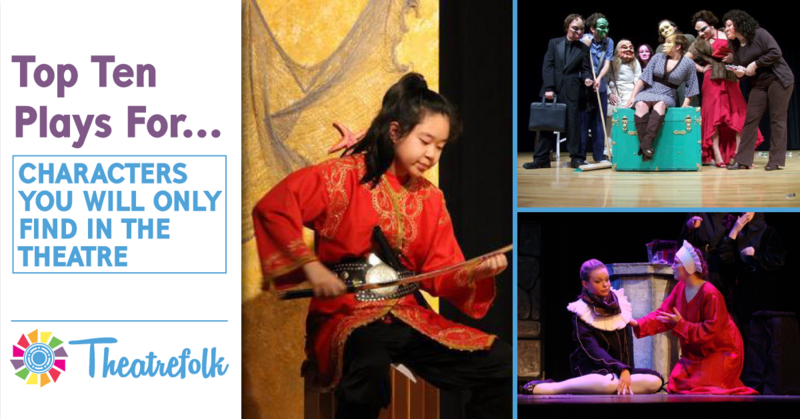
Theatrefolk’s Top 10: Characters You Will Only Find in the Theatre
Time for a Tfolk Top Ten Plays About…Characters you will only find in the theatre. You want unique characters for your students? We got them! Cat hair, archetypes, Shakespearean, and a severed head just to name a few. Read one, read them all!
Click the link and you’ll be taken to the webpage for each play. There you’ll get the details and read sample pages.
All the best with your search!
Inanimate
Ani talks to the inanimate objects in her life and they talk back. It all seems friendly and fun at first. So why is Ani writing hate texts to her friends? Why does she let the objects control her? What if feels she can’t leave her room anymore?
Characters: The inanimate objects in Ani’s life
Floating On A Don’t Care Cloud
Jamie Peel is a pothead. He lives in his own world, a bubble, a cloud that calls his name and reaches out to him. His sister TJ has watched him slowly drift away and doesn’t know what to do. An emotional tightrope.
Characters: Marijuana is personified by a cloud of 7 characters.
To Kill a Mocking Birdie
Birdie would like you to meet her parents: a goldfish and a moldy piece of bread. You may also meet What, When, Alexa (who’s hiding in the bathroom) and Birdie’s sister Scoot, who thinks she’s a glazed Virginia Ham. It’s a perfectly crazy dinner party. Consider this your invitation.
Characters: Everyone is Absolutely abnormal
Lose Not Thy Head
Joan pleads for life, Death waits for death, a severed Head says beheading isn’t so bad, a doctor tries to convince everyone that you can’t sew a head back on a body, and then things get weird. Shakespeare, Monty Python, a little love, a little death, a lot of laughs and a talking head.
Characters: Death. A freudian Doctor. A severed head. Shakespeare’s sister who’s impersonating Shakespeare.
Censorbleep
The Bleep Bleep Girls are the greatest group in school. They know what’s best. And when students try to stand up for themselves, or don’t do the “right” thing, they get dealt with.
Characters: Teenagers are turned into garbage and disappear.
Postcards From Shakespeare
Shakespeare has writer’s block. He pleads to the one person who can help him – Queen Elizabeth the First who sends Shakespeare around the world in 30 minutes. Denmark! Venice! Egypt! Join his whirlwind tour as he desperately searches for material.
Characters: Shakespeare. Shakespeare’s Characters. Elizabeth the first.
Myth-o-logues
Cassandra is here to be your Greek mythology tour guide. She’ll lead you through stories of war, relationships and the origins of good and evil. Pick and choose from this must-have collection of monologues.
Characters: Greek Mythology’s greatest
The Dread Playwright Sadie
Sadie wishes to leave her life on the high seas to pursue her true passion: theatre. But there’s a problem. She’s not just Sadie; she’s The Dread Pirate Sadie, the most feared pirate in all the land. And there’s another problem. She’s a horrible pirate.
Characters: Pirates. And Playwrights.
The Absolute Insidious and Utterly Terrifying Truth About Cat Hair
Cat hair is infinite. It is the secret driving force behind business and politics, and is plotting the downfall of humanity even as we speak. Unbelievable? Find out for yourself in this hilarious, insidious and utterly terrifying tale…
Characters: Lint Roller, Granola Bar, Masking Tape, and of course, Cat Hair.
Emotional Baggage
Seven strangers meet in a train station. Instead of luggage, they all carry their “emotional baggage.” This unique play is based solely on action and has no dialogue.
Characters: All the characters in this play are archetypes: Dead End Job, Living in the Past, etc.
Production
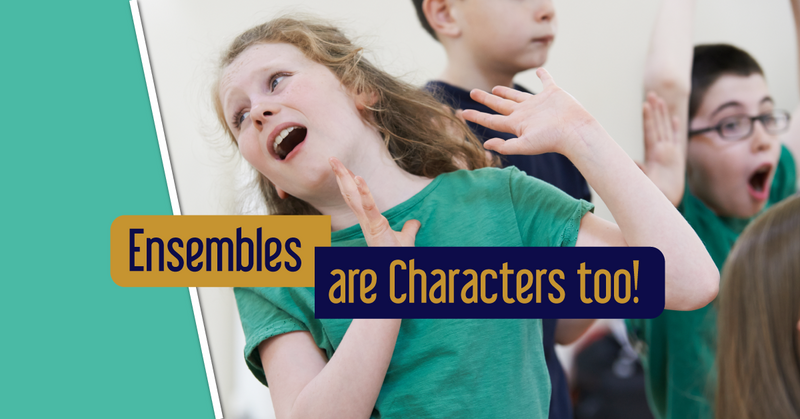
Ensembles Are Characters Too!
If you are working on a play or musical with a large ensemble, those actors can sometimes feel “less than” the named characters or the leads. I’m just in the ensemble. I don’t matter. You want to nip those thoughts in the bud. If your actors feel unworthy, that will lead to them giving lackluster performances, or worse, missing rehearsals and eventually dropping out of the production altogether.
Give ensemble actors character development opportunities. Even unnamed ensemble members can be three-dimensional characters that connect with the audience members sitting in the back row of the theatre.
Character ProfileA character profile gives an actor a document to refer to throughout the rehearsal process. It has all the information an actor needs for a character.
Traditionally, the character profile has a page of questions, personality traits, likes, dislikes, and memories. The actor fills it in with information from the script.
However, your ensemble may not even appear in the script. Or perhaps it’s made up of “Townspeople,” “Pirates,” or “Ladies in waiting.” Sometimes there is no information in the script for them to use in their character profile.
That’s perfectly OK. Not only can every member of the ensemble fill out a character profile, it’s going to be easier for them than for the leads.
Why? Because every single character detail comes from an actor’s imagination. They come up with their name, family background, occupation, and where they live. They don’t have to stick with the details the playwright gives them, but can come up with their own details.
There are boundaries, of course. The characters they create have to fit within the world of the play. For example, if you’re playing a Shark in West Side Story, it wouldn’t make sense to have the name Nostradamus and live in a spaceship. But other than that, the sky’s the limit.
Enter, Sit, ReactHere’s an exercise that your ensemble can work on by themselves. It also works as a great warm-up. It’s going to help your ensemble establish a physicality for their characters. Often, the ensemble members simply walk, pose, and gesture like themselves. They don’t have a designated character and perhaps the director hasn’t given them the tools to create one. Along with a character profile, you want your ensemble members to think about the physicality of their characters.
Put a chair in an empty space. Have actors enter the space one at a time, as if they are entering a room. They enter, move across the stage, then sit in a chair. Remind them that they have to stay in character while doing each of these actions.
Once they sit, the character realizes they forgot to do something. So they stand and exit.
Each step must be done with a specific physicality. For example, if they are playing an older character, that’s going to affect the way they sit and stand. Students can incorporate the details they come up with in the character profile into this exercise.
Start Here, End There, Carry ThisHere’s an exercise that will save you time staging ensemble scenes and help actors keep their character in mind.
Look at a scene in the play you’re working on that requires the ensemble to enter and end up in a certain place (i.e. on a riser or downstage left). You’re going to decide three things:
• Where the ensemble enters from (stage right, right, or audience)
• Where they end up
• What props (if any) they bring with them
This defines where they start, where they end, and what they’re carrying.
Send the ensemble off to another room. They’re going to do an exercise on their own before you see them on stage again. They have the basics – start here, end there, carry this. But what they’re going to do together is share and discuss their moment before as characters. What’s going on in their lives as they come onstage? Where are they coming from? They’re not coming from stage left, right, or the audience. They have to think about their lives in the world of the play. Are they coming from their homes? Are they coming from work? Are they coming from a fight? Are they coming from a date?
Tell the ensemble to pair up or form small groups of 3 or 4. Have them create the story of where they’re coming from, where they’re headed to, why they have those objects, and (most importantly) why they stop onstage at this exact moment. Why here, why now? Have them identify the relationships within their group. Who are they to each other? Remind students they won’t have words to communicate that story to an audience. They’ll have to show the story with action, as they enter and move to their designated spot.
There should never be a movement on stage that isn’t motivated by something. So an actor needs to fill in the details of the basic actions of arriving onstage and stopping. Where are they coming from? Where are they headed to? Why are they stopping here? Who are they with? Every member of your ensemble needs to answer these questions.
Once they’ve answered the questions, have them rough out the staging that gets them to those positions. Have them enter and make their way to their designated spot while “telling” their story without words. Remind students to not forget their physicality. Let them do this on their own and present it to you.
After the students present, you now have something you can shape, as a director. You have a visual story. You’re engaging your actors and encouraging them to make choices that fit within the world of the play. You’re focusing their movements toward the ultimate goal: a stage full of life and story. And furthermore, your ensemble has played an active part in achieving this goal. They weren’t just told to “go downstage and stand there.”
Classroom Exercise
Nine Questions Actors Needs to Ask Themselves
Uta Hagen held a lot of influence in 20th century American Theatre. She made her Broadway debut in 1938 in Anton Chekov’s The Seagull. She also acted against Marlon Brando in A Streetcar Named Desire. She also originated the role of Martha in Who’s Afraid of Virginia Woolf? Uta taught for years at the Herbert Berghof studio in New York. She instructed many well-known actors including Jack Lemmon, Matthew Broderick, and Al Pacino. She wrote two books on acting: Respect for Acting (1973) and A Challenge for the Actor (1991). When it came to the craft and technique of theatre, her career encompassed the four roles of actor, director, teacher, and writer.
In Respect for Acting, Uta identified 9 questions an actor should ask themselves as they prepare. It’s all about being as specific as possible. (Note: She reframed these questions into six steps in A Challenge for the Actor.)
1. Who am I?
Who is your character? Identify all the details: name/age, physical traits, education, personal opinions, likes, dislikes, fears, ethics, and beliefs.
2. What time is it?
The year, the season, the day, the minute. What is the significance of time?
3. Where am I?
Identify the country, the city/town, the neighborhood, the building, the room or the specific area of the room.
4. What surrounds me?
What is happening in the environment around you? Weather, landscape, people, animate/inanimate objects?
5. What are the given circumstances?
Identify events in the past, present, and future. What has happened, what is happening, what is going to happen?
6. What are my relationships?
This is more than your relationship to other people. Think about your relationship to objects, characters, and events.
7. What do I want?
What do you want immediately? What does the character want overall?
8. What is in my way?
What are the obstacles to getting what you want?
9. What do I do to get what I want?
What actions do you take (both physically and verbally)? What tactics?
These questions will give students a comprehensive list to follow with their character development. Start students off by having them answer these questions about their own life and then identify the answers for any character work they do.
Acting
Dealing with Difficult Characters: 3 Tips for Success
Student actors are frequently cast into a role that is totally outside their comfort zone. They might have to portray someone completely different than themselves, with radically different beliefs or ethics. Characters often make actions that make actors cringe – anything from fighting onstage (when they’ve never picked up a sword in their life) to kissing someone (when they barely know their scene partner). Their character might be much older or younger than them, from a very different social class or background, or deal with problems that the student might have never even thought of.
Teachers, if you are working with students and you notice that they are having trouble dealing with difficult characters in class or in the show they’re working on, here are three tips that speak directly to students which can help alleviate their concerns.
Tip 1: Remember that you were cast into this role for a reason.There are a multitude of reasons why your teacher or director cast you into the role you’re playing:
• To challenge you.
• To give you experience playing a character you don’t normally get to play.
• To push you outside of your comfort zone.
• To improve your acting skills.
• To give you insights on a character that is very different from you.
Your teacher has faith in your skills; otherwise, they wouldn’t have cast you into the role. They feel you can handle it. Believe them!
Tip 2: Speak up — sooner, rather than later.Talk to your teacher or director. If it’s something morally, ethically, or safety-wise that you have an issue with, you need to talk to your teacher immediately — preferably before you rehearse the scene. Be prepared to clearly express your concern, and why you’re concerned. It might be possible to make an accommodation – for example, if it’s a stage combat move that you feel unsafe doing, maybe the choreography could be changed to make it safer.
If what you’ve been asked to do is not morally objectionable or unsafe, just embarrassing to you – still speak up! If your teacher doesn’t know about your concerns, then they can’t do anything about it. If you wait too long to say anything, it will be too late. Your teacher may be able to adjust the scene, but know that they may not be able to, or won’t. You may have to suck it up and do it, or risk being removed from that particular scene or re-cast into a different role.
Tip 3: Your character is not “you.”Remember: it’s called acting! Your job as an actor is to portray the character you’ve been cast to play. Remember that it’s not “YOU” up on stage, it’s “Romeo” or “Miss Jackson” or “Kate.” Separate yourself from your character. Your character is the one expressing their thoughts and completing the tasks that help them get closer to their goals, not you. Your friends and family coming to the show are not reacting to you, they are reacting to the situations your character is in.
Make a list with two columns. On one side, write your character’s name. On the other side, write your name. Under your character’s name, write down thoughts, traits, and actions that the character does. Then under your own name, write down how you would react if you were in the same situation, or your thoughts, traits, and actions in comparison to your character’s. Are they similar or different? Most likely, a challenging character will be different from you, and that’s the point!
Above all, be brave. There are so many people who wouldn’t even dream of walking out on a stage, let alone memorize lines, sing and dance, or have to do something embarrassing up there – in front of an audience, no less! In taking a drama class, auditioning for a play, or performing in a competition, you are an actor and you have already made a major achievement by putting yourself out there. So take the next step! Push yourself outside of your comfort zone, trust your skills, and (as Nike’s slogan says) “just do it!” Believe me, you will impress everyone with your dedicated performance!
Acting
To Research or to Not Research?
As an actor, character research is part of your job. Doing research gives you the foundation and background to help make your character believable to an audience. Research helps you understand a character fully in terms of why he/she does the things they do and thinks the way they think.
What should you research for your character? Where do you start?
Start with the scriptThe script is your ultimate tool for starting the research process. Go through the script page by page and make notes about your character. Circle or underline important information/clues about your character: actions, thoughts, stage directions, and lines (both spoken by your character and spoken about your character by others). Put a star next to ideas you want to explore with your director/teacher, or concepts you don’t understand. Those are things you’ll want to research further.
Start with source materialsIf your script is an adaptation or based on a previous work (like a book, film, television show, or comic), find the original source and study it. For example, there are many stage versions of the famous protagonist Alice from the book Alice’s Adventures in Wonderland by Lewis Carroll. Theatrefolk even has one! It would be useful to read the original story, then compare and contrast it with your version. Perhaps your production will be similar to the original, or perhaps your director will have a totally different concept and approach! (For example: Alice doesn’t necessarily have to wear a blue dress and white pinafore.)
Start with previous productions/performancesThe internet is your friend. Look at photos and videos of previous productions. If you’re performing a musical, listen to previous cast albums, if they’re available. Read interviews by actors who have previously played the role – what are their thoughts? How did they approach the role? Use caution when looking at previous productions – don’t let someone else’s performance influence your own. It’s great to look for inspiration, but remember that your performance will be different (because it’s YOU performing the role!).
Start with real-life situationsIf your show is based on real events, you will definitely want to research those real events. For example, if you are working on a show like The Diary of Anne Frank or The Laramie Project, you will want to learn more about the real people that inspired those productions (i.e. Anne Frank and Matthew Shepard, respectively).
It is also extremely useful to research the time period that your show is set in. Look at historical events, the economy, political leaders and events, and fashions and trends during that time period. How did those events affect what life was like for your character? How does that time period compare to your contemporary life right now? Researching the time period will help you understand why your character might use a kind of slang, refer to a product or person you aren’t familiar with, or dress a certain way. This type of research will help you avoid anachronisms – something that is not in its correct historical or chronological time (like an MP3 player in the 1960s). The most common anachronism I usually hear in productions is actors saying “OK” or “Yeah” when they should be saying “Yes”!
Start with things that directly affect your characterThere are many “things” that may be unfamiliar to you which can affect your character. For example:
• Illness or a disability. If you’re working on Rent or The Normal Heart, you’ll want to research HIV/AIDS. If you’re working on The Miracle Worker, research blindness and deafness.
• A talent or skill. In Billy Elliott, the title character is a talented ballet dancer. In Robin Hood, the protagonist is a skilled archer and quarterstaff fighter. You may need to take lessons or classes to learn your character’s skill and perform it proficiently.
• An accent or different language spoken by or to the character. You may need to seek out a dialect coach. You could also watch YouTube videos!
• A different way of moving. For example, you might be playing an animal – how does a gorilla move? A rabbit? A bear? A snake? Watching documentaries or YouTube videos might be helpful.
If you are not familiar with the “thing” that affects your character, doing research will help you to understand it and perform it more accurately.
Kerry Hishon is a director, actor, writer, and stage combatant based in London, Ontario, Canada. Check out her blog at www.kerryhishon.com.
Classroom Exercise
What Does My Character Want?
Figuring out what your character wants will help you add depth and interest for your character, making them more realistic and believable. A character that doesn’t want anything is a boring character. Having a want, wish, goal, or desire will push your character throughout the show – what do they want and how will they go about achieving it?
The following series of questions will help you figure out exactly why your character is in the scene and what they want. Go through your script and make notes while you’re thinking about these questions. The script will give you clues and information about what your character wants. For each question, note what it was in the script that gave you that information. List the page number and/or the line number in the script, for you to refer back to. It could be a line spoken by your character, a line spoken by another character, a stage direction, or something else.
If you can’t find proof in the script, you may wish to brainstorm some ideas about your character and what they want. Talk to your teacher or start a class discussion to get more ideas and insights!
The following written exercise consists of three sections. You may wish to use just one or two of the sections for your character analysis. You might decide to use just one or some of the questions. The questions will help you start thinking about your character and raise more questions to explore in class.
Overall Analysis1. What does your character want? What is their wish, goal, or ultimate desire?
• This should be big – it’s the reason your character exists in the show.
• Why is your character essential to the story?
2. How do they attempt to achieve their wants? What actions do they take to achieve their goals?
3. Why does your character want what they want? What pushes or drives them?
4. Does your character end up getting what they want? Why or why not?
5. How does your character grow and change from the beginning of the show to the end?
Changing What You Want1. Does your character’s want stay the same throughout the show, or does it change?
2. If your character wants change, what causes the change?
• Does something happen directly to the character to cause the change?
• Does another character influence your character?
• Does your character make a choice to change?
Influencing Others1. Does your character’s want influence other characters’ wants?
2. Does your character help or hinder other characters’ attempts to achieve their wants?
• Does your character know or realize that fact?
• How does that make your character feel?
• Does that help your character get what they want?
That’s a lot of questions, isn’t it? But asking these questions will get you thinking about your character. Will they get what they want? You’ll have to wait and see!
Kerry Hishon is a director, actor, writer, and stage combatant residing in London, Ontario, Canada. Check out her blog at www.kerryhishon.com.
Acting
5 Tips for Physicalizing a Nonhuman Character
Are you playing Puck in A Midsummer Night’s Dream? One of the seven deadly sins? A banana in an improv scene? A god in a Greek myth? The Lint Roller in The Absolutely Insidious and Utterly Terrifying Truth About Cat Hair?
One of the best aspects of theatre performance is that if the actors on stage believe what and who they are presenting, so will the audience. Audience members will suspend their disbelief when they see a talking cat or a piece of baloney come to life on stage. Theatre is the perfect playground for nonhuman characters.
Student actors find it challenging to depict nonhuman characters because of the physical component. It’s hard for student actors to get out of their decidedly human bodies. As a result, nonhuman characters often end up looking human.
Here are the top 5 tips for playing nonhuman characters:1. Find a different level
2. Find a different shape
3. Get a little uncomfortable
4. Change your natural rhythm of movement
5. Don’t neglect the character’s background
1. Find a different levelStudent actors often occupy space at a medium level. They stand and move on stage the way they do in their regular life. They don’t think about incorporating a variety of levels into their character building. A different level will help them to visually identify a nonhuman character. Ask students how their character occupies space and how it’s different from their own choices. Encourage students to explore levels outside the day to day. Have students kneel or crouch down for a medium low level, or get down flat on the floor and try to move without using arms and legs. Have them run on their tiptoes or stand on the furniture to explore a high space. Push them out of the norm and encourage them to make choices that are out of their comfort zone.
2. Find a different shapeStudents’ bodies follow pretty straight lines (albeit with a bit of a standard slouch). They keep their limbs close to their body and their legs and arms stay straight. They walk one foot after the other in a line. Get students thinking about the possibilities of different body shapes. Have them bend elbows and knees. Raise one shoulder up to their ears. What is the identifying shape for this nonhuman character? Can you you make your body a circle? A triangle? Once students have defined their character’s body shape, ask how they can incorporate shapes into their movement. Does this character roll? How can you roll with your gait? If this character’s defining shape is a triangle with the legs spread out wide, how does that affect your walk?
3. Get a little uncomfortableStanding and moving in a different shape at a different level by its nature is going to be uncomfortable for students. They’re going to want to revert back to their normal ways. Practice holding an uncomfortable stance. Have students discuss how it feels. The goal is not to shy away from new body shapes but to learn how to embrace discomfort. It could be a series of stretches afterward. It could be setting a 10 second limit for the hold and increasing the time over subsequent classes. It could be defining two poses for the character and creating a transition between the poses that releases any tension.
4. Change your natural rhythm of movementThere are so many options when creating a movement rhythm for a character. You can speed up or slow down. You can combine the two in a quick, quick, slow pattern. You can create imbalance in your rhythm by walking on the inside of the left foot and the outside of the right foot. You can drag the left leg behind in a limp. Before asking students to define a rhythm of movement for their nonhuman character, have them practice possible ways of moving. Start students moving at a 1 (where 1 is slower than a turtle and 10 is all out running) and play with speed. Have students walk on their toes, their heels, and all points in between. Get them to walk with their feet close together and far apart. Encourage students to move as differently than their natural rhythm as possible.
5. Don’t neglect character backgroundDefining the physicality for a nonhuman character doesn’t stop with the body. Character details can influence physicality. Sometimes students assume they don’t have to come up with the same details as they would with a human character. The answers certainly won’t be the same as they would be for a human character. Who would make up the family of one of the seven deadly sins? What would Greed’s pet peeve be? What would Sloth’s favourite food be? Identifying character details gives an actor more to work with and that’s essential for a nonhuman character. You don’t want to present a novelty piece. A nonhuman character needs to be as three dimensional as any other character. Once students come up with these details, ask “How can these details be incorporated into your character’s physicality?”
The more they practice different physical choices, the easier it will be to create a nonhuman character.