đŁSCRIPT SALE! Treat yourself to an easier Fall. Save 30% on 5+ perusal scripts with code SPRING30 before May 3 and head into summer stress-free.
Choral Work
Production
Picture-Perfect Poe: Shuddersome: Tales of Poe
Looking for a way to bring the works of Edgar Allen Poe to life? Shuddersome: Tales of Poe by Lindsay Price is a vivid and theatrical adaptation of some of Poeâs best known works.
The thumping of a heartbeat. The creek of a door. The howl of a bitter wind. The gong of a clock tower. The clang of alarm bells. The sound of beating wings getting closer and closerâŚ
Specters, ghosts and ghouls come alive in this vivid theatrical adaptation of some of Edgar Allen Poeâs best-known works. Included are The Tell-Tale Heart, The Raven, and The Masque of the Red Death.
Poeâs words rise from the page like corpses from the grave. Be careful. Do you hear that tap, tap, tapping?
Multi length versions to fit every performance need.
Sarah Hankins of Clinton High School in Clinton, MS was excited to share the success of her drama students who were nothing short of âPoe perfectionâ. Not only did they win Best Overall Costume at the North Mississippi DramaFest and the Mississippi Theatre Association, but check out these amazing set pieces!
The clock was a student designed piece that shows the evil eye that appears in the grandfather clock, and the face of the clock that opens for Death to enter through. An amazing set piece!
Featured Plays
Picture Perfect Poe: Shuddersome: Tales of Poe
If youâre looking for a great adaptation of some of Edgar Allen Poeâs best-known works, then look no further than Shuddersome: Tales of Poe by Lindsay Price.
Specters, ghosts and ghouls come alive in this vivid theatrical adaptation, which includes The Tell-Tale Heart, The Raven, and The Masque of the Red Death. Multi-length versions of the script to fit every need.
Under the direction of Nelson Berry , the drama group at Montgomery Bell Academy in Nashville, TN brought these mysterious, dramatic adaptations to life, creating a strong production from a strong ensemble:
âI really enjoyed directing and putting together my schoolâs production of âShuddersome.â My colleagues and I really love the script, both for its helpful notes and also for the different styles of each scene.
Honestly, I was considering the show solely because of âTell-Tale Heart,â and reading âOval Portraitâ cemented my decision. I used an ensemble of 16 actors, assigning 2-3 roles to each person. We had a few rehearsal challenges, but ultimately the show came together well and we all loved the final product.â
Featured Plays
Theatrefolk Featured Play â Ariadneâs Thread by Judith White
Welcome to our Featured Play Spotlight. Itâs time to bring Greek mythology to life! Ariadneâs Thread, the Adventures of Theseus and the Minotaur by Judith White is a fantastic modern version of Theseus and the Minotaur, complete with an active chorus.
âThe threadâs on the spool,
The spoolâs wound tight,
You must feel it in the dark, cause there is no lightâŚââ
Theseus is a young man on an adventure. As he makes his way to Athens to meet his father he must fight bandits, carnivorous pigs, and travel the underworld.
He offers himself as tribute to rid the land of the murderous minotaur. But the story isnât as simple as it seems. King Minosâ daughter Ariadne is willing to help, but only if Theseus promises not to kill the minotaur. How will Theseus get out of the labyrinth alive?
Why did we publish this play?
There is a reason that Greek myths have survived the test of time. They have great stories and great characters. Ariadneâs Thread is no different.
While telling a story that is as old as time (Theseus meet Minotaur, Minotaur meet Theseus) Judith has crafted a play that is not your every day retelling of this myth. This is a fantastic modern version with a very active Greek Chorus. Do you have a unit on choral speaking? Read this play, now.
Letâs hear from the author!
1. Why did you write this play?
I have been intrigued by Ariadne, the Minotaur, and Theseus since I was a teenager. As I researched the story, finding many different versions of the myth, I found myself thinking about the Minotaur â how he was deserted and alone, and condemned to the depth of the labyrinth. My mind teemed with questions. How would he feel? Who else, among those young actors performing the play, might feel abandoned and alone, deserted by family, bereft of friends? What makes Asterion strike out and kill? And what about his half-sister, Ariadne? And Theseus, his half-brother by Poseidon? I was intrigued and informed by the questions â the human questions â surrounding the myth.
2. Describe the theme in one or two sentences.
Theseus follows his destiny, listens to an inner voice, and Ariadne, whose powers have deserted her, regains her creativity and her own voice. Together, they transform Asterion, discover his source of anger, and release him to the sea. They all risk going deeper into their emotional selves â as do actors.
3. Whatâs the most important visual for you in this play?
I enjoy Theseus trip beneath the sea. Also, the confrontation between Theseus and Asterion, the Minotaur when we learn why the Minotaur is so angry: one child is preferred by his father, Poseidon, and we see the results in the neglected child, Asterion.
4. If you could give one piece of advice for those producing the play, what would it be?
Work as an ensemble; enjoy creating the chorus and the varied characters, small and large.
5. Why is this play great for student performers?
All the myths have eternal lessons. This one is about emotions, hidden deep in the labyrinth of our souls, which may erupt in negative ways. It also speaks to the transforming power of love â and the heroâs quest, involving great risk, wit, and inner strength. There are parallels in the brother/sister/half-sibling relationships. And the play has humor too, to balance the serious stuff. Lots of juicy characters. (Not just the pigs- the Crommyon Sow. )
Featured Plays
Life Lessons Learned: Hoodie
Middle schoolers face a tornado of questions every day. What do I wear? What if I wear the wrong thing? What is she wearing? What do I look like? Stop looking at me!
Hoodie by Lindsay Price examines image and appearance in the vignette style and poses what may be the most difficult question of all â Do I stay in the clump or do I stand alone?
The drama students at Washington Jr. High School in Manitowoc, WI asked and answered these tough questions in their performance of Hoodie. From the first read-through to the set design to opening night, it is obvious that this was a true labour of love.
Not only were the students able to gain experience and insight into the theatrical process, but they were able to truly relate to the theme and messaging throughout the play:
âYou should learn how to be an individual and do what you want to do in your life.â
âYou donât always have to be in a certain group. Just be yourself. Be unique.â
Featured Plays
A Symphony of Sound Success: Stressed
A symphony of sound. A symphony of character. Vivid themes. Vivid characters. Stressed by Alan Haehnel is a true theatrical experience for any drama students looking for a bit of a challenge and a whole lot of fun.
For Alex, itâs school. For Josh, itâs his girlfriend. For Carmen, itâs dealing with her coach. And Mindyâs frustrated with her parents. Stress is driving this quartet crazy â so much so they canât stop talking about it.
This play is a symphony of sound and character. A challenging but incredibly fun piece.
The incredibly talented group of student performers that make up the Stromness Drama Club off the northeastern coast of Scotland in Orkney , didnât stress at all about their production of Stressed. In fact, they thrived!
âEvery year we try to put on a youth production as part of the Scottish Community Drama Associationâs one-act play competition. This year we were fortunate (or good!) enough to win the youth trophy and also to come 3rd overall. We also won the Northern Divisional Youth Final and will be competing at the Scottish Finals as well.â
Featured Plays
Stunning Success: Shuddersome: Tales of Poe
Do you hear the tap, tap, tapping? The thumping of a heartbeat? The creek of a door? The sound of beating wings getting closer and closerâŚ
In Lindsay Priceâs vivid and theatrical adaptation Shuddersome: Tales of Poe, ghosts and ghouls in some of Edgar Allen Poeâs best known works come alive.
Drama teacher, Shannon Boatwright , shared how the student group at Chapin Middle School (Chapin, SC) had the audience shaking in their seats with their unique and visually stunning interpretation of Shuddersome:
âI can say that as a producer/director, this show has truly been one of my favorites. Our experience and take on your incredible script of Shuddersome was an enormous success!
I am a music lover and dancer, so I incorporate music and dance into pretty much every show that I do. I love to feature the awesome & many talents of my students! So, our version of Shuddersome not only featured my stars singing and dancing, but also performing sign language. It all worked beautifully and really was an incredible adventure for myself and my 40 honors 8th grade students at Chapin Middle School.â
Featured Plays
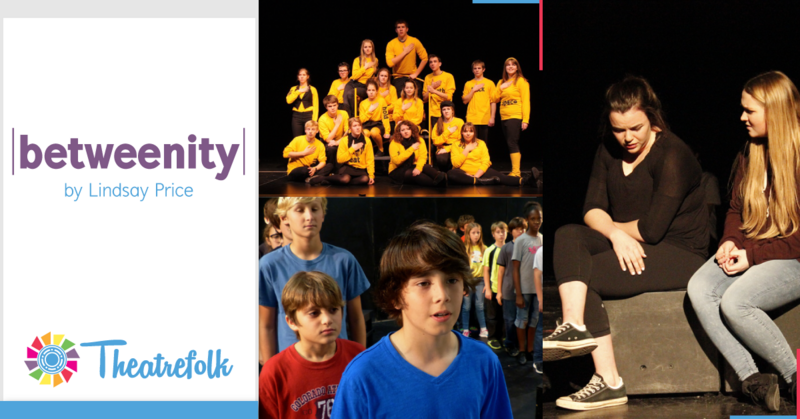
The Power of the Pause: betweenity
Sometimes itâs not the words themselves but the spaces between them that say the most. In the vignette play betweenity by Lindsay Price students have a chance to explore the beats, pauses and neverending silences in conversation. It sounds easy but are you up to the challenge of the âawkward pauseâ? This is an excellent class project play with parts for everyone at all levels with a great technique exploration. Charlie McMeekin and the drama students at The Sharon Academy in Sharon, VT fine-tuned their techniques and learned that silence can be awkward⌠and golden.
âMy student director expanded the concept of the silence between words using a warm-up where we stood in a circle and tried counting to twenty, one person randomly at a time. If two spoke at the same time, we returned to zero. Only when we began to âfeelâ the silence did we make it to twenty. On performance night at our regional festival, the cast was pretty wound up. Before performing, our warm-up was this same exercise, despite strenuous objections from the cast. It worked to calm them down, however, and focus them. . . and we counted to 20!â
Congratulations, Sharon Academy!
Featured Plays
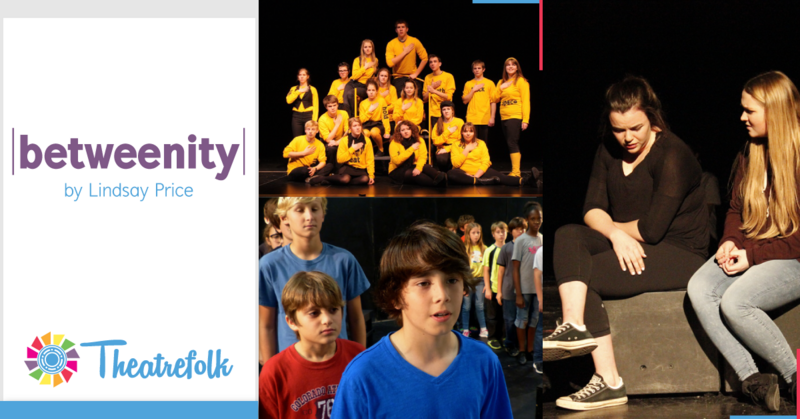
Theatrefolk Featured Play: betweenity by Lindsay Price
Welcome to our Featured Play Spotlight. Today we look at betweenity, a vignette play that explores the beats, pauses, and never-ending silences in conversation. The girl who tries to tell her best friend she wants to date him. The boy who creates the wrong kind of pause. The sister who is dealing with the silent treatment. The guy who wants to confess but canât open his mouth. The daughter who doesnât want to talk because talking makes her remember.
Weâve all been there. The awkward pause. The silence where you just canât think of something to say. The space in-between words where nothing is said and yet so much is spoken. The state of being between. This is an excellent class project play with parts for everyone at all levels with a great technique exploration. How do you act in a pause?
Why did we publish this play?
Okay I have to take my writer hat off now and put on my publisher hat. Goodbye writer Lindsay, hello Publisher Lindsay! Vignette plays are a staple here at Theatrefolk. Itâs one of the reasons Writer-Lindsay writes them. :) They work well with classes and with beginner groups â the small scenes are excellent primer grounds for moving toward one-acts and full lengths. With betweenity there is a little bit more work involved than just short scenes â thereâs learning the skill of acting in the pause. Students are not just putting together something fun, theyâre exploring a communication skill. What is communicated when there isnât any dialogue? Itâs an added bonus.
Letâs hear from the author!
1. Why did you write this play?
Before writing the play I had been working with a group of students who were having difficulty with pauses. They didnât want to take them. They didnât want silence on stage. That issue was eventually solved, but the thought never left me. What if I wrote scenes where the pause (or the beat or the long, long silence) was the focus? That started the ball rolling and betweenity is the result.
2. Describe the theme in one or two sentences.
Itâs not whatâs being said thatâs important sometimes. Itâs the space in-between.
3. Whatâs the most important visual for you in this play?
The opening. Itâs done almost in silence, so itâs all visuals. Most of the actors have to stand, look at the audience, and wait. Itâs unnerving, but it sets up the whole play.
4. If you could give one piece of advice for those producing the play, what would it be?
Love the pauses! Practice the pauses. Figure out the timing of the pauses. Get comfortable with silence, even when the audience is uncomfortable. I would also say, to keep in character during the pauses. Itâs not the actor who has stopped talking but the character. What does that mean? What are they thinking in the silence? Have your actors come up with own their inner monologue, especially with the longer pauses. The acting doesnât stop when the lines do.
5. Why is this play great for student performers?
Learning how to act in a pause is a fabulous exercise. But on top of that, this is an ensemble piece with a lot of immediate character work. Because itâs a vignette play characters have to come to life immediately within their short scene. Another fabulous exercise for students.
Featured Plays
Ancient Greek Tale With a Modern Twist: Pandoraâs Fire
You may know the classic story of Pandora and her curiousity, but do you know the whole story? Drama teacher Kate Olena and the talented group of student performers at Nichols Middle School in Buffalo, New York took on Theatrefolkâs classical adaptation, Pandoraâs Fire, by Judith White that left their audience not only entertained but asking some big questions. Kateâs admin sent out the following email after seeing the production.
ââŚ.The story asks us to consider design and purpose. How did we get here? Why are things as they are? Who is responsible? We are also asked to consider the role of scapegoats and whether or not they deserve the distinction. Finally, we must also consider our own complicity. As always, things are rarely clear, but perhaps one of the many benefits of the arts is that they help us to understand ourselves and the times in which we live.
We are still wrestling with these questions, maybe especially so during this election season, and I can think of no one better to guide our students than all of you who are wise enough to take the long view and confident enough to consider multiple perspectives.
Thank you Kate for inviting these important questions, and thank you all for dazzling the world with your light.
Burn, burn Pandoraâs bright fireâŚâ
Great job, Nichols Middle School!
*Photo credit: Tom Maynor
Featured Plays
A play in pictures: Agatha Rex
Because I live in a small corner of Canada and my plays are often performed far away from me, I donât get to see many productions. So I love it when a director or a teacher reaches out to let me know what they did with a play and how it went. Stacey Meisetschlaeger from Texas recently directed Agatha Rex with her middle school and had great succeeds with it.
Featured Plays
Spread the Love: Drum Taps â adapted by Lindsay Price from Leaves of Grass by Walt Whitman
This week on Spread the Love we talk about Drum Taps â adapted by Lindsay Price from Leaves of Grass by Walt Whitman. Filmed live on location at Old Fort Erie.
Featured Plays
Theatrefolk Featured Play: Drum Taps, adapted by Lindsay Price from Leaves of Grass by Walt Whitman
âThe poems in Drum Taps represent Walt Whitmanâs firsthand account of the Civil War. See the words, the emotion, the blood come to life in this theatrical adaptation. This is not your traditional readers theatre or poetry recital. This is flesh and bone words breathed to their fullest humanity. This is struggle and pain. This is confusion and contradiction. This is war.â
The primary danger in theatricalizing a series of poems is that such adaptations tend to be static â they amount to not much more than a poetry recital with lights and costumes. Iâm not dissing poetry recitals, Iâm just saying that theyâre not inherently theatrical. By the way â can you believe âdissingâ passed my spell checker but âtheatricalizingâ didnât?
I wasnât quite sure what I was expecting when Lindsay told me she was working on an adaptation of Leaves of Grass, a collection of US Civil War-era poems written, modified and rearranged over an entire lifetime by Walt Whitman. I wasnât familiar with the poems at the time nor, being Canadian, did I have that much knowledge about the US Civil War. But my main concern was this: will it be theatrical?
I am proud to report that it is. Even just reading the script I could see the actors, hear the chaos, smell the gunpowder, feel the loss. I canât wait to see a production of this!
Two versions are included in the same book: A small cast version (5 actors â 2M+3W) and a large cast version (20 actors â 6M+14W) . The casting is very flexible, however, and is limited only by the directorâs imagination. Genders can be switched for many characters and the cast size can be expanded or contracted fairly easily. Both versions run about 35 minutes, ideal for most contest requirements.


.png)

.png)