đŁSCRIPT SALE! Treat yourself to an easier Fall. Save 30% on 5+ perusal scripts with code SPRING30 before May 3 and head into summer stress-free.
Costumes
Technical Theatre
Costume Organization & Storage Tips
If you have been blessed with a huge costume inventory, ample storage space, and a head of wardrobe to keep tabs on everything, feel free to skip this article. For the rest of us, keeping our costume stocks in order can feel like a full-time job. Implementing some storage systems and being very specific about what costume items you keep in your inventory can help immensely with keeping you organized. Read on for some helpful tips!
1. Be specific about what you store.No matter how large or small your storage area, there will always be a limit to the number of items you can store. Be aware of what you have in stock and reassess your inventory frequently. Youâll always be adding items as you do more shows, through purchases, donations, or sewing new pieces, so youâll need to leave some room in your stocks for growth. A yearly purge can keep your storage space looking good.
If youâre having trouble deciding what to keep and what to get rid of, ask yourself these questions:
⢠Does the item need repairing? Are you actually going to take the time and effort to repair it? (If an item is beyond repair, get rid of it!)
⢠Can you replace the item for less than $20? Can you easily acquire the item at a thrift store?
⢠Do your students have something like it in their closets? (This could be a basic costume item drama students should own, or their own clothes for shows set in modern time periods.)
⢠Have you used it in the last five years?
⢠Are you likely to use it again or is it super specialized?
For the last question, think about items like the Enchanted Objects from Beauty and the Beast, or the full-company set of band uniforms from The Music Man. Those costume items may be oversized and difficult to store, or there may be a large quantity of the items that takes up a lot of precious storage space. However, if you anticipate being able to loan costume items to other schools, it may be worthwhile to keep certain items in your stocks.
Check out the bottom of this article for a free giveaway: Does It Stay or Does It Go?
2. Keep like items with like.Rather than putting things away willy-nilly, separate your items in a way that makes sense. Store aprons in one box, neckties in another, shawls together. If you have a lot of items in a similar category, such as hats, break down your storage further â one box for baseball caps, one box for cowboy hats, one box for fascinators, and so on.
The same goes for hanging items. Put jackets with jackets, and gowns with gowns. Short-sleeved and long-sleeved shirts and blouses should be separate. How you organize items within each category is up to you. Some teachers like to separate items by colour; some prefer to put items of similar time periods together; some prefer to organize items by size. Whatever you decide, make sure that anyone who has access to the storage space (students, other teachers, volunteers, etc.) knows how to put things back properly.
3. Clear, labelled bins and hanging costume racks are your friends.If your storage space allows, youâll need two sections: one area for hanging items and one for bins and boxes. Items like gowns and jackets should be hung up, while items like t-shirts can be folded and stored in bins. A plastic rolling drawer unit is useful for small items such as jewellery, glasses and frames, and suspenders.
If your budget allows, invest in clear storage bins (much easier to see whatâs inside) and sturdy, non-slip clothing hangers. A basic closet bar can suffice for hanging storage, but a rolling rack allows you to move items around more efficiently.
Label EVERYTHING. Labels can be as simple as a piece of painterâs tape on the front of a bin labelled with a marker. For hanging items, you can divide sections using paper plates â cut a circle in the centre of the plate, as well as a vertical slit from the outside edge of the plate to the centre, and pop it on the bar. Or, you can get fancy with a Cricut machine or similar. Just remember: no matter how fancy your labels are, theyâre no good if people still donât know where to find an item.
4. Be selective about receiving donations.When youâre first building your costume inventory, you might be thrilled to receive donations from other schools, community theatre groups, dance companies, or families cleaning out their closets. However, there is no rule that says you have to keep everything.
It can take a lot of time to go through donation items, so make decisions as quickly as possible. Look back to the questions in section one when deciding what donations to keep. Immediately let go of items that are clearly the wrong size (for example, donât keep child-sized items for a high school), items you already have duplicates of, and anything stained or dirty.
Bonus Tip: Put together a costume repair kit. A fishing tackle box is a good size. Add items like thread in various colours, sewing needles, scissors, safety pins, velcro, extra buttons, two-sided tape, a few measuring tapes, a seam ripper, and a stain remover pen.
Additional Resources:
Best Costuming Advice for a New Director
Common Costume Concerns
The Great Storage Struggle: What to Do With All That Stuff
Costume Care: Dos and Donâts
How to Effectively Communicate With Rental Sources
Classroom Exercise
Costume Challenge: Creative Creation
This costume challenge builds on the costume design skills that students practiced in two recent blog posts: Rehearsal Blacks, Elevated and One Item, Three Ways. Students will work in pairs to create a costume design using only found materials, such as construction paper, newspaper, toilet paper or toilet paper rolls, fabric scraps, duct tape, and so on â anything you might find in a craft supply box or recycling bin. Theyâll create a detailed, labelled costume sketch, and use the found materials to add colour, texture, and interesting features.
Then, if you have an abundance of materials and would like to take this challenge to the next level, pairs will use the found materials to make a human-sized costume. Some of the problems theyâll need to solve include figuring out how much of a material theyâll need to complete the costume, how to use the found items in a way that covers the body appropriately while still looking stylish, and how to make their costume actually stay together on a body.
Materials Needed:⢠Plain paper
⢠Pencils
⢠Scissors
⢠Glue
⢠A box of various found materials, such as construction paper, tissue paper, wrapping paper, newspaper, toilet paper and/or toilet paper rolls, fabric scraps, straws, yarn, tin foil, bottle caps, cotton balls, duct tape, leaves, and so on. If students will only be designing, youâll need a smaller container of materials. If students will also create real costumes from their designs, you will need as many materials as you can get your hands on! You might want to reach out to other school departments, local crafting communities, and/or students and their families to help acquire supplies.
⢠If students are constructing real costumes, they may need to access a basic neutral base garment to attach their materials to. (They also might come up with their own interesting way of constructing the garment and not need the base item.)
Instructions1. Divide students into pairs.
2. Each pair will select a person or character to design a costume for. The subject can be a character from a play or musical, or a character from popular culture (a book, movie, television show, comic book, etc.).
3. Each pair will create one original sketch of their characterâs costume. Students who arenât the most confident artists can do a search for âdesign figure templateâ or âblank costume template.â
4. Students will cut and glue the items from the found materials box to the sketch they made to show colour, texture, material choice, details, and/or accessories. Perhaps theyâll design a fluffy robe using cotton balls, a dress made of leaves and tree bark, or a suit made of wrapping paper, with a matching top hat and lapel flower decorated with gift bows.
5. Students will label all the parts of the design, indicating the different aspects of the costume and what the materials are. Be sure to note all details that are included, such as acorn buttons on the leaf dress, or glasses made out of pipe cleaners to go along with the cotton-ball robe.
As well, students must title their sketch with the characterâs name and what theyâre from (e.g., âAnnabeth Chase from The Lightning Thief: The Percy Jackson Musicalâ) and include a brief description of the outfit and its purpose (e.g., Cinderellaâs ball gown for Act 2 Scene 1, Harry Potterâs Quidditch uniform from The Chamber of Secrets, Lumiereâs human transformation outfit from the final scene of Beauty and the Beast).
6. Each pair will submit their completed costume design. Each student in the pair will complete and submit an individual exit slip response (found in the download below).
7. Optional Next-Level Challenge: Students will build a life-sized version of their costume design, using the same found materials indicated and used in their design. Both students in the pair will work on the design and construction of the costume. Students may want to use a neutral base garment (such as a plain t-shirt and pants) and attach the items to it, or they might come up with their own creative method of constructing the costume. Once they have constructed their costume, theyâll present it to the class, either live or by recording a video. One student will model the costume while the other student verbally presents and describes the design, the inspiration, and a breakdown of the materials used. (What kind and why? How much/many used?)
Classroom Exercise
Costume Challenge: One Item, Three Ways
In our last post, we challenged students to create elevated costume looks using only black clothing and accessories. This time, weâll have one costume item and challenge students to style it differently to create various looks. In short, how can students use one item in many different ways? This exercise is useful to show students how they can create different, interesting looks using very little. Going forward, students can use this experience to help them costume a show on a budget, because when you use multi-purpose items, you donât have to spend as much money.
This exercise works best with groups of three. Each student will get the chance to be the costume head, the assistant, and the model.
The exercise is done in three rounds. Youâll need enough costume items so each group has an item to work with. The colour and pattern of the items doesnât matter. For the first round, each group will need a large piece of rectangular or square fabric, such as an oversized scarf, a sari, a bedsheet, or a towel. For the second round, each group will need a large piece of clothing, such as an oversized hoodie, a long dress (preferably made of an easy-moving fabric such as cotton or jersey), or a similar oversized, billowy clothing item. For the third round, each group will need a pair of shoes with laces. Itâs up to you whether you keep the costume items a surprise or reveal them to the groups in advance.
Instructions1. Have each group determine who is Partner A, Partner B, and Partner C.
2. For the first round, Partner A is the costume head, Partner B is the assistant, and Partner C is the model.
3. Partner A will receive the first round costume item â a large piece of fabric. Over the top of Partner Câs clothes, Partner A needs to manipulate and style the fabric to create three different costume looks. They can fold, scrunch, wrap, twist, and otherwise manipulate the fabric to make different styles or items â just donât rip or cut the fabric. For example, the fabric might be tied around the modelâs waist to create a wrap skirt or beach coverup, tied around the modelâs neck to use as a cape, or wrapped around their arm or leg to use as a sling. As the assistant, Partner B is there to provide help and take a digital photograph of each look to submit to the teacher.
4. Once they have styled the fabric in three unique ways and taken the photographs, the group can neatly fold the fabric and return it to the teacher, and then move on to the second round.
5. For the second round, Partner B is the costume head, Partner C is the assistant, and Partner A is the model.
6. Repeat Step 3 with the second round costume item â an oversized hoodie, long dress, or similar large, billowy item. Again, no cutting or ripping the item. This round will be a bit different because, in contrast to the plain piece of fabric, the hoodie or dress will have a definite shape and different features, such as sleeves and pockets. For example, the hoodie could be worn as it usually is (as a shirt), tied around the waist for a casual look, and then tied around the neck for a preppy look. Students might fold the hoodie into a hat, using the sleeves to tie it to the modelâs head or create interesting details. The long dress might be shortened by tying knots around the edge of the fabric, or worn as a skirt or an off-shoulder dress with the bodice tucked down at various points on the body.
7. Once Partner B creates three different looks and Partner C photographs, the items are to be neatly folded or hung up, and returned to the teacher for the third and final round.
8. For the third round, Partner C is the costume head, Partner A is the assistant, and Partner B is the model.
9. Repeat Step 3 with the third round costume item â a pair of shoes with laces. This item poses a challenge because itâs unexpected and doesnât provide much coverage. If your students have played the theatre game Props, have them think about the shoes in the same way. Where on the body could the shoes be worn, other than on the feet? The shoes could be tied to the modelâs head like a hat or fascinator, worn on their hands like puppets, or worn as a scarf or necklace by tying the laces together and draping them over their shoulders. If students are stumped, how could they style the shoelaces in three different ways?
10. Once Partner C creates three different looks and Partner A photographs, they can return the items to the teacher. All group members will complete and submit an individual reflection (found below) as well as submit their three photos.
Classroom Exercise
Costume Challenge: Rehearsal Blacks, Elevated
If youâre working on a show with a tiny budget, one way many drama teachers have saved funds is by having student actors wear ârehearsal blacksâ onstage â plain black pants and long-sleeve shirts. These items create a neutral visual palette. Theyâre easy to find and buy, generally easy to move in, and they allow the focus to be on the studentsâ performance.
But rehearsal blacks donât have to be plain. Letâs elevate our rehearsal blacks and use them as a tool to enhance the play. The following exercise gives students the opportunity to consider how thoughtful and creative choices with rehearsal blacks can denote character, status, mood, atmosphere, and more. Students can complete this exercise by sketching, using online images to create a mood board, or using black clothing items that they own to create character looks.
Instructions1. Introduction: List and analyze various pieces of clothing and the words, phrases, moods, or feelings that each item conjures. Donât think about the colour of the items or items with logos; just imagine plain clothes for this section. Here are a few examples:
⢠Tops: tank top/muscle shirt, t-shirt, long-sleeve shirt, button-down, turtleneck, crop top, sweater, sweatshirt
⢠Bottoms: dress pants, yoga pants, leggings, jeans, skirts, cargo pants, capris, cutoffs/âjortsâ (jean shorts), sweat pants
⢠Shoes: sneakers, flats, heels, boots, flip flops, crocs, slippers
⢠Layering pieces: cardigan, hoodie, jacket, vest, bathing suit/coverup
⢠Accessories: hat, cap, belt, jewelry, scarf, bag/purse, hosiery/socks, tie/bow tie, hair accessories
⢠Miscellaneous: sports wear/uniforms, work uniforms, scrubs, military uniforms, suits, tuxedos, gowns, vintage/retro items
Be sure to write down any interesting ideas that you think of.
2. Next, compare and contrast different fabrics and style choices. For example:
⢠A dress made of cotton vs. satin vs. denim vs. lace
⢠Ripped jeans vs. unripped jeans
⢠Skinny jeans vs. baggy jeans, flared vs. straight-legged, capris vs. cutoffs
⢠A black suit vs. a black tuxedo
⢠A baseball cap worn forwards vs. backwards
What do the different fabrics and style choices make students think about? What feelings or moods do they evoke? What do they say about the character and their personality and their choices?
3. Select a character from a play youâre studying or a play of your choosing. Using only black clothing and accessories, create a costume design for the character that shows their personality, evokes a particular mood, or is appropriate for a part of the play. Students may present their design in one of the following ways:
⢠A costume sketch, with clearly labelled item and fabric choices
⢠A digital mood board, using images found online
⢠A physical mood board, using magazine clippings and fabric swatches
⢠A live costume creation, using studentsâ own items or items borrowed from friends/family/school costume stocks (either presented live in class or through a series of photographs showing front, side, and back of costume, with optional close-ups of accessories)
For example, if students are studying Romeo and Juliet, they might choose for Juliet a short black summer dress, black sandals, and a black bangle bracelet at the beginning of the play, or a long black dress, black slippers, and black veil when she is in the tomb at the end of the play.
4. Regardless of the method of presenting the costume design, students will include a brief (one page or less) written piece describing why their costume design choices make sense for the character. Why did they choose those specific styles or fabric choices? What mood are they trying to evoke? Why are those items appropriate for that character? What are they trying to say, or what story are they trying to portray through the costume choice?
5. Take it a step further:
⢠Option 1: Using only black clothing and accessories, create three costume designs for your character that show their character arc throughout the play. Using the Romeo and Juliet example, Romeo might wear a black hoodie, black ripped jeans, a black cap, and black Converse sneakers at the beginning of the show; a black suit when he and Juliet get married, and a wrinkled black t-shirt (instead of the hoodie) when he kills Tybalt and is banished.
⢠Option 2: Using only black clothing and accessories, create an overall âlookâ or âaestheticâ for groups of characters, to show their connection or social status. Perhaps Romeo and Benvolio wear Mad-Max-style black leather jackets and combat boots, while Lord Capulet and Tybalt wear black suits. Why did the student choose that aesthetic for that group? Give examples from the text as applicable.
Teaching Drama
Dressing Rooms: Solutions that Meet Student Needs
Letâs talk about dressing room setups. When your students are getting ready for a show, are they comfortable with their changing facilities? Does your setup meet the needs of all your students? Whatâs your policy on student privacy?
There are many reasons why a student might need a different dressing room setup without being singled out in the process. You may have trans and non-binary students. You may have students who are uncomfortable changing in front of others because of modesty concerns or body image issues.
Many students need a private space to change, so put an option in place before it becomes necessary. Make the option commonplace and available to all students, regardless of their reason.
We went straight to the source to get the inside scoop from those whoâve been there: drama teachers.
We asked: When getting ready for a show, how do you make your actors comfortable and not single anyone out? How do you address students who want privacy for changing? What solutions have you tried?
Separate stallsI worked in a youth theatre that simply had one big dressing room area with several stalls for changing. (Picture the changing stalls when you try on clothes in a store.) It was great! Everyone had privacy to change and everyone was together in the dressing room area to do makeup and such. There was no need for binary male/female spaces. (Jennifer R.)
Weâve made these pop-up changing rooms available to anyone who would like to use them. (Laura M.)
Editorâs note: Need a simpler/cheaper solution? If you have drop ceilings, you can push sheets between the metal grid and the ceiling tiles to make your own pop-up changing room. You can also put a clothes hanger in the ceiling and hang a sheet off of it, or ask parents for pop-up shower tents.
Student choiceLast year one of our trans boys was met with a rapturous chorus from the other boys from their changing room announcing, â_____ your costumeâs in here!â Our students have the option to change in the changing room of their choice and I make an announcement to the entire cast that the backstage bathrooms are available to anyone. What has worked for us is to give everyone the same message and not make trans kids feel any more segregated than they already may be. So no one-on-one chats, for instance. Just mutual respect. This works for us, and each year the number of trans kids participating has increased. (Georgina C.)
I typically have three dressing spaces (male, female, and gender neutral), and students are allowed to select whichever one theyâd like. Theyâre also welcome to use the bathroom stalls if they want more privacy. All wig and makeup assistance is done in my black box space (so that people are going in and out of various dressing rooms). I have closed off areas backstage for costume changes if needed. (Heather C.)
If you have a trans person in your company itâs important that you donât âoutâ them or make them identify publicly as trans if they choose not to. I worked on a show with a trans person who identified themselves to me as trans but opted not to reveal this to the company. They were happy in the shared dressing room of their identifying gender and wore base layers to avoid any need to change in front of anyone, although each dressing room has a private bathroom area. It also sparked us, as a theatre, to create a policy around transgender company members for the future so we have a careful and respectful process in place. The biggest and most helpful thing was asking this cast member to advise us about what they wanted/needed and following that carefully. We regularly checked in with them, usually over email, to keep their anonymity and to see if our plans were working and they felt supported. It worked well. (Sally G.)
I have a non-binary student. For a recent school performance, the students were given a survey to fill out asking their dressing room preferences: male, female, or gender neutral. The studentsâ survey responses were used to assign dressing room spaces. (Lynn K.)
Base layersEditorâs note: Be aware of students with body issues who may be uncomfortable being in their undergarments around others.
All kids are required to have an under layer â a neutral-colored tank top and slim-fitting shorts or leotard. (Rebecca D.)
My kids all wear âunderclothesâ (tank top and shorts/leggings) so any changes that need to happen can happen anywhere. They go to whatever bathroom to make the initial change, then thatâs what they wear under costumes. (Andi C.)
In my youth theatre, everyone must be dressed in undergarments that allow for changing anywhere. Usually a dance liner or black tank top and spandex shorts. No issues. (Roberta W.)
Set a scheduleCurrently we have set dressing room times because we just block off a space in our costume shop. Anyone who is uncomfortable with that uses a bathroom. This works for gender and other possible modesty needs. (Shelby S.)
Finding non-traditional spacesA few years ago, we arranged for a student to use one of the private bathrooms in the main office as their changing room. (Jim D.)
We donât have dressing rooms. We donât judge anyone for where they dress. Some go in my bathroom, some dress backstage, some go in the student bathrooms. No one talks or discusses who goes where. Many of my students identify as trans or non-binary⌠respect is a norm. Not having dressing rooms helps this, I think. Nothing is identified and because there really is no privacy my students are told to wear underclothes like leggings and undershirts under their costumes and show up that way for comfortâs sake. (Wendi J.)
We are lucky that we have single-use bathrooms available in the backstage area. Wearing the underclothes is key as well. I allow students to arrive very early if they want to. (Joanne F.)
Get creative and innovative with makeshift dressing rooms. Any kind of tri fold partition will work. That way you donât have to identify gender. Itâs for anyone to use. Itâs an option for everyone. (Cynthia W.)
I used to use the facility restrooms. I have a number of students who arenât comfortable with changing in front of others, for modesty or body image issues. Thatâs not the best solution, but itâs another alternative. (Michael A.)
Disclaimer: Check with your administration and district policy on anything discussed in this article with regard to LGBTQ+ (LGBTQIA, LGBTQ2S), as laws vary from region to region.
Directing
Round-up: Best costuming advice for a new director
Costumes are a fabulous part of theatre â they help tell the story, they help actors get into character, and they immediately tell the audience something about whatâs going on. But whether theyâre extravagant or simple and functional, sometimes it can seem overwhelming to know where to start.
So we went straight to the source to get the inside scoop from those whoâve been there: drama teachers.
We asked: What is your best piece of costuming advice for a new director?
Second-hand successBuild relationships with second-hand stores (the independent ones). Many will let you borrow items out of your budget in exchange for their name in the program. Some will ask for a deposit but I have borrowed furniture pieces (couches, chairs) that we didnât have space to keep so would have donated back anyways. Sometimes they will ask for a refundable deposit. (Jessica)
Always check thrift stores first. Itâs amazing what costumes can be made from thrift store finds. (Sue)
Get creative! Curtains make great cloaks, aprons, skirts, etc. and the fabric is cheap when you shop resale. (Kendra)
Thrift shops, peopleâs attics, yard sales, borrowing from other companies. Then return on time and in good condition. (Debbie)
Shop Halloween stores November 1st and 2nd. 50-75% off costumes, makeup, props, etc. (Jennifer)
Many of my best costumes, props, and sets came from local theater companies in town who often had storage rooms full of these things and let me âborrowâ them if they were not using them at the time. I, of course, return them cleaned. A tremendous help! (Tina)
Think outside the boxIf youâre in a school with houses, make costuming a competition between houses. All of a sudden all the teachers who can sew and glue and make things are there to help. Used recycled materials. Budget for a trophy. Works every time. (Amina)
I used to do sketch comedy, and I was told to âsuggestâ the costume. There was never time to do full costumes with no crew and fast changes. And use glow tape to find your shoes in the dark! (Marilynn)
K.I.S.S.Keep it simple! Children can make a great deal of costumes creatively at home or indeed in a workshop. Itâs really good to include them in that process. Encourage them to think about their charactersâ appearance and props. Simple materials and methods can be very beautiful. Drama lessons should promote an awareness of all of the elements of theatre. (Grace)
Keep it simple! Ask for help. And use your imagination to repurpose the resources (sets, costumes, props, whatever) you already have available. Iâd also suggest: Choose a play or plays that allow for flexibility in casting. Itâs hard to know how many kids will audition, etc. (Lisa)
Keep it simple! Donât try to recreate Broadway. Choose pieces that lend themselves to simplicity in staging and costume design. Be open-minded â just because a piece traditionally has a big set and splashy costumes doesnât mean it canât lend itself to simplicity. Look to the themes of the play â can they be supported by a simple set and costumes? (Elizabeth)
Keep it simple, because it can very easily spiral out of control. For example, have the actors provide a basic black outfit. You provide hats, scarves, and neck ties to define the character. Also, always have another adult around if/when youâre taking measurements and/or doing fittings. (Josh)
Keep it simple. âWear all white,â âjeans and plain white t-shirt,â âborrow from friends/family,â etc. are common phrases around me. If you do buy costumes, sell off the old ones to buy new. Donât get attached. Besides, you donât need them cluttering up your storeroom. (Heidy)
Get by with a little help from your friendsBorrowing is a thing! You donât have to build or buy it all yourself. Shoot out emails to families, staff, your grandma, everyone. And make social media posts: âHereâs what we need.â People will come out of the woodwork to give or loan you things. I once got a 6â tall paper mache horse. Just saying, ask and youâll get sooo much for free! (Andi)
Ask for help! Donât put too much on yourself! Youâll be surprised by how many people might be willing to help if you just ask. (Stephanie)
Facebook groups for sharing props, costumes, etc. among communities are great. Someone has done that show near you and might still have that item to lend. (KJM)
Plan your work & work your planKeep lists. WRITE DOWN EVERYTHING. Lists are your friend. Staying organized with your tech will make your show run 1000 times more smoothly. (Mary)
Plan early but be willing to make adjustments and changes in your vision too. (Mikki)
When youâre deciding what to store and what to do away with, think of it through this framework: Keep what you would not easily be able to replace. Good examples of this are vintage items like typewriters or old televisions or expensive items like wedding dresses and suits. (Miranda)
*Need some more advice and direction? *Weâve got you covered!
⢠Round-up: Your Costume and Prop Challenges
⢠Round-up: Common Costume Concerns
⢠Costume Care: Doâs and Donâts
⢠Basic Costume Items Every Drama Student Should Own
⢠Measuring Up: Costume Measurements
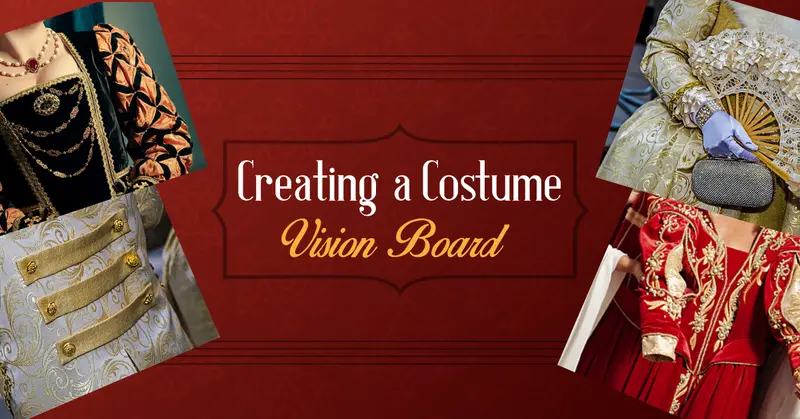
⢠Create a Costume Vision Board
⢠How Costumes Affect Your Character
Classroom Exercise
Costume Challenge: Modernizing a Classic Characterâs Ensemble
The following exercise challenges students to take on the role of costume designer and come up with a modern look for a character from a different era. Students will learn about the character and the time period in which they lived to create a modern ensemble inspired by the traditional looks of the era. This exercise can be done individually or in pairs, and adapted for distance learning.
Materials Needed:
⢠Sketch paper and pencil
⢠Colouring tools â pencil crayons, markers, or paints
⢠Fashion magazines/catalogues
⢠Scissors
⢠Glue or tape
⢠Box of various fabric scraps, buttons, trims, etc.
⢠Computer with Internet access and colour printer
⢠Poster board or binder with plastic page protectors
Instructions:
1. Select a character and get to know them.Select a character from a play to design a costume for. The play must be set in a different era. Shakespearean plays and classic Greek theatre plays immediately jump to mind, but there are plenty of shows that would be applicable. Read the script and get to know the chosen character. Are there any descriptions in the text about what the character wears? What does the character do in the show that might give an idea of what they need or choose to wear? How old are they? What is their job or social status? What time of year is the play set in?
Write a short biography (5-8 points) about the character that would help a costume designer think of what they would wear.
2. Research Part 1.Identify the time period that the play is set in. Learn about the traditional fashions of the era. For example, in Greek theatre, actors wear draped fabrics and masks. The style of the Renaissance era was short puffed pants with high socks, neck ruffs, and various hats, often with a feather as decoration.
Create a brief written description of the clothing worn, and choose 3-5 images (such as printouts from the internet, photocopies from books, tear outs from magazines) to illustrate the clothing. Note interesting and important details that are characteristic of the era, such as fabric (types, colours, fit â tight or loose), trim (buttons, ribbons, lace, jewels â or lack thereof), or accessories (hats, belts, shoes, gloves, jewelry, masks).
3. Research Part 2.Look up images of past productions of the selected play, and focus on the chosen character. Look for âtraditionalâ costume interpretations of the selected character that reflect the fashions of the era that students learned about in the previous step.
Choose 3-5 images to represent the traditional costume interpretation of the selected character, and create a brief written description noting those particular aspects of the costumes.
4. Research Part 3.Now itâs time to get modern! Search through fashion magazines and catalogues (both print and online) and look for details in modern fashion looks that are reminiscent of historical fashions. Maybe a Prada jacket with a fancy collar is reminiscent of an Elizabethan neck ruff, or a Gucci gown has a similar shape to an Edwardian dress. It doesnât have to be only high fashion â perhaps a celebrity photo shoot from Teen Vogue or an image of an athlete in a suit in Sports Illustrated might inspire students.
Choose 3-5 inspirational images to be the basis for the costume design. Be sure to indicate in a written description the specific details of the modern fashions that are reminiscent of the outfits of the past era.
5. Design.Students will create an original sketch of their characterâs modern costume. Students who arenât the most confident artists can do a search for âdesign figure template.â Students will draw and colour the costume.
Have students indicate and label on the sketch important details such as types of fabric, trims, notions, accessories, and shoes. Include physical pieces such as fabric swatches, or a sample button, ribbon, or trim. Note how the modern costume elements relate to the fashion of the original time, as well as how the modern costume serves the character and their needs/wants/job/social status.
6. Present.Students will collect their written pieces, images, sketch, and extra pieces, and either attach them to a poster board or assemble them into a binder with plastic page protectors. Students will present their costume design to the class.
Distance learning alternatives:
⢠Gather students on zoom and have them present their costumes.
⢠Students can create a digital poster board and submit them.
⢠Students can video their sketches and narrate their choices. No need for a camera; they can use their phones.
7. Reflect.Students will complete and submit a reflection, found below.
Teaching Drama
Round-Up: Your Costume & Prop Challenges!
We reached out to you, our amazing community, through social media to ask, What are your biggest props/costume challenges for your productions or upcoming show?.Turns out, there are lots of challenges that drama teachers are facing when it comes to props and costumes! Here are just a few of the concerns that came up, with some suggestions for dealing with these issues.
1. Dealing with those crucial, yet difficult, costumes or props that are specific to a particular show.There is always something that is absolutely necessary to the plot of the show that is a royal pain in the butt to try and create or acquire â either itâs super-expensive, technically difficult, or just really hard to find. Some of the challenges mentioned included acquiring the printing press and loads of newspapers in Newsies, finding sardines and fishing lures (without hooks) for Noises Off, and creating an amulet that lights up and that the actor can control (possibly for a show like The Little Mermaid or Peter and the Starcatcher).
⢠For these crucial items, make it the highest priority to get them taken care of early. Donât leave these items until the last minute to try and find.
⢠Search out other productions and see what they did with that specific prop or costume and how. For example, for the light-up amulet, I have seen similar items made out of a battery-operated tea light or lit up with a flashlight. Try posting on a theatrical message board or Facebook group (like the Theatrefolk Facebook page!) to see if other directors have ideas or creative solutions.
⢠Sometimes talking to friends or other teachers not associated with the production can help to gain a new perspective or great idea for creating or acquiring a particular item. They also might have a connection that you werenât aware of. For example, a friend of mine was directing The Music Man and was having a tough time finding the matching band uniforms. I just happened to know a friend of my motherâs who is associated with our local universityâs marching band. I was able to make a connection between the director and the marching band leader, who was willing to rent the items out for the production. You never know where a connection could occur.
⢠Try Getting Other Departments Involved in Your Production. Again, your colleagues and other students at your school can be great resources for new, fresh ideas.
2. Dealing with soooooo many costume changes!Some shows have what seems like hundreds of costume changes, which creates a whole host of issues: finding/creating/acquiring all the costumes, staying on budget, storing the costumes during the run of the show, and general chaos in the backstage area. Consider the following:
⢠See if there are costume items that can be worn layered for faster changes.
⢠Could you go deliberately minimalistic and have your students wear a set of basics (for example, a black shirt and black pants and add/remove items as needed?
⢠Donât feel that you need to change every single item for a costume change to be effective. Sometimes just changing a hat, jacket, jewelry, or other accessories can make all the difference.
⢠Be sure that every item backstage is labeled with the name of the student who wears the piece.
⢠Arrange studentsâ costumes so that those with the most or fastest changes have quick and easy access to their stuff â i.e., put their costumes nearest to the stage.
⢠Rehearse any difficult or particularly fast changes as part of your standard run-throughs of the show. Have extra costume team members or assistant stage managers available to act as dressers and help with quick changes.
⢠Start working with costumes early and do as many costume run-throughs of your show as possible so students can be organized and familiar with their costume items.
3. Needing to get period costumes and props for low- to no-budget productions.Weâve got you covered! Check out these articles from the Theatrefolk blog for help:
⢠Props on a Budget: A Resource Guide
⢠3 Tips: How to Stage a Show on a Small Budget
⢠Small Budgets: Doing so Much with so Little in a Drama Program
⢠How to Effectively Communicate with Rental Sources
⢠Using One Item to Show Character
Technical Theatre
Round-Up: Common Costume Concerns
Costumes, whether fabulously extravagant, simple and functional, ragged and threadbare, or anything in between, are lots of fun. Costumes help to tell the story of the show visually, and really help students to fully embrace their character. Costumes are also frequently a cause for concern. You have to deal with finding the perfect item for each student and taking care of each item so it doesnât get dirty or damaged, or disappear. Here are some common costume concerns with suggested solutions.
1. What happens if a costume gets ripped or is damaged during a show?⢠Create an emergency sewing kit and have it available backstage in an easy-to-find spot. Include items such as:
⢠Safety pins (lots and lots of safety pins)
⢠Needles and various colours of thread (at the very minimum: white, black, navy, and brown)
⢠Scissors (small, sharp, and pointy â round-tip scissors arenât particularly useful when working with costumes)
⢠Seam ripper
⢠Clear nail polish (for stopping a run in a pair of stockings)
⢠Temporary hem tape
⢠Various sizes, shapes, and colours of buttons
⢠In a pinch, gaff tape can temporarily solve many costume issues!
⢠You may want to have a backup item for any costume pieces that are particularly fragile or delicate.
⢠Always have a couple of extras when it comes to large groups of accessories, such as hats, belts, gloves, or kerchiefs. Someone will always lose one at some point.
⢠Remember: Always stay calm during an emergency!
2. The backstage dressing area stinks!⢠Have a frank conversation with your students about the importance of personal hygiene. Showering and deodorant are absolute musts. Avoid heavy perfumes and body sprays though, as many students are sensitive to the chemicals in scents.
⢠Assign and schedule costume team members to launder and/or air out sweaty costumes throughout the performance run.
⢠Ensure that students are hanging up their costumes neatly after every performance â clothes that are balled up on the floor not only get dirty and wrinkled but retain their stink.
⢠Spread out the hung-up costumes throughout the dressing area so the costumes are able to air out while not in use. Donât pack all the items together tightly on a costume rack.
⢠Place half a dryer sheet in each shoe to reduce odors.
⢠Bring in some large household fans and run them overnight after all the students leave. If weather and security permit, leave some windows cracked open as well.
3. A student hates their costume.⢠Have the student try on the costume so you can see them in it. If you like the costume, let the student know how great you think they look. Sometimes students need reassurance that they look good.
⢠Have your student explain to you why they hate the costume. Do they have a genuine concern about it (perhaps it doesnât fit properly or it itches) or do they just not like the item itself?
⢠If they have a genuine concern, see if you can find an alternative item or a solution to the problem. For example, if the item is too tight, can someone let out the seams or add a panel of fabric? If the item is itchy, can the costume be laundered or could a base item (such as a tank top or slip) be worn underneath?
⢠If a student doesnât like their costume item, explain why the item is appropriate for their character. Remind the student that their character may live in a different time period or have different likes/dislikes than the student does. The student must separate their own personality from that of the character they are playing.
⢠Give the student the opportunity to suggest what they think their character would wear and why. Have them create a sketch or bring in items that they think might work. Be open-minded â if the item does work, why not let them wear it?
⢠Some students are weirded out by the idea of wearing clothing that someone else has already worn. If possible, let the student take the costume item home and wash it. That sometimes helps ease their mind.
⢠When all else fails â tough love. Sometimes, as performers, we have to wear a costume we donât like, and we just have to deal with it!
4. Other costume concerns and solutions:⢠Dealing with a messy cast?
/blog/backstage-blues-deal-messy-cast/
⢠Need help taking costume measurements?
/blog/measuring-costume-measurements/
⢠Wondering how costumes affect a character?
/blog/how-costumes-affect-your-character/
⢠Need help creating a costume vision board?
/blog/create-costume-vision-board/
⢠Thinking about how much money you can spend on costumes?
/blog/how-to-create-a-budget-when-youve-never-done-it-before/
⢠Need help approaching rental sources for costumes?
/blog/effectively-communicate-rental-sources/
⢠Do your students balk at the idea of wearing special shoes onstage?
/blog/need-rehearse-characters-shoes/
⢠Wondering where and how to store your costumes?
/blog/great-storage-struggle-stuff/
⢠Need help knowing when quick changes occur during the show?
/blog/running-list-need/
⢠Do you only have the budget for one special costume item per student?
/blog/using-one-item-show-character/
⢠Need help recruiting costume team members?
/blog/recruiting-crew-members/
⢠Using stage blood in your show?
/blog/working-stage-blood/
⢠Have you scheduled a costume run into your rehearsal plans?
/blog/rehearsals-need-include-schedule-may-not-thought/
⢠Do students have the appropriate hair and makeup items needed to finish their look?
/blog/make-basic-hair-makeup-kit-student-actors/
Technical Theatre
Costume Care: Dos and Donâts
Teachers, the following list of dos and donâts is a great way to introduce costume care etiquette to your students. Whether your students are beginning actors or seasoned drama department pros, costume care is a vital skill that all students must have._
With proper knowledge of costume care etiquette, students who are interested in costume design and creation, as well as parent volunteers, will be empowered to both enforce these rules and receive the proper respect from the rest of the group for their time and hard work. Mutual respect between the performers and crew members goes a long way!
Have all your students to read these dos and donâts, and challenge them to come up with some more examples to add to the list. Discuss why costume etiquette is so important for both performers and costume team members. Divide the class into small groups, assign each group a Do or a Donât, and have them create an attractive poster illustrating the rule. Display the posters in your classroom or costume storage area.
Do listen to and respect the costume team. They are there to make you look great onstage and they have an entire cast of students to focus on, not just you. Whether your costume was pulled from stock, purchased, or created from scratch, it was assembled specifically for you. Listen, be polite, and thank the team for their hard work!
Donât treat the costume team as if they are your personal maids and butlers. They are not there to pick up your costume or clean up after you. Hang up your costume neatly rather than leaving it in a heap on the floor.
Do wear your costume how it is supposed to be worn. Maybe you donât like wearing a skirt at your natural waist or you feel silly wearing a neckerchief, but it is meant to look a certain way onstage. Be sure to wear all the parts of your costume. For example, you may not like your costume hat and want to âforgetâ to put it on, but you will pull focus onstage without it and not in a good way.
Donât reject a costume just because you donât like it, or before youâve even tried it on. Items always look different on a hanger or lying flat than they do when theyâre actually worn on a person. Remember as well that while YOU, the actor, may not like a certain costume item, it is entirely appropriate for YOUR CHARACTER, who may have different likes or dislikes from yours, or live in a different time period than you.
Do speak up if a costume doesnât fit properly or pinches, pulls, rides up, or digs in. You need to be comfortable onstage in your costume, and you will not be able to focus if you are constantly picking or adjusting it. Also, be sure to tell the costume team if you have to do something particularly physical in a costume, such as a high kick or the splits and you have concerns about the fabric tearing.
Donât wait until the last minute to let a costume team member know about a broken or damaged costume item. If you let them know as soon as possible (preferably as soon as you notice the damage), theyâre more likely to be able to help replace or repair the item. If you bring them a problem half an hour before the performance starts, they are less likely to be able to solve the problem.
Do ask for help (politely!) if you need assistance with a quick change, or help with a particular part of your costume â for example, zipping up a zipper on the back of your dress, or buttoning the cuffs of your sleeves. Costume team members are happy to help, but they canât help you if you donât ask.
Donât touch or try on other actorsâ costume items. Just like props, if itâs not yours, donât touch it. (You wouldnât like it if you went to do a quick change and discovered an item of yours was moved, missing, or damaged.)
Do bring in requested items from home (such as dress pants or black shoes) in a timely manner, clearly labeled with your name.
Donât eat or drink anything other than water while in costume. If you need to eat something, either change out of your costume or cover it up with a coat or robe. Do not risk spills or stains on your costume!
Do pay attention to details â ensure that your socks are the correct colour to go with your costume, that your shoes are clean and polished, that all of your accessories are on properly, and that your undergarments are not visible.
Technical Theatre
Telling the Story Through Clothing: Choosing a Colour Palette for Your Show
Costumes are such a fantastic way of making the story of a show come alive. Costumes help students really understand and embody their characters. Costumes can also clearly and easily demonstrate the time period of the show â think about the immediately identifiable costume items of the Swinging Sixties (go-go boots, mod mini dresses, wide lapels and trouser legs), the Roaring Twenties (flapper dresses, bobbed hairstyles, cloche hats, and three-piece suits), or the Renaissance (tight bodices, floor-length skirts, muffin hats, and doublets).
Students interested in costume design can take their choices further than just selecting appropriate costume items â they can choose a specific colour palette for their show. A colour palette is a range of colours that are carefully selected and put together. Unless students are doing some sort of a rainbow-themed show, a colour palette will only include particular colours, and particular tones and shades within those selected colours, while excluding other colours, shades, and tones. Colours could be bold, muted, pastel, jewel-tone, dull, bright â or a combination of all of these. It depends on the show itself, and the look and feel that the costume team wishes to present.
The most important concept for students when they are selecting a colour palette is to know WHY they are selecting those specific colours. Ultimately, their choices must support the story being presented onstage.
Here are four ideas to consider when students are selecting costume colour palettes:
1. Historical accuracyIn certain time periods, such as the Renaissance, some colours were reserved for those of royal or noble birth. Purple is generally considered to be a royal colour, as is true red. Peasants and merchants didnât wear these colours because they simply didnât have the means to purchase fabrics or dyes in those colours as they were imported from distant countries and tended to be very expensive. Lower-class people generally wore earth-toned fabrics â browns, greens, blues, and so on â as they were much easier to acquire and maintain. In this case, colour is a great way to show class distinctions as well as representing the time period.
2. The mood or emotion the character is intended to evokeIn the Disney/Pixar movie Inside Out, each of the personified emotions has a distinct colour. Joy is sunshine yellow, Sadness is (clearly) blue, Anger is passionate red, Disgust is envious and jealous green, and Fear is light purple â a colour often associated with spooky Halloween. The colour is an easy identifier of each emotionâs primary purpose in Rileyâs âheadâquarters.
Think of the mood that each character is meant to evoke. A villainous or scary character might typically be dressed in black, green, or purple â think of Severus Snape from the Harry Potter series. A heroic character might dress in a strong jewel tone â think of Spiderman, Captain America, and Wonder Woman in their bold red and blue outfits. A cute character might wear pink, a powerful character might wear red, while a depressed character might wear blue. However, creating a contrast is also an interesting concept. A villain dressed in a pastel costume, such as Dolores Umbridge in her pink wardrobe, or Velma Von Tussle (from Hairspray) in her fancy dresses and perfectly coiffed hair, can be fascinating as well.
3. Showing connections or contrasts between characters or groups of charactersColour palettes are a simple and clear way to group similar characters together, or show difference between the groups. When I directed The Little Mermaid, the merfolk and under-the-sea creatures were all costumed in bright, bold, glittery costumes in primary colours, while the land folk were dressed in soft pastel colours. This created a fun contrast between the two worlds.
More recently, when I directed Heathers: High School Edition, the character J.D. is known for wearing black jeans, combat boots, and a dark trench coat. However, we went a step further by showing his changing emotional states through the simple t-shirts he wore under his trench coat. In Act 1, he wore a royal blue t-shirt that matched Veronicaâs royal blue blazer and plaid mini-skirt, to show their eventual love connection. (Veronicaâs parents were also costumed in navy blue, to show their family connection to their daughter.) In Act 2, after having committed many villainous acts, he appears in a red t-shirt, as a contrast to Veronicaâs blue.
Costuming similar groups of characters in similar colours is a great way to show connections between families, class distinctions, similar trades or employments, cliques, or friend groups. Think about the signature pink of The Plastics in Mean Girls, or the red and white of the East High Wildcats in High School Musical â these colours bond the characters together.
4. Creating an overall look or concept for the showSometimes convention is entirely thrown out the window and shows are costumed in a style that may be anachronistic or stylistically unusual for the time period or subject matter of the show. This is most evident in a show like Chicago where, despite the Jazz Age time period, most productions costume their performers in various modern, tight-fitting dance ensembles â and entirely in black. Everybody â from the Cook County Jail inmates to the members of the press to Roxie and Velma themselves â is dressed in different textures of black lace, mesh, fishnet, spandex, and frills (and despite being entirely the same colour, each fabric looks very different under the stage lights!). Obviously, that is not what prison inmates in the 1920s would actually wear, but it does create a striking look onstage.
I was in a production of Christopher Marloweâs Edward II, which is set in the 1300s. Rather than costume the show with historical accuracy, the director and costume team selected a sort of space-age, cyber-punk, rock-and-roll look, with all the characters dressed in a palette of black, grey, and silver. Everything, from our costumes to our shoes to our jewelry and makeup were in the black/grey/silver palette, and created a jarring yet memorable effect. Not to mention, it was a lot of fun to wear!
Exercise: Have your students come up with a colour palette for a show you are currently studying in class, or that your school is currently working on. Students will illustrate their colour palette choices using magazine tear-outs, fabric samples, hex colour codes, Pantone colour systems, or another method of their choosing.
Have them reflect on their choices using the provided Reflection sheet. If choosing a colour palette for an entire show is too large a project, have students choose two characters from the show and create colour palettes for those two characters only. Remember, students must be able to explain why they chose those specific colours!
Technical Theatre
Basic Costume Items Every Drama Student Should Own
Getting to try on a new costume for the first time is one of every studentâs favourite parts of the rehearsal process. A costume helps so much to tell the story of the show, and helps students really become their characters. But before that, it is useful for students to have the following costume basics in their possession.
The following items should be staples in every drama studentâs closet.
1. A plain black long-sleeved shirt and plain black dress pantsThese are called ârehearsal blacks,â and in many cases, can be used as actual costume pieces either together or separately. The purpose of rehearsal blacks is to create a blank, neutral canvas for the actors so they can truly embody the character without having their personal choice of clothing influence their performance, intentionally or not.
The shirt can be a button-down or a long-sleeved t-shirt. Long sleeves are preferable over short sleeves, as they cover more of the body and make students look more neutral.
The type of pants will depend on the preference or requirements of the teacher or director. Some directors will permit black jeans, yoga pants, leggings, or athletic/sweatpants, but, personally, I think dress pants look the best onstage. Try to find pants with a bit of stretch to allow for movement. If students choose to wear leggings or yoga pants, be sure to check that they are not sheer or see-through under the stage lights!
This should go without saying, but any basic costume items should be logo-free. Try to acquire clothing without visible logos. But if it is impossible, cover up the logos with a small piece of black gaff tape. Avoid details such as stripes, dots, and glitter. Even if the designs are black-on-black, they are still visible onstage underneath stage lighting.
2. A plain white long-sleeved dress shirt with buttons and a collarA crisp white dress shirt has so many uses â itâs great for portraying a businessperson, a server in a restaurant, wearing under a suit or for any formal occasion, and much more. It can also be worn dressed down with jeans, open over a fun t-shirt, or even as a beach cover-up.
Make sure the dress shirt is clean! If it gets weird stains around the collar, cuffs, or armpits, itâs time to replace it!
3. Appropriate undergarmentsFor the gentlemen, a plain white T-shirt or undershirt and neutral-coloured boxer shorts. For the ladies, a skin-tone bra, bandeau, or undershirt, and neutral-coloured dance or yoga shorts. Black shorts are generally appropriate and easiest to acquire, but it will depend on what colour the studentâs costume is. Black wouldnât work underneath a light-coloured pair of trousers.
Nothing is worse that seeing visible undergarments under a beautiful costume, and wearing a layer of basic, appropriate undergarments will also preserve studentsâ modesty if they need to make a quick change. Again, students should stick to plain colours and avoid large prints or logos.
4. A plain leather (or leather-looking) beltIt can be black or brown, depending on the rest of the costume. Having a belt is useful if a student is using a sword onstage, or simply for holding up their pants.
5. Plain black dress shoes for everyone!For the gentlemen, lace-up shoes are probably the most versatile. Slip-ons or shoes with buckles can be appropriate for certain shows but can look too modern for shows set in earlier time periods. And donât forget a pair of tall, plain black dress socks. Socks should match the shoes, and they need to be tall so audiences donât see bare ankles â especially if the student is wearing a suit! Leave the athletic socks and ankle socks at home!
For the ladies, âcharacter shoesâ are the most frequently requested by directors. These are a flexible, heeled dance shoe with a strap (Mary Jane style, t-strap, or cross strap) and they come in black or tan. Itâs important to note that character shoes should never be worn outside of the theatre or dance studio â they are specifically made to be worn indoors and donât hold up well on asphalt or concrete. Depending on the show, a simple black flat shoe may also be acceptable.
For younger students or certain shows with lots of movement, black slip-on jazz shoes or black tennis-style shoes may also work. When in doubt, students should always ask the teacher before making a purchase!
Please note that these items need not be expensive. Families may initially be concerned about the cost, especially if their student is still growing, but the majority of these items can be found at department stores, big box stores, or thrift stores. Focus on finding neutral and durable items that can withstand sweat and lots of movement.
Recap:⢠Basic, neutral costume items are staple items in drama studentsâ closets!
⢠Select items that are plain (stay away from patterns and glitter) and avoid visible logos.
⢠Keep basic costume items clean â once an item start to get worn or weird stains appear around collars, cuffs, and armpits, the item needs to be replaced.
⢠Be aware of what colour the costume is when choosing undergarments so they donât show through the material.
⢠If students are unsure as to whether or not an item is acceptable, be sure to ask the teacher before purchasing the item.
Technical Theatre
How to Effectively Communicate with Rental Sources
Real talk: Teachers, it is likely you wonât have every item on your props, costume, and set wishlists for the show. It is also unlikely that you are staging your show with an unlimited budget, a massive design team, and an extensive props and costume storage warehouse. In that case, it will be necessary to reach out to other schools and drama departments in your area, community theatre groups, or other resources, to rent or borrow items for your show.
Renting and borrowing items is a great way to help you to fill your costume, prop, and set requirements without having to create or buy everything yourself (and eat up your entire budget), and to forge relationships with fellow community members.
Here are some tips to help you navigate this situation, and thoroughly impress your rental sources with your professionalism â which will make it more likely that theyâll rent to you again in the future!
1. Give the source as much information as you can.When you approach the potential resource, give them as much pertinent information as possible right away, including:
⢠Your name, as well as the names of any other people who may potentially act on your behalf (assistants, parent volunteers, etc.)
⢠The name of the school you represent, as well as the age/grade level of your students (this gives the rental sources an idea of how roughly their items might be handled)
⢠The title of your show
⢠The performance dates of the show, how long youâd like to rent the items for, and when you would be able to return the items
⢠Your budget allocation for rentals or, if you have no budget, some way to âpayâ for the rented/borrowed items (advertising space in the program or an exchange offer, such as loaning items from your stock to their production)
2. Have a clear and specific list of what you need.Please donât contact a source without having a clear list of what youâre looking for, along with sizes and quantities. Yes, itâs easy to say âI need costumes for our production of The Lion King, Iâll take anything you have,â but that doesnât give your source much information. Be specific â for example, if you need to costume fifteen hyenas and twelve lionesses who range in size from small to extra large, your life will be much easier if you know exactly how many students are what size! This way you wonât end up with a bunch of useless costumes that donât fit, or only five matching costumes when you needed twelve.
Or, if youâre looking for a particular set piece or prop, have the ideal measurements of the item, or the measurements of your performance space available to compare. There is no sense in trying to rent a prop coffin for Oliver or a torture rack for The Addams Family, only to find you canât get the item through the door of your space. (Side note: Be sure you have a large enough car or truck at your disposal to pick up the item. Donât expect the source to deliver to you unless they offer.)
3. Have a clear idea of the design vision for the show.Are you setting your show in the period in which it is written, or are you setting the show in a different time period? Thereâs no sense getting a renaissance-style cottage flat if your Hamlet is set in outer space. Having a Pinterest inspiration board or inspirational sketches to show your source can help them to help you find exactly what youâre looking for â no wasting time looking at ruffs and robes when blasters and space suits are whatâs needed.
This will also help your source to quickly identify what they have in stock that will work for your show. For example, you and your source may both have done Willy Wonka and the Chocolate Factory, but they may have dressed their Oompa-Loompas in orange overalls, while you were hoping for green. Would the orange overalls work with your show, or will you have to look elsewhere?
4. Be flexible and prompt.The rental sources are doing YOU a service by lending or renting their items to you, so be as flexible with your time as possible. If their office hours for pickup are between 10 am and 4 pm, donât ask them to stay until 7:30 just for you. Make arrangements to go at the time they indicate to you, and arrive on time. This may mean sending someone on your behalf if their hours are during school hours, or going on your lunch hour or during your prep time if that is possible.
Being extra early can sometimes be as inconvenient for them as being late â sources usually book their meeting times for a good reason, and if you arrive super early, they may not have had a chance to pull the items in question out of storage.
5. Do not alter borrowed or rented items without the express permission of the source.The pants you got for your leading actor are nearly perfect â theyâre just a little bit too long for the student. Itâs fine to go ahead and hem the pants, right? NOPE! Always be sure to contact the source and ask permission if you want to make alterations, and be sure that any alterations are reversed before returning the item unless arranged otherwise. For example, if you hem a pair of pants, be sure not to hack off the excess material â hem the pants carefully and then remove the hemming stitches after the show. Or if you have permission to paint a flat, paint it back to its original colour after the show.
6. Return items in the same or better condition than you got them, and in a timely manner.Make a detailed list of every item you rented or borrowed, and which source it came from (especially if you rented or borrowed from multiple sources). It might be useful to photograph all rented/borrowed items for this purpose. If you can, label each item as well. That way, rented items are less likely to go missing.
Find out how to properly care for all the items, and return the items in as good or better condition than you got them. Make sure all costume pieces are properly washed and/or aired and that there are no rips, stains, or missing/broken trims. Make sure that the props are in good working order, and that flats or set pieces are touched up and looking fresh.
If something happens and an item does get broken, contact the rental source right away. This is to not only inform them that the incident happened, but to find out how theyâd like to proceed â do they want you to fix the item, do they want to fix the item themselves, do they want the item back or not, will there be a damage fee, and so on. Honesty is the best policy in this case.
You also need to ensure that your items are returned in a timely manner â on or before the sourceâs due date. They may have the items going out to another production after yours, or they may be planning to use the items in an upcoming show of their own. Be respectful of the source and return all the items on time. Donât make them have to hunt you down to get their items back!
7. Be courteous.Find out the full name of the person in charge of rentals so you can credit them in the program (such as in a âSpecial Thanks Toâ or â_________ Provided Byâ section), and send a thank you card afterwards. Small gestures like this go a long way to creating a positive relationship with rental sources.
Production
Why You Need to Rehearse in Your Characterâs Shoes
There are so many approaches to developing a character and making them fascinating and engaging. Some methods are more analytical, some are emotional, and some are physical. In this case, think of the old saying, âYou canât understand someone until youâve walked a mile in their shoes.â Rehearsing in your characterâs shoes is a very helpful way for students to further develop their characters and increase their own confidence onstage. It seems simple but itâs easy to overlook â directors frequently tell actors to dress comfortably for rehearsal, and actors donât often start immediately rehearsing in their costumes. But if students are able to start working with their shoes right away, it can make a huge difference.
Your shoes affect your physical movements.Think of all the different types of shoes out there â boots, flats, sneakers, high heels, flip-flops, sandals, slippers⌠the list goes on and on. Simply put, the body moves differently while wearing different footwear. You might be able to leap nimbly across the stage in jazz shoes or ballet slippers, but can you do the same movements in steel-toed combat boots? Can you swordfight wearing Converse high-tops? Can you run away in five-inch stilettos?
In rehearsal, as soon as possible, start wearing the shoes you will be wearing onstage. Your need to be confident in your movements while performing, no matter what the role calls for. The sooner you start wearing your show shoes in rehearsal, the more comfortable and poised you will be while performing. It will be one less thing you have to worry about.
This also is useful to do if a character doesnât wear shoes at all! When I directed Tarzan, the gorilla characters didnât wear shoes, while the students playing humans did. It was important for the barefooted students to get comfortable being barefoot all the time (some people are weird about their feet!), and the students wearing shoes had to be aware how they moved in their shoes, while also being extra careful not to step on the toes of the students who were barefoot!
If you donât know right away what shoes your character is wearing, try experimenting with different types of shoes during rehearsal. Look through the script and make notes about what your character might wear, and try out different shoes. Alternatively, make notes of the actions taken during the show, such as climb stairs, dance, fight, run, or tumble. What shoes would be best for your needs as an actor? For example, if you have to jump down off a ledge, you will need shoes with good ankle support. If you need to do turns, shoes with rubber soles might be too grippy to execute the moves properly. This information can help the costume team determine what shoes would work best for you. Once you receive your shoes, try out all your movements right away so you can communicate with the director and costume team if there are any concerns.
Your shoes are part of your costume, which helps to define your character.Once you know what kind of shoes your character wears, think about how your character feels about their shoes. It seems trivial, but itâs another way of delving deeper into your character and getting to know them better. Why did they choose those shoes? For style, for comfort, for practicality? Did they even have a choice of what shoes to wear? Do their shoes fit them properly? Are the shoes well-maintained or shabby? Does your character change shoes throughout the show? Why?
For example, think about a show like My Fair Lady. Eliza starts as a humble flower seller wearing thick boots, and is made over into a society lady in fancy high heels. How would that affect both the actress playing the role, and the character herself? How does she walk in her everyday boots versus her new, stiff, heeled shoes? At what point does she become more comfortable in her new shoes? How can you, as an actor, accurately show this evolution of movement?
Thatâs a lot of thought for a simple pair of footwork, isnât it? But getting those shoes on your feet will really help you with your character, both physically and mentally. And after walking, dancing, and moving in your characterâs shoes throughout the rehearsal process, it will be easy to make a smooth transition to walking a mile in their shoes onstage.
Acting
Backstage Blues: How to Deal With a Messy Cast
Cleaning up anybody elseâs mess is no fun. Cleaning up a messy backstage after a show is especially disheartening â it takes away any good feelings that were cultivated during a good performance, and creates resentment between the actors, the crew, and the teachers in charge. With teamwork and some carefully laid-out ground rules, though, messes can be reduced and everyone can go home quickly!
Read on for three ideas about how to deal with theatrical messes.
1. What are the general backstage policies?Establish these early and make sure the cast and crew know what they are. Make handouts and distribute them to the cast and crew. Post the policies where they can be easily seen by everyone. You may even want to make up a contract that each student signs to indicate that they are aware of the backstage policies. Here are some points to think about:
⢠Are students permitted to bring personal items (such as cell phones, bags, etc.) backstage? If so, where will the items be kept?
⢠Does each student have their own assigned space in the dressing area, or is it a free-for-all?
⢠Where are costumes stored when not in use?
⢠Is there a place to store boots and coats during inclement weather?
⢠Are food and drinks permitted backstage? Are there adequate garbage cans and recycling bins available? Who empties those when they become full?
⢠Is there an established Lost and Found area or bin? What happens when the bin becomes full?
⢠Items of a personal nature (such as solitary socks) I tend to just throw out. Nobody is going to claim them.
2. What are the rules regarding costumes?Costumes tend to be misplaced and damaged more often than other items, simply because it is so easy to toss a costume over a chair or drop it on the floor. Oftentimes students arenât aware of how to properly care for their own clothes, let alone a costume. Discuss with your students how to properly care for and store their costumes â it will make your costumes teamâs lives a whole lot easier.
⢠The first rule of costume care is that costume team members are not servants or maids â they are not there to pick up after actors who leave their stuff everywhere.
⢠If necessary, spend time with your students to teach them the correct way to hang and/or fold and store their costume pieces.
⢠My rule is this: If I find a costume piece randomly on the floor (doesnât matter how it got there, whether it was carelessness on the owner him/herself or if someone else knocked it on the floor), I take it away and put it in â costume jail.â The owner then has to come and find me to get it back, and explain why the item wasnât put away correctly.
⢠Iâve also used consequences, such as:
⢠Having to pay a fine (usually 25 cents per item) to buy it back
⢠Having to do push-ups or sit-ups to earn the item back
⢠Completing another task, such as singing a song in front of the rest of the cast and crew, to earn the item back
⢠You will know your students best â use your best judgment when assigning a consequence for a left-behind item
3. What are the rules regarding props?Props can easily be misplaced between shows. Sometimes they mysteriously vanish. To avoid this, assign a props head or assistant stage manager to oversee the proper care and storage of props.
⢠Are props kept out on a shelf or table in between shows, or are they put away after each show? If they are put away, is there a specific plan for the storage?
⢠If items are put away between shows, large bins (with lids) are very useful. Attach a list to each bin-lid of what belongs in that bin.
⢠Props that are left behind or not put away in their proper spots could be treated the same way as costumes and put in âprops jail.â
⢠But consider, tt may be more difficult to determine who missed the prop â is it the responsibility of the props head, the assistant stage manager, or the actor who uses said prop to return it?
⢠At the end of the run of the show, remind students that all prop items must be returned to the props storage area. Students frequently ask to keep a prop as a souvenir of the show, failing to remember that props may have been borrowed or loaned, or will be used again for a future show. Unless the teacher specifically states that a particular student may take a particular prop home, all props need to be returned and accounted for! (This goes for costume items too!)
Acting
How Costumes Affect Your Character
Costumes are such a fabulous part of theatre â they help tell the story, they help actors get into character, and they immediately tell the audience something about whatâs going on. For many student actors, receiving their costumes is a really exciting day. However, once students are actually in their costumes challenges can crop up. Many directors request that students come to rehearsal wearing comfortable clothes that they can move in. While that is useful for learning choreography and blocking, itâs less useful if the students will be wearing costumes that are not workout-gear-esque. Costumes definitely affect an actorâs performance â for better or worse. Letâs look at some ways that costumes can affect performances and character portrayal, starting from the feet and working our way up to the head.
1. Feet and Lower Body⢠Shoes
⢠People walk differently in boots vs. sneakers vs. heeled shoes vs. sandals vs. bare feet.
⢠In general, avoid wearing flip-flops on stage, as they are super noisy and do not provide good traction.
⢠Heeled shoes can be noisy both onstage and off. Students should practice walking in them to avoid looking and sounding clumpy.
⢠If some students are wearing shoes and some are barefoot, the students with shoes on must take extra care not to step on the barefoot studentsâ feet.
⢠While this should be done before every show regardless, it is especially important to sweep the stage of any debris before the show if any of your students will be barefoot onstage.
⢠Solution â Get your shoes early and practice with them during rehearsals.
⢠Skirts and Dresses
⢠People sit, stand, and move differently depending on the length and fit of the skirt. Larger and longer skirts can be a tripping hazard. Shorter and tighter skirts can impede movement.
⢠Students frequently will try to wear older-style period skirts down lower on their hips (modern) rather than at their natural waists.
⢠It is important that students wearing skirts and dresses wear appropriate undergarments, to avoid âwardrobe malfunctions.â
⢠Also be sure to give special consideration to accessories such as bustles, petticoats, and crinolines, which can be noisy (lots of rustling) and make it difficult to sit down. As well, the more layers of clothing you add, the hotter and potentially heavier the costume is going to be.
2. Upper Body⢠Shirts
⢠Some shirts can impede arm movement, depending on how tight or billowy the sleeves are.
⢠Jackets, coats, capes, and shawls
⢠How do you put them on and remove them?
⢠Gloves
⢠Gloves can make it more challenging to grip props (could be slippery or tight enough to impede hand movement).
⢠Jewelry
⢠Putting on and removing jewelry can be challenging, particularly if it is being done onstage.
⢠Jewelry is easily lost and/or broken.
⢠Solution â Use necklaces/bracelets/chains with magnetic clasps.
⢠Solution â Have multiples/backups available just in case.
3. Head and Face⢠Hats and Headpieces
⢠Hats fall off easily if not secured properly.
⢠Caps and wide-brimmed hats throw shadows on actorsâ faces.
⢠Large brims can hide actorsâ faces entirely.
⢠Headpieces (such as fascinators and tiaras) can get tangled in long hair making them difficult to remove.
⢠Wigs and Facial Hair
⢠Wigs are in constant danger of falling off.
⢠Care must be taken to keep wigs looking fresh and tidy.
⢠Wigs and wig caps should not be shared between cast members.
⢠Both hats and wigs can affect or interfere with body mics worn at the hairline or on the cheek.
⢠Fake facial hair must be applied with spirit gum (a special adhesive), which can be challenging to put on and requires a special product to remove.
⢠Masks and Specialty Makeup
⢠Masks can impede actorsâ vision and facial movements.
⢠Masks also force students to emote differently, since the face is hidden.
⢠Some masks can muffle the voice.
⢠Makeup can pose allergy concerns.
⢠Makeup can also smear onto costumes or other actors.
4. Overall Concerns⢠Quick changes
⢠Solution â You may need to layer your costumes, if thatâs possible.
⢠Solution â Have costume team members available to assist. Be sure to practice any quick changes before technical and dress rehearsals.
⢠Movements such as dancing, stage combat, and even sitting or standing can be affected by any of your costume pieces.
⢠Storage
⢠Ensure that all costumes are neatly hung up and taken care of (rather than left all over the floor or in a random pile, where they can get stained, stinky, or wrinkled.)
⢠Rule â No eating or drinking anything while in costume, other than plain water.
⢠Rule â Any mending, cleaning, or maintenance needs must to be reported to the costume team immediately for them to deal with. Donât try to fix a broken item yourself without consulting the costume team. Donât wait until the day of the performance to speak up â it is most likely the team will not be able to do anything at that time.
The most important takeaway is for students to practice as early as possible with important costume pieces. In this case, âimportantâ can refer to items that are difficult to work with and/or new and unfamiliar to the student. Characters must look as though the items they wear are completely normal and natural for them. The more natural an actor looks in their costume, the easier it will be for them to sink into their character.
Click here for a free mini-exercise and reflection.
Technical Theatre
How to Run a Tech Challenge in the Drama Classroom
Have you heard of Tech Challenge (sometimes itâs called Tech Olympics)? Teams compete in common tasks that every technician should know and/or participate in during the run of a show. Some examples include hanging and focusing a light, taping out a groundplan, doing a prop shift, doing a costume quick change, or setting up a sound system. Many thespian festivals include a tech challenge as part of their schedule which makes for a nice balance of onstage and offstage activities. Onstage actors often get all the accolades for a show even though any production is always a group effort of onstage and offstage team members. A Tech Challenge puts tech crews in the spotlight.
How can you use this in your classroom?After you take your students through the definitions of the backstage roles (eg: stage manager, lighting operator, costume designer, stage crew), put the following two tech tasks into action: Costume Quick Change, and Prop Shift.
(Note: I resourced the information regarding the Costume Quick Change and the Props Shift from four Thespian websites: Georgia Thespians, Texas Thespians, Kansas Thespians_ (they have score sheets), and_ Nebraska Thespians.)
Costume Quick Change1. Identify the definition of a costume quick change.
⢠To help an actor get out of one costume and into another costume in a limited period of time â sometimes quick changes have to take place in under a minute!
⢠Emphasize to students how important the costume quick change is to the showâs success. Emphasize how backstage roles connect to onstage roles. Everyone is part of the same community.
⢠Find online examples of costume quick changes to show students what a quick change looks like. Search for âQuick Changeâ on YouTube. Hereâs one from Mary Poppins and one from The Wizard of Oz. Point out to students how the actor stands/helps during the quick change. Note that each dresser has a specific job and that no one is frantic during the quick change.
2. Explain to students that they are going to run through a costume quick change in small groups.
3. Show students the two costumes each group is going to use to during the quick change. Both costumes should include pieces that go from head to toe. For example:
⢠Costume one: Baseball hat, t-shirt, jacket, pants, belt, running shoes.
⢠Costume two: fedora hat, dress shirt, jacket, tie, suspenders, dress pants, dress shoes.
These are just examples â modify the costumes to fit what you have available. Just make sure that each costume is a complete head to toe set.
4. As a class, identify the step by step actions needed in a costume quick change. What are the most efficient steps when changing between two costumes? If there are a couple of dressers, what can each do to make the change quicker? You could even go through the change slowly as a model to try out different suggestions.
5. Divide the class into small groups. Each group will complete the Costume Quick Change as follows:
⢠Gather at the start/end area. Put a line of tape on the ground to identify when the stopwatch person starts the watch and when they stop.
⢠Move to the costume quick change area
⢠Help actor out of costume one
⢠Help actor into costume two
⢠Hang up costume one
⢠Move back to the designated start/end area
Identify that everything must be properly undone on costume one and refastened for costume two. (Meaning, you canât just rip off the shirt for costume one or leave a shirt unbuttoned for costume two, to save time.)
Note: The actor is allowed to help (unbutton a shirt, slip out of shoes), but only at the request of the techs.
6. Each group will compete for time. Give each group a copy of the Costume Quick Change Info Sheet (see button below for the free download!). Each penalty adds time to the final score. Penalties include:
⢠Any items not properly placed on actor (eg: shirt left unbuttoned) â 10 seconds per item
⢠Missing hat/tie â 15 seconds per item
⢠Unnecessary roughness of the actor â 5 seconds
⢠Rude treatment of actor â 15 seconds
⢠Costume 1 outfit not hung up or not placed on hangers properly â 5 seconds
⢠Dropping hangers or other items during the change â 5 seconds per occurrence
⢠Blatant disregard for the rules â disqualification
7. Give groups time to discuss their strategy and practice. Donât let groups practice with the actual costumes/pieces they will use during the challenge.
8. Each group completes the Costume Quick Change. Have someone monitor the stopwatch so that you can pay attention to the change. Watch the change to identify if any of the penalties occur. The timer will start the stopwatch when the group leaves the start/end area, then stop the watch when the last member of the group reenters the start/end area.
9. Unpack the experience. What was it like to work under a time crunch? What was it like to work together on the change? What went well? What would you change? Can you imagine doing this in a production?
Prop Shift1. Identify the definition of a Prop Shift.
⢠To take props offstage at the end of one scene and dress the set as required for the next scene. For example: a table complete with place settings and a tablecloth are removed at the end of Act 1 and is replaced with a different tablecloth and a different set of plates/glasses/cutlery for the top of Act 2.
⢠Emphasize to students how important the prop shift is to the showâs success. If actors donât have their props in place, it will affect the scene. Emphasize how backstage roles connect to onstage roles. Everyone is part of the same community.
2. Explain to students that they are going to run through a prop shift in small groups. They are changing an âAct 1â table dressing to an âAct 2â table dressing. They will have a maximum of five minutes to take the items from a table onstage, place them on a prop table offstage, and then re-dress the table onstage with new items. Each table dressing should include:
⢠tablecloth
⢠four plates/four glasses/four sets of fork, knife, spoon
⢠napkins
⢠centerpiece
The items have to be different for each table dressing, which means that students canât reuse anything from the first dressed table for the second dressed table.
3. Show the setup to students. Explain that there is a fully dressed table onstage and that those items will need to be placed on a prop table backstage. They will also have to re-dress the table with new items. Ask students to identify what a prop table is and why itâs important backstage. If you google âprop table,â you will come up with images that exactly visualize what a prop table looks like.
4. As a class, identify the step by step actions needed in a prop shift between the two table dressings. What are the most efficient steps? If there are a couple of techs, what can each do to make the change quicker? You could even go through the change slowly as a model to try out different suggestions.
5. Divide the class into small groups. Each group will complete the prop shift for time. Give each group a copy of the Prop Shift Info Sheet (see button below for the free download!). Go through the sheet and identify the rules for the prop shift.
⢠The timer begins when the group leaves the start/end area and stops when the group returns to the start/end area.
⢠Students cannot drop props during the change.
⢠Students cannot place props in their mouths or pockets.
⢠Students must work quietly as if they are doing the change during a show.
⢠Students must set the props in their proper place offstage (on the props table).
⢠Students must place all props properly onstage (the setting cannot be askew!).
⢠If students reach the end of their 5-minute time limit, they must stop immediately.
6. Identify the penalties for the prop shift competition. Each penalty adds time to the final score. Penalties include:
⢠Dropping a prop â 10 seconds each time
⢠Making noise with a prop â 5 seconds
⢠Carrying a prop in the mouth or pockets â 5 seconds
⢠Excessive noise during the shift â 5 seconds
⢠Wrong prop placed on table â 5 seconds per item
⢠Prop not set properly or carefully onstage â 5 seconds
⢠Props not set properly offstage â 5 seconds
⢠Blatant disregard of the rules â disqualification
7. Give groups time to discuss their strategy and practice. Donât let groups practice with the actual props for the challenge.
8. Each group completes the Prop Shift. Have someone on stop watch so that you can pay attention to the shift. Watch the shift and identify if any of the penalties occur. The timer will start the stopwatch when the group leaves the start/end area, then stop the watch when the last member of the group reenters the start/end area.
9. Unpack the experience. What was it like to work under a time crunch? What was it like to work together on the shift? What went well? What would you change? Can you imagine doing this in a production?
Production
Measuring Up: Costume Measurements
Many modern teen plays can be easily costumed from the closets of the cast or (even more simply than that) jeans and show t-shirts.
But if youâre moving into the realm of period pieces, musicals with large ensembles, or shows that have a specific look or aesthetic, then costuming has to play a much larger part. And that means that costumes have to be made from scratch or sourced from existing materials.
In order to properly fit actors for costumes, the costume designer has to know each actress or actorâs measurements. Measuring a person is an exacting task, but guesswork often results in an ill-fitting look. Because of the time it takes to put costumes together for some shows, a production may ask actors to fill out a measurement worksheet before they start rehearsals.
How can students make sure theyâre measuring up? How do you take measurements correctly?Costume Measurement Guidelines
1. Donât measure yourself. Get someone else to help so they can write down each measurement as you go.
2. Donât estimate with measurements or sizes. Always use a measuring tape.
3. Donât wear bulky clothes when getting measured. It sounds like common sense, but sometimes we need to remind ourselves of these things!
4. Do follow instructions. If a costume sheet doesnât give specific measurement how-toâs, make sure to ask. The costume designer may have one criterion and you may have another. Alternatively, look up the most common instructions online. For example:
⢠Waist measurements are always at the most narrow part of the waist.
⢠Hip measurements are taken at the fullest part.
⢠Head measurements are taken by measuring the circumference above the ears.
5. Do learn the lingo â many costume info sheets ask for a ânape to âŚ..â Measurement. The nape is at the base of the neck at the back. Do you know the difference between the inseam and the outer seam?
6. Donât put down the wrong measurements because you want to appear a different size or shape. Youâll get an ill-fitting costume, or worse, one that doesnât fit at all.
How can you use this concept in the classroom?See how well students follow instructions. Before you do this exercise, take the measurements of a few students yourself. Better yet, see if you have students not in this particular class that can act as models. Youâre looking for measurement consistency, so you want something to assess students against.
Divide students into small groups, give them the Costume Measurement Worksheet and the Measurement Instructions Sheet. (download button below!)
Each group will take the measurements of the model and write it down. Do their numbers âmeasure upâ to yours?
NOTE: Some people are uncomfortable having someone else touch them while taking measurements. Be aware of this during the exercise. And when taking the inseam measurement, the model is always the one who holds the tape at the inside top of the thigh. Keep it safe!
Classroom Exercise
Create a Costume Vision Board
A vision board is a visual representative of the look of the show. Directors can use a vision board to illustrate their concept of the show to their design team. It can also be used to illustrate the mood of the show that the director intends to evoke onstage.
A costume designer can use a vision board in a similar way; to illustrate their design concepts for the show. It clearly displays the overall image of what each character will look like and wear onstage, including costumes, hairstyles, and makeup.
Each actors can even create their own vision board for their character to help them get to know the character. How do they visualize their character? What do they look like to the actor? What clothes does the character âchooseâ to wear?
A vision board can inspire other aspects of the design, from the props and sets to the sound and lighting.
The following exercise puts students in the role of costume designer. Assign each student a different character in a show they are currently studying, and follow the directions to create a vision board for that character. For a bigger challenge, have them go through the process for ALL the characters in the show to create an overall cohesive look!
1. Read through the script and make note of the following:⢠The year or time period the show is set in.
⢠The location of the show. For example, a show set in Africa will have very different costume needs compared to a show set in Antarctica.
⢠Any specific or essential costume notes included in the script. For example, a stage direction might say something like âFred removes his hat and sets it on his deskâ or âMinnie bursts into the room, dressed for bed.â Youâd note that Fred needs a hat of some kind, and Minnie needs some sort of nightwear. (Pajamas? Nightgown? Bathrobe? What suits the character best?)
⢠If the character changes clothes in the show or wears the same costume throughout. (How many costume changes? Are they all necessary?)
2. Think about your âvisionâ for costuming the show.Are you going to stick to the date and location stated in the script, or go in a totally different direction? I have seen productions of âThe Scottish Playâ performed in many different ways: traditional Scottish garb, black, witchy, and Gothic costumes, or Desert Storm fatigues.
Describe your vision in five words or less. Perhaps your version of âThe Scottish Playâ will be âelegant, vintage, and flowyâ versus âblack, witchy, and Gothic.â Whatever you choose, make sure that every design aspect of the show supports your vision.
Think about your costume details from head to toe. Itâs not just the actual clothing that the character wears, but also specific hairstyles, makeup, accessories (hats, gloves, jewelry, belts, bags), and footwear.
Although technically any item carried onstage is a prop, if an item is essential to the character (like a fan, a makeup compact, a weapon, or a book), include it in your vision board to illustrate that it is an essential part of the character.
3. Hereâs the fun part â creating the vision board. Here are my two favourite ways:⢠Analog â Get some scissors, glue, a stack of magazines, a big piece of poster board, and start creating! Look for images of clothing, makeup, hairstyles and words that describe the characterâs look. Cut them out and create a collage on the poster board. Include printouts from websites, sketches, colour palettes, and textile samples such as fabric swatches, ribbons, trims, and buttons as well.
⢠Digital â Pinterest is a great website that can be used to create a digital vision board. Itâs like a virtual bulletin board where you can âpinâ images from around the Internet to your own curated profile â and itâs free to join!
If youâd rather not join a website, collect appropriate images from the web that illustrate your vision for the show, and put them together in a PowerPoint slideshow, or create a digital collage using Photoshop or similar editing program.
Whatever your concept, creating a vision board will help clarify and cement your ideas into an appealing visual display. Be sure to send us photos of the vision boards you create!
Technical Theatre
Without the Idea, Youâre Lost
Came across this lovely article about costumer Jane Greenwood over at the TDF Stages website. She has been designing costumes since 1963 with multiple Tony nominations under her belt. Sheâs in the middle of designing the costumes for the upcoming Broadway production of Rebecca.
Hereâs what I took away from this article. First, the amount of prep work that goes into Greenwoodâs process before she even meets with the production team. She is âimmersedâ in the world of the play. She knows everything there is to know about what the characters might wear.
âThe show wonât begin performances until October 30 or even start rehearsals until next month, but Greenwood is already making choices that will shape its future. For instance, she has filled several large binders with sketches and âinspirational photographsâ for every character.â
Second, that sheâs prepared to throw away that prep work if it doesnât jive with the direction of production. She wants the costuming to be a part of the team and because theatre is a living entity, things change.
Things change. If you are an actor, an artist, a writer, a dancer, that is the core of the creative process.
Things change. If you are so married to your idea that youâre not willing to alter it when need be youâre not getting the most out of your creative process. This is not to say that you have to throw everything out the window on someone elses say so. But if the idea needs to change to make it the best work possible then you need to be able to make that change.
Things change. But in order for things to change you need a start. You canât change in a vacuum. You need a starting point, you need that idea. And you just canât come up with something frivolous and slight. âWhatâs the point in putting work into my idea if itâs just going to change anyway.â No. I meet so many young writers who donât want to put the work into an idea, they just want to jump into the deep end of the pool. And then theyâre upset when the play starts to fall apart in the middle. The idea is as valuable a part of the process as the finished product. As Greenwood states: âWithout the idea, youâre lost, so you have to have that. But then you have to take the idea and channel it through so many different areas.â
Are your students flexible enough to go with the flow when change is suggested for a scene?