📣SCRIPT SALE! Treat yourself to an easier Fall. Save 30% on 5+ perusal scripts with code SPRING30 before May 3 and head into summer stress-free.
Expectations

Directing
How to get Students to Commit to a Role
Does this sound familiar: A student auditions for a play. That student is cast. Halfway through the rehearsal process they either start missing rehearsals because of “other commitments” or drop the show altogether. Why is it so hard for students to commit to a role? And more importantly, how do you get students to commit to a role they accepted? Here are three strategies to keep students committed throughout the production process.
Clearly Communicate ExpectationsIf a student has not been involved in a theatre production before, they may not fully understand what is expected of them. They’re excited to accept a role until they are confronted with the full rehearsal calendar, and they suddenly realize they have over committed. It’s easier to hold students accountable for their commitments if they (and their parents!) know what they’ve committed to. Before the production process even starts, create a simple “contract” that clearly communicates requirements, expectations, and timelines associated with the production. Read it out loud at the start of auditions, and have students get their parents to sign a copy of it before you agree to cast them. Even though this contract is not legally binding, it does eliminate the excuse of students and parents claiming they didn’t know what was expected of them.
Emphasize CommunityA sense of belonging and positive peer pressure can be powerful tools to keep students involved with a production when their commitment begins to ebb. Help students understand that they are a valuable member of the ensemble and an important piece of the “production puzzle” that the cast is depending on. Let them know that if they don’t honor their commitment it will have a negative impact beyond the immediate disruption of the show, and their peers, their school, and their director are all counting on them. Appeal to their community spirit and help them recognize how important their commitment is.
Provide Positive FeedbackAt some point in their career all theatre teachers will have to give the “Life is about making choices and honoring commitments” speech. However, that speech sticks better when a student feels like they are a genuine asset to the production and process. When a student sees their participation in a positive and constructive light, they’re more likely to commit to sticking it out. So improve the odds of students staying in your production by providing positive feedback as often as possible. When a student feels appreciated they are more likely to choose your production over another conflicting commitment.
Additional Reading:
Accountability: In Rehearsal, the Classroom, and as a Citizen
Calling All Theatre Teachers: Should I set classroom expectations or include my students?
Helping Drama Students Understand Commitment
Addressing Scheduling Conflicts with Show & Student Commitments
Teaching Drama
Calling All Theatre Teachers: Should I set classroom expectations or include my students?
Welcome to our video series, Calling All Theatre Teachers! In this series we’re going to answer questions that drama teachers have about stepping into a theatre program.
QUESTION: Is it better to come to the start of school with classroom expectations all ready to go, or should you include students in setting expectations?
Watch the video to see Laramie’s answer to this question. He is definitely on one side of the questions, particularly when it comes to beginning students.
Click the link below for a Community Building, Expectations and Procedures document.
How do you set expectations for your class? Do you include your students in the discussion?

Teaching Drama
Community Agreements in the Drama Classroom
Community agreements are a great tool to use at the start of a new term or semester, or at the beginning of the rehearsal process for your school show. Also known as learning or classroom agreements, community agreements are a collection of guidelines produced by both students and educators for how everyone agrees to work together in class or rehearsal. The difference between community agreements and rules is that rules are made and enforced from a position of authority (usually teachers, but also principals and/or school boards), while community agreements are created and maintained by everyone in the classroom. Community agreements are a good way to build trust with your students, as they are given a voice about how the classroom should be run. It helps you get to know your students better and learn about what they value in the drama classroom. Students adhering to the community agreements can also help to create a respectful and compassionate learning environment.
Community agreements should be phrased positively rather than in the negative, for example, “Actively listen to others while they’re speaking” rather than “Don’t talk while others are talking.” Here are a few examples of community agreements you might use in your drama classroom (you’ll find more in the giveaway below):
• Treat others the way you wish to be treated.
• Approach new topics with a beginner mindset: it’s safe to explore, make mistakes, and try again.
• Arrive on time, with all your equipment (scripts, scores, pencils, water, etc.), ready to work.
• If you don’t understand something, ask! (And be patient when someone asks a question; something might be obvious to you but new to them.)
• Be aware of time. Know the difference between a question and a comment, and decide if this is the right time to share.
• Be open to feedback.
• Cheer each other on.
• Celebrate our successes.
To make your community agreements, you’ll need a large poster board, some colourful Post-it Notes, and writing utensils. Write your class title or show title at the top or in the centre of the board in large letters, as well as “Community Agreements” (for example: “ADA201 Community Agreements” or “Fiddler on the Roof Community Agreements”). Have your students sit in a circle and give them each one Post-it and a pencil, place the board in the centre of the circle, and spread additional blank Post-its around the board. Take some time to brainstorm agreements, and have each student write one agreement per Post-it Note. If students have more ideas, they can take more Post-its, but each student should have the opportunity to share one Post-it before suggesting another one — this way, everyone has the opportunity to contribute. One at a time, have students share their community agreement and add it to the board. Some agreements might be similar, and that’s ok. Place similar agreements together on the board, and once everyone has shared their agreements, as a group you can determine the best phrasing.
If students are having trouble phrasing their agreements in a positive way, allow them to suggest alternate phrasings for the statement. If students have a question about a suggested agreement or disagree with a suggested agreement, allow time for them to voice these in a respectful manner. Revisions are allowed, but students must clearly explain their sides on the matter. Community agreements are “living documents,” meaning they can be periodically updated to better serve the needs of the class.
Once students have come up with their agreements, display the board in the classroom so you can refer back to it when needed. If you wish, have students sign the board to acknowledge that they have contributed to and will abide by the community agreements. In the future, if a student is behaving in a way that doesn’t align with the community agreements, you can gently guide them back to the board and remind them that these are the agreements that everyone in the class contributed to.
If you teach more than one drama class, it would be interesting to compare and contrast different classes’ community agreements. There will likely be overlap in suggestions but each class might have different priorities. Make note of common themes and make those your priority to adhere to, because your students' insights are invaluable and they’ll be putting their individual marks on your classroom environment, helping everyone to grow and shine.

Teaching Drama
Be Ready for the Start of the School Year
Whether you’re a brand-new teacher or an established teacher with a couple of years of teaching under your belt, completing these five tasks will be the key to getting your school year off to a successful start:
1. Set up your classroom.
2. Prepare your curriculum.
3. Establish classroom rules and expectations.
4. Plan ensemble-building activities.
5. Rest and reflect.
1. Set up your classroom.Making sure your classroom is ready is job one. If you’re a new teacher, this will be your first chance to see your assigned classroom space. This will also be true if you have recently transferred schools or been assigned to a new classroom. No matter the circumstances, it’s crucial that you prepare your classroom space so it’s ready for students: organize your teaching areas, arrange the student seating, and make sure you have all the supplies you need, from furniture to extra pencils. Creating a well-thought-out and organized classroom space will set the tone for your entire year, so take the time now to make your space as efficient and effective as possible.
For more information about how to set up your classroom, check out the Classroom Setup Toolkit.
2. Prepare your curriculum.The first few weeks of any school year comes hard and fast, and it’s easy to get lost in the weeds with respect to curriculum and lesson planning. There’s no worse feeling than being unprepared in front of a group of students, and the last thing you want to do is fall behind in the first month of school. That’s why it’s a good idea to prepare a number of lessons for each of your classes prior to the first day of school. Plan out your curriculum ahead of time (identifying the subjects you want to cover throughout the year), and have those first lesson plans ready when students come through the door. Being prepared for the first month of teaching buys you time to write the lessons you’ll need in the second month, which prepares you for the third month, and so on.
If you need information on how to properly write a lesson plan, take a look at the Lesson Planning Toolkit.
3. Establish classroom rules and expectations.It’s important to have your classroom management plan in place before you begin to interact with students. Things move quickly in the drama classroom, and once you have students in front of you you won’t have the time or mental capacity to create your classroom rules or expectations. That’s why you need to have those rules and expectations ready to go on day one. When you have rules and expectations in place on the first day of school, you can spend the first month enforcing the rules instead of creating them.
If you need some guidance on setting up your classroom rules, you can find the top five discipline mistakes teachers make here.
4. Plan ensemble-building activities.Building ensemble in the drama classroom is vital. Our classes require students to engage in creative problem solving and unconventional thinking, as well as physical and emotional risk taking. This demands vulnerability from our students, and that vulnerability cannot exist without trust. Theatre games and activities are a fantastic way to build trust in the drama classroom. These low-stakes activities allow students to work together and have fun. Through games, students work together to build ensemble and establish trust. That sense of ensemble is crucial for the more complex and challenging assignments to come, such as performing monologues and scenes. Building ensemble is an investment that will pay off over the course of the school year, so put together a list of your favorite ensemble-building activities and be ready to execute them in the first few days of school.
You can find some useful ensemble-building activities here.
5. Rest and reflect.If you have never been a full-time teacher before, or if you’re teaching theatre for the first time, you may not be prepared for how physically demanding this subject is. New theatre teachers are often exhausted in the first few weeks of school, and that exhaustion can affect every aspect of your teaching. That’s why it’s important to take time in the first few days of school to rest and reflect. Pace yourself and make sure you practice self-care as often as necessary. Do what you need to do to disengage from your teaching duties and recharge your batteries. Give yourself the headspace to reflect on successes and challenges you encountered during those first few weeks of school, and allow those reflections to positively influence your teaching. The school year is a marathon, not a sprint, and small investments in your mental and physical well-being now will pay dividends throughout the school year.
Take some time now to develop simple strategies to take care of yourself.

Teaching Drama
Expectations: Lowering vs. Adjusting
Teachers are special people. Yes, you are! You do so much for your students and wear so many different hats. But teachers are human as well. You may feel frustrated with your students’ apparent lack of interest or effort. You may feel that your students are not performing at their pre-pandemic level. You may notice that things are taking longer than they used to.
And all of that is true. While things have changed drastically since March 2020, we are still dealing with the fallout of the pandemic. Students, teachers, and parents are still getting sick. Students are re-learning how to function in the real world. Their focus and stamina are low, and their coping skills have been stretched and tested. We’re all sick of pivoting.
Thanks to social media, students are also acutely aware of current political issues and more in tune with their mental health. It’s a lot to deal with, on top of the regular problems of teenage existence. So it’s no wonder that students may not be living up to our previous expectations. It’s too much pressure.
Rather than thinking that you have to lower your expectations of your students, look at it as adjusting your expectations. Sometimes we get caught up in the drama of drama class, and we need to pause and re-frame things. So take a deep breath and read the following five tips for adjusting your expectations — not only for your students, but also for yourself.
1. Find out what students need.Your students are likely trying their best. Remember that they are re-learning social and emotional skills and that their best may change from day to day. Observe your students during class and see where they’re struggling. Ask them what they need to succeed. Do they need more rehearsal time? More time to practice new skills? Do they need shorter scenes, or alternative lesson plans? For example, if you have a class of reluctant performers, could they focus on analysis, tech work, assistant directing, or playwriting? The Drama Teacher Academy (please include link) has over 1000 lesson plans to help you mix it up.
2. Simplify.If you’re working on a production, what can you simplify? Before you begin, can you choose a shorter script or cast fewer actors? Does your set have to be entirely built from scratch, or can it be simple curtains or a few flats? Does every costume need to be hand-sewn, or can you rent or borrow from another school or a local theatre? If you’re directing a musical, could you reduce a four-part harmony to two or three parts? Can choreography be simplified (time permitting, of course)?
Simplifying your show helps your students by reducing the extra “stuff” and allowing them to focus on their lines and character work. Be gentle with yourself and know that it is ok to simplify. Don’t hold yourself to impossible standards. On that note…
3. Adjust your expectations of yourself.You may also not be operating at full capacity at the moment. Teaching drama can be exhausting (especially if you’re doing additional work such as directing a show, organizing a fundraiser, or supervising the drama club) and you may be burnt out. Your students will likely pick up on how you’re feeling, and you don’t want to push yourself towards illness. Try to delegate or eliminate some tasks if possible — perhaps a student teacher, assistant director, or volunteer team member can help. Know that, like your students, your best will be different depending on the day.
4. Rebuild and restructure.It’s taking longer for students to learn right now. Accept it, and let it go. Look at this as a time to rebuild and restructure in your drama department. Curriculum evolves and changes over time. Go back to the basics and help your students build a solid foundation of skills they can develop. If you’re doing a class or school production, you may want to add a few more rehearsals to your schedule than you usually do. You can always cancel a couple rehearsals closer to showtime if you find that your students are doing better than you expected.
5. Remember that drama class is supposed to be fun!Yes, we have a lot to teach, work to be assigned, and grades to give out, but when it comes to creating theatrical pieces in the drama classroom, I don’t know about you, but I believe the point of drama is to be fun and entertaining! Don’t get bogged down in the details. A theatrical piece is called a “play,” so let yourselves play and enjoy the process.

Directing
Adjusting Your Expectations During the Rehearsal Process
We all have grand plans when we’re directing shows. We want our students to engage with the material and rise to the challenges presented. We want our shows to look spectacular. However, in the theatre, as in life, sometimes things don’t go the way we want them to. Teachers often must adjust their expectations during the rehearsal process. It’s not easy, but here are some tips that can help.
Be willing to be flexible.Sometimes you must adjust your expectations because things aren’t going well. For example, imagine that you’re directing a musical, and your students are having a difficult time with the choreography in a particular number. What can you do in this situation?
You might:
• Offer extra rehearsal time for students to come in and practice
• Take some students who are struggling out of the dance
• Move the stronger dancers to the front of the group
• Ask the choreographer to adjust the moves to make the dance easier
• Make a recording of the choreography for students to practice at home
• Make the number shorter
• Cut the dance section out
You’ll need to consider students’ feelings when you make your decision – will the change affect morale? Will it make students feel relieved, or like they’re being punished? It’s important to consider each situation individually and communicate your thoughts with your students, as well as your artistic team. Your students may be relieved to hear that a difficult dance number has been cut from the show, but your choreographer likely will not be happy that all that hard work was tossed out.
Figure out the root cause of the problem.It’s frustrating when your students appear to not care about rehearsals or the show. It’s easy to write them off as unfocused, unengaged, or immature if they are not delivering the results you had hoped for in rehearsal. If this happens, try to take a step back and figure out the underlying cause of the problem. Are they overloaded with homework? Is something going on at home that is bothering them? Do they not understand the text? Are they having trouble with the choreography, but too embarrassed to ask for help? Don’t assume that they don’t care or aren’t trying hard enough. Also, consider your students individually. Is one student bringing down the rest of the group, or is it truly the full group that is having issues?
Communicate clearly with everyone.Talk to your students. Talk to your team members. Talk to your volunteers. Check in with everyone and find out what’s going on with them. If possible, take five minutes at the beginning of rehearsal and let them express their concerns or frustrations. Alternatively, let your team members know that they can pull you aside after rehearsal, send you a note, or email you with any issues they might have. Clear communication can solve many problems before they arise.
Pick your battles.Imagine you’re directing a big show like The Wizard of Oz, with a huge ensemble of munchkins, Emerald citizens, jitterbugs, apple trees, optimistic voices, and so on, on top of all the named characters. Some elements of the show are non-negotiable. Does Dorothy need a pair of ruby slippers, and does she need to be able to sing “Over the Rainbow” like a champ? Absolutely. Does every Emerald citizen need to be in head-to-toe green, or can they get away with green tops and black bottoms? Do the jitterbugs have to be able to tap dance, or can they do a less specific style of dance? Does it matter if some of the Munchkins are taller than Dorothy? Do you want a real dog to play Toto, or will you use a prop? Or cast a student to play the role? Decide which elements of the show are non-negotiable, and which elements have some flexibility.
Express to your students your expectations and non-negotiables for the show as clearly as you can. Find out what their expectations are. See if they are on the same page as you. Also, try asking students for their input. Sometimes they’ll have great ideas — use them! Your students will rise to your expectations when they feel like their ideas are appreciated and useful. The process will feel collaborative, rather than like a dictatorship.
Working on a show with your students is a balancing act. As the teacher and director, you need to be sympathetic to your students, but avoid letting them off the hook. You need to challenge your students without pushing them beyond their capabilities. You need to have a clear vision, while being open to change. And ultimately, the process needs to be fun – otherwise, what’s the point?

Directing
Communicating Classroom Expectations vs. Rehearsal Expectations
Have you ever stopped to consider your expectations of drama class compared to your expectations during show rehearsals? It’s interesting and useful to compare the two. Do you notice yourself being more strict in the classroom and more flexible during rehearsals, or vice versa? Are your classroom policies the same for an extracurricular production? Are your students aware of the possible differences in expectations?
Clear communication about your expectations of your students in the drama classroom and in rehearsals is important, both so your time and efforts are respected by your students, and so your students feel that their time and efforts are respected by you. This creates a safe and positive environment for exploration, creativity, and fun, while achieving your goals at the same time.
Behavioural Expectations:A respectful, positive attitude is the norm for both the drama classroom and rehearsals. In both cases, a clear explanation of your expectations for your students’ behaviour should be made available in written format (either digitally or in a written handout), or posted someplace where it is easy to see. That way, the expectations are easy to refer to, if/when it is necessary.
If there are any differences in behavioural expectations between the classroom and rehearsal, you’ll need to explain the reason for the difference. For example, you may decide that in rehearsal, cell phones are permitted when students are not onstage, or that students may work in the hallway when they aren’t in the scene, while during class, cell phones must be put away and students must stay in the classroom at all times. Be clear about why the two situations are different so everyone is on the same page.
Be aware of “unwritten” behavioural expectations as well. For example, it is not uncommon for students to become close to their teacher/director while working on a play with them, and come up with a nickname for that teacher, or even refer to the teacher by his or her first name during rehearsals. In this case, you may have to remind that student that they must refer to you as Mr./Mrs./Ms. _____ during class time. Again, be sure to explain why.
Attendance & Lateness:Attendance and lateness policies should be basically the same for class as they are for rehearsal: be there, be on time, be ready to work. For rehearsals, however, students need to be made aware that schedules are generally made well in advance and if they are not there, it wastes everyone’s time because their scene partner is missing. In the drama classroom, it would depend on the topic being studied and if scene partners/groups were assigned for that particular day, or if the assignment is more individually focused. Students are still responsible for getting themselves caught up, either way.
Consider your school’s policies in terms of consequences for frequent lateness or absences. Is it a three-strike policy? When does the vice principal or principal get involved? Are the same policies applicable for extracurricular activities, or are they different? For example, your rehearsal attendance policy might be if students miss rehearsal three times without explanation, they may be removed from scenes or from the show entirely. Conversely, you may not be able to remove a student from your drama class for frequent absences.
Just as students receive notice of attendance and lateness policies from the school, give copies of your attendance and lateness expectations for rehearsal to your students at the beginning of the rehearsal period. You might even want to have copies of it available during auditions. If necessary, go over these expectations as a group, so each student is clear on your expectations and the possible consequences of missing rehearsal.
Stakes & Goals:In a classroom setting, the stakes are much more individually focused. Students are focused on their own learning, their own grades, and their own performances. While there may be group work involved, ultimately their responsibility is their own performance.
Conversely, in a rehearsal setting, while students will certainly want to improve their own personal dramatic skills, they also must focus on the success of the show as a whole. This means that they not only have to focus on their own work within the production, but the work of each and every cast and crew member, and see how each person’s contribution fits together to create the world of the show.
Do your students’ expectations coincide with your own? Are your students clear about what exactly the expectations of them are for participating in drama class and/or the production? Their expectations may be vastly different than those above. Use the worksheet included below to help your students clarify their classroom/production expectations. You may even wish to fill it out yourself. You can then read over their thoughts and ideas and see how they compare to yours. If you notice any common threads, or if your students’ expectations do not match yours, this will give you a great jumping off point for classroom discussions. Your students’ responses may even make you reconsider your previous expectations. Either way, clear communication will only benefit your classroom and/or production experience in the long run.
Teaching Drama
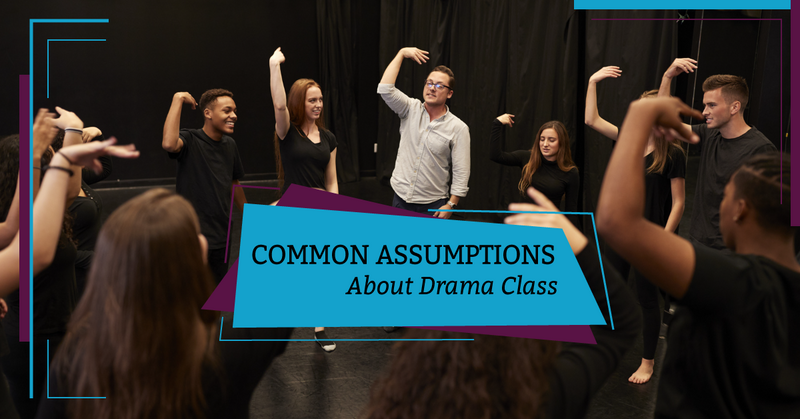
Common Assumptions About Drama Class
There are lots of reasons why students choose to take drama class. But unfortunately not all of them are positive reasons. On the other hand, students also come up with lots of reasons to avoid taking drama class. In this article, we look at four common assumptions students often have about taking drama class, with different thoughts about why these assumptions are false.
1. “I’m taking drama because it’s easy.”Teachers, we know that drama class isn’t easy. But unfortunately some students will take drama because they think they’re going to breeze through it, and not because they are actually interested in drama .
At the beginning of the semester, it is useful to sit down with your students to find out their thoughts, expectations, and goals for taking drama. If students respond that they think drama class is easy, be sure to have them describe why. With that information, you can then work with your students specifically to teach them that drama class isn’t necessarily easy; it’s different, and that’s a good thing.
Go through your course syllabus with your students and discuss the differences from other classes. For example, does your drama class have a final written exam, or a large practical project (say, selecting and directing a scene) instead? What does the project entail? How many hours might a student spend working on this project, compared to studying for a math exam? How much physical energy does a student spend choosing, memorizing, rehearsing, and performing a monologue (for example) versus completing an essay in English class? Which is “easier,” and why? If students don’t know, it’s okay. You can come back to this discussion when you are working on those specific units.
This is also a great opportunity for students to work on their empathy skills. Remind students that just because one person thinks that something is easy, it doesn’t mean it is easy for everyone else.
A word of caution – when working with students on the “easy versus different” concept, you will need to find a balance between sounding desperate to legitimize your drama program and scaring students into thinking they’ve signed up for an impossibly difficult class. It is important to listen more than speak, and allow your students to lead the discussion. It also may be useful to discuss how the skills in drama class can be applied to many different situations – in other classes and in the “real world” as well. Check out What Skills do you Need to Work on a Show for more.
2. “I’m only taking drama because I hate visual art/music/dance.”Students are required to have an arts credit in order to graduate, and many students take drama because they think they can’t draw, read sheet music, or coordinate their limbs. However, visual art, music, and dance feature heavily in drama classes!
Students may not be learning traditional dance technique in drama class but they will be exploring different types of movement and ways of communicating by using their bodies (think mime, tableau, or stage combat). Students will explore different vocal sounds and sound effects, soundscapes, and how music can affect a scene. And if their drama class has a musical theatre unit, students may end up singing anyway! Maybe students don’t use pastels and gouache, but they will eventually design and create props, costumes, and sets, either by drawing/painting and constructing the items or by using found objects creatively.
Drama is one of the most cross-curricular subjects out there, so regardless of students’ opinions on visual art, music, and dance, they’ll eventually use those skills in the drama classroom. Discuss the term “cross-curricular” with your students. Have them come up with ways students learn and practice cross-curricular skills in drama class, as well as how skills in the drama classroom can be used in other classes. Take it a step further and have students create brief scenes from this brainstorm – use the “Dramatic Rules” game as a framework.
3. “I’m not going to be an actor, so I’m not going to learn anything in drama class” or, “It’s not useful for the future.”We wrote a whole post about how studying drama benefits students outside the drama classroom! The skills that students learn in drama class are definitely transferable to so many life experiences, including time management, problem-solving, dealing with nerves when they arise, and growing confidence.
On top of that, there is a myriad of theatrical jobs that are not acting jobs: technical roles, design roles, stage management, sewing, construction and carpentry, musical direction, choreography, front-of-house and box office roles, theatre management roles, and more. Drama class is not just for actors!
4. “You have to be super creative to take drama” or “I’m not creative enough to succeed in drama class.”When it comes down to it, creativity is all about trying new things. Students often feel that they aren’t creative. Or they compare their perceived creativity (or lack thereof) to that of others. Drama class is not about who is the most creative. It is about being brave and willing to try new things. Each student is different, and you never know what might inspire some unexpected creativity.
There are so many fascinating aspects of drama class that there is bound to be something to make each student feel confident, successful, and creative. It could be one of many different types of design, stage management, playwriting, directing, singing, improvisation, creating scenic elements. It just takes bravery and patience on the part of students to find that particular thing that works for them. Check out our articles Kicking Creativity out of the Drama Classroom and Prompting Creativity in the Classroom for more.

Classroom Exercise
Making Assumptions About Characters
An assumption is when someone accepts something as true about a person, place, thing, or idea without proof. People do this all the time, often without thinking. We assume all sorts of things about others: That student has a designer bag, so they must be rich and snobby. That student answered that easy question wrong, so they must be pretty stupid. The teacher gave me a bad grade on my project, so they must hate me.
By making assumptions, we open ourselves up to all sorts of negativity: feelings of jealousy, resentment, frustration, self-pity. We also risk causing conflict, particularly if the person we make assumptions about finds out and disagrees with our assumption.
In plays and musicals, assumptions frequently create conflict and drive the plot of the story. In Shrek: The Musical, Shrek overhears a conversation and assumes that Princess Fiona thinks he is an “ugly beast” (she is actually describing her feelings about herself, being cursed to turn into an ogre at night), which causes him to storm off in anger and treat Fiona badly the next day. In Legally Blonde, Warner breaks up with Elle, assuming she is just a silly sorority girl who isn’t serious about anything, until she proves him wrong by getting into Harvard Law School. In The Lion King, Simba runs away after his father Mufasa is killed, as he assumes he will be blamed for Mufasa’s death. This is further complicated when Scar tells the rest of the pride that Simba was also killed and the other lions believe him.
In all three situations, the characters believed that what they were experiencing was true, without looking for proof otherwise. This creates conflict, which makes for an interesting story, as the audience waits to see if and how the conflict will be solved. Assumptions, in this case, can be a useful tool when creating a new theatrical piece.
If your students are feeling stuck when working on a playwriting assignment or when attempting to devise a scene, have them try this assumption exercise to get their ideas flowing. Start by having students consider the following:
• Think about a time when someone made an assumption about you,
OR
Think about a time when you made an assumption about someone else.
• Did the assumption turn out to be correct or incorrect?
• How did it make you feel?
• How did it make the other person feel?
• Did the assumption lead to conflict?
• Were there any consequences or fallout from the result of the assumption?
From there, divide the class into groups of three. Using the ideas they brainstormed, groups will select one idea to use in creating a brief, one-minute scene where one student plays a character that makes an assumption about another character, played by the second student. This assumption creates a conflict of some sort. The third student can be used in any way that helps the scene progress. Perhaps they are a character who tells the second character that the assumption was made, perhaps they are a mediator who helps solve the conflict, or perhaps they are a friend to the first character who makes the conflict even worse by adding another assumption to the mix. Give students about ten minutes to plan their scene, and then have them present to the rest of the class.
After each group presents, have the rest of the class discuss the following questions:
• What was the assumption that was presented in the scene?
• How did it create conflict between the characters?
• How did it make the first and second characters feel?
• How was the third character used?
• Did the third character improve the situation or make it worse?
• How could the presented scene possibly be developed further into a new or larger piece? What could it be used for?