Facebook Pixel Skip to main content

📣SCRIPT SALE! Treat yourself to an easier Fall. Save 30% on 5+ perusal scripts with code SPRING30 before May 3 and head into summer stress-free.

Lesson Plans

Character Study in the Drama Classroom
Teaching Drama

Character Study in the Drama Classroom

Ideally, we want students to study characters and bring them to life through scene work. But what if you have students who have been away during rehearsals and you need a related activity for them to complete? Or you need an emergency lesson plan that focuses on individual work? Character study could be just what you’re looking for. Analyzing characters in class is a great way to help students move from simply reading a text to truly understanding it. A well-designed character study lesson (click below to download one right now!) does far more than teach students to identify traits; it develops critical thinking, empathy, textual analysis, and self-reflection skills. From Reading to Critical ThinkingAt its core, a character study lesson invites students to ask deeper questions: Who are these people? What motivates them? What evidence supports our interpretations? To answer these questions, students need to engage with the text. This can be highlighting key details, lines, and moments; distinguishing between facts (unchangeable information directly stated in the text) and assumptions (interpretations that may vary from reader to reader); and inferring character traits. Have students support their conclusions with textual evidence. Instead of saying, “This character is selfish,” they must prove it with a quote from the script. Building Empathy Through PerspectiveCharacter analysis can also build empathy. Have students reflect on their analysis with questions such as: • Who do you connect with most? • Who do you connect with least? • Who would you want to play or not want to play, and why? This gives students the opportunity to explore identity, perspective, and personal values. Imagining what a character looks like, how they move, and how they think pushes students to see the world through someone else’s lens. The reflective writing component can transform analysis into personal growth. Students must synthesize what they’ve observed and explain their thinking clearly in their own words. This reflection reinforces self-awareness, independent thought, and ownership of interpretation. Because analyzing a character is subjective, and there is rarely one “correct” answer, students learn that their insights are important.
Lesson Plan: Using the Arts to Navigate Life
Teaching Drama

Lesson Plan: Using the Arts to Navigate Life

How do the arts make life more bearable? Click below to access a one-class lesson plan that uses this George Bernard Shaw quote as its starting point: “Without art, the crudeness of reality would make the world unbearable.” Here’s a sneak peek: ObjectiveStudents will be able to: • Analyze the quote and connect it to their own experiences. • Identify ways in which the arts help people process. • Create an artistic response to demonstrate understanding. DescriptionIn this lesson students will discuss the George Bernard Shaw quote and consider how the arts make life more bearable. Students will explore and analyze works in different mediums that demonstrate how art is used to express emotions in wartime. Students will then apply this knowledge through a short theatrical expression that reflects on how art can transform or interpret reality. Note: You know your students best. Pay attention to how they’re responding to these discussions and whether you need to take a break. The point is not to upset students. Time Management: This lesson is scheduled for 60 minutes. If your classes are longer or shorter, adjust accordingly.
Emergency Lesson Plans: Middle School Drama Class Task Sheets
Teaching Resources

Emergency Lesson Plans: Middle School Drama Class Task Sheets

The Emergency Lesson Plans: Middle School Drama Class Task Sheets resource is specifically designed for the middle school drama teacher. Everything you need is at your finger tips: task sheets with activities in drama subjects such as playwriting, design, theatre jobs, and theatre vocabulary; a template lesson plan with substitute teacher fill-in forms; and teacher notes with activity time management and suggestions for how to address industrious students. You’ll never worry about being unexpectedly absent again!
Playing to Your Students’ Strengths
Teaching Drama

Playing to Your Students’ Strengths

Drama teachers understand that we must plan our curriculum around the standards established by school boards, administrators, and other leadership. But whenever possible, it’s wonderful to incorporate the strengths and interests of your students into the assigned curriculum. That doesn’t mean letting students dictate every moment of drama class, doing an entire semester of only improv, or trying to find a show with 30 starring roles. It means that you’re showing care for and interest in your students, that you’re listening to their thoughts and opinions, and that you’re being flexible, adaptable, and thoughtful in your lesson planning. You aren’t just doing the same thing year after year; you’re continually growing and evolving your approach. It can also help you to reach out to and connect with students who are reluctant to participate or who aren’t taking drama class by choice. Making those connections and showing students how aspects of theatre can relate to them personally can make their drama class experience much more pleasant. These are all key ingredients in a recipe for success. Let’s think of some drama class scenarios. What are your students’ strengths? Perhaps you’ve got a class full of hilarious students who love cracking jokes and making each other laugh. Use that energy and consider teaching a unit on commedia dell’arte, having students try their hand at writing sketch comedy scenes, or creating costume designs that make others smile, such as a new outfit for a Weird Barbie-type character. If you’ve got a class full of athletes and sports aficionados, they might enjoy movement-based drama units such as stage combat, dance, or puppetry, and studying plays and musicals like The Wolves, Chariots of Fire, Rocky, or Bring It On. Student activists and future leaders might really appreciate activities focused on community service, opportunities to direct, stage manage, or problem-solve, or coming up with sustainable ideas for theatre, such as creating sets out of recycled materials or researching eco-friendly lighting boards, sound systems, and makeup suppliers. Computer wizards and social media moguls can discover (or build!) the best apps for theatre tech and ticket sales, create viral marketing plans for upcoming shows (actual school productions or exercise-based), or study shows featuring social media use, like The Prom or Dear Evan Hansen. Students can use their strengths and skills in many new and different ways in the drama classroom. Furthermore, incorporating your students’ personal interests into your lesson plans can really help to engage them and increase buy-in on certain topics, especially ones that they may be less interested in or nervous about. For example, perhaps some of your students are big professional wrestling fans. For a monologue unit, they could write and perform solo pieces where they are “cutting a promo” (wrestling-speak for performing a monologue to advance a storyline). Or maybe your students are big Swifties — in a playwriting class, you could have those students write quill pen, fountain pen, or glitter gel pen scenes, inspired by Taylor’s songwriting process. Marvel and DC fans could design and build new costumes and tools for or inspired by their favourite superheroes and villains. The possibilities go on and on. What if you don’t know what your students’ strengths and interests are yet? Use a questionnaire to find out what they’re interested in, what their skills and strengths are, and why they’re taking drama class. You might find that there are a few similar topics that most students want to explore, so if it’s possible, spend more time on or do a deeper dive into those topics. If there is a wide variety of interests expressed, perhaps an independent study assignment where students pitch their own topics could be a good final project. You can even use the questionnaire results to help with tasks such as creating bellwork questions or exit slip topics: Would you rather watch a monster truck show or go to the ballet? What is your greatest strength, and how can you use it in drama class? If you could become an expert on a topic, which topic would you choose and why? You’ll find a sample questionnaire in the giveaway below; feel free to use it as is or adapt it to suit your students’ needs.
Writing Lesson Plans for the Drama Classroom Toolkit
Teaching Drama

Writing Lesson Plans for the Drama Classroom Toolkit

Lesson planning is the backbone of effective teaching. Think of lesson plans as your classroom's roadmap—they guide everyone toward shared learning goals. When they're on point, the classroom runs smoothly; when they're not, learning stalls. Our Writing Lesson Plans for the Drama Classroom Toolkit will break down the essentials of a standard lesson plan, show you how to adapt it for theatre, and help you integrate Bloom’s Taxonomy and National Standards for Theatre, all while keeping state standards in focus.
Setting Up Your Theatre Curriculum
Teaching Drama

Setting Up Your Theatre Curriculum

Curriculum is the cornerstone of your entire teaching foundation. Your curriculum is the roadmap that tells you what, when, why, and how you will teach your students. However, there is no “official” curriculum for theatre, and if you have never set up a curriculum before, it can be daunting. If you’re a new theatre teacher worried about planning your curriculum, here are the steps you will need to take to get your curriculum up and running. Choose SubjectsAs stated above, there is no standard curriculum for theatre. However, there are fundamental ingredients of theatre and drama that should be included in any formal curriculum, including acting, history, and design. In addition, there are other subjects that you could include based on your training and interest as a theatre teacher, like playwriting, directing, and technical theatre. No matter what subjects you choose to include in your curriculum, it’s essential that you are confident in your knowledge of the materials to be covered. The most important rule of building a curriculum is: teach what you know! Do not include a subject you are not prepared to teach. If in the future you decide you want to expand your curriculum, take the classes or do the research necessary to make you “teacher fluent” in a subject before you include it in your curriculum. Choose Your FormatCurriculums are typically built in one of two formats: subject-based or chronological. Subject-based combines units within a subject that are taught under a specific heading. For example, an acting unit can contain lessons on pantomime, improvisation, monologues, and scenes, with the lessons introducing new skills as the days and weeks progress. After the acting unit you can move on to history and cover material from ancient theatre to modern times, and so on. A chronological curriculum would start with the ancient Greeks and cover all aspects of theatre during that time including acting, design, and playwrights of that era. Then you would shift to a different era, such as Roman theatre, and cover the same fundamental building blocks of acting, design, and playwrights. You would continue to move through different eras until you arrived at modern theatre. Both of these curriculums cover the same general information, but they are presented in different ways. Build UnitsOnce you have decided upon the format of your curriculum, you can begin to build the specific units you wish to present. Units form the building blocks of information for each major subject you teach. For example, the acting unit might include subcategories like pantomime, storytelling, improvisation, monologues, and scene work as the building blocks of acting. All of these subcategories fall under the general heading of “acting” so they will be part of your acting unit. Break down the other units in similar ways, choosing the specific topics and subcategories you wish to cover, and then determine the order in which you will present them to your class. Once you have assembled the units you plan to cover, you can begin to write your lesson plans. Write Lesson PlansLesson plans are the essence of teaching in written form. A good lesson plan provides maps, mission statements, launching pads, and a contract between you and your students. Writing lesson plans allows you to map out the content of your classes down to the minute, and track the progress of a classroom full of students towards mastering a subject. When you write a lesson plan, think about the What, Why, and How of the materials you are presenting: • What information do you want students to learn? • Why do they need to learn it? • How will you teach it? Then write your lesson plans in enough detail to execute them exactly as you envisioned. They will not always turn out that way (see below), but the more thought and detail you put into your lesson plans, the better chance they will have for success. If you want more information on how to write lesson plans, check out the Lesson Planning Toolkit. Reflect On Your CurriculumThere is an old military saying that I repurpose for teaching: “No lesson plan survives first contact with the students.” That means that no matter how exciting and well thought out a lesson plan is, it will change once students are involved. Sections will go faster or slower than expected. Student groups will act up unexpectedly. A sure-fire warm-up game will flop. You will learn a lot about a lesson plan the first time you present it to a class, but you won’t have time to think about it, because as soon as one class is over, the next class is already coming through the door! It’s important to set aside a chunk of time each week to reflect on your curriculum and make notes about what went well and what you need to change. If you don’t give yourself the chance to reflect on your curriculum while it’s fresh in your mind, you’ll find yourself making the same mistakes year after year. So give your curriculum the best chance to succeed by taking time to reflect.
Current Events: Diversity in Theatre Lesson
Teaching Drama

Current Events: Diversity in Theatre Lesson

The following lesson was created for students to discover, appreciate, and display respect for diverse, real-life issues and events in the theatre world. It can be done live in class, assigned as homework, or as part of distance learning. You may wish for students to submit this as a written assignment or create an oral presentation from the information. Instructions:1. Students will complete an online search for a current event in the theatre world where diversity is the focus. This event could be expressed as a written article, a podcast, a video, or another news source. Topics might include casting choices, opportunities for transgender and nonbinary actors, LGBTQ+ issues in theatre, lack of diversity in current shows being performed, opportunities for performers with disabilities, representation in current theatre productions or in playwriting, diversity in technical and artistic staff roles (not just actors), successes of and accolades for diverse theatre-makers, neurodiversity in theatre, and so on. Here are some notable events in the last few years that might help get your students on track: • Brittney Johnson was the first Black woman to be cast as Glinda in Broadway’s Wicked, which premiered in 2003 (2020). • Ali Stroker was the first performer who uses a wheelchair to win a Featured Actress Tony Award, but had to be seated backstage during the category presentation and could not join her castmates onstage during their Best Revival of a Musical win because there were no ramps available in the theatre (2019). • Mj Rodriguez, a Black, transgender actress, was cast as Audrey (traditionally cast as a white, cisgender actress) in Little Shop of Horrors at the Pasadena Playhouse (2019). • Beaumaris Theatre (Australia) canceled their production of Little Shop of Horrors after accusations of whitewashing (2021); this follows a similar incident when a different Australian company cancelled their production of In the Heights due to the same complaints (2017). If students are having difficulties finding articles specifically about theatre, you may wish to permit them to include events in television or film as well. 2. Have students respond to the following questions as either a written response or a oral presentation: • What event did you choose and why? What format is your event expressed in (written article, podcast, video, or other news source)? • Identify the main focus of the author(s). What is the heart of the issue being presented? Summarize it in your own words in one sentence. Why is this topic important? • What is the tone? Is it informational, inspirational, biased, accusatory, critical, uplifting, gossipy? What do you think the author’s intention is, based on the way they presented the information? Is it effective? Why or why not? • Is there a call to action? Consider how the information brings awareness to the issue in the theatre world going forward, or how the issue could have been improved or fixed. If there isn’t a call to action, create one. What do you think it could be? 3. Discuss afterward. What did students learn? What surprised them? What could students do in the classroom or upcoming productions to address the issues raised?
Lessons Learned from Directing a Virtual Show
Distance Learning

Lessons Learned from Directing a Virtual Show

If you miss doing shows with your students, you’re not alone. We’re all missing live theatre! Luckily, there are playwrights writing virtual plays for online platforms that you can do right now. Check out the available shows in the Theatrefolk catalogue. While you’re at it, check out the following lessons I learned while directing my first virtual show. I hope they help you on your virtual show journey! Know the rules.Be aware when you’re selecting your show that different theatrical rights companies have different rules and requirements for streaming online shows. Some companies require you to use a particular streaming and/or ticketing platform. Some companies allow you to purchase “on demand” tickets (meaning audiences can watch the show at their leisure), while others only allow performances to be streamed at a particular time (like going to the theatre for real, so if you miss the streaming time, you’re out of luck). Some companies also don’t allow their shows to be presented online at all. Be sure to check all the requirements before you select a show to produce, and contact the company with any questions ahead of time so you don’t risk disappointment — both your own and your students’. Zoom fatigue is real.Try to keep virtual show rehearsals shorter than you would when rehearsing a show in person. I found that two hours was my limit for being able to focus during rehearsal. It’s hard to feel a true connection when rehearsing online, and you will likely have to use even more energy than you usually do because your students are tired too. To combat this, let your students know in advance what you’ll be rehearsing at each rehearsal and encourage them to familiarize themselves with the scene and their lines ahead of time. This doesn’t mean they need to be off-book before you’ve blocked the scene, but they shouldn’t be wasting time reading their lines for the first time during rehearsal. (This goes for in-person rehearsals as well, but it’s extra important when you have limited rehearsal time and waning focus.) Mix up what you’re working on — call smaller groups to rehearse shorter scenes for a shorter amount of time when you can, to break up the time and keep your mind fresh. Record footage as you go.Have clear deadlines in place for students to record and submit their footage at home. When I directed She Kills Monsters: Virtual Realms, we rehearsed on Thursdays and Saturdays, and the scenes that were rehearsed that week were due to me by the following Wednesday. Recording and uploading footage as you go makes things much easier. It reduces stress on students, because they won’t have a huge backlog of footage to record all at once. As well, if there are any issues with the recording (volume problems, incomplete footage, recording portrait rather than landscape, etc.), there will be time for students to re-record the footage. Make sure your final due date for all footage (no matter what) allows plenty of time for the final project to be submitted to your streaming service. Allow yourself plenty of time to work on the footage, so you aren’t editing for 24 hours straight the day before the show is due. Allow yourself some wiggle room to submit the final project as well in case of technical issues with your editing software or Internet service. On the topic of editing:If you can, hire an editor to piece the audio and video footage together. It is time-consuming, tedious work, and it will be one less thing on your plate. Do you have a student who is keen to take on the project for extra credit? Volume and diction is important.Students still need to project their voices when they’re performing for the camera. Many students think that because they’re close to their device and alone in a room that they can speak in their “regular” tone. While they aren’t in the theatre and having to make sure the entire audience can hear them, volume and diction is still important. There are many things that can affect sound levels when recording, such as background noise (even ambient noises like the hum from overhead lights, a fan going in the room, or pipes running) or the audio quality of the student’s device. Students may also hold back when they’re recording themselves because they’re worried or embarrassed that their family will overhear them. However, you can only crank the audio so high when you’re putting the footage together, and having one student noticeably quieter than the rest of the cast will make it difficult for your audience to understand what’s going on (just like in in-person theatre!). Have fun.You and your students are getting to do theatre — not the way you’re used to, true, but you’re still getting to do something together! Your students are learning new skills: acting for the camera, framing and camera work, creative problem-solving. Rather than focus on the negatives of being away from each other and missing the feeling of being onstage, try to focus on working on a new creative endeavor together. On top of that, you’re caring for each other’s health and safety by doing a virtual show.
Tips for Adapting Existing Lessons
Distance Learning

Tips for Adapting Existing Lessons

How do you adapt existing lessons to a virtual environment? The goal is to adapt without reinventing the wheel, which is an added unnecessary stress. Some lesson plan elements will remain the same and others will need adaptation. Here are five things to consider: *1. Keep the general structure of a traditional classroom lesson. *If you started every class with a journal prompt and ended every class with an exit slip, keep that structure. If you started every class with a check-in (How are you feeling?) and ended every class with a check-out (What did you learn today?), this is a routine that students are used to. Keep the routine because it tells students that you consider virtual lessons as important as traditional lessons. You may have to adapt the way you present elements. For example, students will not be able to take a hard copy of an exit slip and hand it in as they exit class, but you can have students keep a journal document and submit it every few weeks. *2. Focus on interactive instruction. *Students will focus and listen differently in a virtual environment. They are more distracted. Sometimes it’s for a good reason and sometimes they’re texting. The biggest change in your lesson will be your method of instruction. It won’t be enough to present instructions, ask the class if they have any questions, and expect execution. It will be much harder to read the room and measure student engagement. Consider interactive instruction. Ask individual students by name to state their next task. Ask individual students to recall a point of information. Don’t assume students understand an assignment because they don’t ask questions. *3. Remove the pacing expectations of a traditional classroom lesson. *Everything takes longer in a virtual environment. You also may have less time with your students. A unit that takes one week in a traditional classroom may take twice as long online. As you work through virtual tasks, don’t get frustrated because it’s not working the same way it did in your classroom. Remove pacing expectations. 4. Adapt class discussions.If you love having class discussions with students, be aware that you may have to change how you prompt those discussions in a virtual environment. From behind a screen, it’s easier for students to simply not respond. You may need to direct discussion questions to individual students. Call them by name and ask for their response. *5. Create a vocabulary of online tasks. *You probably establish a working task vocabulary in your traditional classroom. For example, if you say “audience seating,” students know to sit on the floor in lines simulating an audience. Giving your virtual classroom a vocabulary of tasks not only helps with routine, it equates virtual work with traditional classroom work. The terms and their definitions are up to you. Teach and practice the execution of whichever terms you choose. Examples: • Recall: Students recall a point from a section of information you’ve just given. • Check-In: Students recall their next task. • Respond: Students give their opinion on a topic. • Brain break: Stand and stretch for one minute.
Tips for Adapting Lesson Plans to the Virtual Classroom
Distance Learning

Tips for Adapting Lesson Plans to the Virtual Classroom

Drama isn’t always the easiest subject to adapt to distance learning. So much of what makes drama fun and worthwhile involves human interaction. Seeing students engage with one another, create connections, and interact as a group while exploring different ways to use their bodies, minds, and imaginations is what drama class is all about. But don’t despair – we’re here to help with some tips to make your life easier when adapting your lesson plans to the virtual classroom. 1. Start with what you have.You don’t need to reinvent the wheel and create a whole set of new lessons for the virtual classroom. Look at your current lesson plans and think about whether your students could do the assignments in their homes, with limited resources. Consider how you could present your material in different ways. Can you present the lesson verbally via a video conferencing app? Could you record yourself giving the lesson and make it into a private YouTube video for your students? Do you have lectures or notes that you could convert to articles, worksheets, or PowerPoint presentations, so students can study the material on their own time and at their own pace? Do you have homework assignments or ISPs that you could turn into lessons? The good thing is that once you have adapted the lessons you already have, you can use them again with future classes. 2. Begin with projects that students can do individually.Go easy on yourself and start by considering lessons, exercises, and assignments that lend themselves to individual work and study. Playwriting, monologues (reading, writing, performing), theatre history, research projects, analysis (scene, line, song, character), design work, business of theatre exercises, theatre trivia, compare and contrast exercises, journaling and reflections can all be completed individually and submitted via email or your school’s virtual classroom program. These projects can be written assignments, video assignments (either performed live or recorded), or a combination of both. 3. Group work is definitely doable!While individual studies are useful, we don’t want to limit ourselves and our students to only independent study. Reading scripts aloud as a full group can be a lot of fun. Full class breathwork, mindfulness activities, and visualization exercises are all beneficial for students both during drama class and in their outside lives. If your platform supports breakout rooms, you can divide students into smaller groups. You can do class brainstorming and discussion over video conferencing, but you’ll need to come up with a signal to ensure students don’t interrupt each other. You can do full group improvisation exercises such as Word at a Time Story by assigning the order of participation in advance (e.g., in alphabetical order – this also is a great way for students to practice coming in for their cues!). You can do improv exercises that require pairs, such as Job Interview and Scenes from a Bag, by having two students do the exercise while other students observe – just like in the physical classroom. Note: some students are more self-conscious on camera than they are in person. One option is to have those watching turn off their cameras during presentations. Choral work or group singing exercises can be challenging due to microphone and video lag, but depending on your technical abilities, you may be able to have students use a click track or backing track to keep them at the same tempo, and have them record their parts for you to edit together. Live choral work over video conferencing technology is difficult due to differences in internet, video, and audio speeds. When planning smaller group work, try to avoid assignments that require a specific number of students. It can be difficult to know whether students will show up for virtual classes, so whenever possible, ensure that the number of students required for the exercise is flexible. 4. Use new challenges to your advantage.A great problem-solving exercise can come from figuring out solutions to new theatrical challenges in the current global situation, or problems that may arise post-pandemic. For example, how could a director stage the spit-take scene in The Drowsy Chaperone without actually having a student spit water in another student’s face? How could someone directing a fairy tale play stage a scene that requires “true love’s kiss to break the spell” while having to follow physical distancing requirements? What would you do during a Zoom production if someone’s internet connection breaks mid-scene, or someone’s microphone stops working? Have students brainstorm a list of new theatrical production challenges, and then come up with ideas on how to solve them. 5. When in doubt, simplify.As much as possible, avoid assignments that require a lot of extra materials – art supplies, props, costume items, stationary, etc. Not all students have access to lots of different supplies in their homes, or the ability to go out and buy supplies. You’ll need to provide access to readings, scripts, and audio/video examples if you use them. Remember that some students may have to share devices with siblings or parents or have old or outdated technology that lags, so as much as possible, leave some wiggle room for technical issues. For example, be aware of whether aural clarity issues are due to a student actually having trouble with their volume and diction, or they’re just dealing with a crappy microphone that sounds tinny in their living room. Try to look at lesson adaptation as an opportunity to refresh your materials, challenge yourself to come up with creative staging solutions (only this time your stage is your virtual classroom), and focus on the topics you really enjoy teaching. Focusing on the topics that bring you the most joy will make the adaptation process easier, because you will be more engaged and determined to make it work. You can do this! And don’t forget, there are lots of resources available at the Theatrefolk distance learning page. We’re here to help!
Create and Perform a Radio Play
Classroom Exercise

Lesson Plan: Create and Perform a Radio Play

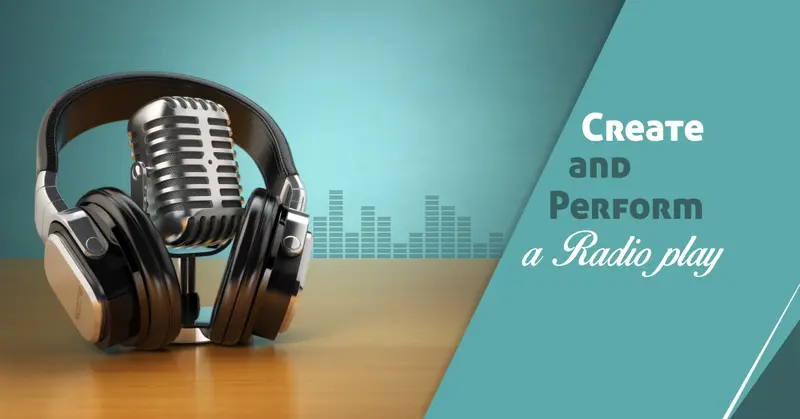
Radio plays are theatrical performances that are purely auditory; they’re meant to be performed on the radio, hence the name! There is no visual aspect, so performers must rely on their vocal performances as well as sound effects and music to convey the story to the audience. Radio plays are fantastic for students to practice and develop many performance skills like projection, diction, and using emotion, without the pressure of actually getting up and performing in front of others. It also gives students the opportunity to creatively work with playwriting, selecting appropriate music, and creating sound effects. The following exercise gives students the chance to create their own radio play using a children’s story as the source material. They will then have the opportunity to perform their play for the rest of the class (either a live or pre-recorded performance). Click below for a four class Lesson Plan version of the exercise! Pre-Assignment: Play examples of radio plays for students. This will reinforce for students that all storytelling aspects have to be oral – there are no visuals! You should also look for some examples of radio play script formatting. It’s a different medium than a regular stage play. 1. Selecting the Source Material Students will form groups of 4-6. In their groups, students will select a children’s story to adapt into a radio play. 2. Writing the Play Students will adapt the children’s story into a script. Remind students to follow the radio play script formatting. Many radio plays use a narrator to set the tone of the story, switch between scenes (“Meanwhile, back at the ranch…”), and to keep the action going between character’s lines. Focus on creating really clear, strong, descriptive lines by using adjectives and “sense” words (sight, smell, taste, touch, sound) to set the mood. For example: • “Jessica sauntered into the room in a shimmering green evening gown.” • “The scent of freshly-baked cinnamon cookies made Mike’s mouth water.” • “A frightened Kyle peeked out the window to see a tall, sinister-looking man skulking around the garbage cans.” • “The wolf grinned menacingly, revealing a huge set of glistening-white, razor-sharp teeth.” 3. Choosing Appropriate Music and Sound Effects Students will choose at least 3 clips of music (one for the beginning of the piece, one for a significant part of the middle of the piece, and one for the end) to use in the play, as well as at least 5 sound effects. These sound effects can be found online or in a sound effects library, or they can be created live. Students must ensure that the music and sound effects are appropriate for the scene while not overpowering the vocal performances. 4. Casting and Rehearsing the Play Students will each take a role in the play and develop an appropriate character voice for their part, focusing on clear diction and enunciation, and showing emotion. Remember that there’s no visuals, they have only their voice to work with. Students should rehearse their roles so they are comfortable and familiar with their words. Performances do not have to be off-book, but will be MUCH easier if students are well-rehearsed. NOTE: If there are not enough roles to go around, one student can be solely in charge of performing the sound effects, or the narrator role should be split up. Alternatively, students can adapt their play to include more characters. 5. Performing the Piece Students have two options to perform the piece: LIVE: Students will perform the piece live, in front of the rest of the class. The rest of the class will face away from the performers while they are presenting, so the group cannot use visual clues to tell the story. Music and sound effects will be performed as part of the presentation, either performed live or by utilizing prepared music and sound effects (on a computer, CD player, or MP3 player). PRE-RECORDED: Most cell phones come with an audio recorder, or students can create their performance using a microphone and audio recording software on their computers (like Audacity or Adobe Audition). Music and sound effects will be performed during the recording, either performed live or by utilizing prepared music and sound effects. The recorded performance will be brought to the class and played for the rest of the class to listen to.
Top 10 Tips For Writing Awesome Lesson Plans
Classroom Management

Top 10 Tips For Writing Awesome Lesson Plans

If you’re starting out in your drama teacher journey, you will learn very quickly that lesson planning is the bane of your existence. It is never-ending. You may need to show your lessons to an administrator. You will probably have to come up with extra lessons to have on hand for a substitute. Every class needs a strategy to get you from the beginning to the end of the year and the building blocks of that strategy will be your lesson plans. When they’re working your class will run smoothly. If they’re not working, your class will suffer. Where do you start? When you’re writing your own lesson plans, follow these top 10 tips! If you want ready-made lesson plan help, keep reading! 1. Use a template. Why try to reinvent the wheel every time? Put together a Lesson Plan Template and fill in the blanks. Common sections: Objective, Materials, Standards Fulfilled, Pre-Lesson Information, Instructions, Assessment. Click below for a fillable Lesson Plan Template. 2. Define the objective. What do you want students to accomplish by the end of the lesson? What transformation do you want them to make? 3. Work backwards. What’s the last thing you want students to do to achieve the objective? Create a scene? Take a test? Write a reflection? How will students be assessed? Know your endgame and work backwards. 4. Itemize the before. What do students need to know or have done before they take on this lesson? Does anything need to be reviewed? 5. Devise a model. This is especially important if you’re teaching a new exercise or skill. Model the exercise and your expectations for the lesson. 6. Decide on a method. What’s going to be the best method of delivery for this lesson? Write it down. 7. Be flexible. Lessons on a piece of paper are just that — paper. Your students are human and their behaviour is going to change depending on the day. Be prepared to adapt. Have alternate exercises in your back pocket. 8. What do you need? Put it in the lesson plan. Need to make copies? Need to have any equipment on hand? Don’t leave anything to your memory. If it’s on paper it doesn’t have to be remembered. It’s right there. 9. Don’t work in a vacuum. Can you write a series of lesson plans that take place over a number of classes? 10. Questions to ask. What are my students learning? What is the objective? How are they learning? What do students need to know before we start the lesson? What will my students do in the lesson? Why are they learning it? How is it relevant? What standards does it meet? What will my students know by the end of the lesson? How will they apply it in the future? How will I know students have met the objective? I need more help! Where do I go? Theatrefolk has you covered. The Drama Teacher Learning CentreExplore our learning centre to discover a ton of classroom-ready exercises regularly created specifically for drama teachers. Articles, writing prompts, acting/directing/teaching tips, resources, warm-ups, games, classroom exercises, reflections, and so much more! All of this will make your lesson planning easier. The Drama Teacher Academy
Commedia Dell’arte in the Drama Classroom
Acting

Commedia Dell’arte in the Drama Classroom

Commedia dell’arte is an improvised comedic theatre form that flourished in Italy in the 1500s. The exact origins of commedia are fuzzy and hard to pin down; there is not much documented previous to the 16th century. The term itself wasn’t commonly used until the 18th century. It is generally acknowledged that the form solidified in Italy in the 1550s and reached its peak in the 1650s. But despite an opaque history, the elements that define commedia are quite clear: • Improvised performances based on scenarios: Actors worked off a base outline and made up their lines. • Stock characters: The characters were always the same; only the situations changed. • Limited themes: Love, money, or food were the base of almost every scenario. • Use of mask: The mask defined the characters. • Use of lazzi: Short comedic physical bits within the story. • Use of mime, acrobatics, and music. So why should you include a commedia unit in your curriculum? It builds strong physical acting skills.Commedia dell'arte is highly physical and expressive. Because the style relies on stock characters and masks, actors must communicate emotions through posture and movement rather than facial expressions. Students learn an exaggerated style of character physicalization, clear body language, spatial awareness, and comedic timing — all great skills for a well-rounded actor. It strengthens improvisation.Commedia performances were built around loose story outlines (called scenarios), not full scripts. Commedia scenarios actually provide a pretty safe improv experience for students: Actors play characters who never change and have very set behaviours, wants, and physical movements. Students will always have a clear picture of how their character will respond in any improv moment. Commedia will give students the opportunity to practice foundational acting skills like thinking on their feet, listening, and reacting. It teaches character archetypes.Commedia characters don’t change. There’s no character arch or subtext. In every scenario or story they’re in, the characters remain the same. They have the same attitude, same look, same drive, same physical action. They never learn from their mistakes! These characters are called “stock characters,” also known as character archetypes. They are a type of character (e.g., the clever servant, the lover) rather than realistic or three-dimensional. The chance to play an archetype offers a unique experience for students as each character has a defined stance, walk, behaviour, and mask. Also, once students recognize the traits of the different characters, they’ll be able to look for these patterns in modern TV, film, and theatre. Many modern comedic characters can trace their roots back to commedia. It connects to theatre history.Commedia dell’arte began in 16th-century Italy as a response to the tight controls of the Catholic Church. It’s interesting how the characters in commedia who we would think have all the power (the Masters: Pantelone, Dottore, Capitano) are the most foolish and those who we would think to be powerless (the Servants: Arlecchino, Columbina) are the most clever. Status is a huge concept in the relationships in commedia. Learning theatre history helps students see how historical performance styles shape contemporary theatre. It’s fun and accessible!Commedia is bold, playful, and exaggerated. It’s not just an old theatre form, it's the foundation of modern performance. And you may even engage your shy students by using masks to commit fully to a character.
Teach any Lesson Through Drama
Teaching Drama

Teach any Lesson Through Drama

I was one of those math and science kids. But I also loved drama. I started university as a computer science student but left with a degree in theatre. I enjoyed studying calculus, chemistry, physics, etc. But when I think of the atom, when I think of all the lectures I sat through, the drawings, the protons, the neutrons, the electrons, the periodic table and so on, the clearest picture in my mind is still Venus Flytrap’s explanation on the TV show WKRP in Cincinnati. WKRP in Cincinnati, for the uninitiated, was my favourite sitcom. On this particular episode, one of the DJ’s (Venus Flytrap) befriended a cleaning woman at the station. Her son was getting involved with gangs and she asked Venus for help to straighten her son out. Here’s the resulting scene:
Preparing Middle School Students to Perform Monologues
Teaching Drama

Preparing Middle School Students to Perform Monologues

Do you notice any of these common issues when your middle school students perform monologues in competition? • They’re overcome with nerves. • They’re unable to grow their characters beyond memorizing lines. • They can’t get out of their own bodies to physicalize the monologue character. If you want your students to participate in monologue competitions, there’s three things that will set them up for success: • Confidence • Character • Character-driven movement Or more descriptively: • An actor with the confidence to sell those two minutes with everything they can muster. • A strong three-dimensional character. • Gesture and movement that comes from the heart of what that character is going through in the monologue and not from actor nervousness. These three elements are the bedrock of every great performance — not just in middle school, but on any stage. How can you instill them in your students? ConfidenceIt is nerve-wracking to perform in front of others, especially in a competitive environment. Students can practice for days, know that monologue inside and out, then lose it all when they step in front of a panel of judges. What can you do to help students rise to the occasion? • Practice breath control. • Share with students: If you have control of your breath it means you’re calm, you can speak with a full voice, and your body is relaxed. These are all the elements you need to perform with confidence. • Practice breathing exercises with students so that when they are waiting to perform, they have something to focus on besides their fellow competitors. • Click below to download a breathing exercise. • Have a mantra. • Share with students: Say your first line over and over in your head. The first line is always the hardest to get out and the easiest to forget. So repeat that first line like a mantra. Keep saying it until it’s your time to perform. • Fake it till you make it. • Share with students: When you are afraid, don’t say anything. Don’t let on how scared you are. Especially don’t tell the adjudicators. Don’t use nerves as an excuse. Take a deep breath, smile, and go on stage and do your best. Never give anyone a reason to second guess your work. CharacterThe text of the monologue doesn’t tell you everything you need to know about the character. Emphasize to students that the more they know about their monologue character, the more the text will transcend being just words on the page. Focus on showing a character having an experience, not just being an actor performing a monologue. What can you do to help students bring their character to life? • Question and answer • Understanding the “what” in the monologue (i.e., the content) is important, but it’s not as important as the “who” and the “why.” The “who” and “why” are where you find the character’s depth. Have your students answer the following questions about their character: • Who is this character? What details do you know about them? • What details do you need to create to fill in any blanks? • Who are they talking to? What is their relationship with that character? • Why are they talking? Why is it important to share this monologue? • Why is this monologue important for this character? What do they want? How do they try to get what they want in the monologue? • How does the character transform from the beginning of the monologue to the end? What is their beginning emotion? What is their end emotion? • Click below for a handout version of these questions! Character-Driven MovementMore often than not, students stand and move like themselves when they perform. They shift their weight from one foot to the other. They fidget with their clothes and hair. They lean into one hip.These are all nervous movements that take away from a student actor’s performance. If you do only one thing with your students, focus on character-driven movement. That means every single twitch, every single shift of the feet, every single hair twirl has to come from the character. Every gesture must be chosen. Every time a student stands or sits it has to be because the character wants to, not because the student thinks they should throw some movement into their piece. This is how a monologue becomes more than memorizing lines. This is how a monologue becomes an experience — not only for the student, but for everyone watching as well. What physicalization exercises can I do with students? • Character Animal • Pretend your character is an animal. How would they move about the space as an animal? At what pace would they move? Would they creep? Would they pounce? Would they soar? • Do a “day in the life” non-verbal improv where students imagine their character in animal form. As an animal, what would they do all day? • Choose one animal movement and add it to your monologue. How does that change the piece? • Pairs Performing • Practice monologues in pairs: one performer, one observer. Every time the performer shifts their weight or fidgets the observer will raise their hand. How often does that happen? • Just Action • Perform the monologue with just the actions, no words. What does your character look like without the words? • Discuss with students what it’s like to perform the monologue with just action. Are they visualizing their character fully? Confidence, character, character-driven movement. Bring these three elements into your middle school students’ rehearsal process and they’ll take their performances to the next level.
Speeches from History – A Cross-Curricular Unit
Teaching Drama

Speeches from History – A Cross-Curricular Unit

Here’s a unit you can use that combines technology, drama, and cross-curricular learning. Talk about a multi-purpose activity! Since the unit involves speeches, it’s probably best-suited to complement history and political science classes. However, there are also some excellent science- and technology-related speeches out there. A link to these can be found in the “More Speeches” resource at the end of this article. Choose a speechChoose a speech (or an excerpt) that is approximately one to two minutes long. Here are some speeches that stood out to me: • Amelia Earhart on Women in Flight • Jane Goodall on chimpanzee aggression • Louis Beats Schmeling • Harold Lloyd on Slapstick Comedy • Eyewitness Account of Hindenburg Disaster • Ronald Reagan on the Challenger Disaster These can all be found on history.com’s Famous Speeches in History website, which has dozens of audio clips for you to use. Feel free to use any other recording that might suit your specific needs better. Other sources for speeches can be found at the end of this article. Transcribe the speechType out a word-for-word transcription of the text of the speech. Do this task even if a transcription already exists. This step will help you get very familiar with the original recording of the speech, which will help you with the later steps. VocabularyAre there any words or phrases in the speech you’re unfamiliar with? Are there any words or phrases in the speech that seem outdated? What words would you change if you were writing this speech for yourself? ReflectionWhat’s your first impression of this speech? Think like a playwrightImagine that the speech is from a play and the text you’ve just transcribed is part of the script of the play. Re-listen to the speech. Note things like pauses and changes in tone. Update your script to include these changes. ReflectionIf you were the playwright, how would write the speech differently? Think like an actorImagine that the recording you’re working on wasn’t spoken by a real person. Imagine instead that the recording was delivered by an actor playing the role of that person. Reverse-engineer the actor’s performance. Note any beats, pauses, non-verbal sounds, and stumbles that the actor made in the performance. Mark up the script as you think the actor would have marked it up. Click here for information on how to mark up a script as an actor. Spend a few minutes researching the speaker, their era, and the events that lead up to the speech. Complete a character profile for the speaker. Click here for sample questions that can be used to help complete a character profile. Look at the places in the speech where the speaker stumbles, pauses, or makes non-verbal sounds. Decide for yourself why those anomalies are there. Are they on purpose, for dramatic effect? Are they there because the speaker is thinking about or struggling with what they will say next? Is the speaker distracted by something? ReflectionWhat parts of the research did you struggle with? How do actors fill in missing details when they prepare to portray a character? Be the actorYou are now going to learn, stage, and perform the speech. Here are some questions you, the actor, should consider when preparing the speech: • Who is the character speaking to? • Why is it important for the character to speak? • What is the character trying to achieve as a result of giving this speech? Stage the speech. Is the character sitting? Standing? Are they speaking to one person? A crowd? Give the character one significant blocking movement during the speech. For example, if they’re sitting at the beginning, have them stand at a significant moment in the text. Perform the speech with your blocking. Think about the tone, accent, pace, pauses, and non-verbal sounds that are present in the original recording. ReflectionIf you were the original speaker, how would you perform the speech differently? Would you be more passionate? More reserved? Would you speak more quickly or slower? Would the words come easy to you or would you struggle? If you were the director, what adjustments would you suggest to the original speaker to improve their delivery? Add some contextIt’s time to put your playwright’s hat back on. Imagine this speech is in a play and the speaker is the lead character. Write a brief outline of this play, placing the speech somewhere in the middle. What events lead up to the monologue? What events follow it? Describe three scenes from the play in more detail: • The scene that takes place before the speech. • The scene in which the speech takes place. • The scene that happens after the speech takes place. Describe three other characters in the play, at least one of whom is present for the speech. How do they relate to the lead character? How do they influence the lead character? How are they influenced by the lead character? Reflection Which role would you rather have in this play? Do you want to play the lead character or one of the other three you have invented? Final Reflection• How are real life events and theatre related? • How are they different? • Do you think speeches are a form of theatre? Why or why not? • What is the greatest speech you ever heard? What made it great? ModificationIt isn’t necessary to do this unit in conjunction with audio recordings. You can easily modify the unit to use just the text of a speech by skipping the transcription and “reverse-engineering” steps. More SpeechesHere are some excellent sources of speech texts: 25 Speeches that changed the world The 10 Greatest Speeches American Rhetoric – Top 100 Speeches (also has recordings of many of them) The History Place Great Speeches Collection Wikipedia’s list of speeches (most have click-through links to the text of the speech) 65 Groundbreaking Science Speeches (includes video) 40 Speeches on Technology (includes video) Great Speeches in History Podcast (updated very infrequently) This one is really neat – it’s a collection of speeches that were written but never delivered. Ted Talks – Probably the best source of speeches if you’re looking for tie-ins to current events and technology
Script Analysis for Actors: Use Action Words
Acting

Script Analysis For Actors: Action Words

Adding on to our previous post on annotating a script for analysis, the next task for student actors is to explore their text through action words (“verbs” for you English majors). The idea is to have students find the “action” in their dialogue. This isn’t about setting blocking, it’s about visualizing action into a performance. Depending on the text, this activity can be easy, hard, or fun! It can also be pretty boring. Use it for an important moment in the play rather than having your students do it for every single line of dialogue. That will become tedious. When used from time to time in smaller doses, it’s a great tool for speeches where students aren’t sure what’s going on, or if a speech seems dramatically static. How does it work? Let’s look at this small section of text. ““I remember it well. It was 1950. Pa was walking to the well.”” On the surface, it seems like there isn’t much action. But theatre needs action. That’s the actor’s job, to bring the text to life. Have your students look at these three sentences and for each sentence (or fragment for a larger sentence) choose one action word and jot it down next to the line. For example: I remember it well. I insist. It was 1950. I taunt. Pa was walking to the well. I paint. With the addition of three verbs an actor has something to play with when saying those lines. They may not be perfect the first time around. There are no right or wrong action words for the first pass. The choices will have to work for the character and the context, but it’s a place to start with visualizing the action. Choosing Good Action WordsShare with your students: What makes a good action word? The action word should imply what an actor is doing or trying to do to the listener. Who is listening to the character and how are they impacted by the choice of action word? “I cry” is not a good choice because it’s only about the character. “I pretend to cry” is better because it involves the listener. “I lie” is a stronger choice still because it’s about what the character wants from the listener. Who is the listener? It could be another character, it could be the audience. Make sure your students choose a listener. Text is never delivered in a vacuum. This is an especially effective tool if your students are preparing a monologue for competition. Your character may or may not succeed with their intended action. It’s better if they don’t. Drama needs conflict and if everyone gets what they want every time then the performance will be boring. Emphasize to students that they should use verbs that are either a physical action (I kick, I punch) or that bring up a mental picture (I taunt). For example, when thinking about the phrase “I taunt,” visualize holding out an ice cream cone and then snatching it away.
Celebrity Gift Bag – Lesson Plan
Acting

Celebrity Gift Bag – Lesson Plan

The Oscars are happening this weekend and celebrities are no-doubt cramming the gifting suites. Here’s a little drama/improv warm-up that makes everybody a celebrity! I call it… The Celebrity Gift BagI got the idea for this game at a recent conference we attended. The organizers were providing gift bags to all the teachers saying that the gifts were superhero-themed because theatre teachers are superheroes! They then admitted that not all the contents were superhero themed, but theatre teachers are creative enough to invent a reason the contents are included. Here’s what you need: • A gift bag or box. • A bunch of random junk in the bag or box. Arrange the class in a circle and explain that they’re all famous movie stars, if only for a moment. Pass the bag around the room. Each person removes an item and exclaims, “Wow! Could I ever use this. It’s a ______________.” The answer should relate to being a movie star. For example: • …a pen for signing all my million dollar contracts. • …an empty Kleenex box to hide my Oscar from thieves. • …a pack of gum to freshen my breath for a love scene. • …a comb to keep my mink stole in top condition. Then pass the bag to the next person, etc. The only goal should be to complete sentence. It’s not a contest to see who can be most “creative.” Don’t worry about being funny or entertaining, or even if the completed sentence makes sense (e.g. …a bag of pretzels for my Lamborghini’s fuel tank). Just worry about completing the sentence without hesitation. I like games like this for improv because they de-emphasize the performance aspect of improv. Just get the brain going. Focus on accepting your own idea. Try different professions: • Superhero • Sanitation worker • Teacher • Bus driver • Skycap • Tree trimmer • Meteorologist Adding on… • After describing the item, demonstrate its use. • Use the item to start a scene.