đŁSCRIPT SALE! Treat yourself to an easier Fall. Save 30% on 5+ perusal scripts with code SPRING30 before May 3 and head into summer stress-free.
New Drama Teachers
New Drama Teachers
How to Survive Your First Year as a Drama Teacher in 10 Steps
The first year of teaching is the hardest: The job is new, the learning curve is steep, and the days are packed. New teachers can easily get overwhelmed, so here are 10 steps you can take to make it easier to survive your first year.
1. Plan AheadNo matter how many tasks are put on your plate, your primary responsibilities are preparing for and teaching your classes, and that means lesson plans. As a new teacher you will be expected to prepare and execute lesson plans at a staggering rate, so make sure you plan ahead. Aim to have your lesson plans ready at least a day before you need them. Writing lesson plans on the fly is stressful and ineffective, so make lesson planning a priority.
2. PreparePreparation goes hand in hand with planning. If your lessons require materials such as scripts or improv scenarios, make sure you have those materials in hand. If youâre introducing a design unit, be sure to have whatever art materials are needed to complete the assignments. If you have to rearrange your classroom for rehearsals or performances, prepare a detailed transition plan that teaches your students what is expected of them. The more prepared you are for the day-to-day operation of your classroom, the easier your first year will be.
3. Ask QuestionsAs a new teacher, you will have a lot of questions: How do I get supplies? When will I have to fill out required paperwork? Why are these students being transferred into and out of my class, and who do I talk to about that? Donât be embarrassed to ask a lot of questions in your first year (and beyond!), because no one expects you to know how full-time teaching works on day one. Ask your department chair and fellow teachers as many questions as necessary to learn how to successfully function in your school.
4. Ask for HelpAsking questions may not be enough. From submitting purchase orders to dealing with a student melting down in the hallway, you will be faced with dozens of tasks and situations you have never dealt with before. When unexpected situations arise and youâre not sure how to deal with them, ask for help. Making an uninformed decision could have unintended consequences for everyone involved, including you! So when in doubt, ask for help.
5. Do the Important ThingsNew teachers are expected to do a lot of things â everything from supporting the sports teams to attending an open house. However, not all tasks are created equally. If you are given a specific responsibility by your administration â such as daily supervision of the bus lot or being in your classroom 30 minutes before the first bell rings â that is considered a âduty,â and carries far more weight than a simple request. Know the professional expectations your administration has set for you, be diligent, and complete them without fail.
6. Donât OvercommitAs a new teacher itâs easy to put too much on your plate. Thatâs understandable when you think about all the exciting projects you hope to accomplish, like entering a show into a local theatre festival, staging your first musical, or starting a drama club. However, there are only so many hours in a day, and if youâre not careful you can become hopelessly overcommitted, and thatâs when you find yourself in the weeds with regards to your work-life balance. Be realistic and choose your projects carefully in your first year. That way you will have the time and bandwidth to do your best work.
7. Say No (When You Can)As noted above, new teachers have a lot of responsibilities, but they also have a lot of projects and productions that are suggested to them in their first year. As a new teacher it is tempting to say yes to every great idea and opportunity that comes your way, but itâs not realistic. If you spread yourself too thin, you will be miserable and exhausted, and that will impact your work both in and out of the classroom. So give yourself permission to say no to extraneous projects during your first year of teaching. Or better yet, say âmaybe later.â
8. Pace YourselfIf you have never taught full-time before, you may be surprised at the amount of energy it takes to be a professional theatre teacher. Theatre classes require you to be active and engaging, both mentally and physically, for an entire regular school day, and that can take a toll under the best of circumstances. However, not all school days are created equally. As a theatre teacher your âregularâ school days can often include both teaching classes AND rehearsing productions. Itâs not uncommon for âregularâ school days to end up being 12 hours long, and that is why you need to pace yourself. Plan your schedule carefully to include breaks for meals and other basic self-care, and stick to it as best you can. Donât burn yourself out.
9. UnplugItâs easy for new teachers to find themselves grading papers or answering emails from students at 11 oâclock at night, but this is not necessary. If you manage your schedule carefully and donât overcommit, your teaching work should not bleed into your personal time. More importantly, you shouldnât share your personal contact information with your students â for both your safety and theirs. There is no reason for you to be available to your job and/or your students 24/7. Make a commitment to disconnect as part of your regular schedule, and let your students (and admin) know there are times when you are not going to be accessible. Give yourself permission to unplug and reset.
10. Practice Self-CareAs you can see, your first year of teaching is going to be exciting, challenging, and hectic, so give yourself the best chance of success by practicing regular mental and physical self-care. Eat healthy snacks, drink plenty of water, and get enough sleep every night. Unplug your phone, unplug your brain, and take the time to rest and recharge. Self-care is the foundation of a long and successful teaching career, so take care of yourself as you start this journey. You wonât regret it!
Teaching Drama
7 Essential Tips for New Drama Teachers
Congratulations, you got a job as a drama teacher! Here are seven essential tips that will help you make it through your first year of teaching theatre.
1. Be prepared.This is the number one tip for new drama teachers: Be prepared. That means do your homework and be ready with a curriculum, lesson plans, and a structure for your classes BEFORE the school year starts. Once students walk through your door, you will not have the energy to catch up on basic classroom planning, so have these materials ready ahead of time. Do your best to have lesson plans and materials ready at least a day or two before you need them, and work to stay ahead of schedule. It may be exhausting for the first couple of weeks, but if you get behind early your entire calendar can unravel, and that is incredibly stressful. So make it a priority to be prepared and stay prepared.
2. Have a classroom management plan.Having a classroom management plan is as important, if not more important, than having lesson plans. If your classroom is in a constant state of chaos it doesnât matter how great your lesson plans are, your students are never going to learn anything. Thatâs why itâs important to create a functional classroom management plan. This plan should include your rules and expectations for how students will behave in your classroom, as well as the consequences for breaking those rules or not meeting those expectations. Once you have a plan, teach it to your students early and often, and be stubbornly consistent in following it. Your students will enjoy your classes much more when they recognize that there are effective rules and regulations in place. Professional consistency with classroom management is a hallmark of highly effective teaching, so have a plan and stick to it.
3. Organize your space.Drama teachers often get placed in âalternativeâ teaching spaces. That means your classes could be held in a classroom, an auditorium, a âcafetorium,â or simply a large open space that is available somewhere in the school. No matter what space you are assigned, take the time before classes start to inspect and organize it for your classes. Think in terms of managing the space in all the different configurations you will use (lecture, rehearsal, research, performance, etc.), and how students will interact with the space. Try to minimize or eliminate areas where students can hide or get into mischief. Think of your classroom as a âworkâ space, not a âplayâ space, and then organize it for maximum efficiency.
4. Check your technology.
No matter what classroom space youâre assigned, you will need working technology. Whether it is a functioning smart board or reliable access to the internet, a modern classroom cannot function without technology. However, as a drama teacher, there is no guarantee that your classroom space will have any technology at all, let alone functional technology. Spaces like the auditorium or gymnasium may not have any technology assigned to them at all, so get into your space as quickly as possible and determine what technology is available. If you find your space is missing necessary equipment, or if your equipment isnât working, let your administration know IMMEDIATELY. Fixing these kinds of problems can take weeks, and until your classroom is technologically proficient, you will not be fully functional.
5. Coordinate with your team.New teachers have a steep learning curve. In your first weeks and months of teaching you will need to learn everything from how to complete âmandatory district initiativesâ to where the teacherâs bathroom is. However, you should not have to learn all of this by yourself. As a new teacher there should be support from your administration and fellow teachers, especially teachers in your department. Seek out your department chair or area coordinator and ask if you can be assigned a mentor for your first few years. Most experienced educators are happy to take a new teacher under their wing and show them the ropes. In addition, there are often assistant principals who are assigned to supervise and support new teachers, so find out who your assigned admin is and establish a good relationship with them. Donât be afraid to ask questions and seek help when you need it.
6. Know (and execute) your duties.In addition to your teaching assignments you will also be assigned âduties.â These are school-wide tasks and responsibilities that are assigned to teachers, such as monitoring the cafeteria or supervising the bus lot. You will be assigned these duties by your administration based on the needs of the school and your schedule availability. Make sure you know your duties and take them seriously. If you are unable to complete your assigned duties, let your admin know immediately. Administrators expect you to execute your assigned duties every day without fail, and you can expect to hear from your administration if you are not at your assigned post.
7. Protect your voice.If you have never been a full-time teacher before, you probably arenât aware of the strain it puts on your voice. Itâs not uncommon for new teachers to lose their voice in the first week of school, and when they do, there is little time for recovery. As you are preparing for the start of the school year, have a plan for self-care that includes protecting your voice: Drink plenty of water, try not to yell, and rest your voice when you can. Full-time teaching is exhausting, so plan, prepare, and get plenty of rest. Remember, the school year is a marathon, not a sprint, and you will need to pace yourself to last the entire year.
Additional Reading:
Advice for New Drama Teachers Series: Planning Ahead
What are your best tips for new drama teachers?
New Drama Teachers
Calling All Theatre Teachers: How do I Navigate School Rules and Climate Around Production Content?
Welcome to our video series, Calling All Theatre Teachers! In this series weâre going to answer questions that drama teachers have about stepping into a theatre program.
QUESTION: How do I navigate school rules and climate around production content?
Watch the video of our discussion of this question â Laramie shares one of the things that administrators donât want when it comes to the content of school plays.
Click the button below for a worksheet to help you organize your thoughts on approaching your admin about a play as well as write down notes on your schoolâs current climate on content.
How do you manage a schoolâs climate for the content of your shows?
New Drama Teachers
Calling All Theatre Teachers: How do I get admin to see that we need money?
Welcome to our video series, Calling All Theatre Teachers! In this series weâre going to answer questions that drama teachers have about stepping into a theatre program.
QUESTION: How do I get admin to see that we need money?
Watch the video of our discussion of this question. We have three ways to answer this question!
Click the button below for a worksheet to help organize your thoughts on ways to be seen by your admin.
How do YOU get your admin to see your program as important, and in need of money to thrive?
New Drama Teachers
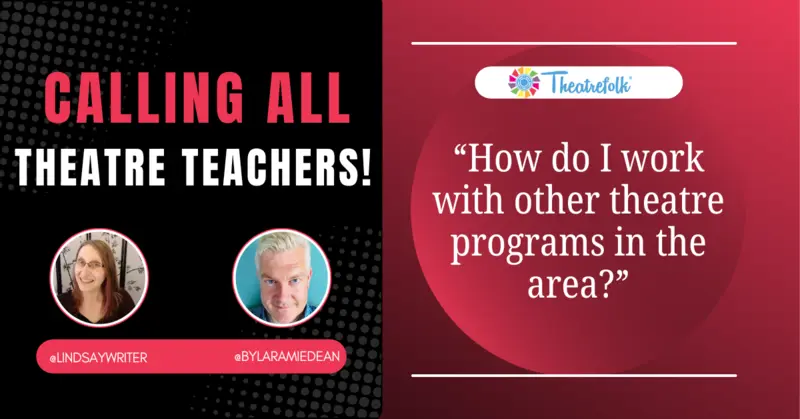
Calling All Theatre Teachers: How do I work with other theatre programs in the area?
Welcome to our video series, Calling All Theatre Teachers! In this series weâre going to answer questions that drama teachers have about stepping into a theatre program.
QUESTION: How do I work with other theatre programs in the area?
Watch the video of our discussion of this question â Laramie shares his number one suggestion for working with other theatre programs.
Click the button below for a Community Analysis form to write down your thoughts on your drama teacher community and how you perceive yourself working within this community.
How do YOU work with other theatre programs in your area?
New Drama Teachers
Calling All Theatre Teachers: How do I deal with angry parents/guardians?
Welcome to our video series, Calling All Theatre Teachers! In this series weâre going to answer questions that drama teachers have about stepping into a theatre program.
QUESTION: How do I deal with angry parents/guardians?Watch the video of our discussion of this question where Laramie shares his biggest suggestion for dealing with angry parents.
Click the button below for some giveaway docs! First, a tip sheet for dealing with parents. Second, a template audition packet and an example show contract that Laramie uses. Sometimes, you can circumvent angry parents by putting all the information out front and getting them to sign off on it. Note that Laramie suggests including a full rehearsal schedule for parents/guardians as well as a character breakdown.
How do YOU deal with angry parents/guardians?
New Drama Teachers
Calling All Theatre Teachers: How many performances should my program do within a year?
Welcome to our video series, Calling All Theatre Teachers! In this series weâre going to answer questions that drama teachers have about stepping into a theatre program.
QUESTION: How many performances should my program do within a year?Watch the video of our discussion of this question â Laramie shares how many he did at the beginning of his teaching career, and how many performances he does now.
Click the button below for a worksheet to help you organize your thoughts on writing down your goals for your program when it comes to in-class performances and extra-curricular performances, as well as a Reflection to help you to look back on a year of performances and consider changes for the next year.
How many performances do YOU put on in a school year?
New Drama Teachers
Calling All Theatre Teachers: Iâm the only drama teacher at my school. Where do I start?
Welcome to our video series, Calling All Theatre Teachers! In this series weâre going to answer questions that drama teachers have about stepping into a theatre program.
This series is hosted by Lindsay Price and Laramie Dean. Lindsay has been in theatre education for 30 years, writing plays and classroom resources specifically for middle and high school through Theatrefolk (Check out Lindsay and Laramieâs The Ultimate Classroom Playwriting Resource and co-creating the Drama Teacher Academy.
Laramie has been teaching theatre since 2003 and writing since he could first wrap his fingers around a pencil. (Check out Laramieâs Theatrefolk plays! Currently heâs the theatre director at Hellgate High School in Missoula, Montana, where heâs worked for the last 12 years.
QUESTION: Iâm the only drama teacher at my school. Where do I start?Watch the video of our discussion of this question â Laramie himself is the only drama teacher at his school â or read the transcript.
Click the button below for a worksheet to help you organize your thoughts on reaching out to your community, a list of resources, and a reflection: What makes you a good teacher? Whatâs your starting point?
Where do YOU think is the place to start for a solo drama teacher at their school?
Classroom Management
Supplies and Equipment Every Drama Classroom Needs
Drama classrooms come in a huge variety of sizes and styles. You may have a fabulous auditorium with a giant storage closet, a dedicated drama classroom, a shared space, or you may not have a classroom at all (hello, rolling supply cart!). No matter what type of space you have, youâll need some essential supplies and equipment for your classroom. The items below are what we consider âdrama classroom must-haves.â
This article focuses specifically on supplies for the needs of the basic drama classroom, so you wonât see items like a lighting board or microphones. Those items are fabulous and necessary for productions, but here weâre talking about the day-to-day needs. Itâs definitely possible to create beautiful theatrical pieces with an empty stage space and your studentsâ creativity, but the essential items below will make things easier:
âą As many pencils with erasers as you can get your hands on. Pencils, not pens â students need to be able to erase their script notes in the drama classroom. For bonus points, choose pencils with unique designs on them or put a bit of colourful tape or a dab of colourful nail polish on them, so theyâre identified as classroom pencils and youâll be more likely to get them back.
âą Highlighters, similarly labeled as your pencils.
âą Sticky notes in a variety of sizes and colours.
âą Clipboards, if youâre working in a classroom without desks.
âą A stopwatch or timer, for timing improvised scenes or rehearsals.
âą A noisemaker, such as a bell or horn, to let students know that their time is up. This saves you from having to shout over the classroom din.
âą Three to five small balls or beanbags, for various warm-ups and exercises.
âą A binder of monologues and scenes for classroom use. Organize your scenes and monologues with dividers indicating number of actors in the scene, comedic versus tragic, modern versus classic, and so on, for easy photocopying.
âą Scripts for students to study. Theatrefolk has a wonderful selection of play scripts to get you started.
âą A box of assorted hats for character work, costume inspiration, games such as Row of Hats, and drawing names out of a hat. If youâre short on storage space, consider soft, easy-to-fold-down hats such as bucket hats, ball caps, berets, or toques/beanies.
âą A box with a random assortment of small hand props for scene work and activities such as Speed Props. Some frequently seen onstage items you might include are a (non-breakable) mug/cup and saucer/tankard, a rotary phone, a magnifying glass, a lantern with a battery-operated candle, a hardback book, a newspaper, a wallet with fake bills/coins, a (non-breakable) hand mirror, a cafeteria tray, and a lightweight blanket or bedsheet.
âą Various types of tape â spike tape (in at least three different colours), gaff tape, scotch tape, painterâs tape.
âą A small portable sound system, such as a Bluetooth speaker or boom box with various adapter cords, for playing music in class.
âą If you have dedicated rehearsal space and/or storage, my number one classroom items are rehearsal cubes. Theyâre incredibly versatile for rehearsing and performing, and can be used as extra seating in your classroom in a pinch. If you have the type with hinged lids, you can also use them for temporary storage of props or costume items.
What items would you add to this list? Let us know!
Additional Resources:Your Drama Classroom Wish List
Advice for New Drama Teachers: Planning Ahead
Teaching Drama
Writing Lesson Plans for the Drama Classroom Toolkit
Lesson planning is the backbone of effective teaching. Think of lesson plans as your classroom's roadmapâthey guide everyone toward shared learning goals. When they're on point, the classroom runs smoothly; when they're not, learning stalls.
Our Writing Lesson Plans for the Drama Classroom Toolkit will break down the essentials of a standard lesson plan, show you how to adapt it for theatre, and help you integrate Bloomâs Taxonomy and National Standards for Theatre, all while keeping state standards in focus.
Teaching Drama
The New Drama Teacher Dictionary Toolkit
As you begin your teaching career, you'll find yourself learning something new every day â from where your mailbox is to how fire drills work. If youâre a new Drama teacher, youâll likely come across a lot of terms and phrases that are unfamiliar.
Since most schools only have one Drama teacher, it can be tough to find a Theatre mentor when you're unsure of whatâs being discussed. Thatâs where this toolkit comes in.
The New Drama Teacher Dictionary Toolkit is designed to help you navigate the terminology and phrases you'll encounter, from general education terms to theatre-specific lingo. Download the New Drama Teacher Toolkit now and feel confident in conversations with administration and peers.
Teaching Drama
Back-to-School Toolkit for Drama Teachers
Whether youâre a brand-new teacher stepping into a classroom for the first time or an established teacher coming back to school after summer break, thereâs a lot of work that needs to be completed before you can say youâre ready for school to begin.
This long list of to-dos includes finalizing curricular materials, organizing your classroom, and prepping your performance space.
Not sure how to prepare for the school year? Donât worry! This toolkit was developed to give you the tips and tools you need to be ready for back-to-school. So download our free Back-to-School toolkit and start your school year off right!
Directing
How Do You Manage Overcommitted Students Who Miss Rehearsals?
In the world of theatre, orchestrating a seamless production is a delicate balance. Directors often find themselves having to gracefully handle overcommitted students juggling demanding schedules. Itâs helpful to have practical insights and strategies that strike the right balance between individual commitments and the collective rhythm of rehearsals. But how do we find the finesse required to keep the show running smoothly while supporting each performer on their individual journey?
We went straight to the source to get the inside scoop from those whoâve been there: drama teachers.
We asked: How do you manage overcommitted students who miss rehearsals?
Engage in Open CommunicationIt is very frustrating to have this happen, and I go to great lengths to outline the time commitment (the rehearsal schedule is out before auditions happen) and make it very clear that the expectation is that the show is the priority for the duration of the process. Parents are told all of this, students are told all of this â every cast member knows it. It helps, somewhat. Luckily, I have had casts who are at least honest about requests for time off, and most of them, I decline (no, you can't miss this rehearsal to go and audition for another play). Sometimes, I accommodate actors who have previous commitments, if they are particularly focused and able to put their full attention into the rehearsals that they can attend. I have little to no patience for those who have been accommodated and then show up and use the âI wasn't here, so you (me, the director) need to fill me in.â (Anne M.)
Literally had this happen last show. I pulled her aside and said, âI think youâre too busy. You need to make a decision on what things are important to you right now. No hard feelings if you quit.â She agreed and then quit the next day. I told her it was the right decision and that if theatre was still an interest, and she made time, she should definitely audition again. Her leaving left an opening for another student and she did wonderfully. Sugar coating things for kids is dangerous and not healthy. Treat high school students like the young adults they are and middle school students like the young, inexperienced children they are. They are all much more resilient than anyone gives them credit for and it gives the students some advocacy in their lives and builds their confidence. It also allows for students to step up to some responsibilities. (W.T.)
Establish Clear ExpectationsOof. This is big. I had three actors show up to my first one-act rehearsal. I called them in and told them that I wanted to see more commitment or I'd have no choice but to cancel the show. I haven't had issues since. (Caitlin D.)
We send a letter home to parents and students outlining the commitment at the beginning of the audition process. Then, if they are cast, they must sign a contract pretty much agreeing to the three-strike rule and that they have full availability during production week. This seems to keep both students and parents accountable. (Natalie C.)
Everything is made very clear up front and an agreement is signed when auditions take place and when rehearsals start. (Cherish T.)
I try to meet them in the middle. I also make them sign a contract at the beginning of the production. This contract creates a limit for missed days. (Baldwin PR)
We assigned understudies to every role, and our policy is after two absences the understudy gets the role. It does two things: 1) the cast knows up front how important attendance is and 2) the understudies really learn the parts! (Philly P.)
Prioritize Essential RehearsalsI require that the show take precedence two weeks before we open. I also don't cast people who have more than one consistent conflict a week. I've also started doing shorter rehearsals during the week and adding a Saturday. (Spartan Drama)
Implement ConsequencesHave understudies to replace them. (Elliott H.)
I recall telling one particularly overscheduled student that I would need to assign them as the understudy. They were a bit sad, but in the end thanked me for taking the pressure off. (Jeff M.)
Cast swings! Miss three rehearsals and the swing gets the part! (Linda)
Involve Parents or GuardiansDepends on the circumstances. If their leaving is detrimental to the performance and we have no alternative, I try to talk to them and their parents about finding solutions to alleviate their stress in order to retain them. If their leaving isnât impactful, I wish them well on their way and congratulate them on making a hard decision in learning how to manage their own stress levels. (Vicky B.)
Sit them down with a parent present. Tell them they seem overcommitted because they have missed rehearsals. Tell them itâs not fair to the rest of the cast. Then spell out that a solution to remedy this includes permission to leave the show. Ask if they want you to step out for five minutes while they talk. Then get an answer right then and there. (Susan G.)
Discuss Schedules & Time ManagementI ask for conflict dates AND a list of other activities and when they participate. If this entails missing what is too much for ME to deal with, then they are cast in a smaller capacity. They usually drop anyway. This gives those hard-working although often second-level people a chance. This goes for kids and adults. (Beatriz E-M.)
Parents also need to see when their child has too much on the go. Allowing them to step down from something doesn't mean they failed. Casting someone who has a lot on their plate usually results in roles they aren't happy with. You can't cast someone into a role that requires time and dedication if they aren't going to be at rehearsals due to too many other commitments. (Cherish T.)
They need to ask themselves, how did they become over committed? Being an adult is about time management and honoring the commitments that you make. You donât get to be everywhere and be in every show and do everything you want because what happens is you stop showing up for the things you really donât want to do. (Carolyn R.)
Discuss CommitmentIf their role is main, I try to talk with their parents and the student to get them to finish what they started, and if that doesnât work, replace them. If they do stay and finish, I make a note never to cast them as a main or pivotal character again, unless they somehow prove that they are prioritizing better. They broke trust in their commitment and one way they can prove they are trustworthy again is by doing smaller or insignificant jobs well. (Adra L.)
It's hard to find a balance sometimes, especially when they have multiple passions that pull them in many directions. However, a production is a commitment and there comes a time when a decision has to be made. You either make the time and commit to the cast, crew, and show or you appreciate your time spent and move on to what matters more to you. You can have many passions in life but if you aren't careful, you'll burn out. That seems to be a major factor in today's teens/youth. (Cherish T.)
It is impossible to give 100% to each activity at the same time. Kids learn from making hard choices, from time management, from failure as much or more than from success. If it were me I would approach it as a collegial lesson. âThe cast depends on each person to create a whole performance. People count on you. Their time and effort is wasted if you are not prepared on stage the night of the performance. It harms the play, the cast members, and you. Another person from tryouts who is interested and prepared but not chosen is harmed as well. You take their chance to shine away by taking the part but not fully committing to it.â (Dianne F.)
Theater MUST have its place and time amongst all other activities! Anything worth doing is worth doing well and that means effort. (Mandy G.)
Create a Supportive EnvironmentI try to be really accommodating because they are 6thâ8th graders, but it is incredibly frustrating. (Eliza L.)
With extreme patience! (Jane R.)
I am big on speaking for people who will never speak. Folks who say no to things to honor being in the show, miss out on events or re-schedule events to honor the show needs, skip lunch because otherwise they will be late, teach others it is fine to say no. You do not need to do anything. I have been in situations where other production members don't see that. More often than not, what I say goes or I say "Okay, when x, y, z happens (and it almost always does) it's on you to deal with and not me. (Kevin S.)
I try to work with mine but unfortunately some of our other programs arenât as flexible. In those instances I make sure my students know itâs not me forcing them to choose. (JMS)
In our small school, I am always sharing with all athletics. It makes for late nights. I'm tired, they're tired. I make sure we have lots of snacks and water. I try to give grace when I have to. It's so hard. But if you think they're not committed, I always say they are always auditioning, showing who they are. (Dotty D.)
Iâll work with kids. They get small parts that donât really influence the show whether they are there or not. But I want a kid to be able to be in a show if they want to. If they arenât honest and arenât there, they arenât in the scene and lose lines, etc. I used to fret. Now I just allow them to do their thing. (V.F.)
Additional Reading:
Helping Drama Students Understand Commitment
Directing
How Do You Handle Disruptive Cast Members During Rehearsal?
Ever found yourself at the helm of a lively, energetic, and occasionally disruptive drama club? In search of practical strategies and teacher-tested tips to maintain positive energy and curb disruptions?
We went straight to the source to get the inside scoop from those whoâve been there: drama teachers.
We asked: How do you handle rowdy or disruptive cast members during rehearsals?
Provide alternative roles or outletsAssuming much of the rowdiness/disruption is during their downtime, I give them a job/assignment/task, whether itâs to help design a prop, run lines with a beginning actor or struggling reader, take notes, learn the sound system, etc. But above all else, if I canât keep the students engaged and busy with valuable contributions to the production 80% of the time I ask them to be there, then I havenât created a very empathetic rehearsal calendar. (Barry H.)
Downtime for long periods while you block shows organically and expect students to be quiet and focused is not good for anybody. Give idle students a task if you have to focus on small group scenes. Make sure they learn when itâs almost time for their cue when backstage. I have also learned that reward gets more students onboard with behaving. So have a reward system. (JS)
Self-control, respect, and remaining on task are expectations and can be achieved. That being said, I try to remember the age of the students with whom I am working. I try not to push them past what is developmentally appropriate. We take breaks often and regroup so that everyone can refocus. Team building games really help everyone feel like they matter, whatever role they play during a production. (LB)
Establish clear expectationsI was a high school English teacher at the start of my career and quickly learned âthe look.â It would stop them in their tracks. In the beginning I would also firmly and quietly say, âNot acceptable.â The kids knew they had crossed the line and I never had a problem again. (Denise H.)
We have a culture of respect. Our contract, which must be signed and turned in before auditions, lays out the ground rules for participation. Then, we have a point system, and kids who are top scorers earn tickets for friends and family. The stage manager handles all point totals. We have very few problems. (Buena HS)
It is part of their grade. Parents see that up front as well as the students. Be up front about expectations/rubric. (FG)
Implement a warning system & consequencesRepeat offenders who have already been talked to, redirected, given a chance, given tasks to combat boredom â they get the boot. Safety issues and blatant disrespect are the things that are zero tolerance for me. (Angela H.)
They would be replaced. The theatre is a dangerous place and there is too much work to do for the production to put up with that nonsense. One reason for that behavior is boredom. High school kids inclined to do that need training and a lot of responsibility. My experience is that they tend to be good leaders if given the proper direction.
(John H.)
I am there to work and so are the rest of the cast and crew. If you need a minute to collect yourself, go for it. Can't? Come back when you can. (Cherish T.)
I dismiss them from rehearsal immediately. (Lisa H.)
Call their parents to come get them. (Roberta L.)
Create a safe spaceI begin with understanding needs and creating an atmosphere of safety. From there, I work to create an environment that everyone, no matter their circumstances, can enjoy the process and experience and thrive within. What many directors fail to understand is that mental health issues or neurodivergence can ignite so-called disruption in rehearsals. However, knowing how to hold space for the rehearsals to be equitable and inclusive is important because we want to build opportunities for everyone, not just those who can meet all the needs of our subjective expectations. (Traci F.)
Sometimes this is ADHD, spectrum, or neurodiverse behavior. ïżŒI try to take my cues from the other young people. Are they bothered by the disturbance? Because sometimes I canât concentrate when thereâs too much disorder, but the students are fine, and sometimes I think what I am presenting isnât holding their attention. ïżŒAnd then, if all of that seems to not be the issue, then itâs time for a one-on-one chat, where I ask them questions such as, âIf I ask you to do such and such and you donât do it, what are you telling me?â and âIf I have to ask you several more times what do you think I should do?â Then that way they are basically firing themselves if they do the behavior, assuming that they can control the behavior. (Barbara M.)
I think it starts with relationships. You build on the relationship and leverage goodwill. (TT)
Directing
How Do You Handle Conflicts & Disagreements During Rehearsals?
Stepping onto the stage is an exciting journey, but, inevitably, conflicts and disagreements among cast members can occasionally take centre stage during rehearsals. To avoid chaos, directors need effective strategies and creative solutions to minimize conflicts and foster a harmonious theatrical experience.
So, we went straight to the source to get the inside scoop from those whoâve been there: drama teachers.
We asked: How do you handle conflicts & disagreements among cast members during rehearsals?
Step Back & Talk It OutTake 10⊠Come back with suggestions⊠đ (Chris C.)
Count to 10 (or 5 slowly!) and ask what the issue is. Then say, âNo one is trying to be difficult. How do we move on?â (Guy N.)
Each person gets their say. We decide what compromise can be made. If not, Iâm the final decision. (Heidi T.)
Do Team-Building ActivitiesStop and do a bonding activity. My fav is apologies, ahas, and appreciations. Everyone says all of those. Strong reset. (Cassandra G.)
Hold Mediation SessionsI canât tell you how many times Iâve said, âKeep the drama on the stage! Now⊠the two of you â you have an appointment with me at 2:30 today. See you then. For now, letâs get back to rehearsal.â (Rogue Playhouse)
They can submit a form with me during rehearsal, and I mediate conflicts during breaks or after rehearsal. (Spartan PA)
Establish a Code of ConductI explain that in the workplace we donât always agree with our co-workers but we must remain respectful. (Claire PM.)
Leave the egos at the door and focus on the production. The rehearsal process is a time for trying out or playing with ideas. At some stage I believe the person nominated as the director will focus on bringing it all together. (Gordon B.)
The Director Gets the Final WordThe rule of acting is that only a director can comment on someone's acting or the stage manager on the loss of a line. (Deborah F.)
Theater is a benevolent dictatorship. The director has the final say, always. Ideas can flow, but in the end the director decides. (Colleen M.)
I tell my casts that every director has their own style, and while I consider myself collaborative, we don't have time for consensus. Someone has to make final decisions and that someone is me. If that is clear from day 0, then no conflict can fester. (Isaac W.)
Additional Reading:
Problem Solving: When Students Donât Work Well Together
Directing
How Do You Support Students Who Feel Discouraged About Ensemble Roles?
As theatre educators we understand the importance of making every student feel valued and inspired throughout their theatrical journey. However, we know that students can become discouraged when consistently cast in ensemble roles despite aspiring to take centre stage. Establishing strategies that foster confidence and resilience among these students is so important. But how do we effectively accomplish this?
We went straight to the source to get the inside scoop from those whoâve been there: drama teachers.
We asked: How do you support students who feel discouraged about consistently landing ensemble roles?
Put the work inAsk if you can cover / learn a smaller role, to expand your skill set. If okayed, then show up and shadow quietly and respectfully. (Amy W.)
Work on your craft with people who have succeeded at what you want to do. Arrive early and be willing to stay late. Focus for the entire rehearsal period. Maintain a positive attitude â never complain or bring your problems to rehearsal. Understudy every role in the production that you could play and be ready to step up in rehearsal to fill in for absent actors. No one starts as a lead â you have to consistently give your best and be seen doing so. (Kimberly F.)
It gives you a chance to show how hard you are willing to work. If you work hard, show up, and limit excuses, a director recognizes that. And that moment at auditions when itâs between you and someone else for a lead role⊠trust me, they wonât forget that. (Matt B.)
The work is the same whether it's a lead, a supporting part, or an ensemble. Do the work. Keep doing the work. Because if you don't like the work you're in the wrong business. (Allan R.)
I always tell my students who are in the ensemble and want to do more to show up on time every day, learn their lines and everyone elseâs lines, do their absolute best, and be an asset to the show. There have been many times that weâve needed to replace a leading role for a myriad of reasons and those faithful ensemble students are the first to be promoted. Also, Iâd tell them that every rehearsal is an audition for your next show with me. If you are a joy to be around you have a much better chance to get a bigger role next time.ïżŒ (Mary R.)
Allow them to savour the chance to shineShine as an ensemble member. Interact with what is happening on stage. Make choices that will show directors, audience, and fellow actors that you are not just taking up space on stage. (Lauren P.)
No matter what the size of the role is, it is how you shine in every role. (Danny J.)
Make the role you got the BEST role it can be. (Amy R.)
I have had leads and ensemble. Ensemble is so much more fun! Less stress, often more stage time. Just because you're in the ensemble doesn't mean you can't steal the show. đ€© (Heather J.)
Explain that ensembles are everythingEnsemble gets the most stage time and, as far as Iâm concerned, is the hardest working performer on stage, between costumes, choreo, and random lines! (Talia K.)
Theater isnât about the leads. Theater is about collaboration. Being a part of it, participating, meeting the best people in the world. (Tommie G.)
Ensemble roles require the ability to blend, and not everyone can do that. It's a gift if you have the right mindset. (Sarah P.)
The ensemble makes or breaks the show. Great ensemble, great show. (Janine M.)
Ensembles are EVERYTHING. They are the glue, the foundation, the heart and soul of storytelling. (Melissa C.)
The most fun roles I ever had were ensemble. Less pressure, fewer lines, all the fun of parts of the team and experience. (Tara F.)
I tell them about how I need strength and talent in the ensemble; it canât just be a bunch of random useless people standing around. I need their skills and leadership to help build a full scene. Then I tell them about shows, good legit shows, where it was the ensemble that made that show great, not the leads â the ensemble made it shine. It helps the kids when they know you see their worth. (Andi C.)
The ensemble can be really great as you often get the chance to play more than one character, you are in almost every large number, plus way less pressure to learn as many lines usually. Becoming a strong ensemble member can lead to becoming the understudy which is absolutely underappreciated. People should be proud of these roles. (Jessica H.)
Show them how to learn from the experienceThere is just as much to be learned in the ensemble as there is in a solo role; it's all what you make of it. (Sarah P.)
Itâs not the size of the role, itâs the fun you make of it. (Alice X.)
Focus on the importance of their role, and why it is critical to the success of the show. (Fiona Y.)
I look for leadership. Can they help lift and inspire other cast members to lend a hand, work hard, get off book, master choreography, give their best? My leads are also leaders. (Colleen S.)
I would say to them, enjoy and learn from whatever roles you are offered â chorus or ensemble is better than not being cast at all. Make connections with others, do your job well, don't complain. You never know, you might be perfect for the next leading role in a show that your director will be doing in the future. (Wendy G.)
Being in the ensemble is one of the best positions to grow within. Not only do you see the stage more than many lead roles do, but you also have an opportunity to watch and learn from the best vantage point. Time. Sometimes you're just not quite ready. Never stop just because you didn't get that role yet. Key word: yet. (Cherish T.)
Encourage them not to give upBe great in your ensemble part and make it your own. If you do it well, you will be noticed and placed in a suitable main role eventually. (Melissa S.)
I agree with many other responses but my foundation is: âTheatre is where everyone has a place,â and I remind them of the unique characteristics I see them bring and that the show would not be the same without them. (Jennifer M.)
Each role is equally as important as the others. I see you and I notice how hard you are working. I am incredibly glad to have you here and our show wouldn't be the same without you. We can only take so many kids a year in our show and you made the cut, so be proud of yourself and let's continue to build your skills in theatre. (Morgan S.)
Your place in this department and in this group is larger than any single role. It doesnât matter what youâre playing, we need you here. (Carlos G.)
Donât give up until itâs not fun anymore. (Rochele S.)
Commit to the role, whatever it is. Fearlessness, good attitude, and willingness to listen to constructive feedback. There is a role that will find you if you work toward being ready for it. (Mitchell B.)
Additional Reading:
* The Importance of Ensemble Thinking
* Ensemble is More
* Top 10 Ensemble Plays for Students
* Ensembles are Characters Too
* There are No Small Parts
New Drama Teachers
Top 5 Discipline Mistakes New Teachers Make (And how to fix them!)
Welcome to Top 5! In this series we look at some of the challenges new teachers face and how to address them. Whether it is avoiding mistakes, improving planning and preparation, or advocating for your program, this information will help new Theatre teachers successfully navigate the first few years in their classroom.
Top 5 Discipline Mistakes New Teachers Make (And how to fix them!)Classroom discipline is a challenge for many new Theatre teachers â and classroom management is even more challenging when teachers use classroom control strategies that donât work! This top 5 list will help teachers identify and correct common discipline mistakes made by new teachers.
MISTAKE #1: Impotent RepetitionProblem: Impotent Repetition is when a teacher endlessly asks for their students attention or repeats an empty threat without consequences or follow through. The teacher says âStop talkingâ or âGet to workâ over and over again without any consequences. It becomes obvious to the students that the teacher doesnât mean what they say and ignoring their authority has no consequences.
Solution: Do not make empty threats or endless requests without following through with some kind of consequence. Create an If/Then scenario and present it to the students - ie. âIf you donât stop talking then the entire class will sit in silence for 5 minutes.â - Students need to learn that your expectations will be met or there will be consequences - every time.
Teaching Drama
The Rehearsal Companion
Youâve chosen the play, paid the royalties, done the script analysis, held your auditions, and cast the show. Tomorrow is the first rehearsal. Are you ready? Really ready? The Rehearsal Companion can help!
Will you be ready if an actor drops out? Will you be ready for the mid-rehearsal blues? Will you be ready to have your tech week run as smoothly as possible? Will
you be ready with a comprehensive strike checklist? You CAN be ready for all these rehearsal situations and more.
The Rehearsal Companion is a comprehensive e-book that will be your guide through problem-solving, getting organized, choosing the best warm-up for your play, giving notes, and keeping track of production goals.
Thereâs more to think about than blocking and learning lines â be the director whoâs ready for anything!
Teaching Drama
The Audition Toolkit
Auditions require more than talent. Even the most talented students need confidence, communication, active listening, flexibility, a strong work ethic, and proper preparation. The Audition Toolkit can help!
This easy-to-use e-book contains 22 articles, exercises and audition templates to help teachers incorporate audition skill building into the program. Plus printable articles, tips, and technique sheets for students to use for their own audition preparation.
Teaching Drama
Impowerment Improv
Impowerment Improv is not your typical improv resource.
Improv Instructor Jennine Profeta will teach you how to validate improv to your administrators as you help students to take risks, embrace failure, find their courage, and become more aware. Learn how you can use improv to create self-awareness and confidence in your students.
There are specific exercises, and pointers on how to debrief with students in order to drive the points home. Improv is not frivolous or âjust games.â It is empowering. Itâs Impowerment Improv!
Learn more and order Impowerment Improv today!
NOTE: Are you a member of the Drama Teacher Academy? This resource is included as part of your membership!
Not a DTA Member? Learn more or join today!* * *


.png)