📣SCRIPT SALE! Treat yourself to an easier Fall. Save 30% on 5+ perusal scripts with code SPRING30 before May 3 and head into summer stress-free.
Photos
Classroom Exercise
Exercise: Creating a Styled Theatrical Photograph
This exercise combines fine art (photography) with drama class. Students will select physical items reminiscent of a play or musical, and arrange them to create a styled still life photograph. These photos can be used for inspiration and mood boards, marketing and advertising, or classroom décor.
Students will need a digital camera or smartphone to take photographs, and access to a variety of items (costumes, accessories, props, etc.) to use for the content of the photo. Students can use items from the classroom, items from home, or a combination of both. This exercise can be completed as an in-class project, or at home as a homework assignment or distance learning assignment.
Instructions1. Choose a play or musical for a topic. Read the script and/or watch the show (live or recorded).
2. Select a minimum of five objects that evoke the mood of the show or are referred to in the show. For example:
• Romeo & Juliet: wedding ring, dagger, vial of poison, letter, masquerade mask
• Peter Pan: bow & arrow, bag of pixie dust, fairy statue, teddy bear, cutlass
• Rock of Ages: 1980s microphone, can of hairspray, cassette tape, Slurpee cup, t-shirt with "The Bourbon Room" logo
• The Phantom of the Opera: ballet slippers, rose, Phantom mask or masquerade mask, sheet music, chandelier
Avoid using items that include text with the title of the show on them.
3. Choose a background. The background of the photo should enhance the photograph. For example, a Phantom themed photograph might use red velvet fabric as a background to represent theatrical curtains, while a Rock of Ages themed photograph might use a scarred wall or a 1980s band poster.
4. Arrange the items in a visually pleasing way. Style the photo in a still life (three-dimensional) or flat lay (bird’s eye view) layout. Try different arrangements until you’re happy with the look.
5. When composing the photo, students will need to think about how the lighting and the positioning of the camera will affect the photograph. Should the photo be bright and light, or dark and moody? Should the camera be positioned up close or far away from the items? Any effects should be done “in-camera,” meaning avoiding cropping or adding filters after the fact.
6. Students will select their best photo and submit it. Decide if you want students to submit their photos electronically or print them.
7. Once all the photos are submitted, post them around the classroom or create a slideshow. See if students can guess the production from the photographs!
Classroom Exercise
Playwriting Exercise: Baby Photo Prompt
In this article you’ll find instructions for a playwriting choice board exercise. For this exercise, students should bring in a photo of them as a baby or toddler. It needs to be a physical copy, not a screen capture on a phone, because some of the options require students to trade the image with a partner or put it up on the wall. If students are uncomfortable with bringing in a photo of themselves or aren't able to do so, they can bring in a photo of another baby or toddler — perhaps a parent or sibling, or a magazine cutout or printout from the internet.
Depending on your timeframe and the size of the assignment you wish your students to complete, you can have students select one or more options from the choices below. Two of the choices are individual, two are for pairs, and two are for groups. So, for example, you may wish for students to complete one individual selection and one partner/group selection. If you want to add a performing component, you can have your students workshop the pieces aloud after they’ve been written. Adapt the exercise to best suit the needs of your class.
You’ll find an evaluation rubric in the giveaway below.
Choice Board Options:Individual: Write a monologue from the perspective of your younger self. It could be in the voice of the baby or toddler, or in an adult voice speaking about childlike topics. It can be comedic, dramatic, whatever you wish.
Individual: Write a monologue from the perspective of the child about to have a total meltdown or temper tantrum. What happened that made them so upset? How did they get from the state they were in in the photo to melting down? How can you write the monologue to indicate that it should have different levels, not just screaming?
Partner: Write a scene together in which your two younger selves meet for the first time. Where are they? Why are they meeting? Who are they with? What other details should you include?
Partner: Trade photos with a classmate and write a character sketch about their baby photo. It doesn't have to be accurate — feel free to make up details! Trade the character sketches back and write a scene together from the perspective of the babies in the character sketches, using the details your partner created. Try to stick to what they wrote, not what you know about yourself.
Group: The teacher will collect all the photos and post them on the wall in small groups (3–5 per group, depending on the size of the class). Those students will get together and write a Rugrats-style scene featuring the group of babies on an adventure.
Group: In small groups, students will write a comedic “baby newscast” scene. Using the details in the photos, each group member will write a segment about issues facing babies, from the perspective of the baby. For example, if one of the baby photos features a baby with food all over their face, the baby might express frustration that they’re messy. A baby wearing overalls might discuss baby fashion dos and don’ts. One of the students’ babies can act as the host or anchor of the newscast to tie all the pieces together.
Directing
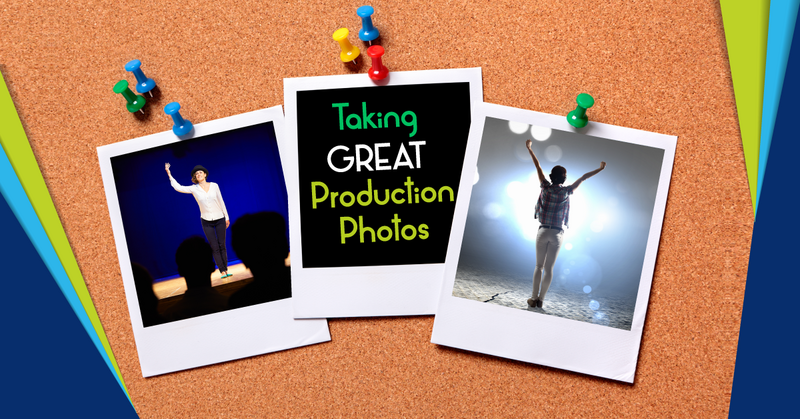
How to Take Great Production Photos
We all know a picture is worth a thousand words – so make sure it’s saying the right things about your productions. Your actors’ performances aren’t afterthoughts. Capturing their moments in the spotlight shouldn’t be either.
We asked drama teachers: What are your best tips on taking great production photos?
Let’s hear from teachers on the front lines.
Leave it to the professionalsKatie O. says “Get a professional! I’ve been fortunate the past several years to have students with dads who are pros (or at least very accomplished amateurs). I haven’t taken a production photo in years but we still have some beautiful shots!”
Randi G. says “My tip is to get a parent who is a photographer to come in and take the pictures! That is what we did this year (he is a pro) and we got amazing shots, including some super backstage photos. If there isn’t a parent, find someone who is trying to build their portfolio who can come take some shots of one of the final rehearsals.”
Jane M. says “My tip is to hire a pro who can capture the whole picture…close ups, full shots, sets, backstage, etc.”
Look around youClaire B. says “If your school has a photography course, as a teacher for a star student.”
Cassandra G. says “Get alumni photographers.”
Heather G. says “We have digital photography programs on campus with phenomenal instructors that take our shots.”
Debb A. says “I’ve always had a former student or a colleague that is a great photographer take mine. The photographer comes to final dress to snap pics, and after the rehearsal we’ll hit various scenes to be sure there are good stills with great lighting.”
Know the EquipmentJason P. says “Find someone with a good camera who knows how to use it. And make sure they shoot an entire rehearsal after they have seen an entire rehearsal.”
Kelly D. shared the challenge of “finding cameras (and especially camcorders) that handle the unique lighting situations of live theatre.”
Kerry H. says “Taking action shots in a variety of different lighting is definitely different than shooting portraits or weddings. Make sure you hire someone with experience in this area.”
Final TipsAnne D. says “Take them during dress rehearsals when you get amongst the action. Also, focus on individual members of the chorus – future stars are found in those photos.”
Rory M. says “Keep moving. And unlike making a video recording spend most of your time dead close to the actors.” (Obviously this is only possible at a dress rehearsal.)
Kerry H. says “Taking action shots in a variety of different lighting is definitely different than shooting portraits or weddings. Make sure you hire someone with experience in this area.”
And don’t forget….Ron D. says “Ask yourself what you intend to do with the results. Be clear on your intent before you do anything! And tell the parents, so they are not blindsided. Second, be sure that you have permission to take pictures or video of every person. Third, if you use a professional, be clear about who owns the photos. Get it in writing. Lastly, if you intend to video, be double sure that you have the rights from the rights holder to do so. If you don’t, you could open your company, your school and yourself to litigation. Doing your due diligence is part of your job!”
Identify the most active moments, the tricky lighting moments, the most colourful moments and so on. That way when you have a conversation with a photographer you’re ahead of the game.
Join the conversation on our Facebook Page and add your own advice to our list!
Teaching Drama
A Picture Tells a Thousand Words: Cross-Curricular Drama Classroom Project
The phrase “a picture tells a thousand words” is pretty well-worn, yet the concept has proven true time and time again. Look at any picture that captures a moment in action – the words needed to explain it could go on for days. Some pictures hold many stories.
Three children sit in front of a pile of rubble. Who are they? Are they related? Where are their parents? What was the building before it was destroyed? What are they looking at? What happens next?
This concept makes pictures an excellent jumping off point for a cross-curricular drama classroom project.
Cross-Curricular Project: History Comes to LifeObjective: To apply dramatic techniques to a moment in history
Description: Students will work in groups to create a short scene. The jumping off point for the scene will be a photo that shows an unexpected moment in history.
Materials: Students will need access to the internet to find photos on their own, or you will have to find a variety of photos and present them to the class.
Instructions:
1. Divide Students into Groups
Depending on your class size, keep the groups small (3-4 people).
2. Choose a Picture
You can either have students choose their own photo or (if they aren’t allowed internet access) you’ll have to choose pictures for them and print them off.
The requirement for the picture is that it has to take place during a historical event (a war, an invention, a significant era like the Depression, a significant person like a world leader).
A few interesting sites that showcase unique historical pictures:
- 40 Must See Historic Moments
- 40 Rare Historical Photos
3. Brainstorm on the Picture
Have each group write down their impressions, ideas, comments, and questions about their chosen picture. Remind students not to think ahead to the final project just yet. Focus on responding to the picture. Also, reject nothing. Accept everyone’s thoughts on the picture and write them down. Brainstorming sessions go awry when students start to censor or judge ideas as they come in. The best method is to write everything down without judgement.
4. Write an Inner Monologue
Before they start working on their scene, give students a short monologue exercise. Have them choose a person in the photo, or (if there are no people) choose the photographer. Write a short, half-page inner monologue. What is this person thinking in this moment? What do they see? Who could they be talking to in their mind (a parent who’s not there, a loved one, an enemy, another person in the picture)? It’s always better when a monologue has a listener, even if that listener can’t hear what’s going on inside a character’s head!
This is an individual exercise. Once completed, have students share their monologues in their groups.
5. Decide the WHO, WHAT, and WHERE
Now that groups have a picture, brainstorm suggestions and a number of monologues. The first step in creating the scene is to come up with the who, what, and where. The criteria is as follows:
• Decide the WHO. Who are the characters in the scene?
• Everyone in the group has to be in the scene.
• The characters in the scene could be from the picture, but they don’t have to be. They could be watching the scene from behind “the photographer.”
• Identify the WHAT. What is happening in the scene? Remind students that they are illuminating the picture. What are the words that bring the picture to life?
• Identify the WHERE. Where does the scene take place? It might not be clear in the picture. Make sure the scene has a specific WHERE.
6. Write the Scene
Have students work together to write a 1-2 minute scene based on their WHO, WHAT, and WHERE. Students might need to do some additional research if the historical moment is unfamiliar to them.
7. Rehearse
Give students time to rehearse. Depending on the length of the project, this could simply be a well prepared staged reading, or it could be a memorized and assessed performance.
8. Perform
After each group performs their scene, show the rest of the class the picture they used. Ask students what they see in the picture and how the scene illuminated the historical moment.

Playwriting
Picture Inspiration
Use a picture as a jumping off point for writing.
Sometimes all students need is a little push to get the writing ball rolling. Use pictures for that push. You can have students create source material for a scene or monologue. You can use pictures as a character development exercise. Use pictures with landscapes or with people. There are endless opportunities.
All of these exercises can be downloaded below in a printable PDF.
QuestionsGive students a picture and take them through a question/answer session. This will give students a method of analyzing a photo as a first step toward writing a monologue or scene.
• Give the photo to the class.
• On the back of the handout, students ask five questions of the photo.
• The five questions should begin with the words “who, what, when, where, and why.”
• Collect the sheets, and then re-distribute them. Each student should receive a handout with questions from a different student.
• Each student must answer the questions on the back of their new sheet.
• Emphasize that the aim of the exercise is to answer the questions with sincerity.
• Collect the handouts and discuss. How did the process differ for students between asking and answering questions? Which was easier? How could they use their answers to write a scene or play? Brainstorm possibilities.
Character DevelopmentGive students a photo that features a person. Have them create a character based on their interpretation of the person in the photo.
Answer the following questions.
• Who is in this photograph? Give them a name and an age.
• What do they do?
• Who is in their family?
• Where do they live?
• What is their favourite food? Least favourite food?
• What is the emotional state of the person in the photograph? Why?
• What will they do next?
• What is their most important relationship? Describe it.
• What secret are they keeping and why?
Divide students into groups and have them share their answers. How are the answers similar and how they are different? How do the students see the character and why did they answer the way they did?
As a class, have a discussion about how they perceive people from the outside. How can an exercise like this help them develop characters for plays?
Location PromptsUse photos to prompt students to think specifically about different locations. Beginning writers often stick to what they know when it comes to locations, and unique photos can show them theatrical possibilities. Also, beginning writers equate theatre locations to movie locations. It is, of course, impossible to stage a scene as realistically as a movie. When students try and inevitably fail, they think it’s because they’re poor writers. If you can prompt students to take something real that they see in a photo and change it to suit the stage, they will start to create a habit of theatrical thinking.
Respond to the questions and activities below using this photo.
• Where is this location?
• What time of year is it?
• Is something usual or unusual happening?
• Automatic write for two minutes in response to this photo. What are your thoughts on the location? Don’t censor yourself! Just get words on the page.
• What character would be comfortable in this location? Describe them.
• What character would be uncomfortable? Describe them.
• Write a conversation between those two characters.
• If you had to stage this location using limited props (two cubes, a bench, a music stand and a garbage pail), how would you do it?
• Theatre often uses dialogue to create the world of a location, rather than realistic sets. Write a line of dialogue that would show the audience where this picture takes place.
MonologueThe best way to get better at a genre of writing is to practice it. So the way to become a better playwright is to practice writing monologues and scenes. The more students practice, the more comfortable they’ll become. Instead of giving students a blanket direction to ‘write a monologue,’ use photos to provide a starting point. There’s a story, a character, at the very least a photograph on which to base the monologue.
Use the photo above as a starting point for a monologue.
Start by asking questions of the photo (who, what, when, where, why), create a character profile (Who is the girl? What’s her name? What’s her most important relationship?), and do some automatic writing on the location. Then use one of the following prompts to write a monologue.
• The girl has just received some bad news. Write that monologue.
• The girl has a secret. She tells it to the dog in a monologue.
• The girl has to make a decision. Write that monologue.
• The girl hates fishing. Why is she doing it? Write that monologue.
• It’s the last day of summer. The girl in this photo is worried about going to a new school. Write that monologue.
Classroom Exercise
Playwriting Exercise: Picture Prompts
Location, location, location , a scene can totally be driven by where it’s set. Picture prompts serve as a great starting point.
To that end, write a scene between two characters that use the following pictures as location inspiration.
Classroom Exercise
Expression Exercise: Who Am I?
Who am I?
It’s a question not a lot of people ask. Who am I? What defines me? Effective artistic expression begins with you. If you’re going to write a well detailed character, you should know those details about yourself. If you’re going to write an opinion on an issue, you should know why you have that opinion. If you’re going to critique someone else’s work, you should know how you’d respond to the same criticism.
Exercise:Complete the following tasks:
List five words that best describe you.Think about these words. Look them up in the dictionary to make sure they describe you perfectly. Look up their synonyms and antonyms in a thesaurus.
Why did you choose these words?
Find five images/pictures that best describe you.They don’t have to be literal (I’m tall so here’s a picture of a tall guy). If you feel that you’re disorganized, you could choose a picture of a mess of colour (like Jackson Pollock) or a messy room, or a broken plate, or a wall of graffiti.
Why did you choose these pictures?
List five symbols that best describe you.Again you don’t have to be literal. Are you a stop sign? Are you a yield? Are you a no smoking sign? Are you a no shirt, no shoes, no service sign? A radiation sign? A cross? No parking? No pets? Information? Here is a website with a ton of different symbols.
Why did you choose these symbols?
List five sounds that best describe you.Are you a howl? A flute note? A guitar riff? A bang? A thunder clap? The ting of a bell?
Why did you choose these sounds?
This is not an ooky-spooky “be one with yourself man” activity. To define yourself in these specific ways creates a visual imagistic picture of yourself. This is a vital skill when it comes to dramatizing characters. You want to write in an visual imagistic way so that an actor can clearly picture the character and so can an audience.
What do I do with all this?• If you’re doing this with a class, have students take all the images, sounds, words, and symbols and create a 30 second non verbal piece. Then have the class reflect on what they see. What impression does the piece create?
• Write a monologue that takes place inside one of the pictures. What is happening? Are you in the picture or is it someone else? Throw one of your sounds into the middle of the monologue – what’s the effect?
• Write a scene between a Symbol and a Sound. What type of character would each represent?
• Re-write the scene and throw yourself into the mix. How would the symbol and the sound react to you?
• Create a Wordle. Reflect on what it’s like to see a picture out of the different words. I’ve put my example below. Use wordle.net and put words in the text box. I used my five words, five sounds and described the five symbols.

Playwriting
Playwriting Picture Post
All of these pictures come from the Japan pavilion at Epcot in Disney World. The store at the pavilion is an experience, based on the Mitsukoshi Department Store. I adore wandering through and seeing products that are decidedly not Disney-fied. They are so lovingly weird.
As a writing exercise, take each of these pictures and make them the focus of a monologue or scene. What is the product in the picture? Who is using them? What would the outcome be of using these products? A couple of the pictures have text on them – use the text as the jumping off point for your monologue. And one picture has no English at all – decide what the product is and have someone use it in a scene.
Playwriting
Playwriting Exercise: Picture Prompts
When I was in San Diego I found a lot of interesting plant life and a number of objects that just struck me as great inspiration for writing. So let’s get to it.
Each picture contains a non-human thing – tree, flower, bike and so on. Look at the picture and decide, if this thing were human what kind of character would it be? How would it talk, move? What kind of personality would it have? What job would it have? Write a monologue in which this character is sharing something with their significant other. It can be in relation to what they may be doing in the picture, or take on the life outside the frame. The choice is yours!

Playwriting
Writing Exercise: A Picture is Worth a Thousand Words
Not sure where to start for your next play, or even your first play? A great way to create ideas is to explore a writing exercise. Try this picture study exercise and see what writing inspiration comes.
Take a picture of a place. Urban or rural, inside or out, city or nature. Choose a picture that focuses on a location without any people in it.
Study the picture and consider the following questions. Take the questions seriously and push your creativity to the limit!
• What is the location in the picture?
• What happened right before the picture was shot?
• Is there anything unexpected in the picture?
• If this picture became unfrozen, what do you think would happen next? What would be the very next action?
• What’s happening outside the frame?
• What’s the most exciting thing to happen in this place?
• What’s the most underhanded thing to happen here?
Once you’ve answered all the questions, you’ll know quite a bit about the picture and the situation surrounding the picture. Now, move from question mode to creative mode.
• Write a paragraph from the point of view of something in the picture (be it tree, or statue, or building).
• Decide who’s taking the picture. Why are they taking the picture? What are they thinking about? Write a monologue on their thoughts.
• What story would take place in this location? Would it be realistic? Abstract? Futuristic? Period? Brainstorm on the potential plot of this story.
For part two of this exercise take up a second picture. This picture should focus on a person. To narrow the scope of the exercise, make sure the picture only has one person in it.
• Who is the person in this picture? Give them a name, an age, describe their family, describe where they live.
• What is this person doing in the picture? Is it something expected or unexpected?
• What will they do next?
• What is their most important relationship? Describe it.
• What secret are they holding? Is there anyone in their life who knows this secret?
• What is their favourite memory? Their least favourite memory?
• Do they like what they do for a living?
• Do they like what they are wearing? Why or why not?
Again, once you’ve answered all the questions you’ll know quite a bit about the person in the picture. Write a monologue for this person. Have them speak about what’s going on in the picture.
• Think about this person as a main character. What do they want? What is standing in their way?
• What life changing event could they face? Brainstorm on the event and how the character would react to it.
Even if this exercise doesn’t directly lead to your next play, practising the craft of writing is always worthwhile. Try this same exercise with a unique object or article of clothing…