📣SCRIPT SALE! Treat yourself to an easier Fall. Save 30% on 5+ perusal scripts with code SPRING30 before May 3 and head into summer stress-free.
Reading
Distance Learning
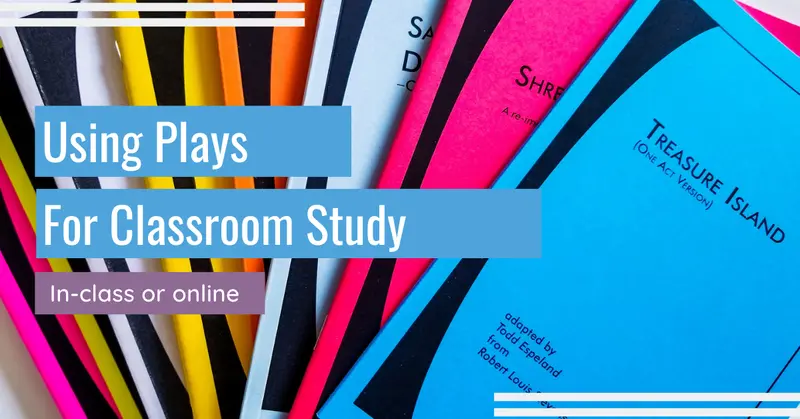
Using Plays for Classroom Study
During a busy school year, when your theatre program is juggling packed schedules, limited rehearsal time, and competing priorities, putting on a full production might not always be possible. Who has the time when you are balancing lesson planning, rehearsals, admin tasks, and, oh, actually teaching your classes?
But if a performance isn’t possible, that doesn’t mean that plays can’t have a place in your program. Scripts are still powerful tools for learning, creativity, and connection in the drama classroom.
Scene analysis, character analysis, monologue performance, and cross-curricular connections can all be explored in any classroom setting.
Here are some examples for using plays for classroom study.
*Close Reading *Close reading is an analysis tool. Students read a text multiple times for in-depth comprehension, striving to understand not only what is being said but how it’s being said and why. Close reading takes a student from story and character to drawing conclusions on author intention. Close reading prompts students to flex their thinking skills by:
• Teaching students to engage with a text.
• Teaching students to be selective. We can’t highlight everything in the text, only the most important elements.
• Teaching students to make educated decisions. All conclusions and opinions must be backed up with a text example.
Close reading does not have to be laborious. You can start quite small, for example, with a play title, and have students individually or in groups analyze the what , the how , and the why of the play title. Your virtual students can work together in break out rooms, and your in-person students can work in socially distanced groups.
Click the link at the bottom for a Close Reading Title Exercise!
You can also close read images. Find a picture of a set from a production of the play you are studying. What is happening in the image? How is it happening (analyze the lighting, whether or not the set is realistic or abstract)? Why have the director and set designer chosen the specific look for the set?
Pre/Post Read ExercisesGive students exercises that explore themes and subject matter before they study the play. For example, if a major theme of the play is friendship, have students discuss what it means to be a friend. Have students create friendship scenes (written or performed) that demonstrate the value of friendship. Another option is to give students personality traits of a character (without telling them the specific character) and have them create a physical movement (standing if in person, sitting if virtual). If the play takes place in a specific era or location (e.g., on an army base), have students do some research. What is life like on an army base?
Post-read exercises should focus on bringing the play to life. Have students create a costume for a character, or a basic set design (depending on the tools they have available). Have students create a music playlist for a specific character or scene. If the play has monologues, have students choose, rehearse, and present a monologue. If you can have students rehearse scenes in your particular environment, do that.
Cross-Curricular ConnectionsRead a play with students and connect it to a subject outside the drama classroom. What you do has always had implications outside of the drama classroom and now is no exception. For example, the play Drum Taps uses Walt Whitman’s poetry and takes place during the civil war. Can you connect virtually with the English or History department?
Check out our full list of recommended cross-curricular plays here.
Student Assignment: Study Guide for a PlayStudy guides are often prepared by a theatre company before students come to see a production of a play. Have your students demonstrate their knowledge of a play by putting together their own study guide. This is a bigger group project and one that can culminate a unit on a play, particularly if a production or scene presentations aren’t possible. It’s also a project that can be divided up among virtual and in-person students. Each person in a group can be assigned a specific part of the study guide.
Start by dividing your students into groups and have each group find a production study guide online. Then have the groups compare and contrast the guides. What are the similarities and differences? As a class, decide on the sections for your study guide and divide the work up among students. Have each group present their guide as a digital presentation.
While we don’t have production study guides, we do have some free classroom study play guides designed to challenge students to deepen their understanding and connection to the plays they’re studying.
Complete with pre-read questions and activities, close reading analysis, and post-read activities, these comprehensive, easy-to-use study guides allow you to provide an in-depth & theatrical learning experience.
Check out our complete list of classroom study guides here. (Plus, keep checking back for more!)
Acting
How to Practice Cold Reading
Cold reading (or sight reading) is where actors read aloud from a script, scene, or text with little to no advanced preparation. It’s frequently used in auditions either instead of or in addition to prepared monologues. Cold readings are great if your students are intimidated by the idea of choosing and memorizing a monologue, or would prefer to audition in a group setting. Cold readings can be challenging though, particularly for students who aren’t the strongest readers. It can also be challenging for students to connect with their scene partners if they’re already busy trying to keep up with just saying the lines correctly. More pros and cons of cold readings can be found here.
However, cold reading is a skill that can be practiced and developed in the drama classroom. Here’s a classroom exercise that you can use with your students to practice cold readings. It will take a minimum of three classes to complete, but could be extended if you wish.
Directions
1. Pre-Exercise PreparationFor this exercise, you will need, at minimum, enough different scenes for every two students in your class (as they will work in pairs). So, if you have 20 students, you will need 10 two-person scenes. This exercise works if you have your students all work on the same scenes, but it can get a little monotonous to watch over and over. This exercise can also be adapted for larger group scenes or monologue work, but for now we will focus on two-person scenes.
If you don’t already have a collection of scenes and monologues for your classroom, start gathering these! Whenever I read a play, I’m always on the lookout for scenes and monologues for my students to use in class. I have a binder full of monologues (read more about that here) and another one with lots of scenes. My scenes binder is organized with dividers for the number of characters in each scene – two-handers, three-handers, four-person scenes, and more than five characters. I also make a note on the top of the page of the character names for easy reference.
Theatrefolk also has a great page of free resources to get your scenes and monologues collection started. Check it out here.
2. Class #1Divide students into pairs. You may select the partners yourself, draw names from a hat, or let students select their partners. One pair at a time will come to the front of the class. You will give them one of your two-person scenes, which they will present in front of the class. (You may choose what role your students play within the scene or let them pick – it’s up to you.) After each pair performs, you may wish to give some feedback or have students provide peer feedback – just remember to keep the comments constructive and focused on practical performance notes rather than focusing on whether or not students liked or disliked the scene/characters/writing. Have the students take notes in a practice log of the feedback they receive.
After each pair performs, students will individually write some brief notes on their practice log about their thoughts on their own performance.
3. Classes #2 and #3For classes two and three, students will repeat the exercise each day with a new partner and new scene. (You may wish to keep a record of which student performed with which partner and what scene they performed so they aren’t repeating.) Again, after each performance have students record their thoughts and any peer feedback on their practice log.
After each student performs with three different partners, they will complete and submit their practice log and an individual Reflection.
Acting
Pros and Cons of Cold Readings
Theatrical “cold reading” (also known as “sight reading”) is where actors read aloud from a script, scene, or text with little to no advance preparation. Actors are handed a script and expected to familiarize themselves with the text in a short amount of time, then present a great performance. It’s an important skill for student actors to develop and practice. Cold readings can be used at auditions instead of OR in addition to prepared monologues, or during callbacks.
If you’ve always run auditions with prepared monologues, mixing it up with cold readings can be useful. Let’s look at some pros and cons of choosing cold readings for your next round of auditions.
PROSHear the sighs of relief everywhere–no need to prepare a monologue!Many students avoid auditioning because selecting and preparing an audition piece can be stressful. What if I pick the wrong piece? What if I forget my lines? What if someone else does the same monologue? Cold readings can alleviate that stress and may encourage more students to come out and audition. Because everyone will present the same material, that concern is alleviated. And while it is great if students can quickly memorize the lines and not have their faces stuck in their scripts, memorizing isn’t expected during cold readings.
Cold readings are great for group auditions.Cold readings lend themselves well to group auditions. Students can come in pairs or groups for an assigned amount of time and try a selection of pieces with different people. You could also specifically put students in groups who aren’t friends or don’t know each other well, to see how students interact with the unknown. This is also a great way of seeing if there is chemistry between student actors, or whether a certain pair or grouping works well together.
Students can perform a variety of characters.It’s good to have a selection of cold reading pieces available so students can try playing some different characters. You might make some interesting discoveries that you hadn’t considered before. (For example, a student who is often serious and quiet in class might prove themselves to be a great comedian when presented with the right material!) It’s also a good way to see if students are NOT right for a certain part.
You can see if students are able to take direction.With cold readings, it is expected that students will be given different directions to try. You can have a student perform their lines first excitedly, then mix it up and have them read the lines angrily. While you can definitely do this with prepared monologues, students tend to memorize their audition pieces in a specific way. Having them try something different can really throw some students off. With a script that they are less familiar with, there’s more room for play and experimentation.
CONSMore preparation is needed on the part of the artistic staff.The teacher or director will need to make appropriate selections for the cold readings in advance and ensure that there are lots of copies available for the audition day. The copies should be clearly labeled with the character’s name and gender, so students can make appropriate choices.
Cold readings can be difficult for students who aren’t strong readers.Students with reading challenges or disorders (like dyslexia) can struggle with cold readings. Since they have to focus so much harder on just comprehension, it can be harder for them to read aloud and emote at the same time. You may wish to have cold reading materials available ahead of time for these students.
Students may not realize that they still need to “do the work” before they audition.With cold readings, it’s very easy for students to just show up, stand there, and read. Students are strongly encouraged to read the play in advance of their audition to familiarize themselves with it, and get a sense of what they might have to perform in the audition and what roles might be a good fit. Be sure to ask students questions during the audition about the content of the play or about the characters, to gauge whether or not your students did any preparatory work in advance.
Kerry Hishon is a director, actor, writer, and stage combatant from London, Ontario, Canada. Explore her blog at www.kerryhishon.com.
Acting
The Ultimate Audition Guide: Teacher Edition
Auditions happen everywhere at every level, from middle school plays, to high school musicals, to college admissions. Audition styles range from prepared monologues, to cold readings, to group activities. No matter the audition, directors go through the same set of emotions, issues and concerns:
• Will I be able to cast my show?
• What am I supposed to be looking for?
• How do I stop the kids from getting so nervous?
The Ultimate Audition Guide: Teachers takes you through the audition process and provide suggestions for the above questions. Auditions don’t have to be nerve wracking experiences!
What’s in The Ultimate Audition Guide: Teachers?There are Seven sections:
• Preparing for Auditions
What should you do to best prepare for auditions?
• Choosing the type of audition
Which is the best audition for your production?
• Activities to help your students ahead of time
How can you prepare students to audition effectively?
• Activities during auditions
How can you calm student nerves?
• Audition Day
What to focus on during auditions.
• Make It A Teaching Moment
How can you assess an audition?
• Dealing with the aftermath
How do you deal with student and parent discontent?
Start the new year off right with a great audition. Break a Leg!
Teaching Drama
Making Close Reading Active in the Drama Classroom
Your first reaction to using Close Reading in the Drama Classroom might be – Ugh! There’s no way my students will sit still for that. This is the only time they get up and get moving.
Fair enough. But if you’re doing any kind of script analysis in class, think about incorporating Close Reading into your program.
Diving into a script – any script, from Shakespeare to modern to absurd – and figuring out what’s being said, how it’s being said, word choice, punctuation, sentence structure, sentence meaning, why it’s being said, what’s the author’s intention – these are the actions of analyzing a script. They become the building blocks of character development. They help a director form their vision. They are also the actions of close reading.
To close read is to look at a text in-depth. It is a detailed specific reading of a text – usually a short text (like a monologue). During the process, students read the text three times, discuss the piece, answer questions. They have to draw conclusions and make inferences as to what the writer is trying to say.
To read a text closely is to be an active reader – that is what we want from our students. We want them engaged with what they are reading, thinking about what they are reading, understanding what they’re reading. Close reading helps students to get to know that text inside and out.
But how do we make close reading active?
Close Reading CAN be Active. After you close read a text, you want to apply the information in some way. And the best way to do that is get students on their feet. Use a culminating activity to visualize what you’re learning.
For example, let’s look at the title “Death of A Salesman.”
In a Close Read, the first time through we’re looking at WHAT is happening. There is a lot happening in this title – “Death” and “Salesman.” We know what’s going to happen to the Salesman. We know that the Salesman is probably the main character. And we know that the play is probably not a comedy. Question: Who is the salesman?
For the second read, we’re looking at HOW the text happens. The structure, the punctuation, the word choice. And there’s some specific word choice here. “A” Salesman. Not “The” Salesman. Does that mean this character isn’t very important? He could be anyone. He’s not even named. He’s just his job. Question: Why does the author identify the main character as “a” salesman?
For the third read, we’re looking at the WHY. Why is the author presenting the theme this way? Why does the author tell us the end of the play before it happens? One possibility is because death is inevitable. It’s not going to matter that we know ahead of time. The tragic events of the play still hold weight, even though we already know the ending. Question: Based on the title, can you draw a conclusion as to why the author gives away the end of the story?
So then, what is the culminating activity? Visualize and physicalize the title before anyone has read one word of the play.
• Tableau it. What images come to mind in the death of a salesman?
• Make the title move – how do you physicalize someone who is just “A” Salesman and not “The” Salesman? How do they get lost in a crowd?
• Create a stage picture that shows the inevitability of death.
To learn more about Close Reading in the Drama Classroom, preview my course over at The Drama Teacher Academy. You’ll find a step by step guide to the Close Reading process, exercises, handouts and on-feet activities specifically designed for the drama class.
Teaching Drama
Preparing Drama Students to Close Read
or, “Dipping the Toe Before Diving in the Deep End”
Do you use close reading in the drama classroom?Close Reading is an analysis tool. Students read a text multiple times for in-depth comprehension, striving to understand not only what is being said but how it’s being said and why. Close reading takes a student from story and character to drawing conclusions on author intention. Close reading prompts students to flex their thinking skills:
• It teaches students to engage with a text. With each particular read, students have to annotate/make notes.
• It teaches students to be selective. We can’t highlight everything in the text, only the most important elements.
• It teaches students to make educated decisions. All conclusions and opinions have to be backed up with a text example.
Why should you use close reading in the drama classroom?The act of close reading fits hand in hand with script analysis. You want your students to get in the habit of reading scenes and monologues multiple times. You want your students to focus on different aspects of a text – it’s not just about the content, it’s about sentence structure and punctuation. Structure analysis is a helpful tool for character development. Close reading is a text dependent exercise – you don’t use research to support an answer, you use the text. When student actors and directors make decisions about their character or their vision, we want them to support their decisions with examples from their script.
How do I prepare my students to close read?Before you even bring a single text into the classroom, use these exercises to prepare your students for the process.
The Reader
Find out what your students think about the act of reading and then dramatize it.
1. Ask your students: What do you like about reading? What do you hate about reading? How do you feel when you read? How do you feel when you get to the end of a book – satisfied? Frustrated? This can be an oral discussion or written in their journals.
2. Next, students create a character based on their thoughts and feelings about the act of reading. If they personify their thoughts and feelings about reading, what kind of character comes to light? Are they human, animal, monster or alien? What is this character’s primary emotion – to make people feel good about reading or to humiliate? What powers does this character have? How do they move and speak? Do they live alone or do they have a big family?
3. Divide students into groups. They are going to create a scene in which each student will play their Reading Character. So if they’ve created a character who is a blob and speaks in clicks and whirs, that’s what they have to do in the scene. Emphasize that they’ll have to find a way to communicate. The group is going to dramatize a party, meeting or event where all of the different reading characters would be in the same room. Decide on a purpose for coming together. Decide how they would react to each other. Do the monsters get together and bully the others? Do the positive reading characters just treat everything positively? The length of each scene is one minute.
4. Discuss with students afterward – what was it like to see reading as a character or to be their reading character? If they have a negative relationship with reading, what can they do to change that? If they don’t want to change, ask why.
Physicalize Annotation
Part of the close reading process is to annotate and make notes about what you’re reading. When you’re reading a text multiple times, it’s easy to forget your thoughts from one read to the next. Students need a system to identify the what, the how and the why. Click below for a PDF version of this exercise that includes a annotation handout. The handout suggests four marks students can use when annotating a text.
Then try this exercise.
1. Divide students into pairs. Give each pair the Annotation Handout. As a pair, they’re going to annotate a monologue together. I’ve included one to use.
2. Each pair will read the monologue three times (focusing on the what, the how and the why) and with each read annotate accordingly, using the Handout as a guide.
3. Next, each pair will prepare the monologue to present. Partner A will read the monologue dynamically: they have to bring a character to the read, they have to be emotionally and vocally present. At the same time, Partner B will physicalize their annotations as follows:
• Underlined text – Partner B lies on the ground in front of Partner A.
• Starred text – Partner B presents “jazz hands” behind Partner A.
• Questions – Partner B stands beside Partner A and use their shoulders, arms, and hands to shrug in a questioning fashion.
• Brackets – Partner B stands behind Partner A and puts their arms around Partner A in an open hug. (Physicalized brackets)
Will this look silly? Absolutely. That’s ok. Take any chance you can to have a little fun with this technique.
The purpose behind this exercise is to show students what it looks like when a passage is over annotated. If one group has Partner B running from lying on the floor to jazz hands to brackets and back again – this shows you and the class that the pair wasn’t being selective or specific in their annotation choices.
Start Small
When you begin the close reading process, take baby steps. Start small. Use the process with the title of a play. (Death of A Salesman). Use a single line from the first scene. Find a production photo from the play and analyze it:
• What is happening: What details can you see in the photo? What are the relationships?
• *How is it happening: * How has the director blocked the moment? Is there a power struggle? Who has the higher status? How are lighting, set and costuming used?
• Why is it happening: Why has the director chosen to present the scene in this way? What conclusions can you draw about the play by what you see in the picture?
Close reading is a dense, focused process. It can also take your students’ script analysis skills to the next level.
Directing
Having an Effective Table Read: A Guide for Directors
A table read is a common first rehearsal activity. The director, actors, and stage manager sit around a large table and read through the script. Oftentimes other department heads are there (set design, costume design, props, etc.). Sometimes the department heads will give a design presentation to the cast.
Lots of people do table reads because… well, that’s what one does at the first rehearsal. In this post I’m going to dive in and explain why we do them. And, more importantly, how to have an effective table read to set your production up for success.
The reason for a table read depends on your role in the show.
DirectorsTable reads are a great way to hear how the voices are going to blend together. It’s usually the director’s first opportunity to have the whole cast together at the same time.
They’re also the director’s first chance to hear the show out loud from beginning to end. The director probably heard a few scenes during auditions, but never the whole play. Directors spend so much time poring over the script, silently reading to themselves. And it’s inspiring to actually hear the show out loud. It’s a reminder that plays are living things, not just words on a page.
A table read is when the director starts building the community that is going to put on the show. It’s a message to everyone that the director is the leader, but we’re all part of the same team with the same goal.
Lastly, the table read is an opportunity to discover tricky spots. Are some actors going to need more help than others? Are there technical issues that you didn’t consider when you were reading the play?
ActorsI love starting rehearsals with a table read because I’m a nervous actor. I always come to the first rehearsal anxious about the process to come. Am I good enough for this role? For this company? A table read is a very low pressure reassuring process to calm actors’ nerves and to get them accustomed to the fact that they’re there, the role is theirs, they were chosen for a reason, and they’re going to be putting on a show.
The table read is an opportunity to hear the story as a whole and to understand our character’s role in the story. Actors can be pretty self-centered when preparing for a show. They have tunnel vision focus on their role, on their character’s objectives and tactics.That’s perfectly understandable. It’s what the actor is required to do.
The table read is a chance for actors to hear from the other characters in the show, to get a sense of what’s happening outside of our own goals and objectives, and to see the show as a whole.
Lastly, it’s a wake up call that we are here, we are putting on a show, we are a team and we all have to contribute. It’s time to get to work.
Stage ManagersThe stage manager’s job begins well in advance of rehearsals and they should be up and running by the time the first rehearsal rolls around. I don’t know how it works in other countries but in Canada, professional theatres must hire stage managers for at least a week before rehearsals. It’s called “prep week” and it’s the stage managers chance to focus solely on preparing for the show without the distractions of rehearsals.
At the high school level I know this is not always possible. Sometimes you get your play sorted out on a Friday and start rehearsals on a Monday!
During the table read, stage managers often read the stage directions aloud. This helps the team to visualize the physical action and to get a better understanding of how the show will come together physically.
Stage managers also use the table read to get a rough timing of the show. The final running time of the show will change quite a bit from the running time of the table read but an experienced stage manager will be able to come up with a pretty accurate estimate.
The table read is an opportunity for the stage manager to clarify the tricky technical aspects of the show. Are there going to be tight costume changes or scenery changes? Is there likely to be a tight set of cues that weren’t apparent before?
Making the Table Read Effective – Tips for DirectorsHere are some tips to make the best possible use of the table read.
Describe your vision for the show. Some of your actors will be nervous. As a director, step up and go first. Describe your vision for the show. Talk about your influences for the direction of this show, why you chose the script, and why you chose this set of actors.
Don’t act. Tell your actors to not “act.” Ask them to just read the script. Focus on clarity. Focus on reading the words on the page. Focus on hearing the story clearly. Coach your cast to slow down if they’re going to fast. Assure your cast that they have already won the roles. They showed you something in the audition that made you choose them. This is not an audition, this isn’t a show, it’s a reading. This is the team on the starting line. There will be lots of time for acting later.
Have word definitions / pronunciations ready. If you’re working with student actors, it’s likely that they will have not done much homework. Identify unfamiliar words and look up the correct pronunciations and definitions. The actors should be doing this for themselves, but they probably won’t. If you’re ready with the answers (you should know the definitions and pronunciations anyway) then you’ll avoid wasting everyone else’s time at the first rehearsal.
Have fun. But be clear that this is work time. You are building a team. Set a fun relaxed environment for the first meeting. But when it comes to the actual table read, be clear that it’s time to work. Stifle side-chatter during the reading and demand focus on the task at hand.
Acting
Audition tips: What can you do with 30 seconds?
As part of the Playworks Program at the International Thespian festival, students have the opportunity to audition and rehearse one of the plays being workshopped. The audition day was very intense. We sat through auditions from 9:00 am straight through to 12:45 and then we have half an hour to cast the roles between five plays. Students were put in groups and performed in scenes from the individual plays with monologues, duets or trios. Over the course of the morning, we say 185 students and that doesn’t count the students we saw twice who were called back. By 11 am we were starting to feel the time crunch. Call backs were discouraged, repeat reads had to be culled down, we had to see the groups and move on if we were ever going to make sure every students got their moment.
To that end, there were some students who got maybe 30 seconds to showcase themselves and their abilities. That’s it. 30 seconds. And you may say, that’s not fair. That’s not long enough. How can we make decisions based on 30 seconds of work. Well, the truth of the matter is directors really only need 10 seconds. 10 seconds is all it takes to see if:
• An actor speaks with clear diction.
• An actor makes a bold physical choice.
• An actor knows how to stand out.
• An actor has read the script or is bumbling through.
• An actor can make a connection with their scene partner.
And in a workshop situation, that’s what a director needs to know. Can you speak clearly? Do you make a decision with the piece or are you just reading? Are you trying to connect? And the bit about standing out? That’s how you make yourself memorable. When a director has to sit through hours and hours of auditions, it’s hard for them to keep all the faces straight. But if you do something memorable, you make the director’s job easier. And that is why 30 seconds is more than enough time to get picked out of the crowd.
So the next time you audition for a play, think about how you are spending that first 30 seconds. What choices do you make? How do you stand out? Be clear, be bold, be memorable. And if a director cuts you off, never beg to say more. If you’re being cut off, more often than not it’s a time thing. Not a personal attack on your acting. The director has seen what they need to see, and rarely will seeing more change their mind.
What can you do with 30 seconds?
Acting
A Quick Tip for Character Analysis
The first place to get insight into your character is by reading the play. Before making any decisions or judgments about your character, read the whole play three times.
The first readThe first read is a “pleasure read”. Just read the play as a whole purely for enjoyment purposes, paying no particular attention to your character.
The second readRead the play a second time, this time recording everything that is said about your character. Also record details you find about the environment and people surrounding your character. Also record actions that other characters do that affect your character.
The third readThe third time through, write down everything your character says about others and every change your character makes to the world around them. By this time you should have a pretty good framework from which to start!