📣SCRIPT SALE! Treat yourself to an easier Fall. Save 30% on 5+ perusal scripts with code SPRING30 before May 3 and head into summer stress-free.
Tech
Directing
10 Tasks for Student Technicians During Pre-Show
Before the performers arrive at the performance space, the student technicians are already there and hard at work. For the purposes of this article, “student technicians” refers to the entire performance crew: stage management, sound and lighting operators, costume and props team members, set and backstage crew, box office team members, front of house staff (ushers, concessions, and house managers, and assistants of all kinds. It takes many people to make a show run smoothly, and having a strong, trustworthy crew makes that process much easier.
Here is a list of 10 general tasks that student technicians should complete during their pre-show time. Each technician will have their own responsibilities that are specific to their department, but this is a good overview for the full crew. Print this page out and post it backstage, as well as in the various technical theatre workspaces. Feel free to adjust or omit any tasks as appropriate to your production.
1. Come to the theatre dressed appropriately for work. Technicians should wear black pants, a plain, long-sleeved black shirt, black socks, and comfortable black closed-toe shoes (no sandals, flip flops, or Crocs). These clothes should be easy to move in and close-fitting, so they don’t get caught up in any equipment (especially if you’re moving large set pieces). Depending on your role, you might need to wear protective gloves or steel-toed safety shoes. Front of house team members may also wear black, but a more elevated version, for example, a black dress shirt, dress pants, and smart shoes. Regardless of your role, if you have long hair, keep it tied back away from your face.
2. Arrive on time, which is actually a few minutes before your call time. Different technicians will have different call times for various reasons. SIGN IN on the attendance form, and get to your workspace. Don’t expect the stage manager to chase you down or have to text you to find out where you are.
3. Review any notes or updates that have been sent out or posted from the director and/or stage manager. Make note of them, ask for clarification if necessary, and review and practice any changes or adjustments before the house opens.
4. Tidy your workspace. Make sure the area is clear of debris and garbage. Sweep and/or mop as appropriate.
5. Do a safety check of your workspace and equipment. The specific tasks will vary from position to position; each department should have their own pre-show checklist and technical manual. If any of the equipment is damaged or malfunctioning, report it to the stage manager right away and follow the appropriate protocol for getting the item repaired, whether that is following a list of troubleshooting tasks to fix the equipment yourself, or calling the head technician to do the repair.
6. Make sure small technical items and safety/emergency equipment are readily available and in good condition, such as batteries, flashlights, glow tape, safety pins, and first aid items. Student technicians should also know where the closest fire extinguisher and nearest emergency exits are, just in case.
7. Complete any technical checks or run-throughs, with or without cast members present, as needed for the show. This could include doing microphone checks, adjusting band levels, reviewing lighting cues or set changes that are dependent upon cast members to do or say something, or practicing any special effects that need to be practiced prior to showtime (e.g., during fight call). Again, this will vary from position to position and show to show.
8. If you are on headset for the show, do a sound test to ensure you can hear and be heard by the rest of the crew.
9. Pitch in and help other crew members with their pre-show tasks. Many hands make light work. If you aren’t specifically asked to help, check in anyway and see if you can lend a hand. Otherwise, stay calm, cool, and out of others’ way. Stay out of the backstage area unless your workspace is back there; there’s already enough chaos backstage without additional bodies around.
10. Check in with your fellow technicians and see how they’re doing. If you’re an apprentice technician, check in with your mentor and ask for feedback or tips to improve your work. If you’re mentoring a new technician, give them some positive reinforcement to boost their spirits, or share your best practices and advice to help them grow. Get yourself into the theatre mindset — try to leave any worries or issues at the door and focus on the task at hand, which is putting on an incredible show.
Technical Theatre
How to Run a Flawless Tech Week
Every director knows tech week can be a triumph or a tragedy. When tech goes right, a production leaps off the stage and is ready for an audience. When tech goes wrong… well, let’s just say that it’s time to stock up on aspirin and antacids. So how do you make sure your tech week is happy, healthy, and headache-free? Most of it happens BEFORE tech week!
PlanFirst and foremost, make sure you have a plan in place well before tech week starts. You should have the foundations of your technical elements in mind as part of the normal process of choosing a show. In fact, the technical elements of a production should always be a fundamental consideration in your play selection process. The concepts and designs for any show you choose should align with the skills of your workforce, the limits of your budget, and the capabilities of your space. Don’t bite off more than you can chew, technically speaking, by choosing a script that is beyond your capabilities to produce. Once you’ve decided on a show, keep your designs and technical expectations within the reasonable limits of what you can successfully execute, and you will remove a great deal of stress and doubt before you ever have your first rehearsal.
PrepareOnce you’ve decided on a show, start preparing for the technical elements as soon as possible. Whether that means purchasing additional building materials or haunting thrift stores for the perfect props, start preparing for tech as soon as you can. That includes asking your students to be on the lookout for important technical elements as well. As a teacher, there are not enough hours in the day, and once tech week hits you will not have time to drive around town looking for that ONE specialty item that will make or break your show. Strive to be prepared for tech week BEFORE it begins so you can spend your time integrating and refining your technical elements, not desperately searching for them at 10 o’clock on a school night.
TeachEvery show is new, and learning how to tech a show doesn’t happen by accident. From figuring out how to properly shift scenery to learning when to call light cues, your students will need to learn the technical elements of a show, and it’s your job to teach them. If you have students who have experience as running crew or board operators, you can quickly get them up to speed and give them the responsibility to solve problems as they arise. Teach them what needs to be done and delegate to them the training of their fellow students. However, if you are a newer teacher, or if you have a cast and crew of inexperienced students, plan on spending more time teaching your students both how the equipment works AND how they will operate it for that particular show.
TrustThe last element of running a flawless tech week is recognizing that there is NO SUCH THING as a flawless tech week! Most directors are control freaks at heart, and it can be very difficult to see all your hard work and planning go down the tubes as you watch both experienced and inexperienced techies struggle through the learning process. However, keep in mind that tech week is a learning process, and that process is just as important, if not more important, than the final product that the audience sees. Sure, tech week can be messy: Issues will arise, mistakes will be made, cues will be missed. But in the end, trust that your students will rise to the occasion and perform beyond your wildest expectations. Trust that your students will band together, work as a team, and bring the best show possible to the stage. And most importantly, trust that what they learn in the process will be beneficial to them long after the final curtain drops. That is something everyone can be proud of!
Additional Reading:
Tips and Tricks for a Less Stressed Tech Week
The Last Few Weeks Before Showtime
New Drama Teachers
The Tech Toolbox Toolkit
Starting a new tech program or taking over an existing one comes with a long checklist of materials. Beyond the basics like lumber, screws, and nails, every tech class needs essential tools—saws, cordless drills, and hammers.
But there are also overlooked tools that can make a big difference in safety and efficiency.
The Tech Toolbox Toolkit is here to help, providing the must-haves for making tech theatre and set building safer and easier.
Teaching Drama
Your Classroom Stage Makeup Toolkit
Stage makeup isn't just an optional extra in the drama classroom; it's a game-changer.
Whether you're taking your first steps into the world of theatre tech or you're already a seasoned pro, mastering stage makeup opens up a world of creative possibilities.
That's why we're here to share our best tip and tricks to help you navigate the ins and outs of stage makeup with confidence. From must-have resources to fundamental techniques, advanced tips for creating convincing old-age makeup, and the all-important clean-up procedures, we've got your bases covered in one handy toolkit.
So why wait? Click the link below to download your free Classroom Stage Makeup Toolkit and get ready to enhance your program and elevate your productions!
Technical Theatre
Sets on a Budget: One Signature Piece
There’s nothing like a big, beautiful set to really create the mood and tone of a theatrical piece. With a little creativity, big and beautiful can also mean striking and singular. Sometimes the most interesting sets focus on one signature set piece. A singular set piece can be simple or elaborate, highly detailed or quite plain, and it doesn’t have to be expensive.
Selecting one signature set piece can be challenging. Since there is only one piece, it has to be chosen with care and consideration. What story are you trying to tell with this set piece? How much of the stage does it take up? How does it contribute to the overall look of the piece? How much is it going to cost in terms of money, time, and effort to assemble it? These are all valid questions no matter what type of set you choose.
First, let’s think about what signature set piece you might select. What you choose will depend on the show title, your budget, the story you wish to portray onstage, and the tone or mood you wish to suggest. Here are some ideas you might consider:
• A single painted flat or curtain. This can portray anything from the sky to a cityscape to a house to a landscape. If it’s double-sided and can be turned around or covered up for certain scenes, that would be a bonus.
• A periaktos, which is a revolving, three-sided prism, usually made of wood. A different scene is painted on each side and it’s turned by actors or stagehands so the appropriate side is facing the audience.
• An item such as a shelving unit or a trunk, which is mounted onto a platform with casters and wheeled about. If it can be opened and/or used for storage, even better. You might also consider a flat object mounted on casters, such as a wall unit, blackboard, or costume rack that could be moved around, hidden behind, or have smaller items attached to it.
• A single, large statement piece, such as a throne, tree, statue, sofa, or piano. A statement piece is generally stationary but still interacted with, such as by leaning against it or hiding behind it.
• Good ol’ reliable rehearsal blocks. These can be painted or left plain, used individually or stacked together, and can be moved (or removed) to create pretty much whatever you need onstage.
Always keep in mind that whatever set piece you choose, it should enhance the overall look, mood, and tone that you’re trying to portray onstage with your students.
Once you have considered what the piece might be, you’ll need to think about how it is going to be used onstage. Is it meant to be looked at, or will it be interacted with? Will it be stationary or moved around? If students will interact with it, how will they do that specifically? Will actors or stagehands move it, or both? Does it need to move with a student on top of it, in it, or beside it? Does it need to hold or conceal smaller items? Does it need to perform an effect, such as light up, display shadows, glow in the dark, or play music? How can the piece be used differently in different scenes? Could it be lit differently, turned around, used by a different actor? Then, all these things considered, how much is it going to cost?
Keeping these needs and desires in mind, the next step is to design and build the piece. (You can use the worksheet below to help with this.) Is it a piece that you already own and can modify, or does it need to be built from scratch? If it needs to be built from scratch, can the materials be donated, discounted, or sponsored to keep costs down?
Once it’s built, use the piece as much as you can! Feature it in photoshoots for headshots and social media posts. Use images of it for the show poster and programme. If you can reuse it for class work or store it for future use, do it. You might also want to consider renting it out or selling it to another school or company for their upcoming production, and using the money towards creating a new signature set piece for your next show.
You can use the worksheet below with your students. Have them come up with different ideas for a signature set piece for the play you’re currently studying. Have them describe and/or sketch out their piece and list three different ways it can be used for the show.
Additional Resources:
Set Design: How to cut a big musical down to size
Full Class Project: Complete Show Design
Creative Fundraising Ideas for Your Upcoming Production
Classroom Exercise
Full Class Project: Complete Show Design
The following exercise is a large-scale culminating project for your entire class.
Students will form small groups and work together to create design concepts for a play in six areas of technical theatre: sound design, lighting design, set design, costumes, props, and hair/makeup. Each group is responsible for completing four components:
• an inspiration component
• a research component
• a practical component
• an analysis component
This is a great way for students to demonstrate what they’ve learned throughout the semester or challenge themselves to explore a new technical area. Students will gain a broader appreciation of all the factors that go into creating a cohesive theatrical design.
Before you start: Don’t worry if you’re not a technical expert! Check out our Technical Theatre section in the Theatrefolk Learning Centre for lots of technical advice. Three good articles to start with are:
Tech Exercises for the Non-Technical Teacher
Tips for Success When Tech Isn’t Your Specialty
Tips for First-Time Lighting Designers
Instructions:1. Select a play that the entire class will design for.
2. Divide students into six groups. Assign each group one of the following areas of technical theatre: sound design, lighting design, set design, costumes, props, and hair/makeup.
3. In this exercise, you (the teacher) will act as director of the selected show, and share your overall vision/concept with your design teams (your students). For example, Romeo & Juliet under the sea, Alice in Wonderland in outer space, a steampunk Beauty and the Beast, or a film noir Antigone. Feel free to give as many or as few details as you wish.
If you’d like to give students more artistic freedom, try one of the following options:
Option B: Have each group pitch a vision/concept (for example, Romeo & Juliet in the jungle, Wild West Romeo & Juliet, or Romeo & Juliet in the year 3000) and allow the class to vote on one.
Option C: Scrap the director idea and have each group come up with their own original design concept for the selected play, without consulting other groups.
4. Once the design concept is settled, each group must complete their design projects, which will consist of the following four parts:
a) Inspiration: An inspiration collage or mood board featuring colours, textures, sketches, photographs, or cutouts that illustrate the concept. (Minimum size: 12 inches by 12 inches)
b) Research: A written (or audio/video recording if that works better for your students) research component on one aspect of the concept. For example, if the concept is “in the jungle,” which specific jungle is the group focusing on? What plants and animals are native to the area? Are there any films, television programs, or documentaries set there? Are there any major current events or important historical events that occurred there? Tailor the questions as appropriate to the selected design concept. (Minimum length: 1 page)
c) Practical: A practical sample element that is relevant to the technical design area, such as a sound playlist, a lighting plot and gel sample display or a found lighting demonstration (live or filmed), a scale model set, an original costume design or built costume, a built prop, an original hair/makeup design, a designed wig, or a makeup demonstration (live or photographed). Students may have their own suggestions as well.
d) Analysis: A written (or audio/video) component describing how and why the group made the design choices they did. (Minimum length: 1 page)
5. Have your students share their projects with the rest of the class, either as group presentations or as a fair-style presentation around the classroom.
6. Discuss how each group approached their design work. Do the different theatrical areas work together as a whole? Why or why not? Do they support the director’s overall vision? What could be adjusted to work better together?
7. Each student will complete and submit an individual reflection (found below).
Teaching Drama
Performing Outdoors Part 2: Safety Considerations
In our previous post (Performing Outdoors Part 1: Technical Considerations), we discussed technical concerns that may arise when selecting a venue to perform outdoors. Today we’re tackling safety considerations. These may have already come up in discussions with your students when talking about the differences between indoor and outdoor theatre, or if you’re planning to perform outdoors. The purpose of discussing safety concerns is not to scare, deter, or make students worry about all the “what-ifs,” but to make students aware of their surroundings.
Safe stagingIf you’re erecting a stage, tent, or backdrops outdoors, you need to ensure that all the pieces are level, sturdy for students to stand on or near, and won’t fly away if a strong wind comes by. You may need some sandbags or tent pegs to anchor items to the ground.
Physical terrainInspect the perimeter of the playing space and audience area. Look for uneven terrain and tripping hazards. Is the space accessible for wheelchair or walker users? Ensure that the area is adequately lit as well, both for students to be seen by the audience, and for actors and crew to see where they’re going.
Privacy and personal concernsIs there a private area for students to change? Will you need to purchase a portable changing tent or similar item? Where is the nearest bathroom facility? Where will students keep their personal items so they don’t go missing? Is there a place to go if students suddenly feel ill? As well, make or purchase a simple first aid kit to have handy if someone does get sick or injured.
WeatherWhen performing outdoors, you’re always at the mercy of the weather report. If it suddenly rains or thunderstorms, or is super hot, you need to ensure there is a safe location for students and audiences to go. Alternatively, if the weather is already inclement before the performance, will you postpone or cancel? Do you have a rain date policy or an alternate venue available?
Have plenty of water available if you’re performing outdoors in the summer or in a hot climate, and avoid costumes and wigs that may overheat students. Make sure students are applying sunscreen as well!
Dealing with the publicWhen performing outside, anyone could be in the area. Are you performing in a place where students could get shouted at, catcalled, or interrupted by passers-by? Is there a risk of a strange person trying to get involved in some way? What security measures can you put in place to protect your students and staff?
COVID-19 measuresCOVID-19 measures will vary depending on your city/province/state, and they can change at any time. Contact your local health unit to devise a plan for your particular area and school. Be prepared to be flexible and have backup plans ready (such as streaming or performing on Zoom) as cases increase or decrease.
You may want to consider having a small cast and crew so there are fewer opportunities for transmission. Many schools normally wish for as many students as possible to participate in productions, but right now you’ll likely want to limit the number of students involved.
You may also consider things like limiting the number of audience members at a given performance, distanced audience seating (indicated by flags, benches, etc.), pre-screening procedures, temperature checks for students and audience members, and sanitizing props and high-touch items or areas between scenes. In terms of costumes, you may want to look into getting themed masks that go with the actors’ costumes, masks matching the skin tone of the actors, or branded masks for your school/theatre company.
Teaching Drama
Performing Outdoors Part 1: Technical Considerations
Performing outdoors can be a lot of fun — Shakespeare in the park, anyone? But as with any theatrical undertaking, there are some things to consider before getting started with rehearsals. The following exercise gives students the opportunity to act as “location scouts” and discover the technical pros and cons of doing theatre outside in nature.
1. Introduction & DiscussionIf you wish, you can start the lesson with a brief discussion of historical outdoor theatre.
2. BrainstormBrainstorm with your students some pros and cons to working outdoors. Some technical considerations may include:
• Space for performers – How will you separate the playing space from the audience? Will you erect a stage? How far away should the audience be from the performers?
• Space for the audience – Will the audience stand? Will you provide seating such as chairs or benches? Will audiences bring their own chairs or blankets?
• Is there a place for a backstage area, a changing area, or storage for props and costumes?
• Accessibility – How do performers and audience members get to the location? Is there parking available? Where are the nearest bathrooms? What is the terrain like (uneven ground, potholes, etc.)? Do you need a permit to use the space?
• Sound concerns – Think about vehicle and foot traffic or ambient noise such as a nearby playground. Will the audience be able to hear the performers? Will you need microphones or will students just have to project?
• Lighting concerns – What time of day is best to perform, before it gets too dark? Will you need to provide lighting? Where are the nearest plugs?
• Weather concerns – What if it rains? What if it’s ridiculously hot?
• Safety concerns – This will be discussed in an upcoming post, but will likely come up in your brainstorming.
3. Get outsideIf you are in person, take your class outside and look at the space around your school. If your students are studying via distance learning, have them walk around their neighbourhood. Have students find a location that could potentially work as an outdoor performance space. If possible, have them take a photo of the location with their phone.
4. AnalysisUsing the technical considerations discussed above, have students analyze the potential location. What are the pluses and minuses? What kind of show might work well for this location? Feel free to use the handout download for students to refer to when doing their analysis, including any additional thoughts from the brainstorm.
5. SubmissionHave students type up their notes (maximum length: 1 page) and submit them to the teacher along with their photo. As well, have them respond to the following exit slip question: What do you think is the most important technical concern when considering an outdoor performance? Why?
Classroom Exercise
Exercise: The Tech Effect
The purpose of this group exercise is to see how technical effects can change the mood and atmosphere of a performed scene. Students will have the opportunity to perform and observe others, while figuring out two simple yet creative technical effects using only resources available in the drama classroom. They are also challenged to keep their acting consistent between the two presentations of the scene, without letting the change in technical effects change their performance.
Instructions:1. Students will form small groups and each will prepare a short scene (1-2 pages). Scenes can be performed with script in hand or memorized, as time permits/teacher wishes. You can find some great two-person scenes and group scenes on our Free Resources page.
2. Each group must use a simple yet clear technical effect in their scene, using resources available in the classroom. Some examples might include:
•
• Dimming the classroom lights
• Background music played on someone’s smartphone
• A few simple props from around the room or their own personal items
• Having one group member make live sound effects using found objects
3. Each group will present the scene for the rest of the class.
4. Each group will then present the scene again, without changing any blocking, acting choices, voice volume, and so on. This time, however, they must create an entirely different effect while using the same equipment (lights, music, props). Using the above examples:
•
• Dimming the classroom lights > performing with very bright lights, or entirely in the dark
• Background music > performing with no music, or with music of a totally different genre (classical vs. disco vs. EDM vs. rap)
• Using a few simple props > miming props
• Having one group member make sound effects > no sound effects, or exaggerated sound effects, or sound effects at different times (a “boing” sound when someone stands up, for example)
5. After all the students have presented twice, they will discuss and/or write a reflection on the following questions:
•
• For the students performing: How did the group decide what technical effect to use in their scene? How did changing the effect between the two performances change the scene? Was it easy or difficult to keep the scene consistent with the change in technical effects?
• For the students observing: How did the scene change with the change in technical effect? How was the mood or atmosphere different? Did the effect add to the scene, or distract from it? Which technical choice worked better for the scene? What might they have done differently?
Classroom Exercise
Technical Theatre Exercises: For the Classroom & Beyond
The exercises listed below can be adapted to distance and online learning opportunities. Students work individually (rather than with partners or in groups).
Group work and discussions can be completed using video conferencing programs (such as Google Hangouts, Skype, or Zoom).
Written work can be submitted electronically via email or uploading to Google Drive or similar.
Performances can be done live via video conferencing programs, or filmed on a smartphone or digital camera and uploaded to a service such as YouTube or Vimeo (privacy settings can be adjusted to accommodate your school’s internet safety policies).
Check out our round-ups of exercises for Vocal and Physical Performance, Monologue and Individual Performance and Playwriting & Written Drama and Analysis Exercises as well.
Technical Theatre ExercisesThese technical theatre exercises sometimes require a bit of adaptation or creativity to complete, but most can be done at home and submitted in a variety of ways, including via submitting a PowerPoint presentation, submitting digital photographs of physical creations (such as costumes or props), or presented via video conferencing. Many group exercises can be completed individually, with allowing more time for students to complete the tasks outside of class time. Since you are doing learning by distance, in many cases, your students will be doing their projects for a fictional or hypothetical production.
1. Costuming Your Show for $50 or Less
2. Create a Costume Vision Board
Focus on the “Digital” vision board suggestion, using Pinterest or Photoshop. Alternatively, students can create physical boards and photograph them, or present via video conferencing.
3. Creating Atmosphere Using Music
4. Found Objects
You can adapt this exercise by having students present monologues and use objects and clothing/costumes from their own homes
5. Getting Other Departments Involved in Your Production (Producing)
Focus on the “ask” letter
6. How to Create a Budget When You’ve Never Done It Before (Producing)
7. How to Create a Master Props List
8. How to Create a Program for Your Production (Producing)
9. How to Prepare a Stage Manager’s Prompt Book
10. Lighting and Sound = Ambiance
11. Rehearsing In Layers (Directing / Stage Management)
Students will practice creating a rehearsal schedule for a hypothetical show
12. Respect the Tech! A Technical Performance Challenge
Students will create individual performances using items from around their homes
13. Shakespeare Set In Another Time (Design)
Focus on DESIGN activity
14. Taking on the Producer’s Role: Elevator Pitch
15. Telling the Story Through Clothing: Choosing a Colour Palette for Your Show
16. The Running List: What It Is and Why You Need It (Props / Backstage)
17. Using One Item to Show Character (Costumes)
Focus on THEORETICAL activity
18. 5 Props Challenges and How to Overcome Them
Focus on prop problem-solving challenge (giveaway)
19. 10 Ways to Publicize Your Show (Publicity / Producing)
Create a hypothetical show and challenge students to figure out how to get the word out.
Classroom Exercise
Tech Exercises for the Non-Technical Teacher
The phrase “technical theatre” can be intimidating for some drama teachers. They may feel that they don’t have adequate experience to teach technical theatre, or that they just aren’t “tech-y” enough to succeed in this area. Some teachers may also have a less-than-idea technical theatre situation in their school, due to budget restraints or lack of funding, outdated or non-existent technical equipment and technological resources, or unfortunate theatrical spaces (cafegymatorium, anyone?).
However, technical theatre does not have to be intimidating, expensive, or state-of-the-art. Here are 15 examples of simple technical theatre exercises that you can do with your class. They don’t require a lot of equipment or extensive technical theatre knowledge – they’re more focused on using found materials and resources, a dash of willingness to experiment, and a dollop of creativity. They’re a lot of fun, too!
1. Have your students find and share YouTube clips of a scene from a movie, a television show, or a filmed theatre production that has interesting lighting. Discuss – what is interesting about the lighting? What made it stand out to you? How do you think they achieved that effect? How could you recreate that kind of lighting in your classroom or performance space?
2. Light a scene using only found lighting – overhead lights, cell phone lights, flashlights, light from a projector, fake candles, light from a window, etc.
3. Create a playlist of ten songs inspired by a play or musical that would be appropriate to use as pre-show or intermission music. For example, if your students are creating a playlist for a production of The Wedding Singer, they might choose popular wedding songs from 1985. However, students can’t use any music that is actually from the play or musical!
4. Create a soundscape, radio play style for a scene, using found objects within the classroom.
5. Use shoe boxes, popsicle sticks, magazine cutouts, and other craft materials to create diorama-style 3D scale model set designs.
6. Partner with the visual art teacher at your school and have them teach your students different scenic painting techniques, such as creating wood grain, brickwork, sand and stone effects with paint.
7. Create a costume colour palette for a show you’re studying. Have students explain how the colours they chose demonstrate different moods or character statuses.
8. Create a costume vision board for a show you’re studying. Divide students into small groups and assign each group a different character from the show.
9. Challenge students to show a character using only one costume piece. What costume piece would they choose and why? Take this challenge a step further and have students create or acquire the costume piece. Have one student model the piece for the rest of the class. (The rest of the costume should be basic black clothing pieces.)
10. Have students learn and practice how to take proper costume measurements.
11. Create and/or design a method for an organized props area. Use your own theatre space as a model and have students figure out the most effective use of the space.
12. Create a master props list for a show you’re studying. If you’re actually doing a school production, give the list to the props head to save them time!
13. Have students design makeup looks for a play you’re studying, using a blank face template. Take it a step further and have students try to create the makeup looks on each other with actual makeup.
14. Find three different recipes for stage blood and test them on different kinds of fabric to see which recipe is most realistic-looking and which one washes out the best.
15. Try the following exercises here on the Theatrefolk blog – all instructions included!
• Found Objects
• Respect the Tech!
• Create a Program for Your Production
• Costume Quick Change & Prop Switch
Don’t forget to check out the Drama Teacher Academy for even more technical theatre lesson plans and classroom resources, as well as professional development courses to increase your technical theatre knowledge, skills, and confidence.
Teaching Drama
Tips for Success When Tech Isn’t Your Specialty
Technical theatre is not my specialty. I admire the creative types who create artful mood lighting, whip together fabulous costumes, make props with little more than glue and glitter, and build sets that transport audiences to all manner of wonderful places. So the following tips come from my own learning process within the world of technical theatre.
It is possible to succeed when tech isn’t your specialty. It’s important to learn as much as you can about various technical theatre disciplines, not only so you know what is achievable for your classes and productions, but also so you can appreciate the work of technical experts and share that appreciation with your students. Read on for five tips for your technical theatre discovery process.
1. Admit you are learning and learn together with your students.Yes, you are the teacher, but that doesn’t mean you have to have all the answers. This is a great opportunity to learn about technical theatre along with your students. Watch clips from filmed plays or musicals and analyze the technical work. Discuss what was most effective, and how they might have created the effects. Learn about your school’s technical equipment together – read the instruction manuals, and then practice making the equipment work. Create simple documents giving step-by-step instructions on how to use the equipment – how to turn it on and off, troubleshooting, and so on. Read and share blog posts about technical theatre – you can start right here.
2. Narrow your focus.You don’t need to focus on every single area of technical theatre at the same time. Choose one area to start your focus – for example, just focus on sets for this semester. Or, if you teach different grade levels, select a different discipline for each grade – grade 9s learn about costumes, while grade 10s learn about sound design, for example. This can encourage students to continue drama studies throughout their time in school, as they’ll learn about a new technical area in each grade.
3. Learn from an expert.Whenever possible, bring in guest speakers, host workshops, and engage experts in your learning process. Reach out to technical theatre specialists – perhaps you can arrange for a backstage tour of a nearby theatre, or have a professional theatre technician come in and speak to your students about what they do for a living. If you hire technicians to help your school production, observe them as they do their work and ask questions. If possible, take a course or workshop yourself and share your new knowledge with your students. And what better way to get hands-on experience in a new technical theatre area than to get involved in a production? If you’re not already involved with your local community theatre group, get in touch with them and join the crew of their upcoming show. While you’re learning, see if these experts would be willing to help out with your upcoming production in their area of specialty!
4. Let your students take the lead.Switch things up and have your students become the experts. Divide students into groups and assign each group a different technical theatre discipline – sound, lighting, sets, props, costumes, hair and makeup, and so on. Have each group complete a research project on their technical area and present it to the class. There are many different topics to explore, such as what tasks their technical theatre area involves, why it’s important in the theatre, the history of their discipline, common equipment used in their discipline, safety concerns, and training/education necessary to work in that area. Have them show what they’ve learned by demonstrating how a piece of technical equipment works (sound or lighting) or creating a piece to share with the class (set mock-up, costume piece, hair/makeup demonstration).
5. Keep it simple.You may have grand technical plans for your class production or extracurricular show, but productions can be just as entertaining and spectacular with little or simple technical aspects. You could set your show on an empty stage, have students perform in simple black pants and shirts, mime props, create live sound effects, or even all of the above. Challenge yourself and your students to create an interesting and engaging low- or no-tech production. Add additional technical elements as your confidence and skills grow.
Teaching Drama
Round-Up: Your Costume & Prop Challenges!
We reached out to you, our amazing community, through social media to ask, What are your biggest props/costume challenges for your productions or upcoming show?.Turns out, there are lots of challenges that drama teachers are facing when it comes to props and costumes! Here are just a few of the concerns that came up, with some suggestions for dealing with these issues.
1. Dealing with those crucial, yet difficult, costumes or props that are specific to a particular show.There is always something that is absolutely necessary to the plot of the show that is a royal pain in the butt to try and create or acquire – either it’s super-expensive, technically difficult, or just really hard to find. Some of the challenges mentioned included acquiring the printing press and loads of newspapers in Newsies, finding sardines and fishing lures (without hooks) for Noises Off, and creating an amulet that lights up and that the actor can control (possibly for a show like The Little Mermaid or Peter and the Starcatcher).
• For these crucial items, make it the highest priority to get them taken care of early. Don’t leave these items until the last minute to try and find.
• Search out other productions and see what they did with that specific prop or costume and how. For example, for the light-up amulet, I have seen similar items made out of a battery-operated tea light or lit up with a flashlight. Try posting on a theatrical message board or Facebook group (like the Theatrefolk Facebook page!) to see if other directors have ideas or creative solutions.
• Sometimes talking to friends or other teachers not associated with the production can help to gain a new perspective or great idea for creating or acquiring a particular item. They also might have a connection that you weren’t aware of. For example, a friend of mine was directing The Music Man and was having a tough time finding the matching band uniforms. I just happened to know a friend of my mother’s who is associated with our local university’s marching band. I was able to make a connection between the director and the marching band leader, who was willing to rent the items out for the production. You never know where a connection could occur.
• Try Getting Other Departments Involved in Your Production. Again, your colleagues and other students at your school can be great resources for new, fresh ideas.
2. Dealing with soooooo many costume changes!Some shows have what seems like hundreds of costume changes, which creates a whole host of issues: finding/creating/acquiring all the costumes, staying on budget, storing the costumes during the run of the show, and general chaos in the backstage area. Consider the following:
• See if there are costume items that can be worn layered for faster changes.
• Could you go deliberately minimalistic and have your students wear a set of basics (for example, a black shirt and black pants and add/remove items as needed?
• Don’t feel that you need to change every single item for a costume change to be effective. Sometimes just changing a hat, jacket, jewelry, or other accessories can make all the difference.
• Be sure that every item backstage is labeled with the name of the student who wears the piece.
• Arrange students’ costumes so that those with the most or fastest changes have quick and easy access to their stuff – i.e., put their costumes nearest to the stage.
• Rehearse any difficult or particularly fast changes as part of your standard run-throughs of the show. Have extra costume team members or assistant stage managers available to act as dressers and help with quick changes.
• Start working with costumes early and do as many costume run-throughs of your show as possible so students can be organized and familiar with their costume items.
3. Needing to get period costumes and props for low- to no-budget productions.We’ve got you covered! Check out these articles from the Theatrefolk blog for help:
• Props on a Budget: A Resource Guide
• 3 Tips: How to Stage a Show on a Small Budget
• Small Budgets: Doing so Much with so Little in a Drama Program
• How to Effectively Communicate with Rental Sources
• Using One Item to Show Character
Technical Theatre
Safety First: Creating a Safe Rehearsal Space
In the drama classroom and rehearsal space, drama teachers work with students to express themselves in a variety of ways. We encourage our students to push their boundaries, to explore new thoughts, characters, and situations, to move their bodies differently, and to share their stories. To do this, we must establish an atmosphere of safety and trust. And that begins with creating a safe rehearsal space. By considering both the physical and emotional safety of students, teachers can get their classes and rehearsals started out right, as soon as students walk through the door. Here are some tips and ideas for making your rehearsal space a safe one.
Physical Safety• Ensure the floors are mopped and swept clean and are free of any debris (such as staples, nails/screws, safety pins).
• Be aware of “secondary targets.” That’s a stage combat term for anything that could pose an inadvertent threat, such as furniture in the room, curtains, set pieces, other nearby students, dangly or flowy costume items, wayward props, and personal items that may be on the floor.
• Ensure that risk-associated props (such as stage weapons), set-building tools, and cleaning supplies are securely stored when not in use. And make sure they are only used while in class or in rehearsal and under the supervision of the teacher in charge.
• Have a first aid kit easily accessible and fully stocked in case of an emergency, as well as incident reporting sheets available. Be sure to know where the nearest washroom, smoke detector, and fire extinguisher are located, and the nearest exit should you need to evacuate.
• Have appropriate garbage and recycling containers available to keep the space tidy and free of junk.
Emotional Safety• With your class/cast, come up with your classroom code of conduct and share ideas on how to treat everyone with respect and dignity.
• Always have at least two artistic staff members present during rehearsals, for the safety and comfort of both the students and the staff. If you must rehearse with only one student, ensure that the door to the room is kept open at all times.
• For sensitive scenes (such as scenes with kissing) or emotionally charged scenes, schedule those rehearsals first for only the students who are actually in the scenes. That way they don’t have to rehearse these scenes for the first time in front of the rest of the cast, which could be awkward or uncomfortable.
• Consent is crucial. Explain what needs to happen in the scene and break it down into easy-to-digest chunks. For example: “George approaches Lucy and places his hand on her waist.” Then check with the students playing these roles and ask, “Are you okay with this?” You never know if what you are asking your students to do may cause them concern or stress. Encourage them to ask questions and work up to the moment in question. While it is important for your students to push themselves outside of their comfort zones, it is also important for them to not be agonizing internally. Nerves are okay; anxiety is not.
• Check in with your students frequently to see how they’re doing. Working on a scene over and over can be physically and emotionally taxing.
• Take breaks, both for your students to recharge and refocus, but also to give your own brain a rest.
Work with your students to include their ideas and suggestions into how to create a safe rehearsal space. Include them in the process of creating their space and encourage them to take ownership and pride in their surroundings. When the students feel safe within their rehearsal space, they are free to create, explore, discover, and push boundaries – which is exactly what theatre is meant to do.
Production
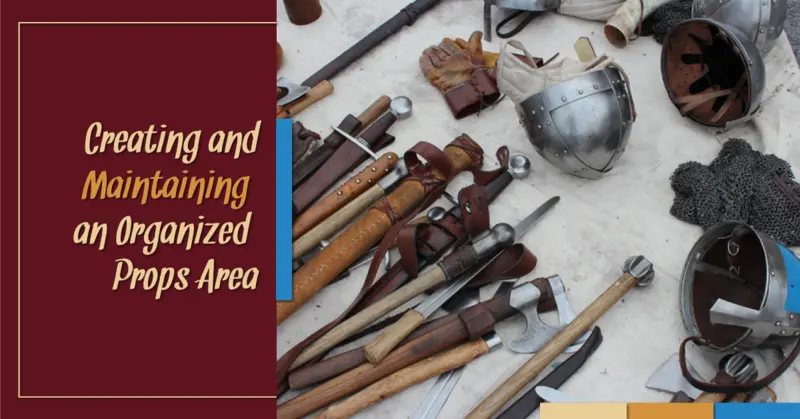
Creating and Maintaining an Organized Props Area
The backstage area can be chaotic enough without having to worry about all the props for the show. Help to reduce backstage stress by using these seven tips to help keep your props area neat, tidy, and organized.
1. Create a designated props table or shelf backstage, with clearly marked spaces for each prop. Use painter’s tape and a marker to create simple labels, or put a large piece of butcher paper, newsprint, or parchment paper on the table and label that. Then place each prop on top of its tape/label, so everyone can see clearly where it goes. This way, people can easily see if a prop is missing. You could even outline the props on the paper so it’s even easier to see if something is missing.
The butcher paper method is great if you don’t have a permanent table or shelf available in your backstage area. You can create a temporary props area using a folding table and the labeled paper. And then, after each show, the props can be packed into boxes, the table neatly folded, and the paper rolled up. You’ll just need to allow some time during pre- and post-show to set up and dismantle the props area. But the dismantled props table won’t take up much space during non-show hours.**
2. Remind all students that the props area is for PROPS ONLY. This is not the place to put scripts, water bottles, costume pieces, or personal items. Make it a rule that any non-prop items found on the props table will be dealt with immediately – whether they are tossed in the lost and found or confiscated by an assistant stage manager.
3. Arrange items in a way that makes sense to your production. For example, if a prop is used frequently or needs to be grabbed quickly, have its home on the props table be closer to the stage than something that is only used once or by an actor who has lots of time to grab it. In general, store larger or heavier props underneath the table/shelf, with smaller and lighter items near the top.
4. If you have a permanent props area in your backstage, install a bulletin board above/nearby the props area. That way you can pin up the props list on the board, and also use it for additional storage. For example, you can pin up paper props, or pin Ziploc bags to the board and store tiny props in them. This way those items don’t take up valuable table space. You can also use the bulletin board to post important notes, such as the locations of any backup emergency props, notes about the proper storage and retrieval of consumable props, and the name and contact information of the props head (in case of emergency).
5. Have a complete list of props stationed near the props area, pinned to the bulletin board or taped to the wall. Be sure the list includes the name of each student who uses the prop onstage. This will help the props head and assistant stage managers know who to reach out to if a prop is missing. You may wish to put the list in a clear plastic sheet so each item can be checked off with a dry-erase marker and re-used for each performance.
6. Tiny props (such as rings, writing utensils, coins – anything smaller than your fist) should be kept in larger, easy to see containers on the props shelf. These containers don’t need to be expensive. Use repurposed items such as plastic takeout containers or shoeboxes.
7. If possible, install a blue light next to the props table, so students can see the table in the dark. This can be as fancy as a permanent stage light or as simple as a desk lamp with a piece of blue lighting gel attached to it. During the show, the props area will be infinitely easier to keep organized when people can see what they’re doing!
Technical Theatre
Tips for First-Time Lighting Designers
Full disclosure – lighting design is NOT my forte. I am in awe of those wonderful people with skills in creating atmosphere with just the right shade of lighting gel, an artfully angled instrument, or the touch of a programming board button. While you may have a lighting designer for your upcoming production, if you are directing the show, you still must have an overall idea of what you’d like your lighting to look like. You can’t just expect your designer to do everything. And if you are a do-it-all director or working on a shoestring budget, you may BE the lighting designer yourself!
Working with a number of talented lighting designers over the years has greatly helped to make the lighting process less scary and less painful for me. What I’m saying is, if I can come up with a basic lighting design, you can too. Here are some tips I have learned over the years that have helped me a lot.
• You need to have a general idea of what look you want to create, lighting-wise. What is the mood of the piece? What is the time period (era)? At what time of day do the scenes occur? Does the scene take place inside or outside? Answering these questions will help get you on the right track.
You may even want to collect pictures that help to show the lighting effects you’d like to have.
• Have a basic knowledge of your school’s lighting situation. Does your school have a full lighting grid or only the most basic of lights that can only be turned on and off? Do you have LED lights, PAR cans, Fresnels, a spotlight, something else? Can your lights move? What is your gel and gobo situation? Do you have the ability and/or budget to rent additional lights?
Basically, this tip is to keep you in check. There is no sense dreaming about LED movers and stained glass gobos when your school doesn’t have these items. You can still create amazing lighting with minimal equipment – you just have to get creative!
• Note directly in your script where you know you want lighting cues to occur. Number and highlight each cue so you can see them in your script. Don’t worry about adding a cue later and having to change all your notes – it is standard practice to put in additional cues by adding .2, .3, .4 and so on, so you don’t mess up your original cue count.
Be sure to include cues for turning on and dimming the house lights at the top of the show, at intermission, and at end of the show, as well as a lighting look for the curtain call. As well, ensure that your stage manager has all these cues noted in their prompt copy of the script, so they are able to call the show properly.
• If you have lighting looks that repeat throughout the show (such as an outdoor wash, an interior wash, a nighttime look, a daytime look, etc.) make a note of the repeated cue numbers so those cues can be programmed all at once.
This will save you time during programming.
• Note how long you want each cue to last. Do you want the lights to fade out, and if so, how long should the fade take? There is a big difference between a 3-second fade and a 5-second fade and the lights snapping out abruptly. Do you want a crossfade? Do you want blackouts between each scene? Do the lights change during a song?
Don’t expect your lighting programmer to know how long a song intro or interlude lasts – give them an exact duration.
• Here’s a final tip that really made me pause and think the first time I heard about it: “blackout” versus “brownout” versus “blueout.”
Many directors will want to have the lights go completely off in between scenes, as a clear message to the audience of time passing or a location change. A “blackout ” means turning off the lights completely so it is pitch dark and the audience can’t see anything happening on the stage. This also means the actors and stage crew will have a difficult time seeing what’s happening on stage, which can be dangerous when people are entering, exiting, and moving set pieces and props on and offstage. A “brownout” gives a similar effect as a blackout but isn’t pitch black – a small amount of light is left onstage so actors and crew can see better. It does allow the audience to see a little bit of movement but is much safer than a full blackout. A “blueout” allows even more light onstage than a brownout but creates an interesting look and atmosphere. You can change the blue to any other darker colour (green, red, etc.) depending on your overall lighting design.
Technical Theatre
Best Practices for Training Your Technicians
Lights, sound, special effects – these are the cherries on top of the sundae of your already amazing production. And for each fabulous effect that you add to your show, you’ll need an equally fabulous technician to operate each one. Most student technicians will have lots of excitement and enthusiasm but little to no prior experience and varying levels of confidence. Use these five tips to get your technicians trained and feeling confident before your upcoming production, and then sit back and enjoy both the performance and the growth of your students’ skills!
• Have a technical training session BEFORE it’s time for tech and dress rehearsals. Try your best not have your technicians’ first time operating their equipment be at tech rehearsal. This training session should include both classroom instruction as well as a practical section where students can interact with the equipment hands-on. This is a great opportunity for senior students and more experienced student technicians to lead the training sessions (perhaps for extra credit or volunteer hours?). You could also format the training sessions not only for specific, upcoming productions, but also as general information sessions for any student who might be interested in learning more about theatre tech – such as students studying communication technology, music, or trades – as many of the skills are transferable. You never know who might show up, and these students could potentially be your technicians of the future!
• Create a training manual for each role – sound operator, lighting operator, wireless microphone assistant, spotlight operator, video operator, and any other applicable roles for your theatre department. Make copies or give students digital access to their respective manuals in advance of the show – preferably before or during your pre-show training session. For each piece of equipment, create a step-by-step list of how to turn on, operate, and turn off the system. Include photographs or videos if possible.
You also may want to post these lists in the area of the equipment for easy reference, whether that is the tech booth, backstage, or elsewhere. Go above and beyond by putting the sheets in a plastic page protector and providing a dry erase marker so technicians can physically check off each step as they go. If there is a specific teacher or person who is in charge of the technical equipment at your school, include that person’s phone number in the training manual or at the bottom of each list, in case there is an emergency.
• Give technicians copies of the script (and score, if applicable) in advance so they can familiarize themselves with the show. Invite technicians to observe some run-throughs of the show so they can get an idea of what to expect when it comes to technical rehearsals. Hold a meeting with the stage manager and technicians (or even better – let your stage manager lead the meeting) to explain any changes to the script, potential challenges for the operators, and overall instructions and expectations for performance time.
• Even if the student is a returning technician, do a refresher demonstration of the equipment at the first tech rehearsal with that student. It may have been a while since they have worked with the equipment and it is never a bad thing to be reminded of what needs to happen. There may also have been changes or improvements made with the equipment that the student will need to be updated on.
• Wherever possible, have a less experienced student technician shadow or assist a more experienced student technician , to learn the ropes of the role and the tasks associated with it. This gives the less experienced student a great opportunity to learn through observation, gain confidence (“If so-and-so can operate this, so I can I!”), and grow the leadership skills of your more experienced student through training the newbie. Peer mentorship is always a good thing!
Production
Pros and Cons of Live Bands versus Backing Tracks
When working on a musical with your students, you will need to decide whether you will use a live band or backing (karaoke) tracks for the music. Whether you use a live band or backing tracks, there will be pros and cons. Just select whatever method is best for your students, your budget, and your production. Here are some pros and cons to help you make your choice!
Live BandsPros:
• It’s exciting for students to get to work with a live band or orchestra. My students always say the show “feels more real” when they get to work with a band.
• A live band provides a huge, powerful sound for performers and audiences alike.
• Some teachers will hire professional musicians to play for their shows, which is definitely exciting for students to perform with, but many will have students from their school’s music department perform as the show band. Having a live band or orchestra provides great opportunities for student musicians to get involved in the drama department, to improve their repertoire, to grow their musical resumes, and to have a lot of fun.
• With live bands, the conductor can make adjustments on the fly if something goes wrong, such as tempo changes or adding additional repeats to cover a mistake (such as a quick change or set change that is taking too long).
Cons:
• Live bands can overpower performers onstage. With backing tracks, you can easily bring the sound down whereas live musicians can turn their own amps up or simply play their acoustic instruments loudly and ignore the conductor’s directions. If you use a live band, your student actors will need to use microphones to balance the sound.
• Live bands don’t always sound exactly like the recordings, so your students will need to really listen to the band and follow along with the conductor.
• Furthermore, musicians are human and will make errors. Musicians have to learn the music just like the student performers and often in a shorter amount of time. Musicians are not making mistakes purposely to mess with the performers and vice versa. Both performers and musicians must be patient and forgiving of each other.
• There will be increased costs in time and money if you are paying professional musicians to perform. A live band will also need additional rehearsal time both on their own and with the actors (called a sitzprobe) so that they are not performing the music for the first time at a tech rehearsal or cue-to-cue (those rehearsals are stressful enough as it is without adding a brand new band to the mix).
Backing TracksPros:
• You will always get a consistent performance with a backing track because it never changes! Your students will know exactly what to expect and exactly what the music will sound like.
• Tracks can be more affordable because you don’t need to hire a full band or take the time to rehearse a band.
• Tracks are more and more accessible nowadays. Many musical licensing companies provide both vocal recordings and backing tracks as part of their performance rights packages.
• Tracks are easy to rehearse with. Depending on your licensing rights, students may be able to take the tracks home with them and rehearse on their own rather than sitting with the sheet music and a piano, figuring out the notes.
Cons:
• Not all licensing companies provide backing tracks, so with some shows you MUST hire a live band or orchestra. Be sure to research this when making your decision on what show to do.
• Since tracks are pre-recorded, they do not allow for adjustments on the fly. If your students speed up, slow down, or miss a cue, the music will just keep on going without them, and it can be challenging to get things back on track.
• There are a lot of different kinds of backing track systems. Some companies use computer programs or apps and some provide CDs. You must have the appropriate playback equipment and amplification equipment available for whatever format you receive.
• As with any other technology, using backing tracks is not foolproof. Technology can fail through power outages or damage to the equipment (such as a skipping CD). Always have a backup method available!
Directing
To Mic or Not to Mic?
That is the question…and it is yet another decision you must make while producing your upcoming school show. Yes, your students are making smart character choices and acting their hearts out; yes, the show is brilliantly written and staged; yes, the audience is packed with eager friends and family who cannot wait to see your students perform… But none of that matters if the audience can’t hear what’s going on.
Luckily, we have an amazing invention, the microphone (or “mic” for short). These wonderful devices that help to amplify voices can absolutely be an asset to your theatre program, but they do come with some challenges. Consider the following points when you are deciding whether or not to use microphones for your upcoming show.
1. Do you absolutely need to mic the show?First and foremost – are microphones absolutely necessary in your performance space? How big is your theatre? If your theatre is a giant cavern of an auditorium with hundreds of seats, then mics may be necessary. But if your show is going up in a small studio theatre, then don’t bother!
Is the show a play or a musical? Plays generally do not need mics unless you are in the aforementioned giant cavern of a theatre. Musicals may need microphones depending on if you are using a band or orchestra (versus backing tracks), how loud the musicians are, and where the musicians are located in relation to the performers and the audience.
Are your students loud already? If your students have loud, healthy voices and great vocal technique, using microphones may be overkill. If not, work with your students on projecting their voices and vocal health and hygiene. Check out these Theatrefolk articles for tips: How Do I Solve Projection Issues, Projecting Your Voice Without Yelling, Why Isn’t My Actor Projecting Their Voice, 3 Tips for Keeping Your Voice Healthy, and 3 More Tips for Keeping Your Voice Healthy.
Remind your students that they still need to project their voices while using microphones. A microphone cannot amplify a small, whispery voice enough to be heard. The sound operator can always bring down the volume on a big voice, but they can only crank up the volume so far, and that risks creating feedback.
Who will put the mics on the students during showtime? Do you have enough crew members available backstage? Is your sound operator skilled enough to run the sound mix and turn different microphones on and off at the same time?
And remember, technology can fail. Do you and your students have a troubleshooting plan in place in case a microphone breaks or dies during a show? Will your performers still be able to be heard, or do they depend on the mic?
2. What kind of mics are you going to use?This will depend on the kind of show you are doing. Some schools have an overhead microphone system that will amplify the general stage area but won’t specifically amplify any one student’s voice. It also will pick up non-voice sounds such as footsteps, set-moving sounds, and other ambient noise.
The most common microphone types that are used in theatres are:
•
• Handheld mics (Wired or wireless; can be attached to a stand)
• Lapel mics (Clips onto a shirt or jacket and attaches to a transmitter that is generally clipped on a microphone belt and worn under clothing/costumes; can be difficult to hear if the student is not facing forward)
• Hair mics (Tiny mics that are set in the hairline with the wire going through the student’s hair and down their back; again usually attached to a transmitter worn under clothes. These mics generally come in black or tan. Can be difficult to use on students with very short hair or shaved heads.)
• Countryman mics (Over-the-ear mics that go across the student’s cheek. These mics also generally come in black or tan. They are fragile and can be difficult to place on student’s heads. Thicker, newscaster style mics tend to be less expensive than the thinner, subtle mics, but are super-visible and distracting to audiences.)
3. How many mics do you need?You’ll need to decide who gets a microphone. Are you going to mic everyone or just the leads of the show? Will you mic any of the ensemble members? If so, who?
More microphones means higher costs. Do you have enough money in your budget to mic the show? If your school already has a mic system in place, that’s great. But if yours doesn’t, will you purchase or rent microphones? Do you have the correct transmitters and receivers needed? You will have to do some research to figure out what microphones are available to you and your school and whether there are funds available to your department to make the necessary purchases or rentals for your show.
Don’t forget about additional costs: batteries, chargers, body tape, hair clips, and disinfectant (if you’re using hair mics). You’ll also want to consider time: the time you will need to set up the equipment, to train your crew members and performers on correct microphone use, and the additional time at each performance to put on the microphones, do a sound check for each student using a mic, to remove the mics after each performance, put them away safely, and clean up.
Directing
Round-Up: Dealing With Production Challenges
It’s never a question of “if” something will go wrong during a theatrical production…it’s completely a case of “when” something will go wrong! But when things do inevitably go wrong, will you and your students panic or persevere? Here are four common production challenges, rapid-fire style, with suggested solutions.
1. Your budget is not nearly big enough for the grand ideas in your brain (or, you’ve already over-spent your budget).• If your budget isn’t big enough, you’re either going to have to figure out ways to save money, or start figuring out ways to drum up more funds.
• Contact other schools in the area to see if they have costumes, props, or set pieces they’d be willing to loan.
• Get a local business to sponsor your production.
• Have your students brainstorm a creative way to raise some funds for the show – a bake sale, a karaoke event, a show merchandise sale, an auction?
• Rather than purchase new, see if there are items in your department’s props and costume stocks that could be repurposed, repainted, redecorated, or resized.
• Think creatively – if you could have only ONE fantastic theatrical focus, what is your priority? Costumes, sets, technology? For example: Would you rather have your actors in fabulous costumes on a bare stage, or have the latest lighting instruments and gobos with actors in basic blacks?
2. Props and costumes seem to vanish, or they mysteriously get broken.• Remember the most important rule: If it’s not yours, don’t touch it!
• Establish clear rules and consequences for not taking care of items. For example: If a costume piece is found on the floor, the actor must pay a fine of 50 cents or do 10 push-ups to “buy” it back.
• Make a rule that nobody leaves after the show until the backstage is tidy and all props and costume items are neatly put away.
• Have clearly marked areas for each actor’s costume(s) and each prop. Ensure that actors and crew members are putting each prop and costume item away carefully when they aren’t using them, not just tossing items on the props table haphazardly or leaving a trail of costume pieces all over the place. (This will ensure that everyone can leave on time, since you’ve established the above rule.)
• Have backup prop items available, especially for fragile or consumable props.
• Assign a costume and props head crew member to oversee the storage and care of each costume and prop item.
• Check out this post (Backstage Blues: How to Deal with a Messy Cast) for more solutions.
3. A tech disaster arises – your lights/mics/sound equipment stop working.• Preemptive idea: Have a clear, step-by-step list near each item indicating the proper method of using and caring for each piece of equipment. Bonus points if you put together a troubleshooting manual or list as well.
• Try to assess the situation as calmly as possible and figure out the reason for the failure.
• Ensure that the cast, crew, and audience are safe. For example: If the reason for a power outage is a storm, take all necessary precautions to ensure everyone’s safety.
• If you have technical issues during a rehearsal, look at it as a great learning experience (like a real life “What If” game). What would you and your students do to keep the show going?
• If the technical issues occur before or during a show, remember: The show must go on.
• If you are producing a musical, have a backup CD with karaoke tracks and a battery-operated boom box available in case the sound equipment fails. Or have the students sing a cappella.
• Can you get backup lighting equipment or found lighting (such as flashlights, floodlights, etc.)? Can you just turn on the work lights or house lights and continue with the performance?
• Can you move the performance to another room/venu or outside?
• Work with your students to practice projecting their voices, even if they are using microphones (a thin, wispy voice will still sound thin and wispy when using a mic). This way, if a mic fails or the battery dies, you’ll still be able to hear them.
4. Your ticket pre-sales are terrible.• Get into publicity mode! How can you drum up more interest? Check out this post (10 Ways to Publicize Your Show) for some ideas.
• Offer a ticket deal – BOGO, student rush, one-weekend-only deal, coupon code, a ticket contest…
• Start a social media contest with your cast and crew – challenge each student to come up with a creative post on their choice of social media channel (Facebook, Instagram, Twitter, YouTube, etc.) to advertise your show.
• If you notify your audience that one of your performances is close to selling out (or even has significantly fewer tickets remaining), it spurs them on to buy their tickets because they’re afraid the rest of the run will sell out too. (Such as “Only ____ seats remaining for Saturday’s matinee performance!” or “Limited availability for the April 28th performance of _______.”)