📣SCRIPT SALE! Treat yourself to an easier Fall. Save 30% on 5+ perusal scripts with code SPRING30 before May 3 and head into summer stress-free.
Movement
Classroom Exercise
Drama Sensory Series: Movement and Physicality-Based Exercises
This month, we’re going to be using the five senses (sight, hearing, taste, smell, and touch) as the basis for exercises and theatre games. This week, we’re looking at the sense of touch, through movement and physicality-based exercises. In the drama classroom, “touch” can refer to students physically interacting with each other, as well as focusing on movement, physicality, and sensations to tell stories, thinking about concepts and ideas such as textures, weight, and moving through the space in different ways. Group touch-based theatre exercises require clear communication and a lot of trust between scene partners, to ensure all students are comfortable and safe throughout the process.
Here are some exercises to try with your students that use touch, movement, and physicality as their focus, with a group work participation rubric and reflection in the giveaway below.
Important Note: Before any exercise is done onstage that involves students physically touching each other, be sure to obtain consent. This includes an instructor (teacher, director, choreographer, etc.) physically demonstrating or explaining a gesture, movement, or concept. Never assume anyone is comfortable with any sort of physical touch, even if the intention is casual or innocent.
General Movement• In “Big, Tiny, Twisted”, students move around the room, meet up with various numbers of students, and create shapes with their bodies based on the titular prompts. Students are encouraged to be in physical contact with their group members when creating the shapes.
• “The Human Knot” is a classic game that requires a lot of physical contact and a lot of trust. Students must maneuver their bodies with care and awareness of others in order to untangle everyone’s limbs.
• Have students explore how their characters move from head to toe. How can students use their bodies to make their characters move and look physically different from how they move as themselves? How does the status of the character affect how they move and physically interact with others? How do the different movements make their bodies feel? Is it easy or difficult to maintain that character’s movement throughout the scene?
Tableau• Do “Tableau Scenes From a Book” without speaking. Team members will stand still in a neutral position, or start the exercise curled up on the floor, as if they were lumps of clay. Group leaders must physically mould and sculpt their teammates into their tableau poses.
• Try doing large-group or full-class tableau scenes with the caveat that each student must be in some sort of physical contact with at least one other group member when creating the frozen picture.
Miming• To make the “unreal, real” in miming, it can be helpful to work with actual items in different sizes and weights so students can get crystal clear on how to physically manipulate the different items and then accurately portray them through miming. For an additional challenge, have students pair up and move items (actual or mimed) as a team.
• “Still, Slippery, Sticky” explores how students’ bodies move and interact with the various substances in the room. Play additional rounds incorporating other textures into the game, such as rough, smooth, slimy, prickly, and icy. As an exit slip question, ask students how they might use these kinds of physical details in their character work.
Classroom Exercise
Character Movement: Speed Up, Slow Down
The following exercise challenges students to explore character movement by focusing on the speed of movements. This exercise is mental and physical — students will brainstorm a list of characters that move fast and a list of characters that move slow. Then, students will get up as a group and act out the different characters.
1. In small groups, students will write out a list of characters that move slowly, for example, an elderly person, a baby who is just learning to walk, a person with a foot or leg injury, a snail, or tortoise. Each group must come up with at least 10 ideas.
2. Next, students will brainstorm a list of characters that move quickly, for example, an Olympic sprinter, a horror movie victim being chased by a villain, a cheetah, a busy personal assistant, or a superhero with super speed. Again, come up with at least 10 ideas per group.
3. Collect all the idea lists.
4. Have students stand up in the middle of the playing space. Using the brainstormed character lists, the teacher will call out one of the fast or slow characters. Students will move around the room like that character, using different postures, gestures, and facial expressions to enhance their characters.
Encourage students to really work with varying speeds — make slow characters very slow and fast characters very fast. With fast characters, students need to ensure they are aware of their surroundings (not bumping into each other) and that their movements are clear enough that an audience member would understand what they’re doing.
5. Repeat with at least three fast characters and three slow characters.
6. Now we do some switching up. This requires some quick thinking on the part of the teacher. Call out a fast or slow character, and at some point while the students are moving around the room as the character, add a prompt that causes a fast character to move slowly or a slow character to move quickly. For example, an elderly person trying to catch a bus, a sprinter with an ankle injury, a cheetah stalking a newly discovered prey, or a snail on a skateboard. How does this affect how the students portray the character?
7. For an additional challenge, have students try entering and exiting the playing space in character, or doing a mini scene change by moving an item such as a rehearsal box, chair, or bench while in character.
8. At the end of the class, have students respond to the exit slip question (found below in the giveaway).
Related Articles:
• Thinking of Your Character as an Animal
• 3 Fun, Physical Warm-Ups to Get Your Students Moving
• Elephant Walk
Teaching Drama
How to Get Student Actors to Stop Rushing
A director friend recently sent me a message asking for advice about how to help her students with their upcoming show.
_Hi Kerry, _
Any tips on helping my students to slow down and stop rushing? There are a few spots in the show where moments are “urgent,” but I feel that the audience is going to miss things as the students rush. We do walk-throughs, I explain and ask them to slow down, but they seem to get caught up in the excitement. Or perhaps they’re convinced it doesn’t look authentic? Maybe this will naturally evolve this week as they become more comfortable off-book, but any suggestions in the meantime would be helpful.
I guarantee this is not the first director dealing with students who rush their lines and movements. Your first task is to try and discover why your students are rushing their lines and/or movements. Then, you can try some of the following 12 tips and techniques I’ve used in various situations with my students to help them slow down:
1. “Slow down” might not be specific enough for your students. Try adding gestures or facial expressions at specific points in the scene to help your students focus on their full performances. Some students are visual learners, so physically demonstrating the movements you want may be helpful. Our Physicalizing Emotions article might help with this.
2. You may also want to try building in specific pauses and physical stops during students’ lines to force them to slow down. Try giving the exact counts you’d like the pause to be (for example, three seconds versus one second). Alternatively, have students try pausing for one beat for a comma or semicolon and two beats for a period, question mark, or exclamation mark.
3. Some students don’t believe us when we tell them what they’re doing until they see it themselves. Try filming students’ run-throughs and show them exactly what they are doing and how much they’re rushing. (I had a director do this to me once — it worked and I finally made the correction!)
4, You could also make rehearsal reference videos of the time(s) when students perform the scene the way you want them to, and make those the official templates of what they need to do each time.
5. If students are not fully off-book or are feeling shaky with their lines, they may be rushing to get the scene over with. Here are some tips to help students memorize their lines. The sooner they have their lines learned, the easier it will be for them to sink comfortably into the scene and avoid rushing.
6. Many students deal with nerves or anxiety, which may cause them to rush their lines or movements. Try some mindfulness techniques to help them combat jitters and see if that helps them slow down and stop rushing.
7. Try having students run their lines deliberately slowly — at half-speed or even slower. What they feel is half-speed is probably an appropriate speed for the stage!
8. If students are rushing their movements during the scene, have them try the scene while moving at half-speed or even standing still or sitting. How does that affect their performance?
9. If you find students are rushing their stage combat choreography, fight directors say that stage combat performance speed is maximum 75% of a “real” fight. Both because the two combatants need to be able to see what’s happening and the audience needs to know what’s happening. If they move too fast, the audience will miss the important moments. It’s not like on film, where the action can be sped up. Onstage, we have to suspend our disbelief in order for the action to be seen and understood.
10. Think scientifically. Have students consider what their bodies do biologically when they are excited or nervous. What happens when students feel an adrenaline spike? Explain that if they are rushing now in rehearsal, they’ll rush even more when show week adrenaline hits. Your 90-minute show may end up being only an hour!
11. Put yourself in the audience’s shoes. Sit your students down and have a frank conversation, considering the situation from the audience’s perspective. The students know the show — the audience doesn’t. The audience paid to be there and hear the story that the actors are presenting. If audience members can’t understand what’s going on, that’s not their fault — it’s up to the actors to help them understand.
12. Have students perform their scenes in front of their peers and have their peers give feedback on the speed. Sometimes having the feedback come from their friends and classmates can be more palatable to students. Alternatively, have someone who isn’t part of the show (such as another teacher) sit in on a rehearsal and watch/listen for rushing, as a neutral party who isn’t familiar with the scenes.
Teaching Drama
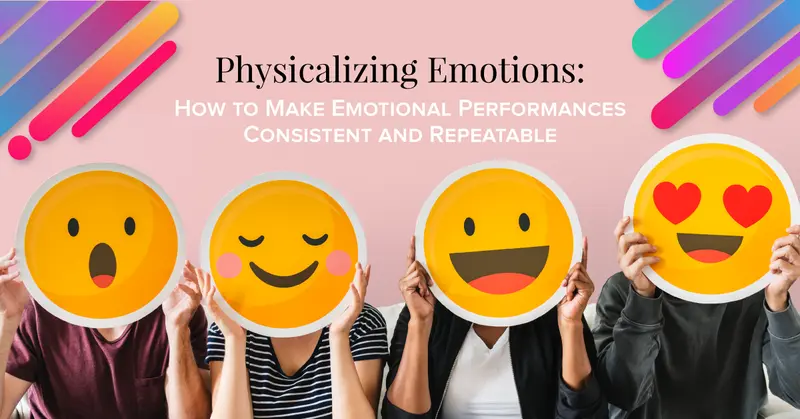
Physicalizing Emotions: How to Make Emotional Performances Consistent and Repeatable
Do you want your students to show you MORE onstage during a heightened emotional scene? “Joshua, can you be more sad here?” “Sannah, I think your character needs to be more angry right now.” “Lise, I need you to show more excitement at this moment.” You may be on the receiving end of confused looks or blank expressions after giving directions like that. It could be that your students don’t know HOW to show these big emotions onstage. “More” is vague, and it’s different for everyone. What your students think is more might not be “more enough” for the scene.
Some actors employ a technique where they think about their own experiences to inform their character’s emotional reactions and achieve a similar performance. In other words, they think of a time when they felt a heightened emotion (sad, angry, excited, etc.) and use that feeling to drive their performance. For example, if they are portraying a character that is feeling heartbroken, they might think about a time when they themselves were rejected by a crush.
This technique can be effective, but difficult for young or inexperienced students to use. Some students may lack the applicable life experiences. Other students may find delving into their past experiences upsetting or even traumatic. Having to bring up those feelings each time they perform the scene can pile on the stress and blur the lines between the student and the character. It can also lead to inconsistent performances. One day your student might feel great, and their performance goes well. On a different day when the student is feeling more stressed than normal, having to bring up an emotionally challenging situation from their real life will only add to that stress. The performance might be heightened, or more subdued, or choppy, and the student will have to deal with even more troubling feelings when they leave the room at the end of class or rehearsal.
Try this technique with your students instead. Rather than leaning on personal experiences, give your students detailed and precise facial or body movements and gestures to physicalize the emotion they are attempting to portray. This can help make your students’ performances more consistent and repeatable, while avoiding causing stress or trauma. Physicalizing emotions allows you to demonstrate specifically what you want your student to do, while verbally describing what you’re doing and why.
Consider the following facial and body movements and how you could use them to portray different emotional states:
• Breathing (fast, slow, stuttered, deep, shallow, held, through mouth or nose)
• Posture (slumped, erect, leaning towards or away from someone else)
• Direction and intensity of gaze (at or away from scene partner, staring, unfocused, eye rolling)
• Proximity to scene partner (close, far away, moving around)
• Body tension (clenched or relaxed body parts such as teeth or fists)
• Speed of movement (fast, slow, varied)
• Additional movements and gestures such as winking, blinking, moving/flailing limbs, hair tossing, shrugging, nodding or shaking head, mouth movements and sounds (yawning, tongue clicking, pursing or licking lips, coughing), or pointing
When you’re giving directions to your students, try giving applicable physical directions for students to perform. For anger, students might clench their jaws and bare their teeth, or they might walk away from their scene partner, turn back quickly, and glare. The movements and gestures will vary from character to character and depend on what’s going on in the scene. Going back to the directions in the introduction, your more specific, physical directions might go something like this:
• Rather than “Joshua, can you be more sad here?” you might say “Joshua, try slowing your breathing down, slumping your shoulders, and looking away from Patricia.”
• Rather than “Sannah, I think your character needs to be more angry right now,” you might say “Sannah, when you say your line, move your face directly in front of Britton’s face, stare right at him, and clench your jaw and fists.” (Be sure that Sannah and Britton are ok with being in close proximity to each other.)
• Rather than “Lise, I need you to show more excitement at this moment,” you might say “Lise, after Terry says their line, try opening your eyes really wide, gasping, and then quickly covering your mouth with your hands.”
The physical directions are more clear and understandable than just, “Be more (sad, angry, excited, etc.),” and easier for your students to follow, both in the moment and in repeated performances of the scene. They also don’t depend on students delving into their past experiences to portray the emotions needed for the scene. As an added bonus, specific directions are easy for students to note in their scripts.
Don’t worry about student performances looking artificial or exaggerated (some people call this “hamming” or “mugging”) while trying this technique. At this point, we want our students to visibly portray consistent physical gestures. You can fine-tune the movements as they practice them so they look more natural. As students gain more experience, they’ll also come up with appropriate physical directions on their own, which is always wonderful to see!
Additional Resources:
• What’s Your Character’s Signature Gesture?
• Improv Game: Verbal vs. Nonverbal Cues
Diversity
Theatrefolk Featured Play: Life, Off Book by Scott Giessler
Welcome to our Featured Play Spotlight. If you’re looking for a show with a flexible cast and great opportunities for ensemble work then prepare yourself for Life, Off Book by Scott Giessler.
In this movement-based drama, Ophelia and Jeb have a relationship that’s like a well-built theatre set. It looks great on the outside, but an empty shell on the inside.
Ophelia is a phenomenal dancer and actress who’s constantly afraid. Jeb is Ophelia’s mild mannered fake boyfriend who is also a closeted gay man. What happens when they have to tear themselves away from the script and live life off book?
Why did we publish this play?
As our submissions manager Nick Pappas said when he recommended this play “It gives me the feels.” Life, Off Book is a play that has a lovely blend of character journey, artistic imagery (if you’re inclined there’s opportunity for music and dance), and a heart felt message. It’s a play teens should be in, should see, should experience.
Let’s hear from the author!
1. Why did you write this play?
I work with many students that are slowly working their way out of the “closet” and go through many of the things the show covers. I also know many students who are afraid of real relationships. I wanted to create a story that handled this subject matter in a way that did not feel preachy or whiny and would give them a sense of confidence for who they are. I also wanted to create a show that would highlight the arts community of a high school that was not cartoonish or cliché in the way that so many TV shows or movies do.
2. Describe the theme in one or two sentences.
It’s important to live your life with love and hope; not fear. You only really start living a worthwhile life when you put away your fear and let the chips fall where they may.
3. What’s the most important visual for you in this play?
I love the moment that Ophelia peels the facades off of the set pieces.
4. If you could give one piece of advice for those producing the play, what would it be?
Look to find what’s real in this story to you. Make this your world, and make these characters and narrators people you know; and don’t be afraid to present this subject-matter. It’s 2018, and this is your world now.
5. Why is this play great for student performers?
Thanks to the exhaustive workshopping with high school students, the dialogue and story are very relevant, clever, and very engaging. It’s real but not too heavy. There are a variety of personalities for actors to connect to. It also highlights a lot of different kinds of talents if you have dancers or musicians.
Classroom Exercise
Dancing in the Drama Classroom: 3 Ways to Get Started
For those students who love dancing, simply mentioning the word “dance” gets them up on their feet and immediately moving. For other students, the idea of pirouettes, step-touches, and fan kicks causes them to break out in a cold sweat. Dancing is fun, a great way to exercise, and a wonderful way to express feelings and emotions onstage, but it can be intimidating for students with two left feet – or even students who are good dancers but lack confidence.
Here are some tips for providing more leadership and growth opportunities for your dance enthusiasts, and to encourage your less dance-inclined students to dip their toes deeper into the dancing pool.
1. Start with those who love danceFirst and foremost, if you are working on a class production and have students who absolutely love dance, that is an ideal opportunity for you to get those students more deeply involved. You can have them work with the choreographer of the show: first by shadowing to learn proper warm-up techniques, how to explain the moves to the other students, and how to give corrections and feedback. (If they have a background in dance already, they may already have this knowledge.) You can assign “dance captains,” and have those students lead warm-ups and rehearse choreography while other students are working on other tasks.
From there, if you have some really skilled and enthusiastic students, have them choreograph a part of the show. Perhaps they can work on a dance break during a song, a transition to cover a scene change, the sequence of bows, or even a brief number within the show. Have the students plan their choreography in advance (either by writing it out on paper, or filming themselves doing their choreography) and show it to you. If it works with your vision for the show, then they are good to teach it to the rest of the cast! Be sure to credit their work in the program (such as “Monkey Around choreographed by Susan Martin and Kyle Reeve”), and let them film the cast doing their choreography, so they can have a recording of their work.
2. Use movement to tell a storyWithin the classroom, challenge your students to think of dance as just another way of telling the story. Compare dancing to singing in a musical – why do characters break out into song? It’s because the character’s emotions and feelings are so strong they can’t just speak the words. It’s the same with dance – it’s another way of conveying emotions, feelings, and advancing the story.
Dance is also so diverse. It doesn’t always have to be all jazz hands and grapevines – it could be a series of interesting movements or lifts, it could be inspired by martial arts (like tai chi), it could be a stylized way of entering and exiting, it could be a dance fight… there are lots of possibilities. Have your students brainstorm a list of different ways that dance could be used beyond just the traditional “song and dance” style of performing. Have them think of it as creative movement, if they need to.
Speaking of diversity, there are so many different styles of dancing to explore. How could these different styles be incorporated into theatre? Perhaps your students claim not to like dancing only because they haven’t found a style they like. Your students might like hip hop, highland, popping and locking, ballroom, or ballet. Encourage them to explore different styles of dance – have them watch YouTube videos of different styles, and see how they might incorporate those moves into a show or scene. Or perhaps they might see two dance styles they like, and combine them together to make a unique hybrid style! (A tap dancing tango? Why not?)
3. Mini Exercise: Flowing Frozen PicturesStudents will create three frozen tableau scenes to tell a story (the beginning, the middle, and the end of a scene), but, rather than breaking the scene and just moving in a quick and neutral fashion to set up for the next scene, students will find a way to transition from scene to scene using flowing, dance-inspired movements. Have students hold the first tableau for five seconds, and then move slowly and smoothly (tai chi speed) for ten seconds to their second position. Students must keep moving for the entire ten seconds until the second tableau, then hold that pose for five seconds. And then, again, take ten seconds to flow their movements into the final frozen picture. Ten seconds doesn’t seem like a lot of time, but when moving from frozen picture to frozen picture, it’s quite a long time! Encourage students to move their bodies in interesting and varied ways – use turns, levels (high/medium/low), reaches, stretches, and so on. Feel free to set the scenes to music if you wish!
Classroom Exercise
The Vowel Tree
The Vowel Tree Exercise enables us to practice making sounds with our voice and exploring the entire vocal range from low to high. It allows us to be vocally impulsive in a non-judgemental way.
When we are younger, we make all kinds of crazy noises. We enjoy our vocal apparatus. It’s new to us and we like discovering how it works. As we get older, we learn to tap down those impulses to make crazy sounds. It’s not something we do in polite society.
Sometimes, this imprinting keeps us from releasing our voice onstage. Acting is behaving truthfully in imaginary circumstances. One of the ways we can get to acting truthfully in imaginary circumstances is to free our voice by allowing it to behave naturally in any circumstance.
With the Vowel Tree Exercise, students make sounds and motions with their bodies. It’s going to look and sound silly! Model each step for your students. That way, they see you do it and know that it’s okay. Practice this on your own before you show it to your students. Sometimes students can feel really self-conscious about this exercise. Model confidence to your students in this exercise. The more confident you are, the more confident your students will be.
Watch the video below for a demonstration of the exercise.