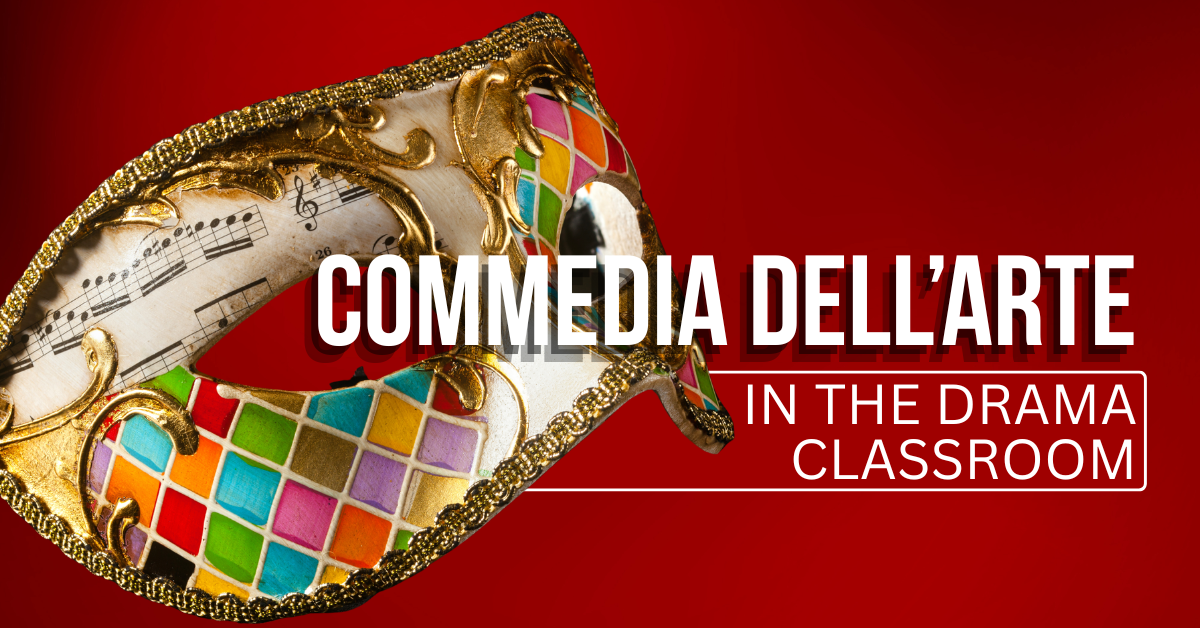
Commedia dell’arte is an improvised comedic theatre form that flourished in Italy in the 1500s. The exact origins of commedia are fuzzy and hard to pin down; there is not much documented previous to the 16th century. The term itself wasn’t commonly used until the 18th century. It is generally acknowledged that the form solidified in Italy in the 1550s and reached its peak in the 1650s. But despite an opaque history, the elements that define commedia are quite clear:
-
Improvised performances based on scenarios: Actors worked off a base outline and made up their lines.
-
Stock characters: The characters were always the same; only the situations changed.
-
Limited themes: Love, money, or food were the base of almost every scenario.
-
Use of mask: The mask defined the characters.
-
Use of lazzi: Short comedic physical bits within the story.
- Use of mime, acrobatics, and music.
So why should you include a commedia unit in your curriculum?
It builds strong physical acting skills.
Commedia dell'arte is highly physical and expressive. Because the style relies on stock characters and masks, actors must communicate emotions through posture and movement rather than facial expressions. Students learn an exaggerated style of character physicalization, clear body language, spatial awareness, and comedic timing — all great skills for a well-rounded actor.
It strengthens improvisation.
Commedia performances were built around loose story outlines (called scenarios), not full scripts. Commedia scenarios actually provide a pretty safe improv experience for students: Actors play characters who never change and have very set behaviours, wants, and physical movements. Students will always have a clear picture of how their character will respond in any improv moment. Commedia will give students the opportunity to practice foundational acting skills like thinking on their feet, listening, and reacting.
It teaches character archetypes.
Commedia characters don’t change. There’s no character arch or subtext. In every scenario or story they’re in, the characters remain the same. They have the same attitude, same look, same drive, same physical action. They never learn from their mistakes! These characters are called “stock characters,” also known as character archetypes. They are a type of character (e.g., the clever servant, the lover) rather than realistic or three-dimensional. The chance to play an archetype offers a unique experience for students as each character has a defined stance, walk, behaviour, and mask. Also, once students recognize the traits of the different characters, they’ll be able to look for these patterns in modern TV, film, and theatre. Many modern comedic characters can trace their roots back to commedia.
It connects to theatre history.
Commedia dell’arte began in 16th-century Italy as a response to the tight controls of the Catholic Church. It’s interesting how the characters in commedia who we would think have all the power (the Masters: Pantelone, Dottore, Capitano) are the most foolish and those who we would think to be powerless (the Servants: Arlecchino, Columbina) are the most clever. Status is a huge concept in the relationships in commedia. Learning theatre history helps students see how historical performance styles shape contemporary theatre.
It’s fun and accessible!
Commedia is bold, playful, and exaggerated. It’s not just an old theatre form, it's the foundation of modern performance. And you may even engage your shy students by using masks to commit fully to a character.