Improv Skills
Top Ten Tips for Teaching Improv
Jennine Profeta is an improv star and educator (you can find her in the Theatrefolk Resource Section with Impowerment Improv and Improv Games with Purpose as well as in the Drama Teacher Academy!)...
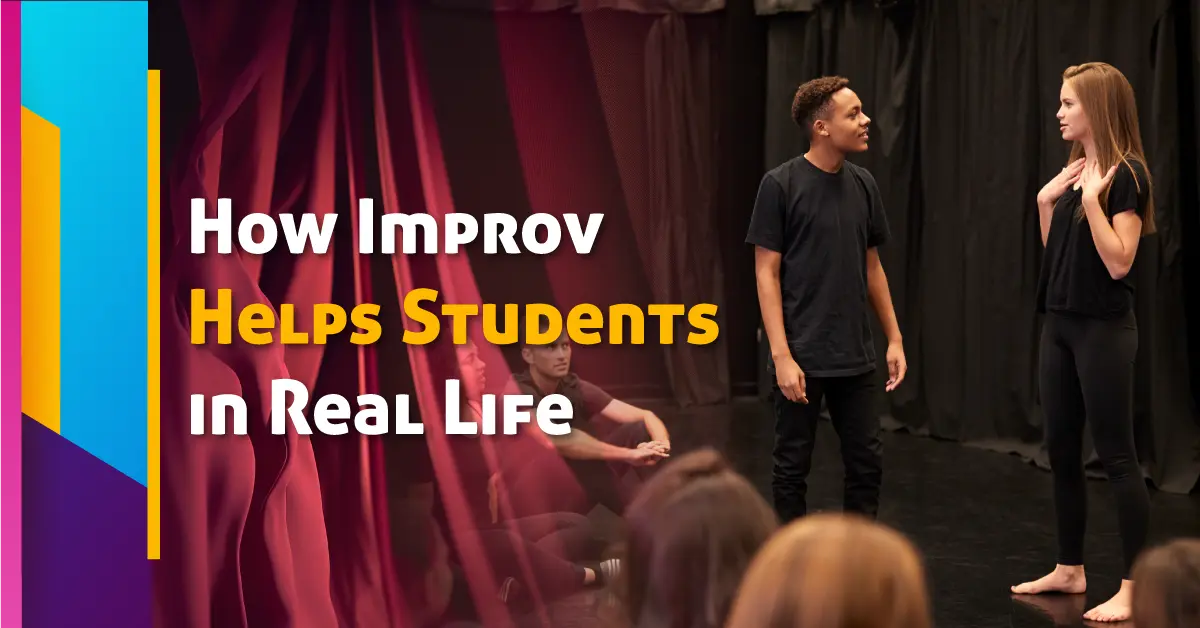
If you’ve ever had a student ask, “Am I ever going to use this improv stuff in real life?” the answer is yes — we use improvisation skills all the time outside of the drama classroom.
Improv isn’t just about being funny or making up jokes on the spot, although those are certainly great skills to have. (Who doesn’t love a good laugh?) Improv is all about active listening and responding appropriately in the moment. It helps students develop communication skills, adaptability, quick thinking, confidence and problem-solving skills, which are all things that will serve them beyond the drama classroom. Let’s look at some examples.
Improv is all about effective communication. Students must listen to the prompts given to them and add on. “Yes, and” is the standard response in improvised scenes to keep the scene going and build upon it. Or, they find a way to subtly navigate those ideas in a different direction, without bringing the scene to a halt. This is the “no, but” concept in improv, which still keeps the scene going but allows for some adjustments to where it goes.
These skills are used every day in group projects, team sports, relationships, and after-school jobs. Actively listening to others helps students respond and contribute authentically, and helps others feel valued because they’re being listened to and understood. Students can work on adding their own thoughts and ideas to a situation, both when they agree with what’s going on and when they want to suggest an alternative without totally disrupting the direction of the project.
Further Reading:
Hearing or Listening?
Improv Game: “Yes, And…” and “No, But…”
Improv Game: Creative Defiance
“Here’s your scenario… and go!” Improv requires students to quickly figure out a direction, make a decision, and go with it. The most interesting scenes are the ones with a problem to solve or conflict to resolve, which happens ALL the time in the real world. Conflicts and issues will arise with people and situations in all facets of real life, so being able to adapt and come up with solutions is an important skill to have. It could be dealing with a difficult situation, such as helping to resolve an argument between friends, assisting a difficult customer at a part-time job, or dealing with an emergency situation. It could also be dealing with a more positive but time-sensitive situation, like answering questions at a dream job interview, or deciding with friends as a group how to spend a beautiful day together before it gets too late.
Further Reading:
Improv Game: Combining Skills
Collaboration Game: Job Interview
Improv Community Game
When students are working without a script, they have to trust themselves and commit to their choices. It can be scary to have to make these decisions so quickly — what if they make the “wrong” choice? Remind students that even if things go sideways during an improvised scene, it’s only for a moment; they aren’t stuck with it. Improv is a great way to try different scenarios. They are allowed (and encouraged) to try different approaches, see what works and what doesn’t, and try again.
Mistakes are going to happen, no matter what — at school, at home, in the workplace. Being able to recover from a mistake or recognize that something didn’t work and try again are useful skills. Having a safe space where failure IS an option and imperfection happens encourages students to embrace a mindset of “that didn’t work, but that’s ok” and “now let’s find a different way,” which will serve them well when they’re faced with real-world situations.
Further Reading:
Using Improv to Address Fear of Failure
Embracing Failure in the Drama Classroom
Round-Up: Theatre in the Real World Exercises
Acting in Everyday Life
Subscribe for our exciting updates, insights, teaching resources, and new script releases. Plus, sign up now and get 4 plays and 2 lesson plans for FREE!
by Jim Hoare
Have you wondered how to take improv to the next level with your students? Your High School Improv Show Playbook is the "how-to" guide for you! Empower students to present their first improv show that is fun and entertaining for all.
by Jennine Profeta
Using improv to create self-awareness & confidence in your students
by Jennine Profeta
Improv games including feedback suggestions and questions, game variations, teaching tips, side coaching tips, entry prompts, exit slip questions, and more!