Facebook Pixel Skip to main content

📣SCRIPT SALE! Treat yourself to an easier Fall. Save 30% on 5+ perusal scripts with code SPRING30 before May 3 and head into summer stress-free.

Improv

How Improv Helps Students in Real Life
Teaching Drama

How Improv Helps Students in Real Life

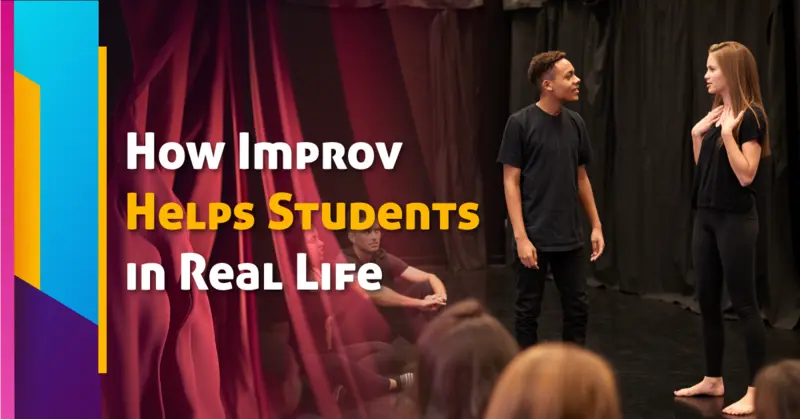
If you’ve ever had a student ask, “Am I ever going to use this improv stuff in real life?” the answer is yes — we use improvisation skills all the time outside of the drama classroom. Improv isn’t just about being funny or making up jokes on the spot, although those are certainly great skills to have. (Who doesn’t love a good laugh?) Improv is all about active listening and responding appropriately in the moment. It helps students develop communication skills, adaptability, quick thinking, confidence and problem-solving skills, which are all things that will serve them beyond the drama classroom. Let’s look at some examples. 1. Improv challenges students to actively listen and respond appropriately.Improv is all about effective communication. Students must listen to the prompts given to them and add on. “Yes, and” is the standard response in improvised scenes to keep the scene going and build upon it. Or, they find a way to subtly navigate those ideas in a different direction, without bringing the scene to a halt. This is the “no, but” concept in improv, which still keeps the scene going but allows for some adjustments to where it goes. These skills are used every day in group projects, team sports, relationships, and after-school jobs. Actively listening to others helps students respond and contribute authentically, and helps others feel valued because they’re being listened to and understood. Students can work on adding their own thoughts and ideas to a situation, both when they agree with what’s going on and when they want to suggest an alternative without totally disrupting the direction of the project. Further Reading: Hearing or Listening? Improv Game: “Yes, And…” and “No, But…” Improv Game: Creative Defiance 2. Improv requires students to think quickly and problem solve in the moment.“Here’s your scenario… and go!” Improv requires students to quickly figure out a direction, make a decision, and go with it. The most interesting scenes are the ones with a problem to solve or conflict to resolve, which happens ALL the time in the real world. Conflicts and issues will arise with people and situations in all facets of real life, so being able to adapt and come up with solutions is an important skill to have. It could be dealing with a difficult situation, such as helping to resolve an argument between friends, assisting a difficult customer at a part-time job, or dealing with an emergency situation. It could also be dealing with a more positive but time-sensitive situation, like answering questions at a dream job interview, or deciding with friends as a group how to spend a beautiful day together before it gets too late. Further Reading: Improv Game: Combining Skills Collaboration Game: Job Interview Improv Community Game 3. Improv helps students embrace failure and imperfection.When students are working without a script, they have to trust themselves and commit to their choices. It can be scary to have to make these decisions so quickly — what if they make the “wrong” choice? Remind students that even if things go sideways during an improvised scene, it’s only for a moment; they aren’t stuck with it. Improv is a great way to try different scenarios. They are allowed (and encouraged) to try different approaches, see what works and what doesn’t, and try again. Mistakes are going to happen, no matter what — at school, at home, in the workplace. Being able to recover from a mistake or recognize that something didn’t work and try again are useful skills. Having a safe space where failure IS an option and imperfection happens encourages students to embrace a mindset of “that didn’t work, but that’s ok” and “now let’s find a different way,” which will serve them well when they’re faced with real-world situations. Further Reading: Using Improv to Address Fear of Failure Embracing Failure in the Drama Classroom Round-Up: Theatre in the Real World Exercises Acting in Everyday Life
Inclusive Improv: Tips for Reflecting the Whole Spectrum
Teaching Drama

Inclusive Improv: Tips for Reflecting the Whole Spectrum

Improv is meant to be a fun and creative way to express oneself in the drama classroom. It’s a great way to “try on” a wide variety of characters and situations in a fast-paced, low-stakes environment. For LGBTQIA+ students and others from marginalized communities, however, it can feel risky — beyond the usual risks we encourage our students to take. Stereotypes, assumptions, and other negative behaviour from students can creep in, unless we set a clear foundation for respect, safety, and inclusion. Inclusive improv isn’t meant to shut down humour or block creativity; it’s about opening up a wider and more respectful range of stories. When students know their identities are safe onstage, they’ll feel more comfortable taking creative risks and bringing their whole selves into the work. Here are some simple, practical ways to make sure your improv work reflects the spectrum of identities and experiences in your drama classroom. 1. Establish ground rules and boundaries as a group.Before you start improv work (or really, any collaborative work) with your students, come up with a set of community agreements that reflect what you want the classroom atmosphere to be. Include guidelines such as “We don’t make fun of people’s identities,” “We respect each other’s boundaries,” and “We remember to follow the ‘Yes, and…’ rule for improv, but we also reserve the right to say ‘No, but…’.” Remember, community agreements are a “living document” and can always be reviewed, updated, and adapted as needed. 2. Normalize all identities.Use neutral prompts whenever possible. For example: “Two students studying for a difficult exam” or “A group of scientists about to discover something terrifying,” rather than “A guy and a girl go to the movies together” or “A mom and dad discuss homework with their daughter.” This opens up more opportunities for interpretations of the prompts, on top of allowing students to play a role in whatever way they feel comfortable doing. You’ll find more neutral prompts in the giveaway below. If gender identity is relevant to the scene, let the students choose how they want to play it. For example, if a student says in a scene, “My moms are picking me up from school today,” or “Alex wants to help me bake a cake, but they’re not great in the kitchen,” affirm it in a neutral manner and go with it. Model this yourself when giving examples as well. Ensure students are portraying all identities in a respectful manner. Which leads us to our next point… 3. Interrupt harmful stereotypes.Sometimes students might unintentionally (or intentionally) portray a character in a stereotypical or caricature-like way, for example, “the sassy gay best friend.” If this happens, stop the scene gently but firmly and address the issue immediately. You might say something like, “Let’s pause here. This is leaning towards being a stereotype, and that’s not where we want to go.” Have a brief discussion to turn it into a learning moment: “How could we re-approach that character to be more honest and real?” 4. Encourage students to reflect.After improv sessions, have your students respond to reflection questions in a discussion or as journal prompts. For example: • Identify moments of inclusivity today. Why did those moments stand out to you? • Did we represent a wide range of people in today’s exercise? Why or why not? What could we do differently next time? • Were you a supportive scene partner/audience member today? If yes, give examples. If not, how could you be more supportive in the next class?
Using Pop Culture to Engage Drama Students
Teaching Drama

Using Pop Culture to Engage Drama Students

A great way to engage students is to bring popular culture into the classroom. From celebrity headlines to social media trends, students are highly engaged in pop culture and are always eager to discuss and debate the latest trends. Here are three ways you can use pop culture as a tool to engage your students. Journal TopicsIf your students are required to complete a journal entry as part of their daily routine, you can create journal prompts based on pop culture to get your students to write about trending people or events. When a celebrity or event is in the headlines, or blowing up on social media, create a journal prompt asking students what they think about what is going on, and what they might do to change or improve the situation. These topics are a terrific opportunity to get your students to think about current events in a different light and engage in critical thinking. Phrase your journal prompt in terms of “how,” “why,” or “what if” and ask your students to think beyond the headlines. You might be surprised with what they share. Improv ScenariosAnother way to bring pop culture into your classroom is by inserting references into improv scenarios. You don’t need to create entire scenarios based on recent cultural events; you can simply include a pop culture reference in a larger scenario, and that will enable your students to incorporate some trendy topic into the scene. This strategy is useful in a couple of ways: First, it allows your students to bring their personal thoughts and feelings about current events into the scene. Second, it gives additional content structure to the improv circumstances the students are working with. Both of these are beneficial because the more information your students can connect with on a personal level, the more confident and creative they will be in their actions. Playwriting PromptsYou can also use pop culture as a starting point for playwriting assignments. It’s easier for students to approach a writing project when they are familiar with, or at least interested in, the subject. Their knowledge of popular culture will give them an easy head start when writing a scene or story. Create open-ended scenarios and allow your students to fill in the details based on celebrities in the headlines or viral events. Challenge them to put themselves in the shoes of those they are seeing on social media and ask how they would change the story. Again, the more familiar and engrossed your students are with the circumstances, the more willing they will be to dive deep and generate creative works. Additional Reading: Three Ways to Engage a Large Drama Class Engaging the Non-Theatre Student in the Drama Classroom
Improv Fun & Games: A Minute of Kindness
Classroom Exercise

Improv Fun & Games: A Minute of Kindness

Here’s a quick and easy improv exercise you can use when you have a few minutes of time to fill in class, or whenever you want to spread a little kindness with your students. You’ll need a timer and a paper and pen or note-taking app. Part 1: One-Minute Kindness BrainstormQuickly match up students into small groups of three to four. Have one student act as scribe, using a pen and paper or a note-taking app on their phone. In one minute, have each group list as many of the following: • Ways to say kind words and/or phrases • Kind actions or acts of service • Ways to help a friend or family member • Good advice to give others • Ways to help your community • Other unique acts of kindness Feel free to have the full class brainstorm about any or all of the topics, or assign a different topic to each group. After one minute has elapsed, have each group choose their five best ideas and share them with the rest of the class. Use these brainstormed ideas for part 2. (Feel free to collect all the brainstorm lists and use these ideas for future classes when devising scenes, playwriting prompts, journal prompts, or actions that your class could undertake for random acts of kindness.) Part 2: A Minute of KindnessHave students sit or stand in a circle. Select two students to go into the middle of the circle. Select one of the brainstormed ideas at random for students to create a one-minute improvised scene. Use the timer to indicate the end of the scene. Remind students that they can use any kind of scenario for the scene; it doesn’t just have to be two students displaying acts of kindness. It could be a parent and child, a person and their pet, two co-workers, two aliens, two dinosaurs — whatever they want to try, as long as kindness is at the heart of the scene. Improv is all about “yes, and…” so encourage your students to make big choices. Once the minute is up, send in two more students and have them take a turn creating an improvised scene. Continue until all students have had a turn, or you run out of time. For a Challenge: If your students are improv pros, you can add surprise parameters to the kindness scene. Write these suggestions onto slips of paper and have students draw one out of a hat: • Standard improvised scene • +10 seconds • -10 seconds • Improvised mime scene • Improvised tableau series (three frozen pictures) • Improvised scene using only voices (act behind the audience) • Interpretive dance • Improvised musical (all lines must be sung instead of spoken) • Add a third student to the scene • One actor must mention pickles at some point during the scene
Kindness Improvised Scenes
Classroom Exercise

Kindness Improvised Scenes

When you can improvise a scene about anything, why not focus on kindness? Incorporating kindness into drama class activities helps students develop the ensemble mindset and creates a more positive, joyful environment. Here is a selection of 20 two-person improv scene prompts related to kindness. Have students pair up and let them select one of the prompts to perform. Or, have them pick a random number from 1 to 20 to determine what prompt they’ll present. Feel free to expand the prompts with more details or add more students to the scenes. Give students a time limit for the improvised scene, or allow it to unfold until it comes to a natural ending. You can also use these prompts for playwriting or devising scripted scenes. 1. A person does something kind for someone else without their knowledge. 2. Two friends try to one-up each other with kind acts. 3. A person helps a friend with a difficult task. 4. Someone discovers the consequences of being unkind. 5. Two friends have a disagreement but are able to de-escalate and forgive each other. 6. A person shows kindness to an animal. 7. Two friends complete a volunteer project to help others. 8. How to show kindness at school. 9. How to show kindness to your family. 10. How to show kindness in your community. 11. One friend encourages another friend to pursue a dream. 12. A student is tempted to be unkind, but decides to be kind instead. 13. Two friends perform a random act of kindness. 14. Two friends participate in a “compliment-off.” 15. Superheroes whose power is spreading kindness. 16. A person welcomes and guides another person in a new environment. 17. A person takes care of a friend who is sick. 18. A person surprises a friend with an unexpected gift. 19. A person receives an award for outstanding acts of kindness. 20. A friend encourages another friend to take a risk and it pays off.
Improv Game: Scenario Generator
Games

Improv Game: Scenario Generator

If you’re looking for a way to mix up your improv sessions and enjoy taking a risk, give this game a try! Combine the mystery of the game Clue with the dice-rolling stakes of Dungeons and Dragons, add a dash of brainstorming and a pinch of silliness, and you’ve got the makings of the ultimate Mad Libs-style mashup drama game. MaterialsYou’ll need a 12-sided die (also known as a D12 or a dodecahedron). If you don’t have any dice, you can Google search “roll dice” for an online dice generator. You’ll also need something large to write on: a large sheet of paper, a whiteboard, or similar. Instructions1. Create a grid with four columns and 12 rows on your writing material. The first column will have the numbers 1 to 12 in descending order. The second column is titled “person,” the third column is titled “place,” and the fourth column is titled “activity” or “action.” 2. Brainstorm enough ideas/prompts to fill each square on the grid. You can have your students suggest ideas, or use one of our handy prompts lists. Here are some samples of person, place, and activity/action prompts. If you need even more prompts, check out our teaching resource Two Thousand Prompts for Drama Class. Here’s a sample grid to get you started:
Improv Game: Row of Hats
Games

Improv Game: Row of Hats

This improvisation game challenges students to think quickly: grab a hat and create a character name, some personality traits, and their voice and signature gesture. This exercise is all about putting yourself out there, experimenting, letting go of expectations, taking risks, and trying again. There are no wrong answers in Row of Hats; only exploration and potential laughs! This game can be played in various stages. If your students are new to drama class or inexperienced, feel free to stay at Stage 1 and keep practicing. Once they feel more confident, have them explore further stages. For experienced drama students, feel free to jump to whatever stage you think is appropriate for them. You’ll need a minimum of five different kinds of hats: baseball cap, newsboy cap, Santa or elf hat, top hat, fascinator, veil, beret, bucket hat, beanie or toque, cloche, fedora, cowboy hat, bowler hat, sunhat, fez, visor, chef’s hat, helmet, mortarboard, party hat… the options are only limited by your costume stocks! For each stage, you’ll start by lining up a row of five hats on a long table, on the edge of the stage, or on the floor. One by one, students will approach the hat at the end of the row, put it on, perform the task required, remove the hat, put it back on the table, and move down the row to the next hat. Repeat for each hat until students have tried on all five hats. Stage 1: For each hat, introduce yourself out loud to the rest of the group. Give your character a name and a greeting. Include a unique voice and gesture. For example, wearing a cowboy hat: “Howdy folks, my name’s Jessie. Nice to meet ya.” Stage 2: For each hat, introduce the character’s name and greeting, using that character’s unique voice and gesture (as in Stage 1). Tell the class something your character does or likes. For example, wearing a mortarboard: “Good afternoon, students. I am Professor Draconis and I study astronomy. My favourite constellation is Ursa Major.” Stage 3: For each hat, introduce the character’s name and greeting, using that character’s unique voice and gesture (as in Stage 1). Tell the class something your character does or likes. Answer a question in character, posed to you by a classmate. For example, wearing a beret: “Bonjour, my name is Pierre. I am a famous French pastry chef.” “What is your favourite thing to bake?” “Bien sur, my favourite thing to bake is chocolate croissants, of course!” Stage 4: Once the first student has moved down the row to the second hat, have a second student put on the first hat. Have the two students interact with each other in character. The second student can either continue acting as the first character that the first student created, or create a new character. Continue down the row, changing characters with the different hats, while continuing to interact with the second student. For more fun experimenting with character creation, try Exploring Different Voices Using Puppets, Masks, and Props.
Improv Fun & Games: Speed Props
Games

Improv Fun & Games: Speed Props

“Speed Props” is a fast-paced, competitive version of the traditional Props game. This is a great game for students who like a challenge and want to practice their improvisation skills. Materials Needed:• Stopwatch or kitchen timer • Bell or noisemaker • Paper & pen • Selection of props • Someone to be the Judge (either the teacher or a student volunteer) Instructions:1. Divide students into a minimum of two groups. 2. Have a selection of props available for groups to choose from. Anything goes: blankets, chairs, mops, mugs, backpacks, sports equipment, stuffed animals… whatever you have handy in your classroom or props cupboard. 3. Determine which team gets to select their prop first (choose a name out of hat, play rock-paper-scissors, answer a trivia question, etc.). The advantage of going first is that the group gets a wider choice of props. The advantage of going last is that their group can use other groups' ideas to spark their scenario ideas, but they have fewer props to choose from. 4. Each team has one minute to improvise as many simple scenarios with their prop as possible. Team members can go up solo, in pairs, as a full group, or whatever they want within the time limit. 5. The Judge starts the timer and watches closely. When the Judge thinks the scenario is clear, they ring the bell or sound the noisemaker and the group can move on to the next scenario. The Judge keeps a tally on the paper of how many scenarios the group completes in one minute, excluding duplicate scenarios. Once the final timer goes off, the group must stop. 6. Talking is allowed to assist with the scene, but students cannot identify the object specifically. For example, they can hold up a broom handle in front of them and pretend to play it as a clarinet and make squeak and toot noises, but they can’t just hold the item and say “This is a clarinet.” Students can use the items any way they wish, as long as they don’t drop or break the prop and the scenario is classroom friendly. 7. Remember that the keyword here is simple! Groups don’t need to come up with long, elaborate scenarios. The goal is quantity, while ensuring the scenarios are clear and understandable. A student might use a prop plate as a steering wheel, but they don’t need to mime getting into a car and starting the engine. Just sit or squat and make a steering motion with the plate, then move on once the Judge sounds the approval bell. Time is of the essence! 8. Continue playing rounds until you wish to stop or you run out of class time. Add up the total scores. The team with the most scenarios wins. Gameplay Adaptations• For less experienced students, you may wish to allow 1.5–2 minutes per group. • Play as many rounds as there are teams. In the first round, the first group chooses a prop that every group must use. In the second round, the second group chooses a prop for every group to use, and so on. No repeated scenarios are allowed per prop. • When deciding which team gets to go first, the winning team can either go first or assign a prop to another group and make them go first. • Silent Speed Props: only miming, no speaking or sounds allowed. • If the Judge sees a group copying another group’s scenario, the offending group must give a point to the team they copied. • If a group is blatantly copying another group’s scenarios, the Judge may determine a penalty (losing points or disqualification).
Improv Game: The Next Chapter
Games

Improv Game: The Next Chapter

The improv game “The Next Chapter” is a fun full-class activity. It takes the traditional “Freeze” improv game and turns it on its head. In that game, small groups of students create an improvised scene, and when the teacher calls “freeze!” the next group of students creates a new scenario from the previous group’s frozen poses. In “The Next Chapter,” the small groups still freeze when the teacher says to do so, but the next group of students picks up where the last story stops, creating a new improvised “chapter” with each subsequent group. The result is one long improvised story that can still take many creative turns, but maintains the characters throughout the process. The learning goals for this improv game include developing teamwork skills and creative quick thinking skills. Additionally, this game challenges students to listen carefully and recall details from previous “chapters” to continue their scene and make it fit in with the overall story. Try it! Instructions 1. Have students get into pairs or groups of three. 2. Select one group to start. 3. For the first group, assign the students a relationship or specific roles. For example: scientists working on an experiment, Grandma babysitting her grandchild(ren), an exercise instructor and student(s). 4. Give the first group a setting to start: a lab, a gym, a shopping mall, a movie theatre, a playground. Make sure the whole class hears the role and location assignments clearly! 5. The first group will start their scene as the first chapter of the story. 6. When the scene comes to a natural pause or after a set amount of time (your decision), call out “freeze!” The group who is performing must freeze in whatever positions they happen to be in. 7. Have the next pair or group of students take over the roles in either a continuous or new setting, i.e. the next chapter of the story. The students must take the same position and roles that the previous students were in. From there, they can either continue the story as it was, or come up with a creative transition into the next scene with the same characters. For example: The first chapter establishes Grandma babysitting her two grandchildren. Second chapter: eating lunch. Third chapter: going to the park. Fourth chapter: coming home for naps. Fifth chapter: baking cookies. And so on. The stories can be as mundane or fanciful as the students wish, as long as the story is continued in a way that makes sense. 8. Students must remember any details established in the prior scenes and continue them going forward. Going with the Grandma example, the kids will stay kids and Grandma will still be Grandma. If one of the students says their character name is Brad, then it stays Brad. Remember the traditional rule of improv: “Yes, and…” Once a detail is established, everyone goes with it and adds more to keep the scene going. However, students can add details and create new scenarios within the story that make sense. For example, perhaps the kids discover that Grandma is a secret agent, or Grandma reveals she’s into street racing and takes the kids on a wild ride in a race car to the playground. Important details need to stay the same. For example, students can't randomly change a character’s name from Brad to Steven. However, if there is a clear reason — perhaps Grandma continually gets her grandchild’s name mixed up and he keeps correcting her — it can become a “bit” (a funny recurring moment or joke) and in that case, it’s acceptable. 9. Continue until all groups have had a chance to perform. The final group has to create a conclusion of some sort. 10. Students will complete and submit an exit slip (found below).
Classic Improv Game: Commercials
Games

Classic Improv Game: Commercials

Advertisements and commercials can be entertaining, educational, heart wrenching, and hilarious. Ultimately though, the goal is to grab your attention, tell you about the product, and get you to part with your hard-earned cash in exchange for whatever they’re selling — as efficiently as possible. In this improv game, students are tasked with improvising an advertisement for a product. It’s challenging because it’s an individual performance exercise, but it has clear parameters to follow, which can help students figure out what to do in the moment. Feel free to print out the requirements (found in the giveaway below) and post them so students know the structure they need to follow. Instructions1. Pre-game prep: Ask your students to identify commercials or advertisements that they like or find memorable. You also may wish to have a selection of ad videos to show students. What makes the commercials memorable? What makes them effective (or ineffective) and why? If money were no object, would you buy that item based on the commercial? 2. Have students brainstorm a list of products to sell. Pretty much anything goes! Here are 10 ideas to get you started: toothpaste, pack of crayons, scuba wetsuit, garbage can, beard trimmer, twelve-pack of tube socks, lunchbox, ice skates, video game system, paper towels. Try to avoid items with established brand names, or at least refer to them as their generic item name (for example, use the non-specific phrase “adhesive strip” or “bandage” instead of Band-Aid). 3. Select a student to begin. Have them stand at the front of the room. Give that student a product to sell in an improvised commercial, or write the products on slips of paper and draw them out of a bag or hat. 4. The student must include the following information in their commercial: • An interesting opening statement (“Are your teeth gray and gross?” “If you love fly fishing, then I have the perfect product for you!” “BAM! Now that I have your attention…”) • A brand name for the product (Students can use an established brand if they like, or invent their own brand name.) • At least two features of the product (How it will benefit you, how it will make you happy, what it’s made of, quality of the material, ease of use, a bonus for purchasing, a jingle or catchphrase, etc.) • The price of the product • Where/how to buy it (In store, online, call now!) Students may present their commercial in any tone they wish: sales-y, comedic, emotional, as a song and dance, as a celebrity endorsement, and so on. There is no time limit, but students should attempt to be as efficient as possible in their delivery. Feel free to cut off students if you think they’re milking their stage time! 5. Once the student has improvised all the required information, they are done! Select a new student to perform. Continue until time runs out or everyone has performed. If your students are pros at the basic commercial improvisation, try these challenge modes! • Challenge 1: Students have to complete all the requirements in one minute or less. • Challenge 2: Students have to complete all the requirements in 30 seconds or less (without rushing). • Challenge 3: Students have to keep selling until you “change the channel” (infomercial style). Even if they’ve completed all the requirements, they have to keep going until you say, “CLICK!” • Challenge 4: “Change the channel” between three students. Have three students stand at the front of the room. Assign each student a channel number. Channel 1 begins their commercial. When you say “CLICK!” they must freeze and then Channel 2 will begin their commercial. Repeat with Channel 3. Once Channel 3 gets “clicked,” the game will go back to Channel 1, who must pick up wherever they were paused. Continue until each channel completes their commercial. • Challenge 5: Add an adjective to each product. For example: vintage lunchbox, glitter toothpaste, waterproof ice skates, glow-in-the-dark beard trimmer, stinky garbage can. Students must include the adjective as one of the selling features for the item, regardless of whether or not they think the adjective is a positive or negative one.
Two Prompts: An Easy Improv Game for When You Just Can’t Think
Games

Two Prompts: An Easy Improv Game for When You Just Can’t Think

There are times when you need a game that doesn’t require much explanation to get started. This is a great game to play with your students at the end of the term when they (or you) are feeling burnt out, or the day after closing a show when you’re tired and need a laugh. The following exercise challenges students to incorporate two prompts into one improvised scene. Students must employ listening skills, teamwork, and quick thinking to complete this exercise successfully. To prepare: Visit our Prompt collection and print out at least two prompt lists. As well, have a timer or clock with a second hand available to ensure each student gets the same amount of time to perform. Instructions:1. Select two students to perform. 2. Have the students choose a number between 1 and 50. (Each prompt list has 50 prompts, with an additional 50 prompts in the giveaway.) 3. Give the students the prompt on each page associated with that number. For example, for the number 37, the animal-related prompt is “What would your two different pets say to each other?” and the location prompt is “science lab.” 4. Give students a countdown of five seconds to prepare. 5. Students will improvise a one-minute scene together, incorporating both prompts into the scene somehow. For the above example, your students might play scientists studying talking pets, or they might play the pets hanging out in a science lab discussing what their owners are doing. It can even be as subtle as two students wondering aloud what their pets talk about when they’re not there, and then hearing the school bell ring and ending the scene with, “Ok, I’m off to the science lab!” It’s up to the students to be as obvious or subtle as they wish, as long as they use both prompts. 6. When one minute is up, the scene is complete. 7. Cross off each prompt as it’s used. Repeat up to 50 times. If your students are new to improv or find it intimidating to come up with ideas on the spot, try doing a brainstorming session before the first pair performs. Select two prompts and have the full class come up with performance ideas that incorporate both prompts. This will give students more ideas about where they could take their scenes.
Improv Game: Yes, And… and No, But…
Classroom Exercise

Improv Game: Yes, And… and No, But…

In improvisation, one of the first rules that drama students are commonly taught is to always say, “Yes, and…” to continue the story. Basically, agree with presented concepts to keep the scene moving forward. If Partner A says, “Wow it’s so hot today!” and Partner B says, “What are you talking about, it’s freezing!” Partner B is stopping the scene from moving forward. But what if the suggestion that one of the scene partners presents makes the other partner uncomfortable? Teachers can try to circumvent awkward or uncomfortable improvised scenes by using prompts to direct the focus of the scene, but you never know where a student will take a scene or what they’ll bring up in the moment. We also can’t know what might be upsetting for a student until it occurs. Once students have learned the basics of improvisation, including “Yes, and…” introduce “No, but…” as an option to take the improvised story in a different direction. This provides a way for students to reframe an uncomfortable situation. Students are still responsible for participating in the scene, adding information, and not derailing the plot (for example, if your partner says something like, “Wow it’s so hot,” then that’s a given for the scene). But they can pivot and adjust where the scene is going. If Partner A says, “Hi Donna!” and Partner B says, “Guess what, I changed my name last week, you can call me Dean,” Partner B is saying No, but also adding information. Having the ability to say “No, but…” is an important aspect of consent within the drama classroom. If students cannot say no, then their “yes” isn’t meaningful, because they don’t have a choice in the matter. Knowing that they have the ability to say no and adjust the scene tells students that their voices are being heard and respected, and that their feelings are important. This is not to say that students should be allowed to not participate in scenarios they just don’t like or feel silly doing. We want to encourage our students to try new things, make mistakes, and explore. But it’s good to have a safeguard in place as well. And, when used sparingly in improvisation exercises, “No, but…” can be an interesting and creative way to contribute to the scene. And sparingly is the key word here. Here’s a quick game you can try with your students to practice “Yes, and…” and “No, but…” You’ll need a timing device and a noisemaker, such as a bell. 1. Start by discussing with your students the concept of “Yes, and…” Remember, students don’t need to say that specific phrase — it simply means going along with suggestions and adding more to the scene. The goal is to keep the scene moving forward; you don’t want to derail it by denying the information your partner has given you. 2. Introduce the concept of “No, but…” Discuss scenarios in which students can pivot and adjust the scene if an uncomfortable situation occurs. It’s not to be used in every scene, or just because a student doesn’t like a given suggestion. Give a sample prompt or scenario and let the full group brainstorm different ways they could apply the idea of “No, but…” to the scenario (with or without the specific phrasing) that move the scene forward. 3. Have students form pairs. Select one pair of students to start an improvised scene. Let them know that each pair will be limited to one minute maximum for the scene. Students will focus on the spirit of “Yes, and…” to the best of their abilities. 4. When the timer reaches the 30 second mark, sound the noisemaker. Whoever’s line is next must use the “No, but…” prompt, and take the scene in a different direction. It doesn’t need to be wildly different, but it needs to go in a new direction while still being related to the earlier work in the scene (for example, same character names). 5. The scene will then continue until the end of the remaining time while going in the new direction from the “No, but…” prompt. Don’t worry if time runs out and the scene hasn’t ended. Sound the noisemaker to indicate that time is up and end the scene where it is. If possible, repeat with the next pair of students until everyone has had a chance to try. 6. Debrief with your students: • How did “No, but…” affect the improvised scene? • Was it difficult to take the scene in a new direction with “No, but…”? Why or why not? • Why is it helpful to have a “No, but…” technique available to use? Some students may find it difficult to say no to others, particularly if they’ve been taught continually about always saying yes in improv. While we don’t want to derail the scene going on, we want students to know that there is an option for them to say no to something that is upsetting for them. Having a consent-based option like “No, but…” ensures that students’ feelings are being respected, while keeping the improvisation fun and forward-moving. Additional Resources: • Top Ten Tips for Teaching Improv • Improv Game: Creative Defiance
Impowerment Improv
Teaching Drama

Impowerment Improv

Impowerment Improv is not your typical improv resource. Improv Instructor Jennine Profeta will teach you how to validate improv to your administrators as you help students to take risks, embrace failure, find their courage, and become more aware. Learn how you can use improv to create self-awareness and confidence in your students. There are specific exercises, and pointers on how to debrief with students in order to drive the points home. Improv is not frivolous or “just games.” It is empowering. It’s Impowerment Improv! Learn more and order Impowerment Improv today! NOTE: Are you a member of the Drama Teacher Academy? This resource is included as part of your membership! Not a DTA Member? Learn more or join today!* * *
Your High School Improv Show Playbook
Teaching Drama

Your High School Improv Show Playbook

Have you wondered how to take improv to the next level with your students? Your High School Improv Show Playbook is the “how-to” guide for you! Empower students to present their first improv show that is fun and entertaining for all. Improvisation is a great tool for the drama classroom to help build ensemble, encourage risk-taking, support spontaneity and foster a sense of humour. But how do you take improv further? Have students do a live performance! Your High School Improv Show Playbook is a fantastic resource to help your student performers build confidence in their creative abilities. It holds everything you’ll ever need to know about putting on your first live show from the what and the why, to game lists, to warm-ups, to host tasks, to audience suggestions and more!
Improv Game: Verbal vs. Nonverbal Cues
Teaching Drama

Improv Game: Verbal vs. Nonverbal Cues

Have you ever had a conversation with someone and felt like something was off? It might have been because the person you were speaking to was using body language that didn’t match what they were saying. Sometimes someone’s verbal cues (what they’re saying) don’t match their nonverbal cues (what their body is doing — posture, gestures, facial expressions — also known as body language). The following improvisation game gives students the opportunity to present and observe various verbal and nonverbal cues, and compare and contrast how they feel when the cues don’t match. 1. Have students stand in a circle. 2. Give the class a generic line, such as “I’m so mad at you,” “It’s good to see you,” “Can you help me?” or “Yes, I understand.” 3. One by one, have students go around the circle and say the line, while using appropriate body language that they think matches what they are saying. For example, if the line is “I’m so mad at you,” students might clench their fists, stomp their feet, or cross their arms to show that they are angry. (The key word is “might” — different students may have different ways of demonstrating what they think are “appropriate” nonverbal cues. You may want to discuss this with your class.) 4. Then, go around the circle a second time and have students say the same line again, but with a different nonverbal cue (gesture, facial expression, or posture) that doesn’t match what they are saying. For example, they might jump up and down while laughing, hide behind a friend, look away, cross their eyes — any sort of gesture that doesn’t “go with” what they are saying. 5. Have two students standing opposite each other in the circle meet in the middle. Give one student an opening line and have the other student improvise a one-line reply. Both students must try to present body language that does not match what they are saying. 6. Discuss: • Was it easy or difficult to present nonverbal cues that didn’t match the words you were saying? Why? • How did you feel when you were watching someone say a line while their nonverbal cues didn’t match? (Confused? Distrustful? Annoyed? Something else?) • If you were playing a character whose body language didn’t match their words, what would you think of that character? What might the other characters in the scene think of them? What might the audience think? • Do you think someone might choose to purposefully use nonverbal cues that didn’t match what they were saying? Why might they do that? • Have you ever experienced a time in “real life” when someone’s body language didn’t match what they were saying? What happened? How did it make you feel? • Do you ever think about the nonverbal cues that you are demonstrating to others — either consciously or unconsciously? What might your body language be saying about you?
Improv Game: Combining Skills
Classroom Exercise

Improv Game: Combining Skills

This fun improv game challenges students to work together and think quickly on their feet to create a scene that solves a problem, using skills possessed by characters with different occupations. This game can be played live, in person, or online via distance learning. 1. Have students form groups of three. 2. Give each student in the group a different occupation, preferably in different fields. For example, a lifeguard, a chef, and an engineer. You can use our resource, Tons of Occupation Prompts, for occupation ideas. 3. Give each group a problem to solve as a group. Perhaps they’re on a sinking boat, or they’re trying to change a diaper, or a bear is chasing them. If necessary, brainstorm some scenarios with your students beforehand, or get suggestions from the class. 4. Students will need to use the unique skills of their character’s occupation to solve the problem. For example, if the scenario is that a bear is chasing the group, the lifeguard could use their whistle to distract the bear, the engineer could design and build a trap, and the chef could cook some food to lure the bear into the trap. Students can create a silly or serious scene while improvising, but they can’t just say something like, “I’m a doctor and I’m running away!” If students aren’t sure what their occupation’s skills are, make them up! 5. The scene is complete when all three students have contributed to solving the problem and figured out a way to exit the scene as a group. 6. At the end of class, each student will complete an individual exit slip.
Improv Game: Imposter
Classroom Exercise

Improv Game: Imposter

The following improvisation game challenges students to stay in character, think on their feet, keep the scene going, and react to each other. They’re also likely going to laugh, because one of the characters in the scene isn’t what they seem — they’re an imposter! This game can be played in person or online via distance learning. 1. Have students split up into groups of three to four. 2. Give each group an occupation or job prompt: a group of kindergarten teachers, a group of dentists, a group of construction workers. You can use this list of occupation prompts for inspiration. 3. One student will play an actor who is studying the others to play a character with that job for an upcoming project. (For example, think of the character Joey Tribbiani from Friends playing Dr. Drake Ramoray on the fictional version of Days of Our Lives on the show.) The other students will play real versions of people with that job, who are experts in their field. 4. The group will start a scene where the experts are doing typical tasks associated with the job they’re doing. Using the examples above, the group of kindergarten teachers might lead their students in a craft or a song, the group of dentists might start examining a patient’s teeth, and the group of construction workers might start using their respective equipment. It doesn’t matter if the students playing the experts actually know what their job is — they need to act like they’re confident and knowledgeable, and keep talking and reacting to each other. 5. The imposter will desperately try to fit in, copying the others in an exaggerated manner, using terminology (real or made up) that they clearly don’t understand. The imposter kindergarten teacher may make up lyrics to a song (“Twinkle twinkle little star… would you like to drive my car?”) while the imposter construction worker might struggle to figure out how to operate a tool. 6. The group must have a specific beginning and end for the scene. Is the actor found out to be an imposter? Do they confess? Or does the imposter fool the rest of the group and escape? It’s up to your students. You may want to have each group perform the scene twice — once where the experts are fooled, and once where the imposter is found out. 7. At the end of class, have each student complete an exit slip (found below).
Resource: Tons of Occupation Prompts!
Teaching Drama

Resource: Tons of Occupation Prompts!

Some improv games call for an action to start the scene, but many improv scenes require a character with a specific job or occupation to get the scene going. Here are fifty gender-neutral occupation prompts that you can use to help your students create some fun characters. Try using them for games like Lines You’re Not Likely to Hear or World’s Worst, Family Portrait, or Job Interview. You can find fifty more prompts in the giveaway at the bottom of this page. Have fun! 1. Actor 2. Director 3. Writer 4. Editor 5. Dancer 6. Choreographer 7. Composer 8. Musician 9. Costume Designer 10. Set Designer 11. Lighting Designer 12. Stage Manager 13. Producer 14. Box Office Attendant 15. Usher 16. Teacher 17. Professor 18. Early Childhood Educator 19. Principal 20. Chef 21. Pastry Chef 22. Restaurant Server 23. Restaurant Host 24. Bartender 25. Dishwasher 26. Housekeeper 27. Childcare Provider / Babysitter 28. Personal Shopper 29. Retail Service Associate 30. Stocking Associate 31. Cashier 32. Lawyer 33. Judge 34. Librarian 35. Archivist 36. Biologist 37. Chemist 38. Physicist 39. Dentist 40. Dental Hygienist 41. Laboratory Assistant 42. Doctor 43. Nurse 44. Surgeon 45. Pediatrician 46. Anesthesiologist 47. Paramedic 48. Tailor 49. Mail Carrier 50. Lifeguard
Warm-Up Game: Show and Tell
Classroom Exercise

Warm-Up Game: Show and Tell

The following warm-up game uses found objects and allows students to work on their improvisation, storytelling, and character building skills. Take the well-known elementary school activity — show and tell — and give it a twist! DescriptionStudents will present a found object as multiple different characters. You may have played a version of this game before where the student sells a found item as if they’re in a commercial or on a shopping channel. In this version, students don’t need to sell the item, just talk about it for an extended period of time, while staying in character. This warm-up game can be done online or in person. Materials Needed• Found objects – whatever students have in their possession or find in the classroom • Timer (optional) • Remote control, bell, or buzzer (optional) Directions1. Have students grab a nearby object to use as their show and tell piece. It can be anything from a pencil to a stuffed animal to a piece of clothing. 2. Students may volunteer to participate, or the teacher can select the running order. The game is played in multiple rounds. 3. One by one, students will present their object. For the first round, students will introduce themselves, present their object, and describe it in detail, as themselves. They can describe what the item is, what it looks like, how they obtained it, how long they’ve had it for, whether it is meaningful to them, and so on. Students must speak using full sentences (not just a list of adjectives). For example, if the object is a pencil, the student might say something like, “My name is Indra, and my item for show and tell is a pencil. It is about six inches long, red, and has a half-chewed eraser on the end. It used to be my sister’s pencil, but I stole it from her room and never gave it back. If you look closely, you can see that she chewed on it. I try not to touch that part of the pencil.” If you wish, you can give a time limit. If you give a time limit, it’s the responsibility of the student to keep talking for the full time. Once they reach the time limit, cut them off. If you don’t want a time limit, have students figure out a conclusion to the story. If you think your students will go overboard, give them a limit — for example, ten sentences or descriptors. 4. For the second round, students will present the same item they picked, only as a different character. This time, they will pretend that they are five years old and are sharing their item with their kindergarten class (or whatever the equivalent is where you live). If students aren’t sure of what to do, brainstorm as a class how a five-year-old might present their item. Have them think back to what they were like when they were in elementary school, or if they have a younger sibling or babysit, what those young people might do. Five-year-olds might be enthusiastic or shy, silly or charming, excited to share their thoughts, or eager to get their turn over with. They might wiggle in their chairs, stumble over their words at times (their brains sometimes go faster than their mouths), or go off on tangents. Going with the example above, a five-year-old might say that they got the pencil from their sister’s room, but then start talking about the sister or the sister’s room, and forget that they were talking about the pencil. Have students present their item in character as five-year-old children. If you want to get silly, have the rest of the class react in character to each person’s presentation. 5. If time permits (or if you want to do this warm-up multiple times throughout the week), have students present their items as different characters or with different prompts. Some ideas for characters may include: • An elderly person, sharing an item they’ve had for a long time • A sports commentator, giving a play-by-play description of the item • An ASMRtist (autonomous sensory meridian response — soothing whispers) • A celebrity “sharing” the item with their fans, while trying not to let slip that they’re actually endorsing the product 6. Here are two twists you can use as well, to keep students on their toes: • Channel Change #1: Create a cue to “change the channel” by using a sound effect such as a bell or buzzer, or by “clicking” a remote control, and have the student present their item using a different character (for example, start as a five-year-old child and then switch to a sports commentator). You can also simply clap your hands or say “pause” or “switch” if you don’t want to use any props yourself. • Channel Change #2: Use your channel change cue plus a student’s name to switch from student to student (for example, start with Indra and then switch to Jonas). For this twist, don’t give your students a running order; they are responsible for paying attention and being ready to go when they’re called.
Top 5 tips for Adapting Improv for a Virtual Performance
Distance Learning

Top 5 tips for Adapting Improv for a Virtual Performance

Jim Hoare is the author ofYour High School Improv Show Playbook and has added a Virtual Performance Pandendum (Pandemic Addendum) to the resource for adapting improv to a virtual environment. For those of you looking to put on a virtual Improv show, here are his top five tips and games suggestions! *1. Practice, Practice, Practice *Experiment with different formats to see which serves you best. If, after trying a virtual improv show on a platform (Zoom, StreamYard), or recording and editing a short improv show for scheduled streaming, you feel that the quality is not something you are proud to share with your community, don’t stream that performance. Consider it a valuable learning experience and try again. The goal is education, not TV ratings. Share what you are proud to share. 2. LightingYou must light the show for the video stream, not the theater, otherwise it may be too dark for those watching at home. You can do this either by adding more light to your performance space or by using a video camera with the ability to adjust to low-light. For those improvisors performing at home, it means having light on their face and not bright light behind them, which will make their face difficult to see. 3. Face MasksGood sound is key. With a socially distanced cast wearing face masks, diction, articulation, and projection are more important than ever. Use face masks as a teaching tool/aid to help students improve in these areas. Warm up with tongue-twisters and articulation exercises. When the face masks finally come off, their diction, articulation, and projection will be better because of it. For those improvisors at home, diction, articulation, and projection are just as important. Before streaming your show, ask someone who was not involved in the filming or editing to watch and listen to the finished product. If they cannot clearly understand what is being said, start over. 4. Social DistancingIf gathering actors in person, tape safe distancing boxes on the stage. However, students who live together, or who have been exclusively socializing together since March, with parents’ permission, may be able to perform together and stand closer on stage. Consider “Cohort Casting” for some group games. 5. Set Clear ExpectationsSet clear goals and expectations for online meetings with parents and students. Before your virtual improv show, set clear goals and expectations with your audience. “What you are about to see is something completely new. It’s not our usual improv show at school – and it’s not the next episode of Whose Line Is It Anyway? It is our best effort to Keep Calm and Carry On With Some Silliness during these challenging days. We hope you enjoy – and we look forward to being back together in person as soon as possible.” (or similar) Top 5 Improv Games to Play Virtually Games where individual players speak one at a time lend themselves to online viewing and screen sharing. Those games are more about speaking and less about physicalizing. Rather than move downstage to participate in the game, players raise their hands and unmute themselves or wait to quickly be acknowledged by you. 1. 185 (a game about puns)The object of the game is to come up with a bad pun that elicits a groan from the audience. Ask the audience to write in chat an occupation or hobby. As soon as the occupation or hobby is announced, any member of the team can step forward (or raise their hands and unmute themselves). The goal is to see how many puns they can come up with in the time given (usually about two minutes). The same person can go more than once. 2. Alphabet Game / A-B-C-provCome up with a relationship, a destination, and a means of transportation for two players (mom and son going to college, dad teaching daughter to drive, etc.). Decide which letter of the alphabet the scene will start with. Beginning with that letter and continuing in the order of the alphabet, the players must build a scene within 26 sentences or phrases, with each sentence or phrase starting with the next letter of the alphabet until every letter has been used. Before you begin, decide how many players will participate (two or more). You may want to establish an order, so that each player knows exactly when they will contribute the next sentence in the conversation (with the next letter of the alphabet). Sentences can be as short as one word or sound (Ahh! Grrh! Zowie!) but avoid run-on sentences which slow the pace of the game. *3. Lines You’re Not Likely to Hear *The whole team will come on stage and be given a person, character, etc. by the host. One at a time, players will step forward (or unmute) to deliver a one-liner demonstrating a line you’re unlikely to hear, from the suggestion. The goal is to see how many one-liners they can come up with in the time given (usually about two minutes). The same person can go more than once. *4. Thought Dubbing *Four Players – two seen (the characters) and two only heard (their thoughts). Give Player 1 and Player 2 a relationship and a location. Player 3 will voice the thoughts of Player 1 and Player 4 will voice the thoughts of Player 2. Players 1 and 2 must remember to pause to hear what they are thinking from Players 3 and 4 and then adjust the scene depending on what they are “thinking.” You may want to have Players 3 and 4 hit “Stop Video” on their device so that we only hear them. If so, then Players 3 and 4 must have clear, distinct voices that Players 1 and 2 will recognize as their thoughts. *5. World’s Worst *The whole team will be given a noun, occupation, etc. by the host. One at a time, players will step forward (or unmute) to deliver a one-liner demonstrating the WORST example of the suggestion. Like Lines You’re Not Likely to Hear, any member of the team can step forward. If the player is at home, encourage the use of props/items or people who may be nearby. This game is about being clear and demonstrative. The same person can go more than once. Click here to learn more about Your High School Improv Show Playbook