📣SCRIPT SALE! Treat yourself to an easier Fall. Save 30% on 5+ perusal scripts with code SPRING30 before May 3 and head into summer stress-free.
Character Study
Featured Plays
Beyond the Battlefront: Letters
If you’re looking for an excellent and challenging Reader’s Theatre script that chronicles the correspondence between the battlefront and home, Letters by Mrs. Evelyn Merritt is one you won’t want to miss. Super simple to stage, the characters in this play are from the civil war, WWI and WWII all the way up to the Iraq War. It is a thought provoking look at what people say to each other in times of strife.
For many wars, letters home were the only form of communication between soldiers and their loved ones.
Letters is thought-provoking and character-driven. It’s not hard to see Marie, Jim, Caleb, Sarah, Harriet and Robert reaching out with pen and paper.
Kristina Mercilliott and the talented student performers at VFW Auxiliary in Afton, New York had an emotional experience with their production that had an incredible impact on both students and their audience:
“This was the first play I directed, I didn’t know what to expect. I wanted to honor our veterans and teach the kids along the way for the understanding on why we stand for the flag, why we have Veterans Day off, why it was important to remember these men and women. This play was perfect – it was more than what I expected and it brought up questions that I had to answer. It was a very emotional play for our audience, and we are looking forward to doing this one again one day! It brought kids and our local veterans together so they could share stories.”

Featured Plays
Something for everyone: Somewhere, Nowhere
Somewhere, Nowhere by Lindsay Price is both a heartwarming and heartbreaking story that follows its characters as they grow, change, and stumble through four seasons.
Somewhere, Nowhere is a place to call home. A place to leave. The best place in the world. Nothing but a memory. How many of us feel one way or the other about the place we grew up? How many of us love or hate our hometown? Maybe it’s both at the same time.
The characters in Somewhere, Nowhere face a dilemma: Do they stay close to home at the end of high school, or do they get as far away as possible? What if they want to do both at the same time? What then?
Kevin Walsh and the student performers at Columbus East High School in Columbus, Indiana had a great time with their production of Somewhere, Nowhere – particularly enjoying the fact that there were roles for everyone of all experience levels:
“A very positive experience. I liked that the set could be as simple or complex as I wanted. I really liked the fact that the playwright answered my messages and was willing to allow me make minor changes to the script to suit our needs.
One of the positive comments my students made was that they liked the wide variety in the sizes of roles – leads for the people who wanted them, but plenty of roles for people who didn’t have confidence in their performing abilities yet.”
Featured Plays
Theatrefolk Featured Play – Same Room, Different Story by Claire Broome
Welcome to our Featured Play Spotlight. Same Room, Different Story by Claire Broome is truly the ideal high school play. Available in full-length and one-act versions, it’s perfect for a class project or drama club to take on and make it their own.
A teenager’s bedroom is important. It’s a place to hide, to consider choices, to reveal. And sometimes, it’s a place to practice the periodic table. Stories can be found under the bed, in a suitcase, in a box that may or may not hold body parts…
This vignette play explores relationships and situations that speak to today’s teens in a variety of genres with flexible gender roles.
Why did we publish this play?Well-written, three-dimensional teen characters in an easy to stage piece are the plays that we love here at Theatrefolk. We want great characters in plays that anyone can produce. Add to that, this play is a roller coaster. It’s funny, (the last scene makes the periodic table HILARIOUS), heart breaking, empowering, and more. So much more! (There may be a body part in a box. Or not. You’ll have to read it to find out.)
Let’s hear from the author!
1. Why did you write this play?I wanted to create a play with options. As a Drama Teacher, I know how hard it can be to please a class, or Drama Club with a play that fits the wants and needs of all performers. By using the location as the part that ties the play together, performers have an opportunity to explore a variety of characters and genres.
2. Describe the theme in one or two sentences.Same Room, Different Story explores teenage experiences and relationships.
3. What’s the most important visual for you in this play?The setting. The bedroom needs to have enough set pieces for each play, and neutral enough that it could belong to anyone.
4. If you could give one piece of advice for those producing the play, what would it be?Allow student performers, directors and technicians take the lead. Let them design the bedroom to work for all of the scenes. Consider allowing students to direct each scene. Let students create the set, props, lighting and sound. This is a great play to develop student leadership!
5. Why is this play great for student performers?It provides students with a variety of characters and genres to play. If doubling characters, students will have an opportunity to grow as actors.
Featured Plays
Theatrefolk Featured Play – Sixteen in 10 Minutes or Less by Bradley Hayward
*Welcome to our Featured Play Spotlight. * Being sixteen isn’t easy. Choosing a play collection that illustrates the ups and downs of being sixteen is. Sixteen in 10 Minutes or Less by Bradley Hayward is a collection of plays that can be performed as a full-length evening of entertainment, or as one or more stand-alone plays that stand perfectly well on their own.
The lives of seven teenagers become intertwined in this humorous and oftentimes bittersweet collection of ten minute plays. From extracting a gummy bear out of a new set of braces to coping with bullies, these characters share their innermost hopes and fears with each other, ten minutes at a time. As the audience drops in on these intimate moments, they will come to understand that being sixteen isn’t always easy.
Why did we publish this play?
We adore a flexible play here at Theatrefolk. This play is a suite of 10 minute plays on what it’s like to be 16 that can be done individually or all together for a full evening of theatre. We also adore well written three dimensional characters which Bradley Hayward is exceptional at creating. It’s so easy to short change or stereotype teen characters. Bradley offers a wealth of multi-faceted personalities who face the sweet and bittersweet of teen life.
Let’s hear from the author!1. Why did you write this play?
I wanted to write a character driven full length piece that would be accessible to a wide variety of performing groups. So I devised the idea of short plays that would work well independently, but also overlap enough to create a moving piece of theatre as a whole.
2. Describe the theme in one or two sentences.
Each of the plays has its own individual theme, but the overall theme is how sixteen year olds maneuver the challenges of making human connections while still in the process of discovering their own identities.
3. What’s the most important visual for you in this play?
In the first scene, Friend Request, the characters are all communicating through Facebook messages in a very static way. The dialogue is performed straight to the audience and none of the actors physically interact. But then in the final scene, Status Update: A Symphony, the actors are working together to create a fluid piece. The dialogue overlaps, the characters make eye contact, and the final image of the play is when all of the characters physically connect by holding hands. This visual gives me chills every time because it shows the overall theme of making connections and how that affects self identification.
4. If you could give one piece of advice for those producing the play, what would it be?
I highly recommend that actors sit in on rehearsals of the scenes they are not in at least once. Almost all of the characters are referenced in each of the individual plays, so hearing what perspective the other characters have of yours will help inform how you play the role.
5. Why is this play great for student performers?
First and foremost, this play is about allowing student actors to dig deep into the characters they are playing. Each character has a back story that is only hinted at, so it is up to the actors to discover and even create their own histories in order to enrich their performances. And because the play is broken up into a series of short plays, rehearsals are easier to schedule, which allows for more in-depth scene study.
6. Do you have any tips or suggestions for those who are performing this play online?
The plays would be perfect for online performances because they are all about teenagers talking to each other, and quarantine has forced us all to communicate via services like Zoom and Facetime, so young actors should be very comfortable with this already. Also, the plays Friend Request and Status Update: A Symphony are already written as online dialogues, so those plays in particular seem like they were tailor made to be virtually produced!
Featured Plays
The Sky’s the Limit: The Super Non-Heroes
Who doesn’t want to be a superhero? The Super Non-Heroes by Taryn Temple is a fabulous middle school play that looks at friendship, acceptance and discovering yourself.
Have you ever felt like you don’t belong? Powerless Charlie sticks out like a sore thumb in a school full of superheroes. Smellinator can’t control her powers and forgot to do her Villain 101 homework. Golden Boy won’t follow protocol. And Toxic Sludge is, well, toxic sludge.
When a supervillain attacks the school Charlie must dig deep within herself. She may not be a superhero but she discovers her unique talents to save the day.
The super talented student performers at Chapin Middle School in Chapin, SC recently channeled their inner superheroes, bringing their own unique super powers to their performances. Director Shannon Boatwright was excited to share their success:
“This is such a perfect play for middle school! From the super fun super heroes, to the subject matter and message – audiences loved it and the students loved it. As a director, there are many options with this play – you can go big with it or depending on your stage options, you can go smaller, but still have a blast. I took the opportunity to go bigger by doing a green screen video that opened the show and introduced the characters. This gave me the chance to teach some on-camera acting and allow the students the opportunity to get on the big screen. Of course the students and parents loved it, and it allowed the audience to have a better understanding of each character.
My advice would be to find ways to add your own special touch and feature any special, unique talents of your students. With a super hero theme, the sky’s the limit and depending on your resources and tech abilities at your school, there are a lot of cool things you can do with this play! I’d highly recommend this play to any middle school! What fun!”
Featured Plays
Theatrefolk Featured Play – The Art of Rejection: Two One-Act Plays by Christian Kiley
Welcome to our Featured Play Spotlight. The Art of Rejection: Two One-Act Plays by Christian Kiley consists of two one-act plays that expertly combine realism with the abstract, and include characters that high school students can really relate to.
R is the only letter in a sea of numbers. Potential sits in a chair. These two one acts – Art of Rejection and Chaired can be performed separately or together.
The Art of Rejection: R is the only letter in a sea of numbers. Always picked last for kickball, never part of the ‘in’ crowd, never gets the girl. What is a letter to do to get through life? An avant-garde look at the price of popularity.
Chaired: Potential sits centre stage in a chair. At times Potential is forced to remain seated by family, teachers and friends. At other times Potential will do anything not to stand. It’s better to stay in place, not move, not reach out. Sometimes the hardest thing to do is just stand up…
Why did we publish this play?There are two one acts in this fabulous collection. It could be something that you easily divide up in a large class. What I like about the plays is their tone – the dialogue is definitely realistic but the situations sway to absurd. If you’re looking for a transition piece for your students before they do something outside the realism box, pick up The Art of Rejection. Easy to stage, costume and both have little to no set! Who doesn’t love that?
Let’s hear from the author!
1. Why did you write this play?This goes back to my junior high days when the school yard was the primary location for bullying. I wanted to capture the feeling of being bullied and rejected for the audience and then give the protagonist the opportunity to get a unique kind of revenge or have an epiphany (which I think R and Potential both experience in different ways). This is truly how I felt in junior high and parts of high school. It is an exaggerated version of it. But the plays grew from seeds of truth.
2. Describe the theme in one or two sentences.Is popularity worth it or is it just conformity with a prettier paint job? When you dig deeper, there is a special kind of courage it takes to be yourself, to discover your full potential and grow into it.
3. What’s the most important visual for you in this play?Definitely when R turns into a tree. It is so unexpected and outside the realm of anything I would have thought of normally. That physical transformation at the end of “The Art of Rejection” is shocking and stunning.
4. If you could give one piece of advice for those producing the play, what would it be?Let the entire production spring forth from the actors. Let the actors represent as much of the world as you think they can. Turn it over to them. The piece is a celebration of minimalism in that way.
5. Why is this play great for student performers?It taps into an energy that I still feel today and I see and feel with the students I teach. Most Theatre students have been R or Potential for at least parts of their lives. And they have been around people like the other characters for so long that they have already engaged in the character study (everyday). I asked one of the actors who played a bully in both plays how he was able to do it (he is such a nice person) and he said, “there are people like this everywhere, you don’t even have to look for them, they are part of your daily life.”
Featured Plays
Theatrefolk Featured Play – Discovering Rogue by Christian Kiley
Welcome to our Featured Play Spotlight. Discovering Rogue by Christian Kiley is a showdown of stereotypes and self-identity and an issue-based drama that your high school performers can truly relate to and connect with.
Rogue has the best beachfront property ever. Right on the ocean – location, location, location. Her home happens to be a cardboard box but she doesn’t mind.
Others, though, mind very much. They want Rogue to leave the beach. Now. But she isn’t budging. Rogue isn’t just runni
away from home; she’s running away from herself.
Why did we publish this play?
I love how Christian writes for teens. He always opens theatrical doors that shed new light on to topics, and that’s what we have here in Discovering Rogue. The play is about perception. How others perceive us and how we perceive ourselves. Rogue isn’t just running away from others, she’s running away from herself.
How many of you know teenagers who desperately want to run away from themselves? This is an awesome character piece with something extremely relevant to say to today’s teen.
Let’s hear from the author!
1. Why did you write this play?
I have often felt like (and I’m sure others have too) I am so far from perfect that I will never reach the magical place where unrealistic expectations dwell (imagine a high, high mountaintop). I wrote this for my daughters, in large part so that they could be proud of who they are without trying to obtain this unrealistic level of perfection that is present in spoken and unspoken forms throughout our lives. Rogue is a really thoughtful young person who has to come to terms with who she really is (and is ready to destroy the expectation of unobtainable perfection).
2. Describe the theme in one or two sentences.
At some point you are going to have to decide who you really are and in doing so, you are probably going to have to destroy the unrealistic expectations that are in the way.
3. What’s the most important visual for you in this play?
Part of it is the setting. The beach. More specifically, the box that Rogue calls her temporary home and the flag that she makes to put on it.
4. If you could give one piece of advice for those producing the play, what would it be?
Really investigate what unrealistic expectations can do to you, people in general, the members of your cast. I talk to students on a regular basis who feel immense pressure to do so much, achieve so much, accomplish so much. The staging is so simple because Rogue is running away from the crazy complexity of her life. I think the key is in the connection to the stress that comes from trying to be perfect. The comedy comes from that as well, because you can have fun overplaying many of the characters (Perfect, Teacher, Students 1-4, Dad, and Mom).
5. Why is this play great for student performers?
It comes from a very real energy I feel and experience with the students I teach. As a parent, I know I can do better in helping quiet those expectations for my children. And I hope as a playwright I have done that with this play. The characters are engaging and fun. And they are grappling with real stresses and problems that young people face today.

Featured Plays
Ready for a Road Trip?: Skid Marks 1 & 2
What’s your driving story? With Skid Marks: A Play About Driving and Skid Marks 2: Are We There Yet? by Lindsay Price you can go from your first car to a cross-country road trip and enjoy everything about the teenage rite of passage: the car.
When did you get your first car? Did it take more than one try to get your license? Did your dad ever shout, “Do I have to stop the car?”
What does the car mean to you?
The car is freedom. The car is a trap. The car is your dream. The car is held together by duct tape. The car is being pulled over! The car is lost in the parking garage… somewhere… B10… D27… D37… 47…
Drive across country to change your life when you’ve never actually driven farther than the next block.
Drive all night for one last fling at the beach. And get completely, totally lost.
Drive your obnoxious brother and your doubly obnoxious sister because… because Mom said!
The road trip. Ever take one? Ever want to? Ever spent hours trapped in a car with your obnoxious brother eating double double burgers and your doubly obnoxious sister whining, “Are we there yet?” Who let those two in the car?!
Let these characters make that road trip for you. Join their journey and see where the road takes them. Are they driving as far away as possible, just to find their way home?
Teacher Sherrie Meredith was thrilled to share her group’s award-winning performances of Skid Marks 1&2. The talented team at McNaughton High School in Moosomin, Saskatchewan took these fast-paced, hilarious vignette plays out for a spin and truly shifted into high gear!
“We had a fabulous experience – we WON!!!! This is the first time our school has won provincial festival – pretty exciting! The kids had a phenomenal performance on the University of Regina Stage. We also won several other Provincial and Regional awards as well, including: REGIONAL: Best Visual Production, Best Overall Production, Acting Recognition Certificates, Technical Recognition Certificates; PROVINCIAL: Best Overall Production, Best Technical Crew, Runner-up to Best Visual Production, individual Technical Certificates of Merit & Acting Certificates of Merit.”
Featured Plays
Theatrefolk Featured Play – Ashland Falls by Steven Stack
Welcome to our Featured Play Spotlight. Are you looking to keep your audience on the edge of their seats? The high school mystery, Ashland Falls by Steven Stack is an intense theatrical experience that is easy to stage and comes with a twist ending that will make them question everything they’ve witnessed…
A school receives a mysterious script about a girl who died long ago. The director disappears. A new director arrives just in time and knows all about the story of the play. In fact, she seems to know it too well. And how did she get the dead girl’s ring?
Are the students of Herbert Hoover High too wrapped up in miscues, awful accents, and stolen boyfriends to notice? Revenge is coming. Who will pay the price when the real world and the play collide?
Each actor must play two vastly different roles in this spine-tingling comedy thriller.
Why did we publish this play?
I love mystery/horror plays. When I say “horror,” I’m not talking about slasher films. Horror can be creepy and mysterious and that’s why I love Ashland Falls.
With the play-within-a-play structure you have first a modern day high school cast and then their character counterparts. This presents a fantastic character showcase for your students. It’s easy to stage and has all the spine-tingling effects needed in a creepy theatrical experience. Plus, there’s humour to throw everyone off the scent. You’ll keep the audience on the edge of their seats with Ashland Falls.
Let’s hear from the author!
1. Why did you write this play?
One of my favorite plays in the world is Noises Off. I’ve acted in it two times (with the third coming up in two years), and I always wanted to write a play-within-a-play. I also knew I wanted to mix teen issues, horror, comedy, and a British ghost story. Once I knew what elements I wanted, I played in the creative sandbox until an idea appeared.
2. Describe the theme in one or two sentences.
For the first act: The rehearsal process is a melodrama within itself. Second act: There’s no limit to what some will do for family.
3. What’s the most important visual for you in this play?
When Ashley Donovan appears at the end of the first act behind Carrie, who cannot see her.
4. If you could give one piece of advice for those producing the play, what would it be?
To take the time for all actors to develop both of their characters’ backstories by creating character bios, discussions, improv, and any other ways that allow that actor to create to distinct three-dimensional characters.
5. Why is this play great for student performers?
This play is great for student performers because you get to play two fun and challenging characters, with one requiring you to develop a British accent. On top of that, it’s set in the world of high school acting and allows the actor to play a variety of genres including drama, comedy, and horror.
Featured Plays
Theatrefolk Featured Play – The Super Non-Heroes by Taryn Temple
Welcome to our Featured Play Spotlight. Have you ever wanted to be a super hero? The Super Non-Heroes by Taryn Temple is a fabulous middle school play that looks at friendship, acceptance and discovering yourself.
Have you ever felt like you don’t belong? Powerless Charlie sticks out like a sore thumb in a school full of superheroes. Smellinator can’t control her powers and forgot to do her Villain 101 homework. Golden Boy won’t follow protocol. And Toxic Sludge is, well, toxic sludge.
When a supervillain attacks the school Charlie must dig deep within herself. She may not be a superhero but she discovers her unique talents to save the day.
P.S. Also available in a fun competition-length version too!
Why did we publish this play?
This play is an absolute gem. Not only is the writing smart and funny, not only are the characters amazingly vivid (who wouldn’t want to play a super-hero?) but there’s a message about friendship, finding your true self, and acceptance that is played perfectly. I highly recommend this script.
Let’s hear from the author!
1. Why did you write this play?
At some point we all feel like if we were different somehow life would be easier. We would fit in better, we could easily do something we struggle at, etc. That feeling is universal. So I wanted to show that even people that the rest of us would perceive as “super” can have those feelings, too. Having special talents or abilities doesn’t guarantee that everything is super all the time.
2. Describe the theme in one or two sentences.
Be kind to people, especially those that are different from you. And we are stronger together than we are by ourselves.
3. What’s the most important visual for you in this play?
When Charlie asks to sit with different groups of people but they all turn her away so she sits by herself. Then Reflector and her group of friends walk across the stage in front of everyone and sit with her so she’s not alone.
4. If you could give one piece of advice for those producing the play, what would it be?
Have fun and play with the “superhero” stereotype (go big, lots of bright colors, super music, epic battles, big gestures, larger-than-life personalities, etc.) but also find and highlight the moments that show these characters as “normal” kids struggling with their everyday lives.
5. Why is this play great for student performers?
First of all, it’s fun! Your students will get to play unique characters with quirky super powers and wear bright, colorful, superhero costumes. Secondly, your students will be able to connect with the characters. I think often middle school kids can feel lonely, like no one understands what they are struggling with. Despite having super powers, the characters in this play are battling many of the difficulties your students face day to day, things like fitting in socially, succeeding or failing at school, the culture of popularity, standing up to bullying, and trying to work as a team with people you don’t always get along with. The conversations that can happen as you bring this show to life will help students realize they aren’t alone, and that others are fighting these battles daily, too.
Featured Plays
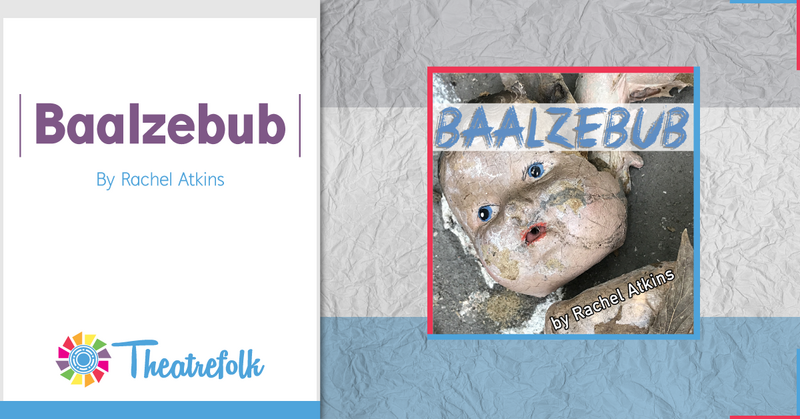
Theatrefolk Featured Play – Baalzebub by Rachel Atkins
Welcome to our Featured Play Spotlight. A response to the classic novel, Lord of the Flies, Baalzebub by Rachel Atkins is a full-length or one-act ensemble piece that offers excellent inclusive, diverse and gender-expansive opportunities in casting.
What would a group of girls do if they were abandoned alone, at a refugee camp, in an unnamed war zone, away from adults and civilization? As time passes without rescue, the girls face the adult challenges of creating and maintaining a working society, as they struggle to cooperate, understand their differences, define themselves, and survive. Will they establish civility or fall back to savagery?
Why did we publish this play?
Rachel writes strong female characters with great emotional impact. That alone is a great reason to publish this play. But she goes further – the play clearly suggests inclusive, racially conscious and gender-expansive choices in casting. Having plays that welcome gender flexibility is a major initiative here at Theatrefolk. Lastly, it’s an adaptation, or more specifically a response to a classic work – _Lord of the Flies. _How does this tale of civility and savagery reflect through a gender flexible lens? It was not hard at all to accept _Baalzebub _for publication.
Let’s hear from the author!
1. Why did you write this play?
I was commissioned by Seattle Public Theater to write a play for their youth program. The director and I brainstormed a range of ideas that could serve their company of young actors. Our conversation covered both the current refugee crisis, and William Golding’s quote about Lord of the Flies: "A group of little boys… are more like scaled-down society than a group of little girls would be” — and putting those two ideas together just made sense. I wanted to write a play that would be both empowering and community-building for an ensemble of young women.
2. Describe the theme in one or two sentences.
Community vs. the individual
Identity
Power
Order vs. chaos, peace vs. war
And how all of the above relates to gender.
3. What’s the most important visual for you in this play?
The song—which isn’t just a visual, so maybe this answers a different question, but their “performance” of it is important: the way the characters personalize it, the ways they use it to bring themselves together and establish their community, and how it morphs through the play as the characters and their relationships change
4. If you could give one piece of advice for those producing the play, what would it be?
Be willing to think outside the box for inclusive casting. For example: the first production had 2 boys playing Sam and Isis as girls, 3 non-binary actors as Juno, Ali and Diamond, and younger (elementary and middle school age) actors playing Baby and Sister. This is an ensemble piece, which benefits from as diverse an ensemble as possible—by whatever definition diversity holds in your community.
5. Why is this play great for student performers?
Opportunities to build ensemble both on and off the stage. The songs and rituals can come from your actors’ own experiences, interests, abilities and strengths. Helping your cast develop their own community will serve the community within the play. Also, particularly if you’re working with a more homogenous or privileged population, this play provides a chance to connect with the world at large. Bring in members of your local refugee support organization to talk to the cast. Coordinate a donation drive during the production. This play has served as a jumping point for young actors to also become activists.
.png)
Featured Plays
Student-directed success: Emotional Baggage
Are your students ready to take their theatrical techniques to the next level? Emotional Baggage by Lindsay Price is ready for you! The most unique play we sell, it is based solely on action and has no dialogue.
Seven strangers meet in a train station. Instead of luggage, they all carry their “emotional baggage.”
They must confront themselves and one another. Everybody carries emotional baggage with them. What’s yours?
Suitable for performance and in-class work, the play focuses on non-verbal storytelling through mask and movement.
Drama teacher, Jeannine LeSann was excited to share her students’ success with us. As a student directed production, the talented ensemble at Esterhazy High School in Esterhazy, Saskatchewan were trailblazers as the first EHS production to earn this award.
“We performed at our Regional Drama Festival and won Best Overall Production!
I just thought I would pass on this success to you along with some images of the play for you to look at. The best thing about this is that the play was actually student directed and this the director’s final year with us. It is so great that he is able to have success with such a great play and a dedicated cast.”
Featured Plays
Theatrefolk Featured Play – Camel Dung and Cloves by Dara Murphy
Welcome to our Featured Play Spotlight. Camel Dung and Cloves by Dara Murphy is not your average tea party. With rich, eccentric parts for girls, the twists and turns in this high school play are definitely worth checking out.
Sara enjoys the ritual of making and drinking tea. Maybe she enjoys it a little too much.
Sara pays Empy to join her at a tea party. Empy is eager to make a quick buck. But what are Sara’s motives? What about the bones in the black box? And what exactly is in the tea?
Why did we publish this play?
Dara Murphy started sending us plays when she was a student and the first thing that struck us was her black sense of humour. We love it. (Don’t believe me? Check out Magic Fairy in the Microwave.) Now Dara is a drama teacher with less time to write but we’re thrilled to be able to share her work with you, including this dark and twisted gem.
Do you have girls who are tired of being stereotyped and enjoy dark and twisted? Camel Dung and Cloves has got rich and eccentric roles for girls with plot turns that never stop coming.
Let’s hear from the author!
1. Why did you write this play?
I was inspired by an email from Theatrefolk that said they needed more plays with female characters. I didn’t have a story in mind, but I suddenly had an image of a tough girl poking around in a girly-girl room. I was curious to write the play and explore the girls’ characters and dynamics. It was a fun play to write!
2. Describe the theme in one or two sentences.
The theme of this play is how easily people can deceive others by taking advantage of their assumptions and expectations.
3. What’s the most important visual for you in this play?
I think of two contrasting visuals. The beginning image is of a tough female character overpowering a sweet girl in her own room. The final image is that same tough character, now totally subdued, in a room that has suddenly overpowered her.
4. If you could give one piece of advice for those producing the play, what would it be?
You might want to make some of the props “larger than life” so they are easy to see. If everything doesn’t fit in one box, the girls can also take props out from under the bed.
5. Why is this play great for student performers?
I think this is a fun play to act because the characters are so mysterious and devious. The ending is also surprising and unexpected. Oh, and they get to say words like “pig fetus”.
Featured Plays
A Human Look at an Epic Event: Upon A Sea of Dreams: A Journey on the Titanic
Are you ready for an intimate, human take on a massive, epic event? Upon a Sea of Dreams: A Journey on the Titanic by Kathleen Donnelly is an amazing character-based drama with a unique look at this infamous event.
It is the night of April 14, 1912. In a tiny third class cabin Emma struggles to quiet her infant brother and calm her younger sisters. The young girls think life on the Titanic is a game. They’re on their way to a new life in America after all.
But the playful air changes when the ship suddenly stops moving and sirens blast. The stewardess says they’re to stay in their cabins. The American boy says his deck is flooded and the ship is sinking. They have to get out now. Do the girls stay put or leave? And if they leave, how do they get past the locked gate?
The students at Nashoba Valley Technical High School in Westford, MA took their vision of this extraordinary play on an award-winning journey at the Massachusetts Educational Theatre Guild High School Theatre Festival. Under the direction of Emily Smith , this talented group won individual acting awards for three cast members*, along with the Stage Manager’s Award.
Performing cast:
Emma: Olivia Spoth*
Milly: Katie Wiitala*
Sarah: Shea Kenny
Matt: Brian McCall
Stewardess: Rachel Cieslik*
.png)
Featured Plays
Life Lessons Learned: Hoodie
Middle schoolers face a tornado of questions every day. What do I wear? What if I wear the wrong thing? What is she wearing? What do I look like? Stop looking at me!
Hoodie by Lindsay Price examines image and appearance in the vignette style and poses what may be the most difficult question of all – Do I stay in the clump or do I stand alone?
The drama students at Washington Jr. High School in Manitowoc, WI asked and answered these tough questions in their performance of Hoodie. From the first read-through to the set design to opening night, it is obvious that this was a true labour of love.
Not only were the students able to gain experience and insight into the theatrical process, but they were able to truly relate to the theme and messaging throughout the play:
“You should learn how to be an individual and do what you want to do in your life.”
“You don’t always have to be in a certain group. Just be yourself. Be unique.”
Featured Plays
A Symphony of Sound Success: Stressed
A symphony of sound. A symphony of character. Vivid themes. Vivid characters. Stressed by Alan Haehnel is a true theatrical experience for any drama students looking for a bit of a challenge and a whole lot of fun.
For Alex, it’s school. For Josh, it’s his girlfriend. For Carmen, it’s dealing with her coach. And Mindy’s frustrated with her parents. Stress is driving this quartet crazy – so much so they can’t stop talking about it.
This play is a symphony of sound and character. A challenging but incredibly fun piece.
The incredibly talented group of student performers that make up the Stromness Drama Club off the northeastern coast of Scotland in Orkney , didn’t stress at all about their production of Stressed. In fact, they thrived!
“Every year we try to put on a youth production as part of the Scottish Community Drama Association’s one-act play competition. This year we were fortunate (or good!) enough to win the youth trophy and also to come 3rd overall. We also won the Northern Divisional Youth Final and will be competing at the Scottish Finals as well.”

Featured Plays
Theatrefolk Featured Play – Have You Heard? by Krista Boehnert
Welcome to our Featured Play Spotlight. If you’re ready to explore the power of the rumour, you’ll want to check out Have You Heard? by Krista Boehnert. This monologue-based one-act drama is extremely relatable and a great way to stretch your performers.
“Did you hear? Have you heard? Promise not to tell anybody?”
Everybody knows a secret. Some keep them quiet. Some let them loose. Some make them larger than life. Secrets, lies and rumours are the subject of Have You Heard?
This monologue-based play follows what happens in a school when rumours and secrets spin out of control. What makes a secret more powerful: When it’s the truth? Or when it’s a lie?
Why did we publish this play?
Have You Heard? not only presents a great acting challenge, but also a directing challenge. And to top it all off, it has a thought-provoking theme. It’s a one, two, three punch and that’s why we published it. If you’ve got a small program, or you’re doing multiple one acts, or you want to stretch your group in competition, have a look at this play.
Why is this play good for online platforms?
This play is monologue based – all the characters share the story through individual monologues. This makes it ideal for an online platform performance where students are in their own spaces.
Let’s hear from the author!
1. Why did you write this play?
I wanted to explore a couple of things with this piece. First was the power of rumour. Rumours grow and change and morph as more and more people breathe life into them. When rumours gain momentum it’s hard to find the truth. Things get murky. I wanted to look at all the various angles of that.
The other thing I wanted to present with the piece was a play where the two main characters never set foot on the stage. They don’t have any lines whatsoever. The characters you do meet are forced to speculate on the motivations and feelings of Josh and Mr. Pender, but the audience never hears from them directly. The audience is ultimately left to formulate their own opinions of what the truth is.
2. Describe the theme in one or two sentences.
A not-so-innocent lie is believed to be true. The ripple effect leaves no one untouched.
3. What’s the most important visual for you in this play?
The opening and closing scenes where the cast appears as an ensemble. For the majority of the play they appear individually, but in those opening and closing moments they’re united in their vulnerability and strength.
4. If you could give one piece of advice for those producing the play, what would it be?
It’s a monologue-based play, but don’t be shy about involving the cast throughout. There are many opportunities for the whole cast help bring the monologues to life through tableau, silently acting the story as a character tells it, small interactions with the speaking character like placing a comforting arm around their shoulders as they speak, etc. The script lends itself to collaborative staging despite its monologue-based structure.
5. Why is this play great for student performers?
On the content side, I think its extremely relatable. Openly talking about the impact of rumours is a good way to shine light on something we all grapple with.
On the performance side it’s a great opportunity to work with monologues. It allows students to really grow a character, and in a different way than they’re used to – through dialogue with other characters. With this play, they must build their character using the clues in the monologue and develop it for themselves from there.
In addition to character development, it’s also a great acting challenge for learning and performing long sections of text. The experience of performing a piece like this will help build skills for more complex performances in the future, like Shakespearian soliloquys.
6. Do you have any tips for those looking to perform this play online?
Both Have you Heard? and Puzzle Pieces? lend themselves nicely for online performance. As a monologue-based play, it allows for that intimate connection between the audience and a single performer. Settings in the performance space provider (such as Zoom) can be set to highlight the speaker, which results in the performer filling the whole screen, rather than the audience seeing all actors at once, if the director wishes to present it this way.
The plays are flexible, however, and do lend themselves to an ensemble performance as well. While actors are performing their monologues, the remaining actors can support the performances in a variety of ways. The director and cast can choose if all actors participate, or if only a select number do. If not all actors are participating in the scene, the director can ask them to simple turn and face their back to their camera, or walk out of frame thus “leaving the stage.”
The staging for Have you Heard? and Puzzle Pieces is flexible regardless of the staging environment – live, virtual, live-streamed. In their simplest form, each scene can be performed with only the actor(s) in the scene who are speaking being “on stage” (or on screen depending on the scenario). The bulk of both plays are monologues, so for the majority of the play, you could have a single actor on stage/screen.
To enrich the performance experience for the audience, I would recommend engaging cast members to enhance the monologues by employing tactics such as mime, tableaux, use of props and costume add-ons, virtual backgrounds and reaction buttons. This creates a space where the audience and the cast are all part of each “monologue moment” and heightens the impact of each characters’ story/experience by bringing it more fully to life.
Featured Plays
Theatrefolk Featured Play – We Are Masks by Lindsay Price
Welcome to our Featured Play Spotlight. We are excited to feature We Are Masks by Lindsay Price – a one-act dramedy that challenges performers and audiences alike to examine the masks we all wear every day.
We all wear a mask. Some hide for good reasons. Some for self preservation. Even when you’re ready to take off your mask, it’s a hard thing to do. What will happen when the world sees who you really are?
Four teenagers wear a variety of masks: Imposter Foster. Persona Paloma. Nolan No-Try. Macy Maintains. Each has to make a choice – show the world their true self, or stay behind their mask. Who will reveal themselves? Who will stay in the shadows?
Let’s hear from the author!
1. Why did you write this play?
The idea of public persona and private persona is a great one to explore on the stage because unlike real life, you can show both. Anytime we get to see “inside” a character is amazing theatre. It was fun to decide which mask each of the characters would wear, and whether or not they would shed their mask by the end of the play. Not all the characters do.
2. Describe the theme in one or two sentences.
We all wear masks. What will happen when the world sees who you really are?
3. What’s the most important visual for you in this play?
The masks! Both the ones that the ensemble wear that we can see and the ones the characters wear that are invisible.
4. If you could give one piece of advice for those producing the play, what would it be?
Discuss with your students the idea of public and private persona. Your students are going to be able to provide a lot of insight about how the people they see every day wear a mask. How can they take their real world experience and translate to their characters?
5. Why is this play great for student performers?
The theme is relevant, and there are awesome physical action possibilities with the ensemble. Everyone wears a mask – what’s yours?
Diversity
Theatrefolk Featured Play: Life, Off Book by Scott Giessler
Welcome to our Featured Play Spotlight. If you’re looking for a show with a flexible cast and great opportunities for ensemble work then prepare yourself for Life, Off Book by Scott Giessler.
In this movement-based drama, Ophelia and Jeb have a relationship that’s like a well-built theatre set. It looks great on the outside, but an empty shell on the inside.
Ophelia is a phenomenal dancer and actress who’s constantly afraid. Jeb is Ophelia’s mild mannered fake boyfriend who is also a closeted gay man. What happens when they have to tear themselves away from the script and live life off book?
Why did we publish this play?
As our submissions manager Nick Pappas said when he recommended this play “It gives me the feels.” Life, Off Book is a play that has a lovely blend of character journey, artistic imagery (if you’re inclined there’s opportunity for music and dance), and a heart felt message. It’s a play teens should be in, should see, should experience.
Let’s hear from the author!
1. Why did you write this play?
I work with many students that are slowly working their way out of the “closet” and go through many of the things the show covers. I also know many students who are afraid of real relationships. I wanted to create a story that handled this subject matter in a way that did not feel preachy or whiny and would give them a sense of confidence for who they are. I also wanted to create a show that would highlight the arts community of a high school that was not cartoonish or cliché in the way that so many TV shows or movies do.
2. Describe the theme in one or two sentences.
It’s important to live your life with love and hope; not fear. You only really start living a worthwhile life when you put away your fear and let the chips fall where they may.
3. What’s the most important visual for you in this play?
I love the moment that Ophelia peels the facades off of the set pieces.
4. If you could give one piece of advice for those producing the play, what would it be?
Look to find what’s real in this story to you. Make this your world, and make these characters and narrators people you know; and don’t be afraid to present this subject-matter. It’s 2018, and this is your world now.
5. Why is this play great for student performers?
Thanks to the exhaustive workshopping with high school students, the dialogue and story are very relevant, clever, and very engaging. It’s real but not too heavy. There are a variety of personalities for actors to connect to. It also highlights a lot of different kinds of talents if you have dancers or musicians.
Featured Plays
Theatrefolk Featured Play – Upon a Sea of Dreams: A Journey on the Titanic by Kathleen Donnelly
Welcome to our Featured Play Spotlight. You know about the Titanic, but you won’t want to miss Upon A Sea of Dreams: A Journey on the Titanic – an amazing character-based drama by Kathleen Donnelly with a unique look at this infamous event.
It is the night of April 14, 1912. In a tiny third class cabin Emma struggles to quiet her infant brother and calm her younger sisters. The young girls think life on the Titanic is a game. They’re on their way to a new life in America after all.
But the playful air changes when the ship suddenly stops moving and sirens blast. The stewardess says they’re to stay in their cabins. The American boy says his deck is flooded and the ship is sinking. They have to get out now. Do the girls stay put or leave? And if they leave, how do they get past the locked gate?
Why did we publish this play?
If you don’t know the date, you know the event. On April 14, 1912 the Titanic struck an iceberg and sank into the frigid waters of the Atlantic. Upon a Sea of Dreams dramatizes this historical event by bringing to life a family in a tiny third class cabin. I love a cross-curricular play that doesn’t come across as a history lesson. The characters come first in Upon a Sea of Dreams. You connect to their story, their dreams and you want to know they’re going to make it past the locked gates and get out alive. Will they? You’ll have to read the play to find out!
Let’s hear from the author!
1. Why did you write this play?
I teach creative writing at a creative and performing arts school. I was working with a 6th grade playwriting class, and I wanted to demonstrate that you can write a play about anything, set anywhere. We’d done a brainstorming activity on the chalkboard, listing big moments in history, and somebody had written “The Titanic.” I randomly grabbed that topic and started to brainstorm how you could tailor a play set on a huge ship to fit a small theatre space. That night, I wrote an opening scene to share with the students as a model. We all enjoyed it so much, that I just continued writing the story. I don’t think I finished the script before that course ended, but I definitely had embraced the project by then.
I enjoyed every minute of researching the story, from the Titanic itself (I found Titanic’s cabin charts online and pinpointed a third-class cabin tucked away next to a stairwell that is, in my mind, where the play takes place), to exploring Irish culture to get a stronger hold on the family’s background. There were times after working on the script, that I felt like I’d spent the day out at sea on the North Atlantic — not a bad getaway without ever leaving Pittsburgh!
2. Describe the theme in one or two sentences.
I didn’t focus much on theme while writing this play, but now that the story’s down on paper, it seems to me that acts of sacrifice come up throughout the play that show how, ultimately, they are the greatest acts of love.
3. What’s the most important visual for you in this play?
Visually, if you’re talking staging and set, I think it’s creating that small, tight space of the cabin. Dramatically, it’s that moment of Emma all by herself in the cabin.
4. If you could give one piece of advice for those producing the play, what would it be?
While it would be very fun to recreate for the stage a (mostly) authentic rendering of a third-class cabin, I think that you could get away with a very minimalistic set for this show. Costuming and sound design could carry the weight of creating the atmosphere of the ship and the event.
And, do the accents. I think some of the dialogue could be a bit unwieldy without the rhythm of the Irish speech patterns.
5. Why is this play great for student performers?
Why is it great for student performers? Let me count the ways:
• I think the play offers challenging character work for young actors. These sisters know each other as intimately as sisters do — to realize these characters asks for fully present and honest acting that fills in all the moments between the lines, too. The role of the stewardess is a most challenging role for a young actor to inhabit the shoes and regrets of someone much older.
• The chance to do some strong vocal work through capturing the Irish dialects.
• The story of The Titanic seems to fascinate each new generation. It is a timeless story that students love, and yet…
• it’s a fantastic way to connect the arts and academics, through learning about this pivotal time in American history and the story of immigrants coming to America in the early 1900s.
• It continues to be a great model for students to see how a stage play can take you anywhere and to any event.