📣SCRIPT SALE! Treat yourself to an easier Fall. Save 30% on 5+ perusal scripts with code SPRING30 before May 3 and head into summer stress-free.
Classroom Study
Teaching Drama
How to Boost Your Drama Class With Our Free Study Guides
You’ve found the perfect play! It’s engaging, relevant, and a great fit for your students. BUT, you can’t produce it this year, for any number of reasons.
Maybe your performance calendar is already full. Maybe your budget is looking more “two rolls of gaffer tape” than “full-scale production.” Or maybe your performance space won’t be available for months.
What do you do?
Good news: You don’t need to mount a production to make the most of a play. You can explore its characters, dialogue, and themes — minus the stress of auditions and tech week.
That’s where Theatrefolk’s free Classroom Study Guides come in.
These study guides are designed to help you get the most out of every script you read in class. And the best part? They’re totally free and ready to download whenever you need them.
Before the Read: Build Curiosity and ConnectionsEvery guide starts with Pre-Read Questions and Activities to get students engaged before page one. These are short, focused exercises that:
• Introduce the play’s themes and big ideas.
• Encourage personal connections so students feel invested.
• Spark curiosity about the story they’re about to read.
Example: For Hoodie - a middle school vignette on self-image - the “Identity Chart” exercise asks students to explore how they see themselves, just as the characters do in the play.
During the Read: From “What?” to “Why?”The Close Reading Questions are organized to guide students through three levels of thinking:
1. What happened? (Comprehension)
2. How did it happen? (Looking at language, staging, and character choices)
3. Why does it matter? (Making connections to playwright intention and personal experience)
It’s a simple structure that works whether you’re reading aloud in class or assigning scenes for homework. You can use these questions as group discussion starters, exit slips, or reflections.
Example: In Underwater, a powerful drama about a competitive teenage swimmer losing her love for the sport, students are asked to analyze the pacing and how it would affect an audience member.
After the Read: Put Creativity Into ActionIt’s always important to have students explore a play beyond just reading the script. The Post-Read Activities give students the chance to bring the script to life without the pressure of a full production.
They can:
• Stage one key scene.
• Design a poster that captures the mood of the play.
• Write a brand-new monologue for a side character.
It’s hands-on, it’s fun, and it keeps theatre-making front and center in your classroom.
Example: In the adaptation of Lewis Carroll’s Alice, students can design costumes or rehearse a scene from a fresh angle, all while sharpening their performance instincts.
Question: How do I find the free study guides for a play?
Go to the individual play’s page and scroll down to the section with details like play length and cast size.
There, you’ll see a message that says:
Classroom Study Guide
Download a free Classroom Study Guide for this play
Just click the link to access your free digital guide!
Ready to give it a try?
Check out our full library of Classroom Study Guides, pair one with a Classroom Script License to bring the play to life in your classroom, and start building your next great drama class unit - no stage required.
Teaching Drama
Approaching Issue-Based Plays in the Drama Classroom
“Issue-based plays” explore a myriad of topics that are current and relevant for your students, such as bullying, mental health, body image, violence, sexuality, identity, and human rights. Issue plays are educational and entertaining at the same time, and they are so important for students to study. Students may see themselves or someone like them represented in an issue-based play. Conversely, studying issue-based plays can open students’ eyes and minds to issues that they themselves may not have experienced, but should be aware of. They can be a great way to open up lines of communication about important topics that need to be talked about.
Here are a few things to consider if you’re thinking about studying or performing an issue-based play in your drama classroom:
1. Be aware and make an educated choice.Whether you are new to your school or a seasoned veteran, you need to stay abreast of issues that are prevalent in your particular school, district, or city. What is appropriate for one school may be a hard no for another school. Issue-based plays can bring out strong emotions during the process of studying, and you’ll need to decide whether you think this particular play would be a great area for exploration or if it could be triggering for some of your students. While it’s important to challenge your students, drama class must not cause harm.
2. Communication is key.When selecting an issue play to study, you will need to ensure that your administration is aware of your choice of material and that they are supportive of that choice. Let them know what the play is, what topics it’s focused on, your goals for teaching it, and what educational standards will be met by studying it. Discuss how you’ll study the play: Will you read it aloud, will you watch a live or film version of it, and/or do you plan on performing it? Will you need to have the guidance office available in case a student needs that resource? If admin presents pushback, do you have an alternative play that you can present?
You may also want to let students’ parents/guardians know in advance that you’ll be studying an issue-based play. Creating a brief overview of the play, the subject matter, and your educational and theatrical approaches will be helpful for keeping parents informed about what their children are talking about in class. Be aware that parents may have more concerns about the material and the topic than the students do.
3. Prepare support materials and resources.Oftentimes we are unaware of potential triggers until we are right in the moment. While we can’t anticipate every possible outcome of a situation, we can prepare ourselves with information and resources to support our students, or at least point them in the right direction. Compile a list of local and national resources (websites and phone numbers) that students can reach out to that are related to the issue. Compile pamphlets, articles, and book lists that you can give to your students. Arrange a visit with an expert to come and talk to your students about the topics they’re studying in the play. Reach out to school clubs, peer helpers, and guidance and let them know what your class is studying, in case students would like someone to talk to. Think about what topics or lessons your students might benefit from prior to studying the play, and put them in your schedule. End your classes with closure practices to help students leave any heavy or lingering feelings in the drama classroom. You don’t need to have all the answers, but your students will appreciate your efforts to support them.
Related Articles:
Social Issue Plays for High Schools / Middle Schools
Talking About Issues Through Theatre
Acting the Issue Play
Teaching Drama
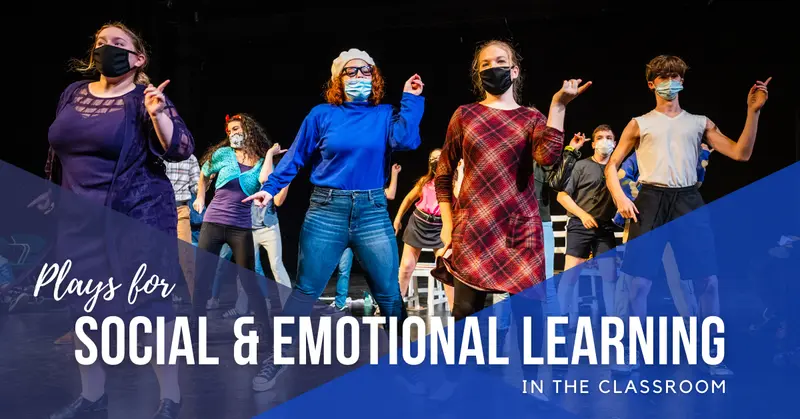
Plays for Social & Emotional Learning in the Classroom
The drama classroom has always promoted skills and lessons that are based on the foundation of social and emotional learning (SEL). Self-awareness, self-management, social awareness, relationship skills, and responsible decision making provide students with important life skills: empathy, collaboration, communication, developing and maintaining relationships, time management, and more.
Every drama class already incorporates many of these concepts into daily lessons through critical thinking exercises, character analysis projects, collaboration activities, problem-solving challenges, and self-reflections. If you’re looking for new ways to incorporate SEL into your classroom, we’ve got a selection of fantastic plays for production or classroom study.
These plays make a great class project activity and can be used to introduce SEL to your students or deepen their understanding and awareness. Plus, many of them come with free Classroom Study Guides, complete with pre-read questions and activities, close reading analysis, and post-read activities, to provide an in-depth theatrical learning experience.
Check out all of our plays to help bring SEL to your classroom here — available in digital PDF and printed scripts.
Distance Learning
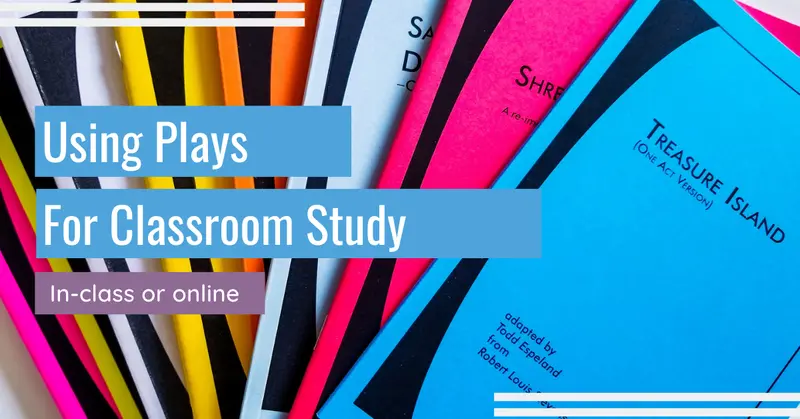
Using Plays for Classroom Study
During a busy school year, when your theatre program is juggling packed schedules, limited rehearsal time, and competing priorities, putting on a full production might not always be possible. Who has the time when you are balancing lesson planning, rehearsals, admin tasks, and, oh, actually teaching your classes?
But if a performance isn’t possible, that doesn’t mean that plays can’t have a place in your program. Scripts are still powerful tools for learning, creativity, and connection in the drama classroom.
Scene analysis, character analysis, monologue performance, and cross-curricular connections can all be explored in any classroom setting.
Here are some examples for using plays for classroom study.
*Close Reading *Close reading is an analysis tool. Students read a text multiple times for in-depth comprehension, striving to understand not only what is being said but how it’s being said and why. Close reading takes a student from story and character to drawing conclusions on author intention. Close reading prompts students to flex their thinking skills by:
• Teaching students to engage with a text.
• Teaching students to be selective. We can’t highlight everything in the text, only the most important elements.
• Teaching students to make educated decisions. All conclusions and opinions must be backed up with a text example.
Close reading does not have to be laborious. You can start quite small, for example, with a play title, and have students individually or in groups analyze the what , the how , and the why of the play title. Your virtual students can work together in break out rooms, and your in-person students can work in socially distanced groups.
Click the link at the bottom for a Close Reading Title Exercise!
You can also close read images. Find a picture of a set from a production of the play you are studying. What is happening in the image? How is it happening (analyze the lighting, whether or not the set is realistic or abstract)? Why have the director and set designer chosen the specific look for the set?
Pre/Post Read ExercisesGive students exercises that explore themes and subject matter before they study the play. For example, if a major theme of the play is friendship, have students discuss what it means to be a friend. Have students create friendship scenes (written or performed) that demonstrate the value of friendship. Another option is to give students personality traits of a character (without telling them the specific character) and have them create a physical movement (standing if in person, sitting if virtual). If the play takes place in a specific era or location (e.g., on an army base), have students do some research. What is life like on an army base?
Post-read exercises should focus on bringing the play to life. Have students create a costume for a character, or a basic set design (depending on the tools they have available). Have students create a music playlist for a specific character or scene. If the play has monologues, have students choose, rehearse, and present a monologue. If you can have students rehearse scenes in your particular environment, do that.
Cross-Curricular ConnectionsRead a play with students and connect it to a subject outside the drama classroom. What you do has always had implications outside of the drama classroom and now is no exception. For example, the play Drum Taps uses Walt Whitman’s poetry and takes place during the civil war. Can you connect virtually with the English or History department?
Check out our full list of recommended cross-curricular plays here.
Student Assignment: Study Guide for a PlayStudy guides are often prepared by a theatre company before students come to see a production of a play. Have your students demonstrate their knowledge of a play by putting together their own study guide. This is a bigger group project and one that can culminate a unit on a play, particularly if a production or scene presentations aren’t possible. It’s also a project that can be divided up among virtual and in-person students. Each person in a group can be assigned a specific part of the study guide.
Start by dividing your students into groups and have each group find a production study guide online. Then have the groups compare and contrast the guides. What are the similarities and differences? As a class, decide on the sections for your study guide and divide the work up among students. Have each group present their guide as a digital presentation.
While we don’t have production study guides, we do have some free classroom study play guides designed to challenge students to deepen their understanding and connection to the plays they’re studying.
Complete with pre-read questions and activities, close reading analysis, and post-read activities, these comprehensive, easy-to-use study guides allow you to provide an in-depth & theatrical learning experience.
Check out our complete list of classroom study guides here. (Plus, keep checking back for more!)
Teaching Resources
Scenes for Classroom Study: Help your students take their work to the next level
Character study. Scene work. Performances. IE competitions. Substitute teachers…
You need scenes. We’ve got them!
With 30 scenes and over 200 pages, our brand new resource, Scenes for Classroom Study, gives students relevant material at their fingertips, to help them take their work to the next level.
But that’s not all! Each scene comes from a published Theatrefolk play and includes:
• Close Reading Questions – Use each scene as a close reading exercise with these text-dependent questions.
• Staging Suggestions – If groups are self-directing, or you have student directors, these notes will help them effectively stage the scenes.
• Character Development – This section includes character-specific questions and suggestions for your student actors. If your students perform Individual Events or compete with scenes, they’re going to want their characters to be at their best!