Facebook Pixel Skip to main content

📣SCRIPT SALE! Treat yourself to an easier Fall. Save 30% on 5+ perusal scripts with code SPRING30 before May 3 and head into summer stress-free.

Inclusivity

Inclusive Improv: Tips for Reflecting the Whole Spectrum
Teaching Drama

Inclusive Improv: Tips for Reflecting the Whole Spectrum

Improv is meant to be a fun and creative way to express oneself in the drama classroom. It’s a great way to “try on” a wide variety of characters and situations in a fast-paced, low-stakes environment. For LGBTQIA+ students and others from marginalized communities, however, it can feel risky — beyond the usual risks we encourage our students to take. Stereotypes, assumptions, and other negative behaviour from students can creep in, unless we set a clear foundation for respect, safety, and inclusion. Inclusive improv isn’t meant to shut down humour or block creativity; it’s about opening up a wider and more respectful range of stories. When students know their identities are safe onstage, they’ll feel more comfortable taking creative risks and bringing their whole selves into the work. Here are some simple, practical ways to make sure your improv work reflects the spectrum of identities and experiences in your drama classroom. 1. Establish ground rules and boundaries as a group.Before you start improv work (or really, any collaborative work) with your students, come up with a set of community agreements that reflect what you want the classroom atmosphere to be. Include guidelines such as “We don’t make fun of people’s identities,” “We respect each other’s boundaries,” and “We remember to follow the ‘Yes, and…’ rule for improv, but we also reserve the right to say ‘No, but…’.” Remember, community agreements are a “living document” and can always be reviewed, updated, and adapted as needed. 2. Normalize all identities.Use neutral prompts whenever possible. For example: “Two students studying for a difficult exam” or “A group of scientists about to discover something terrifying,” rather than “A guy and a girl go to the movies together” or “A mom and dad discuss homework with their daughter.” This opens up more opportunities for interpretations of the prompts, on top of allowing students to play a role in whatever way they feel comfortable doing. You’ll find more neutral prompts in the giveaway below. If gender identity is relevant to the scene, let the students choose how they want to play it. For example, if a student says in a scene, “My moms are picking me up from school today,” or “Alex wants to help me bake a cake, but they’re not great in the kitchen,” affirm it in a neutral manner and go with it. Model this yourself when giving examples as well. Ensure students are portraying all identities in a respectful manner. Which leads us to our next point… 3. Interrupt harmful stereotypes.Sometimes students might unintentionally (or intentionally) portray a character in a stereotypical or caricature-like way, for example, “the sassy gay best friend.” If this happens, stop the scene gently but firmly and address the issue immediately. You might say something like, “Let’s pause here. This is leaning towards being a stereotype, and that’s not where we want to go.” Have a brief discussion to turn it into a learning moment: “How could we re-approach that character to be more honest and real?” 4. Encourage students to reflect.After improv sessions, have your students respond to reflection questions in a discussion or as journal prompts. For example: • Identify moments of inclusivity today. Why did those moments stand out to you? • Did we represent a wide range of people in today’s exercise? Why or why not? What could we do differently next time? • Were you a supportive scene partner/audience member today? If yes, give examples. If not, how could you be more supportive in the next class?
Tips for Building a More Inclusive Drama Classroom for Your LGBTQIA+ Students
Teaching Drama

Tips for Building a More Inclusive Drama Classroom for Your LGBTQIA+ Students

Inclusion is about what happens every day in your classroom. It goes beyond visibility (which is still incredibly important!). Your choices, your leadership, the materials you share with the class, and more shape the atmosphere of your drama class. When your LGBTQIA+ students trust that you see them fully, the drama classroom becomes more than a performance space; it becomes a safe haven for self-expression. Here are some simple, effective tips for creating an emotionally safe and affirming space where LGBTQIA+ students feel seen, respected, and celebrated: • Set clear, shared classroom agreements around respect, listening, and boundaries for all students. • Model curiosity and care when a student’s name or identity shifts. For example: “Thanks for letting me know. Want me to update my notes?” Here are some other inclusive questions you might ask. • Include opt-out language in emotionally intense activities, such as, “It’s okay to step back from this scene today” or “Let’s take a break and come back to this exercise when you’re feeling up to it.” Try the improv exercise “Yes, And… and No, But…” as an example of opting out of a particular topic but still participating in the exercise. • Use inclusive language. Refer to groups of students as “actors,” “performers,” “ensemble,” “friends,” “students,” “everyone,” or “folks/folx,” rather than “ladies and gentlemen” or “boys and girls.” Use everyone’s pronouns correctly. • Practice correcting gently but right away when mistakes happen, yours included. “Jason’s pronouns are they/them, Mr. Brown.” “Sorry Jason. Thank you El for the reminder.” Acknowledge your mistake, correct it, and move on. Focus on kindness over shame. Don’t get upset and make the student have to console you for your mistake. • Be affirming without making students feel like spokespeople for their identity. • Acknowledge LGBTQIA+ history months, playwrights, and trailblazers as part of your curriculum. • Seek out plays with queer representation, especially those that centre joy and complexity, not just trauma. • Make inclusivity the norm in classroom exercises and games. Let students help reimagine stories in new and different ways. Improvise a scene where Juliet has two moms. In a dance scene in your school’s musical, allow students to dance with the partner of their choice, regardless of gender identity. Offer monologue and scene choices that include characters of all genders and orientations. What are some tips and techniques that you use to create a safe, inclusive drama classroom? Let us know on Facebook or Instagram.
June Reading List: Plays to Celebrate Gender Diversity & Inclusivity
Featured Plays

June Reading List: Plays to Celebrate Gender Diversity & Inclusivity

As we start putting together this summer's reading list, how about diving into some amazing plays that celebrate gender diversity and inclusivity? There's a whole world of stories out there just waiting to be discovered, offering endless possibilities for your students to connect with powerful characters and inspiring narratives. These plays are perfect for embracing the magic of diverse storytelling and will make a fantastic addition to your stage or classroom this summer!
Tips for Running a Relaxed Performance  of Your Show
Production

Tips for Running a Relaxed Performance of Your Show

Sensory-friendly, or “relaxed” performances of theatrical shows, are becoming more prevalent and popular for theatre-goers. A relaxed performance is where the theatrical atmosphere is adapted to better accommodate audience members who may benefit from a more relaxed environment. This may include audience members with autism or sensory processing sensitivities, audience members with disabilities, or families with babies or young children. Relaxed performances are a wonderful way for audience members who may not otherwise be able to experience live theatre to do so. Adaptations at a relaxed performance may include: • Providing patrons with informational materials in advance that describe what to expect at the performance to reduce potential anxiety about the experience • Keeping the house lights dimmed (rather than fully out) during the performance • Reducing the volume of the music and/or microphones • Adjusting, reducing, or omitting effects that may startle theatregoers • Allowing audience members to get up, move around, leave and re-enter, or vocalise quietly during the performance • Designating a quiet area nearby for audience members who may benefit from it • Having additional resources available, such as closed captioning devices, noise-dampening headphones, large-print versions of the show programme, or an ASL translator So, what do you need to do to hold a relaxed performance of your show? Here are some tips:1. If possible, engage experts to help you, such as one in diversity, equity, and inclusion, an ASL translator, and/or a developmental services worker who can advise you on ways to accommodate patrons. You may also wish to reach out to people from various disability communities and ask them firsthand what they would most benefit from to have a great theatre experience. 2. Choose a date and time for the relaxed performance, and clearly indicate it on all your promotional materials. A matinee or a morning performance might be better for young theatregoers and parents than an evening performance. 3. Go through your show and note any potential concerns, such as special effects, loud music, or startling moments (e.g., explosions or gunshots). Think about the performances of your actors as well. A character who screeches, yells frequently, or has a grating character voice might need to be adjusted for the relaxed performance. Ask your students what moments occur in the show that they think might be an area of concern. 4. Make adjustments to your technical systems (such as reducing the lights or lowering the sound volume) ahead of time. If your technical systems allow it, pre-program a full, separate relaxed performance technical plot. This way your operators won’t have to adjust everything in the moment. 5. Explain to your students what a relaxed performance is, and the benefits of having one. Inform them of the changes you’ll make to the show for that performance, and make them aware of anything that might occur (such as vocal crowd reactions or audience members walking around and/or leaving during the performance). Performing at a relaxed performance may be a new experience for your students, and they might be thrown off by the changes. 6. If possible, do a run of the show with your students with all the relaxed performance accommodations in place ahead of time, so they aren’t surprised on the day of the performance. This is especially important if there are acting changes. Remind students that even though the volume of the performance may be slightly different, the energy, enthusiasm, pacing, and commitment must remain the same. 7. Spread the word to communities who might enjoy attending a relaxed performance (e.g., developmental education teachers, special needs companies and communities, early childhood education centres, and new parents). The more you reach out, the more audience members you’ll bring in! 8. After the performance, you may wish to reach out to your audience members and ask them what they thought about the experience. What did they like? What could you adjust for a future relaxed performance?
Start With One Thing
Teaching Drama

Start With One Thing

There is a lot of talk about what teachers should be doing to create inclusive classrooms for LGBTQ+ students. But the amount of information and resources available can be overwhelming. Where do you start? What’s the right thing to do? Teachers are not therapists and shouldn’t take on that role. In some areas, teachers may be prohibited from being inclusive. This can put teachers in a difficult position. Every teacher wants the best for their students. So what can they do, regardless of their situation, to create an inclusive environment? These are the Theatrefolk 2021–2022 Equity, Diversity & Inclusion Advisory Panel’s suggestions: * Know your students’ names and greet them by name every day. Don’t underestimate the connection that alone can make. * As much as possible, use gender neutral terms. * There are many “out” theatre artists. Bring some visibility to those identities by hanging posters that feature those artists. * One panel member told us, “I don’t get called on the carpet for things that my students create. It’s not me doing it, it’s the students.” What can your students create and bring into the classroom that promotes inclusivity? * Start networking. You might feel like you’re the only one in this situation, but you’re not. Take comfort in knowing that you’re not alone. * Prioritize time for connection and community in your classroom. Establish yourself as someone who students can come to for anything. * Refer to everyone the way they wish to be referred to. * Don’t group students by gender for activities. If you need to categorize students, do it in any other way. For example, use a deck of cards and group by suit or number, or have students line up by height, birthday, or alphabetical order and then pair them up. Disclaimer: Consult your administration and district policy about anything discussed in this article with regard to LGBTQ+ (LGBTQIA, LGBTQ2S), as laws and policies vary.
LGBTQ+ Inclusive Questions for Your Beginning of the Year Survey
Teaching Drama

LGBTQ+ Inclusive Questions for Your Beginning of the Year Survey

The Theatrefolk 2021–2022 Equity, Diversity & Inclusion Advisory Panel shares its thoughts on LGBTQ+ inclusive questions for your beginning of the year survey. What strategies do you use to get to know your students at the beginning of the year or semester? Certainly you’ll learn about them from what they share in your class, how they approach assignments, and how they work with others. But there are some specific details that won’t come to light in the day-to-day routines of your class. A student survey can help you learn those details. Potential questions can range from personal reflections to learning preferences. The answers will give you insight into your students’ goals for your class, what they want, and how they express their individuality. For example: • What three words describe you best? • What’s your favourite movie or book or song? • What are you most proud of? • What is your favorite way to learn? But there are other key questions to consider, particularly for your students in the LGBTQ+ (LGBTQIA, LGBTQ2S) community. The answers to these questions are key to student safety and inclusivity. Student safety is extremely important. Inadvertently outing students to their peers, families, and/or other teachers may lead to bullying, abuse, etc. Consider the following inclusive questions for your LGBTQ+ students: • What is your name on the official school roster? • What is the name you would like me to call you in class? • May I use this name with parents and other teachers? • What kind of experiences and stories do you enjoy seeing on stage? • What kind of experiences and stories do you wish you could see more of on stage? • What pronouns do you use? • Note: Give examples with this question (he/she/they/ze/etc.). Sometimes a student might be wondering what they are. Give them a choice! Be sure to add etc. at the end of the list — there are always more pronouns out there. • What pronouns should I use for you? • Is there anything you would like to discuss with me regarding pronouns/names? • Can I share this with substitute teachers? • Who are the adults in your home? • Is there anything I need to know about you to make your experience more comfortable or safe this year? • Are there any daily traditions, routines, or habits that I should be aware of? • Virtual students • Do you work with or without headphones? • Are you in a space by yourself or do you work with others around? Note: This is not a document that you pull out when you assume you have an LGBTQ+ student. Don’t assume. Give students the opportunity to share that information with you. These questions should be normalized as part of your classroom procedures for getting to know your students. Disclaimer: Check with your administration and district policy about anything discussed in this article with regard to LGBTQ+ (LGBTQIA, LGBTQ2S), as laws vary from region to region. *Terminology: * L = Lesbian. Women sexually/romantically attracted to women. G = Gay. Men sexually/romantically attracted to men. B = Bisexual. People sexually/romantically attracted to their own and other genders. T = Transgender. People whose gender identity differs from the sex they were assigned at birth. Q = Queer/Questioning. An umbrella term with a variety of meanings. Used by some individuals who don’t identify as straight or cisgender and do not conform to traditional societal norms with regard to gender and sexuality, or who are questioning their sexuality or their identity. I = Intersex. An umbrella term. A person born with sex characteristics that do not fit binary definitions of male and female. A = Asexual. People who feel little to no sexual attraction to others. 2S = Two-Spirit. An umbrella term used by some Indigenous people who identify as having both a male and female spirit.
Non-Gendered Honorifics & Group Greetings
Teaching Drama

Non-Gendered Honorifics & Group Greetings

The Theatrefolk 2021–2022 Equity, Diversity & Inclusion Advisory Panel shares its thoughts on non-gendered honorifics and group greetings. “Every time I addressed a group I was directing, I always used “guys and gals.” It was gently brought to my attention a couple of years ago that I needed to be more inclusive and from their suggestions, I now use “guys, gals, and non-binary pals.” In a recent production there was a student who previously I had clashed quite a bit with for a variety of reasons. When they heard, “guy, gals, and non-binary pals,” it was like night and day. I learned that they were transitioning and this made all the difference in feeling included in the group.” ~Matt Webster How often do you address your audience as “ladies and gentlemen”? Or ask someone if they are a Ms. or Mrs.? Or say to a group, “Hey guys”? These are honorifics and group greetings that people have been using for a long time. But there is more expansive and inclusive language available. There are and always have been non-binary, transgender, or gender non-conforming individuals in your class or audience, and it is our responsibility to foster an inclusive environment. It’s easy to take language and word choice for granted, especially when they’re words you’ve always used, your parents and grandparents have always used, and so on. But if you want your classroom to be an inclusive place for all students, being purposeful about what you say when you address others is a great place to start. Here is a list of non-gendered honorifics and group greetings (for addressing your class as a group, or your audience before a show). These are not the only possibilities and there may be some on the list you don’t like. Do your own research to find something that works for your situation. Ask your students for suggestions or feedback on your choices. Try some out and observe the response. If you’ve never spoken any other way, it will take effort to be inclusive, but it’s worth it. Teacher and last name (Teacher Smith) My Liege My Excellence Coach Citizen Mx, Misc, Myr Y’all Folks Folx Future leaders of the world Friends Family and friends Artists and actors Scholars Students Esteemed guests Company Welcome everyone Humans My people Fam Disclaimer: Check with your administration and district policy about anything discussed in this article with regard to LGBTQ+ (LGBTQIA, LGBTQ2S), as laws vary from region to region. *Terminology: * L = Lesbian. Women sexually/romantically attracted to women. G = Gay. Men sexually/romantically attracted to men. B = Bisexual. People sexually/romantically attracted to their own and other genders. T = Transgender. People whose gender identity differs from the sex they were assigned at birth. Q = Queer/Questioning. An umbrella term with a variety of meanings. Used by some individuals who don’t identify as straight or cisgender and do not conform to traditional society norms with regard to gender and sexuality, or who are questioning their sexuality or identity. I = Intersex. An umbrella term. A person born with sex characteristics that do not fit binary definitions of male and female. A = Asexual. People who feel little to no sexual attraction to others. 2S = Two-Spirit. An umbrella term used by some Indigenous people who identify as having both a male and female spirit.
The Importance of Pronouns
Teaching Drama

The Importance of Pronouns

The Theatrefolk 2021–2022 Equity, Diversity & Inclusion Advisory Panel shares its thoughts on pronouns. “I grew up with a mom and two sisters. There was a lot of female power. Growing up with that I felt feminine. As I grew older, and discovered about myself, sometimes in my look and the way I present myself, it’s ‘they’.” ~ Julie Z. (she/they) *What are pronouns? *They act as a substitute for and often a short form of other nouns. When referring to people, they are used instead of a person’s name. There are gender-specific pronouns (He/Him and She/Her) and there are nonbinary pronouns (They/Them, Ze/Hir, Ve/Vir). There are also individuals who use a combination of pronouns (She/They). Note: This is by no means the entire list of pronouns! It is an assumption that everyone wants to use gender-specific pronouns. It is an assumption that you can guess a person’s pronouns by looking at them or hearing their name, or that only some people choose their pronouns. *Why are pronouns important? *If someone uses a gender-neutral pronoun, that means they’ve probably thought long and hard about it. They have determined that who they are inside, their identity, cannot be encapsulated by existing gendered pronouns. It is a measure of respect for that person to use their chosen pronouns, whatever they may be. There are a lot of pronouns out there, just as there are a lot of different identities out there. Pronouns are fluid. Some change their pronouns as they figure out who they are; some change their pronouns depending on who they’re talking to. Should I ask, “What is your personal pronoun?” or “What is your preferred pronoun?”The best way to ask is “What pronouns do you use?” or “What pronouns should I use for you?” For some, personal pronouns lean toward being gendered. Saying “these are my preferred pronouns” means those are the pronouns they want to use. Some use “preferred” pronouns because “personal” makes it sound like they’re private and not to be shared. For some, “preferred” means there’s an option, as opposed to “these pronouns are the only ones that should be used.” To that end, they prefer “personal” pronouns. Should I ask everyone their pronouns?Absolutely. But to be clear, everyone means EVERYONE. Do not single out students you assume are LGBTQ+ or who you think look like they would have a different pronoun. Never force someone to share their pronouns or question a student for what they share. Normalize the act of sharing pronouns in your classroom culture. Make it commonplace to identify your pronouns and have a procedure in place for students to do so. What if I misgender someone?It all comes back to respect. If your goal is to respect all of your students, do your best to use their chosen pronouns. Talk slower than you’re used to. Think about what you’re saying. And if you do misgender someone, don’t make the situation about you by exaggerating your remorse or making a long apology. Acknowledge it, correct yourself, and move on. As it is with everything in life, the more you practice the easier it will become. It takes time. And if you see students misgendering others in your classroom, consider tactics for accountability. You want students to feel safe. Respecting a person’s identity is a big part of securing student safety. How can I explain the importance of pronouns to someone?Inclusion is an important conversation. So why is it such a hard sell? Why is it easy for some to talk about supporting inclusion but not use a student’s pronouns when talking about them? Why is it hard to change a student’s name on the school roster so that a substitute teacher doesn’t use someone’s dead name? Some people are resistant to gender identity issues and avoid taking action that could help make a student feel safe and included. How do you frame the importance of pronouns for these individuals? Here are some suggestions: • Everyone wants their students to succeed. Using their chosen pronouns is conducive to students’ success. • If a colleague emphasizes the importance of community in the classroom, say that not using a student’s pronouns demonstrates that not everyone is welcome in their community. • SEL (social and emotional learning) is a hot topic. What better way to build relationships and show social awareness than to establish these inclusive and safe spaces? • Emphasize that pronouns are part of a student’s identity. Gender identity does not equal sex. Body parts do not equal identity. • Do you have a group or club for LGBTQ+ students? Have the student leaders come in and talk to your staff. It’s important to listen to the students’ perspectives, and see and hear how students want to be seen and heard. • Make the nickname argument. We as a society have no problem when students (or anyone) want to be called by a different name than what is on the school roster: • The roster says “Allison” but the student wants to be called Ally. • The roster says “Amelia” but she goes by Minnie. • The roster says “Robert” but no one has ever called him anything but Bud. Why are we okay with these names — names that aren’t “official” — but we’re not ok with a name or pronoun they request? • Demonstrate what it feels like. Say to your male colleague, “If I were to call you Miss Smith repeatedly, no matter how many times you corrected me, how would that make you feel?” What else can I do?• Again, normalize talking about pronouns. The more it happens, the better. • Put your pronouns in your email signature and Zoom profile name. • If you use name tags, use ones with a place for a pronoun. • Do something for International Pronouns Day (next year’s date is October 19, 2022). • Be aware if a student only wants their pronouns used in specific environments (like your classroom). Finally, it’s important to know that there are many pronouns. And they change. There’s no reason people shouldn’t be able to choose how they wish to be identified. Perhaps you won’t understand their choice. You don’t need to. But it’s up to you to welcome, to respect, to be open, and see what a difference that makes. Disclaimer: Check with your administration and district policy about anything discussed in this article with regard to LGBTQ+ (LGBTQIA, LGBTQ2S), as laws vary from region to region. *Terminology: * L = Lesbian. Women sexually/romantically attracted to women. G = Gay. Men sexually/romantically attracted to men. B = Bisexual. People sexually/romantically attracted to their own and other genders. T = Transgender. People whose gender identity differs from the sex they were assigned at birth. Q = Queer/Questioning. An umbrella term with a variety of meanings. Used by some individuals who don’t identify as straight or cisgender and do not conform to traditional societal norms with regard to gender and sexuality, or who are questioning their sexuality or identity. I = Intersex. An umbrella term. A person born with sex characteristics that do not fit binary definitions of male and female. A = Asexual. People who feel little to no sexual attraction to others. 2S = Two-Spirit. An umbrella term used by some Indigenous people who identify as having both a male and female spirit.
Be human, open, and honest: Using BIPOC material in the classroom
Teaching Drama

Be human, open, and honest: Using BIPOC material in the classroom

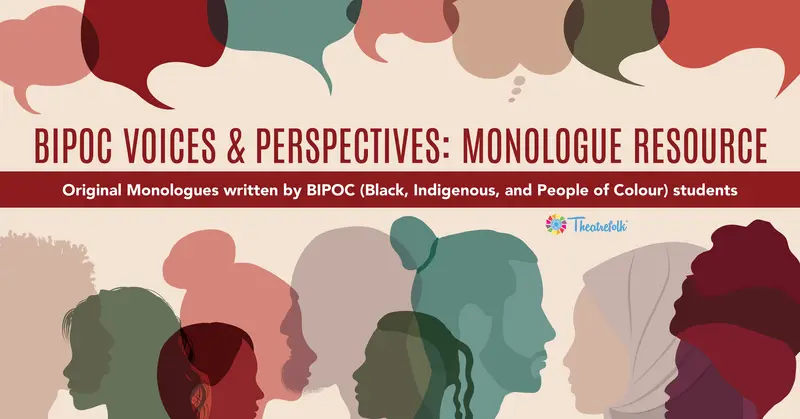
Our 2020-2021 Equity, Diversity & Inclusion Advisory Panel shares some thoughts on using BIPOC material (like the monologues in the BIPOC Voices and Perspectives Monologue Resource) in the classroom. And if you’re not, consider the reasons why. What’s stopping you? How can you overcome those obstacles? 1. Do your research.Do your dramaturgy. If you’re going to use BIPOC material, take care of those characters and those who write from that perspective. Research the background. Research unfamiliar words, phrases, and events. Know what you’re talking about before you talk about it. 2. Ask for help.Don’t be afraid to ask for help. Be okay with not knowing all the answers. Come from a place of honesty. If you’re uncomfortable working with BIPOC material, bring someone in to talk to your students. Reach out to others. 3. Be student centred.Be a student-centred teacher. The era of the “sage on the stage” is over. Give students agency in what they learn and how they learn it. If you teach a community of students that differs from your own, that community should have a focus in your curriculum. For example, perhaps you usually invite theatre professionals in to talk to your students. Make space for a BIPOC stage manager, director, designer, or actor. 4. Be open minded.Some people are uptight when it comes to conversations about race. Many people are afraid of their own stereotypes and preconceived notions. But the worst thing you can do is ignore the identities of your students. Don’t be afraid to take on bilingual material because you don’t speak the language. Actively model anti-racist behaviour and be open to deprogramming yourself in that regard. Start from a place of truth. Acknowledge when you make a mistake. Address how you can get past these obstacles. Everyone’s stories are important. Sit back. Listen. Don’t bring negative energy. Ask for help. Be human, open, and honest.
Creating a Safe Space for Your LGBTQ+ Students
Teaching Drama

Creating a Safe Space for Your LGBTQ+ Students

In 2021, you would think we’d be at a point where inclusivity and acceptance are the norm. However, LGBTQ+ students are still frequently the victims of bullying, harassment, and discrimination, and are often made to feel alone, uncomfortable, scared, or unsafe in school. In drama class, we ask our students to open themselves up and take risks every day. This can be difficult for students who feel that just being themselves is risky. We say drama class is a safe space but for some students, no space feels safe. Let’s help our students feel comfortable and safe in our drama classrooms. Read on for some tips and ideas for creating a safe space for your LGBTQ+ students. 1. Stay up to date on current issues and terminology.This is particularly important if you do not identify as LGBTQ+ yourself. Language is ever-evolving. Do you know what the acronym “LGBTQ+” stands for? Start there! Listen to your students, and take it upon yourself to learn. Stay up to date with issues and changes in the LGBTQ+ communities. Familiarize yourself with signs and symbols used in LGBTQ+ culture. Check your own language. Avoid heteronormativity (the assumption that the “default,” “preferred,” or “norm” is heterosexual/straight), consider your own biases in relation to LGBTQ+ concerns, and learn about things like the differences between gender and sex, and pronoun usage. Click here for some introductory information about pronouns in the drama classroom, andthoughts on gender and casting. 2. Be a visible ally to your students.Try hanging a rainbow flag in your office, displaying a safe space poster or sticker in your drama classroom, or wearing a rainbow pin. This lets students and other faculty members know you are supportive, and that anti-LGBTQ+ language or bullying behaviour will not be tolerated. Even if your students don’t say anything directly to you about it, knowing that you are an ally may be helpful or comforting to them. 3. Study LGBTQ+ topics in your curriculum.Representation is important. To this end, read and perform plays featuring LGBTQ+ characters and written by LGBTQ+ playwrights. Show examples of LGBTQ+ performers, and encourage students to write about topics that are relevant to them. Be inclusive in your choice of source materials. Check out plays such as Completely, Absolutely Normal: Vignettes about LGBTQ+ Teens by Bradley Walton, available from Theatrefolk. 4. Be available to your students.You may have students who approach you in clear-cut ways. They may come out to you, confide in you, or ask you direct questions. You also may have students who test the waters first. They might show you a photo of a transgender performer, mention a pride item they purchased recently, or drop a term such as “two-spirit” into a conversation. How you respond to those students is important; they’re watching and listening to your reaction to see if you’re someone they can trust. Observe and respond genuinely. Students can sense a fake or insincere reaction a mile away. Show interest, ask questions (as appropriate — don’t interrogate the student or expect them to educate you), and listen, listen, listen.
Thoughts on Gender & Casting
Teaching Drama

Thoughts on Gender & Casting

Casting a show, or even a class reading, is a tricky business. It takes care and thought to find just the right person to fill each role. As the song “I Hope I Get It” from A Chorus Line says, “How many people does he need? How many boys, how many girls?” Gender is a major consideration when casting a show, but there is more to think about than just the number of roles available. How can teachers promote inclusivity and create new and interesting acting opportunities for students through their casting choices? 1. Start a discussion with your students about their thoughts on gender and casting.When studying plays in class, discuss with your students why a playwright may have indicated that a certain role must be a certain gender. Does it affect the story? Do the characters in the show portray “traditional” gender roles or stereotypes? Is the show a product of the time period in which it was written? How would an actor feel to play a role of a different gender? How would it affect the play if a person of a different gender played a particular role? Go beyond “Well, the playwright wrote it that way.” Does it matter? In some shows, yes, gender does matter. In others, it doesn’t. Why? Do a “dream cast” with famous performers for the play you’re currently studying. Challenge your students to think beyond gender for interesting casting choices. Could Ezra Miller play Juliet? What about The Rock as Heather Chandler? How about Lupita Nyong’o as Prince Charming? Do your students have roles that they themselves would love to play, regardless of the traditional gender casting of the role? 2. Select plays/musicals with gender-neutral or gender-flexible casting opportunities.Choose plays to read as a class or for production in which any student can play any role, regardless of gender identity. Theatrefolk has tons of options for plays with gender-flexible roles. Open your world up to interesting casting choices and acting challenges for your students! Try having students of different genders read the same monologue. How do different students’ genders affect the portrayal of the character, if they do at all? How do others students in the class receive the portrayal? This can be difficult, as students may be considering and refining their definition of gender. What thoughts, concerns, or stereotypes immediately come to students’ minds? 3. Consider gender-expansive casting in your shows.It’s common to see “cross-gender” casting in school theatre productions. How many of your female students have had to dress as boys and play male roles before? Probably most of them, at some point in their theatrical lives. (It’s pretty rare for a male student to play a female role, unless it’s one that is played in drag.) But where possible, try to cast roles with students of different genders, if they are well suited to the role. Consider whether the student will play the role as the gender it’s written for, or as the gender of the student. I once saw a production of A Midsummer Night’s Dream at the Stratford Festival in which the role of Lysander was played by a woman, as a woman. This meant that Helena and Lysander ended up together in the end as a same-sex couple, and it worked just fine. It’s much easier to do gender-expansive casting in a show that is public domain, such as Shakespeare’s catalogue of plays. If you have chosen a show that requires rights to be paid, please be aware that the playwright must approve script changes, which includes gender-expansive casting of roles that are written to be a specific gender. As well, some students may be unsure about non-traditional casting choices. You may want to include an audition questionnaire that touches on gender-expansive casting opportunities and whether your students are comfortable playing a role of a different gender. 4. Look beyond the binary.Gender stereotypes can be deeply ingrained in us, even if we believe ourselves to be open-minded and up-to-speed on gender identity. There’s more than simply “cross-gender” casting. Don’t forget that roles can be played as and by students who are genderfluid, transgender, cisgender, agender, non-binary, or genderqueer. Look beyond the male/female binary and be thoughtful and inclusive in your casting choices. Let “Who is the best student to play this role?” be your casting criterion. Check out our post, Pronouns in the Drama Classroom, for more about this topic.
Pronouns in the Drama Classroom
Teaching Drama

Pronouns in the Drama Classroom

Respect and inclusivity are vital in the drama classroom. One way to demonstrate respect and inclusivity is to use students’ personal pronouns correctly. How does a person wish to be referred to in the singular third person in the English language? This includes (but is not limited to) he/him, she/her, they/them, ze/hir, and no pronoun (use my name). Some people use multiple pronouns (she/her and they/them, for example). You can’t assume what someone’s pronouns are just by looking at them, by what their name is, or by what they’re wearing. As well, pronouns are not necessarily indicative of a person’s gender or other identities. We want our students to be comfortable expressing themselves, and using a student’s preferred pronouns helps foster a more inclusive environment in your drama classroom. Read on for three tips to help you incorporate this inclusive language into your classroom, whether it’s in-person or online. 1. Introduce yourself.Start your class with introductions: “Hi, my name is Mr. Taylor, and my pronouns are he/him.” That shows students that you are aware of the concept of pronouns, that you are open to sharing your own pronouns, and that they can share theirs in your classroom. There’s even a gender-neutral honorific: “Mx.” (pronounced “mix” or “em-ecks”), for those that prefer a gender-neutral title. When preparing for an upcoming production, you can also include a section for pronouns on audition forms in the personal information portion: Name, Age, Grade, Pronouns. 2. Group considerations.Rather than addressing your students by phrases such as “good morning boys and girls” or “ladies and gentlemen, may I have your attention?” choose gender-neutral terms such as “students,” “people,” “friends,” “everyone,” “loyal subjects” – well, maybe not that last one, but you get the idea! Be conscious of your words when referring to groups of people. Even seemingly casual phrases like “what are you guys up to?” have gender-specific connotations. As well, avoid dividing students into groups by gender (“girls will work on Scene 1 and boys will work on Scene 2”). 3. Educate yourself.The website www.mypronouns.org is a fantastic resource and a great place to start for more information about personal pronouns. You’ll also want to learn more about gender identity terms such as gender expansive, transgender, cisgender, agender, genderfluid, non-binary, and genderqueer. The website https://pflag.org/glossary is another great resource for learning terminology. If you make a mistake and use incorrect pronouns for one of your students (this is called misgendering), apologize, and be sure to use the correct pronouns going forward. Find out if the student would like you to use that moment to educate others (for example, explain to the rest of the class what happened, how to use correct pronouns, and why) or just leave it. Each person’s reaction will be different. Look at films, television shows, and other media to see representation of people using personal pronouns, and how they do it. For example, in the show The Chilling Adventures of Sabrina, the actor Lachlan Watson (who is non-binary and uses they/them pronouns) plays Theo Putnam, a transgender boy (previously “Susie”) who uses he/him pronouns. As well, learn more about plays and musicals that deal with gender identity and use of pronouns, such as Head over Heels by Jeff Whitty and James Magruder, Hedwig and the Angry Inch by John Cameron Mitchell and Stephen Trask, or Hir by Taylor Mac. Please be aware that there is no universal agreement on terms relating to gender identity and pronouns. Language is always evolving. However, continually educating ourselves on these matters will help us support our students and help them feel safe and respected in the drama classroom, exactly as they are.
The Importance of Ensemble Thinking
Directing

The Importance of Ensemble Thinking

What does it mean to focus on “ensemble thinking”? Ensemble thinking focuses on a whole-show mentality. Rather than an “us versus them” mentality for leading actors versus ensemble/chorus members, or actors versus the crew, ensemble thinking focuses on creating a community of equals within a show. Every student, no matter their role, experience level, or grade level, is a vital part of the production and must be treated with equal respect. And, yes, we cannot forget the crew members! We often only think of the actors when considering the “ensemble,” but the crew is a vital part of the whole show. And they are often overlooked because their jobs and tasks are much less flashy than appearing onstage. Just because crew members don’t get a bow at the end of the show doesn’t mean that they are lower status than everyone else! Ensemble thinking means focusing on inclusivity and collaboration, rather than a hierarchy. It takes the “me-first,” egocentric mentality out of the picture. Instead, one student’s success is everyone’s success. Everyone is focused on a common goal – to present the best production possible! So, why is it important to create an atmosphere that focuses on “ensemble thinking” for your school productions? Let’s look at the last point again. In an atmosphere that focuses on ensemble thinking, everyone is focused on a common goal, which is to present the best production possible. This singular focus guides the overall production process. For example, if something goes wrong – which it inevitably will – with ensemble thinking, students are more focused on solving problems as a team rather than worrying about how something might affect them personally. For example, during a production I directed of Disney’s High School Musical 2 Jr., our lead actress literally broke her ankle during a day off between performances. Rather than get themselves into a panic, the rest of the cast and crew came to the next performance an extra hour early so we could re-choreograph some of the dances and make adjustments to the scenes so a chair could be brought onstage at various times so the lead actress could sit down and take the weight off her crutches. The focus was not on what the audience was going to think or blaming the student for getting hurt outside of the show; rather, the cast and crew worked together to help their fellow teammate through the remaining performances. This experience also served as a learning point for future productions – I have definitely told that story to my first-year students when they get nervous and start playing the “What If” game. Ensemble thinking is also important as it encourages inclusivity. As I mentioned before, backstage crew members and stage management are often overlooked as members of the ensemble. I remember being an assistant stage manager for the first time on a production in university, and overhearing one of the actresses say to her friend, “I could never be an ASM – they have to do all the hard work and get none of the glory.” That made me feel like my role within the production was completely useless, even though in my head I knew I was helping make the show succeed (moving five risers and a dog cage in a 20-second scene change, anyone?). I chose not to work with that particular actress again in the future, but your students may not have that choice in a high school setting if they want to continue working on productions. Actors get the bows and the applause, but must remember that the applause is not simply for them – it’s also for the costume team members who sewed their costumes, the lighting designer and operator who made sure they could be seen onstage, the microphone technician who ensured their wireless mic had fresh batteries and was attached securely to their hair, and so on. Without the contributions of every student and staff member involved – the full ensemble – the show could not be what it is. Check out the following articles for more ideas, warm-ups, and games to encourage ensemble thinking: • No one is Less. Ensemble is More. • Ensemble: Is it time to dismantle the pyramid? • 5 Tongue Twister Exercises for Ensemble-Building
Inclusion in the Drama Classroom: Assessing Your Space
Classroom Management

Inclusion in the Drama Classroom: Assessing Your Space

In education, inclusion refers to students with disabilities or special needs (whether their needs are medical, mental, physical, or psychological) spending most or all of their class time with students in a general education setting – that is, with students who are considered neurotypical or able-bodied. (The phrase “neurotypical” or “neurologically typical” refers to a student who does not have a diagnosis of autism or any other neurological diagnosis.) The goal of inclusion is to ensure that students with disabilities or special needs are clearly included and engaged within the classroom, and are considered to be an equal and important part of the whole class. There are many ways you can promote inclusivity and assist students with special needs in the drama classroom, and it can seem overwhelming at first. However, you can start by assessing your drama classroom and seeing how accessible it is. Here are some ideas to consider: • Look at the overall accessibility of your school. How accessible and inclusive is it in general? What are the accessibility features that your school possesses? Are they up to date? Are there school policies in place for students with special needs? Where do you find this information? • Find out what your school’s policies are for the safety of students with special needs (e.g. service animals, evacuation procedures, field trip rules and regulations, etc.). Where is this information located? How easy/difficult is it to access? • Ensure that your classroom and auditorium have the necessary accessibility tools for students who use wheelchairs or walkers, such as ramps, lifts, or elevators. Look closely to see how accessible the facilities truly are – for example, where is the nearest accessible washroom? Would a student using a wheelchair be able to reach the whiteboard or a bookshelf? Can your student’s wheelchair or walker fit through all the doorways and entryways into/out of the theatre and on/off the stage? • Designate a quiet area for students with sensory concerns who may need to relax or decompress during a high-energy or over-stimulating exercise or theatre game. How would you keep this area clean and clear for use? How might you keep other students from using this area as a hangout space? • Find out if your student would benefit from an aide, assistant, or interpreter. How would this person be most helpful in your drama class? • Find out if your school allows service animals and if your student might benefit from one. • Post class syllabuses, scripts, rehearsal schedules, and classroom rules/policies ahead of time in a specific area in your classroom (such as a bulletin board clearly marked for this purpose) where these important files can be posted and referred to. This way, students can know what to expect during class/rehearsal and can plan accordingly. • As well, a visual calendar and/or visual schedule can be useful to indicate to students what the plan for that day’s class is. • Encourage students with special needs to advocate for themselves and ask for what they need to succeed. However, they may need your assistance and guidance in that area. Be sure to check in with your student privately to see if there is anything they need help with. Every student is different. Any student with special needs is going to have different abilities and different things they can and cannot do. We can’t possibly predict what students you will have in your classroom and what diagnoses they might have. However, with some planning ahead and awareness of the accessibility of your classroom, you can be better prepared to help all your students succeed, regardless of diagnosis.
Teen Plays for Inclusive Classrooms
Teaching Drama

Teen Plays for Inclusive Classrooms

As drama educators, we have the opportunity to instill a love and appreciation of theatre for all students. Teen Plays for Inclusive Classrooms by Dara Murphy is a fantastic resource for classrooms that are made up of a wide variety of talents and abilities. Read on to learn more about Dara’s tips to ensure a successful acting experience for your entire classroom. Teen Plays for Inclusive Classrooms contains two fun and simple plays for teens that were originally performed by teens with developmental disabilities, but they could be useful for many groups. Perhaps you are looking for a play for first time actors, or for your ESL group, or you have a student in your class who’s deserving of a lead role but, for whatever reason, they need simpler material in order to be successful. This leads us to inclusive classrooms. Most classrooms are full of diversity, with a wide variety of talents and abilities. As a teacher, it seems obvious to pick material that suits the academic level of the majority, and then to adapt that material for any outliers. In the arts, this can lead to certain students always having to “stand in the back,” or “lip sync along to the song.” So, I challenge you to first, when you are designing your units, think of the students who need more support. Design a performance unit with them in mind. It’s going to force you to be creative about how they will learn the material and how they will express what they’ve learned. Then you will have lots of good ideas that you can pull through to your other learners. Plays like the ones in this book can be another tool in your kit. Although the language is uncomplicated, the acting doesn’t have to be! These plays can give advanced learners room to explore other drama techniques such as movement, masks, melodrama, and directing… perhaps they could even perform the whole play through mime. People with disabilities can be fantastic actors. When given the opportunity, they will wow audiences with their authenticity and energy. In return, you will likely see these students grow and develop their confidence, social skills, and communication abilities. This would be a great outcome for your inclusive classroom! Some Tips Here are some tips on giving these students a successful acting experience: Starmaker SchoolThis is a fun play to watch and perform. Because it contains music and dance, it includes students with a variety of talents and abilities. For example, a nonverbal student can dance in the Dance Crew or play an instrument in the Music Crew. Also, practicing the different musical numbers breaks up the rehearsal so you don’t always have to focus on acting and memorizing. When we performed this play, we collaborated with the music and dance teachers, and we made sure to choose cool songs that the students loved. The Forest CreaturesThis play is enjoyable for older students who like to scare their audiences. Don’t be shy; use scary music, sets, costumes, and make-up! The Forest Creatures has some non-speaking roles, as well as some more challenging roles. Although there’s no music or dance in this play, the variety of characters allow for more character exploration. How will the forest creatures move and make sounds? Is Evil Eye really evil? Who is Cal? How do the campers change when they are “zapped?” Also, have fun with the final fight scene at the end. Take your time with the choreography and make sure that everyone is safe. The most difficult part of this play is the entrances and exits. We found it useful to have volunteers in the wings to help the students enter. We also had a fellow teacher acting as one of the campers (Connie). This teacher was able to help lead the students who needed more assistance. Learning LinesMany students, regardless of their reading level, enjoy having a script and highlighting their lines. A script means that they are part of the team! Often, when actors are introduced to a new play, the script is handed out and the cast does a group read-through. This can be discouraging for those students who struggle with reading. To help with this, you can give the students their scripts beforehand so they can pre-read it. You can also run the read-through by chunking the play into sections. Read a section to them first, while they follow along. Discuss what has happened, and then have the actors read or repeat it. Learning and memorizing lines might be difficult for many students. When we rehearsed these plays, we learned the lines by rote, working on one small section at a time. It’s still valuable, however, to give students a sense of responsibility for learning their own lines. Teach them how to memorize their lines at home by using a friend or a recording, and encourage them to do so. Also, it’s important to make sure that students understand the words that they are saying. Students should not be saying lines that they don’t understand. Don’t be surprised if a student memorizes all of their lines with ease, and perhaps even all of the lines in the play! Our students have amazing abilities. In the end, however, you might need to have a line whisperer during the performance. That’s okay! But during rehearsals, don’t teach the actors to rely on that person. It’s okay to let them experience a missed line. Finally, everyone is different when it comes to learning and saying lines. Some words might be hard to pronounce, some lines might be too complicated, and some lines might be too simple. Please feel free to edit the lines in these plays as needed and adapt the plays to fit with your group. Stage DirectionsSometimes knowing where and when to move can be a struggle for students. When you are starting to block the scenes, look at how and where your students naturally want to move. Your students’ unique and creative ideas are gifts to your rehearsal process. If you see that a student is having trouble with stage directions, have them follow another actor. Their characters can be friends! Our groups can’t rehearse on a real stage, so we found it useful to mark out a stage on the floor with pylons. Almost every rehearsal we reminded the students where the entrances were, and we demonstrated how to face the audience. We then taught the students a “group position.” This was a place where everyone stands when the whole group is onstage. We practiced entering and standing in that position. For certain students, you might want to create a visual script. For example, in Starmaker School, after Eggman says “check out the dance group” a student has to walk to their mark and start dancing. A visual script for that section could have a picture of Eggman with a speech bubble that says “check out the dance group,” then a picture of walking, then a picture of where you want them to walk, and then a picture of dancing. A visual script would have to be tailor made for the student and simplified so that it shows only what that student is doing or reacting to. Lastly, it’s useful to have someone on both wings to help with entrances and exits. That person can also whisper helpful reminders to students before they enter, such as what scene they’re on, where they should stand, and what their first line is going to be. RehearsalsHere are a few final rehearsal tips: • Students love warm-ups, but be careful when selecting games. Some of the popular “calling around the circle” games are tricky for students with hearing impairments, and tongue-twister type games, like Zip Zap Zop, can be very challenging! • Don’t give too many directions at once and be encouraging and positive. It might take a while to learn everything, so you need to keep the motivation up. • Give breaks so your actors can relax and socialize with one another. • Miming or imagining a prop or set piece can be difficult. It’s much easier to have the actual, tangible item. • Music can be a useful for cues, and sometimes I even stand by the stage with a guitar. For example, when the music sounds like this, exit, when the music sounds like that, march around. Keep moving until the music stops! • Putting on a play might be a new experience for some of your students. Be sure to leave time to answer their many questions. It’s valuable for them to understand your expectations and your routines. I hope these plays and these tips are useful for you. We had a lot of fun performing these plays, and I hope you do too. Please help make the theatre a fantastic experience for all actors. Everyone deserves a chance to be in the spotlight! Click here to learn more and read free sample pages of Teen Plays for Inclusive Classrooms
The Inclusive Classroom: Drama Class for Students with Special Needs
Classroom Management

The Inclusive Classroom: Drama Class for Students with Special Needs

“Special needs” is a broad term that describes individuals who require assistance for disabilities that may be medical, mental, or psychological. Every student with special needs is different, and their needs are entirely unique. Students with autism or Asperger’s syndrome, dyslexia and other learning disabilities, blindness or vision impairment, ADHD, epilepsy or cerebral palsy may be considered to have special needs. But there are many more clinical diagnoses for special needs as well. With the advent of relaxed performances at professional theatres around the world (where shows are performed with reduced sound and lighting levels and the option to move around or leave and return to the performance as needed), and wonderful productions such as Deaf West Theater’s Broadway production of Spring Awakening, which featured actors who are hearing-impaired as well as actors who use wheelchairs, theatre is proving to be a wonderful place for all – regardless of abilities or disabilities. As drama educators, we have the opportunity to really encourage students to explore the world of theatre and to take steps to make sure it is accessible for any student who desires to learn more about it, to participate in it, and to grow a life-long love for theatre! Here are some tips to get started. 1. Identify the unique needs of each student.Every student is different, and any student with special needs is going to have different abilities and things that they can and cannot do. Make it a priority to meet with your students (or their families, if necessary) to discuss what their goals are and what they’d like to achieve by taking drama classes or participating in a production. The more information you have ahead of time, the better prepared you are to help your students to succeed. 2. Use proper language.Using correct language is important. There is some debate about whether people-first language or identity-first language is preferential. In people-first language, the aim is to not define students by a disability or health issue because it is considered to dehumanize them and define them as something that they are rather than a condition or trait that they have. In this case, it is proper to use terms like “student with autism” or “student with ADHD” rather than “autistic student” or “ADHD student.” On the other hand, identity-first language is also frequently used, particularly by those in Deaf culture, since being culturally deaf considered to be a source of positive identity and pride. Overall, it is a personal preference for each student. It is also important to avoid negative and ableist terms when referring to students with special needs. Avoid saying things like “he suffers from x diagnosis” or “she is a victim of x diagnosis.” Students with special needs are not victims or are suffering, and must not be patronized or treated in a way to bring shame or embarrassment. Nor are they worse-off or inferior for having special needs or a disability. A disability descriptor is simply a medical diagnosis. 3. See what you can do to help students succeed in drama.There are lots of ways you can assist students with special needs in the drama classroom. Focus on what your students can do, rather than on what they can’t do. Consider the following: • Ensure that your classroom or auditorium has the necessary infrastructure for students who use wheelchairs or walkers, such as ramps or lifts. • Provide large-print, Braille, or audio scripts for students who are blind or have vision impairment. • Provide visual cues such as signs or hand gestures for students who are deaf or hard of hearing. If possible, a video feed would be wonderful to help students who can’t hear auditory cues know when they need to go onstage. • Give scripts to students who have dyslexia or difficulty reading ahead of time, so they can prepare in advance. • Designate a quiet area for students with sensory concerns so they can relax or decompress during a high-energy or over-stimulating exercise or theatre game. • Learn more about augmentative and alternative communication methods for students with speech or language problems. For example, a student could use a voice recorder or iPad application (such as iConverse) to help them perform their lines. • Find out if your student would benefit from an aide, assistant, or interpreter. • Offer a relaxed performance of your next school show for audience members who could benefit from it. • Don’t rule out a student with special needs from performing in a production. If they are the best actor for the part – cast them! • Look for and study shows that feature characters with special needs. For example, the character Archie in 13: The Musical uses crutches because he has muscular dystrophy. The lead character Christopher in The Curious Incident of the Dog in the Night-Time has autism. Treat all of your students equally. A student with special needs may need some specific accommodations at times, but mostly they want to be part of what everyone is doing.
The Drama Classroom: Divergent Learning
Classroom Management

The Drama Classroom: Divergent Learning

There is no more class that is more divergent than the drama classroom. You have the vast number of different students who end up in your classroom, some who want to be there and some who don’t. You also have the ability to look for many different solutions to a problem in the drama classroom. Playwright and teacher Steven Stack knows first hand that theatre is the perfect place for divergent learning to happen. Here are 5 tips he has from the the front lines: What is Divergent Learning?Divergent learning means to look for as many possible answers and solutions to the topic and material you are teaching. It’s looking at students not as a group of students but as a group of individuals. You adjust your teaching, your expectations, and your perspectives to the individual student. This way you can give them what they need to be better students, to learn more efficiently, and in some ways, to be better at life. How can I incorporate Divergent Learning in my classroom?• Change your perspective. Divergency is not something to be feared. It’s an opportunity to reach these students on so many levels and that’s the big thing. It’s a perspective shift. • Be willing to adjust. Understand that students are going to take you in various directions. • Create a community that embraces differences and supports one another. Where do I start?Here are a few ways Steven addresses divergent learners in his classroom: Community Building ‘Check In’s’: Students start each class by sharing (if they want to) something that’s on their minds. It can be funny; it can be what they had for breakfast; it can be something that’s stressing them out. But they share and everyone else listens. The sharing isn’t complicated, it’s one basic fact about themselves. Those in the circle don’t address or comment on what they hear. The teacher has to share something asl well. It’s a simple exercise but it starts creating community. It’s safe and students are listening to one another. Group Projects with Success based on Process Give students the challenge to audition, cast, stage, and perform a play within a week. Give them the script on Monday and tell them the performance is Friday. The students either succeed or they don’t succeed together. There are no stars. They have to work together for success. And the success is not based on the performance. It’s based on the process. If they did their best, that means they tried to put it together, they worked hard, and everybody was working together. They faced struggles but they dealt with those struggles. It’s an amazing exercise. Get Students to Discover Multiple Perspectives It’s critical to get students to take ownership of their learning decisions. Tell students: “When you’re answering this, don’t give me the answer you think I want. I don’t want that. I want you to own it. You do what you think is right.” Do a quote of the day where you pick various quotes about life, about empathy, various things about learning, and write them on the board. Have students reflect either in their drama journals or on a separate piece of paper. Ask them: What does this quote mean to you? Each day, push them to think a little more. The hope is that you plant these seeds and slowly see the progress as the students start to evolve their thinking, as they start to see that there are other viewpoints rather than just their own and other teachers. And then, they start to expand their thought process. Click here to listen to the full podcast or read the transcript.
The Drama Classroom: A seat for everyone at the table
Acting

The Drama Classroom: A seat for everyone at the table

Drama Teacher Podcast.Scott Giessler is a teacher and a playwright. He went into theatre teaching without any training. Not only is he still doing it, but he has a strong philosophy for how to do it. He’s well aware that what you need as a teacher isn’t necessarily what your students need. Scott is adamant that there is a seat for everyone at the table in the drama classroom. Learn from his experience by incorporating these tips into your own program, from the Drama Teacher Podcast. 1. It’s not about YOU, it’s about THEM.What you get excited about is not necessarily what’s going to light their fire . Get to know the needs of each particular group of students. What do they bring in the door with them? Realize that every year, every semester, as the group changes, so will their needs. You’ve got to constantly learn and adapt. 2. Build trust.In a math classroom, trust is going to be built with “I’m going to show you how to do this and, when it works, you trust me.” With a theatre class, you’re asking them to dig down into themselves and take some social risks. Building a relationship with them is key. If you don’t have a relationship with them, you won’t have the type of trust you need for them to take those social risks. 3. Find a place for everyone – well beyond the actors who already love theatre class.You have the guy who is in the construction trades class who, for some reason, gets dragged in because his girlfriend is in the program. We send him over to the scene shop and we can’t live without him. We’ve got the kid who doesn’t want anything to do with the stage but just loves the costume room . We have the kid who is really great with Photoshop and wants to do all the posters for us . We have kids who just want to be a part of the magic and end up being our house crew or backstage crew. Find the place that each student is comfortable, and you’ll be on your way to building a great program. 4. Help them realize that they are ALL an important part of the team.In basketball, if the third-stringer player doesn’t show up, well, it’s not really a problem because we’ve got two other strings to send in. Whereas, in theatre, anyone that doesn’t show up, it throws a monkey-wrench into the whole works. Embrace the concept that there is no unimportant cog in the machine. We need every last piece to make it move. Instead of “the show must go on,” the proper phrase really is “the show will go on as long as the people running it are a concerted group of people who care a great deal about the outcome.” 5. Include everyone. Don’t cut anyone out.For the same reason that a math teacher doesn’t throw a kid out of math class because he can’t get the hang of math, don’t cut a kid from a high school theatre program because he’s not very good at theatre. The moment they make a commitment to be there, they’re there and we’re going to invest time in them. More importantly, though, they’re investing time in others. Click here to listen to the full podcast or read the transcript. Scott’s got lots more to share, including details of his play Finishing Sentences.
Theatre and Autism: How do you include students on the spectrum?
Acting

Theatre and Autism: How do you include students on the spectrum?

How do Theatre and Autism fit together? Do you have students on the spectrum in your classrooms? Have you ever put on a sensory friendly performance? All of these questions and more were answered in a Drama Teacher podcast with James Lekatz, program director of the CAST program (Creative, Accepting, Sensory-Friendly, Theatre) at the Stages Theatre Company in Hopkins, MN. We’ve shared a few highlights here to help you in your classroom. Click here to listen to the full podcast! How do you help a student who is on the spectrum make the most of the theatre classroom? What can the student do to make the most of the class?Structure and schedule. James says, “We make sure that students know what we are doing every day and make sure it’s very clear. I’ve used this in all my classes now because it works really well as a schedule of events…” Many students on the spectrum are meticulous. They need to know exactly what is going to happen in the class so they can prepare themselves and know that A goes to B, B goes to C, C goes to D. You can help them by ensuring a consistent and constant schedule. Patience and understanding. James relates, “Being able to work one-on-one with students on the spectrum is really useful and being able to ask questions helps navigate a situation.” After you’ve given instructions to the group, connect with the student one on one. For example: “Did you understand what’s happening?” “Yes.” “Do you know what you need to do next?” “No.” “Oh, okay. So, go find a partner and sit down and talk about A, B, and C. Great. There you go.” Giving that extra support to each student will help them to thrive in the classroom. Breaking it down to the smallest step is essential as asking for a partner might be a huge barrier for a student. Explaining the ‘how’ is very important. Use physical tactics. James explains, “With my students on the spectrum, I say, “I’m going to come up to you. Can I touch you to help move your body around?” If they say no, I just say, “Watch my body.” If they say yes, then you can go ahead and do it, but I always ask them permission first. Physical theatre is acting from the outside in, even if a student is unable to start on their own – i.e. “I don’t know how an angry person looks.” The teacher can model: “Well, look at my body. I’m going to start in actor neutral,” which is a great place to always start from when working with physical theatre, “And, now, I’m going to be angry.” So, I’m going to tense up my body. “See how my body is tensing?” Ask them, “Can you see my body is tensing? Tense up your body. Okay, now, relax. Now, I’m going to change my posture. My shoulders are going to come up and I’m going to keep my body tense. Do you see how that is changing?” If they say no, then you can help them move their body to that way. You can use the physical approach of how our body replicates emotions and have that be the starting point for students to create characters and stories from. Find peer mentors. James suggests: “If you are able to have peer mentors in your classroom as well, having a neurotypical student in the classroom helping model, it achieves so much more than just having a teacher or two adults in the classroom. Modeling is very, very, very important.” Further to working with students in a class setting, James has four years experience of putting on sensory-friendly performances. Would you like to do the same? Want to learn more? Listen to the entire interview or read the transcript here. UPDATE FALL 2018: James Lekatz is now the Artistic Associate at Interact Center for the Visual and Performing Arts. The mission of Interact is to create art that challenges the perception of disability.