📣SCRIPT SALE! Treat yourself to an easier Fall. Save 30% on 5+ perusal scripts with code SPRING30 before May 3 and head into summer stress-free.
Online
Distance Learning
Theatrefolk Featured Play – Virtual Platform by Claire Broome
*Welcome to our Featured Play Spotlight. * Virtual Learning by Claire Broome is a perfect play to navigate the chaos of online learning. Life is absurd right now – time to embrace it!
Online learning is a world of its own that doesn’t come with a map. Will Student be able to navigate this world of rotating classes, overwhelming assignments and classmates with initials?
How can anyone make sense of a virtual platform?
Why did we publish this play?
We’re not out of the woods yet with the Pandemic and that means we still want to provide great material for virtual performance. I love the absurd nature of this piece – because it does feel like real life is more absurd than ever. Now is the time to channel all of life’s frustrations with something weird!
Let’s hear from the author!1. Why did you write this play?
I had the idea for this play in the fall of 2020, and was going to write it in the summer of 2021. I ended up sharing the idea with my grade 11 class, and they wanted me to write the play for them. We were in the last quad of the year, and my class wanted a fun script to work on. I wanted to write this play to celebrate and laugh at the absurdity of virtual learning. I also wanted to honour the experiences of various students.
2. Describe the theme in one or two sentences.
The theme of this play is the absurdity of virtual learning and how this experience felt so chaotic.
3. What’s the most important visual for you in this play?
I’m not sure how to answer this question, but Student says this line: “Kind of like this puzzle, but I don’t have all the pieces. I keep thinking I see what the picture is, and then all of a sudden, I don’t know if the piece I am holding is part of the sky or part of the sea, or even if the puzzle is a landscape.”
4. If you could give one piece of advice for those producing the play, what would it be?
This play was meant to be performed online, but it could be performed in person with isolation staging; therefore just keep it simple.
5. Why is this play great for student performers?
I hope it is a cathartic experience, a chance to laugh at how ridiculous their experiences have been. Also this is a great chance to play these characters BIG!
6. Why is this play great for online performances?
My advice for performing online is to know that something may go wrong. Wi-Fi can be unpredictable, rehearse scenarios when things go wrong. But online performances are a wonderful platform to explore characters and experiment with ways of creating staging and focal points, even when everyone is on the screen.
Get your copy of Virtual Platform right here, right now!Not right for your group right now? Search our play catalogue to find one that your performers will love!
Classroom Exercise
Exercise: Outdoor Virtual Monologues
The following distance learning exercise challenges students to take their performances outdoors. Students will select a monologue, perform and film it outdoors, and submit it for evaluation.
Instructions1. Students will select a short monologue (30 seconds to a minute) to prepare and perform. It must be set in an outdoor location and make sense to perform outdoors, rather than a monologue they just happen to present outdoors. If students are having trouble finding one, they could start with a show like Alice in Wonderland, A Midsummer Night’s Dream, or Lord of the Flies, all of which have outdoor settings. Alternatively, have students write their own monologues that are set outdoors. Check out our post, Tons of Outdoor Prompts, for lots of monologue-writing ideas to get your students started.
2. Before they film their monologue, have students submit a proposal to you, responding to the following:
• Name and author of the play the monologue is from
• Technical considerations:
• Setting/location (optional: include a photo of the selected location)
• Time of day
• Weather
• Props or costumes needed
• Safety considerations
• Why is this character outside?
• How will you incorporate the outdoor setting into your performance?
3. Once their proposal has been approved, give students a deadline to prepare, memorize, rehearse, and film the monologue. Students should create a basic appropriate costume (as best they can using items they already have or can easily acquire) and include props if needed. Students will need to ensure they can be seen and heard while filming, as well as decide on appropriate framing of the camera. Students also need to perform safely. For example, while it would be visually cool to perform outside during a thunderstorm, it could be potentially dangerous! (See our posts: Performing Outdoors Part 1: Technical Considerations and Performing Outdoors Part 2: Safety Considerations for some helpful tips.)
4. Students will submit their completed videos to the teacher, along with a written or verbal (filmed) response to the reflection found below. If students are completing a filmed reflection response, it should be in a separate video from the monologue.
Distance Learning
Theatrefolk Featured Play – Pandemic Pancake by Lindsay Price
*Welcome to our Featured Play Spotlight. * Pandemic Pancake addresses the ongoing changes in the new world we find ourselves in – and is great for virtual or socially distanced performances, or a hybrid of the two.
Pandemic Pancake asks the question: What now? Characters decide, for good and for ill, how they will respond to this evolving new world. Do they find hope? Do they shut down? Do they open doors? Do they strategize long-term? Or do they take it day by day, hour by hour, minute by minute?
We are no different than the characters in this play. We all must decide “what now?”
Let’s hear from the author!1. Why did you write this play?
After writing Scenes From A Quarantinein April 2020 I’ve known that I wanted to do a follow up play as circumstances surrounding the pandemic have changed. Also, as we continue along, I wanted to explore the “what now” of the future rather than remain in the past of the situation. Lastly I wanted to present characters who have figured out how to have hope in this situation. That was the most important element I wanted to present – that there has to be hope as we move forward.
2. Describe the theme in one or two sentences.
Things are different but they’re not impossible.
3. What’s the most important visual for you in this play?
There’s a scene at the end of the play in which two teens, who are on a zoom call and one of them says “Clasp your hands together and close your eyes. Hold tight. I’m holding your hand. That’s me. We’re together.” And they do. And that visual of each of them showing that they support each other sums up the whole play.
4. If you could give one piece of advice for those producing the play, what would it be?
Whether you’re performing virtually or you’re in person, it’s all about the characters. Focus on the characters as they experience their story. Focus on character physicalization. It doesn’t matter if you’re sitting in front of a screen, an upper body physicality is still important. You can still make a character specific.
5. Why is this play great for student performers?
The characters are mostly teen aged and the story is relevant and current.
6. Do you have any tips for those who are performing this play online?
Everything is in the script. The play was written to be performed on line, hybrid, or social distanced with suggestions for how to adapt scenes to fit your situation.
Get your copy of Pandemic Pancake right here, right now!Not right for your group right now? Search our play catalogue to find one that your performers will love!
Distance Learning
Lessons Learned from Directing a Virtual Show
If you miss doing shows with your students, you’re not alone. We’re all missing live theatre! Luckily, there are playwrights writing virtual plays for online platforms that you can do right now. Check out the available shows in the Theatrefolk catalogue. While you’re at it, check out the following lessons I learned while directing my first virtual show. I hope they help you on your virtual show journey!
Know the rules.Be aware when you’re selecting your show that different theatrical rights companies have different rules and requirements for streaming online shows. Some companies require you to use a particular streaming and/or ticketing platform. Some companies allow you to purchase “on demand” tickets (meaning audiences can watch the show at their leisure), while others only allow performances to be streamed at a particular time (like going to the theatre for real, so if you miss the streaming time, you’re out of luck). Some companies also don’t allow their shows to be presented online at all. Be sure to check all the requirements before you select a show to produce, and contact the company with any questions ahead of time so you don’t risk disappointment — both your own and your students’.
Zoom fatigue is real.Try to keep virtual show rehearsals shorter than you would when rehearsing a show in person. I found that two hours was my limit for being able to focus during rehearsal. It’s hard to feel a true connection when rehearsing online, and you will likely have to use even more energy than you usually do because your students are tired too. To combat this, let your students know in advance what you’ll be rehearsing at each rehearsal and encourage them to familiarize themselves with the scene and their lines ahead of time. This doesn’t mean they need to be off-book before you’ve blocked the scene, but they shouldn’t be wasting time reading their lines for the first time during rehearsal. (This goes for in-person rehearsals as well, but it’s extra important when you have limited rehearsal time and waning focus.) Mix up what you’re working on — call smaller groups to rehearse shorter scenes for a shorter amount of time when you can, to break up the time and keep your mind fresh.
Record footage as you go.Have clear deadlines in place for students to record and submit their footage at home. When I directed She Kills Monsters: Virtual Realms, we rehearsed on Thursdays and Saturdays, and the scenes that were rehearsed that week were due to me by the following Wednesday. Recording and uploading footage as you go makes things much easier. It reduces stress on students, because they won’t have a huge backlog of footage to record all at once. As well, if there are any issues with the recording (volume problems, incomplete footage, recording portrait rather than landscape, etc.), there will be time for students to re-record the footage.
Make sure your final due date for all footage (no matter what) allows plenty of time for the final project to be submitted to your streaming service. Allow yourself plenty of time to work on the footage, so you aren’t editing for 24 hours straight the day before the show is due. Allow yourself some wiggle room to submit the final project as well in case of technical issues with your editing software or Internet service.
On the topic of editing:If you can, hire an editor to piece the audio and video footage together. It is time-consuming, tedious work, and it will be one less thing on your plate. Do you have a student who is keen to take on the project for extra credit?
Volume and diction is important.Students still need to project their voices when they’re performing for the camera. Many students think that because they’re close to their device and alone in a room that they can speak in their “regular” tone. While they aren’t in the theatre and having to make sure the entire audience can hear them, volume and diction is still important. There are many things that can affect sound levels when recording, such as background noise (even ambient noises like the hum from overhead lights, a fan going in the room, or pipes running) or the audio quality of the student’s device. Students may also hold back when they’re recording themselves because they’re worried or embarrassed that their family will overhear them. However, you can only crank the audio so high when you’re putting the footage together, and having one student noticeably quieter than the rest of the cast will make it difficult for your audience to understand what’s going on (just like in in-person theatre!).
Have fun.You and your students are getting to do theatre — not the way you’re used to, true, but you’re still getting to do something together! Your students are learning new skills: acting for the camera, framing and camera work, creative problem-solving. Rather than focus on the negatives of being away from each other and missing the feeling of being onstage, try to focus on working on a new creative endeavor together. On top of that, you’re caring for each other’s health and safety by doing a virtual show.
Distance Learning
Theatrefolk Featured Play – The Virtual Support Group from Hell by Jeffrey Harr
*Welcome to our Featured Play Spotlight. * The Virtual Support Group from Hell by Jeffrey Harr is a perfect play for an online environment – a hilarious virtual adaptation with fun, vivid characters.
Wendy joins an online teen support group. However, she quickly discovers that the others are anything but typical.
Who is Vladimir and why does he speak with a Transylvanian accent? Why does Lucy only speak one word (braiiinnnnssss)? And why does Janet think she’s Batman?
Why did we publish this play?
We’re still in the weeds of virtual productions, so why not produce something you can put together RIGHT NOW. Jeffrey Harr has adapted his play “The Support Group From Hell” so that it can be done virtually. He was inspired to do so after a school last spring did their own adaptation and it worked so well. Vivid characters that are so fun to play, and a story that makes total sense in a virtual environment.
1. Why did you write this play?
I’ve always been a huge fan of old-school movie monsters—Dracula, the Wolfman, Frankenstein’s creature—and wondered what they would be like in group therapy. And I’ve always been just as interested in throwing shade at Dr. Phil, so I figured, how about a wackadoodle therapist obsessed with Dr. Phil and a perfectly normal teen girl who unknowingly wanders into a group full of monsters? I loved the idea of taking characters who have such incredibly rich backstories and making them teens. Let’s face it—being a vampire is hard, adolescence is harder.
2. Describe the theme in one or two sentences.
Every kid’s got problems, undead or not, and talking them out with a licensed therapist can’t hurt.
3. What’s the most important visual for you in this play?
Because the play’s meant to be performed virtually, the appearance of the “monster” characters is really important—they’ll be on screen throughout the entire show. Plus, it’s a lot of fun to interpret them visually—Dracula, Frankenstein’s monster, a witch, a zombie. It gives the kids a chance to be creative in putting together what they’d look like as teens, not to mention what to do with the background. Like, what would a teen witch have in her room that would add to her character? It’s something that wouldn’t have to be considered on stage, but in this medium, it’s an extra dimension that could really add something to the character.
4. If you could give one piece of advice for those producing the play, what would it be?
I’d suggest having the actors playing the monsters to do a little research to have somewhere to start with their characters. What kind of vampire do you want to be? What would Frankenstein’s monster’s kid act like? How do you inflect the word “brains” to suggest a variety of different tones? Which Batman voice feels right? Getting a bunch of pop culture references can be a great place to start for ideas.
5. Why is this play great for student performers?
The play gives the kids a chance to play some pretty outlandish characters, which is always fun. And they have a lot of room for creativity in how they interpret them, as iconic as they are. The virtual aspect is really powerful, too—so much of a play in this format is up close and personal, making facial expressions and voice so important. Things that wouldn’t be seen or heard quite so crisply are impossible to hide on screen, and that’s a good thing. So much can be said with a great facial expression or a sarcastic whisper.
6. Do you have any tips for those who are performing this play online?
I’d suggest that the actors think carefully about what will be in the background of their screen so they can be deliberate in helping to create a humorous tone. And now that they’ve been spending so much of their lives online, they probably have some wonderfully creative ideas for how to best use the medium to help tell the story. Video tricks. Little things that happen while in one of those Zoom calls that would add something funny. I’d let them do what they do best—be creative, try different things, make it as relevant as possible.
Get your copy of The Virtual Support Group from Hell right here, right now!Not right for your group right now? Search our play catalogue to find one that your performers will love!
Distance Learning
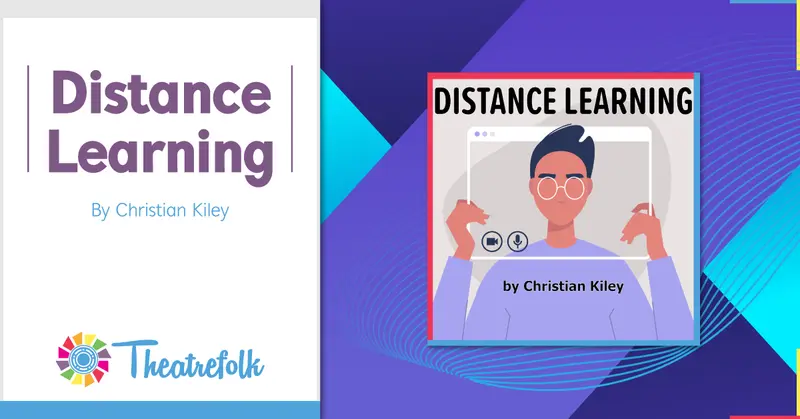
Theatrefolk Featured Play – Distance Learning by Christian Kiley
Welcome to our Featured Play Spotlight. Distance Learning by Christian Kiley is a fantastic ensemble play written specifically to be performed on an online platform.
Distance Learning takes us inside the student experience of trying to survive and thrive in a virtual classroom. What’s the future of virtual classrooms? Are they the new normal? Will we ever experience the old normal again? There are no rules to help overcome feeling alone. It’s time to get class started. Won’t you join us?
Why did we publish this play?
We are continuing to focus on plays that can be produced in a virtual environment. Theatre must go on! This play is a vivid “now” play. It’s about our current pandemic situation, which isn’t going away just yet. It will connect to students and give them the opportunity to explore characters within a virtual world.
Let’s hear from the author!1. Why did you write this play?
This is what we are living through right now. I really want to help express the voices and emotions of my students. I appreciate the opportunity to write about the significant moments of life that I observe and experience with the young artists I mentor and teach.
2. Describe the theme in one or two sentences.
Even during a pandemic, people can continue to strive for improvement, grow, and become better, stronger people (yes, even teachers). People need a sense of community and the support that a community provides (even in virtual or distance learning).
3. What’s the most important visual for you in this play?
It is a recurring moment. When all or most of the characters stare right into the camera with an “I see you” look. This should be as close to a fourth wall break as is possible in a virtual performance.
4. If you could give one piece of advice for those producing the play, what would it be?
Use your current feelings (good, bad, and all those in between) to help you connect to your characters and the world of the play. I am very excited to see, hear, and experience how directors, actors, and designers push the boundaries of virtual performance.
5. Why is this play great for student performers?
It is my perspective of what the students I teach and interact with on a daily basis are going through.
6. Do you have any tips for those who are performing this play online?
Find ways to push the boundaries. Each character has a facet of their personality that can be portrayed in a dynamic way. Don’t be afraid of your creative ideas and your ability to put them out there. Your mind, heart, and talent can make a meaningful difference.
Get your copy of Distance Learning right here, right now!Not right for your group right now? Search our play catalogue to find one that your performers will love!
Distance Learning
Theatrefolk Featured Play – The Date by Steven Stack
*Welcome to our Featured Play Spotlight. * The Date by Steven Stack is a theatrical horror masterpiece that’s written specifically for online performances. You don’t want to miss this one!
Chris is about to go on his first online date. He’s practiced the steps for success, he has his best friends as a dating model, what could go wrong? Only everything. Demons on a date are never good.
Why did we publish this play?
Steven Stack is a master at creating theatrical horror. It starts funny so you’re guard is down and that’s when the demons start coming. We love his approach and we love _The Date! _It’s great for online performance because the whole play takes place on an online date. With friends. Of course.
1. Why did you write this play?
I thought of a girl I knew growing up, and even though we went to school together from 1st through 12th grade, for some reason in mind, she’s always the sweet first-grader that sat across from me at lunch. She died recently, and I don’t think her life turned the way she dreamed of as that first grader because, in some ways, the universe had other plans. I also wrote for the students I’ve taught over the years that thought they were invisible.
2. Describe the theme in one or two sentences.
That you never really know someone else’s story and what they would be willing to do to what they feel is the right thing or just to matter for once.
3. What’s the most important visual for you in this play?
The moment Felicia sees the drawing on Jinny’s wrist. From that moment on there’s tension beneath the surface because Felicia knows that something is off.
4. If you could give one piece of advice for those producing the play, what would it be?
Let the honesty come through each character while focusing on levels and pacing.
5. Why is this play great for student performers?
It allows students to play 4 diverse and realistic characters with concrete wants in an environment that takes advantage of the online medium. Plus, it’s funny, sad, and disturbing.
6. Do you have any tips for those who are performing this play online?
Focus on internalizing the characters because there is limited movement so connecting with your character is vital. Also, take full advantage of the online element, especially when it comes to the shadows.
Get your copy of The Date right here, right now!Not right for your group right now? Search our play catalogue to find one that your performers will love!
Classroom Exercise
What Is Your Body Language Saying?
When teaching virtually to students with their cameras on, teachers get to witness all sorts of interesting student antics — students tuning in from strange locations (their closet, their family’s car, under the table), students in various states of dress (pajamas, anyone?), and students in a variety of body positions. When learning from home, students may choose to attend virtual classes while they are lying down on the couch or in bed; they may try to disguise the fact that they’re watching television behind their device; or they might yawn, slump, scratch, or barely be visible on their device. They may or may not realize that their body language is saying something about them.
The goal of the following distance learning exercise is to help students become more aware of their body language in the virtual classroom (both conscious and unconscious) and how it makes others perceive them. Students have to turn their cameras on to participate, but it is fairly low-risk as they will complete the movement portion as a group, and they don’t need to have their microphones on.
Instructions:1. Have students brainstorm a list of body positions that they have seen other students display during class, or that they themselves have displayed. Here’s a list to get started:
• Sitting in a straight-backed chair with your device on a desk
• Slouched in a squashy armchair or on the couch
• Lying in bed with their device on their lap
• Sitting on the floor with their device above them (only the top of their head visible)
• Sitting on the floor with their device on the floor with them (body visible but head/forehead cut off)
• Eyes diverted to the side or down (clearly watching TV or looking at a phone while class is happening)
• Leaning head on hand
• Yawning
• Scratching head/face
2. Have the class go through the list and at the same time, have students move into each position while you stand or sit in a neutral position and talk about a topic of your choosing, or read a monologue aloud.
Have a student volunteer stand or sit in a neutral position and talk about a topic or read a monologue aloud while the rest of the class stays in the chosen position.
Then, you or the student volunteer will display the chosen position and speak/read aloud, while the rest of the class listens while sitting/standing in a neutral position.
3. Discuss the following questions as a group (orally or in the chat box), or have your students submit a written response.
• Were you able to focus on listening to the teacher while displaying the requested body language position? Was it easy or challenging to focus?
• Were you able to maintain the position for an extended amount of time? Were you tempted to move? If so, how? (Perhaps into a more comfortable or practical position?)
• How do you think your teacher felt trying to give a lesson while all the students were in that position?
• How do you think your fellow classmate felt while their peers were displaying the requested body language?
(Ask the student how they actually felt after the class responds.)
• How can you apply the study of body language to performance in drama class? How does body language affect the character being portrayed, and the audience’s perception of the character?
• (If your students are preparing to perform virtually) How can you use body language to enhance/enrich your virtual performance?
Going forward in your virtual drama classes, you may want to do a “body language check in” with your students occasionally. This can help them refocus if they seem distracted, and make them more aware of how their body language might be perceived by others.
Featured Plays
Theatrefolk Featured Play – Chicken. Road. by Lindsay Price
Welcome to our Featured Play Spotlight. Chicken. Road. by Lindsay Price is an issue-based play for high school performers that is not an answer to the issue, but an amazing forum to start the discussions.
Why did the chicken cross the road? Why is the sky blue? What’s two plus two? Why did he kill himself?
A group of teenagers grapple with unanswered questions as they struggle to understand why someone would run out on to the highway in front of semi. Especially when that someone seemed to have it all.
Here’s a chicken. Here’s the road. There’s the other side. What do you do when there is no answer?
Why did we publish this play?
Our philosophy at Theatrefolk is that issue plays should start conversations, not be the answer to the issue. Chicken. Road. is all about questions, especially the big one “Why would someone who has it all, kill themselves?” The play shows students struggling with this questions and others, and it presents a possible doorway for teenagers to share their own struggles.
The original staging for the play is very simple – a line of students. There is no identified set. This would translate easily to a virtual platform, in fact, the isolation that some of these characters feel would make for a vivid image in a virtual production.
Love the play but need a shorter version? Check out Chicken. Road. Competition Version too!
Let’s hear from the author!1. Why did you write this play?
The question “why” is always the first people often ask when someone they know commits suicide. And that’s because they want a clear cut answer – two+two=four. And the truth is there is no answer. I wanted to explore that question in a theatrical context. I also feel that issue plays should start conversations rather than be the one and only answer. That was definitely my goal for the script.
1a. Why did you write a separate Competition Length version of this play?
One of the challenges with some of my plays is their length—plain and simple. Schools that compete with 30-minute productions can’t perform 50-minute plays, no matter how strong the material. Recently, I’ve taken on the challenge of revisiting several of my longer works, aiming to preserve their integrity and intention while making them more concise. It’s been an exciting project, and I’ve loved reconnecting with pieces I haven’t read in over a decade. I’m eager to see if this streamlined version of Chicken. Road. can find a new audience.
2. Describe the theme in one or two sentences.
Suicide cannot be easily explained.
3. What’s the most important visual for you in this play?
There’s a moment in one of the final monologues in which the best friend of the teenager who killed himself describes the reaction from his mother: “She wants to throw her swarm of questions at me and watch me die from the stings.” I think that is a vivid picture of someone who is desperate to find an answer, and someone who just doesn’t have the answer.
4. If you could give one piece of advice for those producing the play, what would it be?
Yes, this is a serious subject and should be treated seriously. But also remember that this is a play. It has to be theatrical. There has to be a variety of tone. An audience will turn off if the play is one note from beginning to end. There’s some humour in the play, don’t ignore or downplay it.
5. Why is this play great for student performers?
This is a topic that some adults would rather not discuss with teens. They don’t want to touch sensitive subjects – if they don’t talk about them, they don’t happen. Which of course is the opposite of how to address a sensitive topic. Students need to talk, to figure out how they feel, and to express their opinions. Refusing to talk about suicide helps no one.
6. Why is this play great for online platforms?
The staging of the play is very simple – a line of students. This would translate easily to rows of Zoom boxes.
Featured Plays
Theatrefolk Featured Play – Ten / Two by Lindsay Price
*Welcome to our Featured Play Spotlight. * Ten / Two by Lindsay Price is a collection of short ten minute plays for two people that is excellent for classwork or competition.
This collection is a drama teacher’s dream! Ten short two-person plays (inspired by the numbers 10 and 2!) in a variety of themes and lengths.
The plays can to be performed as a group or individually. More flexibility than you’ll ever need. Over three million combinations!
Why did we publish this play?
We wanted a connected scene book – the plays in Ten / Two can be performed individually or together for a full evening of theatre. You could have an entire class working on individual scenes and then put all of the scenes together. The collection is also ideal for student directors because each play is a contained piece.
Why is this play great for online performances?
The framework of the Ten / Two duets will transfer well to an online platform. Each individual play only requires two actors and there are no scene changes within scenes.
1. Why did you write this collection of plays?
I love writing challenges – and to write a whole collection for two actors, that were basically ten minutes in length and explored the concept of Ten and Two in the content of the scene was a fun one!
2. If you could give one piece of advice for those producing the play, what would it be?
These plays are all about relationships. Some of them new, some of them well ingrained. Focus on the characters: why they are together, and what they want from each other.
3. Why is this play great for student performers?
The scenes focus on two characters in a specific, vivid moment. That’s great for students to explore!
Get your copy of _Ten / Two _right here, right now!Not right for your group right now? Search our play catalogue to find one that your performers will love!
Distance Learning
Safety Concerns in Distance Learning
Our world has become increasingly dependent on digital means to work, play, and learn, and school is no exception. More and more students are participating in distance learning for their classes. This comes not only with new ways of approaching teaching, testing, and creating experiences for students, but also with new safety concerns for students and teachers. Let’s look at three different safety concerns in distance learning.
PrivacyA big safety concern in distance learning is privacy. When students attend school, there is a natural separation between school life and home life. Distance learning using video conferencing programs blurs those lines. Unless participants have a dedicated space for online learning or use a digital background, others are going to see some of their surroundings. It can feel awkward and invasive for both students and teachers to have part of their residence visible during class.
It can be particularly difficult for students who are dealing with personal concerns such as an unstable family situation, poverty, or homelessness to have their living situations visible to others. It’s easy to say something like “pin up a sheet on the wall to cover your personal items!” when you have your own walls to pin things on, and an extra sheet that’s not being currently used. Students and teachers alike may worry that their home has distinguishing features that will allow people to find out where they live. They may worry about footage from class leaking and someone being able to find it online. They may also feel embarrassed about their living situation and worry that they are leaving themselves open to teasing, judgment, or bullying.
Bullying BehaviourBullying behaviour unfortunately still exists, and this has not changed during the transition to online learning. There have been reports of students using a second device (usually their smartphone) to record videos or take photos of teachers and peers during virtual classes and posting the footage online, often freeze-framing unflattering images or adding negative comments. It can be hard to track down the original source of the recording (the bully might have had their video screen closed so others couldn’t see them recording, and then posted it with an anonymous social media account, like Snapchat, TikTok, or an Instagram “spam” account) and other students might feel scared to report the culprit. Students might worry that they will get teased or bullied for their living situation, embarrassing incidents that may occur in the background, or possessions or décor that may have been cool in younger grades but not in high school.
They may also be afraid to participate in class projects for fear of saying something “wrong” or because they think someone will record them and post it online. In drama class, teachers give students the opportunity to let loose and be silly, experiment with different acting styles, voices, facial expressions, and body language, take risks, fail, and try again. However, there is a big difference between taking risks in the physical drama classroom, where everyone is visible and on equal footing, and taking risks during a virtual class, where you can’t immediately see what students are doing.
Mental Health ConcernsA third safety concern in distance learning is dealing with mental health. Teachers and students alike are frequently feeling burnt out, stressed, overwhelmed, fatigued, foggy, or unable to focus. As mentioned above, they may be worried about privacy or bullying issues, or a myriad of other concerns (parental job loss, not being able to see their family or friends, getting sick, not knowing when the pandemic will be over, not being able to keep up with the pace of online learning, etc.). It’s a lot to deal with mentally, and it’s exhausting.
These issues compound on each other. Students might worry about other students seeing their homes, so they keep their cameras off, which results in teachers trying to teach to a bunch of black screens, and having to work that much harder to ensure that their students are learning, participating, or even just attending (raise your hand if you’ve had a student simply vanish during a virtual class!). Then, since students don’t have the immediate pressure of someone having their eyes on them in class, they may goof off, get distracted, or leave the room, which results in the students missing out on information and falling behind. Then it takes more time and effort for the teacher to re-teach the material and deal with poor homework and projects, if they’re submitted at all. All of this can create a vicious circle of frustration and stress!
Unfortunately there are no easy or one-size-fits-all solutions to any of these concerns. We are all doing the best we can with the information and technology available to us, with the best effort we can muster from day to day. When dealing with difficult situations that concern a student’s virtual safety, it’s necessary to approach each situation individually, while still protecting your own personal safety and mental health. Reach out to your school’s administration and your colleagues for assistance and support as needed. Included below is a reflection with various scenarios concerning student safety. Read them over and consider how you might respond to the different situations.
As well, check out the following articles for some additional tips and ideas on the topic of virtual boundaries and self-care:
• Separating School Life and Home Life
• Coping with Social Distancing for Students and Teachers
• Addressing Distance Learning Concerns
• Drama Teacher Self-Care
• For students who can’t/won’t turn on their cameras: No See Scenes
Distance Learning
Theatrefolk Featured Play – Jane Austen, Completely Zoomed by Treanor Baring
*Welcome to our Featured Play Spotlight. * Jane Austen, Completely Zoomed by Treanor Baring is a fast-paced, witty modern take on Austen’s six classic masterpieces.
Suitable for online presentation, adaptable for in-person performances, this is not your great-great-great-great grandmother’s Jane Austen.
Choose to perform the canon in its entirety for a total of one hour, or select among the novels for shorter or competition-length performances.
Middle and high school players will delight in bringing to life these relatable homework-less romps through Jane Austen’s beloved novels.
Why did we publish this play?
We were so delighted to receive this collection – Jane Austen adapted with a wonderful tongue in cheek tone and specifically for virtual performances. This collection covers so many bases from classical literature, to tech suggestions for your tech crew (there’s lots for your costume and sound design students), to the acting style of the shows. It’s a win across the board.
Let’s hear from the author!1. Why did you write this play?
I’ve always liked Jane Austen. I wanted to give theatre students something really fun and funny to perform. They aren’t stuffy, musty novels to me. They’re witty and wickedly comic. Because I wanted to base this adaptation on the books, not the recent film adaptations, it gave me incentive to read them all again. I felt it was important to write a “complete Jane Austen” to give people exposure to some of the lesser known novels. And a wide choice about which ones and how many to perform.
2. Describe the theme in one or two sentences.
Jane Austen’s classic novels about finding the person you can trust and love forever come to life in a modern way. Really fast, totally fun.
3. What’s the most important visual for you in this play?
The slides. Besides the dialogue, there are commentary slides that offer a lot of humor. They could even be spoken by an additional character if need be, but they’re an important part of the storytelling comedy.
4. If you could give one piece of advice for those producing the play, what would it be?
Feel free to use this in the way that best suits your program. This play is written to be flexible. The performances can be on line, live, in person, on stage, any way circumstances allow. You can pick two plays out and just do those. Or one. Or all five. Go big with period costumes, or keep it simple and have students wear colorful t-shirts. You can treat this like a teleplay and produce it with in class students to show on line. Or if you’re fortunate enough to be in a place where audiences can be live, it can be performed on stage. Of course, it can performed with everyone remote. You can change your mind about how you perform it at any time.
5. Why is this play great for student performers?
Lots of different parts. Lots of humor. Lots of modern references. Lots of character development possible for all the characters, even the smaller parts.
6. Why is this play great for online performances?
Characters look right at the audience or camera and deliver their lines. It’s written with the “third wall” broken in a lot of places. The narrator explains the plot developments, and who is who. It’s all very accessible.
Featured Plays
Theatrefolk Featured Play – Arctic Adventure Theatre: The Case of the Crazed Crashers by Matthew Webster
*Welcome to our Featured Play Spotlight. * Arctic Adventure Theatre: The Case of the Crazed Crashers by Matthew Webster is an opportunity for BIG VOCAL CHARACTERS. Written in the style of a radio serial, this script is ideal for an online setting.
Welcome to Arctic Adventure Theatre! What is the frozen north to do when evil wakes from hibernation? And demands an invite to the Spring Extravaganza? How will they deal with this Predictable and Pernicious Party Crashing Polar Bear Plague! Issue the Peril Proximity Alert!
Why did we publish this play?
First of all, because it’s a radio play it’s ideal for production during these times. You can do it virtually or in a social distanced environment. Secondly, the play is written in a specific style, which is great for study purposes as well as performance. Lastly, great characters. I wish I could play them all!
Let’s hear from the author!1. Why did you write this play?
I have wanted to write this play for a LONG time. I literally created the hero and villain characters of this play in the 80’s when I was in high school! Then the pandemic hit I realized it was a great time to write a radio play. I’m a big fan of classic serial radio shows and these characters were a perfect fit for that format. So following the style and structure of an old-timey radio serial, I created the support characters and devised a plot, and the story jumped off the page!
2. Describe the theme in one or two sentences.
A super hero play in the style of a classic serial radio show – Good vs. Evil at it’s campy, colorful best!
3. What’s the most important visual for you in this play?
There isn’t one! It’s a radio play!! However, the sound effects are VERY important, as is the music. Those are the technical elements that will create the locations and moods of this play. This play provides a great opportunity for experimenting with sound.
4. If you could give one piece of advice for those producing the play, what would it be?
Make the characters as big as possible, but at the same time be truthful to the world of the play. Even though the characters are broad and campy at times, they are still earnest, so the actors should commit to the style of the play without becoming cheesy.
5. Why is this play great for student performers?
This play provides great opportunities for unique vocal work. Actors can make BIG CHOICES when creating the character voices. In fact, accents and cartoonish voices are exactly what the script calls for!
6. Do you have any tips or suggestions for those who are performing this play online?
This play is a radio play and was created specifically with online and socially distanced challenges in mind. It can be rehearsed and performed in person, as a hybrid, or entirely on line!
Get your copy of Arctic Adventure Theatre: The Case of the Crazed Crashers right here, right now!Not right for your group right now? Search our play catalogue to find one that your performers will love!
Classroom Exercise
Distance Learning Exercise: Lipdub
The following exercise, Lipdub, brings together observation, critical thinking, scene writing, and vocal performance. As well, it’s a lot of fun! Lipdubs are commonly seen on YouTube as musical performances, but they can also be created for spoken scenes, which is what this exercise focuses on.
The instructions below are for students to perform via distance learning (and can be completed without students having to turn on their cameras if necessary) but can also be done live in class.
Instructions:1. Preparation: Divide students into pairs. Select a YouTube video of two characters talking to each other (live, animated, people, animals, whatever you want). Keep the scene brief – one minute or less.
2. Observation: Turn the sound off and have students watch the video multiple times. Have students study the facial expressions and physical gestures performed by the characters, as well as the movements of the characters’ mouths and how long they talk for. Individually, students will make notes about what they think the characters might be talking about and what emotions are portrayed.
3. Scene Writing: In their pairs, students will write a script from the scene. The scene can be about any topic. Students should aim to make the lines match the mouth movements of the characters in the video, and make the lines and theme of the scene make sense with the emotions portrayed on screen (Critical Thinking). Students should use proper playwriting formatting and will submit the script for evaluation.
4. (Optional) Vocal Performance: Depending on the time allotted for this exercise and your students’ technological abilities/limitations, you may wish to include the following performance portion of the exercise. Students will either record themselves speaking over the video and submit it, or perform the scene “live” over your class video conferencing app. You’ll need to be able to share your screen while the students perform with the video, and be aware of any technical difficulties such as freezing computers, lag, or echoes. Feel free to have students start again if they have a technological malfunction while they’re performing.
5. Reflection: Students will complete and submit a reflection (found below).
Distance Learning
Top 5 tips for Adapting Improv for a Virtual Performance
Jim Hoare is the author ofYour High School Improv Show Playbook and has added a Virtual Performance Pandendum (Pandemic Addendum) to the resource for adapting improv to a virtual environment. For those of you looking to put on a virtual Improv show, here are his top five tips and games suggestions!
*1. Practice, Practice, Practice *Experiment with different formats to see which serves you best. If, after trying a virtual improv show on a platform (Zoom, StreamYard), or recording and editing a short improv show for scheduled streaming, you feel that the quality is not something you are proud to share with your community, don’t stream that performance. Consider it a valuable learning experience and try again. The goal is education, not TV ratings. Share what you are proud to share.
2. LightingYou must light the show for the video stream, not the theater, otherwise it may be too dark for those watching at home. You can do this either by adding more light to your performance space or by using a video camera with the ability to adjust to low-light. For those improvisors performing at home, it means having light on their face and not bright light behind them, which will make their face difficult to see.
3. Face MasksGood sound is key. With a socially distanced cast wearing face masks, diction, articulation, and projection are more important than ever. Use face masks as a teaching tool/aid to help students improve in these areas. Warm up with tongue-twisters and articulation exercises. When the face masks finally come off, their diction, articulation, and projection will be better because of it. For those improvisors at home, diction, articulation, and projection are just as important. Before streaming your show, ask someone who was not involved in the filming or editing to watch and listen to the finished product. If they cannot clearly understand what is being said, start over.
4. Social DistancingIf gathering actors in person, tape safe distancing boxes on the stage. However, students who live together, or who have been exclusively socializing together since March, with parents’ permission, may be able to perform together and stand closer on stage. Consider “Cohort Casting” for some group games.
5. Set Clear ExpectationsSet clear goals and expectations for online meetings with parents and students. Before your virtual improv show, set clear goals and expectations with your audience. “What you are about to see is something completely new. It’s not our usual improv show at school – and it’s not the next episode of Whose Line Is It Anyway? It is our best effort to Keep Calm and Carry On With Some Silliness during these challenging days. We hope you enjoy – and we look forward to being back together in person as soon as possible.” (or similar)
Top 5 Improv Games to Play Virtually
Games where individual players speak one at a time lend themselves to online viewing and screen sharing. Those games are more about speaking and less about physicalizing. Rather than move downstage to participate in the game, players raise their hands and unmute themselves or wait to quickly be acknowledged by you.
1. 185 (a game about puns)The object of the game is to come up with a bad pun that elicits a groan from the audience. Ask the audience to write in chat an occupation or hobby. As soon as the occupation or hobby is announced, any member of the team can step forward (or raise their hands and unmute themselves). The goal is to see how many puns they can come up with in the time given (usually about two minutes). The same person can go more than once.
2. Alphabet Game / A-B-C-provCome up with a relationship, a destination, and a means of transportation for two players (mom and son going to college, dad teaching daughter to drive, etc.). Decide which letter of the alphabet the scene will start with. Beginning with that letter and continuing in the order of the alphabet, the players must build a scene within 26 sentences or phrases, with each sentence or phrase starting with the next letter of the alphabet until every letter has been used.
Before you begin, decide how many players will participate (two or more). You may want to establish an order, so that each player knows exactly when they will contribute the next sentence in the conversation (with the next letter of the alphabet). Sentences can be as short as one word or sound (Ahh! Grrh! Zowie!) but avoid run-on sentences which slow the pace of the game.
*3. Lines You’re Not Likely to Hear *The whole team will come on stage and be given a person, character, etc. by the host. One at a time, players will step forward (or unmute) to deliver a one-liner demonstrating a line you’re unlikely to hear, from the suggestion.
The goal is to see how many one-liners they can come up with in the time given (usually about two minutes). The same person can go more than once.
*4. Thought Dubbing *Four Players – two seen (the characters) and two only heard (their thoughts). Give Player 1 and Player 2 a relationship and a location. Player 3 will voice the thoughts of Player 1 and Player 4 will voice the thoughts of Player 2.
Players 1 and 2 must remember to pause to hear what they are thinking from Players 3 and 4 and then adjust the scene depending on what they are “thinking.” You may want to have Players 3 and 4 hit “Stop Video” on their device so that we only hear them. If so, then Players 3 and 4 must have clear, distinct voices that Players 1 and 2 will recognize as their thoughts.
*5. World’s Worst *The whole team will be given a noun, occupation, etc. by the host. One at a time, players will step forward (or unmute) to deliver a one-liner demonstrating the WORST example of the suggestion.
Like Lines You’re Not Likely to Hear, any member of the team can step forward. If the player is at home, encourage the use of props/items or people who may be nearby. This game is about being clear and demonstrative. The same person can go more than once.
Click here to learn more about Your High School Improv Show Playbook
Classroom Exercise
Improv Game: Creative Defiance
The core tenet of improvisation is “Yes, and…” To keep the scene going, each participant must agree with any suggestion that is brought forward, and add something on. It’s a balance of giving and taking, and listening to each other. Teamwork is key. Participants look good by making their fellow group members look good.
In this game, the cardinal rule of improv is turned on its head. In groups, two students work together to keep a scene going, while a third student breaks the “Yes, and…” rule by disagreeing and taking the scene in another direction, leaving the rest of the team to follow along.
The purpose of “creative defiance” is for students to practice thinking quickly on their feet and problem solving, while staying cool under pressure. It’s a challenge no matter what side of the scene you’re on. This exercise can be done live in person, or online using a video conferencing program such as Zoom or Google Classroom.
Directions:1. Divide students into groups of three. Select one student to be “No” and the other two students to be “Yes.”
2. Give each group a scene starter, such as a situation (baking a cake, climbing a mountain, taking a test), a location (the doctor’s office, on holidays in Spain, an underground lair), or a starting line. This could be as simple as “Good morning class!” or “Can you believe what they said?” or as complicated as you wish.
3. The two “Yes” students will start and perform the scene following the rule of “Yes, and…” by agreeing with what is currently happening in the scene and adding something to push the scene forward and give their group members something to work with.
For example: If the opening line is “Can you believe what they said?” a less than helpful response would be something like “What did they say?” or “I can’t believe it!” because while they are continuing the scene, they’re not offering any material for their partner to play off of. A better response would be something like “I know! Caitlin told Jeremy that his shoes were hideous. Frankly, I think she’s right.” Students are challenged to think quickly and make a decision.
4. The third student (“No”) will follow the rule of “No, and…” They will disagree or change what their group members have suggested, but they can’t just disagree – they must also come up with something different for the scenario.
From the previous example, one of the “Yes” students said “I know! Caitlin told Jeremy that his shoes were hideous. Frankly, I think she’s right.” The “No” student might say, “That isn’t right, Caitlin told Sherry that she’s terrible at math” or “You heard wrong, it was Jeremy that said Caitlin’s whole outfit was hideous, and Caitlin cried all night about it.” The “No” student disagrees with what is said, and gives some different piece of information to their group.
5. The “Yes” students need to go with whatever the “No” student says and figure out how to continue the scene while following the changes that have been presented. This can be frustrating or stressful – it is up to the “Yes” students to stay calm and cool and do their best to keep the scene going.
The challenge for the “No” student is to keep coming up with different, interesting ways of changing up the scene without resorting to obnoxious behaviour, giving repetitive or one-word responses, or shutting down. The goal of the “No” student isn’t to kill the scene (although that might happen), but to push it in a different direction and keep the rest of the group on their toes.
6. Keep the scenes brief. Be sure to cut groups off before students get too frustrated or run out of ideas. It’s likely that the scene may die organically – it’s challenging for students to have to constantly switch directions. But you may have to give them an out.
7. Discuss with the group members:
• Did the scene work? Why or why not?
• What did you try to do to keep the scene going?
• How did you feel when one of the team members was constantly disagreeing with you?
• How would you feel if someone acted this way in the real world?
• What would you do/how would you respond to this person?
Questions for the rest of the class:
• Did the scene work? Why or why not?
• How did you feel watching the scene?
• Was the scene funny, interesting, or entertaining? Why or why not?
• Why is the “Yes, and…” rule important when doing improv?
• How can this exercise be applied to the real world?
8. If you have time, start the scene again with all students following the “Yes, and…” rule. Have students compare it with the previous scene.
9. As an alternative challenge, select 1-3 students to act as referees. They will watch the scene carefully, listening for rule-breaking (such as the “No” student disagreeing but not offering a new piece of information, or the “Yes” student not going with new information presented) and giving strikes for rule-breaking. If a group member gets three strikes, they are out, and another student will jump in and take their place.
You may wish to end the class with a brief relaxation exercise or do something silly, like a dance party, to ease any tension or frustration that may have arisen from doing this exercise.
Distance Learning
How to Deal With Disruptive Students
Keeping students focused and engaged is challenging enough in the drama classroom. It can be just as challenging trying to deal with disruptions in the virtual classroom, because you’re not physically there with them. We’ve got some tips for you to help navigate student behaviour in the virtual drama classroom and deal with distractions as best as possible.
Remember that not all disruptions are inherently negative.We often think of disruptive behaviour as rudeness or bad attitudes. However, when students are in their homes, there will be more distractions and a stronger likelihood of students not thinking about how their behaviour translates online. Students don’t realize that getting up in the middle of class to go to the bathroom, grabbing a snack, snuggling their pet, or checking their phone – all regular home behaviour – can be distracting and disruptive, no matter how subtle they think they’re being.
Be clear about your expectations, but know that you’re likely going to have to adjust and be flexible.Explain your virtual classroom rules and expectations right away, but be prepared to adjust them. There is a natural separation between you and your students when connecting online. Discuss with your students what their expectations are for distance learning etiquette, compare them with your own, and adjust from there. Know that some students won’t look at the camera, interact with you, or acknowledge that they’re paying attention or understanding the material. If they aren’t being outwardly disruptive, keep forging on with the lesson as best you can.
Use the “mute” button liberally.Most online learning platforms have a “mute all” function. Learn how to use it, and know whether or not students are able to un-mute themselves. Have students make a gesture to indicate they’d like to speak, or use non-verbal feedback functions (such as “raise hand” or “thumbs up”) if your system has those features.
Avoid repeating yourself.If a student chooses to be disruptive or not pay attention, let them figure out what they missed. Give limits on the number of questions you answer. It’s easy for students (particularly younger ones) to get you off track by asking questions or wanting to share an anecdote. If your video conferencing program has a written chat box, you may want students to submit questions there rather than asking them verbally to reduce distractions.
Get active and take breaks.Drama class is normally a great way for students to get active and expend energy during a regular school day, but distance learning usually requires students to sit in front of a screen for long periods of time. To reduce the chance that students will get squirrely and disruptive, try to do warm-ups and exercises that get students up and moving, and take breaks when you can. You may also want to try giving students a few free minutes at the beginning of class to talk to their classmates, to avoid interruptions later in the class.
Consider rewards versus consequences.You can’t exactly send a disruptive student to the principal’s office when teaching virtually. Try to focus on rewards and positive reinforcement for good behaviour, such as verbal or written praise (check out this post for 20 Ways to Praise Your Students), or virtual rewards such as time to play improv games or do another fun group activity.
Get to the root of the disruption.Put on your detective cap and figure out the reason for the disruption. Does the student truly not understand the assignment? Are they having technical issues with their device and can’t hear you? Are they trying to impress their classmates? Are they only taking drama because they have to? Are they unhappy about the fact that they have to do distance learning, rather than going to school in person? Is there something going on at home? There’s always a reason for negative behaviour. Reach out to your student (privately!) to see if you can get a conversation going. Determine an action plan going forward, and check in regularly to see how they’re faring.
Additional Resources:• Adjusting Your Expectations During the Rehearsal Process
• Communicating Classroom Expectations vs. Rehearsal Expectations
• “Act It Out” Game: Virtual Edition
• Encouraging Active Listening in the Digital Classroom
• Accountability: In Rehearsal, the Classroom, and as a Citizen
Distance Learning
Helping Drama Students Understand Commitment
It can be difficult to get students to really feel committed to distance learning. It’s so easy for students to check out when they’re not physically present in a classroom. They may struggle with even showing up to class. The following tips are meant to help you, as your students’ teacher, help them understand commitment to their drama class – even in this challenging time.
1. Distance learning is still school – just in a different format.Students are in a weird spot at the moment – some are already back in class in person, some are studying from home full time via distance learning, and some are doing a hybrid of both. It’s not what anyone is used to. We are all hoping to “get back to normal,” but there’s no definitive end in sight.
In the meantime, students should try as much as possible to treat distance learning as regular school – get up, get dressed, and get ready for class, wherever that may be. Showing up is half the battle. For a lot of students (and teachers too, for that matter), showing up is the hardest thing. Once they arrive, they’re fine – it’s the process of getting there that is difficult, even if “there” is across the room to their laptop or tablet. The goal is to eventually be back to school as “normal,” so in the meantime, it’s important for students to commit to keeping up with their studies as best they can.
2. You get out what you put in.Try this: Have students describe a time when they had to buckle down and work really hard on something challenging. How did they feel while they were getting ready to tackle the task? How did they feel while they were in the thick of the work? Stressed? Frustrated? Exhilarated? Determined? How did they feel once they completed the work? They most likely felt relieved, but maybe also proud of what they accomplished. They committed to getting the task done, and they did it.
Students need to figure out their “why” for attending drama class. Of course, teachers all hope it’s because students enjoy studying drama and want to learn and gain new experiences. But unfortunately, some students are only there because they need an arts credit or to fill their timetable, not because they actually want to be there. At the very least, help these students understand that putting effort into drama class will help them get through the class in the long run.
3. Drama class is all about teamwork.So much of drama class focuses on class discussions, brainstorming, and group work. When students aren’t in class, it’s harder for the rest of the class to complete what they need to do. It’s hard to do a read-through for a group scene when one of the actors is missing, or to fairly divide up work on behalf of an absent team member.
On the other hand, remind your students that their presence in class benefits everyone attending. Each student has their own unique thoughts, opinions, and experiences. Their voices deserve to be heard just as much as anyone else’s. Students can learn so much from having a variety of peers in their class, and teachers can learn a lot from each of their students as well.
4. Show grace.For the students who appear to be uncommitted, try to find out why. It is easy to write off a student who isn’t there (physically or otherwise), but there may be a reason beyond their control or something they are struggling with. Day to day existence in a pandemic is something we are all struggling with. It may help your students to write journal entries or create a monologue, scene, or movement piece to express how they’re feeling. As well, demonstrate your commitment to your students by showing up, acknowledging their feelings, and maybe even sharing your own feelings at times.
We teachers should continue to have high expectations for our students, because students can and do meet and exceed expectations when they feel supported by their teachers, but we must also extend grace and understanding during difficult moments. We are all just trying to do our best right now.
Distance Learning
Teaching Life Skills Through Virtual Drama Class
We’ve talked at length on the Theatrefolk blog about how studying drama can benefit students outside the drama classroom and how students can learn and develop soft skills from working on a production. And these learning opportunities don’t disappear when students study drama through distance learning.
Although teaching drama online is challenging because of the physical disconnect between students and teachers, it’s still important for students to have the opportunity to continue taking arts courses. They are learning transferable skills in drama class – skills that are applicable to other aspects of their lives. Let’s look at some of them:
1. Students are learning to communicate their thoughts and ideas through different technological mediums , which is important because our lives are increasingly dependent on technology. They also often teach their parents and siblings how to use different programs and apps, and keep their teachers abreast of what’s currently popular tech-wise among teens.
2. Working on performance skills using their webcams gives students a taste of what it’s like to work in television and film. They learn about framing the camera, positioning their bodies so they can be seen properly, solving audio and lighting issues, troubleshooting technical snafus, recording performances, and editing videos they’ve recorded. These skills are used in a variety of professions, so they can help students build their resumes.
3. Students are learning the technical differences between acting for the stage and acting for the screen. Onstage we are told to go big! Play to the back of the room! For the screen, however, students need to focus on smaller details that are picked up by the camera. Projecting their voices is still important, but it’s different when working virtually – they need to be heard, but they also need to figure out how to avoid feedback and tinny audio.
4. Virtual learning depends on students being self-sufficient, focused, and organized. They need to ensure that they are getting their homework and prep work completed, as well as focusing during virtual class time, while dealing with the competing distractions of home life. They may or may not have the full attention or support of their parents or guardians, so they must be able to support themselves.
5. Because we can see into people’s homes through their webcams, students are becoming more aware of their surroundings – which hopefully encourages them to clean up their rooms more frequently!
6. Emotionally, students are learning to deal with the frustration of not being able to see their friends freely, trying to understand lessons without immediate access to their teachers, and figuring out how to navigate the “new normal,” which is uncertain and ever-changing. For young people, stability and knowing what to expect creates a feeling of security, and right now we don’t have that. So much is being asked of our students, and while they are gaining coping skills, they still need to learn that it’s ok to ask for help, and that there are resources available to them to help them with what they’re feeling.
7. Students are learning to reframe their thoughts about the purpose of the drama class. Virtual drama class looks different than, say, a math class or English class that can be taught seated at a desk in school or at home. Drama students are used to interaction, movement, brainstorming, trying new things, failing, and trying again. That still happens during distance learning – it just looks different now.
Distance Learning
Theatrefolk Featured Play – Myth-o-logues by Janice Harris
*Welcome to our Featured Play Spotlight. * Myth-o-logues by Janice Harris is a fantastic one-act and classroom resource. Pick and choose from this must-have collection of monologues from Greek Mythology’s greatest characters. Great for in-class and online study and performances!
Cassandra (the Trojan prophetess no one believes) is here to be your Greek mythology tour guide. She’ll lead you through stories of war, relationships and the origins of good and evil. She’ll share all before old Charon ferries the whole audience across the River Styx. Will you listen? Will you learn? Will you believe?
Why did we publish this play?
I love this title. It describes this play perfectly – a collection of monologues about Greek myths. This is a great way to introduce both (myths and monologues) in one package. You can even put them all together for a unique monologue driven production – which will make it really accessible for an online performance.
Middle school teachers – you will want this play in your classroom!
Let’s hear from the author!1. Why did you write this play?
I wrote this play because I wanted to give my students a more comprehensive understanding of traditional Greek stories and characters, particularly in the context of the study Greek theatre history.
2. Describe the theme in one or two sentences.
The topic of the play is Greek Mythology. The theme changes with each character as the performers explore the characters— faithfulness, loss of love, revenge, power, etc.
3. What’s the most important visual for you in this play?
At this particular time, I visualize an online performance. See below.
4. If you could give one piece of advice for those producing the play, what would it be?
I would encourage those producing this play to have your actors do a lot of research on the whole storyline of each character. This will strengthen the portrayal of each character as the students do the character study needed for a successful performance.
5. Why is this play great for student performers?
This play is good for student performers for several different reasons. The monologues are of different lengths, so a student can choose one that fits his/her comfort level. (My method for assigning monologues or scenes is for students to submit several choices. I make the final assignment.) The subject matter is cross-disciplinary. The material can be performed by a beginning or advanced level student. Character study is necessary for a successful performance.
6. Do you have any tips or suggestions for those who are performing this play online?
I think this play is particularly suited to an online performance. I can picture a performance of individual actors appearing on the screen. As narrator, Cassandra could be in the center. The focus could shift from actor to actor, the screen could fade in and out. There is a great opportunity for students working on the technical side of the performance online. Actors could easily perform in their own rooms or yards, in a garden, or even on a stage, observing social distancing. There is plenty of room for creativity in an online performance.
Get your copy of _Myth-o-logues _right here, right now!Not right for your group right now? Search our play catalogue to find one that your performers will love!