đŁSCRIPT SALE! Treat yourself to an easier Fall. Save 30% on 5+ perusal scripts with code SPRING30 before May 3 and head into summer stress-free.
Resources
Teaching Resources
Holidays, Celebration and Remembrance Student Playwrights â Chosen Monologues
Recently we called out to middle school and high school student writers to share their voices and perspectives on a holiday, celebration or remembrance through their original monologue submissions.
We were thrilled with the incredible response we had to our call-out and so thankful to all who shared their work with us.
Congratulations to the following student playwrights whose monologues have been chosen for publication in a Theatrefolk resource book to be released later this year.
Night of Broken Glass by Ariella Green
A Holi Hazard by Khyati Eda
Iâm Sorry by Sophia Kanior
Pride Day by Grace Hinkle
Christmas by Grace Hinkle
Flag Day by Grace Hinkle
Extraordinary by Allison Hurd
Can I Be Alright Too? by Ruhi Tabassum
Please say one last goodbye by Kylah Renehan
Why Couldnât I Keep You With Me? by Kylah Renehan
Another Year, Another Sphere by Dreana Henry
The Funeral on My Birthday by Charlie Smith
My Autism Day by Angelina Parker
Motherâs Day Plans by Calliope Yannuzzi
Operation Christmas by Lola Frey
Unhappy Happy Birthday by Sophie Petronzio
Contradicting Expectations by Jake Katz
Winter Solstice by Lily Couture
I Have Something Important to Tell You by Irish Cornwell
Diwali and Hindi by Shikhar Misra
Happy Fatherâs Day, Dad, Wherever You Are by Tiara Zjana Linne Delubiar
Groundhog Day Ritual by Madelyn Davies
The Happiest Birthday by Ainsley Owens
The Promposal by Molly Moody
Vegan Thanksgiving by Alexandra Adamo
Stocking Stuffers by Suray Vargas
My Own Anniversary by Ella Munson-Jackson
Turn the Tide by Maddie Snyder
Congratulations to all participating student playwrights and be sure to keep checking our site for the launch of our Holiday, Celebration and Remembrance student monologue collection resource.
General
BIPOC Student Playwrights â Chosen Monologues
Recently we called out to BIPOC (Black, Indigenous, and People of Colour) student writers to share their voices and perspectives through their original monologue submissions.
We were thrilled with the incredible response we had to our call-out and so thankful to all who shared their work with us.
Congratulations to the following student playwrights whose monologues have been chosen for publication in a Theatrefolk resource book to be released later this year.
You Do You by Tatyana Miller
But hey, thatâs my opinion by Kendrick Jackson
My Culture by Yiming Low
The Truth Behind Blackness by Shameka Samuel
Ambiguity by Malia Strayhand
Conclusions, Solutions and Whatever In Between by Charlize Ga
OKAY? by Eryn George
Dear Diary⌠by Pavani Mishra
Indianâs Prayer by Kaiya Mongrain
See Me by Czarien Jones
Young Black Boy by Nashaun Bates
Dancing Queen by Victoria Huerta
Do I scare you yet? by Bex Gilbert
Home by Isabella Stallworth
Bittersweet by Keyla Morales
The Lights by Mirann Mangino
Mom by Arya Hanumara
identity by Linda Gist
Wash Day by Alexandria Radford
To be American by Yunseo Chung
The Gift by Ken Kanyiri Njoroge
Eyes by Elijah Powell
My Hijab by Nabeeha Mohammed
Clone Sister by Sophia Cecilia Misel
Only Half by Bella Cintron
N.E.R.D. by Armand Walton
Everythingâs Ok by Kadence Cross
You Did it for Me by Cynthia Tinschmidt Leal
Their Faces by Lanice Tuck
Questions by Avariella Duran
COLOR ME BROWN by Mia Joelle Baillie
I Can Explain⌠by Perri Patterson
Peace Entry: More Than Dream by Tunmise Adebowale
My Identity by Rachel Wyatt
Congratulations to all participating student playwrights and be sure to keep checking our site for the launch of our BIPOC student monologue collection resource.
**UPDATE: You can learn more and order a this monologue collection here.**
Teaching Drama
BIPOC Classroom Resources
Are you looking for Black playwrights, plays to produce, plays to study, or inspiring quotes to use in your classroom? Look within our BIPOC resources.
Teaching Resources
Scenes for Classroom Study: Help your students take their work to the next level
Character study. Scene work. Performances. IE competitions. Substitute teachersâŚ
You need scenes. Weâve got them!
With 30 scenes and over 200 pages, our brand new resource, Scenes for Classroom Study, gives students relevant material at their fingertips, to help them take their work to the next level.
But thatâs not all! Each scene comes from a published Theatrefolk play and includes:
⢠Close Reading Questions â Use each scene as a close reading exercise with these text-dependent questions.
⢠Staging Suggestions â If groups are self-directing, or you have student directors, these notes will help them effectively stage the scenes.
⢠Character Development â This section includes character-specific questions and suggestions for your student actors. If your students perform Individual Events or compete with scenes, theyâre going to want their characters to be at their best!
Teaching Drama
Teaching Resources for the Drama Classroom
Drama teachers: you are not alone! Our quality teaching resources and materials are specifically designed to make your life easier and help your classroom thrive.
Classroom Management
Top 10 Tips For Writing Awesome Lesson Plans
If youâre starting out in your drama teacher journey, you will learn very quickly that lesson planning is the bane of your existence. It is never-ending. You may need to show your lessons to an administrator. You will probably have to come up with extra lessons to have on hand for a substitute.
Every class needs a strategy to get you from the beginning to the end of the year and the building blocks of that strategy will be your lesson plans. When theyâre working your class will run smoothly. If theyâre not working, your class will suffer.
Where do you start? When youâre writing your own lesson plans, follow these top 10 tips! If you want ready-made lesson plan help, keep reading!
1. Use a template. Why try to reinvent the wheel every time? Put together a Lesson Plan Template and fill in the blanks. Common sections: Objective, Materials, Standards Fulfilled, Pre-Lesson Information, Instructions, Assessment. Click below for a fillable Lesson Plan Template.
2. Define the objective. What do you want students to accomplish by the end of the lesson? What transformation do you want them to make?
3. Work backwards. Whatâs the last thing you want students to do to achieve the objective? Create a scene? Take a test? Write a reflection? How will students be assessed? Know your endgame and work backwards.
4. Itemize the before. What do students need to know or have done before they take on this lesson? Does anything need to be reviewed?
5. Devise a model. This is especially important if youâre teaching a new exercise or skill. Model the exercise and your expectations for the lesson.
6. Decide on a method. Whatâs going to be the best method of delivery for this lesson? Write it down.
7. Be flexible. Lessons on a piece of paper are just that â paper. Your students are human and their behaviour is going to change depending on the day. Be prepared to adapt. Have alternate exercises in your back pocket.
8. What do you need? Put it in the lesson plan. Need to make copies? Need to have any equipment on hand? Donât leave anything to your memory. If itâs on paper it doesnât have to be remembered. Itâs right there.
9. Donât work in a vacuum. Can you write a series of lesson plans that take place over a number of classes?
10. Questions to ask. What are my students learning? What is the objective? How are they learning? What do students need to know before we start the lesson? What will my students do in the lesson? Why are they learning it? How is it relevant? What standards does it meet? What will my students know by the end of the lesson? How will they apply it in the future? How will I know students have met the objective?
I need more help! Where do I go? Theatrefolk has you covered.
The Drama Teacher Learning CentreExplore our learning centre to discover a ton of classroom-ready exercises regularly created specifically for drama teachers. Articles, writing prompts, acting/directing/teaching tips, resources, warm-ups, games, classroom exercises, reflections, and so much more! All of this will make your lesson planning easier.
The Drama Teacher Academy
Teaching Drama
Teach any Lesson Through Drama
I was one of those math and science kids. But I also loved drama. I started university as a computer science student but left with a degree in theatre.
I enjoyed studying calculus, chemistry, physics, etc. But when I think of the atom, when I think of all the lectures I sat through, the drawings, the protons, the neutrons, the electrons, the periodic table and so on, the clearest picture in my mind is still Venus Flytrapâs explanation on the TV show WKRP in Cincinnati.
WKRP in Cincinnati, for the uninitiated, was my favourite sitcom. On this particular episode, one of the DJâs (Venus Flytrap) befriended a cleaning woman at the station. Her son was getting involved with gangs and she asked Venus for help to straighten her son out. Hereâs the resulting scene:
Classroom Exercise
Exercise: Shakespearean Insults
If you have a Shakespeare unit or play study planned for your class, start with this exercise; itâs a great doorway to engaging with the Bard. The key to Shakespeare is to get students up and performing. Shakespeare was never meant to be read or studied. His actors didnât read and study their lines, they acted them. They breathed life into the words. That is what you need to get your students to do.
Click below to download the Shakespeare Insults Handout. It has this exercise in PDF form as well as an Insults Table your students can use to create their own.
Instruction⢠Start off with some vocal warm-up exercises. Tongue twisters are a good choice!
⢠Divide your students into pairs. Each pair will work together to create a 30-second scene. For example:
A: Hey!
B: Hello there.
A: Let me by, I have to cross this bridge.
B: You canât.
A: Why not?
B: Because.
A: Cause why?
B: Cause thereâs a bear on the other side.
A: Why didnât you say so?
⢠Have pairs present their scene.
⢠Share with students that people often think of Shakespeare as dull or dreary because of the language barrier. But Shakespeare was dramatic and his characters are larger than life. Nowhere is that more evident than in the insults Shakespeare gave his characters.
⢠Give students this insult and have them all say it at the same time. Repeat the insult so that everyone has the words down:
⢠âThou dankish, guts-gripping, maggot pie!â
⢠Highlight to students that âthouâ means you. Simple as that.
⢠Give students the Shakespeare Insult Table (you can download it below), which has a simple formula for creating an insult: Thou A+B+C!
⢠Gather in a circle. Have students pick phrases from each column and combine them to create a Shakespearean insult that starts with âThou.â Have everyone âinsultâ each other.
⢠Get students back in their pairs and review their scene. To make it Shakespearean, they are going to add an insult, following the formula Thou A+B+C! to at least five lines. So, the sample scene from above might look like:
A: Hey thou gorbellied, motley-minded hugger-mugger!
B: Hello there thou yeasty, clapper-clawed strumpet!
A: Let me by, thou frothy, dizzy-eyed maggot pie! I have to cross this bridge.
B: You canât.
A: Why not?
B: Because, thou surly, guts-gripping harpy!
A: Cause why, thou dankish, sheep-biting pignut?
B: Cause thereâs a bear on the other side, thou spleeny, fly-bitten varlet!
A: Why didnât you say so, thou mewling, swagbellied footlicker?
⢠Everyone will present the new version of their scene.
Itâs silly, itâs fun and yes, itâs Shakespeare.
Want More?
Head on over to the Free Resources section of the Theatrefolk site for more Shakespeare help, including:
⢠Directing Shakespeare for the First Time
⢠Romeo and Juliet Word Search
⢠Iambic Pentameter
Teaching Drama
Growing Your Drama Program Through Outreach
ââThere are two ways of spreading light â to be the candle or the mirror that reflects it.â ~Edith Whartonâ
I was very lucky growing up where I did.
I grew up in North Bay, Ontario, Canada. Population 50,000.
What we lacked in numbers we made up for in theatre. We had a very active high school theatre scene. It was very competitive, too. Our school never won much of anything but I loved it all the same.
In the summer, drama kids (and non-drama kids) from every school in the city would get together and perform a musical. The program was called Summer Challenge and the super-amazing Marty Southcott would cram casts of 100+ onstage.
Rehearsals were in the evenings, but my fondest memories come from the afternoons. There was always some kind of activity in the afternoon for kids who didnât have summer jobs. Weâd have a baseball game, put a float together for the Canada Day Parade, etc.
We also did our fair share of community outreach such as singing at nursing homes. I loved the outreach activities the most.
Community outreach is a wonderful way of building awareness for your program, growing your program, and making it flourish. It confirms how important a role you play as an arts leader. And, most importantly, itâs a way of giving back to the community that supports you.
Here are some tips and ideas to get your outreach program off the ground.
Outreach within your programThe first community to look at is your own â the community of drama makers in your program.
Orientation
Welcome new students to your program with an orientation get-together. Do this even before you hold auditions.
Talk a bit about your plans for the year, the shows youâre doing, schedules and expectations, and the opportunities for involvement. Get everyone excited about whatâs to come.
But donât make it all about you, make it about them. Turn the rest of the session over to your senior students.
⢠Have your seniors perform a scene from last yearâs show.
⢠Have a senior talk about their first audition for you, what it was like, how they felt then, how they feel now.
⢠Do a modelling exercise. Auditions are very mysterious and scary for newcomers. Stage a mock audition so your newbies can get an idea of what to expect. Show them what a good audition looks like and what a bad audition looks like and discuss the differences.
⢠Have your tech kids describe the various behind the scenes opportunities for kids that donât want to be on stage.
⢠Promise to find a role (onstage or off) for every kid who is interested and is willing to put in the time. And keep your promise. Itâs not possible to have a lead (or even a speaking role) every time, and not every script lends itself to having dozens of bodies on stage, but thereâs always a place for extra offstage personnel. Keep kids interested in coming back and if you have way too many actors this time, you know that next time youâre going to need to do a show with a larger cast.
Peer Leadership
Empower your seniors to welcome the new kids and to give them tools to flourish in your program. Seniors can help with:
⢠Audition preparation
⢠Learning lines
⢠Choreography / blocking review
⢠Modelling rehearsal etiquette
⢠Modelling backstage etiquette
⢠Learning a new technical skill
Break up cliques
Every group has cliques, this is unavoidable. And cliques can be harmful when youâre trying to build a community. Take note of the cliques that form within your group. When youâre casting a show, it might seem like a good idea to keep the cliques together, but this comes at the expense of being an inclusive program.
Spread the wealth
Itâs tempting to always give your âbestâ kids the âbestâ roles. And every so often you get that awesome class who you want to work with forever. Avoid casting the same kids in the âbestâ roles. It discourages your newer kids and when that perfect class graduates youâll find yourself back at zero.
Reward your kids for making it through the year
Hold an âEnd of Yearâ award ceremony. Let off the steam from the stresses of the past year and celebrate everyoneâs accomplishments.
Be creative with the awards. Some ideas:
⢠Most offstage hours put in by a student who wants to be onstage
⢠Scariest backstage âdisasterâ
⢠Peer mentor of the year
⢠Most promising newcomer
⢠Best ârise to the occasionâ moment
School Community OutreachOutreach within your school community can raise awareness of your program and boost your numbers. The more awareness there is for your program, the bigger the involvement, the more ammunition youâll have when budget cuts threaten its existence. Here are some ideas to keep your program front and center in the minds of your school community.
Have a âJob Fairâ
When people think of a drama club, they think of acting in plays. So if kids arenât interested in acting, they wonât think to get involved in your program.
Hold a job fair to raise awareness of all the myriad other talents that we need in the theatre.
Your school is teeming with talented kids who arenât actors, but would still be excellent assets to your program. Mine those talents!
Find the musicians in the school. Even if youâre not doing a musical, many plays can benefit from some live music, perhaps as underscoring, or to transition between scenes.
Hereâs an example of a student who scored and performed music for Bradley Hawyardâs Sixteen in 10 Minutes or Less.
Acting
Celebrity Gift Bag â Lesson Plan
The Oscars are happening this weekend and celebrities are no-doubt cramming the gifting suites. Hereâs a little drama/improv warm-up that makes everybody a celebrity! I call itâŚ
The Celebrity Gift BagI got the idea for this game at a recent conference we attended. The organizers were providing gift bags to all the teachers saying that the gifts were superhero-themed because theatre teachers are superheroes! They then admitted that not all the contents were superhero themed, but theatre teachers are creative enough to invent a reason the contents are included.
Hereâs what you need:
⢠A gift bag or box.
⢠A bunch of random junk in the bag or box.
Arrange the class in a circle and explain that theyâre all famous movie stars, if only for a moment. Pass the bag around the room. Each person removes an item and exclaims, âWow! Could I ever use this. Itâs a ______________.â
The answer should relate to being a movie star. For example:
⢠âŚa pen for signing all my million dollar contracts.
⢠âŚan empty Kleenex box to hide my Oscar from thieves.
⢠âŚa pack of gum to freshen my breath for a love scene.
⢠âŚa comb to keep my mink stole in top condition.
Then pass the bag to the next person, etc.
The only goal should be to complete sentence. Itâs not a contest to see who can be most âcreative.â Donât worry about being funny or entertaining, or even if the completed sentence makes sense (e.g. âŚa bag of pretzels for my Lamborghiniâs fuel tank). Just worry about completing the sentence without hesitation.
I like games like this for improv because they de-emphasize the performance aspect of improv. Just get the brain going. Focus on accepting your own idea.
Try different professions:
⢠Superhero
⢠Sanitation worker
⢠Teacher
⢠Bus driver
⢠Skycap
⢠Tree trimmer
⢠Meteorologist
Adding onâŚ
⢠After describing the item, demonstrate its use.
⢠Use the item to start a scene.
Playwriting
Playwriting Exercise: Passwords
I read an article about the 25 most used passwords. I looked at the title and had one of those mac truck moments â thereâs something there. Something. What? A play? Who knows. Most definitely an idea. Most definitely a scene. Hereâs are the 25 things that came to mind when I looked at those 15 most used passwords. I pass them on to you â write a scene, write a monologue, just write.
1. Write a scene the title of which is QWERTY.
2. Write a monologue in which a character deals with being named QWERTY.
3. Write a monologue in which a character talks on the phone to tech support. Heâs trying to get help getting into his computer but has forgotten his password. Heâs convinced itâs something out of the ordinary, because he is out of the ordinary. Turns out itâs very ordinary.
4. Write a scene in which a character is berated for not using a common password.
5. Write a scene in which a hacker berates a character for using an overly common password.
6. Write a monologue in which a character explains why the computer password is the most important password of all. It reveals everything about a person. This characterâs password? Monkey.
7. Write a scene between a couple who have just started dating. Her password? Michael. His? Trustno1. What happens when they find out the others password?
8. Write a scene between two best friends, the girl has been snooping and found out her boyfriends password: Trustno1. How does she react? Especially since she was snooping?
9. Write a scene that only exists of passwords.
10. Write a monologue in which a man wants to change his password to reflect a big change in his life.
11. A new addition to the most popular list is shadow. What type of character would use the word shadow as a password.
12. Write a monologue in which a very sour character has a very uplifting password: Sunshine. Why did he choose this password?
13. The scenario is a workplace. Two disgruntled cubicle workers have come across a master list of passwords for the entire company. What do they do with it?
14. A girl wants to break up with a boy because she doesnât like his password.
15. Write a scene between a character and their talking computer. The computer has changed the characterâs password⌠for their own good.
Happy writing!
Teaching Resources
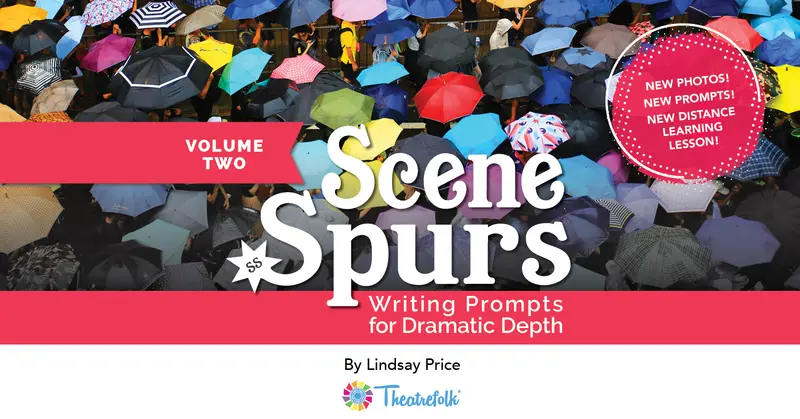
Scene Spurs: Writing Prompts for Dramatic Depth
The hardest part of writing for a novice is finding a place to start. The blank page intimidates as it stares back at you. A lack of inspiration is often blamed â Iâm not inspired. Thereâs nothing inspiring in my life. I donât have any inspiration. Writing is often linked to inspiration. Thatâs hard to compete with if you donât feel inspired. Arenât writers ethereal beings who are inspired seven times before breakfast?
It has become a wee mission of mine to dissuade beginning writers from this notion. And that thereâs nothing wrong with picking up a few tools so that having a place to start is never an issue. No one builds a house out of thin air, why think the same of writing?
To that end, we want to provide tools to the beginning writer. A place to start. A way to trigger the brain into action. To take inspiration out of the equation altogether and get words on the page.
Scene Spurs: Writing Prompts for Dramatic Depth is one of those tools. This new Theatrefolk resource will help any teacher get their students started in the writing process. It will get students writing.
As the title suggests, _ Scene Spurs _ is a collection of photo-based writing prompts â some wonderful, weird, interesting photographs. These pictures were specifically chosen to trigger the brain into action, to push writers to (at the very least) ask, âWhat on earth is happening in this photo?â
But wait â thereâs more!A starting place is occasionally not enough . If you throw someone off the cliff, sometimes they fly and sometimes they, well, they donât.
Each Scene Spur includes:
⢠Warm-up questions to prompt students to write without pressure.
⢠An automatic writing suggestion.
⢠Multiple monologue and scene topics. Choose one. Choose them all!
Learn more about Scene Spurs and read free sample pages here!
Playwriting
Inspiration File
I was teaching at a private school last week during their playwriting unit. One of their pre-writing exercises was to create an âInspiration Fileâ the point of which was to find, create, give opinions on different elements that may inspire a play. Poems, song lyrics, jump-starter writing exercises, personal credos, objects, and so on. Each student had to submit a booklet (folder, scrapbook) with 20 pieces of possible âinspirationâ for the plays they were starting to write. I was there when one class handed in their files, and they were fascinating to flip through.
If you are looking for a tangible way to have your students answer the question âWhere do Ideas come from?â this is a great exercise. Iâve included below some of the pieces this particular school included for their Inspiration Files and added some of my own as well. Try it with your class!
Song Lyrics: Select three specific song lyrics (as opposed to full songs) and describe what inspires you about them. What type of character would say these lyrics?
Poems: Select three poems and describe what inspires you about them. What type of play could come from the poem?
Articles/Speeches: Select three articles or speeches and describe what inspires you about these pieces.
Pictures: Select three pictures. Why did you choose them? What is happening in the pictures? What do the pictures inspire you to write about?
Headlines: Select three headlines. Why did you choose them? What story could you write about?
Jump Start Writing Exercises: These are writing exercises that were done in class to practice writing monologue and dialogue.
⢠Scar Monologue: Write a monologue from the perspective of someone who has a scar, or is looking at someone with a scar, or from the scar itself.
⢠Impression Monologue: Create two characters. Come up with a name, age, physical appearance, and relationship with the other character. Write two monologues, one for each character in which they reveal their impressions. What do they think when they see that other character? What is their impression? NOTE: This exercises was also used when the students started work on their particular plays to allow students to delve further into their particular characters.
⢠I have to talk to you right now: The scene takes place in an empty classroom. Two characters enter. âI have to talk to you right nowâ is the first line spoken by one of the characters. Write ten more lines of dialogue between the two characters. NOTE: This could also be a monologue.
⢠We are in big trouble: The scene takes place at the mall. Two characters enter. âWe are in big troubleâ is the first line spoken by one of the characters. Write ten more lines of dialogue between the two characters.
⢠Change: Write a monologue where a person has changed into something else (an animal, an inanimate object).
⢠Emotion: Pick an emotion. Write monologue where a character experiences that emotion.
Personal Credo: Write out a formal belief statement with the following as the first line: âI firmly believe thatâŚ..â
Focus Objects: Pick out five objects from you life (letters, pictures, pieces of clothing, trophies, post cards, jewelry) things that mean something to do. Describe why they are important to you.
Character Profile: Create a character. Come up with the following for that character: Name, Age, Physical Appearance, Family, Job, Fear, Secret, Primary personality trait, Secondary personality trait.
Memories: Write down your favourite memory, your least favourite memory and your oldest memory.
Emotions: Write down ten emotions. Which one is your favourite and why? Which one is your least favourite and why?
Sentence Starters: Pick five of these sentence starters and finish the thought.
⢠I have alwaysâŚ..
⢠I rememberâŚâŚ.
⢠It would be interesting ifâŚâŚ
⢠I have no problem withâŚ..
⢠I try not toâŚ..
⢠I have neverâŚ.
⢠I wantâŚ..
⢠I donât wantâŚ..
⢠I knowâŚ.
⢠I would like toâŚ..
⢠Why doesâŚâŚ
⢠I hateâŚâŚ
⢠I fearâŚ..
⢠I loveâŚ..
⢠I wishâŚ..
As you can see, the possibilities are endless! But a project like this can give students something to return and refer to when they say âI donât know what to write aboutâŚ.â
Directing
Shake Up Rehearsal Routine: Five Exercises to Take Your Production to the Next Level
Oftentimes, weâre flying by the seat of our pants in the theatre. On opening night, the show⌠isnât⌠quite⌠ready⌠yet⌠We need just one more week! Just one! Please!
But what if youâre Ăźber-prepared? The cast is off book, the blocking is solid, the set is fully built, and you still have a few days of rehearsal left? Or what if the show is already mounted and youâre just keeping things going between levels of a competition?
Peaking too soon is just as scary as peaking too late. The feeling of a show being âdoneâ before opening is very dangerous because the beauty of a live art like theatre is that itâs never complete. Thereâs always new territory to explore, new discoveries to be made.
Here are five easy techniques to use to keep the discoveries rollingâŚ
Role SwitchPut everyoneâs name into a hat and recast the show totally at random. Run scenes with the ânewâ cast. Donât worry about getting the blocking right, just do it for fun. This allows everyone to see the play from a completely different perspective, allowing the actors to step outside of their own roles and to be more sensitive to the other charactersâ wants, needs, objectives, journeys.
Isolation RunSpread everyone about the room and tell them to close their eyes (or turn out the lights). Do a line run of the show like this, with everyone in isolation. You can also coach the cast to whisper their lines, yell their lines, sing their lines, etc. Youâll really like the whisper part, itâs a great focus-builder.
Italian RunThis is a variation of a line run. Have the cast stand or sit in a big circle. Do a line run of the show as quickly as possible. No pauses, no drama, no emotion, just raw speed. Itâs my favourite thing to do in the late stages of rehearsal. Itâs a great team- and focus-builder and is a big help for actors struggling to pick up their cues.
Play BallAnother line run variation. Have the cast stand in a circle and do a line run. Whatever character is speaking holds a big rubber ball in his or her hands. At the end of their line, they toss the ball to the next speaker, and so on. Use the physical act of throwing the ball to mirror the emotional act of the line. If the character is angry, theyâll throw it with some intensity. If the character is loving, theyâll toss it gently. If the character is infirm or very young, maybe they roll the ball. If the character is teasing, maybe theyâll roll the ball just short of their scene partner.
Opposites AttractRun various scenes of the show playing the exact opposite of the intention of the scene. Play comedy for tears, drama for laughs, make suspenseful scenes obvious, make silly scenes dangerous. A world of discoveries comes out of an exercise like this. Every scene should be three-dimensional. Nothing in life is ever one note.


.png)