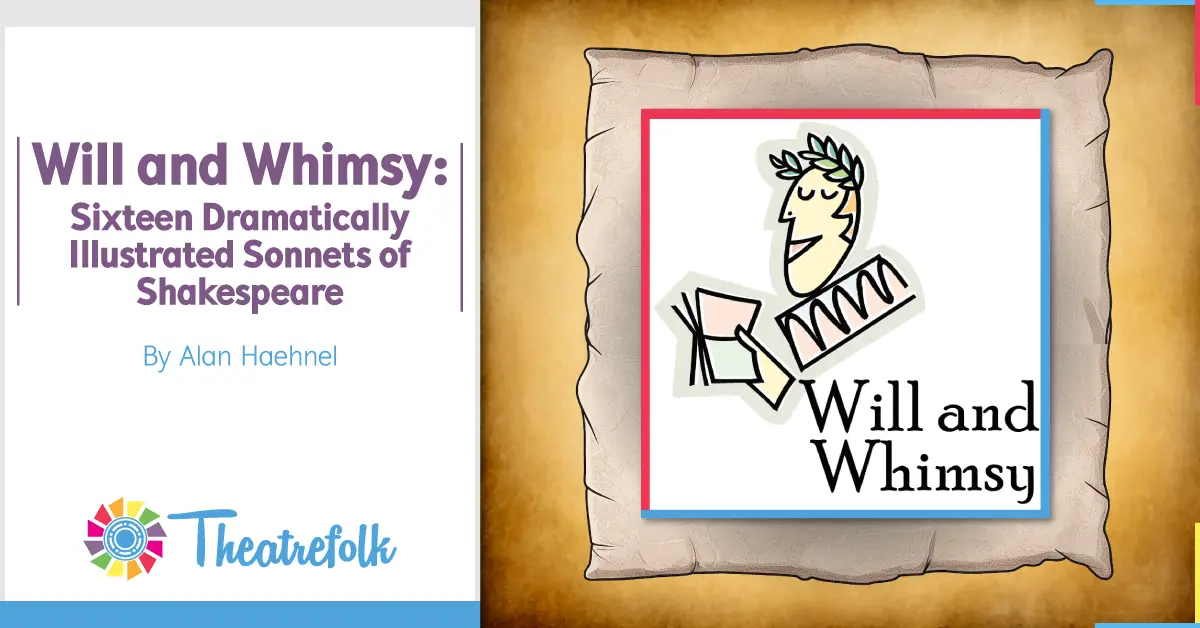
Welcome to our Featured Play Spotlight. Shakespeare's Sonnets come alive in Will and Whimsy: Sixteen Dramatically Illustrated Sonnets of Shakespeare by Alan Haehnel where modern scenes play hand in hand with the original text. Very flexible casting.
Shakespeare stands before you with a book of his 154 sonnets. Will you read them?
No way! Shakespeare isn’t meant to be just read. He’s meant to be performed, loved, fought for… lived.
If the language feels overwhelming, start with Will and Whimsy. Modern scenes meet the original text, and the sonnets come alive.
No bleeding required. Promise.
Why did we publish this play?
Shakespeare is meant to be performed and sometimes you need a doorway to get students to engage and connect. Will and Whimsy is just that door. The play looks at sixteen sonnets both in their original form and in modern scenes that illuminate what Shakespeare is trying to say. You get moments that are poignant, heartbreaking, comedic, and everything in-between. It’s perfect for competition because of its flexible casting, flexible length (you can cut and rearrange the sonnets as you choose) and easy staging. In short, we love how this play brings Shakespeare to life and how you'll be able to do the same.
Let's hear from the author!
1. Why did you write this play/collection?
I have long loved Shakespeare's sonnets, particularly for the way they use elegant language to describe timeless emotions and situations. I wanted to create a play that would help people appreciate the sonnets by pairing them with contemporary scenes.
2. Describe the theme in one or two sentences?
To quote another famous text: There is nothing new under the sun. (But, I would add, there are endless ways to describe those not-new things!).
3. What's the most important visual for you in this play/collection?
A juxtaposition of a classically-dressed Bard next to characters in contemporary costumes.
4. If you could give one piece of advice for those producing the play/collection - or studying it with their class - what would it be?
Make certain that the person or people playing the Bard really understand every word of the sonnet they are reciting. It should be delivered with intention, with a need to communicate an important concept. And sometimes, if the sonnet calls for it, with humor!
5. Why is this play/collection great for student performers?
Whenever students can have an opportunity to use poetic language as profound as Shakespeare's, it's a win. But when you can mix the poetic and classical with brief contemporary scenes featuring a lot of action and humor, then you really have a rich, multi-faceted theatrical opportunity!
6. Who is your favourite character in the play/collection?
I'd love to be the Bard.
7. What is your favourite line in the play/collection?
"If this be error, and upon me proved, I never writ, nor no man ever loved."