Show Notes
Episode Transcript
Welcome to TFP – The Theatrefolk Podcast – the place to be for Drama teachers, Drama students, and theatre educators everywhere.
I’m Lindsay Price, resident playwright for Theatrefolk.
Hello! I hope you’re well. Thanks for listening!
This is Episode 148.
You can find any links to this episode in the show notes at theatrefolk.com/episode148.
Okay. So, today, I am talking to Treanor Baring.
Treanor started out her career working in educational television for PBS and has hit a number of different writing forms along the way. I like this conversation and this is a great conversation about what makes different genres unique and what makes writing as good as it can be.
You know, it’s a really awesome thing to have a playwright in our catalogue who also has dipped their toe into a bunch of different formats. I think that it’s an amazing thing to be multifaceted as a writer and that’s why this conversation, I think we should get right into it, right?
Let’s get into it. Let’s go.
LINDSAY: Today, I get the pleasure of talking to Treanor Wooten Baring. Hello, Treanor!
TREANOR: Hi!
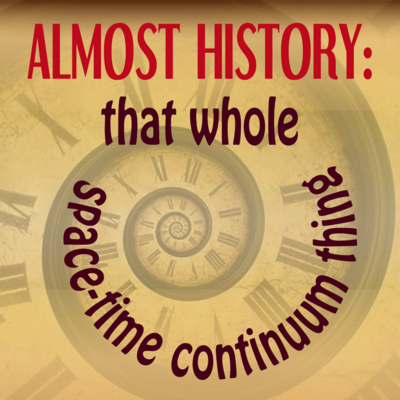
LINDSAY: Treanor is a new to Theatrefolk playwright this year. She wrote a play called Almost History: that whole space time continuum thing and it’s an awesome title because it tells you so much, right? It tells you that we know something – we know something about history is happening but we also know that it is a little perhaps left of centre, a little wonky – but we’re going to get into that.
First, hello! How are you?
TREANOR: I’m good! Hello to everybody!
LINDSAY: Awesome! That’s great!
So, Treanor, the first thing that I want to talk to you about is that you have a fabulous sort of multi-career background and a whole bunch of different parts of the arts and none of it is steeped in theatre. I’m fascinated. It’s so fascinating when we get these plays because we don’t know who the playwrights are and we’re only going on “will this play work for our audiences?” So, when I went back and looked at your bio again, I was like, “Oh, this is going to be fun stuff!” So, that’s my first question to you.
TREANOR: Okay
LINDSAY: Where is your background in theatre? Is there something in the distant past that sort of started you on that path?
TREANOR: Yes. Actually, in high school – well, a little bit before that – I think it was when I was about ten or eleven. I joined a local theatre company just as an actor and to get training in that in our area. I grew up in South Florida and we had great community theatres and they had classes for young people and they had plays that they put on that you could try out for and so I did that from about the age of ten on. That’s where I really found my love for plays and theatre and acting. I was in Summer Stock in Florida. I was actually the maid in Private Lives when I was fifteen – you know, tiny little part, but I got to work with professional actors and work around theatre. That was my youth background.
Then, I knew that I wanted to get into writing and directing somehow and I also am just a very visual person so I went to undergraduate school in broadcasting and film. I ended up graduating and going directly into working with PBS affiliate in my home state of Mississippi. There, I did educational programming. I started out working my way up the ladder from an assistant doing logging and that kind of thing to going and directing children’s programming and scriptwriting for them and script editing especially. Then, like you said, an eclectic career, I decided to go back and get my master’s degree in education so that I would know a little bit more about what I was doing with technology. This was before computers were really in everything and that was the new and cutting-edge field and this was something I wanted to learn more about – the educational theory behind all this. So, I went back and got my master’s degree in educational technologies.
And then, just on a personal note, I got married to someone who was moving to Germany. And so, I moved to Germany and that kind of interrupted the whole trajectory of working in television for a while there. That’s when I started finding a way to be in the arts and in others ways that involved raising a family and moving around with a science husband who got different positions in different places.
And so, that’s how I ended up writing on my own and also doing the other types of work that I do with poetry editing and poetry and that kind of thing.
LINDSAY: I think it’s such a good point to say, you know, having a career in the arts or having arts in your life, it does not necessarily have to be a narrow track, and I think a lot of students – and I think this is not necessarily for today’s students; I think this was always the way – it’s like, you know, if you’re going to be in theatre, well, it better be acting. Or, in TV, it has to be this one thing and that’s not necessarily the case.
TREANOR: No, it’s not, and the thing about careers in theatre or careers in television – and I’ve talked to young people about this when I go to talk about the play with the theatre director – the actors are the ones upfront. In television, we call them the “talent.” For every actor, there are about ten other positions that are creative and that have real input into the creation that ends up being that night that the curtain goes up or that program that gets broadcast or that film that gets projected. There’s so many people involved in the creation of that whose names aren’t the first ones that come up on the screen or in the program upfront, but those careers and that input is really a great way to have your creativity out there and to work in the arts and to have something that you’ve created and make a contribution to something creative.
LINDSAY: I love that. It’s not a statistic but it’s a piece of numbers – you know, like, for one talent, there’s ten other people who are also working to make this creative thing happen. I love that.
TREANOR: Yeah, at least! Because, in some films, it’s one to five hundred when you get into animation graphics and that kind of thing – you know, it takes that many more people.
LINDSAY: Let’s hover on your television stuff for just a bit because I know that people listening have students who have that star in their eye – “Oh, wouldn’t it be wonderful to work in television?” I’ll admit, I had a very tiny, tiny foray into writing for television and way back when enough for me to go, “Yeah, I don’t need to do that anymore.”
When you started into it, because this was your first career, you were the same age as a lot of our teenagers, what was your biggest misconception about what your career was going to be like?
TREANOR: Biggest misconception, I think the first thing that I realized was that you’re going to have to pay your dues. That is that, when you get into something like television, not everybody is going to fall down and say, “You’re the best writer we’ve ever had! Here, let’s put you as head of the entire writing group right now as a twenty-year-old,” which is I guess I was around twenty-one when I got my first professional job in television. And so, I paid my dues.
I realized, “Wow! Okay, I’m going to have to sit in a little, small room with a computer and a pen,” – nowadays, it would be a keyboard and an iPad – “and log all of this film that some other director went out there and shot and I’m going to have to write down. For documentaries, this is how I started – writing down, you know, “At 2:14, for 6 minutes, this medium shot of a ship,” and all that has to be logged in so that the editors can find it. That was a lot of tedious hours of doing that and everybody says that’s paying your dues, but you learn so much by doing that and I worked with people who were willing to mentor me as well and say, “Okay, you know, you look like you have an eye for this, let me show you what I know as well.”
I think that that mentorship is very important. I work now with a women’s organization and that’s for the arts and that’s one thing that we work on. As I get older, I want to mentor young people as well to bring them up because that’s how you learn – from people who have come before you.
LINDSAY: I think it’s the most fabulous way to learn. You know, it’s not a book. It’s not a test. It’s “I’ve done this. I did the failing. Here, let me pass something on to you to add to your toolkit.”
TREANOR: And to take what they say and think, “Okay.” You know, I had a degree in broadcasting and so I had done broadcasting in a university setting. We had done classes that were practicums where you actually made little TV shows and that kind of thing. Now, everybody can do that on an iPad – just hold it up and make a movie. So, people have a lot more experience now even. But getting into a setting where you’ve got someone who says, “Okay, this is great, let’s go with this. Let’s try this. Let’s go with where we can go with this,” and who believes in you and that you can learn from, too.
LINDSAY: What was it like and what’s very unique about scriptwriting in the television genre?
TREANOR: Scriptwriting for television, I think the biggest thing is that you’ve got to balance what’s happening on the screen with the dialogue with moving the plot along because, in a theatre setting, you can be a little more worried, you can be a little more talky, and you can have things happen that are explored in greater detail. When you work with television, you’ve got to get it out there, you’ve got to say what you need to say as quickly as possible, as short as possible. I just looked at the script – out of curiosity – for Twelve Years as a Slave and it’s amazing how short all the lines are and yet they conveyed so much information in those short lines.
Writing for television or writing for film, you’ve got that balance between what’s being said and then what is the visual that goes with it that can also convey information.
LINDSAY: It’s funny you say that. I’ve just started – I am way late to the party but I just started watching Mad Men. That’s one of the things I noticed. Yes, they do these juicy things that Don Draper gets to say, but there is also a lot of silence in terms of all you are doing is seeing someone react and that’s the inner monologue that we would write in theatre. In TV or movies, there shouldn’t be any words. We should just see the physicality of it.
TREANOR: And that visual communication is I think more important in television and film and the scriptwriter has a role in that. Those scripts do convey that. The director will take it and do things with it and set it up but the scriptwriter – a good scriptwriter – will have that all in there so that the director can take it. I’ve worked on both sides of that equation. I’ve worked with other people’s scripts and then I worked with directors using my scripts. You hone both sides of that talent, looking at it and saying, “Okay, I’ve got to get this so the director knows exactly what I’m trying to convey with this scene,” so that they can’t, in a way, misinterpret it and have it be something that you didn’t really mean by that. So, you want to write the directions and you want to write the visuals and the inner dialogue, the inner monologue of what’s going on with that actor so that the director and the actor really understands what’s happening there.
You might have a scene where the person reacts and the line might be, “Oh, really?” but the direction might be “looks skeptical” or “looks surprised” or “looks like ‘Oh, I didn’t understand that before.’” Those directions can tell you what the meanings behind those lines are. A good scriptwriter will include those. I’ve read a couple of scripts lately where they translate something like Jane Austen into script form and Emma Thompson’s is like one of the greatest and she actually takes Jane Austen’s writing and puts it in that direction so that actors can understand, “Oh, that’s what’s meant by this!”
LINDSAY: It’s fascinating just why books and movies are not the same thing. I think what you’ve just said, in a nutshell, is that you need to take the words and make it a visual a director can follow.
TREANOR: And something that the director can then say, “Okay, that,” because the director is going to be work with the actors and the actors are going to interpret the character and the motivations. The more the scriptwriter gives good guidance on that, the more that the scriptwriter will be satisfied with the production.
When I was first starting out, I would write things that I thought were clear but they really weren’t. And so, I learned, if I want this to be obvious, I have to say it, and that’s not to say that you write rambling directions that are so elaborate that the director goes, “Aaaah! Whatever!” You write something that’s clear and that conveys the emotional content as well because that’s the other thing about writing for television – and I think this is true for theatre as well – that you want the emotional motivation to be true.
LINDSAY: Well, that’s what we’re connecting to, isn’t it? That’s what an audience wants. They want to have an emotional reaction and it doesn’t matter if the person onstage or the person onscreen is going through something that they’ve never been through. If there’s an emotion attached, the person in the audience can go, “Oh, okay! Sadness or anger or frustration, I get that.”
TREANOR: And how that emotional content gets conveyed is the scriptwriter’s first task. And then, there is a letting go that happens – that you trust your actors to bring it to another level as well.
LINDSAY: Absolutely.
Okay. So, you’ve written scripts for TV and, also, for the stage which we’re going to get into – Almost History: that whole space time continuum thing – and poetry as well. What’s your favorite type of writing?
TREANOR: Oh, whatever happens… wherever the inspiration is!
LINDSAY: Whatever is happening right now.
TREANOR: It’s an interesting thing. I’ve been working on the same novel. I’m writing this novel. I’ve got about twenty in my head at any given time and I’ve been working on this same novel for about six years. When I wrote the play, I wrote it in a day and a half.
LINDSAY: Ah!
TREANOR: I wrote it one weekend. So, you know, whatever comes easily, I think. after I wrote this play, the Almost History play, I thought, “Okay, I probably should go back to playwriting because this was a whole bunch easier than the other things I’ve tried. Poetry is always really nice because poetry is another case, like scriptwriting, where you’re taking something that might be disparate and out there and cloudy and distilling it down into that perfect teardrop of meaning. That’s when you get to find the perfect word for the situation and to put it into a form that is basically short which doesn’t mean it’s easier because, in a lot of ways, it’s even more difficult to get it really distilled down into something understandable.
So, I don’t know… I don’t have a favorite. Like I said, I like wherever inspiration takes me and, in spite of the craft of it, I think that it’s really important in writing to love what you’re doing. I’m always a little bit in love with whatever my current project is. It’s kind of like a new boyfriend and you get to play out that feeling of being in love and, “Wow! I’ve got this idea!” type, type, type, type, type, and then you get to go back and look at the craft of it and hone it and be a little more deliberate about the craft of it.
LINDSAY: I think that’s a great way to put it – that’s a good difference between a first draft and a second draft, isn’t it? You know, the first draft is just, you know, love on the page. And then, the second draft is craft on the page and sort of think about the why.
TREANOR: People work differently. I tend to be more talkative, obviously, so I tend to be longer winded when I’m writing and then I have to go back and cut things out instead of adding. Some people get the skeleton down and then they have to flesh it out. I tend to get a big fat person that I have to put on a diet.
LINDSAY: I’m the same way. Actually, I have a great relationship with a teacher who I give my stuff to and she’ll read a monologue and go, “XYZ,” and I’ll go, “Okay.” To sort of take that monologue and really start to distill it and cut it down and then write the one sentence that actually the whole monologue was trying to say, that’s like cheesecake for the rest of the day. If I can get something down into one sentence, that is my favorite thing as a writer.
TREANOR: That’s an interesting point because, I think, if you looked at it… People say, you know, this novel I’m writing, they say, “What is it about?” For a long time, I couldn’t really say what it was about. Well, that’s a big warning sign if you can’t write the blurb for it, then maybe you need to think about, “Well, what is the blurb? What are you really trying to convey? What are you trying to write about?” because that’s the question people will say. “What is it about?” It could be, you know, “Wuthering Heights, what is that about?” You can come up with that or what the novels today or the plays that you read or Mad Men, what is that about? It’s about this Don Draper guy. You can find what it’s about.
LINDSAY: And you should be able to take your work and distill it into one sentence. I think that’s a great exercise for the classroom, too. I find students, that’s the one thing that they miss. “Okay, I have these characters, I’m going to make them funny and we’re going to go and we’re going to be in Germany in this scene and then we’re going to be on the beach in this scene,” but then, what you ask them what it’s about, they don’t have a conflict and they don’t have a thesis, essentially. Once you do, things become much clearer because everything has to support the thesis which – I know – it’s very…
TREANOR: Teacher-y!
LINDSAY: Teacher-y – yeah, that’s it exactly, except that’s true.
TREANOR: It is true. When somebody asks you what it’s about and you have to really think, “Well, what is it about?” then it really makes you think – you know, even with just my left brain, right brain, you know, can they communicate with each other what it’s about? Can I say for sure that this is where I want to go with it and what do I need to load in there? I know, when you say everything has to support the thesis, there’s a lot of room for things to support the thesis if your thesis is really the essence of it. If you’ve written a thesis that maybe doesn’t really encompass it, then you might have trouble. Like, if your thesis is too narrow or your idea is too narrow, then you might have trouble getting everything to fit that.
LINDSAY: Yeah, and a great example I think – just because that’s what’s on my brain right now – as I think about Mad Men, I think about the thesis being the perfect world of ads versus the messy real world, right?
TREANOR: Yeah.
LINDSAY: That’s my interpretation but I just think there’s so much. Just as you say, there’s so much that you can explore with that – with the characters and with storylines and all that other stuff.
TREANOR: And it doesn’t have to get old. You know, those things can have a lot of fresh takes on them.
LINDSAY: Absolutely. So, scriptwriter, novelist now, and poet.
TREANOR: Unfinished!
LINDSAY: Hey, man, if it’s on the page somewhere, write down “novelist.”
So, Almost History: that whole space time continuum thing – where did this come from?
TREANOR: Yeah, I was up in Virginia. I live in Houston and we’d gone up to DC and, you know, had a big trip around and we went to Monticello and there was Jefferson’s study and there was his grave and there was a lot of talk about he and John Adams fought – had real arguments, had real theoretical and political arguments over their lifetime – and then the story goes, the American myth is that they died on the same day. I think on July 4th which I think is an amazing fact. And so, I got to kind of thinking about how the image of the founding fathers as squabbling children – even though they were adults – that they were squabbling with each other and how funny it would be to have a scene with that.
To just give a little background about the play, it goes through American history and it’s got a time travel element and it’s got a messing up the whole space time continuum thing element but it has scenes throughout American history so we have seminal moments in American history and that was the first scene that I wrote – the scene about the founding fathers. I just thought in my mind, it came to me that we have these squabbling founding fathers and we have someone from today who is trying to learn history and is watching this who is all confused about all this history because they’re really not learning history all that accurately. They’re just Googling it and finding little fun facts here and there. And then, what if they messed up that history? Like, that scene is they knock over the ink and ruin the Declaration of Independence and it kind of throws a spanner in the works of everything. And so, that’s where that came from and I just love time travel stuff. I think middle school kids love time travel. All their books are all into that. And so, the idea of somebody modern going back in time and doing that messing something up just seems like a great way to key into what middle schoolers like and are interested in. Plus, I just thought it was funny – the ideas. You know, some of the funny things came to me and I have a quirky sense of humor and I guess I’m laughing at my own jokes while I was writing it.
LINDSAY: Well, it’s a great look at when we talk about this whole notion of what is cross-curricular for our listeners. That’s their thing particularly in the drama classroom about what they sometimes have to do – link what they do into other classes. To take moments from history and make those people human and not statistics or dates on a page I think is a really effective way of exploring history and why not make them funny and why not make Einstein and Marie Curie have a sense of humor?
TREANOR: Well, they did! In real life, they did! You know, I don’t think it’s too irreverent the play. I was hoping that it wasn’t too irreverent toward American history and toward our most cherished figures in American history but it is this idea that these reporters go back and just really get things wrong and mess things up. That would just have a lot of goofy possibilities but it also had a lot of possibilities of bringing those characters to life and have those characters up there where they were really interacting with the characters too and where it wasn’t so heavy-handed a curriculum. But I had people come up to me after and say, “Wow! I really learned a lot from that! I didn’t know all these things.”
The last line of the play is, “Well, if you learned something, we apologize!”
LINDSAY: Well, it’s the best way to learn – when you’re enjoying something and it becomes part of your knowledge.
TREANOR: And to see it come to life too in a way. Also, one of the things that comes out in the play was that everything that happened in these timelines of American history affects who we are now. There’s a scene with the Declaration of Independence and, if that doesn’t happen the way it’s supposed to, we’re in a different country now and the different scenes are there’s the founding fathers. There’s Columbus, for instance. It starts out with Columbus’ ships and acknowledges the controversy about Columbus and who he was and acknowledges that there are different viewpoints. That’s the other thing I wanted to point out, too – that history is not a static – just words on a page, there it is and that’s it and this is what you have to learn. There are different ways of looking. People have different ways of looking at the same historical events. Columbus is a hero to a lot of people but he’s also an invader to others. Acknowledging that and saying, you know, it doesn’t get too heavy-handed into that – believe me, it doesn’t go deep. It is middle school.
LINDSAY: Okay. So, I was going to ask you the question of what the thesis of your play was since, you know, we’re talking about how do we describe our writing in one sentence, but then you beat me to it! I really like that history is not static as a thesis for this play. I was going to go with the past is connected to the present.
TREANOR: Yeah, that’s true. I guess, also, when I had it in mind, it was that it’s important to learn history because we need to figure out where we are now by where we’ve been, too. History is important to learn; otherwise, you can mess up that whole space-time continuum thing.
LINDSAY: Absolutely, and that’s the thing that I think a lot of students – and, again, I think people say this about today’s students but, quite frankly, I think we were all guilty of this – that, when we’re that age, we live in the now, right? With little blinders on and we don’t have a concept of where we’ve come from.
TREANOR: Yeah, and there’s something, I was reading about this the other day – the bias of the now which makes people think this is the best tennis player in the entire history of the world just because they’re winning now and you look back and that’s what they thought about some tennis player in the 1920s, too. There is that and I think that there is also this idea that history is Snoozeville and it’s not; it’s really fun and there are a lot of good characters in it and there are also a lot of interesting ways of analyzing it and looking at it and thinking about, “What if this had happened a different way? Where would we be now?” We’d be in a different place. The Space Race, what if that had gone a different way? I can really do this bad intentionally in the play. I was writing a nice, funny play – hopefully funny – but, you know, that’s all in there, too.
LINDSAY: Well, it’s true because history has become a litany of this happened in 1773 and this happened in 1863, we don’t think about these individuals in history as people and that, hey, guess what, some of them probably swore a lot and some of them probably smoked and some of them liked eating ice cream for breakfast is the only thing that comes to mind even if they didn’t have ice cream but it’s all these things that we do. Any time that we can take folks from history and just, again, it’s all about emotion and humanity – whether it’s for a laugh or for a nod, I think it’s valuable.
TREANOR: And it’s worth knowing. It’s worth knowing who Jefferson was. I mean, it started with Jefferson but there are a lot of other characters that come up in the course of things – a lot of real heroes. Alexander Graham Bell was a real hero. I mean, he really worked on this and really got us the technology that we have today. And so, it’s worth going back and seeing, you know, Marie Curie and Einstein. You know, these are people that contributed but that doesn’t mean that they are not human and that they don’t have their foibles.
LINDSAY: As we wrap up, I think that that’s what we’re sort of landing on here today – that history is about humanity and writing is about humanity. If we can find that, whether you’re going to write it in a script or you’re going to write it in a poem or you’re going to write it in a play about Ben Franklin and Alexander Graham Bell, I say that’s a good thing!
TREANOR: And go with your gut feeling on it. If you’re a writer or if you’re a director, go with how it makes you feel, too.
LINDSAY: Love it! All right. Treanor, it’s been a delight talking to you. It’s been lovely and let’s everyone remember that play name – Almost History: that whole space time continuum thing – where a reporter and a sidekick sort of livestream great moments from American history with some mishap – some mishaps along the way.
Thank you very much!
TREANOR: Thank you!
LINDSAY: Thank you, Treanor!
Okay. Before we go, let’s do some THEATREFOLK NEWS.
It’s a play feature! It’s a play feature! It’s time to feature a play and it is Treanor Baring’s Almost History: the whole space time continuum thing…
So, we’ve got time travel, we have middle school, we have history. Yes, one of these things seems not like the other but keep on, dear listener. Please, keep on.
History is not static, right? People have so many different ways of looking at historical events and how the past is connected to the present and that’s sort of the underlying theme in this play. In a hilarious series of time traveling misadventures, a Reporter and a Sidekick livestream from great moments in American history. Despite the über-scientist Sidekick’s best efforts to keep the clueless Reporter out of trouble and they change the course of history and return to a chaotic but comedic present. Even Einstein and Marie Curie cannot undo the disastrous effects of their mishaps. Eventually, they are able to save democracy and technology by restoring order to – you guessed it – that “whole space-time continuum thing.”
Want to make history human? Do you want an awesome cross-curricular experience for your students? Do you want to see Marie Curie with a sense of humor? Almost History: the whole space time continuum thing by Treanor Baring.
You can check out this play at theatrefolk.com. You can also find the link in the show notes – theatrefolk.com/148.
And that’s where we’re going to end. Take care, my friends. Take care.
Music credit:”Ave” by Alex (feat. Morusque) is licensed under a Creative Commons license.