National Core Arts Standards
Interpret intent and meaning in artistic work - Grade HS Advanced
6 units • 2 professional development courses aligned to TH:Re8.1.HSIII.a - Use detailed supporting evidence and appropriate criteria to revise personal work and interpret the work of others when participating in or observing a drama/ theatre work.
TH:Re8.1.HSIII.a Use detailed supporting evidence and appropriate criteria to revise personal work and interpret the work of others when participating in or observing a drama/ theatre work.
This page lists 6 units and 2 professional development courses aligned to TH:Re8.1.HSIII.a from the National Core Arts Standards. Designed for drama teachers, these resources directly address TH:Re8.1.HSIII.a - Use detailed supporting evidence and appropriate criteria to revise personal work and interpret the work of others when participating in or observing a drama/ theatre work.
In this unit, students learn how to write their own scripts using correct formatting. These scripts will be more detailed than the contentless scenes. Students will learn how to write dialogue that provide information about relationships, conflicting objectives, and setting.
They’ll also learn how to correctly add expression and movement directions into the script itself. The unit will end with a partner script writing assignment which is performed in front of the class.
In this unit, students will be introduced to the musical theatre form by asking and answering the question “What is a musical?” They will learn and demonstrate knowledge of musical theatre vocabulary terms. They will be introduced to two foundational songs in the musical form: the “I want” song and the “I am” song and analyze an example of each song. They will also start to think about their own voices and reflect on their skill set and confidence level with regard to singing in front of others. Students will learn the musical theatre warm-up that will be used throughout the curriculum. This set of exercises will help students prepare to perform through a physical and voice warm-up. Finally, students will watch, discuss and analyze one or two musicals (depending on your time and access to materials).
In this unit, students will incorporate character development into their musical theatre preparation. Students will explore internal and external tools that they can use to express emotion in their singing. Students will then take everything they have learned and apply it to a song which they will then perform (solo or in groups).
In this unit, students will combine knowledge of the previous two units: singing and movement. Students will review singing technique and terminology and work on a song together. They will build on their vocabulary of simple dance moves. Then, students will work in groups to learn and rehearse a section of a musical theatre song by choreographing movement that expresses the song’s meaning and characters, presenting their work to the class, and working on curriculum goals of risk taking, endurance, confidence, commitment, character, and emotion.
In this unit, students will look at the real world of musical theatre. They will learn about roles that keep professional musical theatre shows running (such as swings and understudies). They will reflect on advice from musical theatre professionals on how to make it to Broadway, and for a culminating project, they will research and present on the career of a musical theatre performer.
Students will show what they have learned throughout the curriculum by writing and performing a musical. They will add modern songs to a traditional fairy tale story. In this way, students do not have to create their story from scratch—the structure and characters are already in place.
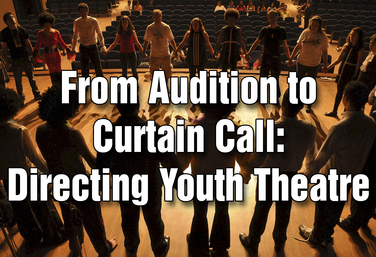
Directing youth theatre can be one of the most thrilling, rewarding, and exhausting jobs there is – because it’s not just about staging a play. It’s about creating an environment that fosters hard work, dedication, trust, and the willingness to take chances, to “play without fear.”
As a writer/teacher/director of youth theatre for over 15 years, I have developed tools and strategies that enable my students and me to focus on the process of creating theatre while fostering an environment that leads to creative freedom and a cohesive groups that doesn't act as individual “stars,” but as a community of one.
In this course, I will share with you these tips and strategies, along with the ways to implement them in your theatre environment.
Holly Beardsley is a do-it-all director. She started directing middle and high school students in her early college years and since then has written over ten shows and directed twice as many.
Do-it-all directors are responsible for everything it seems – the direction, the costuming, the choreography and of course, the set too. And though directors are ready to direct, to costume and even dance, there is something intimidating about designing and building a set.
The Do-it-All Director’s Introduction to Set Design will give you the director, who must do-it-all, the confidence and skills to not only direct but build your own set as well - no matter your experience or budget. This course will teach you set design basics, construction tips, budget tricks, and how to tackle your precious performance space armed with a hammer, and most importantly, without fear.
Our parent company Theatrefolk offers a fantastic selection of plays written specifically for high school and middle school students.
Whether for performances or class study, there's something for everyone: relevant & relatable themes, simple sets & costumes, flexible casting options and much more - a perfect addition to any drama program!
Please note:
Plays are offered separately from your membership and can be purchased through Theatrefolk.