
Facebook Pixel Skip to main content

Georgia Performance Standards - Theatre Arts
Grades 9-12 - ACTING LEVELS I-IV - Responding

40 units • 9 professional development courses aligned to
TAHSA.RE.1 - Engage actively and appropriately as an audience member.
a. Examine and reflect on the relationship between actor and live audience in historical and contemporary performances.
View all Standards for Georgia Performance Standards - Theatre Arts

TAHSA.RE.1 Engage actively and appropriately as an audience member.
a. Examine and reflect on the relationship between actor and live audience in historical and contemporary performances.

This page lists 40 units and 9 professional development courses aligned to TAHSA.RE.1 from the Georgia Performance Standards - Theatre Arts . Designed for drama teachers, these resources directly address TAHSA.RE.1 - Engage actively and appropriately as an audience member.
a. Examine and reflect on the relationship between actor and live audience in historical and contemporary performances.

Creating the Ensemble-Based Classroom

by Gai Jones
5 modules 2 hours, 12 minutes 4 Credit Hours
Gai Jones will help you establish an ensemble-based environment from the first day of class or rehearsal. Learn how to set up your ensemble-based classroom from day one, get students to set classroom norms, and find the balance between creative activity and structure. You’ll learn how to give your students creative freedom through structure and classroom management. The cornerstone of this course are the detailed ensemble experiences from large group to small group and even individual experiences. This course culminates in a devising model that you can use with your students, and takes you through process, product, performance and an evaluation. You too can create the ensemble-based classroom.

Teaching Theatre with Divergent Students and Class Sizes in Mind

by Steven Stack
5 modules 1 hours, 41 minutes 3 Credit Hours
Have you ever wondered how in the world you can have a successful theatre classroom with so many variables that you have absolutely no control over? The two biggest ones being the size of your class and the students that you’re in charge of turning into some truly talented theatre geeks. This course by Steven Stack explores that wonderful and often ridiculous world of theatre classrooms while giving you the tools for you and your students to not only succeed but to flourish as well. Lessons will include how to make any size class the Goldilocks class as in "just right", defining and working with all types of students you may encounter in your classroom, the seven must-haves of any theatre class, and the importance of structure in the theatre classroom by providing a guideline for setting up your day-to-day class time. The course also provides tons of ideas, games and activities that you can use instantly in your classroom. So, if you’re a first-time theatre teacher or one just looking for new ideas, this is the course for you.

Close Reading in the Drama Classroom

by Lindsay Price
11 modules 3 hours, 38 minutes 7 Credit Hours
Close reading is an activity that puts curriculum standards into practice and it can be easily applied to the drama classroom. Close reading asks a lot of your students. They have to read and think at the same time. This course teaches drama teachers how the close reading process works, and gives them exercises and tools to apply it in the classroom.

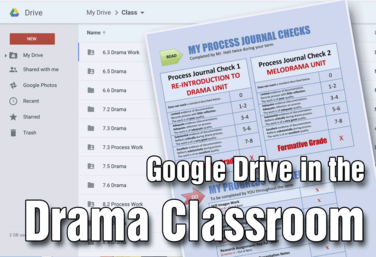
Google Drive in the Drama Classroom

by Josh Hatt
10 modules 1 hours, 21 minutes 3 Credit Hours
Instructor Joshua Hatt has taught drama students all over the world. He is passionate about the power of drama to connect people and the importance of reflection and journaling to build creative, critical thinkers. He started using Google Drive as a response to the frustration of having his students lose curriculum booklets time and time again. His work developed into a powerful online home whereby students and teachers can communicate, contribute, collaborate, edit, and house all their documents online. In this course, Josh will show you how to use Google Drive and Slides in your drama classroom. He's included step-by-step guided instruction, as well as activities to help you solidify your knowledge. Your drama classroom will be forever transformed!

Play Adaptation Project

by Lindsay Price
6 modules 44 minutes 2 Credit Hours
Adaptation is a fabulous classroom project: it requires students to analyze, adapt, modify, plan synthesize, devise. All the higher order thinking skills. But you can’t just throw a narrator into a script and call it a day. You have to have a preparation process leading up to the writing process. In this course you will learn practical exercises and a path to prepare your students to take on their own adaptation project. We’ll look at the guidelines to adaptation, things to think about when choosing a text, how to analyze the source material and writing that first draft. So join me, Lindsay Price, in the Play Adaptation Project.

How to Give Feedback to Student Playwrights

by Nicholas Pappas

6 modules 1 hours, 23 minutes 3 Credit Hours
The two big questions we’re going to answer in this course are: What is feedback? And, What is useful feedback? Now, if you asked a hundred people to answer these two questions, you’ll likely get a hundred different answers, but at its core, all the answers will focus on giving notes that will improve the work, which, in this case, is our student’s plays. And, as a teacher, that’s what your hope is, right? To help your students improve as writers, one work at a time. We want our students to write, and to grow through their writing. If we want our students to get better, we need to get better. Understanding the definition of feedback, and understanding how to provide useful feedback is the key to all of us getting better. Join Nick Pappas in this course designed to give you the tools to help your student writers find their voice.

Playwriting Outside the Lines

by Steven Stack
6 modules 1 hours, 34 minutes 3 Credit Hours
Instructor Steven Stack leads this course in a unique way to teach playwriting. He will show you how to set foundations and guide posts for your students, and then give them freedom to play. The intent is to help students develop their own voice and create for creating sake. The 5 modules lead teachers through how to use this style of teaching playwriting, and includes handouts and resources to support the learning.

Screenplays 101 - Part 1: Basic Structure

by Nicholas Pappas
8 modules 1 hours, 22 minutes 3 Credit Hours
Screenwriter Nick Pappas leads a two-part course on screenplays 101. Great scriptwriting is not something that can be covered in a single course: so we're going to start with the basics. Those basics are going to be split up into a Part 1 and a Part 2. Part 1, this course, will concentrate on basic film structure. Part 2 will concentrate on screenplay formatting. By the end of this course, students should have a basic understanding of history, terminology, and are able to identify the barest bones of the three-act structure, all with an eye toward developing their own screenplay.

21st Century Skills Through Devising

by Allison Williams

12 modules 1 hours, 18 minutes 4 Credit Hours
Allison Williams leads the course: 21st Century Skills Through Devising. This course covers what devising is, why to do it, how to do it, and how your students can master the 21st Century Skills of collaborations and cooperation, critical thinking, creative thinking through devising. High school is a great place to try devising with your students. But it’s not something you want to throw at your students without any preparation. Framework is important and this course takes you through a number of exercises you can take into the classroom tomorrow to help build a place of physical safety, a place where students work at making a lot of choices instead of waiting for the perfect choice, and a place where students feel comfortable making creative choices. The material also reviews the process of putting together a show from the idea/research stage to editing, to giving feedback. Your students have what it takes to create their own material, collaborate with each other, and have a unique theatrical experience!

View all Standards for Georgia Performance Standards - Theatre Arts    Standards Master List
