Facebook Pixel Skip to main content

📣SCRIPT SALE! Treat yourself to an easier Fall. Save 30% on 5+ perusal scripts with code SPRING30 before May 3 and head into summer stress-free.

Hamlet

Hamlet

cutting and notes by Lindsay Price from the original by Shakespeare

Undeniably the most famous play in the English language. The ghost of Hamlet's father orders Hamlet to avenge his murder. Hamlet's inaction leads to madness and tragedy. The play's the thing.

Drama Character Study Classical Adaptation Shakespeare Shakespeare in an Hour

Recommended for High Schools and Middle Schools

Running Time
About 60 minutes
Approximate; excludes intermissions and scene changes
Cast
24 Characters
15 M | 9 F, Doubling Possible
Set
Simple Set
Length
47 pages
Free Excerpt

What to order?

Not sure what you need to order? Check out our pricing and ordering guide.

Performance Royalty Fees

Royalty fees apply to all performances whether or not admission is charged. Any performance in front of an audience (e.g. an invited dress rehearsal) is considered a performance for royalty purposes.

Exemption details for scenes and monologues for competition.

24 Characters
15 M, 9 F, Doubling Possible

Characters in this play are currently identified as male or female. Directors are welcome to assign any gender (binary or non-binary) to any character and modify pronouns accordingly.

Francisco [M] 6 lines
A Solider
Bernardo [M] 8 lines
A Solider
Marcellus [M] 13 lines
A Solider (officer)
Hamlet [M] 131 lines
Prince of Denmark, nephew to Claudius. Several Monologues.
Claudius [M] 40 lines
King of Denmark
Gertrude [F] 29 lines
Queen of Denmark, Hamlet's mother
Ghost [M] 7 lines
Hamlet Senior, the ghost of Hamlet's father
Polonius [M] 17 lines
Chief advisor to the King
Ophelia [F] 21 lines
Daughter to Polonius
Laertes [M] 29 lines
Son to Polonius
Horatio [M] 4 lines
Friend to Hamlet
Rosencrantz [M] 11 lines
Childhood friend of Hamlet
Guildenstern [F] 14 lines
Childhood friend of Hamlet
Osric [M] 8 lines
Member of the court

Players (Five players for the dumb show):
King (M), Queen (W), Poisoner (M), and two followers/dancers (W)
A Priest [M]
First Gravedigger [M]
Second Gravedigger [F]
A Messenger [F]
A Gentlewoman [F]
Lords and Ladies to fill out the court scenes.

More Plays Like Hamlet

Romeo and Juliet (One Hour)

cutting and notes by Lindsay Price from the original by Shakespeare

A one act annotated version of Shakespeare's tragic tale of star-crossed lovers.

Twelfth Night, or What You Will

cutting and notes by John Minigan from the original by Shakespeare

A one act annotated version of Shakespeare's comedy filled with unrequited love, disguises, and a shipwreck.

As You Like It

cutting and notes by John Minigan from the original by Shakespeare

A one act annotated version of Shakespeare's love filled comedy.

A Midsummer Night's Dream

cutting and notes by Lindsay Price from the original by Shakespeare

A one act annotated version of Shakespeare's magical tale of mischievous fairies, and love potions.

The Comedy of Errors

cutting and notes by John Minigan from the original by Shakespeare

A one act annotated version of Shakespeare's comedy about mistaken identity.

Much Ado About Nothing

cutting and notes by John Minigan from the original by Shakespeare

This one act annotated version of Shakespeare's comedy brims with wordplay, romance, and deceit.

From the Drama Teacher Learning Centre

A Picture-Perfect Production: Hamlet
Production

A Picture-Perfect Production: Hamlet

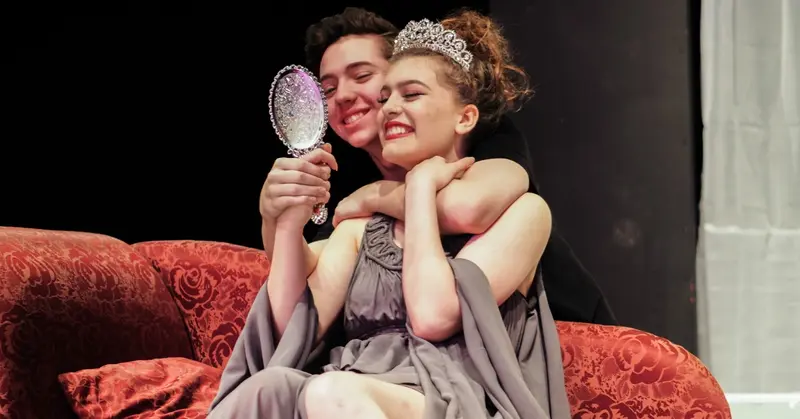
To be or not to be is the infamous question. However, there is no question that Lindsay Price’s annotated version of Hamlet is a great way for students to experience Shakespeare’s tragic tale. This one-act version of what is undeniably the most famous play in the English language focuses on the themes of murder, ghosts and revenge. The ghost of Hamlet’s father orders Hamlet to avenge his murder. Hamlet’s inaction leads to madness and tragedy. The play’s the thing. Under the direction of Zachary Roberts , the student performers at Southeast Raleigh Magnet High School in Raleigh, NC put their own twist on the tragic tale. We think the results are picture perfect! “Thank you so much for the great adaptation of Hamlet. I truly try to challenge my students with a wide range of plays and musicals, and your adaptation really served my students well. I love being a part of the DTA family. The resources and community are so helpful.”
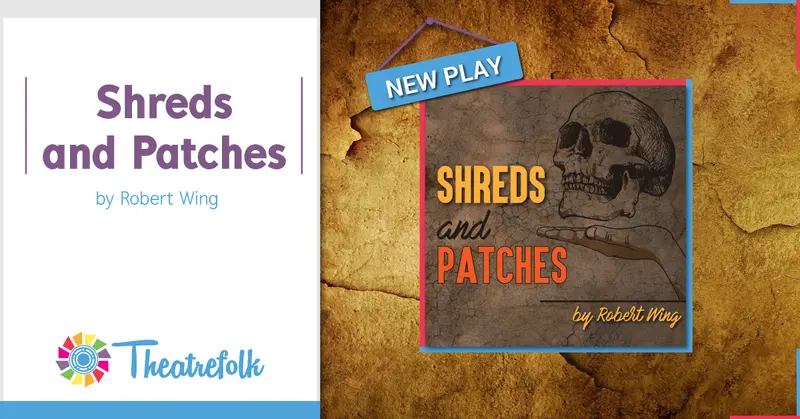
Theatrefolk Featured Play: Shreds and Patches by Robert Wing
Featured Plays

Theatrefolk Featured Play: Shreds and Patches by Robert Wing

Welcome to our Featured Play Spotlight. Shreds and Patches by Robert Wing is a re-imagining of Shakespeare’s Hamlet. The location is a “wellness facility” for disturbed teens. Dane, our anti-hero, confronts his bullying step-father and self-centered mother with the help of his fellow patients and Dr. Osric. Will Dane be able to get through to his mother about “the king of shreds and patches” or will he be left in the dark? The play fuses Shakespearean speech with modern dialogue, reinforcing the notion that the teens and adults speak different languages. An excellent easy-to-stage competition piece! Why did we publish this play? Shreds and Patches is a great addition to the Theatrefolk catalogue and we’re thrilled to have it on board. The play puts the story of Hamlet into a modern context while still using the original language. It’s a perfect example of how one can take the parts of a text and synthesize new meaning. And let’s not forget the awesome character challenge. I love seeing Shakespeare in a new light and this play shines the brightest bulb you can get. Let’s hear from the author! 1. Why did you write this play? I have the best job in the world. I am paid to introduce young minds to some of the greatest works of literature, Hamlet being one of them. (Though Hamlet is not my favorite Shakespeare play – The Tempest is. ) It’s my job to make Shakespeare come alive; I’ve got to really sell it to my everyday audience, my students, and I think I’m pretty good at it. Why? Because I don’t “dumb it down.” I “sherpa” my students through the challenging syntax and thematic acrobatics, but never strip away the glorious complexity of the language. Many instructional practices and teaching guides do this, but not “Shreds.” It puts Hamlet in a modern context without gutting the complexity (and beauty) of the language. Yes, I take enormous liberties with who says what and in which order, but it’s still “Hamlet.” There’s enough of the original script there to give students – and audiences – a taste of Shakespeare’s incandescence. That’s why I wrote this play; I never want Shakespeare to fade away. “Shreds” is a gateway to deeper exploration and deeper appreciation of Shakespeare for my both students and audiences. The way I see it, “Shreds” is a my little attempt to keep Shakespeare alive in the classroom and on the high school stage. 2. Describe the theme in one or two sentences. Shreds and Patches explores the traditional themes of Hamlet (inaction, madness, etc.) but its thematic bullseye is one that high school students really, really take to heart: parents can do enormous damage to their children. 3. What’s the most important visual for you in this play? I love the final scene where the kids rush in to embrace Dr. Osric. Osric has stood up for them, risked everything for them, and the kids are deeply, deeply appreciative. The good doctor has restored their faith in adults and in themselves, and left them with the one thing none of them had at the beginning of the play – hope. 4. If you could give one piece of advice for those producing the play, what would it be? In Shakespeare’s own words: “Be bloody bold and resolute.” (Of course, that’s from Macbeth, but it’ll do.) 5. Why is this play great for student performers? Decades as a social worker and a public educator have taught me that the quality of a child’s life is entirely dependent upon the adults in that child’s life. Period. Parents and teachers are instrumental in developing a young person’s sense of worth. The characters is “Shreds” have nothing. They are unloved and unwanted. In popular parlance, the are “broken.” Broken children sit in high school classrooms, drama classes, and in audiences in high schools, well, everywhere. “Shreds” was written for them. Students actors are acting out their own story. I wrote “Shreds” to give them hope, hope that comes from knowing that they are not alone, that they are powerful, and that there are adults who give a damn – like me.
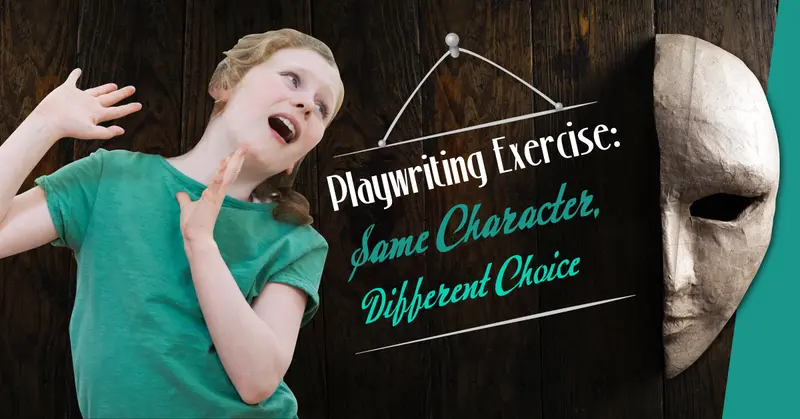
Same Character, Different Choice
Classroom Exercise

Same Character, Different Choice

Are your students feeling stuck or frustrated with their playwriting assignments? This exercise will help get them unstuck by challenging them to explore alternative situations for their scenes and characters. You can do this exercise in three different ways: • Students changing a scene written by themselves, OR • Students pairing up, trading scenes, and changing a scene written by their partner, OR • By adapting a scene from an existing script. First, students will take their scene (either previously self-written, written by a partner, or a scene from an existing play) and read it through carefully. Then, they will answer the following questions on a separate sheet of paper, brainstorming 3-5 suggestions for each question. Suggestions could be comedic, dramatic, tragic, or ridiculous – the point is for students to generate lots of ideas and alternatives. 1. What might happen if one of the characters didn’t appear in the scene, or a different character appeared instead? (For example, in Hamlet, what if Ophelia or Rosencrantz was hidden behind the tapestry instead of Polonius?) 2. What might happen if one of the characters reacted in a completely different way than they did in the scene before? (For example, in Macbeth, what if Macbeth and Macduff start breakdancing instead of swordfighting?) 3. What might happen if one of the characters makes a completely different decision than they did in the scene before? (For example, in A Midsummer Night’s Dream, what if Oberon decides to kill Puck as a punishment when Puck places the potion on Lysander instead of Demetrius?) From this brainstorm session, have students choose one of their suggestions and use it to rewrite their existing scene into something new. The only rule is that the scene cannot just cut off and end abruptly with the change (as in, “He dies. The end.”). How does the change affect the rest of the scene, the characters, and the overall story? What happens now that the change has occurred? How do the characters react to the changes? Have students explore these thoughts during their rewrite. Optional: Once the scenes are rewritten, have students do staged readings of the new material. If students are working with scenes that they have written themselves, this exercise will be especially useful as they develop their scripts. It’s so easy to get stuck with clichéd scenarios and stock characters – this exercise helps students to push their limits and realize that anything is possible in the world of playwriting!
What does Public Domain Mean? A Guide for Drama Teachers
Directing

What does Public Domain Mean? A Guide for Drama Teachers

I instruct a course on Copyright for the Drama Teacher Academy and I wanted to share what I’ve learned about Public Domain material – particularly how it applies to Drama Teachers. Before I get started, I want to be clear that I’m not a lawyer and so please don’t take anything here as legal advice. This is a summary of what I’ve learned in my years as a publisher. Let’s answer the question in the headline first: What does “Public Domain” mean?A work that is “in the Public Domain” is a work that is completely free for anyone to use in any way they like. It has entered the Public Domain either because the term of the copyright expired or the work was never covered by copyright in the first place. An example of this would be the works of William Shakespeare. Nobody holds a copyright on his works and so anybody can do whatever they please with them. Publish them in a book? Sure. Perform them without royalty? Absolutely. Translate the text into “modern English?” Yes. Into Italian? Si. Write a derivative work such as Postcards from Shakespeare? I hope so, otherwise our lawyers are going to be busy. Cut them down to an hour? You bet. Shakespeare works are in the domain of the public. They are there for all of us to use, share, enjoy, build upon, be inspired by, and perform. Here are some other examples of work in the Public Domain. • Greek Drama (there are Public Domain translations available on Project Gutenberg) • Grimms’ Fairy Tales (there are Public Domain translations available on Project Gutenberg) • The works of Charles Dickens (one of the reasons that there are so many versions of A Christmas Carol available) • Gilbert and Sullivan How do you know that a work is in the Public Domain?This depends on an awful lot of things. The first question is: Where you are going to be using it? It doesn’t necessarily matter where the work originated, it matters where you’re using it. Copyright law is applied in the country of use. Modern copyright law is based on the date of the author’s death. In Canada, the work is under copyright for 50 years after the author dies. In the US, it’s 70 years after the author dies. Therefore, the works of George Bernard Shaw (who died in 1950) is in the Public Domain in Canada but is still under copyright in the US. Copyright law has changed many times and it can be tricky to navigate all the ins and outs of the various changes. Sometimes it matters when a book was first printed, sometimes it matters if it had a copyright notice, sometimes it matters if the copyright was renewed. There are some wonderful flowcharts that help with this. Remember that copyright law applies in the country in which the work is being used, not in the country in which the work originated. Make sure you’re using the proper flowchart for your country: • American flowchart http://copyright.cornell.edu/resources/publicdomain.cfm • Canadian Flowchart http://kaplanmyrth.wordpress.com/2008/12/16/updates-to-the-canadian-copyri/ Thankfully, copyright is simpler today. It’s automatic. It exists the second the author writes the words. It doesn’t require registration, it doesn’t require the © mark, it doesn’t require much of anything except a creative being “fixed” in a tangible way. The big caveat!Only the original work is in the Public Domain. Any creation based upon or inspired by or translated from the original work is most likely under a form of copyright protection. Postcards from Shakespeare is a fine example of this. It’s based many of Shakespeare’s plays, all of which are in the Public Domain. But the new work is protected by copyright. Project Gutenberg is a wonderful source of Public Domain translations of classic works like Molière and The Greeks. But John Barton’s The Greeks is protected by copyright. Public Domain is NOTYou know what Public Domain is, here are some things that it is not. Works posted online. The fact that a work is posted online (even by the author herself) does not place it into the Public Domain. There are hundreds of copies of Star Wars posted on the Internet. It isn’t Public Domain. It’s just heavily pirated. Anonymous works. Just because the author has used a pseudonym or is anonymous doesn’t mean that it’s free to use. It’s still protected by copyright. The term of the copyright is different for anonymous works but it’s still protected for many years. Work for which you can’t find the author or the rightsholder. Also known as orphan works. These are still protected by copyright for the same duration as mentioned above. Work released under a Creative Commons license. Creative Commons is a fabulous evolution to the world of copyright and intellectual property. It’s a very forward-thinking and open look at copyright. For that reason, many people confuse CC-licensed work as totally free to use. But CC in and of itself isn’t a license to have free reign with the work. Each work is licensed with certain terms and restrictions. A discussion of the various CC licensing schemes is well beyond the scope of this article, but suffice to say that CC licensed work is still covered by copyright. Want more?Interested in learning more? Consider joining the Drama Teacher Academy – professional development on demand for drama teachers.
We accept

In addition to the above payment methods, Purchase Orders are accepted from US and Canadian Schools.

Info for your purchasing department