
Facebook Pixel Skip to main content

📣SCRIPT SALE! Treat yourself to an easier Fall. Save 30% on 5+ perusal scripts with code SPRING30 before May 3 and head into summer stress-free.

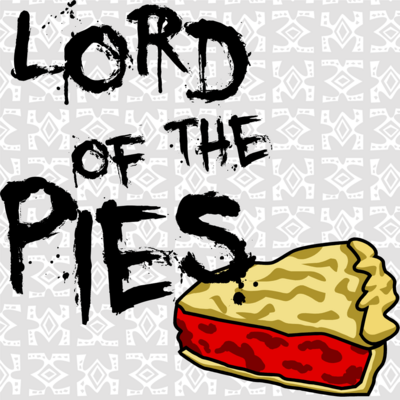
Lord of the Pies

Lord of the Pies

by Clint Snyder

A parody of Lord of the Flies by William Golding.

A pie shop erupts into panic after Franny, a brash cat-lady, announces the arrival of the apocalypse. Franny starts to reconstruct society (called Frannyland) in the tiny pie shop and takes out anyone who stands in her way with baby food and scotch tape.

Is the apocalypse real? Will the bathroom serve as an adequate prison? Why is there a muffin tin in a pie shop? Lord of the Pies answers these questions and more.

Comedy Classical Adaptation Student Directors

Average Producer Rating:

Recommended for High Schools and Middle Schools

Running Time
About 30 minutes
Approximate; excludes intermissions and scene changes
Cast
19 Characters
2 M10 F7 Any Gender
Set
Simple Set
Length
20 pages
Free Excerpt

What to order?

Not sure what you need to order? Check out our pricing and ordering guide.

Performance Royalty Fees

Royalty fees apply to all performances whether or not admission is charged. Any performance in front of an audience (e.g. an invited dress rehearsal) is considered a performance for royalty purposes.

Exemption details for scenes and monologues for competition.

19 Characters
2 M, 10 F, 7 Any Gender

Characters in this play are currently identified as male or female. Directors are welcome to assign any gender (binary or non-binary) to any character and modify pronouns accordingly.

Franny [F] 98 lines
Leader of the new country, founded in light of the apocalypse. May her rule be long. Four Monologues.
Cashier [M] 26 lines
Skeptical of Franny’s newly founded kingdom. The first to feel her wrath.
Dolores [F] 17 lines
Calm and level-headed. Two trains that will be quite useful in the apocalypse.
Isabel [F] 13 lines
More impressionable than Dolores. She will go far in Franny’s new regime.
Amanda [F] 16 lines
Another skeptical shopgoer to get pulled into Franny’s craziness.
Janice [F] 10 lines
The first to crack in Franny’s mad new world.
Manager [M] 24 lines
Has no time for Franny’s zany new kingdom.
Five women: [F] 1, 5, 11, 2, 7 lines
Jill, Eileen, Haley, Selma, Veronica
Five pie makers [A] 4,3,7,5,7 lines
Two random customers [A]

Praise for Lord of the Pies

Josephine Owens
Creative Arts Charter School
Great fun! The kids enjoyed it a lot and had fun staging it.
Carly Newman
Newton Middle School
It was a great show and very fun and easy to put together.

More Plays Like Lord of the Pies

The Pied Piper of Hamelin

adapted by Mrs. Evelyn Merritt from Robert Browning

There are consequences for the people of Hamelin when they refuse to pay the Piper. A theatricalization of the Robert Browning poem.

Hamlette

by Allison Williams

Hamlet is played by a girl in this twisty-turny comedic interpretation of the classic Danish tale.

Oddball

by Lindsay Price

A vignette play that embraces the odd. Odd jobs, odd socks, odd one out, odd reactions and odd boyfriends.

The Taming of the Shrew

cutting and notes by Lindsay Price from the original by Shakespeare

A one act annotated version of Shakespeare's controversial tale about the relationships between men and women.

Four campers are not only lost in the wood, they are lost at the edge of the world with no land, water, stars or sun. The only way to bring life back is to ask the right questions that will release stories from the wind.

Sarah and Dave think it would be fun to direct a play for drama club. And they both love Julius Caesar. What could go wrong?

From the Drama Teacher Learning Centre

Theatrefolk Featured Play - Lord of the Pies
Featured Plays

Theatrefolk Featured Play - Lord of the Pies

Welcome to our Featured Play Spotlight! Lord of the Pies by Clint Snyder is a hilariously fun one-act parody of Lord of the Flies that you need in your classroom. A pie shop erupts into panic after Franny, a brash cat-lady, announces the arrival of the apocalypse. Franny starts to reconstruct society (called Frannyland) in the tiny pie shop and takes out anyone who stands in her way with baby food and scotch tape. Is the apocalypse real? Will the bathroom serve as an adequate prison? Why is there a muffin tin in a pie shop? Lord of the Pies answers these questions and more. Why did we publish this play? We get a lot of adaptation and parody pieces based on classic works. It's always a joy to read one that's done well! I have much respect for the parody form. It takes a great deal of skill to not only take a work in another genre and transform it into a play, but then on top of that to turn the work on its ear. Lord of the Pies is a wonderful example of parody, it had me giggling from the title right on through to the last word on the last page. Let's hear from the author!1. Why did you write this play? I’ve always had a strong connection to Lord of the Pies since high school and have found the added apocalyptic themes added in to still ring relevant today.. 2. Describe the theme in one or two sentences. A strange woman enters a pie shop and envelopes everyone into end-of-the-world panic, much to her pleasure as their newfound leader. 3. What’s the most important visual for you in this play? The muffin pan of authority.… 4. If you could give one piece of advice for those producing the play, what would it be? Have fun, take charge and let yourself have fun with your cast-mates. 5. Why is this play great for student performers? It’s an absurd large cast/ simple set play that allows students to develop strong characters, but still have fun and learn to enjoy the dramatic process as well as learn practical theatrical skills. 6. Who is your favourite character in the play? While Franny is definitely a powerhouse and a star, Janice has an innocent but incredibly intelligent honesty that I find endearing. 7. What is your favourite line in the play? “What we need first is a source of food. Can anyone think of a source of food we could find in a pie shop?”
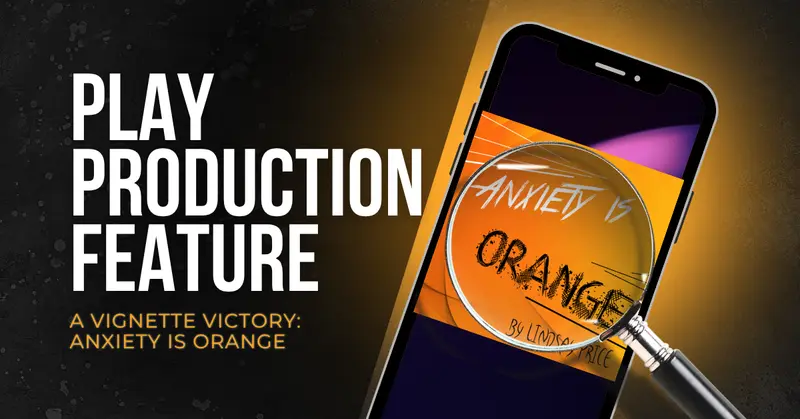
A Vignette Victory: Anxiety is Orange
Featured Plays

A Vignette Victory: Anxiety is Orange

““Oppositicitis. Like appendicitis. Only different.”” Anxiety is Orange by Lindsay Price helps us examine how we navigate the world through a sea of green, grey, blue, red, pink, yellow and orange. Does orange make you anxious? Colours can be symbolic. Red is fiery. Purple is royal. Blue is calming. Sometimes, colours can take on too much meaning. I can’t date you – you wear wenge! He sent yellow flowers! Orange gives my brother anxiety! The talented student performers at Gulf Coast Academy of Science and Technology in Spring Hill, Florida were able to utilize the short, vivid scenes in this vignette play to maximize their experience and character-development opportunities. Director Stephan Hoda was thrilled to share their success: “The play went beautifully and was, according to the students, their favorite, thus far. We’ve also performed Circus Olympus, Sleepy Hollow, Lord of the Pies, and Snow Queen. Vignette plays are WONDERFUL for middle school. I hadn’t directed one before but it really made life much easier. The students were able to learn their lines faster and we were able to focus on performance almost immediately. This is essential for a four-week turnaround.”
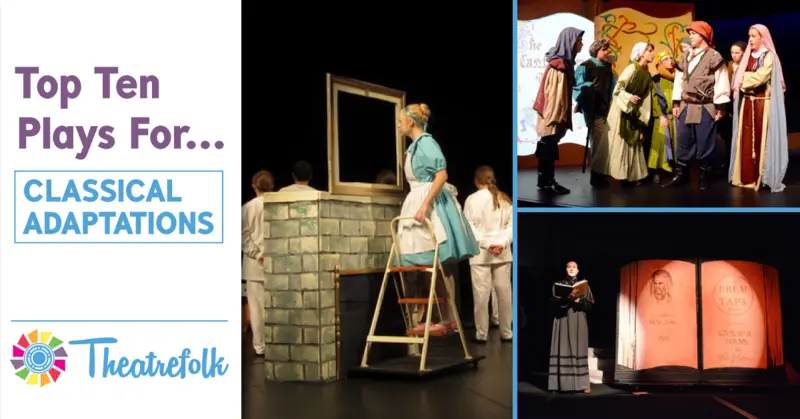
Theatrefolk’s Top 10: Classical Adaptations
Featured Plays

Theatrefolk’s Top 10: Classical Adaptations

Time for a Tfolk Top Ten Plays About…Classical Adaptations! Who’s looking for a little arts integration? How about some cross-curriculum? Or how about a great story turned into a great play. It’s time for ten classical adaptations. Adaptations are my favourite type of play to write. It’s an intriguing challenge to take a story in one form and determine what will make it a theatrical experience. Click the link and you’ll be taken to the webpage for each play. There you’ll get the details and read sample pages. All the best with your search! Shuddersome: Tales of Poe Original: Stories and Poems by Edgar Allan Poe Not only our most popular adaptations, but one of our most popular plays! Specters, ghosts and ghouls come alive in this vivid theatrical vision of Edgar Allan Poe’s best works including: The Tell-Tale Heart, The Raven, and The Masque of the Red Death. Hamlette/Mmmbeth Original: Hamlet & Macbeth by William Shakespeare The first of many of Shakespeare adaptations. We’ve paired Hamlette and Mmmbeth together because they make for a hilarious evening of theatre. Imagine if you will that “Hamlet” was not “Hamlet” at all, but “Hamlette” – a woman! Great for competitions. AND in Mmmbeth everything goes wrong. The witches take over the storytelling, Queen Duncan would rather open a donut franchise than die, Lady M’s a bloodthirsty June Cleaver, and the murderers are preoccupied with creating a commercial for their services. Introduce your students to the world of the Bard with these parodies. Will and Whimsy Original: Sonnets by William Shakespeare Shakespeare was meant to be performed, not read. This vignette play does that by bring his sonnets to life. Modern scenes play hand in hand with the original text. Mix and match the sonnets to your whimsy! Lord of the Pies Original: Lord of the Flies by William Golding In this parody piece a pie shop erupts into panic after Franny, a brash cat-lady, announces the arrival of the apocalypse. SHe starts to reconstruct society and takes out anyone who stands in her way with baby food and scotch tape. Drum Taps Original: Drum Taps by Walt Whitman The poems in Drum Taps represent Walt Whitman’s first hand account of the Civil War. See the words, the emotion, the blood come to life in this theatrical adaptation. This is not your typical poetry reading. This is war. Alice/Through The Looking Glass Original: Alice’s Adventures in Wonderland and Through the Looking Glass, and What Alice Found There by Lewis Carroll These two make excellent theatrical companion pieces. Both are one-act adaptations of the famous novels by Lewis Carroll. They follow Alice’s adventures down the rabbit hole and across the life-sized chess game. Fantastical physical journeys! The Canterbury Tales Original: *The Canterbury Tales by Chaucer* Chaucer’s classic collection of tales comes to life! A group of travelers set out for Canterbury on a pilgrimage. Each and every performer gets a chance to shine in this spirited, charming script. Text uses modern English. Pandora’s Fire Original: Pandora’s Box, Ancient Greek Myth Everybody knows the story of Pandora. Her curiosity got the better of her and she is to blame for releasing all the ills into the world. But is that the whole story? Pandora’s Fire is a wonderful mix of Ancient Greek choral storytelling with a modern twist. Hamlet, Zombie Killer of Denmark Original: Hamlet by William Shakespeare Denmark is plagued with zombies led by Hamlet’s uncle/step-father, the current king. Will Hamet become a zombie himself? A gruesomely comic adaptation of the Shakespeare’s classic tragedy, this version blends original text with new, zombified dialogue – written in iambic pentameter! The Tragicomedy of Julia Caesar Original: Julius Caesar by William Shakespeare Sarah and Dave think it would be fun to direct a play for drama club. And they both love Julius Caesar. What could go wrong? Oh, a post-death dance number, Brutus is allergic to peanut butter, Rome is now Georgia, and giant killer robots. That’s all….
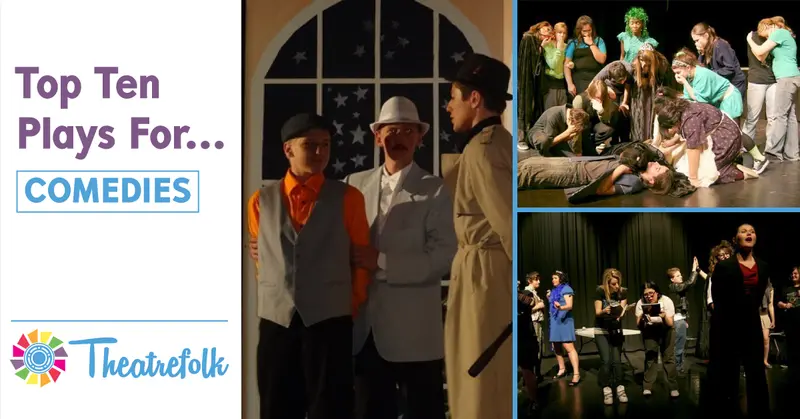
Theatrefolk’s Top 10: Comedies
Production

Theatrefolk’s Top 10: Comedies

Time for a Tfolk Top Ten Plays for…Comedies. Read one, read them all! Click the link and you’ll be taken to the webpage for each play. There you’ll get the details and read sample pages. All the best with your search! The Baloney, The Pickle, The Zombie, and Other Things I Hide From My Mother Trevor is bringing food to life with experiments he hopes will lead to the creation of zombies he can sell as cheap laborers. He may discover that his food may actually be smarter than he is… Apostrophe’s Are you sometime’s amazed at how many apostrophe’s s’ome people manage to fi’t into s’entence’s? Then you’re not the only one. That’s just the problem that needs to be solved in this outrageous comedy. Lord of the Pies A pie shop erupts into panic after Franny announces the arrival of the apocalypse. She starts to reconstruct society and takes out anyone who stands in her way with baby food and scotch tape. Is the apocalypse real? Will the bathroom serve as an adequate prison? Why is there a muffin tin in a pie shop? Hamlet, Zombie Killer of Denmark Denmark is plagued with zombies led by Hamlet’s uncle/step-father, the current king. When Hamlet learns from his zombified father that his uncle plans to turn Denmark into a land of the undead – Hamlet knows he must stop him! Or not. If he could only be sure… A gruesomely comic adaptation! Original text with new zombified dialogue. A Lighter Shade of Noir Trent Trowel is your typical gumshoe. Searching the mean streets for crimes to solve and dames to fall for. He joins some of the world’s most famous detectives at the International PD gala. But is this all a plot for the world’s most dastardly villains to foil them with a fiendish master plan? A fabulously funny and high styling take on film noir – it’s a lighter shade of noir after all! Close Encounters of the Undead Kind Wendy walks into a typical teen support group. Claire thinks Halloween is going to be humdrum as usual. Rachel wants her parents to be nice to her new boyfriend. Three ordinary scenarios… or are they? Is that a werewolf at the support group? A vampire at the door? A zombie boyfriend? With some close encounters of the undead kind, these plays are far from typical and humdrum! Epic Adventures in a Rinky Dink Art Museum High school students reluctantly visit a small town art museum to complete a creative writing project. But there’s more to the eye than a couple of paintings: Vanishing Valerie! Love-struck Kaitlin! Duncan… trying to eat a clay apple! A wonderfully sweet character driven comedy. Drop Dead, Juliet Juliet has had enough! Enough with the poison, enough with the stabbing, and especially enough with the dying. She wants a new story and she wants it now. _ Romeo and Juliet_ will never be the same – or will it? She Wrote, Died, Then Wrote Some More This comedic, melodramatic one-act mystery is an hilarious romp that features betrayals, broken hearts, a rather odd but beautiful love story, and many twists. Like the main character ending up dead. Or not dead… Lose Not Thy Head Joan pleads for life, Death waits for death, a severed Head says beheading isn’t so bad, a doctor tries to convince everyone that you can’t sew a head back on a body, and then things get weird. Shakespeare, Monty Python, a little love, a little death, a lot of laughs and a talking head. Planning on performing one of these or another Theatrefolk play? Let us know all about it with pictures and highlights – we might even feature you on our site! Click here to submit your story.
Seven Tips for Student Directors in the Classroom
Directing

Seven Tips for Student Directors in the Classroom

Do you include student directing in your program or are you thinking about introducing it this year? Tfolk playwright Clint Snyder reveals some tips for student directors. Directing can be extremely difficult and exhausting in a school setting. If you are a student director, directing your first production, the task can seem almost impossible. Luckily, here are a few quick tips to making your first production a successful one. 1. Have Faith in Your Cast & CrewIt can be tough, particularly in a classroom setting, to make choices on who is best qualified for a role or position. If you are a student director, it can be even tougher. The last thing you want people to think is that you are making selections based off who you are friends with. The best thing to do is always to cast who would be most qualified for the position and to let everyone know that their input and work is valued. If they did not get the role they wanted offer them a crew position based on their talents. After all, theater is one of the few collaborative art forms. 2. Develop a Sense of CommunityYour cast and crew should feel like a family by the end of the production. Sure families fight and bicker, but at the end of the day they come together for a common goal. You should make it your job to create situations where they can bond together outside of rehearsal. Try visiting a local community or professional production as a group. This will give the students a chance to bond and also allow them to brainstorm for ideas that they could apply to their own production. 3. Plan in AdvanceWhen you can avoid it, never put yourself in a situation where you have to scramble at the last minute. Sure, there will always be last minute adjustments, but major setbacks can be avoided by taking on the big projects at full force before going into rehearsal. If there are rehearsal space restrictions because of the classroom setting, talk them over with your crew far in advance so you can brainstorm ideas together. 4. Devour the Script BeforehandBy the time rehearsals start you should have a familiar sense of what each character’s motivation is, where each scene is set, and the general atmosphere of the play. You should still be open to the artistic process and allowing your crew and cast to bring their own unique creative perspective to the production. However, it is essential that the director is aware of what their perspective on the production is. For example, my script Lord of the Pies is set in a pie shop during the supposed apocalypse. Ask your cast and crew what would be unique about the set based on the circumstances of the play? 5. Find a Unique TwistPushing yourself beyond the script to bring some unique directorial aspect to the production can be one of the most rewarding parts of the process. As long as it is done in the spirit of the production, you can find ways to elevate the material. For example, a director might collaborate with the makeup artist and set designer to make all of the actors in a dated piece to appear in black and white. 6. Stay PositiveThere is bound to be some negativity that arises in the production process, but the cast and crew rely on you to set the tone for the play. If you are in a bad mood every rehearsal, chances are the cast and crew will be too. 7. Don’t Forget to AdvertiseNever forget that you rely on an audience to feed the energy of the production. If a crowd is dull or small, the actors will feel it onstage. Don’t forget to take lots of pictures and utilize social media to get excited about the production that you’ve been working so hard on. Consider having other classes visit and watch the performance. You want the students to be proud of their hard work and showcase it to the rest of the school. The added excitement of having other students watching can be enough to elevate your production to the next level. Clint Snyder is a playwright and actor who hails from Portland, Maine. He has a fond love of absurd comedy and currently has two plays published through Theatrefolk, To Kill a Mocking Birdie and Lord of the Pies.
5 questions with Clint Snyder
Playwriting

5 questions with Clint Snyder

We have a great community of amazing playwrights here at Theatrefolk that contribute to our collection of middle and high school plays. We hope you’ll enjoy this peek behind the curtain as they share how they approach the creative process, how they overcome challenges, and what advice they have for young playwrights. Don’t forget to check out their work! Meet Theatrefolk Playwright Clint Snyder – the author of many popular plays including Lord of the Pies and To Kill a Mocking Birdie. What was your first theatrical experience? How did it impact you?My first theatrical experience was not actually on stage. I was involved with my school’s speech team (forensics) and my love of theater and writing really grew out of that. I performed a piece by Christopher Durang and an original parody I wrote called Al in Wonderland. Looking back on it, it really imprinted on me an absurd style of writing that I have grown to love and use to express myself. Why do you write plays?I see writing is a way of learning about myself. I don’t always know exactly where the story is going to go, but I have the characters formed in my head and I just write. In the case of some of the parodies I write, Lord of the Pies for example, I am not just mocking the work that I am parodying, but I try to throw in some social commentary as well. With theater and comedy in particular you have a chance to slap an audience in the face with a very opinionated viewpoint and have them laugh at themselves. The play is really how quickly society degenerates into a disorganized cluster of fear led by a woman wearing a cat sweater. What’s the most challenging part of writing a play?The most difficult part about art in general can just be separating yourself from the work. It has taken me a long time to be able to look at my life objectively and write about it. If you go into a play with a clearly prejudiced opinion about one of your characters it will show in the writing. When I wrote To Kill a Mocking Birdie, for example, I have a character that is convinced she is a glazed Virginia ham. When I wrote that character I did not tell myself not, “Wow, this person is insane and they think they’re a cured meat product.” Instead I put on my writer’s cap and said, “I am a glazed Virgina Ham… and how do I feel about my situation right now.” How do you address/overcome those challenges?I think not taking things too seriously is a huge part of it. As writers we will always face rejection and critique. The challenge is to not get defensive of your work, but to listen to honest objective opinions and learn from them. As a young playwright I feel like I’ve not only learned some of my strengths and weaknesses in my writing, but also as a person. We have a unique opportunity in theater, not just to put ink to paper, but to bring a world to life on stage and anytime I get down on myself for failing, I try to remember how blessed I am to have been given that opportunity and ability. What advice do you have for young writers struggling to finish a draft?Turn off the television, sign off of Facebook and get the ink on the paper. A lot of writers will procrastinate because they are worried to fail, but you are only really failing if you never try.
One Act Plays for Middle School
Featured Plays

One Act Plays for Middle School

Choosing one act plays for middle school is not an easy task. The students are at a very in-between point in their lives. They no longer want to be seen of as “kids” yet many are not quite ready to tackle heavier issues. Play selection is a total “your mileage may vary” situation. It depends on each specific set of kids. Some will be content with fairy tales while others will want intense make-’em-cry dramas. Here is a direct link to all of our one act plays for middle schools. I reached out on our Facebook page for some feedback from middle school teachers: “What are the major factors you need to consider when selecting a one act play for your middle school?” Here are some of the more representative responses we got. “Large cast size (25-35) for my classes, appropriate for their age, doesn’t focus on typical angst of the MS student, it needs to be mostly funny (they’ll get enough serious stuff at the HS level), and I LOVE vignettes which allow me to cast many kids in roles The Snow Show ~ Jessica Landry Stafford “It has to have a message. My students don’t like fluff. They want something to sink their teeth into. It also has to have a good ending. I have found most one act plays just drop off and don’t have strong endings.” ~Leslie McKibben “Cast size over 20. Smart script. Age/audience appropriate but not talking down to teenagers. Would love to see more stories that weren’t necessarily anchored in school angst.” ~Aidan O’Hara “A play “the cast and crew will care about.” Most middle schoolers are not yet such experienced theatremakers that they’ll enjoy doing any show for any reason–the story needs to engage them pretty quickly for them to commit to the process.” ~Becky Schlomann “I always think about the talent that I have available at the school and choose a show that will make all their talents shine. I want to pick a show that will both challenge the students, but also engage them and nurture their love for theatre.” ~Bethany Kennedy “No more mangling of fairy tales or Shakespeare! Something that they can sink their teeth into without being angsty. Heavier on girls. Boy roles where they don’t have to be ‘manly.’” ~Amy Medina “Opportunity, creative challenges, meaningful and accessible character development. LOVED Tick Talk for middle schoolers in particular, BTW.” ~Jessica Shulman McGettrick As you can see, the answers are wide and varied. There’s no magic bullet. There’s no “one size fits all” play for a middle school group. Choosing a one act play for middle schools depends heavily on the group of kids that you have at the time. Here are some of the main factors brought up by our Facebook fans. AppropriatenessAppropriate is in the eye of the beholder. It would be impossible to say what’s “appropriate” because standards vary. Our customers request plays that run the gamut between requests to remove all references to dating from a play (a play that doesn’t show a date, it just uses the world) to our most challenging plays, some of which aren’t even on our recommended list of plays for middle schools. Cast sizeThis one was almost universal. A large cast size is important. This is particularly tough in a one act play format. Writing a play that has a lot of characters isn’t challenging, but it is challenging to develop them all, to give them individual traits so the actors feel like they can contribute as individuals to the production. Some of our one act plays that achieve this nicely are: • Funhouse – a bullying play with a cast of 20 • The Absolutely Insidious and Utterly Terrifying Truth About Cat Hair – A fun play with a long title and a huge cast. • Shuddersome: Tales of Poe – A very large cast adaptation of Poe’s most theatrical stories • Lord of the Pies – a delicious parody of Lord of the Flies Students Can Relate to ItThe plays we publish and promote for middle schools tend to have the majority of characters of student age (except in the case of literary adaptations). It’s important that the characters and the situations they find themselves in are realistic and relatable. Not necessarily how adults see the middle school student, but how they see themselves. The Play Stretches the PerformersIt’s important that the play stretch them as performers. But “stretch” doesn’t have to mean “a different age, like grandparents” In the professional world, for example, I’ve always played roles that fit my age and every experience I’ve had has stretched me as a performer. A meek student can be stretched by playing a bully. A straightlaced student can be stretched by playing a troubled kid. Typecasting is lovely and it makes casting easy, but if you’re looking to stretch kids then it’s important to cast against type sometimes. At the end of the day the most important thing in educational theatre is the students’ learning experience. For example, our middle school play The Happiness Shop looks at the issue of Middle School Depression. This is a serious topic and allows middle school students to tackle a big issue in a theatrical manner. The Fractured Fairytale DebateSome people on our Facebook post said they love fractured fairytales, others are sick of them. That’s what makes art so wonderful – there are plays to suit every taste. We don’t have any fractured fairytales but I don’t think there’s a single thing wrong with them besides the fact that it’s very easy to write a bad one. I’ve seen so many come through our submission process that just aren’t theatrical. They are just re-worded versions of fairytales – parodies or spoofs. They are funny on the page and that’s probably the medium they belong in. The best way to tell if a script is theatrical or not is to ask yourself these questions: How will staging this play (bringing it to life) differ than just reading it? What parts of the script would be enhanced by live performers? Can you visualize the script in action when you read it? Do you see people moving? Are there moments that will affect the audience? If you struggle to answer these questions then there’s probably not much theatre written into the play. I have no doubt that we’ll publish a fractured fairytale at some point but when we do it will also work as an engaging piece of theatre. Here are a couple of examples of **adaptations/parodies that work as theatre:** • Drop Dead, Juliet! – Juliet tries to change her inevitable death at the end of the play and engages in a battle of wills with William Shakespeare. • Circus Olympus – A collection of Greek myths come to life. The script encourages liberal use of circus skills – what’s more theatrical than a Greek myth & circus mashup? • Rebootililzation – Not a one act, but this clever play incorporates a ton of fairtytale and literature based characters. More Girls than BoysThis is a purely logistical issue. More girls audition for middle school shows than boys. Pretty much all of our plays have more girls than boys for this very reason. We also try our best to get some gender-neutral characters in there for casting flexibility. Bradley Hayward’s Apostrophe’s and Sixteen in Ten Minutes or Less are both fantastic choices for flexible casting. Simple StagingIn our experience, the middle school budget is limited. The middle school play is more about putting as many students on stage, rather than having the most elaborate staging. We got you there, too. We always aim for scripts that are easy to stage. Our running joke is that most of our plays can be staged with two chairs and a cube and if you’re really pressed for budget, then one of the chairs could be cut. Personal TasteBecky Schlomann had this to say about what kinds of plays she looks for: “Something I personally like. I’m going to be spending more time with the script than anybody, and if at the beginning of the process I hate it, by the end of the process I’ll be ready to poke my eyes out.” This is the main reason that every play on our website comes with an extensive free excerpt. That way there are no surprises when you order a play for production, and you don’t have to order a dozen perusal scripts based on a catalogue blurb only to end up disappointed that none of them appeal to you. There are a lot of one act plays for middle schools on our website. If that overwhelms you, feel free to email us or use our live chat through this page. Tell us your likes, dislikes, cast size, and the age of your group. We’re always happy to send recommendations your way.
We accept

In addition to the above payment methods, Purchase Orders are accepted from US and Canadian Schools.

Info for your purchasing department