

Facebook Pixel Skip to main content

📣SCRIPT SALE! Treat yourself to an easier Fall. Save 30% on 5+ perusal scripts with code SPRING30 before May 3 and head into summer stress-free.

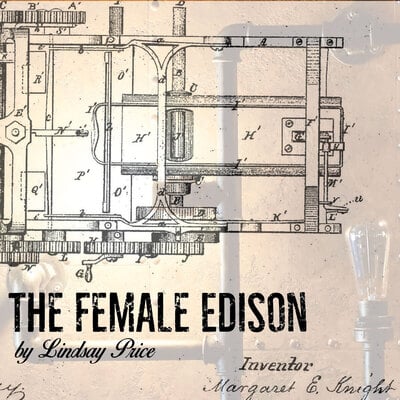
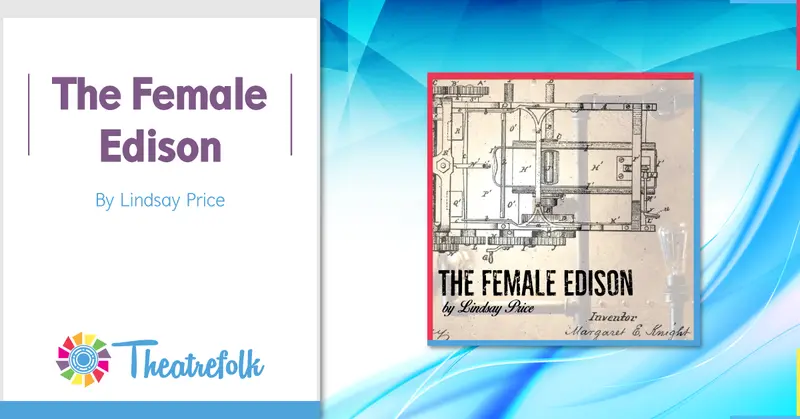
The Female Edison

The Female Edison

by Lindsay Price

Margaret E. Knight was a 19th century inventor with two big but forgotten stories.

At 12 years of age, while working at a textile factory, she invented a part to improve the safety of a power loom. How did she not only get mill management to listen to her idea but implement it?

As an adult, she invented a machine to mass-produce flat bottom paper bags. This invention was eventually stolen from her so she hired a lawyer to take the case to court. The defense was that “there is no way a woman could have invented this.” How did Margaret persist and secure her place in the annals of invention?

Drama

Recommended for High Schools and Middle Schools

Running Time
About 70 minutes
Approximate; excludes intermissions and scene changes
Cast
24 Characters
2 F22 Any Gender
Set
Simple set
Length
79 pages
Free Excerpt

What to order?

Not sure what you need to order? Check out our pricing and ordering guide.

Performance Royalty Fees

Royalty fees apply to all performances whether or not admission is charged. Any performance in front of an audience (e.g. an invited dress rehearsal) is considered a performance for royalty purposes.

Exemption details for scenes and monologues for competition.

24 Characters
2 F, 22 Any Gender

Aside from Margaret, directors are welcome to assign any gender (binary or non-binary) to any character and modify pronouns accordingly.

MARGARET [F] 238 lines
Inventor. Adult. Worked in factories and many jobs where she used her hands (repairs, furniture upholstery)
MATTIE [F] 162 lines
Margaret at 12 years old. Tough. Spirited.

ACT ONE
Margaret's Family
HANNAH [A] 41 lines
Margaret’s mother, factory worker
JIM [A] 42 lines
Margaret’s brother, Weaving Room #3 Assistant Overseer
CHARLIE [A] 44 lines
Margaret’s brother, factory worker

Factory Operatives
HARRIET [A] 23 lines
MARY [A] 10 lines
SARAH [A] 17 lines
ELIZA [A] 8 lines
LUCY [A] 13 lines
FRANCES [A] 17 lines
GEORGE [A] 9 lines
HENRY [A] 11 lines
SAMUEL [A] 11 lines
5 ADDITIONAL OPERATIVES FOR GROUP SCENES [A]

Factory Management
BAKER, Jacob [A] 21 lines
Weaving Room #2 Overseer
GREEN, Daniel [A] 26 lines
Foreman of Repairs
LIGHTBODY, Eugene [A] 4 lines
Superintendent of Weaving
STICKNEY, William [A] 33 lines
Weaving Room #2 Assistant Overseer
PIERCE, James [A] 3 lines
Mill Manager #4

ACT TWO
CHARLES [A] 45 lines
Machinist. Inventor.
KNOX, John [A] 29 lines
Factory Supervisor.
CANTWELL, David [A] 23 lines
Patent Lawyer.
GRAHAM, Wil [A] 5 lines
Machinist
ABBOT, Lewis [A] 7 lines
Machinist
DUNCAN, Arthur [A] 6 lines
Acting Commissioner
PATENT OFFICE CLERK [A] 1 line
Duncan’s clerk.

Factory Operatives
EMMA [A] 36 lines
GRACE [A] 33 lines
RUTH [A] 19 lines
ELLIE [A] 33 lines
ALICE [A] 24 lines
4 FEMALE INVENTORS [A] 4 lines
Should come from cast of actors

Groups
19TH CENTURY GROUP [A] 23 lines
INVENTORS GROUP [A] 12 lines
INVENTION GROUP [A] 56 lines

More Plays Like The Female Edison

Failure and fortitude are the touchstones for every inventor, but even more so for 19th century female inventors.

How did a 12 year old girl, with little education and no experience with mechanical engineering invent a safety part for a power loom?

Finding Jo March

by Laramie Dean

You should know right away that this is not a traditional adaptation of Little Women.

The Pauper Princess

by Holly Beardsley inspired by Mark Twain

A retelling of Mark Twain’s The Prince and the Pauper.

A fast-paced, witty modern take on Austen’s six classic masterpieces.

A modern absurdist play that puts elements from three of Franz Kafka’s works into the context of the everyday absurdities of our 21st century lives.

From the Drama Teacher Learning Centre

The Female Edison
Featured Plays

Theatrefolk Featured Play: The Female Edison

Welcome to our Featured Play Spotlight. The Female Edison by Lindsay Price is an incredible ensemble piece with something for everyone! Margaret E. Knight was a 19th century inventor with two big but forgotten stories. At 12 years of age, while working at a textile factory, she invented a part to improve the safety of a power loom. How did she not only get mill management to listen to her idea but implement it? As an adult, she invented a machine to mass-produce flat bottom paper bags. This invention was eventually stolen from her so she hired a lawyer to take the case to court. The defense was that “there is no way a woman could have invented this.” How did Margaret persist and secure her place in the annals of invention? NOTE: There are also two independent one-act versions of the script available that can both be performed without any knowledge of the other: Patterns & Power: The Female Edison and Failure & Fortitude: The Female Edison. Let's hear from the author! 1. Why did you write this play?A lot of times I go down rabbit holes of research because of some observation that came across my world view. That's what happened which led me to Margaret E. Knight and her paper bag machine invention. There isn't a lot about her online, but everything I read made me excited to share her story theatrically. 2. Describe the theme in one or two sentences?Failure and fortitude are the touchstones for every inventor, but even more so for 19th century female inventors. 3. What's the most important visual for you in this play?I love seeing the 19th century machines come to life through actors. I knew, writing this for schools and student performers that any of the machines would have to be actor driven rather than actual set pieces. It took a long time in my research to figure out how to turn a power loom into three different action sets and how to turn Margaret's mass-produced paper bag machine into action. But I love the results. 4. If you could give one piece of advice for those producing the play, what would it be?There's a lot of ensemble work in this play and a lot of moving pieces as actors enter and exit. The more you practice transitions the smoother the flow of the piece will be. Also, don't be put off by the number of traditional male roles. It is my intention that the majority of the roles are played by the actors who best suited for the role regardless of their gender. 5. Why is this play great for student performers?It has everything! Some history, characters fighting and succeeding through great adversity - I mean, someone tried to steal Margaret's patent for the paper bag machine to the point that she had to go to court and get it back. In a time period when a married woman wasn't even allowed to put her own name on a patent, the fact that she won her case is remarkable. Further to that, there is so much ensemble opportunity in the play. You can really expand the cast size if you want. 6. Who is your favourite character in the play? OR Which character would you be in this play?Margaret all the way! I love her story. She had everything against her: no schooling, no desire to be "normal" in an era that really required women to be and act in a certain way, and in court, the man who stole her patent said that "there was no way a woman could have understood such mechanical complexities" And yet she still persevered. 7. What is your favourite line in the play?"I am not a cog in any machine."
We accept

In addition to the above payment methods, Purchase Orders are accepted from US and Canadian Schools.

Info for your purchasing department