Facebook Pixel Skip to main content

📣SCRIPT SALE! Treat yourself to an easier Fall. Save 30% on 5+ perusal scripts with code SPRING30 before May 3 and head into summer stress-free.

Dramedy

Theatrefolk Featured Play - Agatha Rex
Featured Plays

Theatrefolk Featured Play - Agatha Rex

Welcome to our Featured Play Spotlight. Agatha Rex by Lindsay Price is a modern high school adaptation of Antigone, transforming the Greek chorus into a dynamic ensemble opportunity. Available in a competition-length version too! Possible expulsion, expulsion, expulsion. Agatha is a girl who stands up for her beliefs, regardless of the consequences. As student council president at Thebes High, she vigorously defends a student who is unfairly punished. Based on her actions, she could be expelled and lose an important scholarship. Set in a modern-day high school, the play translates the original Greek chorus into a fantastic ensemble opportunity. Let's hear from the author! 1. Why did you write this play?I love adaptations, and Antigone is an epic play - adapting it is always a fun challenge. The original story translated seamlessly to the high school stage: Antigone defies the king to honor her brother, while Agatha defies the principal to support hers. Both Agatha and Antigone stand up for what they believe in, no matter the consequences. In this modern version, Agatha isn’t faced with a life-or-death choice—apologize or die—but her actions will still change her life. She risks losing everything she’s worked for, all for a brother who may not even be worth the sacrifice. 1b. Why did you also write a competition length version?Agatha Rex is one of my more popular plays for production and for classroom study because of its link to Ancient Greek Theatre. I've had many teachers ask for a competition length version of this play and it's been great to be able to adapt my adaptation! 2. Describe the theme in one or two sentences?Do you stand up for your beliefs, regardless of the consequences? How do you define right vs wrong? 3. What's the most important visual for you in this play?The "Greek Chorus" of students who observe the action and comment on it. 4. If you could give one piece of advice for those producing the play, what would it be?Agatha Rex is a great example of an ensemble that has a lot to do and can't stand around being wall paper. The Greek Chorus in the original is transformed into an ensemble of high school students. Frankly, it's the toughest part in the play – they set the scene, they set up the world of the play and its characters. The ensemble acts as foils for Agatha (both encouraging her to act and then backing away when she asks for their help) they are the atmosphere of the play. They act as the voice of the student body. And they have to do it in unison. 5. Why is this play great for student performers?This play has a lot to offer from offering a modern look into an Ancient Greek play, to the ensemble work, to the strong character development, to the discussion of the themes. How do you define right from wrong? What would you do in a similar situation? Should someone be punished less harshly because they are a good student? What are your thoughts on personal responsibility? 6. Who is your favourite character in the play? OR Which character would you be in this play?Eunice, the head hall monitor, is my favourite character! I would love to play her. 7. What is your favourite line in the play?Any time the chorus called Dr Creon "Cromagnon."
neeT Teen
Featured Plays

Theatrefolk Featured Play - neeT Teen

Welcome to our Featured Play Spotlight. neeT Teen by Lindsay Price is a fantastic play for your group. It's got a little bit everything - from the absurd, to movement, to audience participation, to song... There's even the opportunity to add your own scene to the mix! Teen life – backwards, forwards and inside-out. From dealing with the tractor beam of insecurity and doubt, to dealing with parents who couldn’t hear you if they tried. From fighting pimples to fighting the hallway. From knowing math skills aren’t going to get the girl to knowing that happy teenagers exist. They may not get the laughs, or the drama, or the big monologue, but they’re there. Let's hear from the author!1. Why did you write this play? I wanted to write a vignette play that went out of my comfort zone in terms of exploring form. And there is every type of form in this play from kitchen sink scenes, to absurd, to movement based moments, to choral work, to audience participation, to song, to groups adding their own scene. 2. Describe the theme in one or two sentences? Teen life – backwards, forwards, inside out. 3. What's the most important visual for you in this play? I love the ending where the entire cast is singing about not feeling great, not being liked and not getting worried about it. They're not going to change who they are. 4. If you could give one piece of advice for those producing the play, what would it be? Don't get bogged down by the different forms. Focus on the individual characters in each scene and express the form through what those characters want and the obstacles in their way. 5. Why is this play great for student performers? It looks at teen life and tackles topics that many teens go through in a unique and varied way. 6. Who is your favourite character in the play? She's not my favourite character, but for me, it's the most vivid moment in the play. Tyne has bullied another girl to the point where she felt she had to take her own life. Tyne is trying to grapple with the vast weight of this moment and rationalizing her actions as just "a little mean." It's one of my "favourite" monologues in its rawness and how words have consequences. 7. What is your favourite line in the play? "The world would be a better place if people weren’t so easily offended by words that don’t actually do anything, they just exist."
Theatrefolk Featured Play - The Happiness Shop
Featured Plays

Theatrefolk Featured Play - The Happiness Shop

Welcome to our Featured Play Spotlight. The Happiness Shop by Lindsay Price is an excellent class project that explores important issues for students. Three middle school students find themselves in an odd curiosity shop. They don’t know what it is, where they are, or how they got there. But that’s no surprise. The Happiness Shop is not like any other. It is filled with Roppets. A Roppet is not quite a robot and not quite a puppet. A Roppet is completely happy all the time. Full of smiles, hugs and hi-fives. Isn’t that all it takes for a middle school student to be happy? They’re too young to have problems. Blake, Melanie and Wally know that’s not true. They all have pretty big problems. But in the shop they have one question to answer and one question only: What would you do to be completely happy? Let's hear from the author! 1. Why did you write this play?I wrote this play specifically for middle school students after a couple of eye opening experiences. First, I watched a 13 year old boy deliver one of my monologues in a competition. The character in the monologue talks about his life and how his family treat him after a suicide attempt. The monologue was written for a 16 year old character and the impact of seeing it done by a 13 year old was huge. Does suicide happen in middle school? Secondly the director of one of my plays shared a rehearsal exercise she did with her cast in which her middle school students wrote on post-it notes the positive and negative things they say to themselves or hear others say to them. The negative board had three times more post-its than the positive one. (The exercise is included in this play's free Classroom Study Guide.) Do middle school students get depressed? I’m the first to admit, until writing this play I did not fully realize that middle school students could experience depression. I thought depression didn’t hit until high school. That’s when I started researching the topic. I found that not only do middle school students get depressed but it’s often overlooked as laziness, and ignored because they’re “too young” to be depressed. Many times the issue is never addressed. I knew I had to bring this issue to life in a play. 2. Describe the theme in one or two sentences?Happiness does not come from burying your feelings and pretending to be happy. Students suffering from depression are not alone in their feelings and they don’t need to suffer alone. 3. What's the most important visual for you in this play?The Roppets. They are supposed to be completely happy and smile all the time. But what's hiding behind those smiles? 4. If you could give one piece of advice for those producing the play, what would it be?Be prepared for discussions. You never know how students are going to be affected by being in the play. You may want to discuss the play with the guidance department. You are not a therapist and shouldn't take on that role. 5. Why is this play great for student performers?The play demonstrates the different faces of middle school depression and the different choices made because of it. Not all the choices these students make are good ones. I feel that’s important to stage. I think, too, it's important to show positive choices. 6. Who is your favourite character in the play?Phoenix is Melanie's best friend and I absolutely loved writing for them. The character is weird and loves being weird. They are not popular and are often bullied, but still has a great outlook on their life. They see their bullies as sad animals and never lets the bullies actions affect them. 7. What is your favourite line in the play?"Oh you did help me. You helped me see myself."
Theatrefolk Featured Play – Characters Behaving Badly by Lindsay Price
Diversity

Theatrefolk Featured Play – Characters Behaving Badly by Lindsay Price

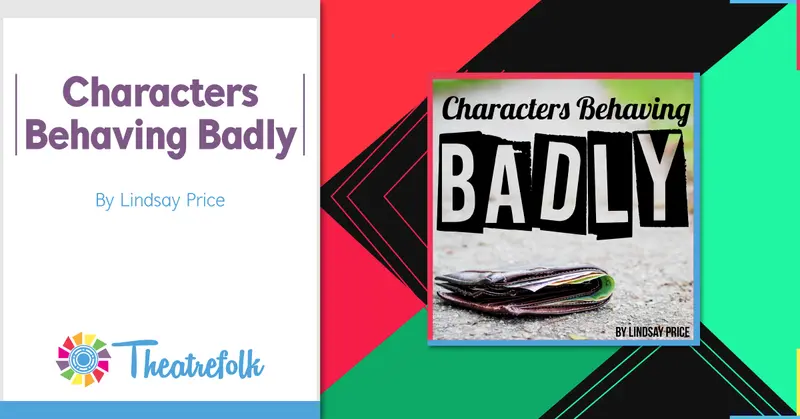
Welcome to our Featured Play Spotlight. The vignette play, Characters Behaving Badly, by Lindsay Price, asks students to look at the concept of what it means to be “good” and “bad”, as well as what it means to play a character with whom they might not agree. Perfect for class performances! If you saw a wallet on the ground, bulging with money, and no one around, would you take it? What’s the worst thing a person can do? Is it murder? Is it lying? Is it getting an A-? What defines “good” and “bad” behaviour? Can “good” people have “bad” thoughts? Let’s hear from the author!1. Why did you write this play? Over the years, I have witnessed a lot of young or student actors being reticent to take on a “bad” character because they felt it would reflect in their own personal character. “If I play a bad character, then I am seen as a bad person.” Which leads to a great question: What does it mean to be “good” or “bad”? And who gets to decide what is “good” or “bad?” And there was my starting point. 2. Describe the theme in one or two sentences. What does it mean to be “good” or bad?” What does it mean to play a “bad” character. 3. What’s the most important visual for you in this play? There’s a moment when a character holds up a wallet full of money and asks the other characters and the audience if they would take it if they found it on the ground. Would you? 4. If you could give one piece of advice for those producing the play, what would it be? It’s a vignette play so it’s easy to default to a blackout between every scene. If you look at the script, it’s specifically designed to avoid that. Blackouts suck the life out of the drive and forward motion of a play. Use choreographed transitions and music to move from moment to moment. 5. Why is this play great for student performers? Not only are the characters great for analysis in this play, the question around what is “good” and what is “bad” is an excellent topic for discussion. How do your students define the two?
Theatrefolk Featured Play – Finding Jo March by Laramie Dean
Diversity

Theatrefolk Featured Play – Finding Jo March by Laramie Dean

Welcome to our Featured Play Spotlight. You should know right away that Finding Jo March by Laramie Dean is not a traditional adaptation of Little Women. A young writer dives into the world of Louisa May Alcott’s most famous novel in order to bring the story to life (with a little help from their friends). Suddenly the March sisters are back, and the writer is one of them… Jo! But as the lives and loves of Meg, Jo, Beth, and Amy unfold, the present constantly threatens to pull the writer back into reality where a tragedy they have yet to deal with waits. It’s about telling someone else’s story so you can find your own. Why did we publish this play? I have seen this play develop for awhile now and it’s a delight to be able to share it with the world! _Finding Jo March _is a heartbreaking, uplifting, and unique take on its original source material _Little Woman. _It beautifully combines past and present. It sees the story through a LGBTQ+ lens through a connection between Jo March’s story, and the play’s main character story with their identity. You must pick up this play and share it with your students. Let’s hear from the author!1. Why did you write this play? I’ve loved Little Women since I was a kid and read my tattered, illustrated paperback copy to pieces. I was intrigued by the challenge of bringing a new adaptation to the stage and playing around with time: was there a way to allow the March sisters and their friends to participate in the 1860s and today? I also wanted to write something for my students to explore LGBTQ issues from different perspectives, especially since several are underrepresented and rarely, if ever, see people like themselves on stage. 2. Describe the theme in one or two sentences. It’s about telling someone else’s story so you can find your own. 3. What’s the most important visual for you in this play? The moment when Amy falls through the ice. It’s the climactic moment of Act One and can be done very simply with lights and music. 4. If you could give one piece of advice for those producing the play, what would it be? Create trust with your actors. Allow them to have fun and to be themselves. Encourage them to express in words how they relate to the characters in the play, the ones they’re embodying and the others as well. 5. Why is this play great for student performers? It gives them some great comedic moments as well as incredibly heartwrenching scenes (try not to tear up when the Writer’s father abandons them and their mother). It also allows your students of different sexual orientations or gender identities to see themselves represented in a play they get to experience for themselves. 6. Do you have any advice for people looking to perform this play online or socially distanced? Live music will help. Get your copy of Finding Jo Marchright here, right now!Not right for your group right now? Search our play catalogue to find one that your performers will love!
Theatrefolk Featured Play – Thought Traps by Lindsay Price
Featured Plays

Theatrefolk Featured Play – Thought Traps by Lindsay Price

*Welcome to our Featured Play Spotlight. * In the high school dramedy, Thought Traps by Lindsay Price, even happy people have issues. Will they be able to set themselves free from the past who invade their thoughts? Ariane walks around with her own personal black cloud. She throws up barriers, lashes out and refuses to tell anyone what she’s thinking. Kate is the exact opposite. Happy, bubbly, outgoing and personable. But even happy people have issues. And there are more similarities between the two teens: both Ariane and Kate deal with people from their past who invade their head space, and pull them into thought traps. Will either be able to set themselves free? Why did we publish this play? The story of Ariane and Kate from Thought Traps exists in another form at theatrefolk.com; in our a cappella musical, Shout. We love the story of the characters so much that the question came up – can we adapt their story into a non-musical one act? The answer is yes! Although, it wasn’t a simple copy & paste. In musicals, characters express their thoughts and emotions through song. In _Thought Traps _songs have to become conversations, or even new characters. The adaptation was a challenge but an extremely worthwhile one. The great thing about adaptation is that we can also adapt to the present times – the original story was written fifteen years ago and many things have changed. The characters in _Thought Traps _are living fully in today’s world. For example, gender identity is an important conversation in the play and the language characters use to express themselves is grounded in the now. We love being able to offer another option for these characters and this story. Let’s hear from the author!1. Why did you write this play? The story of Ariane and Kate exits in another form at theatrefolk.com; in our a capella musical, Shout. I love their story and decided to see if I could turn it into a non-musical one act. A great challenge and a satisfying one – songs in which characters expressed their thoughts had to be turned into dialogue, and in some cases all new characters! The title Thought Traps came directly out of this new writing. 2. Describe the theme in one or two sentences. Ariane and Kate deal with people from their past who invade their head space. Will either be able to set themselves free? 3. What’s the most important visual for you in this play? Essa and Andy are the “thought traps” for Ariane and Kate respectively. Make it clear visually that these characters aren’t “real,” even though they’re based on “real” people in the world of the play. They’re thoughts taking up space in Ariane and Kate’s head. 4. If you could give one piece of advice for those producing the play, what would it be? Don’t foreshadow Kate’s story. She is bright, happy and positive for a lot of the play. Her inner struggle is not part of her every day persona, until she learns what happens to her brother. 5. Why is this play great for student performers? The characters are interesting and unique teenagers. Playing unique characters their own age is a great place for students to start with character development. Get your copy of Thought Traps right here, right now!Not right for your group right now? Search our play catalogue to find one that your performers will love!
Theatrefolk Featured Play – The Gorgon Sisters by Laramie Dean
Featured Plays

Theatrefolk Featured Play – The Gorgon Sisters by Laramie Dean

*Welcome to our Featured Play Spotlight. * The Gorgon Sisters by Laramie Dean is a fabulous take on some Ancient Greek characters – complete with lots of casting flexibility and suggested cuts for one-act competitions. The story is everything to Stheno, the oldest gorgon sister. And this story is a big one, a hero’s quest. And not some lame quest like the one Perseus went on for a girl. Stheno wants to bring her sister Medusa back to life. It’s impossible, and everyone tells her so – Hades, Heracles, Athena… but for someone like Stheno, the impossible just takes a little longer. Why did we publish this play? This play is a win-win-win all around: cross-curricular material, with the Medusa myth told in such a unique way. It’s easy to stage with great characters. If you’re looking for something new in the Ancient Greek canon, The Gorgon Sisters is for you! Let’s hear from the author!1. Why did you write this play? I was commissioned to write a play about Greek mythology by Teresa Waldorf, who was, at that time, the head of the educational tour branch of the Montana Repertory Theatre. I’ve been fascinated by Medusa since I saw her fight Harry Hamlin in CLASH OF THE TITANS when it ran on TV when I was wee; I was unaware that there were two other Gorgon sisters left alive after Perseus claimed her head, and immediately I thought what a good story that would make: the baddest of the bad, the worst Gorgon of all, trying to become a hero and bring her beloved sister back to life. 2. Describe the theme in one or two sentences. People you love will always be with you, no matter where you go or the distance between you. 3. What’s the most important visual for you in this play? Making Stheno look as cool as possible: she has a hairful of snakes, for Hades’ sake. And wings. And scales! 4. If you could give one piece of advice for those producing the play, what would it be? Have fun with the tech and design. Cast as many people as you want and then dress ‘em up. The Greeks gave their gods and monsters a lot in the way of visuals: go nuts with props and costumes. 5. Why is this play great for student performers? It’s funny. It’s also incredibly sad: dealing with grief is never easy. It has unexpected moments, particularly with characters like Hades, who audiences probably remember best dramatized from Disney’s Hercules. This guy is a little different. Stheno is a strong, determined, and intelligent woman and a great role. 6. Why is this play great for online performances? We performed it at my school early last fall as a staged reading with costumes, props, and masks. It worked just fine. Concentrate on the words and the characterizations; encourage students to go even bigger, especially vocally. Tell them to have fun!
Theatrefolk Featured Play – Split by Bradley Hayward
Featured Plays

Theatrefolk Featured Play – Split by Bradley Hayward

Welcome to our Featured Play Spotlight. Split by Bradley Hayward is an emotional, theatrical, ensemble-driven play that your student performers are sure to love. Children of divorce are united through humor in this honest and theatrical look at the day to day reality of growing up in a family that’s been torn apart. As these teenagers navigate a winding road that includes new bedrooms, new siblings and new responsibilities, they begin to put the pieces of their broken homes back together. Why did we publish this play? First of all the play has such a theatrical journey. The most important aspect of an issue play is how it’s theatricalized. _Split _has wonderful physical moments, like the symbolic rebuilding of the home at the end. It’s so lovely. Second, Bradley has such a keen ear for writing for teen aged characters – the voice of each character, and how they deal with the issue just leaps off the page. Lastly, it’s always a plus when issue plays include humour. Variety of tone is key and Bradley knows exactly how to use tone to great effect. Let’s hear from the author!1. Why did you write this play? While the play is inherently about divorce, that word is never uttered once in the entire script. I wanted to write a play that celebrates love, among family and friends, by showing what happens when that love is threatened. 2. Describe the theme in one or two sentences. The play is about how people react when their lives are split in different directions, and the variety of approaches they take in order to put the pieces back together. 3. What’s the most important visual for you in this play? The closing moment of the play, when the characters finally feel safe enough to set foot into the home they build together, always brings me to tears. It is my favourite moment in any of the plays I have written. 4. If you could give one piece of advice for those producing the play, what would it be? All of the characters are well developed; however, they have a limited number of lines each to get their stories across to the audience. This makes it a great play for young actors to read between the lines of dialogue to come up with a back story for each character. I would suggest having each actor write a biography for their characters, which will help them with any motivation they might need while performing the play. 5. Why is this play great for student performers? Since the scenes are so short, learning the lines should not be too difficult. This opens up student actors to really dig deep into every single moment they are on stage, and make each of those moments count. 6. Do you have any advice for people looking to perform this play online or socially distanced? The entire play is split into short scenes, not unlike you would see on TikTok. I think it would be interesting to see an online production as though it was a collection of TikTok videos put together, and then have the final scene be the first time the entire cast of characters are together in one place.
Theatrefolk Featured Play – Bungee Jump Bear Trap by Lindsay Price
Featured Plays

Theatrefolk Featured Play – Bungee Jump Bear Trap by Lindsay Price

*Welcome to our Featured Play Spotlight. * Bungee Jump Bear Trap by Lindsay Price is a vignette-style dramedy with a gender-neutral cast that reminds us that sometimes risks are worth taking. And sometimes there are bear traps. Risk comes in many forms (skateboarding without a helmet) and fears (raising your hand in class). There are dumb risks (don’t bungee jump into a bear trap) and smart risks. Sometimes you need to leap without knowing what the outcome will be. Is safety really as simple as duct taping pillows all over your body and never going outside? Join the characters in this vignette play as they try to figure it all out. Seriously though, stay away from bear traps. Why did we publish this play? We we looking for another middle school specific piece. In one of my conversations with middle school teachers, we ended up talking about how middle schoolers view and respond to risk. Risk is an amazing play topic because it has positive outcomes and negative consequences. Let’s hear from the author!1. Describe the theme in one or two sentences. How do you asses and approach risk? 2. What’s the most important visual for you in this play? There’s a lot of humour in the play, but the biggest risk of all is when a character opens up to their friend about their identity and refers to the potential risk as a five okay fire. At the end of the scene the friend says “I’m not going to set you on fire.” Which is a vivid image that means, tell me everything and I will listen. 3. If you could give one piece of advice for those producing the play, what would it be? As always with vignette plays, avoid blackouts. Use music and movement to transition. Blackouts will slow the pace of your play to a crawl. Also, use the subject as a springboard discussion about risk. Have students self-assess their relationship to risk. Do they consider risk positive or negative? Are the a risky person? Do they strive to take positive risks, why or why not? 4. Why is this play great for student performers? Middle school students definitely need to think about their relationship with risk and figure out the difference between positive and negative risk. Plays are a great place to start that process!
Theatrefolk Featured Play – Red Tee by Lindsay Price
Featured Plays

Theatrefolk Featured Play – Red Tee by Lindsay Price

*Welcome to our Featured Play Spotlight. * With flexible gender casting, flexible cast size and an easy to stage set-up, Red Tee by Lindsay Price asks the question ‘Who are you?’. Gender, family patterns, traditions, labels… It’s time for role call. Who are you? If you’ve been wearing red for generations, what happens when it doesn’t feel right? And what happens when everyone says you’re the one who’s wrong? This vignette play examines questions of identity and what happens when someone doesn’t fit in the way everyone expects them to. Are you ready to have these conversations? Why did we publish this play? Students are thinking about, talking about, and making decisions about their identity. Adults don’t want them to, but its happening. If we’re going to give students a voice, we need plays and characters that explore identity. Let’s hear from the author!1. Describe the theme in one or two sentences. This play explores personal identity and what happens someone doesn’t fit in the way everyone expects them to. 2. What’s the most important visual for you in this play? When Blue holds out a blank label and says “You get to choose.” Meaning, you don’t have to let others decide your identity. Everyone gets to choose, some make bad choices, but they are their own. 3. If you could give one piece of advice for those producing the play, what would it be? Have a discussion with your admin so there are no surprises. Make sure you have them on board. Have a discussion with parents. It’s not the students who will push back but the adults who don’t like change. 4. Why is this play great for student performers? It’s great for students on stage and off because everyone at some point has to make decisions about their identity. Students have to assess who they are, who they want to be and if changes have to be made. Theatre is a great springboard for discussion. 5. Do you have any advice for anyone looking to perform this play online? Acting is acting whether you’re in front of a screen or in front of a scene partner. Know your character. Create specific physical and vocal choices for that character. Know your lines! Online performing has issues beyond your control, so make sure you’re on top of the things within your control.
Theatrefolk Featured Play – Completely, Absolutely Normal: Vignettes About LGBTQ+ Teens by Bradley Walton
Diversity

Theatrefolk Featured Play – Completely, Absolutely Normal: Vignettes About LGBTQ+ Teens by Bradley Walton

*Welcome to our Featured Play Spotlight. * Completely, Absolutely Normal: Vignettes About LGBTQ+ Teens by Bradley Walton is a collection of ten interconnected vignettes with LGBTQ+ themes that are unified by the emotion and humanity found in anyone who is completely, absolutely normal. A girl’s big moment of coming out takes an unexpected turn. High school sweethearts holding hands in public for the first time are greeted by hatred. A transgender teen struggles with an unaccepting best friend. Why did we publish this play? This play is about human contact and showing that all human contact is normal. As we see this concept being challenged and legislated against, it’s important to take a stand and provide a voice for students. All students. Let’s hear from the author!1. Why did you write this play? When I started writing this play, I didn’t know it was going to become “this play.” It began as a monologue about a teenager coming out at their dad’s grave. That monologue gave way to a second vignette, and then a third, and…you get the idea. Now, as to why I wrote this play after I knew that this play was turning into “this play”… I wanted to show that human emotion is universal regardless of sexual orientation or gender identity. 2. Describe the theme in one or two sentences. LGBTQ+ teens are completely, absolutely normal. 3. What’s the most important visual for you in this play? The visual simplicity of the play as a whole is very important for me. It’s a bare stage show. There’s no fancy lighting. It’s stripped-down and intimate, with all of the emphasis on character and emotion. 4. If you could give one piece of advice for those producing the play, what would it be? Include questions in the audition paperwork to find out what students are comfortable and not comfortable portraying onstage—ask if they’re okay with doing a same-sex kiss, and find out if there are roles they don’t want to play. Don’t ask for explanations, and respect their answers. 5. Why is this play great for student performers? It is bursting at the seams with great acting opportunities featuring characters with complex emotions. 6. Do you have any advice for people looking to perform this play online or socially distanced? The play has ten scenes. Five of them are monologues and the other five have two characters. Socially distanced performance shouldn’t be a huge issue for 90% of the show, but the scene “Brave” is specifically about a couple holding hands and kissing. In light of the current pandemic, I think the hand-holding could be mimed, and I would be okay if the kiss was omitted (the end of the scene wouldn’t be as powerful, but the dialogue would still make sense). I could also see the show being performed like a staged reading, with the two-person scenes performed by students on opposite sides of the stage delivering their dialogue directly out to the audience. I have a hard time imagining the play being done online. I feel like it demands a level of connectivity with the audience best achieved through in-person performance. A staged reading-style approach might work. But with that being said, if someone has a vision for an online production that they think would be fabulous…go for it. Just keep that sense of audience connection at the front of your mind.
Theatrefolk Featured Play – Pandemic Pancake by Lindsay Price
Distance Learning

Theatrefolk Featured Play – Pandemic Pancake by Lindsay Price

*Welcome to our Featured Play Spotlight. * Pandemic Pancake addresses the ongoing changes in the new world we find ourselves in – and is great for virtual or socially distanced performances, or a hybrid of the two. Pandemic Pancake asks the question: What now? Characters decide, for good and for ill, how they will respond to this evolving new world. Do they find hope? Do they shut down? Do they open doors? Do they strategize long-term? Or do they take it day by day, hour by hour, minute by minute? We are no different than the characters in this play. We all must decide “what now?” Let’s hear from the author!1. Why did you write this play? After writing Scenes From A Quarantinein April 2020 I’ve known that I wanted to do a follow up play as circumstances surrounding the pandemic have changed. Also, as we continue along, I wanted to explore the “what now” of the future rather than remain in the past of the situation. Lastly I wanted to present characters who have figured out how to have hope in this situation. That was the most important element I wanted to present – that there has to be hope as we move forward. 2. Describe the theme in one or two sentences. Things are different but they’re not impossible. 3. What’s the most important visual for you in this play? There’s a scene at the end of the play in which two teens, who are on a zoom call and one of them says “Clasp your hands together and close your eyes. Hold tight. I’m holding your hand. That’s me. We’re together.” And they do. And that visual of each of them showing that they support each other sums up the whole play. 4. If you could give one piece of advice for those producing the play, what would it be? Whether you’re performing virtually or you’re in person, it’s all about the characters. Focus on the characters as they experience their story. Focus on character physicalization. It doesn’t matter if you’re sitting in front of a screen, an upper body physicality is still important. You can still make a character specific. 5. Why is this play great for student performers? The characters are mostly teen aged and the story is relevant and current. 6. Do you have any tips for those who are performing this play online? Everything is in the script. The play was written to be performed on line, hybrid, or social distanced with suggestions for how to adapt scenes to fit your situation. Get your copy of Pandemic Pancake right here, right now!Not right for your group right now? Search our play catalogue to find one that your performers will love!
Theatrefolk Featured Play – Myth-o-logues by Janice Harris
Distance Learning

Theatrefolk Featured Play – Myth-o-logues by Janice Harris

*Welcome to our Featured Play Spotlight. * Myth-o-logues by Janice Harris is a fantastic one-act and classroom resource. Pick and choose from this must-have collection of monologues from Greek Mythology’s greatest characters. Great for in-class and online study and performances! Cassandra (the Trojan prophetess no one believes) is here to be your Greek mythology tour guide. She’ll lead you through stories of war, relationships and the origins of good and evil. She’ll share all before old Charon ferries the whole audience across the River Styx. Will you listen? Will you learn? Will you believe? Why did we publish this play? I love this title. It describes this play perfectly – a collection of monologues about Greek myths. This is a great way to introduce both (myths and monologues) in one package. You can even put them all together for a unique monologue driven production – which will make it really accessible for an online performance. Middle school teachers – you will want this play in your classroom! Let’s hear from the author!1. Why did you write this play? I wrote this play because I wanted to give my students a more comprehensive understanding of traditional Greek stories and characters, particularly in the context of the study Greek theatre history. 2. Describe the theme in one or two sentences. The topic of the play is Greek Mythology. The theme changes with each character as the performers explore the characters— faithfulness, loss of love, revenge, power, etc. 3. What’s the most important visual for you in this play? At this particular time, I visualize an online performance. See below. 4. If you could give one piece of advice for those producing the play, what would it be? I would encourage those producing this play to have your actors do a lot of research on the whole storyline of each character. This will strengthen the portrayal of each character as the students do the character study needed for a successful performance. 5. Why is this play great for student performers? This play is good for student performers for several different reasons. The monologues are of different lengths, so a student can choose one that fits his/her comfort level. (My method for assigning monologues or scenes is for students to submit several choices. I make the final assignment.) The subject matter is cross-disciplinary. The material can be performed by a beginning or advanced level student. Character study is necessary for a successful performance. 6. Do you have any tips or suggestions for those who are performing this play online? I think this play is particularly suited to an online performance. I can picture a performance of individual actors appearing on the screen. As narrator, Cassandra could be in the center. The focus could shift from actor to actor, the screen could fade in and out. There is a great opportunity for students working on the technical side of the performance online. Actors could easily perform in their own rooms or yards, in a garden, or even on a stage, observing social distancing. There is plenty of room for creativity in an online performance. Get your copy of _Myth-o-logues _right here, right now!Not right for your group right now? Search our play catalogue to find one that your performers will love!
Theatrefolk Featured Play – Scenes from a Quarantine by Lindsay Price
Distance Learning

Theatrefolk Featured Play – Scenes from a Quarantine by Lindsay Price

*Welcome to our Featured Play Spotlight. * The vignette-style play, Scenes from a Quarantine by Lindsay Price, can be easily performed using an online platform and has a variety of scenes to address all student skill levels. Did you know COVID-19 likes to be known as Co? And what if Romeo and Juliet missed their marriage by one day because of a stay-at-home order? Would they still make it? You know all the people in Scenes From a Quarantine. The person who thinks quarantine is going to be easy. The person whose life changed overnight. The person who thinks hairdressers are an essential service. The person who just wants to use class meetings to talk. Why did we publish this play? As everyone knows, in-person productions stopped in the middle of March. It’s impossible to predict when they’ll start again. At the time, we didn’t think we’d move into this genre, but as more and more teachers talked about their online performances and were looking for shows that could be produced online, we knew we had to provide some options. The first thing we wanted to do was provide plays that were specifically written for an online platform. That way, teachers don’t have to figure out how to adapt something – they can present the play as is. We also wanted something that addressed our present situation in a theatrical manner: What if COVID was a character in a scene? Let’s hear from the author!1. Why did you write this play? I wanted to write an online specific play, and they always say write what you know! It’s all pandemic, all the time. 2. Describe the theme in one or two sentences. Pandemic Theatre. 3. What’s the most important visual for you in this play? My favourite visual is seeing the four horsemen of the apocalypse having a Zoom meaning. Because meetings are hell, especially Zoom meetings! 4. If you could give one piece of advice for those producing the play, what would it be? Don’t neglect physical character work. Just because your actors may be sitting in a chair staring at a camera, doesn’t mean they can’t act with their upper body. Focus on the facial expressions of their character. How does this character do their hair? 5. Why is this play great for student performers? The characters are both familiar (they’re going through what students are going through) and theatrical (What if COVID-19 was personified as a character?). 6. Why is this play great for online platforms? This play is written to be performed on an online platform. No need to figure out how to adapt scenes to fit, it’s all done for you. Get your copy of Scenes from a Quarantine_ _right here, right now!Not right for your group right now? Search our play catalogue to find one that your performers will love!
Terrific Tech: The Gorgon Sisters
Featured Plays

Terrific Tech: The Gorgon Sisters

The Gorgon Sisters by Laramie Dean is a fabulous take on Ancient Greek characters with lots of casting flexibility and suggested cuts for one-act competitions. The story is everything to Stheno, the oldest gorgon sister. And this story is a big one, a hero’s quest. And not some lame quest like the one Perseus went on for a girl. Stheno wants to bring her sister Medusa back to life. It’s impossible, and everyone tells her so – Hades, Heracles, Athena… but for someone like Stheno, the impossible just takes a little longer. Thanks so much to Shelly Riggs and the incredibly talented students at Logan High School in Logan, Ohio for sharing their experience with The Gorgon Sisters with us. We’re thrilled that they were able to let their creative energy loose and enjoy everything the play has to offer: “This show is WONDERFUL. We loved the script, and the opportunities for creativity with the character design. Lighting and sound are really key to this script, and there are so many possibilities for properties and costumes as well. Highly recommended! TIPS: Make sure you have enough time to prepare this one. Reading it does not give you the full sense of this show. It was not until we were in rehearsals that we fully realized its potential. We had intended for it to be a low tech show for an acting class exercise, but it is really beautiful when more fully designed.”
Theatrefolk Featured Play – The Bottom of the Lake by Steven Stack
Featured Plays

Theatrefolk Featured Play – The Bottom of the Lake by Steven Stack

Welcome to our Featured Play Spotlight. The mysterious dramedy, The Bottom of the Lake by Steven Stack is an awesome combination of ghost stories, urban legends, teen issues, romance, absurd comedy, and film noir, all in a single play! Summer camp. The memories. The s’mores. The campfire. The ghost stories. Dani’s out in the middle of the woods at night, alone, without a flashlight. She meets three girls from another camp, and the new friends tell ghost stories to pass the time. After each of their stories comes to life onstage, only one story remains to be told – a story none of them saw coming. Why did we publish this play? Ghost stories are common in film, but much less common onstage. And that’s exactly why we love this play. It works as a piece of theatre and as a ghost story. When I read the play for the first time, I didn’t see the end coming! Let’s hear from the author!1. Why did you write this play? Two main reasons: One, I spent most of my younger years feeling like, for whatever reason, I didn’t fit with everyone else, and I dealt with it in a variety of ways, depending on my maturity level. The second reason was that I love mixing humor, horror, and heart, especially when they don’t seem to fit together. 2. Describe the theme in one or two sentences. That what we define has “normal” isn’t the norm, and all of us are always seeking to know that we are enough the way are. 3. What’s the most important visual for you in this play? Dani pulling her hood down. 4. If you could give one piece of advice for those producing the play, what would it be? Focus on the things that the characters aren’t saying or doing that drives them to say what they are saying or doing. 5. Why is this play great for student performers? It lets them play a variety of fun and challenging characters in a world that is different than their own but also connects with what they go through every day with searching for a place where they fit. In the end, all of these characters are seeking belonging. They just all go about finding that belonging in different ways depending on who they are and how they deal with the damages they carry.
Theatrefolk Featured Play – Something to Keep us Warm by Stephen Gregg
Featured Plays

Theatrefolk Featured Play – Something to Keep us Warm by Stephen Gregg

*Welcome to our Featured Play Spotlight. * Something to Keep us Warm by Stephen Gregg is a fantastic competition piece and an incredible experience for your high school student performers. Norma is running out of time. Thanksgiving Trick or Treat is upon her and the tablesweat isn’t finished and she can’t remember which of her daughters is older. How does a family deal with watching one of their own disappear? This heartbreaking and hilarious one act would be a wonderful experience for students onstage and off. Lots for your tech team to explore—from ghost costumes, to lighting, to creating a “tablesweat.” Why did we publish this play? Stephen Gregg is well known for his play This is a Test. It’s been performed by high schools for over 20 years. Something to Keep us Warm is a different experience – Humour and heartbreak is difficult to pull off, and that is exactly what Stephen’s new work does. Add to that, any time a script has the opportunity for student driven tech elements, we’re in. A fantastic competition piece. Let’s hear from the author!1. Why did you write this play? I started the play 25 years ago. It was meant to be the first scene of a full-length play that I was working on but, when I finally decided to publish the longer play without it, I had a 25 minute min play that didn’t belong anywhere. And it didn’t really stand on it’s own. Norma, the mother, was dying and the kids were angry. There was no center and no drive, so I put it away. Then one week I was due to present at my writer’s group, Lab Twenty6, and I didn’t have anything. I brought in the play and the feedback was smart, and over the course of about four months I developed the play. It has what I didn’t have 25 years ago: clear objectives. I want to go to the party. I want to comfort a loved one. I want to stop my mother’s crazy behavior. I want to protect my family, even after I’m gone. 2. Describe the theme in one or two sentences. The things we love best never altogether go away. 3. What’s the most important visual for you in this play? Easy. It’s the tablecloth that extends all the way across the stage at the end of the play. 4. If you could give one piece of advice for those producing the play, what would it be? Play the lines of conflict, not the ending. Keeping the warm end of the play too much at front of your production will result in what I had for twenty or so years: a play that sags under the weight of its sentiment. 5. What is your favourite moment in this play? My favorite moment is the end: the actions and the character and the themes all get wrapped up — literally wrapped up — in the tablecloth that the mother has been furiously working. (It has often made people cry.)
Simple Set, Strong Theme: Hoodie
Featured Plays

Simple Set, Strong Theme: Hoodie

Hoodie by Lindsay Price is one of our most popular middle school plays that asks all of the tough questions that middle schoolers deal with every day. Middle schoolers face a tornado of questions every day. What do I wear? What if I wear the wrong thing? What is she wearing? What do I look like? Stop looking at me! Hoodie examines image and appearance in the vignette style and poses what may be the most difficult question of all – Do I stay in the clump or do I stand alone? Dorothy Lance and the incredibly talented group of student performers at Clark Lane Middle School in Waterford, Connecticut put on an evening of entertaining theatre for cast, crew and audiences alike: “Our show is over and was a great success. As a first act, we did Quippage, The Big Lie and Santa Runs a Sweat Shop, featuring my four graduating eighth graders. Great little plays for developing a character in a short piece. The second act was Hoodie, and got all the attention. Parents, students and staff had nothing but great comments. I had the clump in pale gray T shirts, dark jeans and white sneakers. Characters in scenes added small accent pieces to their costumes. What I liked best was that, including all four plays, I had 21 students playing more than 50 characters-a challenge for all of us. Thank you for your wonderful writing. Your understanding of the adolescent mind and personality provides an entertaining and insightful evening for all.”
Theatrefolk Featured Play – Somewhere, Nowhere by Lindsay Price
Featured Plays

Theatrefolk Featured Play – Somewhere, Nowhere by Lindsay Price

Welcome to our Featured Play Spotlight. The heartwarming and heartbreaking story, _Somewhere, Nowhere _by Lindsay Price, is a full-length play made up of four one-act plays. See the characters grow, change, and stumble through four seasons. Somewhere, Nowhere is a place to call home. A place to leave. The best place in the world. Nothing but a memory. How many of us feel one way or the other about the place we grew up? How many of us love or hate our hometown? Maybe it’s both at the same time. The characters in Somewhere, Nowhere face a dilemma: Do they stay close to home at the end of high school, or do they get as far away as possible? What if they want to do both at the same time? What then? Why did we publish this play? Home is a universal topic – and leaving home is something every senior high school student has to face – do they want to get as far away as possible, or is the thought terrifying? A topic like this makes for an excellent play material and that’s what Somewhere, Nowhere explores to the fullest: Relatable characters going through the ups and downs of dealing with their relationship with home. Great for every program. Let’s hear from the author!1. Why did you write this play? On a long distance drive I had an experience in a small town oil change place and was so taken by the young people working there, it was the spark that lead to the whole play. I basically wrote the rest of the trip! I’m also always interested in the places that people call home – what makes people stay? What makes people leave? 2. Decribe the theme in one or two sentences. What does home mean to you? What does it mean to leave home? 3. What’s the most important visual for you in this play? It’s not something that we see, but it’s a visual that is vital to each character – and that’s how they see the town. I’m purposefully vague about where the town is because I want each cast to make it their own. Every character has a specific relationship to the town and that has to come through in every moment. 4. If you could give one piece of advice for those producing the play, what would it be? Establish the relationships between characters outside the world of the play. The play shows four scenes in the year of the life of these characters in summer, fall, winter, and spring. There’s a lot of time in-between where characters change, sometimes drastically. It’s important to establish how those changes happen. 5. Why is this play great for student performers? Character work is always great for student performers – how do they interpret the information in the text and make the play come alive? Also, the play addresses the question every teenager has to answer for themselves by the end of high school – do they leave? Do they stay? Who will decide not to go away to school and face the consequences? Who will want to leave, but fears the unknown? Who will end up covered in egg cartons and shaving cream?
You are not alone: Box
Featured Plays

You are not alone: Box

Box by Lindsay Price is a middle school vignette play with flexible casting. It can be expanded for a large cast or reduced to a cast of 10 with doubling, and has excellent small scene and monologue opportunities. Sometimes we choose the way the world sees us. Black box – indestructible. Jewelry box – plain on the outside, shiny on the inside. Sometimes our box is defined by others – our parents, our friends, our enemies. A box built by others can feel small, confined, impossible. How do we handle the boxes imposed upon us because of our gender? Our race? From peer pressure? From parent pressure? Do we have to live with our box for the rest of our lives? Can we change? Michelle Wilson and the fantastic drama group at Davison Middle School in Davison, Michigan were able to share “all the feels” with their performance of Box. Cast, crew and audience members were all left with the incredibly unifying message that we’re all in this together: “I have done Box several times with my 7th and 8th grade Introduction to Theater students (public school). I love the play. A fun fact is that the scene with groups A B and C always makes a parent cry–because of all the students on stage (with each other) yelling “I am alone!” It really shows how alone we feel in our culture, even though we are surrounded by people who feel alone. TIPS: I had a grandparent of one of the students make me 6 heavy duty plywood boxes with these dimensions (2 of each): * 2 ½ feet high, 2 ½ feet wide, 1 ½ feet deep * 3 ½ feet high, 1 ½ feet wide, 1 ½ feet deep * 5 ½ feet tall and 2 feet wide and deep They are heavy, so the students have to work together to move them, but we use them all the time for improv, and have used them for many productions of Box. They are so strong, students could jump up and down on them and they wouldn’t break.”