đŁSCRIPT SALE! Treat yourself to an easier Fall. Save 30% on 5+ perusal scripts with code SPRING30 before May 3 and head into summer stress-free.
Middle School
Featured Plays
The Skyâs the Limit: The Super Non-Heroes
Who doesnât want to be a superhero? The Super Non-Heroes by Taryn Temple is a fabulous middle school play that looks at friendship, acceptance and discovering yourself.
Have you ever felt like you donât belong? Powerless Charlie sticks out like a sore thumb in a school full of superheroes. Smellinator canât control her powers and forgot to do her Villain 101 homework. Golden Boy wonât follow protocol. And Toxic Sludge is, well, toxic sludge.
When a supervillain attacks the school Charlie must dig deep within herself. She may not be a superhero but she discovers her unique talents to save the day.
The super talented student performers at Chapin Middle School in Chapin, SC recently channeled their inner superheroes, bringing their own unique super powers to their performances. Director Shannon Boatwright was excited to share their success:
âThis is such a perfect play for middle school! From the super fun super heroes, to the subject matter and message â audiences loved it and the students loved it. As a director, there are many options with this play â you can go big with it or depending on your stage options, you can go smaller, but still have a blast. I took the opportunity to go bigger by doing a green screen video that opened the show and introduced the characters. This gave me the chance to teach some on-camera acting and allow the students the opportunity to get on the big screen. Of course the students and parents loved it, and it allowed the audience to have a better understanding of each character.
My advice would be to find ways to add your own special touch and feature any special, unique talents of your students. With a super hero theme, the skyâs the limit and depending on your resources and tech abilities at your school, there are a lot of cool things you can do with this play! Iâd highly recommend this play to any middle school! What fun!â
Featured Plays
Taming the Tricky Tightrope: School Daze
Middle school can be tricky. School Daze by Lindsay Price explores the tricky tightrope between being a kid and a teenager on the first day of middle school.
You remember middle school. That first day can be a funhouse or a hall of horrors. Will I fit in or be left behind? Did I wear the right clothes? How will I find the right class? Why do those eighth graders look so bigâŚ
Middle school is the tricky tightrope between being a kid and being a teenager. How did you fare? Did you fall off the tightrope? Did you hold on?
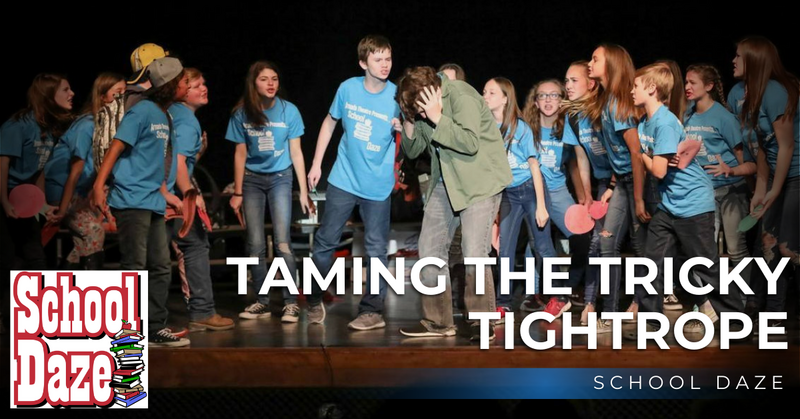
See the characters in School Daze try to keep their balance on the first day of middle school.
Thanks so much to Robin Caporuscio and the amazing student performers at Armada Middle School in Armada, MI for sharing their photos and experience with their production of School Daze:
âThis was a cast of all 7th and 8th graders and the show was their final exam for acting class and it was presented in an evening performance for the public.â
Featured Plays
Theatrefolk Featured Play â The Redemption of Gertie Greene by Taryn Temple
Welcome to our Featured Play Spotlight. _ The Redemption of Gertie Greene_ by Taryn Temple takes an upside-down look at bullying and the importance of standing up for those who canât do it for themselves. This play is a not-to-be-missed dramedy for middle school students.
New student Gertie Greene is a bully. Gossip spreads like wildfire that she attacks kids in the bathroom, knocks down football players, and gets suspended all the time. Even teachers are afraid of her. Everyoneâs talking about it so it must be true. But is she really a terrifying monster?
In The Redemption of Gertie Greene the truth comes out in the most unexpected ways. Is Gertie really what everyone calls her: a freak, strange, stupid, clumsy, and mean? Or can Mrs. Fillmoreâs quirky drama students see past the scuttlebutt to discover the real person behind the rumors? As they separate fact from fiction, Gertie and her fellow drama students bring to light the transforming power of kindness, and the importance of standing up for people who canât defend themselves.
Why did we publish this play?
Plays about bullying can leave a sour aftertaste, especially if the message has the bully stand up and accept the error of their ways. It just doesnât happen that way in real life. And itâs not fair to say âbullying doesnât happenâ because it does happen. Every day. Bullying is a relevant topic in every school at every level. Thatâs why the backwards look at bullying in this play presents a refreshing change. It opens the door to conversation about the topic, which is what all issue plays should do. Itâs not about solving the issue in 30 minutes. Itâs about prompting the conversation to continue after the curtain goes down. Check it out.
Letâs hear from the author!
1. Why did you write this play?
Middle school is tough. Kids are exploring the kind of person they want to be, who is âinâ and who is âoutâ of their friend groups, and how they should treat others. I wanted kids to see their own struggles reflected in the characters in this play, and help them start conversations with other kids and with adults about what they are going through.
2. Describe the theme in one or two sentences.
Itâs important to include people and stand up for others, especially those who canât stand up for themselves.
3. Whatâs the most important visual for you in this play?
When each student in drama class stands up and gathers around Gertie one by one, recognizing her gifts and making her a part of the group. Sheâs been an outcast up until that point. Itâs a lovely image of inclusion when the other students are finally the ones that stand up for her.
4. If you could give one piece of advice for those producing the play, what would it be?
Use this play as a springboard to start conversations with your actors and crew about times theyâve felt like an outsider, how someone made them feel included, and how they can (appropriately) step in and help people when someone is being bullied.
5. Why is this play great for student performers?
The situations in the play feel relatable and real to the actors so they buy in, plus it has some serious scenes to give young actors a chance to widen their range.
Featured Plays
Theatrefolk Featured Play â The Super Non-Heroes by Taryn Temple
Welcome to our Featured Play Spotlight. Have you ever wanted to be a super hero? The Super Non-Heroes by Taryn Temple is a fabulous middle school play that looks at friendship, acceptance and discovering yourself.
Have you ever felt like you donât belong? Powerless Charlie sticks out like a sore thumb in a school full of superheroes. Smellinator canât control her powers and forgot to do her Villain 101 homework. Golden Boy wonât follow protocol. And Toxic Sludge is, well, toxic sludge.
When a supervillain attacks the school Charlie must dig deep within herself. She may not be a superhero but she discovers her unique talents to save the day.
P.S. Also available in a fun competition-length version too!
Why did we publish this play?
This play is an absolute gem. Not only is the writing smart and funny, not only are the characters amazingly vivid (who wouldnât want to play a super-hero?) but thereâs a message about friendship, finding your true self, and acceptance that is played perfectly. I highly recommend this script.
Letâs hear from the author!
1. Why did you write this play?
At some point we all feel like if we were different somehow life would be easier. We would fit in better, we could easily do something we struggle at, etc. That feeling is universal. So I wanted to show that even people that the rest of us would perceive as âsuperâ can have those feelings, too. Having special talents or abilities doesnât guarantee that everything is super all the time.
2. Describe the theme in one or two sentences.
Be kind to people, especially those that are different from you. And we are stronger together than we are by ourselves.
3. Whatâs the most important visual for you in this play?
When Charlie asks to sit with different groups of people but they all turn her away so she sits by herself. Then Reflector and her group of friends walk across the stage in front of everyone and sit with her so sheâs not alone.
4. If you could give one piece of advice for those producing the play, what would it be?
Have fun and play with the âsuperheroâ stereotype (go big, lots of bright colors, super music, epic battles, big gestures, larger-than-life personalities, etc.) but also find and highlight the moments that show these characters as ânormalâ kids struggling with their everyday lives.
5. Why is this play great for student performers?
First of all, itâs fun! Your students will get to play unique characters with quirky super powers and wear bright, colorful, superhero costumes. Secondly, your students will be able to connect with the characters. I think often middle school kids can feel lonely, like no one understands what they are struggling with. Despite having super powers, the characters in this play are battling many of the difficulties your students face day to day, things like fitting in socially, succeeding or failing at school, the culture of popularity, standing up to bullying, and trying to work as a team with people you donât always get along with. The conversations that can happen as you bring this show to life will help students realize they arenât alone, and that others are fighting these battles daily, too.
Featured Plays
Middle School Magic: Box
If youâre looking for a middle school play that has it all, look no further than Box by Lindsay Price. Flexible casting, small scene and monologue opportunities, and dealing with issues that middle-schoolers can relate to, this vignette play is not to be missed.
Sometimes we choose the way the world sees us. Black box â indestructible. Jewelry box â plain on the outside, shiny on the inside. Sometimes our box is defined by others â our parents, our friends, our enemies. A box built by others can feel small, confined, impossible.
How do we handle the boxes imposed upon us because of our gender? Our race? From peer pressure? From parent pressure? Do we have to live with our box for the rest of our lives? Can we change?
Director Sally Vopnfjord was thrilled to share the success of the amazing student performers at Kipling Collegiate Institute in Toronto, Ontario, who were able to create and share their own middle-school magic:
âOur school recently performed BOX as part of the National Theatre School Drama Festival (formerly Sears Drama Fest). Despite competing in the festival for the first time and featuring first-time actors â we won! We were selected as one of the top 3 shows in our district. BOX will now be performed in the Toronto Regionals at Hart House â fingers crossed that we can take this show all the way to the Provincial Finals.â
Congratulations on your success, Kipling Collegiate!
Featured Plays
A Connection Across Cultures: Box
âThis is the box my parents want for me. This is who my parents want me to be. A shining star⌠I donât want to disappoint my parents, but this is not my box.â
How do we handle the boxes imposed upon us because of our gender? Our race? From peer pressure? From parent pressure? Do we have to live with our box for the rest of our lives? Can we change?
Box by Lindsay Price is a middle school vignette play with flexible casting. It can be expanded for a large cast or reduced to a cast of 10 with doubling. Excellent small scene and monologue opportunities.
Under the direction of Stephanie Brook the student performers at GEMS World Academy in Switzerland demonstrated that the challenges of choosing how the world sees us is shared by students worldwide.
âThis was performed by my theatre class made up on only Grade 6 students (ages 11-12), from a variety of backgrounds and nationalities. We have Italian, Spanish, Swiss, Canadian, American, British, Scottish, Irish, Filipino, Dutch, Argentinian, Venezuelan, Brazilian, Israeli and Portuguese, to name a few.
I had to do a lot of unpacking of the material for them to understand what the play was speaking about, but this is a beautiful age to be addressing stereotypes and âboxesâ, and they really connected with it. I have been receiving messages from parents all evening telling me how wonderful it was.
Several of the parents, kids and staff at school commented on how relevant, how real and how engaging the play was. One of the students really connected with it, and she was in Grade 4! She said it helped her to understand a lot of what goes on at school.
The school counsellor wants us to take this on as a Grade 6 play every year â she thinks it is so perfect.â
Congratulations GEMS World Academy!
Featured Plays
Performing with the Playwright: The Redemption of Gertie Greene
New student Gertie Greene is a bully. Gossip spreads like wildfire that she attacks kids in the bathroom, knocks down football players, and gets suspended all the time. Even teachers are afraid of her. Everyoneâs talking about it so it must be true. But is she really a terrifying monster?
In The Redemption of Gertie Greene by Taryn Temple, the truth comes out in the most unexpected ways. Is Gertie really what everyone calls her: a freak, strange, stupid, clumsy, and mean? Or can Mrs. Fillmoreâs quirky drama students see past the scuttlebutt to discover the real person behind the rumors? As they separate fact from fiction, Gertie and her fellow drama students bring to light the transforming power of kindness, and the importance of standing up for people who canât defend themselves.
The student performers at Pioneer Trail Middle School in Olathe, Kansas had an amazing opportunity to not only perform this incredible play, but were fortunate enough to work directly with the playwright herself. Drama teacher and director, Sarah Mattie , reached out to Taryn, inviting her to the performance and to see if she would be willing to video chat with the cast. The result was an amazing experience for everyone involved!
Playwright Taryn Temple shares her thoughts on the experience:
âThey asked great questions about where I got the inspiration for the show, how I saw the characters when I wrote them, if I had doubts about including tough subject matter like the scene between Nicole and Pete Mackleson, and even what hobbies I had outside of theater. I also got to ask them questions like what they hoped the audience would take away from the show (the boy that played Pete Mackleson said, âI want people that watch the show to know that even though this is a play it is also real life, that things like this really happen to us.â), and what experiences theyâve had with bullies in the past.
I got to go see their show and they did a great job! They were ecstatic to see me (I felt like a pop star).
One extra fun note: the girl that originated the role of Shannon was able to come to the show, too! (I work with her momâŚhee hee!) The picture of the girl with the roses on her shirt (new Shannon) and the girl in the grey jacket (original Shannon) are the two Shannons meeting each other!
On the playbill the included statistics about bullying, and what adults and kids can do to fight bullying. The kids created their own PSA at the end of the show (completely the studentsâ idea!). They came out for the curtain call holding posters with negative words and phrases they have witnessed or that have been said to them. One member of the cast stepped forward and read a PSA about how we can stand up to bullying and work to make the world a better and more positive place. Then all of the students flipped their posters over and on the back was written positive compliments and affirmations. It was so personal. It brought tears to my eyes.â
Featured Plays
An Introspective Middle School Journey: Hoodie
Middle school can be tough. What do I wear? What if I wear the wrong thing? What is she wearing? What do I look like? Stop looking at me! Hoodie by Lindsay Price examines image and appearance in the vignette style and poses what may be the most difficult question of all â Do I stay in the clump or do I stand alone?
The drama group at Turning Point School in Culver City, California asked themselves some of these tough questions as they navigated their way through this issue-based dramedy. Director Jane McEneaney shares her thoughts on this amazing journey:
âIâm writing to thank you for your play, HOODIE. We performed on Friday and it was so successful. The play is just the tip of the iceberg. The girls (no boys signed up) learned so much about themselves. It was fantastic!
The girls also sponsored a Mirror-Free Friday in honor of the show. This involved covering the bathroom mirrors with paper and inviting everyone to look at the beauty inside and write positive comments on the paper. I canât thank you enough for this script.
As well, the cast did a talk-back with the audience after the performance and revealed quite a bit about their own struggles and how that challenged them as actors.â
Great job, Turning Point School!
Featured Plays
Theatrefolk Featured Play: Boat by Lindsay Price
Welcome to our Featured Play Spotlight. Weâre excited to introduce a brand new play to our catalogue! If youâre a fan of Hoodie and Box, then you definitely want to check out Boat by Lindsay Price.
Sometimes itâs easy to see the world as your own personal sinking ship. Itâs way easier to look into our own whirlpool than look out at whatâs going on with others. I donât care about them. Why should I? Theyâre not like me. Theyâre wrong.
In this one-act middle school vignette play, characters come face-to-face with the fact that there are other people in their boat. Some are different. Some only seem different.
Who will learn to paddle together? Who will spin in circles? Who will realize weâre all in the same boat and we always have been?
Letâs hear from the author!
1. Why did you write this play?
Boat is the third play in a trilogy of vignette plays I wrote about middle school life â the others being Hoodie and Box. Middle school is a time when students are so focused on themselves and how they present in the world. To that end, for this play I wanted to put the emphasis on looking outward rather than inward.
2. Describe the theme in one or two sentences.
The theme of the play is empathy. How do we empathize with others? How do we realize that weâre all in the same boat and always have been?
3. Whatâs the most important visual for you in this play?
The first visual that comes to mind is two boys who hate each other, find common ground in a fear of falling elevators, and cling to each other for dear life.
4. If you could give one piece of advice for those producing the play, what would it be?
The opening movement section will take practice â walking in lines can be tricky because itâs hard to get everyone moving at the same pace and the same foot stride. Iâd suggest video taping your efforts so students can see when the movement is sharp and crisp and where it looks messy. Thatâll be way better than trying to verbally explain any issues. Also, when the two groups are on stage, think in shapes and levels. Make sure the audience can see everyone at the same time, and create an interesting stage picture at the same time.
5. Why is this play great for student performers?
This play is about middle schoolers, with middle school aged characters, and addresses middle school issues. Itâs great for them!
Featured Plays
Navigating the Tricky Tightrope: School Daze
Do you remember how you kept your balance on the first day of middle school? In the one-act comedy, School Daze by Lindsay Price, middle-schoolers navigate the tricky tightrope between being a kid and being a teenager. Alton Bryant and the drama students at Haynes Bridge Middle School in Alpharetta, Georgia had a great time taking on this vignette play and entertaining students, teachers and audiences alike.
âThe students love it and the teachers love it as well. We videotaped a few teachers talking about their first day in middle school and played the video right before the play started .â
Great job, Haynes Bridge Middle School!
Featured Plays
Award-Winning Play for Middle School: Hoodie
Drama teachers, if youâre looking for a production for your middle school group thatâs great for group work and focuses on issues your students can relate to, be sure to check out Hoodie by Lindsay Price. Middle schoolers face a tornado of questions every day. What do I wear? What if I wear the wrong thing? What is she wearing? What do I look like? Stop looking at me!
Hoodie examines image and appearance in the vignette style and poses what may be the most difficult question of all â Do I stay in the clump or do I stand alone?
The talented drama students at Lee Scott Academy in Auburn, Alabama, led by drama teacher Tricia Oliver , tackled these relevant issues in this engaging play which led them on an extremely successful journey.
âI ended up going with a 7 minute cutting from Hoodie for our ensemble piece for our 15 girls (7-12th grade) and we won 2nd place at our state competition! We will be reworking the piece to perform it at Alabama Thespian festival with my senior thespians.
â Tricia Oliverâ
Congratulations on your award-winning performance, Lee Scott Academy!
Featured Plays
Thinking Outside of (and Within) the Box: Box
How do we handle the boxes imposed upon us by society? Help your students choose how the world sees them with the issue-based vignette play, Boxby Lindsay Price. Perfect for middle schools, Box offers flexible casting along with excellent small scene and monologue opportunities.
How do we handle the boxes imposed upon us because of our gender? Our race? From peer pressure? From parent pressure? Do we have to live with our box for the rest of our lives? Can we change?
Under the direction of Deborah Horn , the drama students at B.L. Gray Junior High in Mission, Texas built upon their previous success with Hoodie to tackle the relatable issues in Box.
âThe Theatre I class at B.L. Gray Junior High presented âBoxâ on November 17, 2016. Because I am working with multiple classes, I always look for vignette plays so that I can divide the scenes between classes. We had such success with Hoodie in 2015 that I wanted to try Box. The growth that I saw in the scholars was impressive. Their stage presence, projection, physical and vocal characterization all improved tremendously. Knowing how much these students each grow by participation in theatre is the best part of play directing.
â Deborah Hornâ
Way to go, B.L Gray Junior High!
Featured Plays
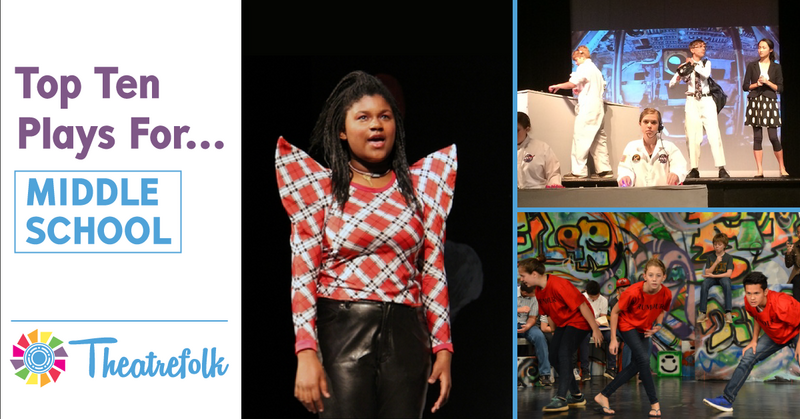
Theatrefolkâs Top 10: Recommended Middle School Plays
Time for a Tfolk Top Ten Plays ForâŚMiddle School! Youâre a middle school teacher looking for material specifically written for your students. Youâve come to the right place! We specialize in middle school plays with age appropriate characters and look at the issues middle schoolers are dealing with right now.
Click the link and youâll be taken to the webpage for each play. There youâll get the details and read sample pages.
All the best with your search!
Box
Sometimes we choose the way the world sees us. Sometimes weâre put into a box by others â parents, friends, enemies. How do middle schoolers deal with perception? A vignette play with great small scene and monologue opportunities.
Frankenstein vs the Horrendous Goo
This play is a delight. Three dimensional characters, fabulous dialogue, creative staging of a horrendous mutant polymer! Students, administrators and parents get âgoo-edâ by a green slime with a mind of its own. Why is Frankenstein called into save the day?
The Pauper Princess
A twist on The Price and the Pauper with two girls in the lead roles and Elizabethan England as the location. The Princess is Princess Elizabeth and the Pauper is a girl hiding as a boy in a location theatre production. A huge cast with roles for everyone who tries out. Donât be scared by the era itâs Shakespeare meets modern middle school!
Roshambo
Some people take Rock-Paper-Scissors (aka Roshambo) seriously. Very seriously. So seriously they organize championship matches with national rankings. A middle school comedy that looks at what people will do to win. Theyâre not above an illegal scipper.
The Redemption of Gertie Greene
An upside down look at bullying in middle school. Is Gertie really what everyone calls her: a freak, strange, stupid, clumsy, and mean? Ms Fillmoreâs drama class separate fact from fiction and the importance of standing up for those who canât do it for themselves.
School Daze
The first day of middle school can be a house of horrors. Will I fit in? How will I find the right class? A vignette style play that you can do with a class. This play has found a lot of success with schools performing it for their incoming students.
Ariadneâs Thread
Bring Greek mythology to life! A fantastic modern version of the Theseus and the Minotaur myth complete with an active chorus. Choral speaking, a twist on the traditional story and a lot of humour.
The Magic Diary of Mozambique
Darla feels invisible and that nothing goes her way. She wishes she had a better life. When her globetrotting sister gives her a diary, Darla thinks itâs just another dumb present. Then, bizarre things start happening and suddenly EVERYTHINGâS going Darlaâs way. Be careful what you wish for.
Hoodie
Hoodie examines image and appearance in the vignette style. It poses what may be the most difficult question of all for middle schoolers â Do I stay in the clump or do I stand alone?
Almost History: that whole space time continuum thing
A Reporter and a Sidekick livestream from great moments in American history. While middle school students watch, the Reporter gets into a number of misadventures and changes the course of history. Even Einstein and Marie Curie cannot undo the disaster! Itâll take a miracle to restore order to the âwhole space-time continuum thing.â
Directing
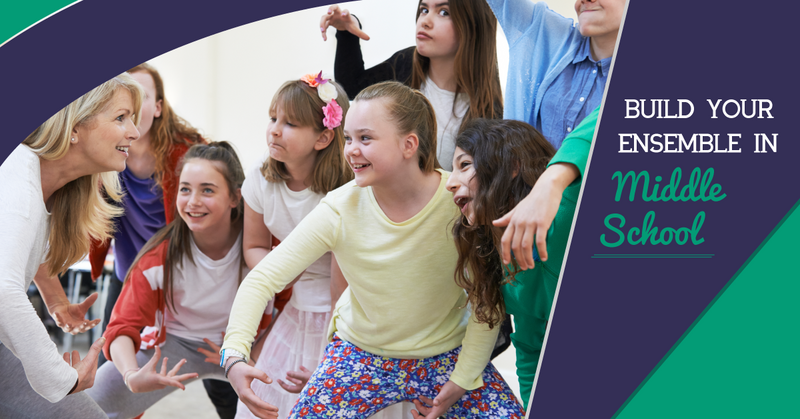
The Ensemble in Middle and High School Plays
Ensemble Definition
A unit or group of complementary parts that contributes to a single effect; all the parts of something considered together and in relation to the whole; the general or total effect of something made up of individual parts all together, all at once.
Whether youâre working with high school or middle school students, the word âensembleâ will be part of your vocabulary. Depending on how you use the word, it can be a positive or negative experience for your students. Many equate the word âensembleâ with âchorus,â implying that to be in the ensemble means youâre not as good as the other actors. But when you look at the definition, you can use the word to motivate your group to think together, work together, and focus on the end goal together.
5 Ways to Motivate Your Ensemble1. From day one, think of the entire group as the ensemble.
Call them as such. Emphasize that everyone is working toward one whole. Every actor, everyone involved. That an ensemble is all parts together, and only works when every part is cohesive together not one side here and one side there. An ensemble is a community and that is what the cast of a play should be.
2. Teach the community to work together from the first rehearsal.
Incorporate exercises at every rehearsal that involve the entire cast working together and that only work if the entire group comes together as one.
⢠Tongue Twister exercises for ensemble building
⢠Ensemble Monologue exercise
Note: Find a downloadable PDF link to more Ensemble exercises, at the end of this post.
3. Teach the ensemble their important role how important they are in helping to create the world of the play
Just because youâre not talking in a scene, does not mean youâre invisible. If you can see the audience, they can see you. If youâre not in the momentâif youâre picking your nose or scratching your buttâthe audience can see that. If youâre not in the world of the play, youâre creating a distraction for the audienceâand that means theyâre not in the world of the play. Ensemble actors can learn the importance of being a character in the scene. Stress the importance of keeping focused on the action, even when they arenât active in the dialogue. This will keep the audience in the world of the play.
4. Make the ensemble the focus.
Have rehearsals just for the ensembleâmake them a key part of the experience of the production. Make sure each ensemble character has a name and a background that helps the world of the play. Make them think about how they interact with each other, in character, while the main action is going on.
5. Remind your ensemble that the audience is counting on them.
The audience counts on every member of a cast to keep the world of the play real and engaging, whether or not a cast member has lines or is part of the atmosphere. Sometimes itâs an ensemble player who shines brightest, not because they are hogging the attention, but because they are so in character that they are a delight to watchâa walk, a look, a shrug of the shoulder.
As student actors and professionals, what it comes down to is that your experience is what you make it. It can be a bitter, boring ensemble experience (âIâm not doing anythingâ), or it can be an exhilarating time with a wonderful, life-changing community that you will remember forever.
Playwriting
5 Great Playwriting Exercises for Middle & High School Students
Strong writing takes practice - and the right kind of practice makes all the difference.
Explore five of our most popular playwriting exercises for middle and high school students, designed to strengthen storytelling skills, sharpen character development, and build creative confidence. Each exercise includes a free downloadable PDF or classroom-ready handout so you can put it to work right away.
1. âHurdling the First Lineâ Playwriting Exercise
Itâs always easier to give in to writerâs block than to overcome it. Use this exercise to jump over that hurdle.
2. âName Gameâ Title Exercise
Whether itâs a movie, novel, or play, the title acts as a doorway into the piece. Use this exercise to practice creating a variety of titles based on a photograph.
3. âInner Monologueâ Playwriting Exercise
If you get into the habit of observationânoticing the details about people, places, and thingsâyouâll never run out of material to write about.Try this inner monologue exercise to sharpen studentsâ observation skills.
4. âSubtextâ Playwriting Exercise
Subtext adds depth. Thereâs the verbal conversation that two characters are having, then thereâs the nonverbal conversation underneath the verbal conversation. This exercise includes 4 sets of writing prompts for students to uncover the meaning behind the words.
5. âSix Impossible Things Before Breakfastâ Creativity Exercise
Being creative means being confident that you can solve a problem in a new way, regardless of what other people think. This post comes with an âimpossible scenesâ exercise and a downloadable poster for your classroom!
Podcast
Theatrefolk Podcast: Middle School Theatre in a Rural Community
Episode 126: Middle School Theatre in a Rural CommunityPatrick Derksen works in a school with 200 students. In total. Heâs a grade eight classroom teacher and playwright who decided five years ago to make theatre with his students.
Find out how he does it, why he thinks theatre is important in middle school and his advice for other rural teachers wanting to do the same.
Podcast
Theatrefolk Podcast: Middle School Play Mania: Multiple Plays with Multiple Classes
Episode 121: Middle School Play Mania: multiple plays with multiple classes
Middle School Teacher Jessica Stafford isnât just doing one play. Sheâs doing a play with multiple classes. And sheâs not doing the same play, each class gets their own play. How do you produce multiple plays with multiple classes and not go crazy? Listen in and learn!
Featured Plays
One Act Plays for Middle School
Choosing one act plays for middle school is not an easy task.
The students are at a very in-between point in their lives. They no longer want to be seen of as âkidsâ yet many are not quite ready to tackle heavier issues. Play selection is a total âyour mileage may varyâ situation. It depends on each specific set of kids. Some will be content with fairy tales while others will want intense make-âem-cry dramas.
Here is a direct link to all of our one act plays for middle schools.
I reached out on our Facebook page for some feedback from middle school teachers: âWhat are the major factors you need to consider when selecting a one act play for your middle school?â
Here are some of the more representative responses we got.
âLarge cast size (25-35) for my classes, appropriate for their age, doesnât focus on typical angst of the MS student, it needs to be mostly funny (theyâll get enough serious stuff at the HS level), and I LOVE vignettes which allow me to cast many kids in roles The Snow Show ~ Jessica Landry Stafford
âIt has to have a message. My students donât like fluff. They want something to sink their teeth into. It also has to have a good ending. I have found most one act plays just drop off and donât have strong endings.â ~Leslie McKibben
âCast size over 20. Smart script. Age/audience appropriate but not talking down to teenagers. Would love to see more stories that werenât necessarily anchored in school angst.â ~Aidan OâHara
âA play âthe cast and crew will care about.â Most middle schoolers are not yet such experienced theatremakers that theyâll enjoy doing any show for any reasonâthe story needs to engage them pretty quickly for them to commit to the process.â ~Becky Schlomann
âI always think about the talent that I have available at the school and choose a show that will make all their talents shine. I want to pick a show that will both challenge the students, but also engage them and nurture their love for theatre.â ~Bethany Kennedy
âNo more mangling of fairy tales or Shakespeare! Something that they can sink their teeth into without being angsty. Heavier on girls. Boy roles where they donât have to be âmanly.ââ ~Amy Medina
âOpportunity, creative challenges, meaningful and accessible character development. LOVED Tick Talk for middle schoolers in particular, BTW.â ~Jessica Shulman McGettrick
As you can see, the answers are wide and varied. Thereâs no magic bullet. Thereâs no âone size fits allâ play for a middle school group. Choosing a one act play for middle schools depends heavily on the group of kids that you have at the time.
Here are some of the main factors brought up by our Facebook fans.
AppropriatenessAppropriate is in the eye of the beholder. It would be impossible to say whatâs âappropriateâ because standards vary.
Our customers request plays that run the gamut between requests to remove all references to dating from a play (a play that doesnât show a date, it just uses the world) to our most challenging plays, some of which arenât even on our recommended list of plays for middle schools.
Cast sizeThis one was almost universal. A large cast size is important. This is particularly tough in a one act play format. Writing a play that has a lot of characters isnât challenging, but it is challenging to develop them all, to give them individual traits so the actors feel like they can contribute as individuals to the production.
Some of our one act plays that achieve this nicely are:
⢠Funhouse â a bullying play with a cast of 20
⢠The Absolutely Insidious and Utterly Terrifying Truth About Cat Hair â A fun play with a long title and a huge cast.
⢠Shuddersome: Tales of Poe â A very large cast adaptation of Poeâs most theatrical stories
⢠Lord of the Pies â a delicious parody of Lord of the Flies
Students Can Relate to ItThe plays we publish and promote for middle schools tend to have the majority of characters of student age (except in the case of literary adaptations). Itâs important that the characters and the situations they find themselves in are realistic and relatable. Not necessarily how adults see the middle school student, but how they see themselves.
The Play Stretches the PerformersItâs important that the play stretch them as performers. But âstretchâ doesnât have to mean âa different age, like grandparentsâ In the professional world, for example, Iâve always played roles that fit my age and every experience Iâve had has stretched me as a performer.
A meek student can be stretched by playing a bully. A straightlaced student can be stretched by playing a troubled kid. Typecasting is lovely and it makes casting easy, but if youâre looking to stretch kids then itâs important to cast against type sometimes. At the end of the day the most important thing in educational theatre is the studentsâ learning experience.
For example, our middle school play The Happiness Shop looks at the issue of Middle School Depression. This is a serious topic and allows middle school students to tackle a big issue in a theatrical manner.
The Fractured Fairytale DebateSome people on our Facebook post said they love fractured fairytales, others are sick of them. Thatâs what makes art so wonderful â there are plays to suit every taste.
We donât have any fractured fairytales but I donât think thereâs a single thing wrong with them besides the fact that itâs very easy to write a bad one. Iâve seen so many come through our submission process that just arenât theatrical. They are just re-worded versions of fairytales â parodies or spoofs. They are funny on the page and thatâs probably the medium they belong in.
The best way to tell if a script is theatrical or not is to ask yourself these questions: How will staging this play (bringing it to life) differ than just reading it? What parts of the script would be enhanced by live performers? Can you visualize the script in action when you read it? Do you see people moving? Are there moments that will affect the audience? If you struggle to answer these questions then thereâs probably not much theatre written into the play.
I have no doubt that weâll publish a fractured fairytale at some point but when we do it will also work as an engaging piece of theatre.
Here are a couple of examples of **adaptations/parodies that work as theatre:**
⢠Drop Dead, Juliet! â Juliet tries to change her inevitable death at the end of the play and engages in a battle of wills with William Shakespeare.
⢠Circus Olympus â A collection of Greek myths come to life. The script encourages liberal use of circus skills â whatâs more theatrical than a Greek myth & circus mashup?
⢠Rebootililzation â Not a one act, but this clever play incorporates a ton of fairtytale and literature based characters.
More Girls than BoysThis is a purely logistical issue. More girls audition for middle school shows than boys. Pretty much all of our plays have more girls than boys for this very reason. We also try our best to get some gender-neutral characters in there for casting flexibility.
Bradley Haywardâs Apostropheâs and Sixteen in Ten Minutes or Less are both fantastic choices for flexible casting.
Simple StagingIn our experience, the middle school budget is limited. The middle school play is more about putting as many students on stage, rather than having the most elaborate staging. We got you there, too. We always aim for scripts that are easy to stage. Our running joke is that most of our plays can be staged with two chairs and a cube and if youâre really pressed for budget, then one of the chairs could be cut.
Personal TasteBecky Schlomann had this to say about what kinds of plays she looks for: âSomething I personally like. Iâm going to be spending more time with the script than anybody, and if at the beginning of the process I hate it, by the end of the process Iâll be ready to poke my eyes out.â
This is the main reason that every play on our website comes with an extensive free excerpt. That way there are no surprises when you order a play for production, and you donât have to order a dozen perusal scripts based on a catalogue blurb only to end up disappointed that none of them appeal to you.
There are a lot of one act plays for middle schools on our website. If that overwhelms you, feel free to email us or use our live chat through this page. Tell us your likes, dislikes, cast size, and the age of your group. Weâre always happy to send recommendations your way.
Podcast
Directing the Large Cast Middle School Play
Episode 111: Directing the Large Cast Middle School Play
Itâs one thing to want to put every middle schooler who auditions on stage. Itâs another thing to pull off a successful production. How do you actually direct a large cast middle school play without feeling like a traffic cop?
Podcast
Directing the Middle School Musical
Episode 108: Directing the Middle School Musical
Brian Borowka teaches a grade 8 musical theatre class which culminates in a production. He passes on his tips for directing a middle school musical, the challenges for casting an entire class and, his favourite/least favourite experience.


.png)
.png)

.png)