📣SCRIPT SALE! Treat yourself to an easier Fall. Save 30% on 5+ perusal scripts with code SPRING30 before May 3 and head into summer stress-free.
Movement Based
Featured Plays
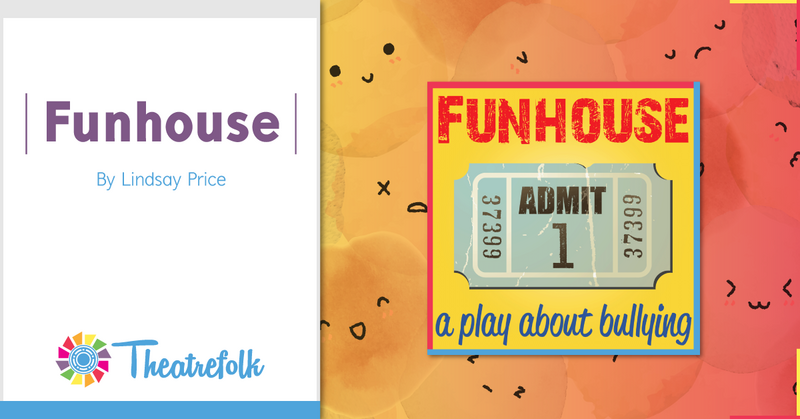
Theatrefolk Featured Play – Funhouse by Lindsay Price
*Welcome to our Featured Play Spotlight. * Funhouse by Lindsay Price is an incredibly unique and challenging vignette-style play that is an excellent catalyst for conversations around bullying.
This play looks at the bullied, the bully, and the bystander through mostly non-verbal vignettes. Life for the bullied is like a funhouse, but the funhouse is anything but fun.
How can you stand your ground when you’re on a falling floor? How can you move forward when you’re caught like a mouse in a maze? How can you win Whac-A-Mole when you’re the mole? How can you like yourself while standing in a distorted hall of mirrors?
There are no cotton candy answers here.
Why did we publish this play?
A lot of our plays come from listening to customers. A piece of feedback from middle school teachers we received is that they loved our non-verbal play _Emotional Baggage _but the concept was a little beyond their students. Could we provide one specifically for middle school? With a larger cast? _ _
Funhouse looks at the bullied, the bully and the bystander through mostly non-verbal vignettes. When looking at other plays on the topic, there wasn’t a lot we liked – many end with a bully-bullied confrontation in which the bully instantly sees the error of their ways and promises to be a better person. And they all lived happily ever after. This never happens in real life. Can bullies change? Of course! But not in one moment on stage. It’s so destructive to show such a fairy tale ending because there will be students in the audience watching the show, being bullied, knowing their situation is not being represented. And therein lies a huge problem.
Issue plays are tricky because they deal with issues that are happening right then, right now to someone watching the play. It’s not therapy, it’s not an informational brochure and theatricality must always preside, but the issue play does have some responsibility to address the reality of the issue.
Having said that, just as you can’t show the sitcom “everyone loves each other” happy ending, you can’t go to the other extreme and show flat out no-win annihilation. Because then that student sitting in the audience, being bullied, has the very terrifying thought of, “Well there’s no hope, is there?” And that is something we’re not prepared to sit on the shoulders of a 10- or 11-year-old.
_Funhouse _has the right balance between the extremes, in a theatrical context and that’s why it’s in our catalogue. It’s unique and a great catalyst for post show discussion on the issue of bullying. It’s a challenging piece, but by no means is it beyond the middle school scope.
Let’s hear from the author!1. Why did you write this play?
I heard from middle school teachers that they loved the non-verbal elements in Emotional Baggage but were looking for a middle school specific play, and could it have a larger cast? Done and done! I had seen a number of plays that addressed the topic of bullying and wasn’t happy with what I saw – a lot of bullies seeing the error of their ways. I wanted to write something different.
2. Describe the theme in one or two sentences.
The funhouse aims to turn reality upside-down – it shows you a distorted version of yourself in a mirror. It tilts the floor away when you least expect it. It jumps out at you from the shadows. It distorts the truth. It’s a vivid image for what life is like for the bullied.
3. What’s the most important visual for you in this play?
Sometimes the bullies win. That’s important to show. These acts are vital to the reality of the play, for indeed they are vital to showing the reality of what a bullied student must face.
4. If you could give one piece of advice for those producing the play, what would it be?
It’s a play that relies primarily on action rather than dialogue, so that’s going to be your focus. How does action tell the story in each moment? It’s a challenging play but by no means beyond the middle school performer scope.
5. Why is this play great for student performers?
The scope of bullying is pretty far reaching these days, from physical to verbal, to the different ways boys bully than girls, to the insidiousness of cyberbullying. This play offers a opportunity for students, in the play and watching the play to engage in conversations on this, unfortunately, extremely relevant issue.
Get your copy of Funhouse_ _right here, right now!Not right for your group right now? Search our play catalogue to find one that your performers will love!
Featured Plays
Theatrefolk Featured Play – Shuddersome: Tales of Poe by Lindsay Price
*Welcome to our Featured Play Spotlight. * Shuddersome: Tales of Poe by Lindsay Price is a creepy, cross-curricular masterpiece with tons of flexibility, theatricality and a whole lot of fun.
The thumping of a heartbeat. The creek of a door. The howl of a bitter wind. The gong of a clock tower. The clang of alarm bells. The sound of beating wings getting closer and closer…
Specters, ghosts and ghouls come alive in this vivid theatrical adaptation of some of Edgar Allan Poe’s best-known works. Included are The Tell-Tale Heart, The Raven, and The Masque of the Red Death.
Poe’s words rise from the page like corpses from the grave. Be careful. Do you hear that tap, tap, tapping?
Let’s hear from the author!1. Why did you write this play?
Adaptation is my favourite form of playwrighting and I love the creepy, scary, macabre stories of Edgar Allan Poe. I thought it was a perfect marriage.
Little did I know. This play was actually a huge challenge to write. Taking a piece of literature from one medium and transforming it into another, is not easy. Poe writes in a way where it’s the single reader’s imagination that takes charge of the interaction. The story lives in the mind of the reader. In a play, we can’t be inside everybody’s head at the same time. We need action and theatricality to do the work. It took over a year to find the right balance of staying true to Poe’s intention and creating a theatrical experience, but I’m really happy with the outcome.
2. Describe the theme in one or two sentences.
Death, Morality, Revenge, Jealousy, come to life from the page like corpses from the grave.
3. What’s the most important visual for you in this play?
The Shudders. They are Poe’s specters, ghosts and ghouls staring you down from every corner of the stage.
4. If you could give one piece of advice for those producing the play, what would it be?
Watch the tone. If everything is played with the same creepy feeling, then the play is going to come across as one note. Which I know is not your intention!
5. Why is this play great for student performers?
I’m often told by teachers and students that this play is a challenge. It’s not easy stuff. But it’s a rewarding challenge. It’s creepy and cross-curricular which makes it great for classroom study. There is also a number of different of storytelling styles that offers student performers a wide variety of challenges. There’s even a humourous story! (Did you know Poe wrote comedies?)
6. Do you have any advice for people looking to perform this play online or socially distanced?
If you’re performing socially distanced, explore how the the isolation between characters impacts the creepy atmosphere of the storytelling. Light and sound will also be your best friends. The Raven would work very well with the different characters in their own areas of light. If you’re doing The Bells virtually, I’d suggest not using unison speaking and play with how the text sounds using individual speakers. Have fun with it! Explore different options, you won’t know if something works or not until you try.
Featured Plays
Theatrefolk Featured Play – The Butterfly Queen by Christian Kiley
*Welcome to our Featured Play Spotlight. * The Butterfly Queen by Christian Kiley looks at the nature of sacrifice and putting others first, and is an opportunity to have a truly transformative experience with your students.
One teacher protects her class from danger. One bystander helps someone timid overcome a fear. One stranger saves another from a burning building.
We all have the capacity to put others before ourselves regardless of the consequences. That is the theme of The Butterfly Queen.
A touching ensemble piece where sacrifice is as simple as a pair of wings.
Why did we publish this play?
Christian is a long time Theatrefolk playwright and we are always thrilled to share his work. In _The Butterfly Queen _Christian explores how sacrifice can be passed forward and how the impact we have on others can be immense. This is a beautiful play with a vivid extended metaphor. The premiere production of _The Butterfly Queen _won its district festival with almost perfect scores. It’s easy to see why.
Let’s hear from the author!1. Why did you write this play?
I continue to be disturbed deeply, as I know many others are, by the violence in our schools. There are many brave people who have sacrificed their lives to save their students. In my small way, I wanted to honor those courageous teachers.
2. Describe the theme in one or two sentences.
We not only have the power to positively change someone’s life; we can save someone’s life.
3. What’s the most important visual for you in this play?
The transformation when Miss Victoria reveals her butterfly wings.
4. If you could give one piece of advice for those producing the play, what would it be?
Heart. Allow your heart to lead you during this process. It will take you back to your childhood and the people you love(d) with unconditional regard.
5. Why is this play great for student performers?
The students I serve and work with are the best at connecting with the depth of emotion involved in life. This is a chance for our talented young people to do just that.
6. Why is this play great for online performances?
I am curious as to how I might approach this if I were to direct it in an online production. I think creating a classroom that is separate for each actor (their private space) and making it communal, sharing it, finding common connections between the actors and their living/playing spaces would be a challenge that I would love to see articulated. Like most great questions, the answers of the talented people producing the play will always be best.
Get your copy of _The Butterfly Queen _right here, right now!Interested in studying this play with your class? Don't miss our FREE classroom study guide!
Not right for your group right now? Search our play catalogue to find one that your performers will love!
Featured Plays
Theatrefolk Featured Play – A Deep, Poetic Journey Into Something by Forrest Musselman
*Welcome to our Featured Play Spotlight. * A Deep, Poetic Journey Into Something by Forrest Musselman is a dramatic character study for high school student performers with excellent movement opportunities.
Jane wants to break out of her box. Colour cows green and the sky purple. She wants a deep poetic journey into something. The problem is she has no idea where to start.
As events spiral out of control around her, that box is looking better all the time. Will Jane choose to hide inside or change her life?
Why did we publish this play?
How many of you have students who feel trapped or boxed in? All they want is to be themselves, which can be the hardest thing to be. In “Deep Poetic” the main characters wants to break out of the box and doesn’t know how. The play’s artistic storytelling and use of shadow offers a really unique approach to this issue which we knew would resonate for both the teens in the show and those watching.
Let’s hear from the author!1. Why did you write this play?
I wanted to write a play for teens that explored the whole idea of feeling like you don’t fit in anywhere. It’s a pretty universal feeling for teens and I wanted them to know that it’s okay.
2. Describe the theme in one or two sentences.
It doesn’t matter what the end result is going to be, it’s the journey of getting there that’s the most important.
3. What’s the most important visual for you in this play?
The shadow work, for sure.
4. If you could give one piece of advice for those producing the play, what would it be?
Have the shadow screens and lights ready to go as soon as possible. The more time the actors have to play with body shapes and pictures, the better.
5. Why is this play great for student performers?
It’s a great movement piece that allows for some experimentation. And it’s a story about themselves.
6. Why is this play great for online performances?
You wouldn’t necessarily have to have the shadow imagery. So feel free to omit it as the story is strong enough without it.
Featured Plays
Theatrefolk Featured Play – Floating on a Don’t Care Cloud by Lindsay Price
*Welcome to our Featured Play Spotlight. * Floating on a Don’t Care Cloud by Lindsay Price is a powerful and emotional issue-based play that is a theatrical and vivid personification of drugs.
Jamie Peel is a pothead. He lives in his own world, a bubble, a cloud that calls his name and reaches out to him.
His sister TJ has watched him slowly drift away and doesn’t know what to do. Is she overreacting? Is it in her imagination? Should she tell somebody what she sees? Will Jamie ever talk to her again if she does? Will everyone see her as a snitch? Is it just pot?
An emotional tightrope between a sister and a brother and what really happens in the world of teenage marijuana use.
Why did we publish this play?
This play takes an issue and makes it theatrical. The theatre has to come first. Our stance on issue plays is that it’s not the job of the play to solve the issue, or point a finger. It’s the job of the play to show characters dealing with, struggling with, sometimes failing within an issue. This way the play ends and the conversation begins.
Let’s hear from the author!1. Why did you write this play?
Issue plays are important to me, not because they provide answers but because they ask questions. I think of the final moment of this play as the beginning of the conversation that should happen afterward.
2. Describe the theme in one or two sentences.
An emotional tug of war between siblings and what happens in the world of teenage drug use.
3. What’s the most important visual for you in this play?
The Cloud! It turns drug use into characters and allows Jamie to interact with others as he sinks deeper and deeper into addiction.
4. If you could give one piece of advice for those producing the play, what would it be?
Don’t go all slow with the Cloud. That will drag the pace of the play.
5. Why is this play great for student performers?
Personification is a wonderful theatrical element that all actors, let alone student actors, should explore.
Featured Plays
Student Drama Success: The Exile and the Onion Girl
The Exile and the Onion Girl by Lindsay Price is a vividly modern adaptation of Aeschylus’ play, The Libation Bearers.
Ore has been exiled for 10 years, working as a goat herder. Onee has been banished to the kitchen – 10 years is a long time to cut onions. Their mother murdered their father and it’s time to avenge his death.
Who cares if all Onee wants is her mother’s love? Who cares if Ore can’t remember what his father sounds like?
In Argos, it’s an eye for an eye, blood for blood, and watch what you say in front of the Domestics. They’re always watching, always listening. But blood is very complicated. And more blood doesn’t necessarily solve problems.
Sarah Hankins and the incredible student drama group at Clinton High School in Clinton, MS took their production of The Exile and the Onion Girl to the Secondary School Theatre Festival at the Southeastern Theatre Conference (SETC) in Louisville, Kentucky.
Two of the students involved in their production shared their thoughts on their experiences:
“I’m really glad we chose this production because it flows so smoothly and provides an excellent platform for me to learn more about the art of performing , not to mention the fact that we have advanced from both Dramafest and MTA with it! I can’t wait to perform in it again. ~ Julia M.
With Price’s skillfully modernized version of a classic Greek Tragedy paired with the hard work of the Clinton Arrow Theatre department, The Exile and the Onion Girl has become one of the most rewarding plays I have had the pleasure of being involved in. ~ Aaron G.”
Featured Plays
A Creative and Effective Interpretation: darklight
darklight by Lindsay Price is not only a fantastic vignette play for high school performers, it’s also an opportunity for discussion, community and communication on a topic that is happening to them and around them every day.
darklight examines depression and anxiety in teens. Characters fight their inner thoughts, search for their truths, and have surreal conversations with death. Some fail, some find hope.
This is a relevant and necessary issue to explore.
We were thrilled to learn about the incredible interpretation of darklight from Freeport High School in Freeport, Maine. Director Natalie Safley and the school’s talented thespian group were able to take the play and really make it their own through the creative use of their lighting and set design. As you can see from the production photos, a picture really does speak a thousand words… and in this case, many, many more!
Featured Plays
An Award-Winning Journey: Through the Looking Glass
Through the Looking Glass by Lindsay Price is a fantastical physical journey for both actor and audience, and a great companion to our adaptation of Alice.
Alice is back in Wonderland and things are more confusing than ever – Flowers talk, the White Queen cries before she pricks her finger, and there’s a life-sized chess game going on. Alice wants to play, but mostly wants to be queen. Will she make it to the eighth square?
Director Laura Michels was thrilled to sing the praises of the amazingly talented student performers at North Branch Area High School in North Branch, MN – and we can see why!
“We placed first at subsections, sections, and are performing at the state level at the Minnesota State High School League One Act Festival.”
Featured Plays
Theatrefolk Featured Play – Chemo Girl and Other Plays by Christian Kiley
Welcome to our Featured Play Spotlight. Chemo Girl and Other Playsby Christian Kiley is an incredible dramatic collection of plays that can be performed as a full night of theatre or as a cutting for competition.
A collection of plays that examine the impact of cancer as seen through the eyes of teenagers. Characters deal with the difficulty of saying the word cancer out loud, the difficulty of admitting a friend or family member has the disease, and the difficulty of finding the energy and the attitude needed to fight.
Why did we publish this play?
We are incredibly proud to publish Chemo Girl and Other Plays. Not only do we respect Christian Kiley as a writer, we love that he trusted us with this particular work as it comes out of his own fight against cancer. Christian has fully theatricalized “the C word” and examines the impact of cancer through the eyes of teenagers – that’s a perspective we don’t often see with this disease.
Let’s hear from the author!1. Why did you write this play?
In May of 2012, I got really sick and was diagnosed with Hodgkin’s Lymphoma. I wanted to do something meaningful, powerful even, while I was undergoing chemotherapy. I started writing “Red Rover” and I realized that I had a story to tell. One that I hoped would give people insight into the experience of battling cancer and maybe even inspire people to fight.
2. Describe the theme in one or two sentences.
Chemo Girl and Other Plays is a look at the resiliency people, particularly young people, have in fighting cancer. We are strong, stronger that we know, and we have to dig deep to find the courage to overcome life’s biggest challenges.
3. What’s the most important visual for you in this play?
I have been amazed with the artwork, photographs, and moments in productions that I have seen of Chemo Girl and Other Plays. I love this question because my answer can change based on a production I have not seen yet (a version of the play that has yet to be produced). My favorite image in the collection of plays is when Camille swims down to attempt to cut the red wire. This is an image that exemplifies the bravery and resiliency required to overcome one of life’s biggest challenges.
4. If you could give one piece of advice for those producing the play, what would it be?
I know this is true for Theatre in general too, but, push the limits, explore your imagination. Experiment, explore, and say yes to creative ideas! One of the things I am most proud of with this play is that it relies almost entirely on the actors individually and as an ensemble to create the world of the play. It is a great challenge for a group of dynamically talented actors to rely on themselves. Embrace the challenge!
5. Why is this play great for student performers?
It hands the issue, the fight, over to talented young people. They are the ones that very soon will have their hands on the wheel that guides the direction of our future, our planet. For me, Jasmine Hamming (the very talented student director) guided the production of Chemo Girl (2012) so beautifully when I was out, not at school, receiving treatment, and returned to see the product, I honestly said what I honestly felt, that I could not have done a better job. I was honored and humbled that a student could convey such love and respect to a mentor/teacher in such a profound way.
In the handful of productions of Chemo Girl and Other Plays that I have seen in Southern California (and they have been high-quality productions), I have been struck by how much the experience has meant to the students. Our young people want to fight for noble causes, they want to make the world better. This play is my small contribution to the myriad of possibilities available for artist-students to fight the good fight.
Featured Plays
Theatrefolk Featured Play – The Myths at the Edge of the World by Matthew Webster
Welcome to our Featured Play Spotlight. The Myths at the Edge of the World by Matthew Webster is a unique cross-curricular storytelling adventure, with excellent opportunities for mask and movement.
Four campers are not only lost in the wood, they are lost at the edge of the world with no land, water, stars or sun. The only way to bring life back is to ask the right questions that will release stories from the wind. These stories come from all over: China, Africa, Native lore, and the Aztecs. Do you know the Myth of the Water Dragons? Or The Girl who Scattered the Stars? Perhaps you are at the edge of the world too…
Why did we publish this play?
How many times have you used Greek myths in your classroom? But what about the myths of other cultures? What about myths closer to home? One of the things that drew me to The Myths at the Edge of the World was that it incorporated stories that I had never heard of. It is a unique cross-curricular storytelling adventure with fantastic opportunities for mask and movement.
Let’s hear from the author!1. Why did you write this play?
This play was written as a collaborative project between a Theatre professor, a Dance professor and an Art professor. It was our intention to create a project where all three disciplines could contribute to a performance project. We decided that a theatre production would be the best way to weave these art forms together, and hit upon the idea of creation myths as the source material for the project. I then researched the stories and wrote the script.
2. Describe the theme in one or two sentences.
A group of campers are lost in the woods. As they wonder out loud how everything around them came to be, the world suddenly disappears. With the help of The Wind, they must unlock stories of creation from around the globe in order to rebuild the world, and find their way home.
3. What’s the most important visual for you in this play?
There are a lot of exciting visual possibilities in this play. Each myth presented provides an opportunity to create a unique visual environment, especially when you combine it with the specific cultures presented in the play.
4. If you could give one piece of advice for those producing the play, what would it be?
Look for creative ways of telling these stories. Do not think in terms of realistic design when producing this play. Think instead about clever ways to bring the stories to the stage using shadows, puppets, masks and other kinds of fun theatrical magic.
5. Why is this play great for student performers?
Besides exposing students to mythology from different parts of the world, this play gives students the opportunity to create characters that are non-realistic and bigger than life!
Featured Plays
Simple Set, Strong Theme: Hoodie
Hoodie by Lindsay Price is one of our most popular middle school plays that asks all of the tough questions that middle schoolers deal with every day.
Middle schoolers face a tornado of questions every day. What do I wear? What if I wear the wrong thing? What is she wearing? What do I look like? Stop looking at me!
Hoodie examines image and appearance in the vignette style and poses what may be the most difficult question of all – Do I stay in the clump or do I stand alone?
Dorothy Lance and the incredibly talented group of student performers at Clark Lane Middle School in Waterford, Connecticut put on an evening of entertaining theatre for cast, crew and audiences alike:
“Our show is over and was a great success. As a first act, we did Quippage, The Big Lie and Santa Runs a Sweat Shop, featuring my four graduating eighth graders. Great little plays for developing a character in a short piece.
The second act was Hoodie, and got all the attention. Parents, students and staff had nothing but great comments. I had the clump in pale gray T shirts, dark jeans and white sneakers. Characters in scenes added small accent pieces to their costumes. What I liked best was that, including all four plays, I had 21 students playing more than 50 characters-a challenge for all of us.
Thank you for your wonderful writing. Your understanding of the adolescent mind and personality provides an entertaining and insightful evening for all.”
Featured Plays
A Conversation that Needs to be Had: darklight
Sadness. Hopelessness. Irritability. Anger. Hostility. Angst. Doubt. darklight by Lindsay Price examines the important and relevant issues of depression and anxiety in teens. Characters fight their inner thoughts, search for their truths, and have surreal conversations with death. Some fail, some find hope.
This is a relevant and necessary issue to explore.
Rachelle Kinn and the skilled student performers of the Century High School Theatre Department in Bismarck, ND challenged themselves and their audience as they shared the important messages in the play:
“darklight is a great play about a topic no one want to talk about. It was a challenging and rewarding play to direct. Rehearsals were not always fun, but the students tackled a subject they could relate to. The topic is heavy, but it resonated with everyone in our audience. We performed darklight for the state play contest, and we took first place!
TIPS: It is important to have fun during rehearsal. Since the topic is serious and takes a toll on emotions, students need to laugh. We tried to start or end with a game or dance to break up the seriousness of the message.
The lines can be delivered many different ways, so we worked hard to have each vignette portray the emotions a little differently since everyone copes with anxiety and depression differently.
We reminded ourselves every rehearsal what our purpose was with the production–that there is hope even in the darkest of times.”
Congratulations, Century High School!
Featured Plays
You are not alone: Box
Box by Lindsay Price is a middle school vignette play with flexible casting. It can be expanded for a large cast or reduced to a cast of 10 with doubling, and has excellent small scene and monologue opportunities.
Sometimes we choose the way the world sees us. Black box – indestructible. Jewelry box – plain on the outside, shiny on the inside. Sometimes our box is defined by others – our parents, our friends, our enemies. A box built by others can feel small, confined, impossible.
How do we handle the boxes imposed upon us because of our gender? Our race? From peer pressure? From parent pressure? Do we have to live with our box for the rest of our lives? Can we change?
Michelle Wilson and the fantastic drama group at Davison Middle School in Davison, Michigan were able to share “all the feels” with their performance of Box. Cast, crew and audience members were all left with the incredibly unifying message that we’re all in this together:
“I have done Box several times with my 7th and 8th grade Introduction to Theater students (public school). I love the play. A fun fact is that the scene with groups A B and C always makes a parent cry–because of all the students on stage (with each other) yelling “I am alone!” It really shows how alone we feel in our culture, even though we are surrounded by people who feel alone.
TIPS: I had a grandparent of one of the students make me 6 heavy duty plywood boxes with these dimensions (2 of each):
* 2 ½ feet high, 2 ½ feet wide, 1 ½ feet deep
* 3 ½ feet high, 1 ½ feet wide, 1 ½ feet deep
* 5 ½ feet tall and 2 feet wide and deep
They are heavy, so the students have to work together to move them, but we use them all the time for improv, and have used them for many productions of Box. They are so strong, students could jump up and down on them and they wouldn’t break.”
Featured Plays
A Comedic Character Crusade: The Super Non-Heroes
The Super Non-Heroes by Taryn Temple is a fantastic middle school play that looks at friendship, acceptance and discovering yourself.
Have you ever felt like you don’t belong? Powerless Charlie sticks out like a sore thumb in a school full of superheroes. Smellinator can’t control her powers and forgot to do her Villain 101 homework. Golden Boy won’t follow protocol. And Toxic Sludge is, well, toxic sludge.
When a supervillain attacks the school Charlie must dig deep within herself. She may not be a superhero but she discovers her unique talents to save the day.
Have you ever wanted to be a superhero? Patrick Derksen and the dedicated drama group at Border Valley School in Reinland, MB did – and they did a super job sharing their super selves in their production:
“Just wanted to thank Taryn Temple and Theatrefolk for a great play! Border Valley School in Manitoba performed “The Super Non-Heroes” last week and we had a blast. The kids loved their roles so much; we had a lot of fun figuring out superhero backstories and character traits. We also enjoyed creating costumes, hair, and makeup for the different superheroes.
I heard many positive comments from teachers that even younger students understood the plot and positive messages, and they appreciated the strong roles for girls.”
Featured Plays
Embrace the Ensemble: Box
Variable gender-casting. Flexible cast size. Excellent small scene and monologue opportunities. What more do you need? Box by Lindsay Price is a relatable middle school vignette play that you don’t want to miss.
Sometimes we choose the way the world sees us. Black box – indestructible. Jewelry box – plain on the outside, shiny on the inside. Sometimes our box is defined by others – our parents, our friends, our enemies. A box built by others can feel small, confined, impossible.
How do we handle the boxes imposed upon us because of our gender? Our race? From peer pressure? From parent pressure? Do we have to live with our box for the rest of our lives? Can we change?
Director Bri Wehman had nothing but great things to say about her student group’s production of Box. The talented team from Wilson Middle School in Plano, Texas allowed their student directors to take themselves and their audience on an extremely relatable middle-school journey:
“Teachers, parents, students… you’ll be hard pressed to find someone who isn’t touched by this script and its characters. We used BOX as a student-directed play for my advanced 8th graders. It has its challenges, it’s touching, and it’s very real-to-life. I cannot recommend this enough to any director or group considering it.
TIPS: Embrace the use of your ensemble!”
Featured Plays
Strength and Success in Numbers: The Super Non-Heroes
Have you ever wanted to be a superhero? Taryn Temple’s The Super Non-Heroes is a fantastic middle-school play that with an important message: Be kind to people, especially those that are different from you. We are stronger together than we are by ourselves.
Have you ever felt like you don’t belong? Powerless Charlie sticks out like a sore thumb in a school full of superheroes. Smellinator can’t control her powers and forgot to do her Villain 101 homework. Golden Boy won’t follow protocol. And Toxic Sludge is, well, toxic sludge.
When a supervillain attacks the school Charlie must dig deep within herself. She may not be a superhero but she discovers her unique talents to save the day.
A fabulous middle school play that looks at friendship, acceptance and discovering yourself. Who doesn’t want to be a superhero?
The fantastic group of drama students at Cherokee Community Schools in Cherokee, Iowa were super excited to transform themselves into a team of super heroes – and non-heroes – complete with fun and flashy costumes that really set the tone. Directed by Jason Wood , the students brought their “larger than life” characters to the stage, demonstrating to everyone present that there truly is strength – and success – in numbers.
Featured Plays
Theatrefolk Featured Play – Emotional Baggage by Lindsay Price
Welcome to our Featured Play Spotlight. Emotional Baggage by Lindsay Price is one of our most unique plays, based solely on action and no dialogue. Suitable for performance and in-class work, the play focuses on non-verbal storytelling through mask and movement.
Seven strangers meet in a train station. Instead of luggage, they all carry their “emotional baggage.”
They must confront themselves and one another. Everybody carries emotional baggage with them. What’s yours?
Why did we publish this play?
Emotional Baggage is one of our most unique plays. There is no dialogue and so the play’s story is told through the physical action of the characters. This presents a wonderful creative challenge for students and directors. We’ve seen many different productions of the show over the years and each one is different than the next.
Let’s hear from the author!1. Why did you write this play?
I love a challenge. So why not write a play in which there is a clearly defined story, but none of the characters have any words to express that story. It went through a number of workshops to get the description just write on the page so that anyone picking up the script would know what they were supposed to do, and convey with an action. This is one of the plays I’m most proud of.
2. Decribe the theme in one or two sentences.
Everybody carries emotional baggage with them. What’s yours?
3. What’s the most important visual for you in this play?
The heaviness of the “baggage” each character carries with them. It doesn’t matter the size of the baggage (one character carries a small purse), the weight is enormous.
4. If you could give one piece of advice for those producing the play, what would it be?
Know exactly what each character is “saying” with each movement.
5. Why is this play great for student performers?
What a great challenge for students! How do you tell a story when you don’t have any words? Also, all of the characters are archetypes so there’s a lot of fun to be with costume, hair, and make-up.
Featured Plays
A Relevant and Meaningful Social Message: darklight
More and more students are dealing with issues surrounding depression and anxiety. darklight by Lindsay Price helps start a relevant and meaningful dialogue and lets students know they are not alone in their struggle.
darklight examines depression and anxiety in teens. Characters fight their inner thoughts, search for their truths, and have surreal conversations with death. Some fail, some find hope.
This is a relevant and necessary issue to explore.
Director Karah Janssen and the skilled student group at Marie Murphy School in Wilmette, Illinois were able to tap into and share the strong social messages in darklight, while allowing themselves to be challenged by the themes and the material:
“The middle school I teach in has many mature, skilled actors and this show gave them a challenge both in scene work and in ensemble work. We felt good about doing a show with a relevant, meaningful social message, not just doing fluffy “middle school” material. There was a bit of hand-wringing on the part of my administration — we had support from our counseling staff for cast members, if they needed it (they didn’t) and for the student audience, if they needed to talk afterwards. (There was one student who did.). It prompted fantastic, meaningful discussions in classes after the school saw the play, and got featured in two local papers. It’s a risk for my age level of students, but it was very worthwhile.
A few tips: Don’t skimp on the quality of lights/sound. It made a huge difference in overall quality. Also, be creative with set design. You can do anything you want, which is really rare.”
Featured Plays
A Loud and Clear Message of Hope: darklight
Sadness. Hopelessness. Irritability. Anger. Hostility. Angst. Doubt. With teenage depression and anxiety rates on the rise, plays like darklight by Lindsay Price are more relevant than ever.
darklight examines depression and anxiety in teens. Characters fight their inner thoughts, search for their truths, and have surreal conversations with death. Some fail, some find hope.
This is a relevant and necessary issue to explore.
Under the direction of Debbie Hornback , the amazing drama team at Montesano Jr/Sr High School in Montesano, Washington had an incredibly successful journey with their production of darklight. Their journey was truly a springboard for discussions and sharing for both the cast and their audience:
“It was a learning experience for both myself (director) and the cast. The issues prompted thoughtful conversations and some insight for those not familiar with all aspects of the illnesses. Hit home with many in the audience as well, and we had tears at the end. The cast really wanted to make sure the message of hope was loud and clear to all who saw it.”
Featured Plays
Theatrefolk Featured Play – The Factory by Lindsay Price
Welcome to our Featured Play Spotlight. Get ready to challenge your students physically with the futuristic tale, The Factory by Lindsay Price.
The Factory is efficient. The Factory runs like clockwork. The Time to Begin song always begins at 7 am. The official Greeting always takes place at 7:02. The Factory workers follow the rules and do their jobs to the letter.
Why shouldn’t they? They are humanoid robots programmed to be efficient and follow the rules. Robots will always do their jobs better than real people. And rules are what make the Factory productive.
Or do they? Rules come with red tape. And red tape can act like a wrench in the works…
Why did we publish this play?
Any time we can offer a script that gives a different style of character, that’s a good thing for us to publish. And as we push further into the 21st century the notion of rules, when to follow them, why we follow them and when to break them continues to be a relevant issue. Students are always going to be pressured to conform and to explore that concept in a theatrical form offers a great starting point for discussion.
Let’s hear from the author!
1. Why did you write this play?
I had just come back from Japan, which while being an inspiring place, is also a place that has an interesting relationship with rules. I’m all about exploring interesting relationships. That was the starting point, and then I went down the road of exploring non-human characters as robots, typically, are programmed to stick to the rules.
2. Describe the theme in one or two sentences.
When conformity becomes consuming.
3. What’s the most important visual for you in this play?
That each character has a specific action related to the product the factory makes as well as a specific action that relates to their specific job,
4. If you could give one piece of advice for those producing the play, what would it be?
Physicality is key! It would be a mistake to put the characters in a straight line across the front of the stage. Lines are static, shapes are active. Put shapes into your staging.
5. Why is this play great for student performers?
Non-human characters give students the opportunity to be creative with physical gestures, and movements. Encourage students to extend and exaggerate their characters!


.png)


.png)
.png)

.png)
.png)