📣SCRIPT SALE! Treat yourself to an easier Fall. Save 30% on 5+ perusal scripts with code SPRING30 before May 3 and head into summer stress-free.
Physicality
Classroom Exercise
Drama Sensory Series: Movement and Physicality-Based Exercises
This month, we’re going to be using the five senses (sight, hearing, taste, smell, and touch) as the basis for exercises and theatre games. This week, we’re looking at the sense of touch, through movement and physicality-based exercises. In the drama classroom, “touch” can refer to students physically interacting with each other, as well as focusing on movement, physicality, and sensations to tell stories, thinking about concepts and ideas such as textures, weight, and moving through the space in different ways. Group touch-based theatre exercises require clear communication and a lot of trust between scene partners, to ensure all students are comfortable and safe throughout the process.
Here are some exercises to try with your students that use touch, movement, and physicality as their focus, with a group work participation rubric and reflection in the giveaway below.
Important Note: Before any exercise is done onstage that involves students physically touching each other, be sure to obtain consent. This includes an instructor (teacher, director, choreographer, etc.) physically demonstrating or explaining a gesture, movement, or concept. Never assume anyone is comfortable with any sort of physical touch, even if the intention is casual or innocent.
General Movement• In “Big, Tiny, Twisted”, students move around the room, meet up with various numbers of students, and create shapes with their bodies based on the titular prompts. Students are encouraged to be in physical contact with their group members when creating the shapes.
• “The Human Knot” is a classic game that requires a lot of physical contact and a lot of trust. Students must maneuver their bodies with care and awareness of others in order to untangle everyone’s limbs.
• Have students explore how their characters move from head to toe. How can students use their bodies to make their characters move and look physically different from how they move as themselves? How does the status of the character affect how they move and physically interact with others? How do the different movements make their bodies feel? Is it easy or difficult to maintain that character’s movement throughout the scene?
Tableau• Do “Tableau Scenes From a Book” without speaking. Team members will stand still in a neutral position, or start the exercise curled up on the floor, as if they were lumps of clay. Group leaders must physically mould and sculpt their teammates into their tableau poses.
• Try doing large-group or full-class tableau scenes with the caveat that each student must be in some sort of physical contact with at least one other group member when creating the frozen picture.
Miming• To make the “unreal, real” in miming, it can be helpful to work with actual items in different sizes and weights so students can get crystal clear on how to physically manipulate the different items and then accurately portray them through miming. For an additional challenge, have students pair up and move items (actual or mimed) as a team.
• “Still, Slippery, Sticky” explores how students’ bodies move and interact with the various substances in the room. Play additional rounds incorporating other textures into the game, such as rough, smooth, slimy, prickly, and icy. As an exit slip question, ask students how they might use these kinds of physical details in their character work.
Teaching Drama
Middle School Miming: Interacting With a Door
By this point, students will have learned about and practiced miming preparatory skills (including stillness, focus, and visualization), portraying items of different weights, and interacting with a wall. All these exercises will help students to work up to this miming sequence of interacting with a door, which is more complicated than students will likely anticipate. We’ve broken down the sequence into three main steps, so students can practice and build their miming skills. Remember: the goal of miming is to “make the unreal, real.” By moving slowly and deliberately and using their visualization skills, students can achieve this goal. Let’s jump right in.
Step 1: Students will first plan out and then practice reaching towards the invisible “door” and grasping the doorknob. Have students stand in neutral positions — feet flat on the floor, hands by their sides, shoulders and arms relaxed. With their right hand, students will reach across their body on a diagonal line in front of the left side of their body, extending their arm at around waist height. Look at the air where you imagine the doorknob would be, and see in your mind’s eye a spherical (round) doorknob. Reach forward and grasp the spherical doorknob on the invisible door in front of you. Remember that you have to give the doorknob “shape” by splaying your fingers wide, reaching forward, then placing your fingers around the shape of the doorknob without “crushing” it. Hold your fingers out so they are curved around the invisible doorknob. Hold this position for a couple of beats. Then, release the doorknob and replace your hand by your side. Practice this motion three to five times, and then repeat on the other side, with the left hand reaching in front of the right side of the body.
Step 2: Next, students will practice opening the door. Again, starting from neutral, have students go through the process of reaching for the doorknob with the right hand and grasping it. Then, students will slowly “turn” the knob in the direction of their choice, and then slowly PUSH the door away from them, keeping their arm steady and level while they are moving it. This is because the doorknob needs to stay level; it can’t shift up and down the door. Once the height of the doorknob is established, it has to stay at that height throughout the sequence.
Be aware that the door would have hinges on the right side (opposite side to the doorknob, near the student’s right elbow), so their hand would move away from themselves on a slight curve towards the right, following the direction of the door. Hold the “door” open for a few beats, then slowly “close” it again. Practice this motion three to five times, then repeat on the other side. Students would grasp the doorknob with their left hand, push open the door away from their bodies and towards the left, and then close it again.
Step 3: Third, students will practice opening the door, walking through it, and closing the door behind them. Starting from neutral and with the right hand, students will reach for the doorknob, grasp it, turn the knob, and push the door open, keeping all movements slow and precise. Once students have “opened” the door, they will slowly walk through the door, turning slightly clockwise towards their right hand. They will switch hands and grasp the invisible doorknob on the “other side” of the door with their left hand. They will release the doorknob with their right hand, then slowly push and close the door away from themselves. Remember to keep the doorknob height consistent, and make sure the door is closing in the correct direction. Once the “door” has been closed, students will release the doorknob and let their hand and arm rest next to their side. Stay on that side and repeat the sequence, remembering that they are now on the other side of the invisible door and they’ll need to repeat the motions with the left hand and on the opposite side. Repeat this full process three to five times.
Extension: There are many different kinds of doorknobs/door handles, so students have some options to explore once they are comfortable miming a spherical doorknob. For example, have students try this sequence again with a thin vertical door handle (completely mounted to the door) or a horizontal door handle (one that you can jiggle the handle up and down on). As well, students can explore pulling the door towards them. They’ll just need to remember to step out of the way of the invisible door coming towards them.
At the end of class, have students fill out an exit slip (found in the giveaway below).
Teaching Drama
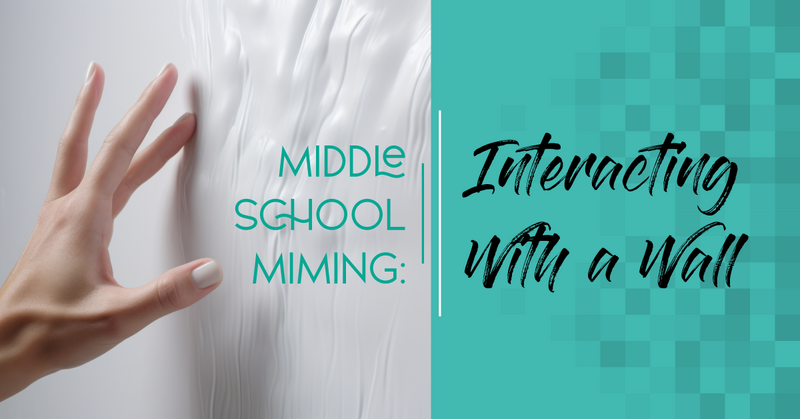
Middle School Miming: Interacting With a Wall
We’ve all seen the classic “mime stuck behind an invisible wall” routine, and when you mention miming to students, typically they’ll immediately start waving their hands around in that fashion. This sequence takes a lot of focus and physical stamina, even though the movements are small. The more deliberate and mindful the movements are and the more concentrated the students are on their eye focus, the more “real” the sequence will appear to the audience. Let’s get started.
1. Practice.Have your students start by practicing interacting with an actual wall. Have them stand facing a wall in the drama classroom, about 12–15 inches away, depending on how long their arms are. They’ll need to be able to place their palms flat against the wall while keeping a bend in their elbows; they shouldn’t be stretching to reach it.
Have students stand with their hands by their sides. Look at the spot on the wall where you will place your right hand. Take your right hand, slowly raise it to around face height, softly spread the fingers apart, and place the palm against the wall firmly and with intent. Now, look at a different spot on the wall where you will place your left hand. Keeping the right hand on the wall, raise the left hand to face height, spread the fingers apart, and place that palm firmly against the wall. Feel the wall against both hands; the wall is strong and unyielding, and even if you press hard against it, it doesn’t move.
Keeping the left hand on the wall, look at a new space on the wall, remove the right hand, and place it firmly on another place on the wall. Keeping the right hand on the wall, remove the left hand and place it somewhere else on the wall. Repeat the motions of removing one hand from the wall and placing it on another part of the wall, while always keeping one hand against the wall and looking towards the new spot on the wall where you will move your hand. Look, remove, place, repeat. Keep movements slow and purposeful — removing and placing, rather than sliding.
To end the routine, take one hand off the wall and let it rest naturally against your side. Then, take the other hand off the wall and let it rest against your other side.
2. Visualize.Have students come away from the walls and find a place around the drama classroom, facing you. Students will stand in neutral positions, with feet flat on the floor and arms resting at their sides.
Have students close their eyes or gaze softly forward. Using their visualization skills, students will picture in their mind’s eye the wall they were just interacting with. Imagine the wall — what colour is it? What material is it made of? How thick do you think it is? How far away from the wall are you? (It should be the same distance as when you were interacting with the actual wall.) Keep that image clearly in your mind as you move to the next step.
3. Make the unreal, real.If students have their eyes closed, have them open them now. Look straight ahead and “see” in your mind’s eye the wall in front of you. Start the same motions as when you practiced touching the actual wall: look towards where you will place your right hand (around face height), slowly raise your right hand, softly spread the fingers apart, and firmly place the palm in the air “against” the invisible wall. This first step is important, as it establishes the parameters of where the wall is in relation to the student. The wall can’t move around or it will become unreal to the audience.
Keeping the right hand in place “on the wall,” look to where you’ll place your left hand, raise the left hand, spread the fingers apart, and place that palm firmly in the air “against” the invisible wall. Make sure that the left hand is placed at the same distance away from the body as the right hand, or the “wall” will be crooked. Students might notice that their fingers or palms feel tingly or warm — they’re getting the blood flowing from moving their hands so purposefully!
Repeat the motions of looking at the new place on the wall, removing one hand from the wall and replacing it on another part of the wall, while always keeping one hand against the wall. Look, remove, place, repeat. As always, keep the movements slow and purposeful. Keep the distance between your body and the “wall” consistent at all times. To end the routine, take one hand off the wall and let it rest naturally against your side, followed by the other hand.
If necessary, have students shake out their arms and hands afterwards to release any built-up energy or tension.
4. Perform.Split students into small groups and have them perform this sequence in front of the rest of the class, to demonstrate what they’ve been practicing. Give students a specific number of hand movements to perform, or have them keep moving until you ring a bell or make a gesture to indicate to them to end the routine.
Classroom Exercise
Middle School Miming: Still, Slippery, Sticky
In our previous Middle School Miming article, students explored using their hands and arms to maneuver invisible objects of various sizes around a circle. Now, we’re adding moving throughout the classroom space to our miming. When they’re moving around the room, encourage students to be on high alert about crashing into another student. This is called spatial awareness — being mindful of your surroundings and being able to navigate safely through your physical environment.
At this beginning stage, movements should be slow and purposeful. This helps students to make solid physical choices and interactions with mimed objects clearer and easier for the audience to understand. Students should use all parts of their bodies and faces to elevate their mime work. They should also continue to use a “beginning, middle, and end” framework. This can be as simple as entering the space in character, interacting with the various challenges/obstacles (listed below), and exiting the space in character. And remember: no talking is necessary for any of these exercises!
You’ll need a small bell or buzzer for this exercise. Alternatively, the teacher can clap their hands when needed to indicate when a movement starts or ends. If your students need a visual cue, wave a small flag or hold up a small sign.
InstructionsWarm-Up: Have students warm up by playing a partner version of Follow the Leader. Have them split up into pairs. Partner A will walk slowly around the room — this is to make it easier for Partner B to follow them precisely. They should start by walking as they usually do, before adding any character walk choices. Partner B will follow them, trying to copy Partner A’s exact walk. Focus on details like the pace of their walk, the size of their steps, how their arms move, if their gait is bouncy or smooth, and so on. Make sure both partners get a chance to be the leader.
For the main part of the exercise, have all the students gather on one side of the room. Three or four students will cross the room at a time to the other side. Have students walk slowly across the room to the other side so they can focus on accuracy rather than speed. At various times throughout the exercise, they’ll complete the tasks listed below.
1. Still: Students will use their visualization skills to imagine that the path in front of them is booby-trapped with floor traps or rays coming from the walls that will freeze them in stillness. At various times while students walk across the floor, the teacher will ring a small bell and students will stop moving (like they’ve been caught by a trap) and hold a still pose. When the teacher rings the bell again, students will continue moving across to the other side of the room. Repeat as many times as you wish while students are on their path. To keep the pace going, have the next round of students enter when the first round is halfway to two-thirds of the way across the floor.
2. Sticky: Before they start to move, have students use their visualization skills to imagine that the path in front of them is littered with wads of chewed up gum, sticky mud puddles, or blobs of glue. Have students walk across the floor, then when the teacher rings the bell, they will step onto a “sticky” spot on the floor. They’ll show to the audience that their foot is stuck by trying to lift it (just their foot, or by grabbing their leg with their hands and trying to pull it), moving the rest of their body around the sticky spot, pretending to pull really hard away from the spot — any action that demonstrates a concerted effort.
When the teacher rings the bell again, students will manage to “peel” their foot off the sticky spot (with much difficulty) and carry on crossing the floor. Have students explore being extremely careful not to touch another sticky spot, avoiding stepping down hard on the sticky foot lest they get stuck again, or getting their food stuck again and having to repeat the process. They could also have a nearby classmate help them get “unstuck.” Have the next round of students enter during the next bell ring to keep the pace going.
3. Slippery: This is the most challenging and risky of the three explorations, so approach this one with caution! Have students use their visualization skills to imagine that the path is covered in ice or slime. Have them enter the space, then when the bell is rung, slow down and very gingerly step, slide, or glide across the floor (as best they can, especially if the floor is carpeted). Please avoid full-out falling unless your students have done safe fall training with a fight director. As well, they should avoid reaching out for friends to “steady” themselves, as they might inadvertently pull them over. Students might explore getting lower to the ground and crawling or shuffling on their bottoms across the “slippery” surface, or acting skilled with slippery surfaces as a skater or skier.
After the exercise is complete, students will fill out and submit an exit slip (found below).
Teaching Drama
Middle School Miming: Preparatory Skills
Miming is a great topic for middle school drama students. The art of miming uses the actors’ bodies and imaginations to tell a story, without using their voices. It’s all about “making the unreal, real” through thoughtful and purposeful movements. But before we jump into mime work, students need to learn and practice three preparatory skills: embracing stillness, developing their focus, and visualization. These skills will help students prepare their bodies and brains to explore different miming exercises.
1. StillnessIt can be challenging for students to practice stillness, as they are generally hardwired to move, wiggle, and fidget. But it’s a skill that can be practiced, and can be used in so many situations.
All miming exercises should start with stillness. This allows students time to breathe, ground, and centre themselves before starting into purposeful mimed movements. To work on stillness, start by reviewing and practicing “neutral position”. As a reminder, it’s a body position where the actor is standing with their feet flat on the floor, about shoulder-width apart, knees relaxed (not locked), back straight, arms and hands by their sides, looking forward without any facial expressions, and silent. You may also have students use a seated neutral position. A seated neutral position is where the actor sits in a chair or stool with their feet flat on the floor, back straight, hands placed gently on thighs, looking forward without any facial expressions, and silent. Blinking and breathing is always allowed!
Have students practice standing or sitting in neutral for short periods of time. Start really small, like 10 seconds of stillness and silence. In between practice sessions, encourage students to move and shake their wiggles out. Then gradually build up to longer increments of time. You can also try having students start in neutral for a count of 5, move slowly over the count of 5 into a specific pose, hold the pose for 5, and then move slowly back into neutral over a count of 5 again. Repeat as many times as you wish.
2. FocusThe classic mirror exercise is a great way for students to practice focus. It’s a drama class standard for a reason! Students partner up and face each other. One student acts as the leader, moving their arms, hands, head, and face in slow and steady patterns so that they can be “mirrored” by their partner. The emphasis on slow and steady is key for students to focus on precision and exact movements — looking at details all the way down to the fingertips, and making each movement purposeful. The goal for the follower is to copy the leader exactly — if someone were to watch the pair, they wouldn’t know who was leading.
Start this exercise with having students stand with their feet planted, so it’s one less movement they have to think about. It’s also a good way for students to practice stillness in their lower bodies. Once students are demonstrating good focus and precision with just their upper bodies, you can add in lower body movements (legs, feet, hips).
Once students feel more confident with the pair mirror exercise, add a layer of challenge by having them make groups of four and complete the exercise in a diamond shape.
3. VisualizationIn mime work, any “props” are invisible — just air. To convince an audience that the mime is actually interacting with a real item (a flower, a rope, a gift box, a door, and so on), students need to make their movements precise and purposeful. To help them do this, they need to visualize the item. Visualization is to imagine or “see” something in your brain, or mind’s eye. If students have a clear picture in their heads of what the item they’re portraying looks and feels like, that really helps them to bring it to life through their movements.
Students can practice visualizing by having the teacher lead them through a guided visualization experience. As a bonus, it’s a great way to practice stillness and focus at the same time!
Have students sit comfortably in the room, where they can hear you easily. If they feel safe to do so, they can close their eyes; otherwise, have them choose a focus spot in the room to softly gaze at. Choose a familiar object, for example, an ice cream cone. Then, have your students listen intently as you describe the item in detail, using all five senses to create an image in their mind’s eye. For the ice cream example, you could describe the size and shape of the ice cream cone, the choices of toppings, the feeling of the melting ice cream touching your hand as you grip the cone, the coldness on your tongue as you take that delicious first bite. Leave some details open to the students’ choices. For example, you might suggest that the ice cream is your students’ favourite flavour.
Then, with students still seated and with the images still clear in their minds, they can start to explore some small movements associated with the item, such as holding the imaginary cone in their hand, taking a bite and savouring the taste, or wiping a drip of melted ice cream off their hand.
All those sensory details, combined with students filling in their own personal details, will help them to create a super-clear picture in their mind. When students are in the midst of visualizing an object for actual miming activities, they won’t take this much time or go into this level of detail in those moments, but this is a way to introduce them to visualizing and help them develop those visualization skills. When they’re able to clearly visualize an object, it will be that much easier for them to portray the item through their movements for an audience.
We’ll be exploring this in upcoming articles, so stay tuned!
Directing
Creative Ideas for Staging Intimate Moments Without Kissing
Many wonderful scripts feature lovely intimate moments between characters: a wedding, a special moment with a crush, a declaration of love, a first kiss. However, many actors (of all ages, not just student actors) are uncomfortable with the idea of kissing another actor on stage. This can be for a myriad of reasons: relationship status, prior experience (or lack thereof), religious or cultural reasons, concerns about hygiene, worries about germs, and more. Student actors may worry about being teased or gossiped about, having their first kiss be onstage, or having to kiss someone they know/don’t know/like/don’t like.
But when it comes down to it, it doesn’t matter what the reason is. The bottom line is that students are minors and cannot truly consent to performing a kiss onstage, whether or not they say they’re comfortable with it. As teachers and directors, we are in positions of power, and students may feel that they have to perform a kiss to be eligible for a role, regardless of whether or not they are comfortable with it. Some directors may feel that actors should just do what the script says, forgetting that working with youth in educational theatre is entirely different from working with adults in theatre. A director — an adult — should not ask a child to do something that crosses a boundary, whether the student is aware of it or not. We need to make decisions that are safe for our students.
However, you don’t have to avoid intimacy onstage entirely. This is a wonderful opportunity to make some beautiful and creative staging decisions. Here are more than 20 ideas about how you can stage a moment of intimacy without lip-to-lip contact. Some of the ideas still ask students to have physical contact with each other, so be sure that students are comfortable having another student touch their hand, face, hair, etc., before proceeding.
• Have actors look into each other’s eyes (which is more challenging than you think).
• Have one actor touch the cheek of the other actor. The other actor might place their hand over the first actor’s hand as well, or close their eyes.
• Have one actor gently brush a tendril of hair away from the other actor’s face.
• Have actors face each other and hold hands, or exit holding hands.
• Have actors embrace or hug each other.
• Have actors place their heads on each other’s shoulders.
• Have actors place their foreheads against each other.
• Have one actor dramatically dip the other actor.
• Have actors slow dance with each other.
• Have one actor put their hands on the other actor’s neck or shoulders, and the other actor place their hands on the first actor’s waist. Then have one of the actors do a “foot pop” behind them for a classic tableau moment.
• Have one actor lift the other actor up and lower them into an embrace. Optional: have the lifting actor safely spin the other actor around.
• Have one actor kiss the other actor’s hand. For extra comfort, the actor giving the kiss might kiss the air above the other actor’s hand. The actor receiving the hand kiss might wish to wear a glove appropriate to their character.
• Place the actors further upstage (closer to the back of the stage) so audiences can’t see the air between their faces during a “kiss” moment.
• Angle the actors so that their heads and hands mask the “kiss.” For example, have one actor stand directly upstage of the other actor, and move their faces fairly close together, so audiences can’t see the air between their faces.
• Mask the “kiss” with a hat, fan, book, umbrella, or other creative prop.
• Have actors sneak or hide behind a couch, curtain, door, or screen, implying that they are kissing behind it.
• Have one actor move towards the other as if they were going to kiss, but at the last minute either shyly or flirtatiously move away (duck away, gently push away, whatever works with the character).
• Have the couple move towards each other as if they are going to kiss, then have the best friend characters pull them away from each other at the last minute.
• For a comedic scene, have actors hold dolls or stuffed animals (“stunt doubles”) or Hershey Kisses chocolates and have them puppet the items together to kiss.
• For a comedic scene, have actors freeze just before kissing, and have another actor hold up a sign that says “THEY KISS.”
• For a lip-to-cheek kiss, have one actor place their downstage cheek next to the other actor’s upstage cheek and kiss the air.
• For a lip-to-arm-or-hand kiss, have one actor get very close to the other actor’s arm and kiss the air upstage of that actor’s arm or hand.
• Some actors might be comfortable performing a “thumb kiss.” Actor A places their hands on Actor B’s face, with Actor A’s thumbs over Actor B’s lips. Actor A kisses their own thumbs. Combine this with creative angling of the two actors.
• Fade the lights or go to blackout before lip-to-lip contact is made.
• Use a projection of a kiss while actors hold a non-contact tableau.
• Have actors hold a non-contact tableau and use a sound effect of a kiss.
Games
Physical Warm-Up Game: Shadows
This is a classic theatre game; you might know it as Shadow Walk, Follow the Leader, or Leader & Follower. It is deceptively simple at first glance: students walking around the room imitating each other. However, there are lots of opportunities for learning in this simple yet fun game: making choices, following directions, leadership, volume management, focusing, spatial awareness, and paying attention to detail. This warm-up game is appropriate for middle or high school students. Read on for instructions and a variation for gameplay.
Instructions1. Have students pair up. All the pairs will participate at the same time. Determine which partner will go first. They will be the leader.
2. The leader will walk around the room in their usual gait but at a slightly slower pace.
3. The second partner, the shadow, will follow them, about two feet behind, trying to imitate them exactly — just like a shadow. This will likely seem like a ridiculously easy task, but to succeed, students need to focus and pay attention to detail. Have them look at the characteristics of their partner’s walk, such as their posture, length of steps, what they do with their hands, and the “weight” of their steps (such as tiptoeing versus stomping). This is why the first partner should walk a bit slower than they usually do, so their partner can try to copy them exactly.
4. Then, the leader will add one element to their walk to make it different, such as a skip, hop, arm movement, or knee bend. The shadow will continue to imitate the leader as precisely as possible.
5. Finally, the leader will do a big, ridiculous walk of their choosing, using all the parts of their body while maintaining the slow walking pace. Students should choose movements that their partner is physically able to do (for example, not everyone can drop down into the splits) and that are safe (keep an eye out for flailing limbs). The shadow will continue to imitate the first partner as accurately as possible.
6. After enough time has passed, have partners switch roles, so the second partner has the opportunity to lead and the first partner has the opportunity to shadow.
7. As a reminder, the challenge is for the leader to move slowly and deliberately, while the shadow copies their partner exactly.
Variation: Once each partner has been the leader, have students get into a big circle and close their eyes. Then secretly select one leader. Students will then open their eyes and walk slowly in a circle, shadowing the student in front of them. The leader will subtly start a movement, with everyone else following them. See if students can guess who the leader is.
Games
Warm-Up Game: Emojis
Japanese artist Shigetaka Kurita invented modern-day emojis in 1999, and they’ve found their place in our world as a unique visual language. Emojis can be used as a way to express ourselves when tone isn’t evident in writing. And they’re a lot of fun too!
There are many ways that you can use emojis for warm-up games in drama class. In this article, we’ll share ways for students to use emojis to express themselves non-verbally, using their bodies and faces. These warm-up exercises are great for any grade level and can also be done online in a virtual classroom setting, with cameras on. You can use these in the drama classroom or as a physical rehearsal warm-up.
To start, you might wish to print out flashcards of different emojis or project them onto the wall.
Students will then physicalize the emojis using their bodies and faces in different ways. Here are 11 prompts to get them started:
• Hold up a flashcard or project an emoji onto the wall so everyone can see it. Using their bodies and faces, students must imitate the emojis as precisely as possible in a frozen pose.
• Imitate emojis as precisely as possible using only their faces. This is easy for the face emojis, but harder for the full-body or inanimate object emojis. For example, how would students use only their faces to imitate a checkered flag or the scissors emoji?
• Using only their bodies, students must imitate the emojis as precisely as possible, while their faces must remain in a neutral expression. This may be easier for the full-body emojis but harder for the face emojis. (If you have access to plain neutral masks, they might be a helpful tool for students to use so they don’t have to think about keeping their faces expressionless while focusing on their bodies. However, they aren’t a necessity.)
• Have students imitate emojis from memory — no visual prompts.
• Have students form groups of three to recreate the emojis. Each student must be included somehow.
• Create a unique walk or movement for an emoji.
• Have students form two lines. Give each student a different emoji. Starting at the front of each line, have two emojis meet in the middle of the room and improvise a conversation.
• Have students form two lines. Give each student a different emoji. Starting at the front of each line, have two emojis meet in the middle of the room and mime a conversation — no voices allowed.
• Have a student draw a flashcard of an emoji and act it out. The rest of the students have to guess what emoji they are portraying.
• Ask students a series of questions. They can only respond silently, using their bodies and faces to imitate emojis. Guess which emojis they’re portraying.
• Play Giants, Elves, and Wizards using emojis. How will students determine which emoji beats which?
Repeat these exercises as many times as you wish!
Related Articles:
Scene & Song Analysis Using Emojis
Exercise: Mimed Relationships
Physical Warm-Up Game: Doodles
Games
Physical Warm-Up Game: Doodles
The following is a quick, simple warm-up game that works for virtually any age range and skill level. All you’ll need is a stack of Post-it notes or a pile of scrap paper, some writing implements, and your students.
There are many different ways you can tailor this warm-up, depending on whether you’re studying mime, tableau, creative movement, or if you just need your students to get their brains and bodies moving. It’s a handy exercise to keep in your back pocket when you need to shake things up in class. Pick one, two, or a few for your students to do.
Instructions1. Give each student a piece of scrap paper or a Post-it note and a writing utensil.
2. Each student has exactly three seconds to make a doodle on the paper. No more, no less!
3. Collect the doodles. Make sure they’re all appropriate for your class.
4. Choose a doodle (or doodles) at random, post it where everyone can see it, and have students try the following exercises:
• Create a frozen pose with your body that physicalizes the doodle.
• Create a frozen pose with a partner that physicalizes the doodle.
• Move very slowly from a neutral stance (feet flat on the floor, hands by sides, eyes forward) to the frozen pose from the doodle.
• Physicalize the doodle. Move around the room (silently) as you think the doodle would.
• Select three doodles and have students slowly flow from the first doodle to the second to the third.
• Divide students into groups of three or four. Select three doodles and have each group create a movement piece that includes the three doodles in some fashion.
• Have one student direct the rest of the students in re-creating a giant version of the doodle flat on the floor.
• Have students come up with their own way of bringing the doodle to life.
Teaching Drama
Physicalizing Emotions: How to Make Emotional Performances Consistent and Repeatable
Do you want your students to show you MORE onstage during a heightened emotional scene? “Joshua, can you be more sad here?” “Sannah, I think your character needs to be more angry right now.” “Lise, I need you to show more excitement at this moment.” You may be on the receiving end of confused looks or blank expressions after giving directions like that. It could be that your students don’t know HOW to show these big emotions onstage. “More” is vague, and it’s different for everyone. What your students think is more might not be “more enough” for the scene.
Some actors employ a technique where they think about their own experiences to inform their character’s emotional reactions and achieve a similar performance. In other words, they think of a time when they felt a heightened emotion (sad, angry, excited, etc.) and use that feeling to drive their performance. For example, if they are portraying a character that is feeling heartbroken, they might think about a time when they themselves were rejected by a crush.
This technique can be effective, but difficult for young or inexperienced students to use. Some students may lack the applicable life experiences. Other students may find delving into their past experiences upsetting or even traumatic. Having to bring up those feelings each time they perform the scene can pile on the stress and blur the lines between the student and the character. It can also lead to inconsistent performances. One day your student might feel great, and their performance goes well. On a different day when the student is feeling more stressed than normal, having to bring up an emotionally challenging situation from their real life will only add to that stress. The performance might be heightened, or more subdued, or choppy, and the student will have to deal with even more troubling feelings when they leave the room at the end of class or rehearsal.
Try this technique with your students instead. Rather than leaning on personal experiences, give your students detailed and precise facial or body movements and gestures to physicalize the emotion they are attempting to portray. This can help make your students’ performances more consistent and repeatable, while avoiding causing stress or trauma. Physicalizing emotions allows you to demonstrate specifically what you want your student to do, while verbally describing what you’re doing and why.
Consider the following facial and body movements and how you could use them to portray different emotional states:
• Breathing (fast, slow, stuttered, deep, shallow, held, through mouth or nose)
• Posture (slumped, erect, leaning towards or away from someone else)
• Direction and intensity of gaze (at or away from scene partner, staring, unfocused, eye rolling)
• Proximity to scene partner (close, far away, moving around)
• Body tension (clenched or relaxed body parts such as teeth or fists)
• Speed of movement (fast, slow, varied)
• Additional movements and gestures such as winking, blinking, moving/flailing limbs, hair tossing, shrugging, nodding or shaking head, mouth movements and sounds (yawning, tongue clicking, pursing or licking lips, coughing), or pointing
When you’re giving directions to your students, try giving applicable physical directions for students to perform. For anger, students might clench their jaws and bare their teeth, or they might walk away from their scene partner, turn back quickly, and glare. The movements and gestures will vary from character to character and depend on what’s going on in the scene. Going back to the directions in the introduction, your more specific, physical directions might go something like this:
• Rather than “Joshua, can you be more sad here?” you might say “Joshua, try slowing your breathing down, slumping your shoulders, and looking away from Patricia.”
• Rather than “Sannah, I think your character needs to be more angry right now,” you might say “Sannah, when you say your line, move your face directly in front of Britton’s face, stare right at him, and clench your jaw and fists.” (Be sure that Sannah and Britton are ok with being in close proximity to each other.)
• Rather than “Lise, I need you to show more excitement at this moment,” you might say “Lise, after Terry says their line, try opening your eyes really wide, gasping, and then quickly covering your mouth with your hands.”
The physical directions are more clear and understandable than just, “Be more (sad, angry, excited, etc.),” and easier for your students to follow, both in the moment and in repeated performances of the scene. They also don’t depend on students delving into their past experiences to portray the emotions needed for the scene. As an added bonus, specific directions are easy for students to note in their scripts.
Don’t worry about student performances looking artificial or exaggerated (some people call this “hamming” or “mugging”) while trying this technique. At this point, we want our students to visibly portray consistent physical gestures. You can fine-tune the movements as they practice them so they look more natural. As students gain more experience, they’ll also come up with appropriate physical directions on their own, which is always wonderful to see!
Additional Resources:
• What’s Your Character’s Signature Gesture?
• Improv Game: Verbal vs. Nonverbal Cues
Classroom Exercise
Warm-Up Exercise: Elephant Walk
This warm-up exercise is simple, but sometimes that’s just what you need — a simple yet fun warm-up that gets your students up and moving around. This exercise is also quiet — no speaking allowed! It’s a great way for students to practice individual mime and tableau skills in a low-pressure environment, since the whole group is moving at the same time.
Elephant Walk is great for students at any skill level. You’ll find some adaptation ideas below for more advanced learners. It’s also useful for helping your students loosen up and be silly together, as well as helping you get to know your students better. You’ll be able to gauge their base effort and risk-taking abilities. How far are they willing to push themselves out of their comfort zone? Give it a try and find out.
Instructions:
• Have students spread out around the room, standing in a neutral position (feet flat on the floor, hands by sides). On your cue, students will walk around the room at a medium to slow pace.
• Call out an animal for students to portray through their movements as they travel around the room. When they hear the animal, they are to immediately (and silently) move how they think that animal would. Choose an animal that has the potential for different levels and/or speeds of movement, such as an elephant, giraffe, snake, crab, lion, gazelle, peacock, parrot — whatever you think will challenge your students! Encourage students to use their entire bodies and facial expressions to portray the animal.
• Call out “freeze!” Each student must freeze in place in a solo tableau until you call out the next animal. At that moment, students will start moving around the room as the new animal until you call “freeze” again.
• Repeat as many times as you wish with different animals.
• Discuss: What was the easiest part of this warm-up exercise? What was the most difficult? What animal did you enjoy portraying the most? Why?
Alternative: Have students move around the room as if they’re engaged various sports activities, such as skiing, skating, rowing, swimming (there are many different varieties), dancing (again, there are many varieties to choose from), bobsledding, triple-jumping, or power-walking. Just ensure that all movement is “non contact,” in case you use football as a prompt!
For advanced drama students: Have students walk around the room in an upright “human” style, but using the animal/sports prompt as a guide to inform their human character. They might plod like an elephant, or glide like they’re a snake. How can they make their movements more subtle and nuanced, but still different from how they normally walk?
You can also use the article Why You Need to Rehearse in Your Character’s Shoes as inspiration for an alternative version of this exercise. Have students walk around the room in the footwear they’re currently wearing (or have them take their shoes off if they’re willing) but call out various shoe prompts such as sneakers, high heels, flip-flops, ballet slippers, scuba flippers, cowboy boots, or tap shoes. How can students portray a different style of shoe through their movements? How does the shoe prompt inform the rest of their body movements?
Classroom Exercise
What Is Your Body Language Saying?
When teaching virtually to students with their cameras on, teachers get to witness all sorts of interesting student antics — students tuning in from strange locations (their closet, their family’s car, under the table), students in various states of dress (pajamas, anyone?), and students in a variety of body positions. When learning from home, students may choose to attend virtual classes while they are lying down on the couch or in bed; they may try to disguise the fact that they’re watching television behind their device; or they might yawn, slump, scratch, or barely be visible on their device. They may or may not realize that their body language is saying something about them.
The goal of the following distance learning exercise is to help students become more aware of their body language in the virtual classroom (both conscious and unconscious) and how it makes others perceive them. Students have to turn their cameras on to participate, but it is fairly low-risk as they will complete the movement portion as a group, and they don’t need to have their microphones on.
Instructions:1. Have students brainstorm a list of body positions that they have seen other students display during class, or that they themselves have displayed. Here’s a list to get started:
• Sitting in a straight-backed chair with your device on a desk
• Slouched in a squashy armchair or on the couch
• Lying in bed with their device on their lap
• Sitting on the floor with their device above them (only the top of their head visible)
• Sitting on the floor with their device on the floor with them (body visible but head/forehead cut off)
• Eyes diverted to the side or down (clearly watching TV or looking at a phone while class is happening)
• Leaning head on hand
• Yawning
• Scratching head/face
2. Have the class go through the list and at the same time, have students move into each position while you stand or sit in a neutral position and talk about a topic of your choosing, or read a monologue aloud.
Have a student volunteer stand or sit in a neutral position and talk about a topic or read a monologue aloud while the rest of the class stays in the chosen position.
Then, you or the student volunteer will display the chosen position and speak/read aloud, while the rest of the class listens while sitting/standing in a neutral position.
3. Discuss the following questions as a group (orally or in the chat box), or have your students submit a written response.
• Were you able to focus on listening to the teacher while displaying the requested body language position? Was it easy or challenging to focus?
• Were you able to maintain the position for an extended amount of time? Were you tempted to move? If so, how? (Perhaps into a more comfortable or practical position?)
• How do you think your teacher felt trying to give a lesson while all the students were in that position?
• How do you think your fellow classmate felt while their peers were displaying the requested body language?
(Ask the student how they actually felt after the class responds.)
• How can you apply the study of body language to performance in drama class? How does body language affect the character being portrayed, and the audience’s perception of the character?
• (If your students are preparing to perform virtually) How can you use body language to enhance/enrich your virtual performance?
Going forward in your virtual drama classes, you may want to do a “body language check in” with your students occasionally. This can help them refocus if they seem distracted, and make them more aware of how their body language might be perceived by others.
Classroom Exercise
Vocal and Physical Performance Exercises
The exercises listed below can be adapted to distance and online learning opportunities. Students work individually (rather than with partners or in groups).
Group work and discussions can be completed using video conferencing programs (such as Google Hangouts, Skype, or Zoom).
Written work can be submitted electronically via email or uploading to Google Drive or similar.
Performances can be done live via video conferencing programs, or filmed on a smartphone or digital camera and uploaded to a service such as YouTube or Vimeo (privacy settings can be adjusted to accommodate your school’s internet safety policies).
Vocal ExercisesVocal exercises can be done together via video conferencing programs (such as Skype, Zoom, or Google Hangouts), or filmed on a smartphone and submitted to the teacher.
1. A Simple Breath Control Exercise for Actors & Singers
2. Can You Hear Me Now? A Peer-Led Volume Exercise
Students should focus not only on volume, but also diction and enunciation
3. Create a Vocal Workout for the Articulators
4. The Vowel Tree
5. 5 Tongue-Twister Exercises for Ensemble Building
For a written project, have students write their own tongue twisters. Have them answer the question: “How does using tongue twisters help them to become actors?”
6. 10 Rounds for Your Next Warm Up
Physical Performance ExercisesStudents can practice physical exercises from their own homes using a video conferencing program and following along with the teacher’s prompts, while teachers can observe students’ participation on their own screen.
1. Bound, Punch, Float: Physicality Exercise
2. Character Development Game: What’s For Breakfast
3. Create a Commedia Dell’Arte Character
Focus on “The Lazzi of the Sandwich”
4. Creating Your Own Commedia Lazzi
Focus on “The Lazzi of Surprise”
5. Developing Your Character’s Physicality from Head to Toe
6. Exploring Different Voices Using Puppets, Masks, and Props
“Props” is the easiest of the exercises to complete via distance learning. However, students could create puppets at home using socks or paper bags, and masks could also be made at home using paper.
7. High Status / Low Status Character Physicality
8. Stage Vs. Screen: A Comparison of Acting Techniques
9. Thinking of Your Character as an Animal
10. 3 Fitness Tips for Drama Students
11. 5 Tips for Physicalizing a Non-Human Character
Directing
Communicating Your Directing Vision Through the Senses
So you’ve selected the show you are producing this year and you have come up with an incredible vision for the show. This is going to be awesome! Obviously, you want your students to share in your excitement – but how will you help your students to clearly understand your vision and buy in to it right away?
Using the senses to communicate your directing vision helps students to really immerse themselves into the world of the show that you will be creating together. Continue to reinforce your vision both before and throughout the rehearsal process. Try the following suggestions to help illustrate your vision and make it super-clear for everyone involved.
Many of the suggestions can fall under two or more senses; work with your students to notice the crossovers.
Sight• First and foremost, create a vision board with images pulled from the internet or cut from magazines, as well as sketches and drawings. Post it in the rehearsal space so students can see it and refer back to it.
• Use video examples – either clips from previous productions that illustrate what you do (or do not) want to do, or clips from movies, television, or music videos that inspire you.
• Create a visual timeline of the show from beginning to end, using a long roll of newsprint. Include instances that occurred prior to the show that trigger the situations within the show. Have students find or draw images to add to the timeline and make it more visually appealing.
• Create a connections board showing how all the characters in the show are related to each other – marriages, family members, friendships, colleagues, servants/masters, and so on. Have students create images of the character that they are portraying, and then pin them up on a bulletin board. Use yarn or string to connect the characters. Notice if someone isn’t connected to anyone – why is that? Also think about broken connections, such as former friends, exes, or enemies. Use a different colour of yarn to illustrate those connections.
• Find books, magazines, and articles that are either about the show or set in the same time period as the show. Have them available for students to look through when they’re not immediately being used in rehearsal.
Sound• Create a soundtrack or playlist of songs that inspire your vision. Share it with your students and explain why you selected the songs you did. Have students suggest songs that could be added to the playlist.
• If your show is set in a certain time period, choose a song from that era and play it at the beginning of rehearsal. Who sang the song? Why was it influential to the era? Then let students select songs for upcoming rehearsals. Why did they choose the songs they did?
• When talking about the show, use descriptive language to get students excited. What adjectives and verbs can you use that will get students amped up?
• If your show is set in another country and uses accents, have students listen to internet talk radio stations from those countries to hear what the accents sound like.
Touch• Create a 3D model or diorama of your set. Create small cutout figures of the actors and move them around the set to demonstrate how transitions and scene changes will work.
• Include tactile materials such as fabric swatches, carpet samples, props and costumes pulled from your stock to use as examples. Allow students to touch the materials and describe how they feel.
• If your show involves specialty props (such as swords or guns) or special effects (such as a swinging rope or a crash mat for stunts) and safety permits, allow your students to touch and try out the items – under supervision of course. This will also help to remove the temptation to play with the items backstage or during pre-show/post-show.
• Have an aesthetics day where students recreate hairstyles and popular makeup looks of the era of when your show is set. This has the additional benefit of giving you the opportunity to select and approve hair and makeup looks for the cast members and gives students the opportunity to find out how to create the styles and how long it takes. They’ll also quickly figure out if they will have to do pre-show prep at home before call time.
Smell/Taste• Note – Be very careful when approaching smell and taste with students. Be sure you are aware of any allergies or sensitivities that students have to particular foods and scents. If your school is a scent-free zone or has restrictions on what food items can be brought in, combine smell and hearing by using descriptive language and visualization techniques to evoke the smell and taste senses. Also, be sure that any food items are prepared in a clean and safety-approved environment.
• If your show had a signature dish, what would it be? What were the popular meals and drinks of the day? Create a sample menu of what people would commonly consume.
• Look through your script to see if there are any references to food or drinks. Make them for your students to try at an early rehearsal.
• Create a “scentscape” for your students. Have students close their eyes and then talk them through a “scent tour” of the scenes of the play. What does the world of your play smell like? For example, if the show is set in a carnival, describe the scent of crisp fall air, the pungent odor of gasoline from the rides, and the various yummy smells of the food vendors such as cotton candy, candy apples, popcorn, and French fries. If the show is set at a beach, you might smell salty seawater, sunscreen, and various scents from picnics and barbeques.
Classroom Exercise
What’s Your Character’s Signature Gesture?
What is a signature gesture? It’s a nonverbal, repeated movement your character is known for, that you perform in a particular way that is unique and identifiable. Common, well-known gestures include the thumbs-up/thumbs-down, the peace sign, air quotes, shrugging, pointing, eye rolling, saluting, and tipping your hat. The list goes on and on! Some famous examples are Matilda’s defiant power pose (hands on hips, feet splayed, face in profile), Hamilton’s triumphant fist punch towards the sky, the cocky hair-combing of the T-Birds in Grease, and J. Pierrepont Finch’s fourth-wall–breaking look towards the audience in How to Succeed in Business Without Really Trying.
TaskHave your class brainstorm a list of well-known physical gestures. How many can you name? What do they mean? Do they mean different things to different people?
Why use gesture?So why should you create a signature gesture for your character? For starters, it creates an interesting physical layer to your character. A signature gesture helps to identify your character from the others through their unique movement, and defines your character as someone different from you, the actor. It shows off your character’s personality. For example, eye rolling immediately identifies you as impatient, a high-five indicates a playful personality, and a firm, close-up handshake demonstrates a person not to be messed with.
Some gestures can indicate multiple personality traits. For example, a pointed figure could indicate someone of a scolding or authoritative nature (such as a parent or a teacher), but it could also be used by a helpful person giving directions. Conversely, different characters might have similar personality traits, but use different gestures to demonstrate them. A well-placed smirk and shrug of the shoulder can be flirtatious, but so could a raised eyebrow, a wink, or a hair toss.
Signature gestures also give the audience something to look forward to. When your character enters the stage, the audience will immediately be drawn to you, anticipating your signature gesture and when it will be used next. It creates a sense of familiarity and fun.
TaskFrom your list of physical gestures, have your class identify a personality trait that goes with each gesture; for example, pointing = authoritative, thumb sucking = immature or babyish. Some gestures might work with multiple personality traits. How do you differentiate them? (Feel free to demonstrate the differences!)
When should you use gesture?When should you use a signature gesture? The best times to employ your signature gesture are at significant moments in the show, to make your point stronger – such as a funny comment, a fit of anger, or as an exclamation at the end of a sentence – or on a repeated phrase or joke. Signature gestures are also commonly used on the “button” at the end of a song, where the music finishes. The High School Musical jump is a well-known gesture that is repeated in each of the films and stage musicals, and is always used on the button of the final song of the show.
How can you find your character’s signature gesture? This is something you’ll explore during your rehearsal period and on your own time. Try different gestures to see what works for your character. Work with your fellow actors to ensure you are the only one doing your signature gesture, to keep your movement unique to your character. Or, look for places where others could “steal” or use your signature gesture – perhaps to taunt your character, to mimic your character, or to achieve or get something your character wants or has. For example, think of when Roxie Hart uses Velma Kelly’s gestures (such as crying into a handkerchief and fainting) while on trial in the musical Chicago – this prompts Velma to sing the song “Class.”
Work through your script and note important or significant moments where your signature gesture could improve or emphasize what you are saying or doing. Ask for feedback from your director, to ensure that your signature gesture works for your character and doesn’t upstage you or the other performers.
TaskHave your students come up with three possible signature gestures. Try using them during rehearsal. What feels most natural, and/or what looks best onstage.
Distance Learning Adaptation
1. Have students list as many gestures as they can think of, such as pointing, raising an eyebrow, winking, tipping a hat, shrugging shoulders, and so on.
2. Have your class brainstorm a list of well-known physical gestures from plays, television shows, or movies. How many can you name? What do they mean? Do they mean different things to different people?
3. One at a time, have students perform the sentence “Hey, how’s it going?” using a different gesture. Each student should aim to do something different. Experiment with different gestures, and where in the sentence the gesture is used. For example:
• “Hey” (finger point) “How’s it going?”
• (wink) “Hey, how’s it going?”
• “Hey, how’s it going?” (tip of the hat)
Ask your students: Does the positioning of the gesture in the line change the meaning of the line or perception of the character? Does a different gesture change how it feels to play that character? Does adding a gesture make it easier to portray a mood or emotion?
4. Have students try performing the same sentence and gesture, but portraying different emotions (scared, flirtatious, angry, secretive, etc.). How does that affect how the audience (i.e. the rest of the class) perceives the character?
5. Try this exercise again with the following sentences:
• “What do you think about that?”
• “I have a fantastic idea.”
• “It’s 9 o’clock… you know what that means.”
6. If you are currently studying a play in class, have students suggest signature gestures for the characters. Have them read lines from the play aloud and figure out where the signature gestures would be used in different scenes.
Acting
High Status/Low Status Character Physicality
If you want your students to physicalize their characters, get them thinking about status.
What is status?Answer this question for yourself. Write down a couple of different answers yourself, then ask your students to come up with a couple of different answers on their own.
Status is about power and control.
Many people talk about status in terms of money and monetary status. Money does give us status because it gives us control. But money does not necessarily mean that we have control. Control is not always about having money.
Status can be the relationship of control, like between a student and a teacher. The teacher has control. Why? Because students have been told the teacher has power over them. The teacher has control over a student’s grade.
A status relationship can occur in the most unexpected places. A homeless man who shouts at you on the street. What’s your first thought? Do you feel uncomfortable by this loud obnoxious person coming at you? You may have more money, but they have the power. They have the status in this situation.
Status can be about the struggle for control. Perhaps a high status person has status over a low status person and the low status person doesn’t like it. Or a low status person disguises themselves as a high status person to take that control back. When you look at a scene, look at who has control or which characters are battling with each other for status because they want control.
Physicalizing statusOne of the ways we can learn about status is by physically playing status in the body. The way a high characters walks is quite different than the way a low status person walks.
How does a High Status person move?
Not afraid to touch or be touched. Initiates contact (eye contact, physical contact, or verbal contact). Body is physically open. Walks in straight lines. Takes time getting to their destination. Confident. Finishes a complete thought on a complete breath and in a complete sentence. Has a positive outlook. Has power. Has a large or small bubble of personal space but not afraid to have that bubble of space broken.
How does a Low Status person move?
Does not like to touch or be touched. Does not make or initiate contact of any kind (eye contact, physical contact, or verbal contact). Body is physically closed off or protected. Does not walk in a straight line. Rushes or moves slowly to their destination. Touches their hair, clothes or face while they talk. Does not finish a complete thought on a complete breath or a complete sentence. Gives away their power or has no power. Has a small bubble of personal space because they feel like they shouldn’t take up much space, OR a large bubble of personal space because they want to keep others away.
In the game you will describe characteristics for status and have your students take on those characteristics. Remind them that high status does not mean snobby or snotty and low status does not mean an emotionally broken person or somebody who has some sort of deep emotional problems. Again, it’s all about power.
Watch the Status Walks game in action!
Acting
Bound, Punch, Float – Physicality Exercise
Student actors tend to keep their limbs close to the body. When we think about creating physical pictures on stage, one of the easiest ways to present depth is through extension. How can we encourage students to extend away from the body?
Here is a physical extension exercise that explores the three states of being bound, of punching out, and of floating up.Start out with your favourite physical warm up to get students up and moving. After the warm up, instruct students to begin walking around the room in neutral when you say so. Neutral means they walk as a steady pace (no shuffling) with their arms at their sides (not in their pockets). They must keep quiet and keep their heads up. They are to focus on moving around the room and filling up any empty space they see. They can’t walk with friends or follow anyone, but must focus only on their movement. This should keep students from banging into one another.
Also establish that they will be given instructions as they walk. They should just focus on their movement and listen to the instructions as they keep moving.
Once you have established neutral movement, instruct students to move as if their arms and legs are sewn to the body. Imagine that your arms and legs are bound to your body. What is it like to move this way? How does that affect movement? What do you have to do to get around the room? Ask students to think about what kind of character would walk like this? Give a name to this character. Think of a voice for this character. Introduce yourself to someone as you walk around the room.
Instruct students: If I tap you on the shoulder, that cuts the ties that keep your limbs close to the body. Your arms are floating away from your body. Your legs are light and they glide away from your body. Keep that image of floating at the forefront of your mind. Keep your arms floating away from your body. Think like a dancer. Legs gliding as you walk, with arms floating and everything away from the body. Think about what kind of character moves like this. Give a name to this character. Think of a voice for this character. Introduce yourself to someone as you walk around the room.
At this point, some students will be floating and other students will be bound. Instruct students: If I tap you on the shoulder, that cuts the ties that keep your limbs close to your body. You are going to sharply punch out with your limbs, like a hero or a military man. Elbows out, hands on hips, straight legs wide whenever you stand. Think like moving with a punch. Punch out as you move with your limbs, keep them away from your torso. Think of the type of character who would move this way. Give them a name and a voice. Introduce yourself to someone as you walk around the room.
Have students switch their physicality. If you are bound and tightly confined to your body, either float or punch your limbs away and take on this character. If you are a character who punches, now either float or become bound. If you are a character who floats, become bound or punch out. How does your character’s personality change when you take on this physicality?
Discuss the three physicalities afterward (bound, punch, float). What was it like to force yourself to move your limbs away from the body? What is the difference between floating with the body and punching with the body? Why might it be important to give a character an extended physical body? How can you use this exercise in your future work?
Acting
Physicalize Your Scene Work
“Body language accounts for 60% of our understanding of emotions, our reception of subliminal messages and our grasp of relationships.” - Ron Cameron-Lewis, Acting Skills for Life
Student actors often spend a lot of time developing the nonphysical part of a character: character profiles, reflection, analyzing the text. Sometimes the physicality piece is left until the last minute or it’s not addressed at all. The result is that the character ends up standing, moving, sitting, and gesturing exactly like the student actor.
How do I encourage students to physicalize their characters?• Have the actors play the scene you’re working on without dialogue. They have to communicate their lines nonverbally. What do they do to replace what they say? Remind students to stay in character as they try to communicate. Is this character patient or impatient as they physicalize their lines? Do they make small or large gestures?
• Before every blocking move, have the actor say “I am moving because I am….” They can only move if they can come up with a character-driven reason to move. This will eliminate the problem of actors who move only because a director told them to.
• Do a scene with just the blocking and no dialogue. Have actors say their lines in their heads and do any blocking they’ve been given. Discuss the experience afterward. What does it feel like to focus on the movement? Did you ever feel like you were in one place for a really long time? Do you feel your blocking is character-driven?
• Create a character zero for each character. Character zero is used in commedia dell’arte. It is the defining pose that a character presents every time they enter or stand still in the space. If you’re doing a realistic piece, it won’t be practical to have a character pose every time they enter a room, but it is something you can play with during rehearsal. You can also pick and choose your character zero moments. Character zero also helps your actors identify what makes their character physically distinct from them. That is what is most important.
• To encourage levels in a scene, do the “sit, stand, kneel” improv game. If you have only two actors, then do “sit, stand.” If you have more, you can do “sit, stand, kneel, lie down, stand on a chair.” As actors perform the scene, have only one person be in one physical state at a time. For example, two actors can’t stand at the same time. If someone is sitting, then have everyone else be in one of the other states. Actors are allowed to stay in one state for only five seconds.
• Have actors come up with an action for each line in a scene. It could be moving from sitting to standing. It could be moving a pillow from a chair to the couch, or clearing the table. The aim is to experiment with possible actions for a scene. Certainly you don’t want your actors moving constantly during a performance, but too often actors sit down and never move. They become motionless, talking heads. This exercise will help actors identify what they are doing in a scene. What if the character is trying to share a secret while cleaning a table at the same time? Or folding laundry? How does the action complement or contrast with the text?
• Videotape a scene. When you watch the scene back, focus on the actor-driven movement. When do the actors shuffle from foot to foot? When do they brush their hair from their face or adjust their clothes? When do they raise a hand and plop it down on their thigh? These are all nervous gestures that actors do, not characters. It takes the audience out of the world of the play. Identify these moments and work to remove them from the action of the scene.
• Have actors play the scene with a specific body lead. What if a character leads through the nose? Or through the belly? Or through the knees? How does the character change with this physicality? It might work or it might not, but it’s important to try. It’s another fun thing to play with during rehearsals.
• Have actors play the scene with a specific foot plant. First do the scene with everyone walking normally: a “heel, toe” foot placement. Next, do the scene with everyone walking with a “toe, heel” foot placement. Be specific and careful, focusing on each step being “toe, heel.” The third time, do the scene with everyone walking on the inside edges of their feet. The fourth time, have everyone walk on the outside edges of their feet. All of these foot placements will change the personality as well as the physicality of the character. If actors get frustrated, tell them to let their frustration out through their characters!
Acting
5 Tips for Physicalizing a Nonhuman Character
Are you playing Puck in A Midsummer Night’s Dream? One of the seven deadly sins? A banana in an improv scene? A god in a Greek myth? The Lint Roller in The Absolutely Insidious and Utterly Terrifying Truth About Cat Hair?
One of the best aspects of theatre performance is that if the actors on stage believe what and who they are presenting, so will the audience. Audience members will suspend their disbelief when they see a talking cat or a piece of baloney come to life on stage. Theatre is the perfect playground for nonhuman characters.
Student actors find it challenging to depict nonhuman characters because of the physical component. It’s hard for student actors to get out of their decidedly human bodies. As a result, nonhuman characters often end up looking human.
Here are the top 5 tips for playing nonhuman characters:1. Find a different level
2. Find a different shape
3. Get a little uncomfortable
4. Change your natural rhythm of movement
5. Don’t neglect the character’s background
1. Find a different levelStudent actors often occupy space at a medium level. They stand and move on stage the way they do in their regular life. They don’t think about incorporating a variety of levels into their character building. A different level will help them to visually identify a nonhuman character. Ask students how their character occupies space and how it’s different from their own choices. Encourage students to explore levels outside the day to day. Have students kneel or crouch down for a medium low level, or get down flat on the floor and try to move without using arms and legs. Have them run on their tiptoes or stand on the furniture to explore a high space. Push them out of the norm and encourage them to make choices that are out of their comfort zone.
2. Find a different shapeStudents’ bodies follow pretty straight lines (albeit with a bit of a standard slouch). They keep their limbs close to their body and their legs and arms stay straight. They walk one foot after the other in a line. Get students thinking about the possibilities of different body shapes. Have them bend elbows and knees. Raise one shoulder up to their ears. What is the identifying shape for this nonhuman character? Can you you make your body a circle? A triangle? Once students have defined their character’s body shape, ask how they can incorporate shapes into their movement. Does this character roll? How can you roll with your gait? If this character’s defining shape is a triangle with the legs spread out wide, how does that affect your walk?
3. Get a little uncomfortableStanding and moving in a different shape at a different level by its nature is going to be uncomfortable for students. They’re going to want to revert back to their normal ways. Practice holding an uncomfortable stance. Have students discuss how it feels. The goal is not to shy away from new body shapes but to learn how to embrace discomfort. It could be a series of stretches afterward. It could be setting a 10 second limit for the hold and increasing the time over subsequent classes. It could be defining two poses for the character and creating a transition between the poses that releases any tension.
4. Change your natural rhythm of movementThere are so many options when creating a movement rhythm for a character. You can speed up or slow down. You can combine the two in a quick, quick, slow pattern. You can create imbalance in your rhythm by walking on the inside of the left foot and the outside of the right foot. You can drag the left leg behind in a limp. Before asking students to define a rhythm of movement for their nonhuman character, have them practice possible ways of moving. Start students moving at a 1 (where 1 is slower than a turtle and 10 is all out running) and play with speed. Have students walk on their toes, their heels, and all points in between. Get them to walk with their feet close together and far apart. Encourage students to move as differently than their natural rhythm as possible.
5. Don’t neglect character backgroundDefining the physicality for a nonhuman character doesn’t stop with the body. Character details can influence physicality. Sometimes students assume they don’t have to come up with the same details as they would with a human character. The answers certainly won’t be the same as they would be for a human character. Who would make up the family of one of the seven deadly sins? What would Greed’s pet peeve be? What would Sloth’s favourite food be? Identifying character details gives an actor more to work with and that’s essential for a nonhuman character. You don’t want to present a novelty piece. A nonhuman character needs to be as three dimensional as any other character. Once students come up with these details, ask “How can these details be incorporated into your character’s physicality?”
The more they practice different physical choices, the easier it will be to create a nonhuman character.
Acting
Developing Your Character’s Physicality from Head to Toe
A character’s physicality is part of the actor’s toolkit. Physicality, along with voice and imagination, helps to tell a story, no matter if you’re doing a mime, tableau, monologue, or scene.
The drama classroom is a great place for students to explore different physical attributes that they can use to make characters unique and real. It’s important for your students to know how to develop their character’s physicality so that it is different from their own. One way to do this is a head to toe approach. That way, every body part is addressed.
Use this exercise in rehearsals or as part of a scene study unit. Click below for a worksheet version of the Head to Toe Questions.
Step One: Have students respond to the following Head to Toe Analysis Questions. They will encourage students to reflect on how their character’s physicality works. For each question, students will think about their character and make a specific choice.
Head, Face, & Neck• The face is one of the first things someone will notice when they see or meet you. Think about how your character’s face shows emotions. Does your character show their emotions clearly on their face or do they mask their feelings (i.e. have a “poker face”)?
• Does your character look others in the eye, or do they look away, down, or in another direction? Why? (This is a good indicator of your character’s confidence level, or if they’re lying or distracted.)
• Does your character have a signature facial expression, or “resting face”? Do they tend to smile, sneer, grimace? Does this change throughout the play?
• Does your character have a physical ailment on their face or head (e.g., blindness, deafness, missing teeth, stiff neck)? These will affect how your character moves their head and face.
Upper Body (shoulders, arms, hands, chest, abdomen)• Does your character have good posture? Do they stand up straight or slouch?
• Does your character swing their arms when they walk, or hold them tightly at their sides? Do they cross their arms, hug themselves, or wring their hands?
• How big are your character’s gestures? Do they use their hands while they speak?
• Does your character breathe deeply or take shallow breaths? Is breathing easy or difficult?
Lower Body (lower back, hips, pelvis, legs, feet)• Does your character move slowly or quickly? Why? Do they limp or stumble?
• Is your character light on their feet or do they plod and stomp along? Do they lift their feet when they walk?
• Do your character’s feet turn inwards or outwards when they walk? Do they walk heel-first or toe-first?
Additional Physicality Thoughts• How old is your character? (A 12-year-old, a 50-year-old, and an 80-year-old will all move differently.)
• How physically fit is your character? Are they strong or weak? Have they ever been an athlete?
• When your character walks, do they lead with their forehead? Chest? Or perhaps they lead with their lower body, like with their pelvis or knees?
• Does their weight affect how your character moves? Do they move in a way that is unusual for their physical build (e.g., a sprightly sumo wrestler)?
• What past or present physical challenges/ailments has your character had, if any? Injuries? Sickness? Pregnancy? Missing limbs? How does that affect how they move?
• Does your character need assistance to move? Do they walk with a cane, crutch, walker, assistance animal, or human assistant?
• Does your character even walk? Perhaps they crawl, creep, or roll (i.e. via a wheelchair, on a skateboard, or by doing somersaults).
• Does your character’s physicality change at any point? When? What causes the change? How does that affect your character?
Step Two: Once students have answered the questions, have them condense this knowledge into a paragraph description. Have students write a Character Physicality description. How would they describe their character’s physicality? How does knowing these details about their physicality help you visualize their personality? Put students into small groups and have them read their descriptions.
Step Three: Analysis and description are just one aspect of determining a character’s physicality. Students have to get on their feet to explore the details they’ve created and bring that physicality to life. Here are two exercises you can use with students:
Enter, Sit, Exit• This is a silent exercise. Students have to enter a room, find a reason to sit in a chair, and then find a reason to exit. All of these actions have to visually demonstrate their character’s physicality. You could have students read aloud their description before they execute the exercise so that those watching can assess the application of the details.
• Discuss the exercise afterward. What was it like to turn a written description into physical acting choices?
Wedding Party• This exercise involves everyone exploring their characters at the same time. Students will bring their character’s physicality to life while interacting with others. Do they make eye contact? What is their “resting face”? Does their character’s physicality change depending on who they are talking to?
• The scenario is a wedding party that all the characters have been invited to. Discuss with students whose wedding it is, and how all the characters fit into the scenario. Are some of them related to the bride? Are some of them working as wait staff? Use some creative license to make the scenario fit, but everyone has to focus on demonstrating their character’s physicality.
• Discuss the exercise afterward:
• How does your character’s physicality change depending on who they are interacting with at the wedding?
• What does your character’s “resting face” communicate at the wedding, and does it match how they truly feel about being there?
• How does your character’s role in the wedding (family member, friend, ex, coworker, wait staff, etc.) influence their movement, posture, and energy in the room?
This is just the tip of the iceberg when it comes to thinking about a character’s physicality. Giving students a starting point for how their characters physically express themselves is going to provide a doorway to further explore, ask questions, and create a vivid portrayal.