📣SCRIPT SALE! Treat yourself to an easier Fall. Save 30% on 5+ perusal scripts with code SPRING30 before May 3 and head into summer stress-free.
School Plays
Featured Plays
Theatrefolk Featured Play – Split by Bradley Hayward
Welcome to our Featured Play Spotlight. Split by Bradley Hayward is an emotional, theatrical, ensemble-driven play that your student performers are sure to love.
Children of divorce are united through humor in this honest and theatrical look at the day to day reality of growing up in a family that’s been torn apart.
As these teenagers navigate a winding road that includes new bedrooms, new siblings and new responsibilities, they begin to put the pieces of their broken homes back together.
Why did we publish this play?
First of all the play has such a theatrical journey. The most important aspect of an issue play is how it’s theatricalized. _Split _has wonderful physical moments, like the symbolic rebuilding of the home at the end. It’s so lovely. Second, Bradley has such a keen ear for writing for teen aged characters – the voice of each character, and how they deal with the issue just leaps off the page. Lastly, it’s always a plus when issue plays include humour. Variety of tone is key and Bradley knows exactly how to use tone to great effect.
Let’s hear from the author!1. Why did you write this play?
While the play is inherently about divorce, that word is never uttered once in the entire script. I wanted to write a play that celebrates love, among family and friends, by showing what happens when that love is threatened.
2. Describe the theme in one or two sentences.
The play is about how people react when their lives are split in different directions, and the variety of approaches they take in order to put the pieces back together.
3. What’s the most important visual for you in this play?
The closing moment of the play, when the characters finally feel safe enough to set foot into the home they build together, always brings me to tears. It is my favourite moment in any of the plays I have written.
4. If you could give one piece of advice for those producing the play, what would it be?
All of the characters are well developed; however, they have a limited number of lines each to get their stories across to the audience. This makes it a great play for young actors to read between the lines of dialogue to come up with a back story for each character. I would suggest having each actor write a biography for their characters, which will help them with any motivation they might need while performing the play.
5. Why is this play great for student performers?
Since the scenes are so short, learning the lines should not be too difficult. This opens up student actors to really dig deep into every single moment they are on stage, and make each of those moments count.
6. Do you have any advice for people looking to perform this play online or socially distanced?
The entire play is split into short scenes, not unlike you would see on TikTok. I think it would be interesting to see an online production as though it was a collection of TikTok videos put together, and then have the final scene be the first time the entire cast of characters are together in one place.
Featured Plays
Theatrefolk Featured Play – Shakespeare’s Super Snowy Seasonal Sleigh Ride Stage Show! by Lindsay Price
*Welcome to our Featured Play Spotlight. * If you believe that Shakespeare’s characters deserve to celebrate the holidays too, then the “what if” holiday extravaganza, Shakespeare’s Super Snowy Seasonal Sleigh Ride Stage Show! by Lindsay Price is for you!
Shakespeare’s characters are festive. Very festive. And they deserve to be part of the corporate machine that celebrates the holidays every year!
Perhaps there are some characters who don’t exactly make the right choices that would fit the seasonal spirit… but if we can overlook that, so can you. Huzzah!
Let’s hear from the author!1. Why did you write this play?
I love putting literary characters in situations they’d never find themselves in. How do their personality and behaviours translate into different scenarios?
2. Describe the theme in one or two sentences.
A holiday themed “what if” extravaganza.
3. What’s the most important visual for you in this play?
It’s not a visual, but the most important piece of the play are the character wants. Every single character, even if they only have a moment on stage, wants something. Bottom desperately wants to take over as host. Peaseblossom wants to be inclusive and detailed and if there was an informational slide deck, they wouldn’t be unhappy. Verges wants to eat 12 grapes and Dogberry wants nothing to do with it.
4. If you could give one piece of advice for those producing the play, what would it be?
Have fun, play the extremes of the character personalities, don’t use blackouts, and do a little googling to find out why all three witches are named Janet.
5. Why is this play great for student performers?
The play offers a great introduction to some iconic characters. The holidays will never be the same!
6. Why is this play great for online performances?
Acting is acting whether it’s on stage, 6ft apart or in a tiny screen box. Focus on character, communication, and conflict and you’ll be great.
Get your copy of _Shakespeare’s Super Snowy Seasonal Sleigh Ride Stage Show! _right here, right now!Not right for your group right now? Search our play catalogue to find one that your performers will love!
Featured Plays
Theatrefolk Featured Play – Shuddersome: Tales of Poe by Lindsay Price
*Welcome to our Featured Play Spotlight. * Shuddersome: Tales of Poe by Lindsay Price is a creepy, cross-curricular masterpiece with tons of flexibility, theatricality and a whole lot of fun.
The thumping of a heartbeat. The creek of a door. The howl of a bitter wind. The gong of a clock tower. The clang of alarm bells. The sound of beating wings getting closer and closer…
Specters, ghosts and ghouls come alive in this vivid theatrical adaptation of some of Edgar Allan Poe’s best-known works. Included are The Tell-Tale Heart, The Raven, and The Masque of the Red Death.
Poe’s words rise from the page like corpses from the grave. Be careful. Do you hear that tap, tap, tapping?
Let’s hear from the author!1. Why did you write this play?
Adaptation is my favourite form of playwrighting and I love the creepy, scary, macabre stories of Edgar Allan Poe. I thought it was a perfect marriage.
Little did I know. This play was actually a huge challenge to write. Taking a piece of literature from one medium and transforming it into another, is not easy. Poe writes in a way where it’s the single reader’s imagination that takes charge of the interaction. The story lives in the mind of the reader. In a play, we can’t be inside everybody’s head at the same time. We need action and theatricality to do the work. It took over a year to find the right balance of staying true to Poe’s intention and creating a theatrical experience, but I’m really happy with the outcome.
2. Describe the theme in one or two sentences.
Death, Morality, Revenge, Jealousy, come to life from the page like corpses from the grave.
3. What’s the most important visual for you in this play?
The Shudders. They are Poe’s specters, ghosts and ghouls staring you down from every corner of the stage.
4. If you could give one piece of advice for those producing the play, what would it be?
Watch the tone. If everything is played with the same creepy feeling, then the play is going to come across as one note. Which I know is not your intention!
5. Why is this play great for student performers?
I’m often told by teachers and students that this play is a challenge. It’s not easy stuff. But it’s a rewarding challenge. It’s creepy and cross-curricular which makes it great for classroom study. There is also a number of different of storytelling styles that offers student performers a wide variety of challenges. There’s even a humourous story! (Did you know Poe wrote comedies?)
6. Do you have any advice for people looking to perform this play online or socially distanced?
If you’re performing socially distanced, explore how the the isolation between characters impacts the creepy atmosphere of the storytelling. Light and sound will also be your best friends. The Raven would work very well with the different characters in their own areas of light. If you’re doing The Bells virtually, I’d suggest not using unison speaking and play with how the text sounds using individual speakers. Have fun with it! Explore different options, you won’t know if something works or not until you try.

Distance Learning
Theatrefolk Featured Play – Virtual Platform by Claire Broome
*Welcome to our Featured Play Spotlight. * Virtual Learning by Claire Broome is a perfect play to navigate the chaos of online learning. Life is absurd right now – time to embrace it!
Online learning is a world of its own that doesn’t come with a map. Will Student be able to navigate this world of rotating classes, overwhelming assignments and classmates with initials?
How can anyone make sense of a virtual platform?
Why did we publish this play?
We’re not out of the woods yet with the Pandemic and that means we still want to provide great material for virtual performance. I love the absurd nature of this piece – because it does feel like real life is more absurd than ever. Now is the time to channel all of life’s frustrations with something weird!
Let’s hear from the author!1. Why did you write this play?
I had the idea for this play in the fall of 2020, and was going to write it in the summer of 2021. I ended up sharing the idea with my grade 11 class, and they wanted me to write the play for them. We were in the last quad of the year, and my class wanted a fun script to work on. I wanted to write this play to celebrate and laugh at the absurdity of virtual learning. I also wanted to honour the experiences of various students.
2. Describe the theme in one or two sentences.
The theme of this play is the absurdity of virtual learning and how this experience felt so chaotic.
3. What’s the most important visual for you in this play?
I’m not sure how to answer this question, but Student says this line: “Kind of like this puzzle, but I don’t have all the pieces. I keep thinking I see what the picture is, and then all of a sudden, I don’t know if the piece I am holding is part of the sky or part of the sea, or even if the puzzle is a landscape.”
4. If you could give one piece of advice for those producing the play, what would it be?
This play was meant to be performed online, but it could be performed in person with isolation staging; therefore just keep it simple.
5. Why is this play great for student performers?
I hope it is a cathartic experience, a chance to laugh at how ridiculous their experiences have been. Also this is a great chance to play these characters BIG!
6. Why is this play great for online performances?
My advice for performing online is to know that something may go wrong. Wi-Fi can be unpredictable, rehearse scenarios when things go wrong. But online performances are a wonderful platform to explore characters and experiment with ways of creating staging and focal points, even when everyone is on the screen.
Get your copy of Virtual Platform right here, right now!Not right for your group right now? Search our play catalogue to find one that your performers will love!
Diversity
Theatrefolk Featured Play – Not Going Anywhere by Emma Fonseca Halverson
Welcome to our Featured Play Spotlight. Sometimes you come across a play that demands to be read, performed and shared. Not Going Anywhere by Emma Fonseca Halverson is one of those plays.
The Mexican family of Ale, Miguel, Mami and Papá are struggling to get by while ICE attempts to tear them apart.
Miguel wants nothing more than to not go anywhere, whereas Ale is desperate to leave and pursue theatre. This works out while Miguel works and helps out at home, and Ale goes to class and rehearsals, but when Miguel isn’t there anymore, Ale must choose between her future and her family.
Why did we publish this play?
We’re thrilled to be able to share Not Going Anywhere. Emma has created compelling characters and a story that, for many students, will hit close to home. The piece crackles with authenticity. It should be performed, it should be read and discussed in class. The story of what happens to Ale in the play is not uncommon – what happens when you have to choose between your future and your family?
Let’s hear from the author!1. Why did you write this play?
This was at the start of quarantine when I wrote the first draft, and I was sitting at home a lot stewing in my thoughts about the world. My cousin who had lived with us had also just been forced to go back to Mexico without warning, and it the topic of immigration and ICE was very fresh on my mind. It was definitely a source of processing a lot of my own feelings that really helped me have an outlet.
2. Describe the theme in one or two sentences.
What are obligations to ourselves and to our families? How does family impact the choices we make in our lives? Family and culture would be the biggest themes in my eyes.
3. Why is this play great for student performers?
It views immigration through a teenagers eyes, and explores topics I think a lot of teenagers think about; and relate to family, culture, future, and identity.
4. Do you have any advice for those producing this play online or socially distanced?
I would say that even though the physical touch would be gone, to focus on the non- physical affection between the characters and their words.
Featured Plays
Theatrefolk Featured Play – The Butterfly Queen by Christian Kiley
*Welcome to our Featured Play Spotlight. * The Butterfly Queen by Christian Kiley looks at the nature of sacrifice and putting others first, and is an opportunity to have a truly transformative experience with your students.
One teacher protects her class from danger. One bystander helps someone timid overcome a fear. One stranger saves another from a burning building.
We all have the capacity to put others before ourselves regardless of the consequences. That is the theme of The Butterfly Queen.
A touching ensemble piece where sacrifice is as simple as a pair of wings.
Why did we publish this play?
Christian is a long time Theatrefolk playwright and we are always thrilled to share his work. In _The Butterfly Queen _Christian explores how sacrifice can be passed forward and how the impact we have on others can be immense. This is a beautiful play with a vivid extended metaphor. The premiere production of _The Butterfly Queen _won its district festival with almost perfect scores. It’s easy to see why.
Let’s hear from the author!1. Why did you write this play?
I continue to be disturbed deeply, as I know many others are, by the violence in our schools. There are many brave people who have sacrificed their lives to save their students. In my small way, I wanted to honor those courageous teachers.
2. Describe the theme in one or two sentences.
We not only have the power to positively change someone’s life; we can save someone’s life.
3. What’s the most important visual for you in this play?
The transformation when Miss Victoria reveals her butterfly wings.
4. If you could give one piece of advice for those producing the play, what would it be?
Heart. Allow your heart to lead you during this process. It will take you back to your childhood and the people you love(d) with unconditional regard.
5. Why is this play great for student performers?
The students I serve and work with are the best at connecting with the depth of emotion involved in life. This is a chance for our talented young people to do just that.
6. Why is this play great for online performances?
I am curious as to how I might approach this if I were to direct it in an online production. I think creating a classroom that is separate for each actor (their private space) and making it communal, sharing it, finding common connections between the actors and their living/playing spaces would be a challenge that I would love to see articulated. Like most great questions, the answers of the talented people producing the play will always be best.
Get your copy of _The Butterfly Queen _right here, right now!Interested in studying this play with your class? Don't miss our FREE classroom study guide!
Not right for your group right now? Search our play catalogue to find one that your performers will love!
Featured Plays
Theatrefolk Featured Play – Bungee Jump Bear Trap by Lindsay Price
*Welcome to our Featured Play Spotlight. * Bungee Jump Bear Trap by Lindsay Price is a vignette-style dramedy with a gender-neutral cast that reminds us that sometimes risks are worth taking. And sometimes there are bear traps.
Risk comes in many forms (skateboarding without a helmet) and fears (raising your hand in class). There are dumb risks (don’t bungee jump into a bear trap) and smart risks. Sometimes you need to leap without knowing what the outcome will be.
Is safety really as simple as duct taping pillows all over your body and never going outside? Join the characters in this vignette play as they try to figure it all out.
Seriously though, stay away from bear traps.
Why did we publish this play?
We we looking for another middle school specific piece. In one of my conversations with middle school teachers, we ended up talking about how middle schoolers view and respond to risk. Risk is an amazing play topic because it has positive outcomes and negative consequences.
Let’s hear from the author!1. Describe the theme in one or two sentences.
How do you asses and approach risk?
2. What’s the most important visual for you in this play?
There’s a lot of humour in the play, but the biggest risk of all is when a character opens up to their friend about their identity and refers to the potential risk as a five okay fire. At the end of the scene the friend says “I’m not going to set you on fire.” Which is a vivid image that means, tell me everything and I will listen.
3. If you could give one piece of advice for those producing the play, what would it be?
As always with vignette plays, avoid blackouts. Use music and movement to transition. Blackouts will slow the pace of your play to a crawl. Also, use the subject as a springboard discussion about risk. Have students self-assess their relationship to risk. Do they consider risk positive or negative? Are the a risky person? Do they strive to take positive risks, why or why not?
4. Why is this play great for student performers?
Middle school students definitely need to think about their relationship with risk and figure out the difference between positive and negative risk. Plays are a great place to start that process!
Featured Plays
Theatrefolk Featured Play – Red Tee by Lindsay Price
*Welcome to our Featured Play Spotlight. * With flexible gender casting, flexible cast size and an easy to stage set-up, Red Tee by Lindsay Price asks the question ‘Who are you?’.
Gender, family patterns, traditions, labels… It’s time for role call. Who are you?
If you’ve been wearing red for generations, what happens when it doesn’t feel right? And what happens when everyone says you’re the one who’s wrong?
This vignette play examines questions of identity and what happens when someone doesn’t fit in the way everyone expects them to. Are you ready to have these conversations?
Why did we publish this play?
Students are thinking about, talking about, and making decisions about their identity. Adults don’t want them to, but its happening. If we’re going to give students a voice, we need plays and characters that explore identity.
Let’s hear from the author!1. Describe the theme in one or two sentences.
This play explores personal identity and what happens someone doesn’t fit in the way everyone expects them to.
2. What’s the most important visual for you in this play?
When Blue holds out a blank label and says “You get to choose.” Meaning, you don’t have to let others decide your identity. Everyone gets to choose, some make bad choices, but they are their own.
3. If you could give one piece of advice for those producing the play, what would it be?
Have a discussion with your admin so there are no surprises. Make sure you have them on board. Have a discussion with parents. It’s not the students who will push back but the adults who don’t like change.
4. Why is this play great for student performers?
It’s great for students on stage and off because everyone at some point has to make decisions about their identity. Students have to assess who they are, who they want to be and if changes have to be made. Theatre is a great springboard for discussion.
5. Do you have any advice for anyone looking to perform this play online?
Acting is acting whether you’re in front of a screen or in front of a scene partner. Know your character. Create specific physical and vocal choices for that character. Know your lines! Online performing has issues beyond your control, so make sure you’re on top of the things within your control.
Diversity
Theatrefolk Featured Play – Completely, Absolutely Normal: Vignettes About LGBTQ+ Teens by Bradley Walton
*Welcome to our Featured Play Spotlight. * Completely, Absolutely Normal: Vignettes About LGBTQ+ Teens by Bradley Walton is a collection of ten interconnected vignettes with LGBTQ+ themes that are unified by the emotion and humanity found in anyone who is completely, absolutely normal.
A girl’s big moment of coming out takes an unexpected turn. High school sweethearts holding hands in public for the first time are greeted by hatred. A transgender teen struggles with an unaccepting best friend.
Why did we publish this play?
This play is about human contact and showing that all human contact is normal. As we see this concept being challenged and legislated against, it’s important to take a stand and provide a voice for students. All students.
Let’s hear from the author!1. Why did you write this play?
When I started writing this play, I didn’t know it was going to become “this play.” It began as a monologue about a teenager coming out at their dad’s grave. That monologue gave way to a second vignette, and then a third, and…you get the idea. Now, as to why I wrote this play after I knew that this play was turning into “this play”… I wanted to show that human emotion is universal regardless of sexual orientation or gender identity.
2. Describe the theme in one or two sentences.
LGBTQ+ teens are completely, absolutely normal.
3. What’s the most important visual for you in this play?
The visual simplicity of the play as a whole is very important for me. It’s a bare stage show. There’s no fancy lighting. It’s stripped-down and intimate, with all of the emphasis on character and emotion.
4. If you could give one piece of advice for those producing the play, what would it be?
Include questions in the audition paperwork to find out what students are comfortable and not comfortable portraying onstage—ask if they’re okay with doing a same-sex kiss, and find out if there are roles they don’t want to play. Don’t ask for explanations, and respect their answers.
5. Why is this play great for student performers?
It is bursting at the seams with great acting opportunities featuring characters with complex emotions.
6. Do you have any advice for people looking to perform this play online or socially distanced?
The play has ten scenes. Five of them are monologues and the other five have two characters. Socially distanced performance shouldn’t be a huge issue for 90% of the show, but the scene “Brave” is specifically about a couple holding hands and kissing. In light of the current pandemic, I think the hand-holding could be mimed, and I would be okay if the kiss was omitted (the end of the scene wouldn’t be as powerful, but the dialogue would still make sense). I could also see the show being performed like a staged reading, with the two-person scenes performed by students on opposite sides of the stage delivering their dialogue directly out to the audience.
I have a hard time imagining the play being done online. I feel like it demands a level of connectivity with the audience best achieved through in-person performance. A staged reading-style approach might work. But with that being said, if someone has a vision for an online production that they think would be fabulous…go for it. Just keep that sense of audience connection at the front of your mind.
Distance Learning
Theatrefolk Featured Play – Pandemic Pancake by Lindsay Price
*Welcome to our Featured Play Spotlight. * Pandemic Pancake addresses the ongoing changes in the new world we find ourselves in – and is great for virtual or socially distanced performances, or a hybrid of the two.
Pandemic Pancake asks the question: What now? Characters decide, for good and for ill, how they will respond to this evolving new world. Do they find hope? Do they shut down? Do they open doors? Do they strategize long-term? Or do they take it day by day, hour by hour, minute by minute?
We are no different than the characters in this play. We all must decide “what now?”
Let’s hear from the author!1. Why did you write this play?
After writing Scenes From A Quarantinein April 2020 I’ve known that I wanted to do a follow up play as circumstances surrounding the pandemic have changed. Also, as we continue along, I wanted to explore the “what now” of the future rather than remain in the past of the situation. Lastly I wanted to present characters who have figured out how to have hope in this situation. That was the most important element I wanted to present – that there has to be hope as we move forward.
2. Describe the theme in one or two sentences.
Things are different but they’re not impossible.
3. What’s the most important visual for you in this play?
There’s a scene at the end of the play in which two teens, who are on a zoom call and one of them says “Clasp your hands together and close your eyes. Hold tight. I’m holding your hand. That’s me. We’re together.” And they do. And that visual of each of them showing that they support each other sums up the whole play.
4. If you could give one piece of advice for those producing the play, what would it be?
Whether you’re performing virtually or you’re in person, it’s all about the characters. Focus on the characters as they experience their story. Focus on character physicalization. It doesn’t matter if you’re sitting in front of a screen, an upper body physicality is still important. You can still make a character specific.
5. Why is this play great for student performers?
The characters are mostly teen aged and the story is relevant and current.
6. Do you have any tips for those who are performing this play online?
Everything is in the script. The play was written to be performed on line, hybrid, or social distanced with suggestions for how to adapt scenes to fit your situation.
Get your copy of Pandemic Pancake right here, right now!Not right for your group right now? Search our play catalogue to find one that your performers will love!
Distance Learning
Theatrefolk Featured Play – The Virtual Support Group from Hell by Jeffrey Harr
*Welcome to our Featured Play Spotlight. * The Virtual Support Group from Hell by Jeffrey Harr is a perfect play for an online environment – a hilarious virtual adaptation with fun, vivid characters.
Wendy joins an online teen support group. However, she quickly discovers that the others are anything but typical.
Who is Vladimir and why does he speak with a Transylvanian accent? Why does Lucy only speak one word (braiiinnnnssss)? And why does Janet think she’s Batman?
Why did we publish this play?
We’re still in the weeds of virtual productions, so why not produce something you can put together RIGHT NOW. Jeffrey Harr has adapted his play “The Support Group From Hell” so that it can be done virtually. He was inspired to do so after a school last spring did their own adaptation and it worked so well. Vivid characters that are so fun to play, and a story that makes total sense in a virtual environment.
1. Why did you write this play?
I’ve always been a huge fan of old-school movie monsters—Dracula, the Wolfman, Frankenstein’s creature—and wondered what they would be like in group therapy. And I’ve always been just as interested in throwing shade at Dr. Phil, so I figured, how about a wackadoodle therapist obsessed with Dr. Phil and a perfectly normal teen girl who unknowingly wanders into a group full of monsters? I loved the idea of taking characters who have such incredibly rich backstories and making them teens. Let’s face it—being a vampire is hard, adolescence is harder.
2. Describe the theme in one or two sentences.
Every kid’s got problems, undead or not, and talking them out with a licensed therapist can’t hurt.
3. What’s the most important visual for you in this play?
Because the play’s meant to be performed virtually, the appearance of the “monster” characters is really important—they’ll be on screen throughout the entire show. Plus, it’s a lot of fun to interpret them visually—Dracula, Frankenstein’s monster, a witch, a zombie. It gives the kids a chance to be creative in putting together what they’d look like as teens, not to mention what to do with the background. Like, what would a teen witch have in her room that would add to her character? It’s something that wouldn’t have to be considered on stage, but in this medium, it’s an extra dimension that could really add something to the character.
4. If you could give one piece of advice for those producing the play, what would it be?
I’d suggest having the actors playing the monsters to do a little research to have somewhere to start with their characters. What kind of vampire do you want to be? What would Frankenstein’s monster’s kid act like? How do you inflect the word “brains” to suggest a variety of different tones? Which Batman voice feels right? Getting a bunch of pop culture references can be a great place to start for ideas.
5. Why is this play great for student performers?
The play gives the kids a chance to play some pretty outlandish characters, which is always fun. And they have a lot of room for creativity in how they interpret them, as iconic as they are. The virtual aspect is really powerful, too—so much of a play in this format is up close and personal, making facial expressions and voice so important. Things that wouldn’t be seen or heard quite so crisply are impossible to hide on screen, and that’s a good thing. So much can be said with a great facial expression or a sarcastic whisper.
6. Do you have any tips for those who are performing this play online?
I’d suggest that the actors think carefully about what will be in the background of their screen so they can be deliberate in helping to create a humorous tone. And now that they’ve been spending so much of their lives online, they probably have some wonderfully creative ideas for how to best use the medium to help tell the story. Video tricks. Little things that happen while in one of those Zoom calls that would add something funny. I’d let them do what they do best—be creative, try different things, make it as relevant as possible.
Get your copy of The Virtual Support Group from Hell right here, right now!Not right for your group right now? Search our play catalogue to find one that your performers will love!
Distance Learning
Theatrefolk Featured Play – Distance Learning by Christian Kiley
Welcome to our Featured Play Spotlight. Distance Learning by Christian Kiley is a fantastic ensemble play written specifically to be performed on an online platform.
Distance Learning takes us inside the student experience of trying to survive and thrive in a virtual classroom. What’s the future of virtual classrooms? Are they the new normal? Will we ever experience the old normal again? There are no rules to help overcome feeling alone. It’s time to get class started. Won’t you join us?
Why did we publish this play?
We are continuing to focus on plays that can be produced in a virtual environment. Theatre must go on! This play is a vivid “now” play. It’s about our current pandemic situation, which isn’t going away just yet. It will connect to students and give them the opportunity to explore characters within a virtual world.
Let’s hear from the author!1. Why did you write this play?
This is what we are living through right now. I really want to help express the voices and emotions of my students. I appreciate the opportunity to write about the significant moments of life that I observe and experience with the young artists I mentor and teach.
2. Describe the theme in one or two sentences.
Even during a pandemic, people can continue to strive for improvement, grow, and become better, stronger people (yes, even teachers). People need a sense of community and the support that a community provides (even in virtual or distance learning).
3. What’s the most important visual for you in this play?
It is a recurring moment. When all or most of the characters stare right into the camera with an “I see you” look. This should be as close to a fourth wall break as is possible in a virtual performance.
4. If you could give one piece of advice for those producing the play, what would it be?
Use your current feelings (good, bad, and all those in between) to help you connect to your characters and the world of the play. I am very excited to see, hear, and experience how directors, actors, and designers push the boundaries of virtual performance.
5. Why is this play great for student performers?
It is my perspective of what the students I teach and interact with on a daily basis are going through.
6. Do you have any tips for those who are performing this play online?
Find ways to push the boundaries. Each character has a facet of their personality that can be portrayed in a dynamic way. Don’t be afraid of your creative ideas and your ability to put them out there. Your mind, heart, and talent can make a meaningful difference.
Get your copy of Distance Learning right here, right now!Not right for your group right now? Search our play catalogue to find one that your performers will love!
Distance Learning
Theatrefolk Featured Play – The Date by Steven Stack
*Welcome to our Featured Play Spotlight. * The Date by Steven Stack is a theatrical horror masterpiece that’s written specifically for online performances. You don’t want to miss this one!
Chris is about to go on his first online date. He’s practiced the steps for success, he has his best friends as a dating model, what could go wrong? Only everything. Demons on a date are never good.
Why did we publish this play?
Steven Stack is a master at creating theatrical horror. It starts funny so you’re guard is down and that’s when the demons start coming. We love his approach and we love _The Date! _It’s great for online performance because the whole play takes place on an online date. With friends. Of course.
1. Why did you write this play?
I thought of a girl I knew growing up, and even though we went to school together from 1st through 12th grade, for some reason in mind, she’s always the sweet first-grader that sat across from me at lunch. She died recently, and I don’t think her life turned the way she dreamed of as that first grader because, in some ways, the universe had other plans. I also wrote for the students I’ve taught over the years that thought they were invisible.
2. Describe the theme in one or two sentences.
That you never really know someone else’s story and what they would be willing to do to what they feel is the right thing or just to matter for once.
3. What’s the most important visual for you in this play?
The moment Felicia sees the drawing on Jinny’s wrist. From that moment on there’s tension beneath the surface because Felicia knows that something is off.
4. If you could give one piece of advice for those producing the play, what would it be?
Let the honesty come through each character while focusing on levels and pacing.
5. Why is this play great for student performers?
It allows students to play 4 diverse and realistic characters with concrete wants in an environment that takes advantage of the online medium. Plus, it’s funny, sad, and disturbing.
6. Do you have any tips for those who are performing this play online?
Focus on internalizing the characters because there is limited movement so connecting with your character is vital. Also, take full advantage of the online element, especially when it comes to the shadows.
Get your copy of The Date right here, right now!Not right for your group right now? Search our play catalogue to find one that your performers will love!
Featured Plays
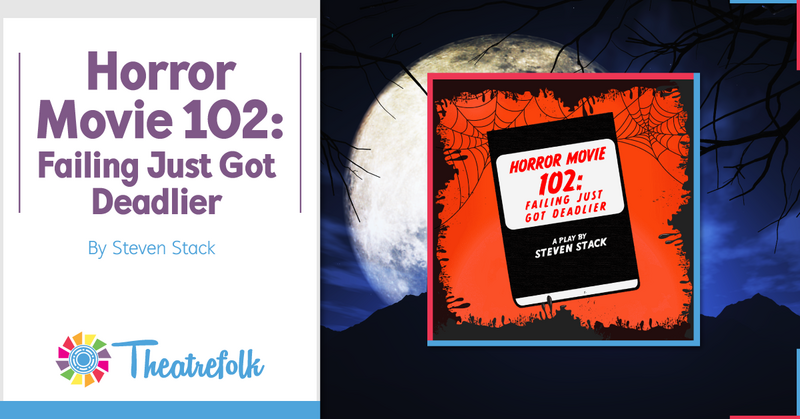
Theatrefolk Featured Play – Horror Movie 102: Failing Just Got Deadlier by Steven Stack
*Welcome to our Featured Play Spotlight. * Did you survive the spookiness and scares of Horror Movie 101: Failing Can Be Deadly? Then hold tight… the spine-tingling horror (and humour) continues with Horror Movie 102: Failing Just Got Deadlier by Steven Stack!
It’s Halloween and a new collection of teens are about to discover the perils of growing up in St. Claire while violating the rules of horror movies in Horror Movie 102: Failing Just Got Deadlier. These fast-paced scenes will frighten you, make you laugh out loud, shock you, hurt your heart and ultimately make you thankful that you don’t live in St. Claire, Minnesota, where the killing of teens in a traditional horror movie style is far too common.
All scenes can be done as standalone pieces or performed together. Easy to stage with few set, sound, or light requirements. The scares are completely theatrical and the ghosts are all in your imagination. Or are they…
Why did we publish this play?
There aren’t a lot of horror plays out there. I love how Steven approaches this genre and makes it theatrical. His work is easily stageable regardless of your situation. Something else Steven does is write great characters with specific personalities – which you don’t often find in the horror genre. And while Horror Movie 102, takes place in the same unlucky horror ridden town as Horror Movie 101, it has it’s own stories. You don’t need to have read or experienced the first play to enjoy producing this one. And enjoy it you will!
Let’s hear from the author!1. Why did you write this play?
I had so much fun writing Horror Movie 101 and I knew that there were more odd happenings to explore in St. Claire. I was totally right. ?
2. Describe the theme in one or two sentences.
In life, all you can do is your best while realizing that, sometimes, life will decide to do something really messed up to you. Like having your head falling off.
3. What’s the most important visual for you in this play?
When Travis’s head falls off and he continues having a delightful conversation with Bean, his beloved. At that point, since it’s the first scene, the audience knows that there is absolutely nothing that can’t happen in St. Claire.
4. If you could give one piece of advice for those producing the play, what would it be?
Avoid playing the jokes or focusing on the ridiculousness aspects of each scene. The humor comes from the fact that what is happening in the scenes is the characters’ reality and something they don’t see as funny.
5. Why is this play great for student performers?
Because it mixes horror, humor, and characters that are complicated and quirky and want to make the right decisions but just can’t for some reason. Which, to be honest, is what students and all of us deal with on a daily basis.
6. Do you have any tips for those who are performing this play online?
Focus on internalizing the characters so that your face will respond to what’s happening to your character. Writing character bios is vital here so that you have an in-depth knowledge of your characters and the others in their world. To do the show online allows the focus to be on the story and the characters instead of the set or the blocking.
Get your copy of Horror Movie 101: Failing Just Got Deadlier right here, right now!Not right for your group right now? Search our play catalogue to find one that your performers will love!
Featured Plays
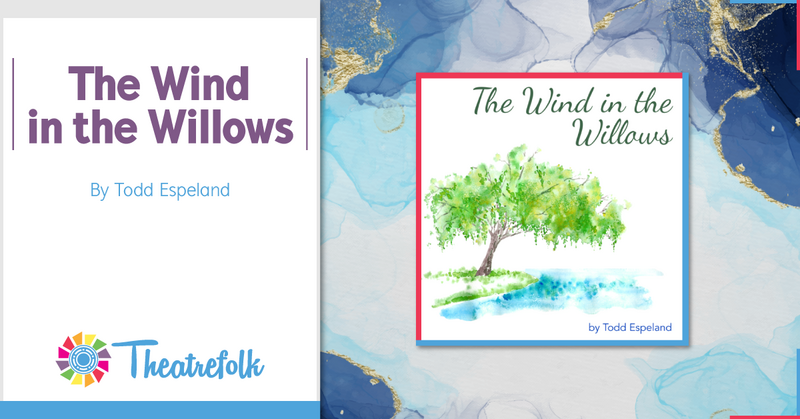
Theatrefolk Featured Play – The Wind in the Willows adapted by Todd Espeland
*Welcome to our Featured Play Spotlight. * The Wind in the Willows adapted by Todd Espeland is a lively and theatrical adaptation of a wonderful classic from Kenneth Grahame.
Mole just wants to make friends, Rat just wants to hang by the river, and Toad just wants everything to go zooooooooom. None of that prepares our friends for the fight to save Toad Hall from Fox and his wicked weasels.
Join them in this in this character-driven thrilling adventure through the Wild Wood and out into the Wide World!
Gender flexible. Easy to stage. Excellent ensemble and tech student opportunities.
Why did we publish this play?
I love an adaptation that takes a world created in one form and brings it to life on the stage. Todd has done just that with this play. It’s easy to stage, the characters are vividly drawn and the text is full of theatricality and humour. So much fun!
Let’s hear from the author!1. Why did you write this play?
I have always liked the story of The Wind in the Willows. It is filled with great characters. My background is in mask and Commedia and the story always felt to me like it had Commedia types in its characters. So I wrote it with that idea in mind.
2. Describe the theme in one or two sentences.
It is about the strength of friendships and believing in someone and helping them become the best person they can be.
3. What’s the most important visual for you in this play?
The moment at the end of the play with all of Toad’s friends on one side of the stage, defending him, and the Fox and Weasels on the other side of the stage backing down from them.
4. If you could give one piece of advice for those producing the play, what would it be?
Trust the absurd, over the top Commedia like comedy of the play. Trust the archetypes in the characters and play them like they were Commedia characters. They may not correspond to classic Commedia characters, but they are all “types”. Trust their character drives and how the comedy comes out of their drives/needs.
5. Why is this play great for student performers?
It gives them a chance to play characters with big needs and characters who play a lot of tactics to get those needs. It teaches them to play “Truth in Size”. If you indicate or play generically BIG, the comedy doesn’t work. Just like in the Simpsons these characters have big needs but those needs are very real for them in the theatrical world of the play. There needs to be an honesty to their large characterizations. That’s why Commedia, when it works, is so much fun. The audience gets sucked into this large theatrical world that is very real of the characters in it.
6. Do you have any tips for those who are performing this play online?
This is a great play for online because it is character driven. Characters using tactics to get their needs from other characters. Any physical business comes out of playing a tactic. Sometimes it is easy to just play the physical business and not play the tactics through your voice and body. Online you have to really be precise about playing your tactics.
If you are planning on doing this show socially distant than I suggest doing a lot of physical characterization work. You will have to use more stage than normal and having specific physical characters will not only help the actors to play off each other but it will fill the stage with these unique physical characters to watch.
Featured Plays
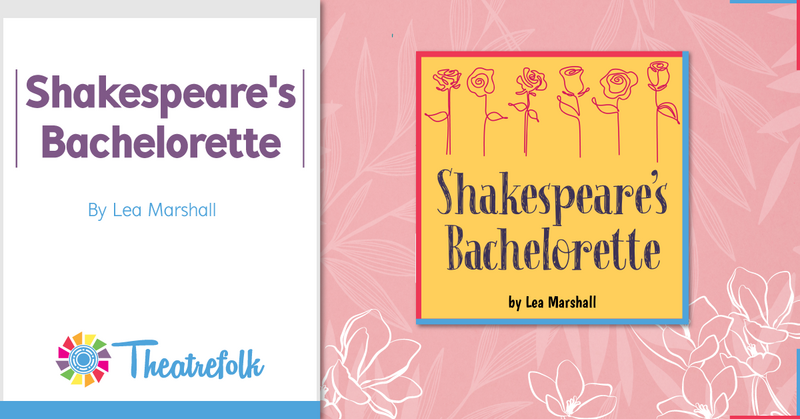
Theatrefolk Featured Play – Shakespeare’s Bachelorette by Lea Marshall
*Welcome to our Featured Play Spotlight. * Shakespeare’s Bachelorette by Lea Marshall is the Shakespeare / Dating show mash-up you’ve been waiting for – complete with video/social distancing options.
Kate is looking for a date and her options are somewhat limited. Hamlet is pretty focused on his step-dad, Macbeth keeps trying to grab a dagger from above Kate’s head, and why does Iago keep giving her a handkerchief?
Oberon seems to think he’s going to win the show and it has nothing to do with that purple flower…
Why did we publish this play?
I love plays that show Shakespearean characters out of context but fully behaving as they would in their original story. So why not take a well known reality show and see if Oberon, Hamlet, Caesar, and Romeo make great dates? (Spoiler alert: they don’t). This play is full on fun and a great introduction to Shakespeare all at the same time.
Let’s hear from the author!1. Why did you write this play?
I had just finished watching the Bachelor, we were reading Shakespeare in all of my classes, and my Honors class wanted to perform an original fun Shakespeare piece for our upcoming Shakespeare-ience showcase. It seemed like a no brainer to put everything together in a crazy mash up.
2. Describe the theme in one or two sentences.
True love is never found on reality TV and the only thing stranger than reality TV “love story” is a Shakespeare love story.
3. What’s the most important visual for you in this play?
The over the top modern day feel of all these characters as reality TV characters. I can see them all in their dressed to impress best, each with a slight costume hat tip to their story: Romeo as a skater boy, Oberon with a floral shirt, Caesar with some red polka dotted shirt, Macbeth trying to look royal and yet innocent, Iago with a hundred pieces of cloth sticking out from every pocket…
4. If you could give one piece of advice for those producing the play, what would it be?
HAVE FUN! Know your character’s story and really imagine how they might act on the Bachelorette TV show.
5. Why is this play great for student performers?
Anyone can play anyone. Plus all those commercials are really fun for new performers. There are parts for first time performers and seasoned performers and everyone in between.
6. Do you have any tips for those who are performing this play online?
If you can find true love on the internet, you can do a play on the internet! This could definitely be done by Zoom. Or with small groups (pods) doing the commercials and filming those to show in between the episodes. There is only one scene with a larger group of characters onstage. So everything else could be very socially distanced blocked with small groups of students.
Featured Plays
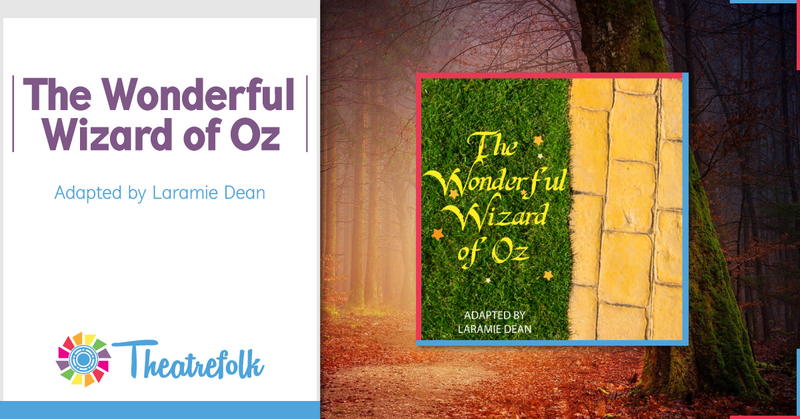
Theatrefolk Featured Play – The Wonderful Wizard of Oz Adapted by Laramie Dean
Welcome to our Featured Play Spotlight. There’s no place like home. And there’s no adaptation of L. Frank Baum’s classic novel like Laramie Dean’s The Wonderful Wizard of Oz!
Dorothy and Toto get swirled into a cyclone and find themselves dropped in the land of Oz – a land where scarecrows talk, lions are cowardly, and witches are very real.
In this fantastic adaptation of the original L. Frank Baum novel (there are no singing munchkins here) every fantasy element is easily and practically staged with just 10 cubes. You too can bring winged monkeys to life!
Gender flexible. Excellent ensemble opportunities. Budget friendly.
Why did we publish this play?
Laramie Dean staged his version of The Wonderful Wizard of Oz when he didn’t have a lot of extras at his disposal – no sets and no special effects. What we’re left with is a fantastically easy to stage piece that uses imagination, collaboration and ensemble theatricality to its utmost. I loved reading this script and seeing a unique version of the story come to life with the use of a few cubes and a stage full of actors.
1. Why did you write this play?
I’ve been in love with the story of The Wonderful Wizard of Oz since I was a wee child. My mother used to read it to me, and then, when I learned to read, I would pore over it at every opportunity. It’s a highly adapted story, and I was super inspired by all the various versions (books, movies, TV shows) I enjoyed as a child.
2. Describe the theme in one or two sentences.
Empathy is essential. Think about how your choices impact other people.
3. What’s the most important visual for you in this play?
I love the end of Act 1, where we finally see the Wicked Witch for the first time, surrounded by all her evil creatures.
4. If you could give one piece of advice for those producing the play, what would it be?
Think theatrically! Often the simplest choice is the most interesting. How can you use fabric, masks, puppets, and simple props to let your performers tell the story?
5. Why is this play great for student performers?
The Wonderful Wizard of Oz offers student performers a chance to perform many different characters and demonstrate their versatility.
6. Do you have any tips for those who are performing this play online?
It’s a familiar story that relies a lot on vocal and emotional resonance. Be big! Be bold! Don’t be afraid to make big choices!
Featured Plays
Theatrefolk Featured Play – Chicken. Road. by Lindsay Price
Welcome to our Featured Play Spotlight. Chicken. Road. by Lindsay Price is an issue-based play for high school performers that is not an answer to the issue, but an amazing forum to start the discussions.
Why did the chicken cross the road? Why is the sky blue? What’s two plus two? Why did he kill himself?
A group of teenagers grapple with unanswered questions as they struggle to understand why someone would run out on to the highway in front of semi. Especially when that someone seemed to have it all.
Here’s a chicken. Here’s the road. There’s the other side. What do you do when there is no answer?
Why did we publish this play?
Our philosophy at Theatrefolk is that issue plays should start conversations, not be the answer to the issue. Chicken. Road. is all about questions, especially the big one “Why would someone who has it all, kill themselves?” The play shows students struggling with this questions and others, and it presents a possible doorway for teenagers to share their own struggles.
The original staging for the play is very simple – a line of students. There is no identified set. This would translate easily to a virtual platform, in fact, the isolation that some of these characters feel would make for a vivid image in a virtual production.
Love the play but need a shorter version? Check out Chicken. Road. Competition Version too!
Let’s hear from the author!1. Why did you write this play?
The question “why” is always the first people often ask when someone they know commits suicide. And that’s because they want a clear cut answer – two+two=four. And the truth is there is no answer. I wanted to explore that question in a theatrical context. I also feel that issue plays should start conversations rather than be the one and only answer. That was definitely my goal for the script.
1a. Why did you write a separate Competition Length version of this play?
One of the challenges with some of my plays is their length—plain and simple. Schools that compete with 30-minute productions can’t perform 50-minute plays, no matter how strong the material. Recently, I’ve taken on the challenge of revisiting several of my longer works, aiming to preserve their integrity and intention while making them more concise. It’s been an exciting project, and I’ve loved reconnecting with pieces I haven’t read in over a decade. I’m eager to see if this streamlined version of Chicken. Road. can find a new audience.
2. Describe the theme in one or two sentences.
Suicide cannot be easily explained.
3. What’s the most important visual for you in this play?
There’s a moment in one of the final monologues in which the best friend of the teenager who killed himself describes the reaction from his mother: “She wants to throw her swarm of questions at me and watch me die from the stings.” I think that is a vivid picture of someone who is desperate to find an answer, and someone who just doesn’t have the answer.
4. If you could give one piece of advice for those producing the play, what would it be?
Yes, this is a serious subject and should be treated seriously. But also remember that this is a play. It has to be theatrical. There has to be a variety of tone. An audience will turn off if the play is one note from beginning to end. There’s some humour in the play, don’t ignore or downplay it.
5. Why is this play great for student performers?
This is a topic that some adults would rather not discuss with teens. They don’t want to touch sensitive subjects – if they don’t talk about them, they don’t happen. Which of course is the opposite of how to address a sensitive topic. Students need to talk, to figure out how they feel, and to express their opinions. Refusing to talk about suicide helps no one.
6. Why is this play great for online platforms?
The staging of the play is very simple – a line of students. This would translate easily to rows of Zoom boxes.
Featured Plays
Theatrefolk Featured Play – Ten / Two by Lindsay Price
*Welcome to our Featured Play Spotlight. * Ten / Two by Lindsay Price is a collection of short ten minute plays for two people that is excellent for classwork or competition.
This collection is a drama teacher’s dream! Ten short two-person plays (inspired by the numbers 10 and 2!) in a variety of themes and lengths.
The plays can to be performed as a group or individually. More flexibility than you’ll ever need. Over three million combinations!
Why did we publish this play?
We wanted a connected scene book – the plays in Ten / Two can be performed individually or together for a full evening of theatre. You could have an entire class working on individual scenes and then put all of the scenes together. The collection is also ideal for student directors because each play is a contained piece.
Why is this play great for online performances?
The framework of the Ten / Two duets will transfer well to an online platform. Each individual play only requires two actors and there are no scene changes within scenes.
1. Why did you write this collection of plays?
I love writing challenges – and to write a whole collection for two actors, that were basically ten minutes in length and explored the concept of Ten and Two in the content of the scene was a fun one!
2. If you could give one piece of advice for those producing the play, what would it be?
These plays are all about relationships. Some of them new, some of them well ingrained. Focus on the characters: why they are together, and what they want from each other.
3. Why is this play great for student performers?
The scenes focus on two characters in a specific, vivid moment. That’s great for students to explore!
Get your copy of _Ten / Two _right here, right now!Not right for your group right now? Search our play catalogue to find one that your performers will love!
Distance Learning
Theatrefolk Featured Play – Jane Austen, Completely Zoomed by Treanor Baring
*Welcome to our Featured Play Spotlight. * Jane Austen, Completely Zoomed by Treanor Baring is a fast-paced, witty modern take on Austen’s six classic masterpieces.
Suitable for online presentation, adaptable for in-person performances, this is not your great-great-great-great grandmother’s Jane Austen.
Choose to perform the canon in its entirety for a total of one hour, or select among the novels for shorter or competition-length performances.
Middle and high school players will delight in bringing to life these relatable homework-less romps through Jane Austen’s beloved novels.
Why did we publish this play?
We were so delighted to receive this collection – Jane Austen adapted with a wonderful tongue in cheek tone and specifically for virtual performances. This collection covers so many bases from classical literature, to tech suggestions for your tech crew (there’s lots for your costume and sound design students), to the acting style of the shows. It’s a win across the board.
Let’s hear from the author!1. Why did you write this play?
I’ve always liked Jane Austen. I wanted to give theatre students something really fun and funny to perform. They aren’t stuffy, musty novels to me. They’re witty and wickedly comic. Because I wanted to base this adaptation on the books, not the recent film adaptations, it gave me incentive to read them all again. I felt it was important to write a “complete Jane Austen” to give people exposure to some of the lesser known novels. And a wide choice about which ones and how many to perform.
2. Describe the theme in one or two sentences.
Jane Austen’s classic novels about finding the person you can trust and love forever come to life in a modern way. Really fast, totally fun.
3. What’s the most important visual for you in this play?
The slides. Besides the dialogue, there are commentary slides that offer a lot of humor. They could even be spoken by an additional character if need be, but they’re an important part of the storytelling comedy.
4. If you could give one piece of advice for those producing the play, what would it be?
Feel free to use this in the way that best suits your program. This play is written to be flexible. The performances can be on line, live, in person, on stage, any way circumstances allow. You can pick two plays out and just do those. Or one. Or all five. Go big with period costumes, or keep it simple and have students wear colorful t-shirts. You can treat this like a teleplay and produce it with in class students to show on line. Or if you’re fortunate enough to be in a place where audiences can be live, it can be performed on stage. Of course, it can performed with everyone remote. You can change your mind about how you perform it at any time.
5. Why is this play great for student performers?
Lots of different parts. Lots of humor. Lots of modern references. Lots of character development possible for all the characters, even the smaller parts.
6. Why is this play great for online performances?
Characters look right at the audience or camera and deliver their lines. It’s written with the “third wall” broken in a lot of places. The narrator explains the plot developments, and who is who. It’s all very accessible.