📣SCRIPT SALE! Treat yourself to an easier Fall. Save 30% on 5+ perusal scripts with code SPRING30 before May 3 and head into summer stress-free.
Vignette
Featured Plays
Theatrefolk Featured Play - School Daze
Welcome to our Featured Play Spotlight. Middle school: a wild mix of excitement, nerves, and really big eighth graders. With a large cast and relatable characters, School Daze by Lindsay Price is an ideal choice for middle school performers navigating their first day of school.
You remember middle school. That first day can be a funhouse or a hall of horrors. Will I fit in or be left behind? Did I wear the right clothes? How will I find the right class? Why do those eighth graders look so big...
Middle school is the tricky tightrope between being a kid and being a teenager. How did you fare? Did you fall off the tightrope? Did you hold on?
See the characters in School Daze try to keep their balance on the first day of middle school.
Let's hear from the author!
1. Why did you write this play?When I’m writing or thinking about writing, my number one method of finding play ideas is observation. Looking at what’s happening around me, listening to conversations, and most importantly, listening to my customers and my audience. Before writing School Daze, I had only written plays for high school students and never considered middle school. After a trip to a conference in Texas, I met so many middle school drama teachers who were looking specifically for plays written for middle school performers and dealing with middle school issues. And the big thing they told me middle school students didn’t want was fairy tales or similar childish stories. I took on the challenge and this play was actually the first of many middle school pieces.
2. Describe the theme in one or two sentences?Middle school is a tricky tightrope. How do you manage the first day successfully?
3. What's the most important visual for you in this play?I love the image of Sam and Pat standing with cafeteria trays trying to figure out how to navigate this new world.
4. If you could give one piece of advice for those producing the play, what would it be?Avoid blackouts. Blackouts take the audience out of the world of the play and if you have one after every scene, the play is going to feel quite choppy. Using staging and music to move from scene to scene. Keep scene changes to a minimum and focus on keeping the play moving!
5. Why is this play great for student performers?I’m thrilled at how schools respond to this play. Some schools present it year after year to their feeder schools as an introduction to Middle School. And because it’s in the vignette format, it’s easy to rehearse with a large cast because you can have several scenes practicing at once. Perfect for Middle School classrooms.
6. Who is your favourite character in the play?I love the race scene because it takes a typical middle school event, moving from class to class, to the extreme. It also gives actors a lot to play with — there’s the humour of the characters and the physical action of the slow motion running. Every time I’ve ever seen the play, this scene has always been a highlight.
7. What is your favourite line in the play?"Everyone at my old school hates Skinny Marie and I know, I just know, she's going to try and be my friend because we're the only ones who know each other."
Featured Plays
Theatrefolk Featured Play - neeT Teen
Welcome to our Featured Play Spotlight. neeT Teen by Lindsay Price is a fantastic play for your group. It's got a little bit everything - from the absurd, to movement, to audience participation, to song... There's even the opportunity to add your own scene to the mix!
Teen life – backwards, forwards and inside-out. From dealing with the tractor beam of insecurity and doubt, to dealing with parents who couldn’t hear you if they tried. From fighting pimples to fighting the hallway. From knowing math skills aren’t going to get the girl to knowing that happy teenagers exist. They may not get the laughs, or the drama, or the big monologue, but they’re there.
Let's hear from the author!1. Why did you write this play?
I wanted to write a vignette play that went out of my comfort zone in terms of exploring form. And there is every type of form in this play from kitchen sink scenes, to absurd, to movement based moments, to choral work, to audience participation, to song, to groups adding their own scene.
2. Describe the theme in one or two sentences?
Teen life – backwards, forwards, inside out.
3. What's the most important visual for you in this play?
I love the ending where the entire cast is singing about not feeling great, not being liked and not getting worried about it. They're not going to change who they are.
4. If you could give one piece of advice for those producing the play, what would it be?
Don't get bogged down by the different forms. Focus on the individual characters in each scene and express the form through what those characters want and the obstacles in their way.
5. Why is this play great for student performers?
It looks at teen life and tackles topics that many teens go through in a unique and varied way.
6. Who is your favourite character in the play?
She's not my favourite character, but for me, it's the most vivid moment in the play. Tyne has bullied another girl to the point where she felt she had to take her own life. Tyne is trying to grapple with the vast weight of this moment and rationalizing her actions as just "a little mean." It's one of my "favourite" monologues in its rawness and how words have consequences.
7. What is your favourite line in the play?
"The world would be a better place if people weren’t so easily offended by words that don’t actually do anything, they just exist."
Diversity
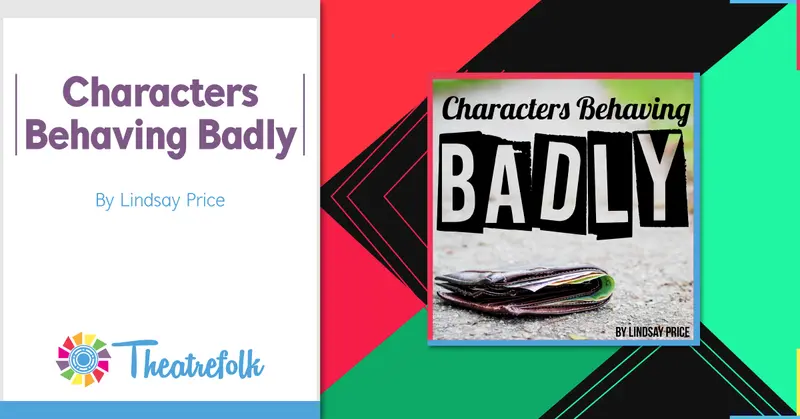
Theatrefolk Featured Play – Characters Behaving Badly by Lindsay Price
Welcome to our Featured Play Spotlight. The vignette play, Characters Behaving Badly, by Lindsay Price, asks students to look at the concept of what it means to be “good” and “bad”, as well as what it means to play a character with whom they might not agree. Perfect for class performances!
If you saw a wallet on the ground, bulging with money, and no one around, would you take it?
What’s the worst thing a person can do? Is it murder? Is it lying? Is it getting an A-? What defines “good” and “bad” behaviour? Can “good” people have “bad” thoughts?
Let’s hear from the author!1. Why did you write this play?
Over the years, I have witnessed a lot of young or student actors being reticent to take on a “bad” character because they felt it would reflect in their own personal character. “If I play a bad character, then I am seen as a bad person.” Which leads to a great question: What does it mean to be “good” or “bad”? And who gets to decide what is “good” or “bad?” And there was my starting point.
2. Describe the theme in one or two sentences.
What does it mean to be “good” or bad?” What does it mean to play a “bad” character.
3. What’s the most important visual for you in this play?
There’s a moment when a character holds up a wallet full of money and asks the other characters and the audience if they would take it if they found it on the ground. Would you?
4. If you could give one piece of advice for those producing the play, what would it be?
It’s a vignette play so it’s easy to default to a blackout between every scene. If you look at the script, it’s specifically designed to avoid that. Blackouts suck the life out of the drive and forward motion of a play. Use choreographed transitions and music to move from moment to moment.
5. Why is this play great for student performers?
Not only are the characters great for analysis in this play, the question around what is “good” and what is “bad” is an excellent topic for discussion. How do your students define the two?
Featured Plays
Theatrefolk Featured Play – Funhouse by Lindsay Price
*Welcome to our Featured Play Spotlight. * Funhouse by Lindsay Price is an incredibly unique and challenging vignette-style play that is an excellent catalyst for conversations around bullying.
This play looks at the bullied, the bully, and the bystander through mostly non-verbal vignettes. Life for the bullied is like a funhouse, but the funhouse is anything but fun.
How can you stand your ground when you’re on a falling floor? How can you move forward when you’re caught like a mouse in a maze? How can you win Whac-A-Mole when you’re the mole? How can you like yourself while standing in a distorted hall of mirrors?
There are no cotton candy answers here.
Why did we publish this play?
A lot of our plays come from listening to customers. A piece of feedback from middle school teachers we received is that they loved our non-verbal play _Emotional Baggage _but the concept was a little beyond their students. Could we provide one specifically for middle school? With a larger cast? _ _
Funhouse looks at the bullied, the bully and the bystander through mostly non-verbal vignettes. When looking at other plays on the topic, there wasn’t a lot we liked – many end with a bully-bullied confrontation in which the bully instantly sees the error of their ways and promises to be a better person. And they all lived happily ever after. This never happens in real life. Can bullies change? Of course! But not in one moment on stage. It’s so destructive to show such a fairy tale ending because there will be students in the audience watching the show, being bullied, knowing their situation is not being represented. And therein lies a huge problem.
Issue plays are tricky because they deal with issues that are happening right then, right now to someone watching the play. It’s not therapy, it’s not an informational brochure and theatricality must always preside, but the issue play does have some responsibility to address the reality of the issue.
Having said that, just as you can’t show the sitcom “everyone loves each other” happy ending, you can’t go to the other extreme and show flat out no-win annihilation. Because then that student sitting in the audience, being bullied, has the very terrifying thought of, “Well there’s no hope, is there?” And that is something we’re not prepared to sit on the shoulders of a 10- or 11-year-old.
_Funhouse _has the right balance between the extremes, in a theatrical context and that’s why it’s in our catalogue. It’s unique and a great catalyst for post show discussion on the issue of bullying. It’s a challenging piece, but by no means is it beyond the middle school scope.
Let’s hear from the author!1. Why did you write this play?
I heard from middle school teachers that they loved the non-verbal elements in Emotional Baggage but were looking for a middle school specific play, and could it have a larger cast? Done and done! I had seen a number of plays that addressed the topic of bullying and wasn’t happy with what I saw – a lot of bullies seeing the error of their ways. I wanted to write something different.
2. Describe the theme in one or two sentences.
The funhouse aims to turn reality upside-down – it shows you a distorted version of yourself in a mirror. It tilts the floor away when you least expect it. It jumps out at you from the shadows. It distorts the truth. It’s a vivid image for what life is like for the bullied.
3. What’s the most important visual for you in this play?
Sometimes the bullies win. That’s important to show. These acts are vital to the reality of the play, for indeed they are vital to showing the reality of what a bullied student must face.
4. If you could give one piece of advice for those producing the play, what would it be?
It’s a play that relies primarily on action rather than dialogue, so that’s going to be your focus. How does action tell the story in each moment? It’s a challenging play but by no means beyond the middle school performer scope.
5. Why is this play great for student performers?
The scope of bullying is pretty far reaching these days, from physical to verbal, to the different ways boys bully than girls, to the insidiousness of cyberbullying. This play offers a opportunity for students, in the play and watching the play to engage in conversations on this, unfortunately, extremely relevant issue.
Get your copy of Funhouse_ _right here, right now!Not right for your group right now? Search our play catalogue to find one that your performers will love!
Featured Plays
Theatrefolk Featured Play – Shakespeare’s Super Snowy Seasonal Sleigh Ride Stage Show! by Lindsay Price
*Welcome to our Featured Play Spotlight. * If you believe that Shakespeare’s characters deserve to celebrate the holidays too, then the “what if” holiday extravaganza, Shakespeare’s Super Snowy Seasonal Sleigh Ride Stage Show! by Lindsay Price is for you!
Shakespeare’s characters are festive. Very festive. And they deserve to be part of the corporate machine that celebrates the holidays every year!
Perhaps there are some characters who don’t exactly make the right choices that would fit the seasonal spirit… but if we can overlook that, so can you. Huzzah!
Let’s hear from the author!1. Why did you write this play?
I love putting literary characters in situations they’d never find themselves in. How do their personality and behaviours translate into different scenarios?
2. Describe the theme in one or two sentences.
A holiday themed “what if” extravaganza.
3. What’s the most important visual for you in this play?
It’s not a visual, but the most important piece of the play are the character wants. Every single character, even if they only have a moment on stage, wants something. Bottom desperately wants to take over as host. Peaseblossom wants to be inclusive and detailed and if there was an informational slide deck, they wouldn’t be unhappy. Verges wants to eat 12 grapes and Dogberry wants nothing to do with it.
4. If you could give one piece of advice for those producing the play, what would it be?
Have fun, play the extremes of the character personalities, don’t use blackouts, and do a little googling to find out why all three witches are named Janet.
5. Why is this play great for student performers?
The play offers a great introduction to some iconic characters. The holidays will never be the same!
6. Why is this play great for online performances?
Acting is acting whether it’s on stage, 6ft apart or in a tiny screen box. Focus on character, communication, and conflict and you’ll be great.
Get your copy of _Shakespeare’s Super Snowy Seasonal Sleigh Ride Stage Show! _right here, right now!Not right for your group right now? Search our play catalogue to find one that your performers will love!
Featured Plays
Theatrefolk Featured Play – Bungee Jump Bear Trap by Lindsay Price
*Welcome to our Featured Play Spotlight. * Bungee Jump Bear Trap by Lindsay Price is a vignette-style dramedy with a gender-neutral cast that reminds us that sometimes risks are worth taking. And sometimes there are bear traps.
Risk comes in many forms (skateboarding without a helmet) and fears (raising your hand in class). There are dumb risks (don’t bungee jump into a bear trap) and smart risks. Sometimes you need to leap without knowing what the outcome will be.
Is safety really as simple as duct taping pillows all over your body and never going outside? Join the characters in this vignette play as they try to figure it all out.
Seriously though, stay away from bear traps.
Why did we publish this play?
We we looking for another middle school specific piece. In one of my conversations with middle school teachers, we ended up talking about how middle schoolers view and respond to risk. Risk is an amazing play topic because it has positive outcomes and negative consequences.
Let’s hear from the author!1. Describe the theme in one or two sentences.
How do you asses and approach risk?
2. What’s the most important visual for you in this play?
There’s a lot of humour in the play, but the biggest risk of all is when a character opens up to their friend about their identity and refers to the potential risk as a five okay fire. At the end of the scene the friend says “I’m not going to set you on fire.” Which is a vivid image that means, tell me everything and I will listen.
3. If you could give one piece of advice for those producing the play, what would it be?
As always with vignette plays, avoid blackouts. Use music and movement to transition. Blackouts will slow the pace of your play to a crawl. Also, use the subject as a springboard discussion about risk. Have students self-assess their relationship to risk. Do they consider risk positive or negative? Are the a risky person? Do they strive to take positive risks, why or why not?
4. Why is this play great for student performers?
Middle school students definitely need to think about their relationship with risk and figure out the difference between positive and negative risk. Plays are a great place to start that process!
Featured Plays
Theatrefolk Featured Play – Red Tee by Lindsay Price
*Welcome to our Featured Play Spotlight. * With flexible gender casting, flexible cast size and an easy to stage set-up, Red Tee by Lindsay Price asks the question ‘Who are you?’.
Gender, family patterns, traditions, labels… It’s time for role call. Who are you?
If you’ve been wearing red for generations, what happens when it doesn’t feel right? And what happens when everyone says you’re the one who’s wrong?
This vignette play examines questions of identity and what happens when someone doesn’t fit in the way everyone expects them to. Are you ready to have these conversations?
Why did we publish this play?
Students are thinking about, talking about, and making decisions about their identity. Adults don’t want them to, but its happening. If we’re going to give students a voice, we need plays and characters that explore identity.
Let’s hear from the author!1. Describe the theme in one or two sentences.
This play explores personal identity and what happens someone doesn’t fit in the way everyone expects them to.
2. What’s the most important visual for you in this play?
When Blue holds out a blank label and says “You get to choose.” Meaning, you don’t have to let others decide your identity. Everyone gets to choose, some make bad choices, but they are their own.
3. If you could give one piece of advice for those producing the play, what would it be?
Have a discussion with your admin so there are no surprises. Make sure you have them on board. Have a discussion with parents. It’s not the students who will push back but the adults who don’t like change.
4. Why is this play great for student performers?
It’s great for students on stage and off because everyone at some point has to make decisions about their identity. Students have to assess who they are, who they want to be and if changes have to be made. Theatre is a great springboard for discussion.
5. Do you have any advice for anyone looking to perform this play online?
Acting is acting whether you’re in front of a screen or in front of a scene partner. Know your character. Create specific physical and vocal choices for that character. Know your lines! Online performing has issues beyond your control, so make sure you’re on top of the things within your control.
Diversity
Theatrefolk Featured Play – Completely, Absolutely Normal: Vignettes About LGBTQ+ Teens by Bradley Walton
*Welcome to our Featured Play Spotlight. * Completely, Absolutely Normal: Vignettes About LGBTQ+ Teens by Bradley Walton is a collection of ten interconnected vignettes with LGBTQ+ themes that are unified by the emotion and humanity found in anyone who is completely, absolutely normal.
A girl’s big moment of coming out takes an unexpected turn. High school sweethearts holding hands in public for the first time are greeted by hatred. A transgender teen struggles with an unaccepting best friend.
Why did we publish this play?
This play is about human contact and showing that all human contact is normal. As we see this concept being challenged and legislated against, it’s important to take a stand and provide a voice for students. All students.
Let’s hear from the author!1. Why did you write this play?
When I started writing this play, I didn’t know it was going to become “this play.” It began as a monologue about a teenager coming out at their dad’s grave. That monologue gave way to a second vignette, and then a third, and…you get the idea. Now, as to why I wrote this play after I knew that this play was turning into “this play”… I wanted to show that human emotion is universal regardless of sexual orientation or gender identity.
2. Describe the theme in one or two sentences.
LGBTQ+ teens are completely, absolutely normal.
3. What’s the most important visual for you in this play?
The visual simplicity of the play as a whole is very important for me. It’s a bare stage show. There’s no fancy lighting. It’s stripped-down and intimate, with all of the emphasis on character and emotion.
4. If you could give one piece of advice for those producing the play, what would it be?
Include questions in the audition paperwork to find out what students are comfortable and not comfortable portraying onstage—ask if they’re okay with doing a same-sex kiss, and find out if there are roles they don’t want to play. Don’t ask for explanations, and respect their answers.
5. Why is this play great for student performers?
It is bursting at the seams with great acting opportunities featuring characters with complex emotions.
6. Do you have any advice for people looking to perform this play online or socially distanced?
The play has ten scenes. Five of them are monologues and the other five have two characters. Socially distanced performance shouldn’t be a huge issue for 90% of the show, but the scene “Brave” is specifically about a couple holding hands and kissing. In light of the current pandemic, I think the hand-holding could be mimed, and I would be okay if the kiss was omitted (the end of the scene wouldn’t be as powerful, but the dialogue would still make sense). I could also see the show being performed like a staged reading, with the two-person scenes performed by students on opposite sides of the stage delivering their dialogue directly out to the audience.
I have a hard time imagining the play being done online. I feel like it demands a level of connectivity with the audience best achieved through in-person performance. A staged reading-style approach might work. But with that being said, if someone has a vision for an online production that they think would be fabulous…go for it. Just keep that sense of audience connection at the front of your mind.
Distance Learning
Theatrefolk Featured Play – Pandemic Pancake by Lindsay Price
*Welcome to our Featured Play Spotlight. * Pandemic Pancake addresses the ongoing changes in the new world we find ourselves in – and is great for virtual or socially distanced performances, or a hybrid of the two.
Pandemic Pancake asks the question: What now? Characters decide, for good and for ill, how they will respond to this evolving new world. Do they find hope? Do they shut down? Do they open doors? Do they strategize long-term? Or do they take it day by day, hour by hour, minute by minute?
We are no different than the characters in this play. We all must decide “what now?”
Let’s hear from the author!1. Why did you write this play?
After writing Scenes From A Quarantinein April 2020 I’ve known that I wanted to do a follow up play as circumstances surrounding the pandemic have changed. Also, as we continue along, I wanted to explore the “what now” of the future rather than remain in the past of the situation. Lastly I wanted to present characters who have figured out how to have hope in this situation. That was the most important element I wanted to present – that there has to be hope as we move forward.
2. Describe the theme in one or two sentences.
Things are different but they’re not impossible.
3. What’s the most important visual for you in this play?
There’s a scene at the end of the play in which two teens, who are on a zoom call and one of them says “Clasp your hands together and close your eyes. Hold tight. I’m holding your hand. That’s me. We’re together.” And they do. And that visual of each of them showing that they support each other sums up the whole play.
4. If you could give one piece of advice for those producing the play, what would it be?
Whether you’re performing virtually or you’re in person, it’s all about the characters. Focus on the characters as they experience their story. Focus on character physicalization. It doesn’t matter if you’re sitting in front of a screen, an upper body physicality is still important. You can still make a character specific.
5. Why is this play great for student performers?
The characters are mostly teen aged and the story is relevant and current.
6. Do you have any tips for those who are performing this play online?
Everything is in the script. The play was written to be performed on line, hybrid, or social distanced with suggestions for how to adapt scenes to fit your situation.
Get your copy of Pandemic Pancake right here, right now!Not right for your group right now? Search our play catalogue to find one that your performers will love!
Distance Learning
Theatrefolk Featured Play – Scenes from a Quarantine by Lindsay Price
*Welcome to our Featured Play Spotlight. * The vignette-style play, Scenes from a Quarantine by Lindsay Price, can be easily performed using an online platform and has a variety of scenes to address all student skill levels.
Did you know COVID-19 likes to be known as Co? And what if Romeo and Juliet missed their marriage by one day because of a stay-at-home order? Would they still make it?
You know all the people in Scenes From a Quarantine. The person who thinks quarantine is going to be easy. The person whose life changed overnight. The person who thinks hairdressers are an essential service. The person who just wants to use class meetings to talk.
Why did we publish this play?
As everyone knows, in-person productions stopped in the middle of March. It’s impossible to predict when they’ll start again. At the time, we didn’t think we’d move into this genre, but as more and more teachers talked about their online performances and were looking for shows that could be produced online, we knew we had to provide some options.
The first thing we wanted to do was provide plays that were specifically written for an online platform. That way, teachers don’t have to figure out how to adapt something – they can present the play as is. We also wanted something that addressed our present situation in a theatrical manner: What if COVID was a character in a scene?
Let’s hear from the author!1. Why did you write this play?
I wanted to write an online specific play, and they always say write what you know! It’s all pandemic, all the time.
2. Describe the theme in one or two sentences.
Pandemic Theatre.
3. What’s the most important visual for you in this play?
My favourite visual is seeing the four horsemen of the apocalypse having a Zoom meaning. Because meetings are hell, especially Zoom meetings!
4. If you could give one piece of advice for those producing the play, what would it be?
Don’t neglect physical character work. Just because your actors may be sitting in a chair staring at a camera, doesn’t mean they can’t act with their upper body. Focus on the facial expressions of their character. How does this character do their hair?
5. Why is this play great for student performers?
The characters are both familiar (they’re going through what students are going through) and theatrical (What if COVID-19 was personified as a character?).
6. Why is this play great for online platforms?
This play is written to be performed on an online platform. No need to figure out how to adapt scenes to fit, it’s all done for you.
Get your copy of Scenes from a Quarantine_ _right here, right now!Not right for your group right now? Search our play catalogue to find one that your performers will love!
Featured Plays
A Creative and Effective Interpretation: darklight
darklight by Lindsay Price is not only a fantastic vignette play for high school performers, it’s also an opportunity for discussion, community and communication on a topic that is happening to them and around them every day.
darklight examines depression and anxiety in teens. Characters fight their inner thoughts, search for their truths, and have surreal conversations with death. Some fail, some find hope.
This is a relevant and necessary issue to explore.
We were thrilled to learn about the incredible interpretation of darklight from Freeport High School in Freeport, Maine. Director Natalie Safley and the school’s talented thespian group were able to take the play and really make it their own through the creative use of their lighting and set design. As you can see from the production photos, a picture really does speak a thousand words… and in this case, many, many more!
Featured Plays
Worth the Wait: Wait Wait Bo Bait
Wait Wait Bo Bait by Lindsay Price is a vignette play all about waiting that’s definitely worth the wait. A high school play with a separate middle school version, students of all ages will not have to wait to impress their audiences or themselves.
Waiting… Waiting… Waiting… What are you waiting for, right now?
Christmas to come? The phone to ring? Class to be over? The man of your dreams? The line to move? The answer? To be yelled at for setting a toilet on fire?
We all have to wait. How long will you? Could you wait all day, or is it killing you? Are you staring at the phone, the line, the door, a clock? A watched clock never boils you know…
The drama team at Fennimore High School in Fennimore, Wisconsin did not have to wait to impress their audience with their performance of Wait Wait Bo Bait. Director Lisa Evans was thrilled to share their success:
“My Dramatic Production class at Fennimore High School presented Wait Wait Bo Bait to members of the student body as the culminating activity for their first semester class. I was very proud of my students and the production. Some of the class members had never appeared on stage before.”
Featured Plays
A Vignette Victory: Anxiety is Orange
““Oppositicitis. Like appendicitis. Only different.””
Anxiety is Orange by Lindsay Price helps us examine how we navigate the world through a sea of green, grey, blue, red, pink, yellow and orange. Does orange make you anxious?
Colours can be symbolic. Red is fiery. Purple is royal. Blue is calming. Sometimes, colours can take on too much meaning. I can’t date you – you wear wenge! He sent yellow flowers! Orange gives my brother anxiety!
The talented student performers at Gulf Coast Academy of Science and Technology in Spring Hill, Florida were able to utilize the short, vivid scenes in this vignette play to maximize their experience and character-development opportunities. Director Stephan Hoda was thrilled to share their success:
“The play went beautifully and was, according to the students, their favorite, thus far. We’ve also performed Circus Olympus, Sleepy Hollow, Lord of the Pies, and Snow Queen.
Vignette plays are WONDERFUL for middle school. I hadn’t directed one before but it really made life much easier. The students were able to learn their lines faster and we were able to focus on performance almost immediately. This is essential for a four-week turnaround.”
Featured Plays
Simple Set, Strong Theme: Hoodie
Hoodie by Lindsay Price is one of our most popular middle school plays that asks all of the tough questions that middle schoolers deal with every day.
Middle schoolers face a tornado of questions every day. What do I wear? What if I wear the wrong thing? What is she wearing? What do I look like? Stop looking at me!
Hoodie examines image and appearance in the vignette style and poses what may be the most difficult question of all – Do I stay in the clump or do I stand alone?
Dorothy Lance and the incredibly talented group of student performers at Clark Lane Middle School in Waterford, Connecticut put on an evening of entertaining theatre for cast, crew and audiences alike:
“Our show is over and was a great success. As a first act, we did Quippage, The Big Lie and Santa Runs a Sweat Shop, featuring my four graduating eighth graders. Great little plays for developing a character in a short piece.
The second act was Hoodie, and got all the attention. Parents, students and staff had nothing but great comments. I had the clump in pale gray T shirts, dark jeans and white sneakers. Characters in scenes added small accent pieces to their costumes. What I liked best was that, including all four plays, I had 21 students playing more than 50 characters-a challenge for all of us.
Thank you for your wonderful writing. Your understanding of the adolescent mind and personality provides an entertaining and insightful evening for all.”
Featured Plays
A Conversation that Needs to be Had: darklight
Sadness. Hopelessness. Irritability. Anger. Hostility. Angst. Doubt. darklight by Lindsay Price examines the important and relevant issues of depression and anxiety in teens. Characters fight their inner thoughts, search for their truths, and have surreal conversations with death. Some fail, some find hope.
This is a relevant and necessary issue to explore.
Rachelle Kinn and the skilled student performers of the Century High School Theatre Department in Bismarck, ND challenged themselves and their audience as they shared the important messages in the play:
“darklight is a great play about a topic no one want to talk about. It was a challenging and rewarding play to direct. Rehearsals were not always fun, but the students tackled a subject they could relate to. The topic is heavy, but it resonated with everyone in our audience. We performed darklight for the state play contest, and we took first place!
TIPS: It is important to have fun during rehearsal. Since the topic is serious and takes a toll on emotions, students need to laugh. We tried to start or end with a game or dance to break up the seriousness of the message.
The lines can be delivered many different ways, so we worked hard to have each vignette portray the emotions a little differently since everyone copes with anxiety and depression differently.
We reminded ourselves every rehearsal what our purpose was with the production–that there is hope even in the darkest of times.”
Congratulations, Century High School!
Featured Plays
You are not alone: Box
Box by Lindsay Price is a middle school vignette play with flexible casting. It can be expanded for a large cast or reduced to a cast of 10 with doubling, and has excellent small scene and monologue opportunities.
Sometimes we choose the way the world sees us. Black box – indestructible. Jewelry box – plain on the outside, shiny on the inside. Sometimes our box is defined by others – our parents, our friends, our enemies. A box built by others can feel small, confined, impossible.
How do we handle the boxes imposed upon us because of our gender? Our race? From peer pressure? From parent pressure? Do we have to live with our box for the rest of our lives? Can we change?
Michelle Wilson and the fantastic drama group at Davison Middle School in Davison, Michigan were able to share “all the feels” with their performance of Box. Cast, crew and audience members were all left with the incredibly unifying message that we’re all in this together:
“I have done Box several times with my 7th and 8th grade Introduction to Theater students (public school). I love the play. A fun fact is that the scene with groups A B and C always makes a parent cry–because of all the students on stage (with each other) yelling “I am alone!” It really shows how alone we feel in our culture, even though we are surrounded by people who feel alone.
TIPS: I had a grandparent of one of the students make me 6 heavy duty plywood boxes with these dimensions (2 of each):
* 2 ½ feet high, 2 ½ feet wide, 1 ½ feet deep
* 3 ½ feet high, 1 ½ feet wide, 1 ½ feet deep
* 5 ½ feet tall and 2 feet wide and deep
They are heavy, so the students have to work together to move them, but we use them all the time for improv, and have used them for many productions of Box. They are so strong, students could jump up and down on them and they wouldn’t break.”
Featured Plays
Embrace the Ensemble: Box
Variable gender-casting. Flexible cast size. Excellent small scene and monologue opportunities. What more do you need? Box by Lindsay Price is a relatable middle school vignette play that you don’t want to miss.
Sometimes we choose the way the world sees us. Black box – indestructible. Jewelry box – plain on the outside, shiny on the inside. Sometimes our box is defined by others – our parents, our friends, our enemies. A box built by others can feel small, confined, impossible.
How do we handle the boxes imposed upon us because of our gender? Our race? From peer pressure? From parent pressure? Do we have to live with our box for the rest of our lives? Can we change?
Director Bri Wehman had nothing but great things to say about her student group’s production of Box. The talented team from Wilson Middle School in Plano, Texas allowed their student directors to take themselves and their audience on an extremely relatable middle-school journey:
“Teachers, parents, students… you’ll be hard pressed to find someone who isn’t touched by this script and its characters. We used BOX as a student-directed play for my advanced 8th graders. It has its challenges, it’s touching, and it’s very real-to-life. I cannot recommend this enough to any director or group considering it.
TIPS: Embrace the use of your ensemble!”
Featured Plays
A Relevant and Meaningful Social Message: darklight
More and more students are dealing with issues surrounding depression and anxiety. darklight by Lindsay Price helps start a relevant and meaningful dialogue and lets students know they are not alone in their struggle.
darklight examines depression and anxiety in teens. Characters fight their inner thoughts, search for their truths, and have surreal conversations with death. Some fail, some find hope.
This is a relevant and necessary issue to explore.
Director Karah Janssen and the skilled student group at Marie Murphy School in Wilmette, Illinois were able to tap into and share the strong social messages in darklight, while allowing themselves to be challenged by the themes and the material:
“The middle school I teach in has many mature, skilled actors and this show gave them a challenge both in scene work and in ensemble work. We felt good about doing a show with a relevant, meaningful social message, not just doing fluffy “middle school” material. There was a bit of hand-wringing on the part of my administration — we had support from our counseling staff for cast members, if they needed it (they didn’t) and for the student audience, if they needed to talk afterwards. (There was one student who did.). It prompted fantastic, meaningful discussions in classes after the school saw the play, and got featured in two local papers. It’s a risk for my age level of students, but it was very worthwhile.
A few tips: Don’t skimp on the quality of lights/sound. It made a huge difference in overall quality. Also, be creative with set design. You can do anything you want, which is really rare.”
Featured Plays
A Loud and Clear Message of Hope: darklight
Sadness. Hopelessness. Irritability. Anger. Hostility. Angst. Doubt. With teenage depression and anxiety rates on the rise, plays like darklight by Lindsay Price are more relevant than ever.
darklight examines depression and anxiety in teens. Characters fight their inner thoughts, search for their truths, and have surreal conversations with death. Some fail, some find hope.
This is a relevant and necessary issue to explore.
Under the direction of Debbie Hornback , the amazing drama team at Montesano Jr/Sr High School in Montesano, Washington had an incredibly successful journey with their production of darklight. Their journey was truly a springboard for discussions and sharing for both the cast and their audience:
“It was a learning experience for both myself (director) and the cast. The issues prompted thoughtful conversations and some insight for those not familiar with all aspects of the illnesses. Hit home with many in the audience as well, and we had tears at the end. The cast really wanted to make sure the message of hope was loud and clear to all who saw it.”
Featured Plays
Theatrefolk Featured Play – Claque Attack by Lindsay Price
Welcome to our Featured Play Spotlight. Claque Attack by Lindsay Price is a fantastic class play that truly deserves a round of applause!
The standing ovation. The regram. The cheer. The boo. The slow clap. The post like. The lengthy applause.
How do you show your appreciation? How do you get the applause you want? How do you make the audience applaud? Do you control the audience or does the audience control you? Join us and find out the answers to all this and more…
Why did we publish this play?
When I was researching this topic, I was surprised to learn how far back the nature of applause, and the need for applause, actually goes. Who knew that Emperor Nero actually had a team of people follow him around applauding! We all need to be told we’re doing a good job. The need for applause is a great character trait and that makes it inherently theatrical. And being theatrical is always a good reason to publish a play.
Let’s hear from the author!1. Why did you write this play?
I’m fascinated by the nature of applause and the audience. Especially in this day and age where everyone seems to be asking for applause in some form or other through Instagram post likes or YouTube subscribers. There are some folks who will take down a post if it doesn’t get enough likes. Who is in control – the person asking for the applause or the person giving it?
2. Describe the theme in one or two sentences.
A clapping contemplation on the nature of applause.
3. What’s the most important visual for you in this play?
There’s one scene where a group applauds for the whole scene because they’re afraid to be the first one to stop. This was the first scene I wrote – it’s based on a story from the Stalin years where an audience applauded for 15 minutes and the first person who stopped was arrested.
4. If you could give one piece of advice for those producing the play, what would it be?
No blackouts! This is a vignette play so each scene is independent of the other. Use music and creative transition staging to keep the play flowing and fluid.
5. Why is this play great for student performers?
The scene work makes it great for a class – everyone can rehearse at the same time, it’s easy to stage and costume.


.png)


.png)
.png)

.png)