Facebook Pixel Skip to main content

📣SCRIPT SALE! Treat yourself to an easier Fall. Save 30% on 5+ perusal scripts with code SPRING30 before May 3 and head into summer stress-free.

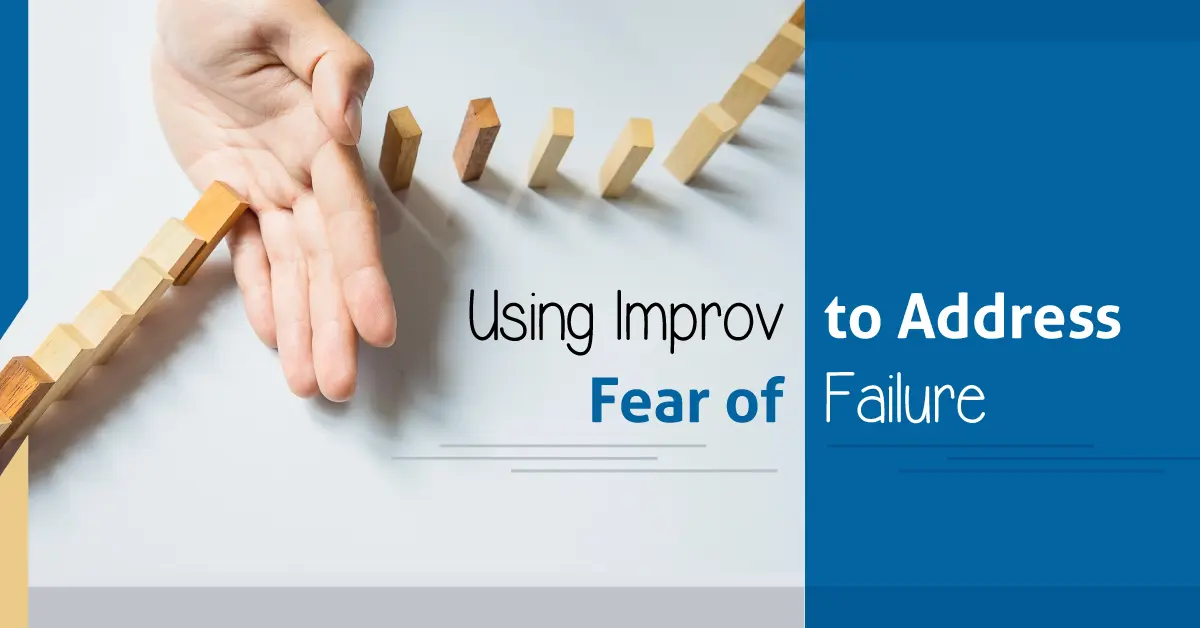
Using Improv to Address Fear of Failure

Fear of failure is a huge concern in drama class. Nobody wants to fail – it’s not a good feeling, and students are hyper-aware of not only their own feelings, but their perceptions of what others in the class think of them. Making a mistake can be paralyzing because students are afraid of looking foolish, unintelligent, or unaware in front of others – so they often won’t even try a task without a huge amount of anxiety.

However, the following improvisation game, The Alphabet Improv Game, is great to try with your students because it’s a pretty challenging one. It is inevitable that your students are going to make mistakes and “fail” while playing it, because even the most seasoned improv performers find this one difficult. The point is to try the game, make mistakes, and see that making mistakes is not the huge deal that students can make it out to be. The goal is that your drama students will realize that everyone makes mistakes – it’s not just them, stuck in their own heads. And at the same time, they get to have a lot of fun!


Instruction

The Alphabet Improv Game is played as a full class.

  • Have students sit in a circle.
  • Select three to four students to start the scene.
  • Have the rest of the group choose a location (e.g. supermarket, classroom, movie set, theatre rehearsal, corporate office, desert, jungle).
  • The first group of students will start the scene. However, each sentence spoken by a new person must start with the next letter of the alphabet, from A to Z. (Each word in the sentence doesn’t have to start with that letter.)
  • Students need to listen carefully and remember what letter they are currently on!
  • For example, if the scene is taking place on a movie set:

1. Student 1: “Annnnnnd…action!”
2. Student 2: “But soft, what light through yonder window breaks?”
3. Student 1: “Cut, cut! Can you do that again, please? We can’t hear you!”
4. Student 3: “Don’t speak so quietly.”
5. Student 2: “Everyone else on this set can hear me…can’t you guys?” …and so on.

  • If a student starts their sentence on the wrong letter or repeats a letter that was already used, then they have to sit down and the next student in the circle replaces them. The scene continues on, with the new student either taking on the same role or coming in as a different person. The location remains the same.
  • If there is a long pause and none of the students can think of the next sentence, all of the current students have to sit down and the next three to four students in the circle replace them. They pick up from the last letter used. So if the last line was “Man, it’s so hot out here!” then the next sentence must start with N.
  • The scene must be completed by the time the students get to the letter Z. Then the scene may start again with three to four new students in a new location until the full class has had the opportunity to play.
  • If your students find this game too easy, have them go through the alphabet backwards, from Z to A!

If your students ask, there is no prize or reward for one person/group being able to complete the game in one try. This is not a competitive game and that’s not the point of it.


After each student has had a chance to participate, have a debrief conversation with the class. How do they think they did? What were the easiest and most challenging parts of the game? How did your students feel if they made a mistake? If you notice students are getting overly critical of themselves, acknowledge that there is always room for improvement but that everyone makes mistakes and it’s completely normal to do so. Then ask them to discuss positive moments that arose while playing the game. They will explore their thoughts further while completing an individual Reflection.


Distance Learning Adaptations

Alphabet Warm-Up (Full Class)

  • The goal is for students to recite the alphabet out loud, from A to Z, one person at a time. One student says “A”, another student says “B”, another student says “C”, and so on, without following an assigned running order.
  • If two students say the next letter at the same time, or a letter is skipped, the group starts over at A. Students cannot cue or coach each other, or give visible hints.
  • Ask students: What is the purpose of this exercise? What are the benefits to students of doing this warm-up?

Alphabet Storytelling (Full Class)

  • Determine a running order of students.
  • Students will tell a story, one sentence at a time, starting with the letter A. The next student will start their sentence with the letter B, and so on, from A to Z. (Each word in the sentence doesn’t have to start with that letter. See the example in the article above.) Students must focus on starting with the correct sequential letter, as well as ensuring their sentence has a specific beginning and ending, and that it makes sense with the story topic.
  • If a student starts their sentence on the wrong letter or repeats a letter that was already used, they are out. The story continues on until the students reach Z.
  • Once students are able to tell a story with an assigned running order, try the exercise again without a running order. Students will need to listen that much more carefully to avoid interrupting each other.

Virtual Alphabet Improv Game (Full Class)

  • This game can be played using a video conferencing program, pretty much exactly the same way as the in-person version. Assign 3-4 students to create an improv scene, and have the rest of the students ready to jump in if a letter is missed or a long pause occurs. If you wish, determine a running order for participating students in advance, so students know when they are “on deck.”
Click here for a free Reflection and Rubric to accompany The Alphabet Improv Game.
Download For Free

Related Articles

Top 5 tips for Adapting Improv for a Virtual Performance
Distance Learning

Top 5 tips for Adapting Improv for a Virtual Performance

Jim Hoare is the author ofYour High School Improv Show Playbook and has added a Virtual Performance Pandendum (Pandemic Addendum) to the resource for adapting improv to a virtual environment. For those of you looking to put on a virtual Improv show, here are his top five tips and games suggestions! *1. Practice, Practice, Practice *Experiment with different formats to see which serves you best. If, after trying a virtual improv show on a platform (Zoom, StreamYard), or recording and editing a short improv show for scheduled streaming, you feel that the quality is not something you are proud to share with your community, don’t stream that performance. Consider it a valuable learning experience and try again. The goal is education, not TV ratings. Share what you are proud to share. 2. LightingYou must light the show for the video stream, not the theater, otherwise it may be too dark for those watching at home. You can do this either by adding more light to your performance space or by using a video camera with the ability to adjust to low-light. For those improvisors performing at home, it means having light on their face and not bright light behind them, which will make their face difficult to see. 3. Face MasksGood sound is key. With a socially distanced cast wearing face masks, diction, articulation, and projection are more important than ever. Use face masks as a teaching tool/aid to help students improve in these areas. Warm up with tongue-twisters and articulation exercises. When the face masks finally come off, their diction, articulation, and projection will be better because of it. For those improvisors at home, diction, articulation, and projection are just as important. Before streaming your show, ask someone who was not involved in the filming or editing to watch and listen to the finished product. If they cannot clearly understand what is being said, start over. 4. Social DistancingIf gathering actors in person, tape safe distancing boxes on the stage. However, students who live together, or who have been exclusively socializing together since March, with parents’ permission, may be able to perform together and stand closer on stage. Consider “Cohort Casting” for some group games. 5. Set Clear ExpectationsSet clear goals and expectations for online meetings with parents and students. Before your virtual improv show, set clear goals and expectations with your audience. “What you are about to see is something completely new. It’s not our usual improv show at school – and it’s not the next episode of Whose Line Is It Anyway? It is our best effort to Keep Calm and Carry On With Some Silliness during these challenging days. We hope you enjoy – and we look forward to being back together in person as soon as possible.” (or similar) Top 5 Improv Games to Play Virtually Games where individual players speak one at a time lend themselves to online viewing and screen sharing. Those games are more about speaking and less about physicalizing. Rather than move downstage to participate in the game, players raise their hands and unmute themselves or wait to quickly be acknowledged by you. 1. 185 (a game about puns)The object of the game is to come up with a bad pun that elicits a groan from the audience. Ask the audience to write in chat an occupation or hobby. As soon as the occupation or hobby is announced, any member of the team can step forward (or raise their hands and unmute themselves). The goal is to see how many puns they can come up with in the time given (usually about two minutes). The same person can go more than once. 2. Alphabet Game / A-B-C-provCome up with a relationship, a destination, and a means of transportation for two players (mom and son going to college, dad teaching daughter to drive, etc.). Decide which letter of the alphabet the scene will start with. Beginning with that letter and continuing in the order of the alphabet, the players must build a scene within 26 sentences or phrases, with each sentence or phrase starting with the next letter of the alphabet until every letter has been used. Before you begin, decide how many players will participate (two or more). You may want to establish an order, so that each player knows exactly when they will contribute the next sentence in the conversation (with the next letter of the alphabet). Sentences can be as short as one word or sound (Ahh! Grrh! Zowie!) but avoid run-on sentences which slow the pace of the game. *3. Lines You’re Not Likely to Hear *The whole team will come on stage and be given a person, character, etc. by the host. One at a time, players will step forward (or unmute) to deliver a one-liner demonstrating a line you’re unlikely to hear, from the suggestion. The goal is to see how many one-liners they can come up with in the time given (usually about two minutes). The same person can go more than once. *4. Thought Dubbing *Four Players – two seen (the characters) and two only heard (their thoughts). Give Player 1 and Player 2 a relationship and a location. Player 3 will voice the thoughts of Player 1 and Player 4 will voice the thoughts of Player 2. Players 1 and 2 must remember to pause to hear what they are thinking from Players 3 and 4 and then adjust the scene depending on what they are “thinking.” You may want to have Players 3 and 4 hit “Stop Video” on their device so that we only hear them. If so, then Players 3 and 4 must have clear, distinct voices that Players 1 and 2 will recognize as their thoughts. *5. World’s Worst *The whole team will be given a noun, occupation, etc. by the host. One at a time, players will step forward (or unmute) to deliver a one-liner demonstrating the WORST example of the suggestion. Like Lines You’re Not Likely to Hear, any member of the team can step forward. If the player is at home, encourage the use of props/items or people who may be nearby. This game is about being clear and demonstrative. The same person can go more than once. Click here to learn more about Your High School Improv Show Playbook
Improv Game: Imposter
Classroom Exercise

Improv Game: Imposter

The following improvisation game challenges students to stay in character, think on their feet, keep the scene going, and react to each other. They’re also likely going to laugh, because one of the characters in the scene isn’t what they seem — they’re an imposter! This game can be played in person or online via distance learning. 1. Have students split up into groups of three to four. 2. Give each group an occupation or job prompt: a group of kindergarten teachers, a group of dentists, a group of construction workers. You can use this list of occupation prompts for inspiration. 3. One student will play an actor who is studying the others to play a character with that job for an upcoming project. (For example, think of the character Joey Tribbiani from Friends playing Dr. Drake Ramoray on the fictional version of Days of Our Lives on the show.) The other students will play real versions of people with that job, who are experts in their field. 4. The group will start a scene where the experts are doing typical tasks associated with the job they’re doing. Using the examples above, the group of kindergarten teachers might lead their students in a craft or a song, the group of dentists might start examining a patient’s teeth, and the group of construction workers might start using their respective equipment. It doesn’t matter if the students playing the experts actually know what their job is — they need to act like they’re confident and knowledgeable, and keep talking and reacting to each other. 5. The imposter will desperately try to fit in, copying the others in an exaggerated manner, using terminology (real or made up) that they clearly don’t understand. The imposter kindergarten teacher may make up lyrics to a song (“Twinkle twinkle little star… would you like to drive my car?”) while the imposter construction worker might struggle to figure out how to operate a tool. 6. The group must have a specific beginning and end for the scene. Is the actor found out to be an imposter? Do they confess? Or does the imposter fool the rest of the group and escape? It’s up to your students. You may want to have each group perform the scene twice — once where the experts are fooled, and once where the imposter is found out. 7. At the end of class, have each student complete an exit slip (found below).
Improv Game: Creative Defiance
Classroom Exercise

Improv Game: Creative Defiance

The core tenet of improvisation is “Yes, and…” To keep the scene going, each participant must agree with any suggestion that is brought forward, and add something on. It’s a balance of giving and taking, and listening to each other. Teamwork is key. Participants look good by making their fellow group members look good. In this game, the cardinal rule of improv is turned on its head. In groups, two students work together to keep a scene going, while a third student breaks the “Yes, and…” rule by disagreeing and taking the scene in another direction, leaving the rest of the team to follow along. The purpose of “creative defiance” is for students to practice thinking quickly on their feet and problem solving, while staying cool under pressure. It’s a challenge no matter what side of the scene you’re on. This exercise can be done live in person, or online using a video conferencing program such as Zoom or Google Classroom. Directions:1. Divide students into groups of three. Select one student to be “No” and the other two students to be “Yes.” 2. Give each group a scene starter, such as a situation (baking a cake, climbing a mountain, taking a test), a location (the doctor’s office, on holidays in Spain, an underground lair), or a starting line. This could be as simple as “Good morning class!” or “Can you believe what they said?” or as complicated as you wish. 3. The two “Yes” students will start and perform the scene following the rule of “Yes, and…” by agreeing with what is currently happening in the scene and adding something to push the scene forward and give their group members something to work with. For example: If the opening line is “Can you believe what they said?” a less than helpful response would be something like “What did they say?” or “I can’t believe it!” because while they are continuing the scene, they’re not offering any material for their partner to play off of. A better response would be something like “I know! Caitlin told Jeremy that his shoes were hideous. Frankly, I think she’s right.” Students are challenged to think quickly and make a decision. 4. The third student (“No”) will follow the rule of “No, and…” They will disagree or change what their group members have suggested, but they can’t just disagree – they must also come up with something different for the scenario. From the previous example, one of the “Yes” students said “I know! Caitlin told Jeremy that his shoes were hideous. Frankly, I think she’s right.” The “No” student might say, “That isn’t right, Caitlin told Sherry that she’s terrible at math” or “You heard wrong, it was Jeremy that said Caitlin’s whole outfit was hideous, and Caitlin cried all night about it.” The “No” student disagrees with what is said, and gives some different piece of information to their group. 5. The “Yes” students need to go with whatever the “No” student says and figure out how to continue the scene while following the changes that have been presented. This can be frustrating or stressful – it is up to the “Yes” students to stay calm and cool and do their best to keep the scene going. The challenge for the “No” student is to keep coming up with different, interesting ways of changing up the scene without resorting to obnoxious behaviour, giving repetitive or one-word responses, or shutting down. The goal of the “No” student isn’t to kill the scene (although that might happen), but to push it in a different direction and keep the rest of the group on their toes. 6. Keep the scenes brief. Be sure to cut groups off before students get too frustrated or run out of ideas. It’s likely that the scene may die organically – it’s challenging for students to have to constantly switch directions. But you may have to give them an out. 7. Discuss with the group members: • Did the scene work? Why or why not? • What did you try to do to keep the scene going? • How did you feel when one of the team members was constantly disagreeing with you? • How would you feel if someone acted this way in the real world? • What would you do/how would you respond to this person? Questions for the rest of the class: • Did the scene work? Why or why not? • How did you feel watching the scene? • Was the scene funny, interesting, or entertaining? Why or why not? • Why is the “Yes, and…” rule important when doing improv? • How can this exercise be applied to the real world? 8. If you have time, start the scene again with all students following the “Yes, and…” rule. Have students compare it with the previous scene. 9. As an alternative challenge, select 1-3 students to act as referees. They will watch the scene carefully, listening for rule-breaking (such as the “No” student disagreeing but not offering a new piece of information, or the “Yes” student not going with new information presented) and giving strikes for rule-breaking. If a group member gets three strikes, they are out, and another student will jump in and take their place. You may wish to end the class with a brief relaxation exercise or do something silly, like a dance party, to ease any tension or frustration that may have arisen from doing this exercise.

Games for the Drama Classroom: More Than Play

by Lindsay Price

A collection of games and activities that go well beyond the notion of "play."

Your High School Improv Show Playbook

by Jim Hoare

Have you wondered how to take improv to the next level with your students? Your High School Improv Show Playbook is the "how-to" guide for you! Empower students to present their first improv show that is fun and entertaining for all.

Create Your Own Choice Board: Drama Activities

by Lindsay Price

Choice boards give students the opportunity to choose how they want to learn a particular subject. Create Your Own Choice Boards: Drama Activities can help encourage your students' independence by allowing them to take an active role in their learning.

Distance Learning

by Christian Kiley

A play about trying to survive and thrive in a virtual classroom.

Impowerment Improv

by Jennine Profeta

Using improv to create self-awareness & confidence in your students

Improv Games with Purpose

by Jennine Profeta

Improv games including feedback suggestions and questions, game variations, teaching tips, side coaching tips, entry prompts, exit slip questions, and more!