Facebook Pixel Skip to main content

📣SCRIPT SALE! Treat yourself to an easier Fall. Save 30% on 5+ perusal scripts with code SPRING30 before May 3 and head into summer stress-free.

Shakespeare on a Shoestring - Cymbeline!

Shakespeare on a Shoestring - Cymbeline!

by Michael Calderone

Did you know that Cymbeline has all of Shakespeare’s most famous plot devices? It has… Faked Death! Mistaken Identity! Parental Marital Veto! But wait, there’s more!

Join our players as they tackle the play in the Shoestring style, which emphasizes ensemble, the physical space (with all scenery created by living tableaux) and audience interaction.

It’s the perfect storm for your students to sync up their Shakespeare and turn up their technique.

Comedy Shakespeare

Recommended for High Schools and Middle Schools

Running Time
About 50 minutes
Approximate; excludes intermissions and scene changes
Cast
12 Characters
6 M6 F, Plus percussionist. Easily expandable.
Set
Simple set
Length
46 pages
Free Excerpt

What to order?

Not sure what you need to order? Check out our pricing and ordering guide.

Performance Royalty Fees

Royalty fees apply to all performances whether or not admission is charged. Any performance in front of an audience (e.g. an invited dress rehearsal) is considered a performance for royalty purposes.

Exemption details for scenes and monologues for competition.

12 Characters
6 M, 6 F, Plus percussionist. Easily expandable.

Characters in this play are currently identified as male or female. Directors are welcome to assign any gender (binary or non-binary) to any character and modify pronouns accordingly.

Yellow Man: Belarius [M] 36 lines
Yellow Lady: Pisania/Pisanio [A] 35 lines
Red Man: Cloten/Jupiter [M] 47 lines
Red Lady: Queen [F] 27 lines
Blue Man: Posthumous [M] 51 lines
Blue Lady: Imogen [F] 71 lines
Purple Man: Cymbeline [M] 35 lines
Purple Lady: Caius Lucius [F] 28 lines
Green Lady: Guilderius/Polydore [F] 40 lines
Green Man: Arviragus/Cadwal [M] 30 lines
Orange Man: Iachimo [M] 62 lines
Orange Lady: Doctor, Narrator [F] 78 lines
Percussionist
An onstage percussionist who punctuates the action

More Plays Like Shakespeare on a Shoestring - Cymbeline!

An emotional tug of war between a sister and brother and what really happens in the world of teenage marijuana use. A vivid personification of drugs.

Hamlette

by Allison Williams

Hamlet is played by a girl in this twisty-turny comedic interpretation of the classic Danish tale.

A shorter version of our hilarious gender-bending take on the Scottish play. Updated version.

Mmmbeth

by Allison Williams

An hilarious gender-bending take on the Scottish play! Updated Version.

Denmark is plagued with zombies in this gruesomely comic adaptation of Shakespeare's Hamlet.

Much Ado High School

by Lindsay Price

What if Much Ado About Nothing took place at a high school dance? An enjoyable introduction to Shakespeare with lightning-fast pace and snappy dialogue.

From the Drama Teacher Learning Centre

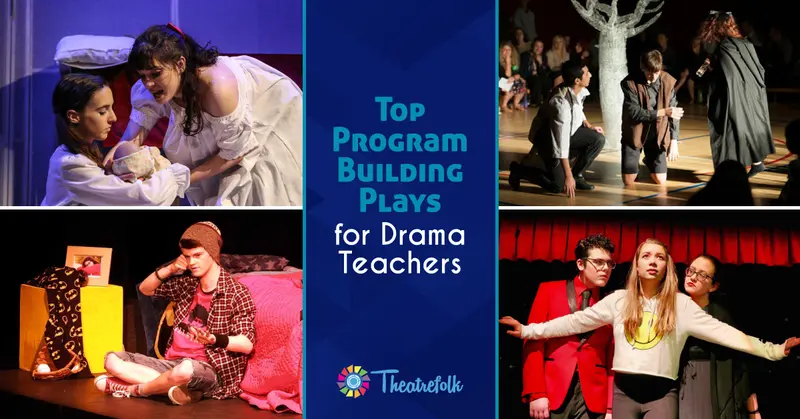
Theatrefolk’s Top Program-Building Plays
New Drama Teachers

Theatrefolk’s Top Program-Building Plays

Time for a Tfolk Top Plays List For….Building a Theatre Program. You’ve had a large group of seniors graduate. You’re starting at a new school that doesn’t have a theatre program You’re taking over a program that needs some serious love. What plays should you choose to build your program? Click the link and you’ll be taken to the webpage for each play. There you’ll get the details and read sample pages. All the best with your search – and with building your program! Choose a play with a familiar link that people know. Use the familiar as your hook.
Theatrefolk Featured Play – Shakespeare on a Shoestring – Cymbeline! by Michael Calderone
Featured Plays

Theatrefolk Featured Play – Shakespeare on a Shoestring – Cymbeline! by Michael Calderone

Welcome to our Featured Play Spotlight. It’s time to get your students ready to sync up their Shakespeare and turn up their technique! Shakespeare on a Shoestring – Cymbeline! by Michael Calderone has all of Shakespeare’s most famous plot devices? It has… Faked Death! Mistaken Identity! Parental Marital Veto! But wait, there’s more! A great opportunity for student performers to tackle the play in the Shoestring style, which emphasizes ensemble, the physical space (with all scenery created by living tableaux) and audience interaction. Why did we publish this play? Shakespeare on a Shoestring is such a fabulous concept – living tableaux, ensemble driven, and audience participation. This is exactly the type of work students should get involved with. I also love that we can feature the process with a play we don’t normally see on the high school stage – Cymbeline! Cymbeline has a lot of twists and turns and every time I went “wait, what?” Michael was right there with a recap in the script. This is a great script and a great theatrical opportunity for your students! Let’s hear from the author! 1. Why did you write this play? I have been writing Shoestring versions of stories for years; first for a Rutgers University Shoestring Players’ production and for various educational programs. I was teaching a Shoestring workshop in Nassau, Bahamas with the company Shakespeare in Paradise showing them how Midsummer could be staged without any scenery aside from the actors in living tableaux. A few years later I wrote Shakespeare on a Shoestring: Midsummer! and it was a hit at Hopkins School where I now teach. From there, my Ensemble Theater Class began staging Shakespeare on a Shoestring each year. Cymbeline was our second venture and when the opportunity came for us to perform at the Edinburgh Festival Fringe in 2017, the cast decided to do Cymbeline. It was a great choice since so many companies do Midsummer each year, but very few do Cymbeline. The main reason why I chose to adapt Cymbeline in the first place was due to the many scenic images that could be created by the cast: a ship to Italy; a four-poster bed; a cave in the wilds; and Jupiter’s Golden Eagle. It lent itself very well to the Shoestring style. 2. Describe the theme in one or two sentences. Is it possible for Shakespeare to include twelve popular Elizabethan tropes in one play? Faked death? Fidelity Test? Cross-dressing? Yes! Have your cast explore this little known play and discover how he did it. 3. What’s the most important visual for you in this play? The most important visual aspect of this production is how creative you as a director can get with avoiding any actual scenery and employing every member of your company in creating the scenic elements. Have them create everything that is needed through living tableaux and the tools available to actors: their bodies, their faces and their voices! 4. If you could give one piece of advice for those producing the play, what would it be? Tempo; always be mindful of your tempo. The percussionist, or on-stage “Foley Artist” keeps the show moving along while supplying incidental sound punctuation. The action is fast until it get’s complicated. At those times Shakespeare puts little re-caps in throughout the original play and I preserved them in out-of-character commentary. Leave room for the audience to get what you’re doing with the living scenery but not enough time for them to question it! 5. Why is this play great for student performers? Full cast involvement. Everyone is engaged throughout the production. Each cast member is part of the whole playing a tree in the forest in one scene and a prince in another. It is the true ensemble experience.
Cheers to the Classics: The Canterbury Tales
Featured Plays

Cheers to the Classics: The Canterbury Tales

Cheers to the classics! In the brilliant full-length adaptation, The Canterbury Tales by Lindsay Price, Chaucer’s classic collection of tales come to life. A group of travelers set out for Canterbury on a pilgrimage. To pass the time they entertain each other with a storytelling contest. Best story wins a prize. Each and every performer gets a chance to shine in this spirited, charming script. With a script that uses modern English text, this play offers great characters, lots of humour, and strong ensemble work. Under the guidance and direction of Drama Teacher (and Theatrefolk playwright!), Michael Calderone, the talented student group at Hopkins School in New Haven, Connecticut successfully brought this cross-curricular classical adaptation to life. From directors to cast members to the stage manager, there was a definite cohesive community feel to this production. “Lindsay Price’s The _Canterbury Tales_ was just the right script for our winter slot, traditionally our one-act production. The one-acts allows for us to rehearse small, complete scenes independently of each other and then bring them together for the production weekend. The difficulty was finding a script, author or theme that could tie the desperate acts together and not have the appearance of completely random scenes. The Chair of our English Department suggested we look at Canterbury Tales which would tie in nicely with the 10th grade English curriculum. After searching the internet for various versions I came across Lindsay’s which, luckily for us, was neither too simple or sophomoric, nor was it too lofty as the Royal Shakespeare version. It was the perfect length, struck the right tone, and satisfied everything needed for our one-acts slot. I was able to cast the individual stories considering everyone’s schedules and abilities, from those who hadn’t had stage time in the past to those who had a few shows under their belts. Lindsay reduced the number of “pilgrims” from the original Chaucer into a manageable ensemble who be came both storytellers and a neat tie-in to the production as a whole. These roles in my production went to our stalwart drama kids who had the time and the experience to carry the important role of holding the show together. The biggest question from the English Department was if the Miller’s Tale was included in the play; and to their joy and fear I told them that it was. But, don’t fear, Lindsay’s version is tame enough for the youngest of audience members yet suggestive enough to give those in the know a good laugh. Long story, short: Lindsay’s script ticked off many boxes for our school production. The English Department felt validated, the audience enjoyed themselves and, most importantly, the students had a great time!”
Shakespeare on a Shoestring
Podcast

Shakespeare on a Shoestring

Episode 202: Shakespeare on a Shoestring What does Shakespeare on a shoestring mean? It means no set, no elaborate costumes, all sound done onstage and life. Just like Shakespeare would have done in his day. If you’re looking for a doorway to Shakespeare, if you’re looking for a show to tour or take to a festival when you don’t have any tech at your disposal, then the shoestring philosophy will be right up your alley. Tune in to learn more!
We accept

In addition to the above payment methods, Purchase Orders are accepted from US and Canadian Schools.

Info for your purchasing department