
Facebook Pixel Skip to main content

📣SCRIPT SALE! Treat yourself to an easier Fall. Save 30% on 5+ perusal scripts with code SPRING30 before May 3 and head into summer stress-free.

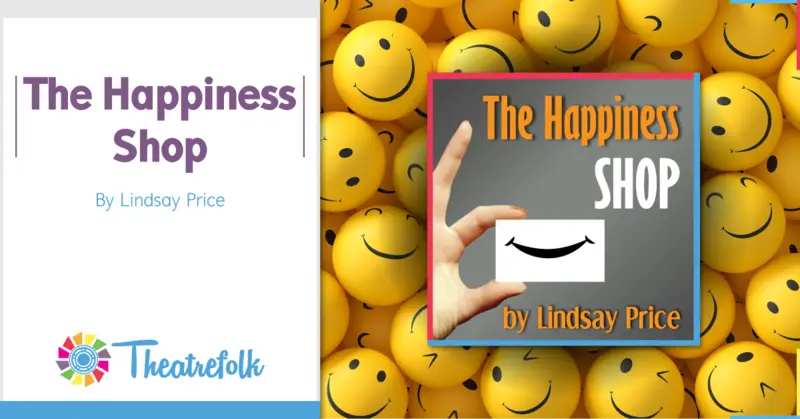
The Happiness Shop

The Happiness Shop

by Lindsay Price

Three middle school students find themselves in an odd curiosity shop. They don’t know what it is, where they are, or how they got there. But that’s no surprise. The Happiness Shop is not like any other. It is filled with Roppets.

A Roppet is not quite a robot and not quite a puppet. A Roppet is completely happy all the time. Full of smiles, hugs and hi-fives. Isn’t that all it takes for a middle school student to be happy? They’re too young to have problems.

Blake, Melanie and Wally know that’s not true. They all have pretty big problems. But in the shop they have one question to answer and one question only: What would you do to be completely happy?

With up to 28 speaking parts and easy staging The Happiness Shop is perfect for a class project.

Dramedy Character Study Issue-Based

Recommended for High Schools and Middle Schools

Running Time
About 35 minutes
Approximate; excludes intermissions and scene changes
Cast
28 Characters
6 M | 9 F | 13 Any Gender
Set
Simple Set
Length
43 pages
Free Excerpt

What to order?

Not sure what you need to order? Check out our pricing and ordering guide.

Performance Royalty Fees

Royalty fees apply to all performances whether or not admission is charged. Any performance in front of an audience (e.g. an invited dress rehearsal) is considered a performance for royalty purposes.

Exemption details for scenes and monologues for competition.

28 Characters
6 M, 9 F, 13 Any Gender

Characters in this play are currently identified as male or female. Directors are welcome to assign any gender (binary or non-binary) to any character and modify pronouns accordingly.


GROUP ONE:
Dr. D (Dompster) [A] 62 lines
One of two deranged Doctors.
Dr. Dee (Dompster) [A] 79 lines
Dr. D’s partner in crime.
Blake [M] 32 lines
Desires to be happy. Can he get his wish?
Melanie [F] 38 lines
Bullied by girls who were once her friends.
Wally [A] 43 lines
Sees through the façade of the Roppets.

GROUP TWO:
Bezmo [A] 54 lines
Works in The Happiness Shop.
Besme [A] 45 lines
Works in The Happiness Shop.
Loopy [A] 37 lines
Works in The Happiness Shop.
Roppet One (Jordan) [F] 2 lines
A Roppet at the shop. The show model.

GROUP THREE (Blake's Story):
Roppets Rubrik (6) [A]
A team of Roppets that act out memories.
Blake 2 [M] 16 lines
A memory of Blake.
Mom [F] 18 lines
Blake’s mother
Dad [M] 19 lines
Blake’s father
Monsieur Grant [M] 18 lines
A teacher at Blake’s school
Ms. Peretti [F] 19 lines
Another teacher at Blake’s school
Depression Troll [A] 31 lines
That nagging voice in your head.

GROUP FOUR (Melanie's Story):
Roppets Rafter (6)
A team of Roppets that act out memories.
Melanie 2 [F] 17 lines
A memory of Melanie.
Kellie [F] 10 lines
Ex-friend of Melanie.
Kensie [F] 15 lines
Another ex-friend of Melanie.
Kelsie [F] 13 lines
A third ex-friend of Melanie.
Phoenix [M] 18 lines
Backs Melanie up.
Depression Troll [A] 31 lines
That nagging voice in your head.

GROUP FIVE (Wally's Story):
Roppets Rookery (7)
A team of Roppets that act out memories.
Wally 2 [A] 34 lines
A memory of Wally.
Demeter [F] 14 lines
Criticizes Wally.
Ajax [M] 20 lines
Criticizes Wally.
Coach Lynch [A] 15 lines
Wally’s coach. More understand than you might expect.
Depression Trolls x3 [A] 12, 10, 9 lines
Those nagging voices in your head.

More Plays Like The Happiness Shop

Through the Looking-Glass

adapted by Lindsay Price from Lewis Carroll

Alice is back in Wonderland and looking to become Queen. This adaptation is a fantastical physical journey for both actor and audience.

A noir play featuring the ace detectives from the Broadly Speaking Detective Agency.

Cobweb Dreams

by Lindsay Price

Cobweb dreams of a different life, away from Titania's train.

Cobweb dreams of a different life, away from Titania's train.

The Pauper Princess

by Holly Beardsley inspired by Mark Twain

A retelling of Mark Twain’s The Prince and the Pauper.

Storied

by Bradley Walton

In a magical dimension, three teenagers are pulled into a conflict between Good and Bad Ideas from classic tales. Who is to blame for the bad idea?

From the Drama Teacher Learning Centre

July Reading List: Issue-Based Plays
Featured Plays

July Reading List: Issue-Based Plays

As you start planning for the new school year, why not explore some incredible issue-based plays? These thought-provoking scripts tackle real-world challenges and spark meaningful conversations in your classroom or on stage. These plays are perfect for fostering meaningful discussions and bringing diverse voices to your stage or classroom. Add them to your collection and watch your students engage with drama that truly matters!
Theatrefolk Featured Play - The Happiness Shop
Featured Plays

Theatrefolk Featured Play - The Happiness Shop

Welcome to our Featured Play Spotlight. The Happiness Shop by Lindsay Price is an excellent class project that explores important issues for students. Three middle school students find themselves in an odd curiosity shop. They don’t know what it is, where they are, or how they got there. But that’s no surprise. The Happiness Shop is not like any other. It is filled with Roppets. A Roppet is not quite a robot and not quite a puppet. A Roppet is completely happy all the time. Full of smiles, hugs and hi-fives. Isn’t that all it takes for a middle school student to be happy? They’re too young to have problems. Blake, Melanie and Wally know that’s not true. They all have pretty big problems. But in the shop they have one question to answer and one question only: What would you do to be completely happy? Let's hear from the author! 1. Why did you write this play?I wrote this play specifically for middle school students after a couple of eye opening experiences. First, I watched a 13 year old boy deliver one of my monologues in a competition. The character in the monologue talks about his life and how his family treat him after a suicide attempt. The monologue was written for a 16 year old character and the impact of seeing it done by a 13 year old was huge. Does suicide happen in middle school? Secondly the director of one of my plays shared a rehearsal exercise she did with her cast in which her middle school students wrote on post-it notes the positive and negative things they say to themselves or hear others say to them. The negative board had three times more post-its than the positive one. (The exercise is included in this play's free Classroom Study Guide.) Do middle school students get depressed? I’m the first to admit, until writing this play I did not fully realize that middle school students could experience depression. I thought depression didn’t hit until high school. That’s when I started researching the topic. I found that not only do middle school students get depressed but it’s often overlooked as laziness, and ignored because they’re “too young” to be depressed. Many times the issue is never addressed. I knew I had to bring this issue to life in a play. 2. Describe the theme in one or two sentences?Happiness does not come from burying your feelings and pretending to be happy. Students suffering from depression are not alone in their feelings and they don’t need to suffer alone. 3. What's the most important visual for you in this play?The Roppets. They are supposed to be completely happy and smile all the time. But what's hiding behind those smiles? 4. If you could give one piece of advice for those producing the play, what would it be?Be prepared for discussions. You never know how students are going to be affected by being in the play. You may want to discuss the play with the guidance department. You are not a therapist and shouldn't take on that role. 5. Why is this play great for student performers?The play demonstrates the different faces of middle school depression and the different choices made because of it. Not all the choices these students make are good ones. I feel that’s important to stage. I think, too, it's important to show positive choices. 6. Who is your favourite character in the play?Phoenix is Melanie's best friend and I absolutely loved writing for them. The character is weird and loves being weird. They are not popular and are often bullied, but still has a great outlook on their life. They see their bullies as sad animals and never lets the bullies actions affect them. 7. What is your favourite line in the play?"Oh you did help me. You helped me see myself."
Theatrefolk’s Top 10: Ensemble Pieces
Featured Plays

Theatrefolk’s Top 10: Ensemble Pieces

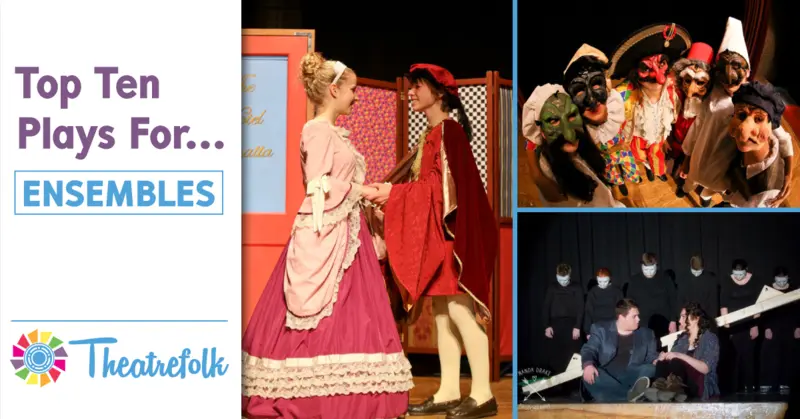
Time for a Tfolk Top Ten Plays For…Ensembles! It’s not about the leads and the chorus, it’s about the ensemble. The definition of the word ensemble is to have parts that come together as a whole and are only considered in relation to the whole. It’s all about working together to make a great production. Here are 10 plays that explore the concept of the ensemble. Click the link and you’ll be taken to the webpage for each play. There you’ll get the details and read sample pages. All the best with your search! The Blue and the Grey This play starts with the sound of drumming and the words of Walt Whitman. This sets the tone of the play and lets us know what to expect. This is the work of the ensemble. In this play of ghosts, the past, and those left behind – The ensemble creates the aural world in The Blue and the Grey – haunting, necessary. Finishing Sentences Sometimes an ensemble is needed to populate the world of the play. In Finishing Sentences Kendra finds herself surrounded by camp life – that’s what the ensemble provides. And besides, you can’t have a colour war without them! (even if the blue team can’t get their chant together) Storied Quite often, the world of the play is, well, out of this world. It’s built in the imagination of the playwright, and in order for the audience to buy in, they need to see characters who also buy into the world. Storied takes place in a magical dimension inhabited by characters from fiction. Everyone from Javert to Santa Claus to Elizabeth Bennett lives there. The ensemble is crucial to the audience leaving the real world behind as they watch the play. The Happiness Shop In this play an ensemble of “Roppets” – robot puppets litter the stage. They are on stage for the entire play. They visual demonstrate “happiness.” They smile, they laugh, they hi-five all the time. It isn’t creepy at all. Aren’t middle schoolers happy all the time? They’re too young to have problems…. The Scarlet Heart The Scarlet Heart is a commedia dell’arte piece which can be played as scripted or off of scenarios. To play off a scenario means a group really has to know each other, listen to each other, improv often together. They’ll have to become a true ensemble. Being Bianca: The Semi Complete Guide Being Bianca has a huge cast – it can include up to 50 actors. And that means everyone has to be on the same page and working toward the same goal. Bianca has to do some community service. She decides the best service is to teach the world what it’s like to be her. Who wouldn’t want to be Bianca? Ariadne’s Thread: The Adventures of Theseus and the Minotaur Ariadne’s Thread has an ensemble in the classical sense of the word – a greek chorus. Again it’s all about creating the world of the play and in this tale of Minotaur’s and mazes the greek chorus observes and comments. They are the voice of the audience and they share that voice in perfect unison. Stupid is Just 4 2day We can’t avoid stupidity. It happens. To everyone! But it’s just temporary. The characters in this vignette play are all named after orchestra instruments. And that’s because all the transition pieces are performed like music rather than theatre. Everyone speaks, and gestures in unison. Win the Best Ensemble award! Chemo Girl Camille is given a video game system from her mom as a form of recovery therapy for cancer. The ensemble creates the video game for Camille as she is drawn into the world and takes on the name “Chemo Girl.” Think video games can’t be done in the theatre? The ensemble makes it happen. Anonymous In Anonymous everyone is just trying to get along, get by, make themselves heard. It’s hard when you don’t have a face or a voice. The teens in this play have no names because they’re everyone. The ensemble brings this theme to life.
One Act Plays for Middle School
Featured Plays

One Act Plays for Middle School

Choosing one act plays for middle school is not an easy task. The students are at a very in-between point in their lives. They no longer want to be seen of as “kids” yet many are not quite ready to tackle heavier issues. Play selection is a total “your mileage may vary” situation. It depends on each specific set of kids. Some will be content with fairy tales while others will want intense make-’em-cry dramas. Here is a direct link to all of our one act plays for middle schools. I reached out on our Facebook page for some feedback from middle school teachers: “What are the major factors you need to consider when selecting a one act play for your middle school?” Here are some of the more representative responses we got. “Large cast size (25-35) for my classes, appropriate for their age, doesn’t focus on typical angst of the MS student, it needs to be mostly funny (they’ll get enough serious stuff at the HS level), and I LOVE vignettes which allow me to cast many kids in roles The Snow Show ~ Jessica Landry Stafford “It has to have a message. My students don’t like fluff. They want something to sink their teeth into. It also has to have a good ending. I have found most one act plays just drop off and don’t have strong endings.” ~Leslie McKibben “Cast size over 20. Smart script. Age/audience appropriate but not talking down to teenagers. Would love to see more stories that weren’t necessarily anchored in school angst.” ~Aidan O’Hara “A play “the cast and crew will care about.” Most middle schoolers are not yet such experienced theatremakers that they’ll enjoy doing any show for any reason–the story needs to engage them pretty quickly for them to commit to the process.” ~Becky Schlomann “I always think about the talent that I have available at the school and choose a show that will make all their talents shine. I want to pick a show that will both challenge the students, but also engage them and nurture their love for theatre.” ~Bethany Kennedy “No more mangling of fairy tales or Shakespeare! Something that they can sink their teeth into without being angsty. Heavier on girls. Boy roles where they don’t have to be ‘manly.’” ~Amy Medina “Opportunity, creative challenges, meaningful and accessible character development. LOVED Tick Talk for middle schoolers in particular, BTW.” ~Jessica Shulman McGettrick As you can see, the answers are wide and varied. There’s no magic bullet. There’s no “one size fits all” play for a middle school group. Choosing a one act play for middle schools depends heavily on the group of kids that you have at the time. Here are some of the main factors brought up by our Facebook fans. AppropriatenessAppropriate is in the eye of the beholder. It would be impossible to say what’s “appropriate” because standards vary. Our customers request plays that run the gamut between requests to remove all references to dating from a play (a play that doesn’t show a date, it just uses the world) to our most challenging plays, some of which aren’t even on our recommended list of plays for middle schools. Cast sizeThis one was almost universal. A large cast size is important. This is particularly tough in a one act play format. Writing a play that has a lot of characters isn’t challenging, but it is challenging to develop them all, to give them individual traits so the actors feel like they can contribute as individuals to the production. Some of our one act plays that achieve this nicely are: • Funhouse – a bullying play with a cast of 20 • The Absolutely Insidious and Utterly Terrifying Truth About Cat Hair – A fun play with a long title and a huge cast. • Shuddersome: Tales of Poe – A very large cast adaptation of Poe’s most theatrical stories • Lord of the Pies – a delicious parody of Lord of the Flies Students Can Relate to ItThe plays we publish and promote for middle schools tend to have the majority of characters of student age (except in the case of literary adaptations). It’s important that the characters and the situations they find themselves in are realistic and relatable. Not necessarily how adults see the middle school student, but how they see themselves. The Play Stretches the PerformersIt’s important that the play stretch them as performers. But “stretch” doesn’t have to mean “a different age, like grandparents” In the professional world, for example, I’ve always played roles that fit my age and every experience I’ve had has stretched me as a performer. A meek student can be stretched by playing a bully. A straightlaced student can be stretched by playing a troubled kid. Typecasting is lovely and it makes casting easy, but if you’re looking to stretch kids then it’s important to cast against type sometimes. At the end of the day the most important thing in educational theatre is the students’ learning experience. For example, our middle school play The Happiness Shop looks at the issue of Middle School Depression. This is a serious topic and allows middle school students to tackle a big issue in a theatrical manner. The Fractured Fairytale DebateSome people on our Facebook post said they love fractured fairytales, others are sick of them. That’s what makes art so wonderful – there are plays to suit every taste. We don’t have any fractured fairytales but I don’t think there’s a single thing wrong with them besides the fact that it’s very easy to write a bad one. I’ve seen so many come through our submission process that just aren’t theatrical. They are just re-worded versions of fairytales – parodies or spoofs. They are funny on the page and that’s probably the medium they belong in. The best way to tell if a script is theatrical or not is to ask yourself these questions: How will staging this play (bringing it to life) differ than just reading it? What parts of the script would be enhanced by live performers? Can you visualize the script in action when you read it? Do you see people moving? Are there moments that will affect the audience? If you struggle to answer these questions then there’s probably not much theatre written into the play. I have no doubt that we’ll publish a fractured fairytale at some point but when we do it will also work as an engaging piece of theatre. Here are a couple of examples of **adaptations/parodies that work as theatre:** • Drop Dead, Juliet! – Juliet tries to change her inevitable death at the end of the play and engages in a battle of wills with William Shakespeare. • Circus Olympus – A collection of Greek myths come to life. The script encourages liberal use of circus skills – what’s more theatrical than a Greek myth & circus mashup? • Rebootililzation – Not a one act, but this clever play incorporates a ton of fairtytale and literature based characters. More Girls than BoysThis is a purely logistical issue. More girls audition for middle school shows than boys. Pretty much all of our plays have more girls than boys for this very reason. We also try our best to get some gender-neutral characters in there for casting flexibility. Bradley Hayward’s Apostrophe’s and Sixteen in Ten Minutes or Less are both fantastic choices for flexible casting. Simple StagingIn our experience, the middle school budget is limited. The middle school play is more about putting as many students on stage, rather than having the most elaborate staging. We got you there, too. We always aim for scripts that are easy to stage. Our running joke is that most of our plays can be staged with two chairs and a cube and if you’re really pressed for budget, then one of the chairs could be cut. Personal TasteBecky Schlomann had this to say about what kinds of plays she looks for: “Something I personally like. I’m going to be spending more time with the script than anybody, and if at the beginning of the process I hate it, by the end of the process I’ll be ready to poke my eyes out.” This is the main reason that every play on our website comes with an extensive free excerpt. That way there are no surprises when you order a play for production, and you don’t have to order a dozen perusal scripts based on a catalogue blurb only to end up disappointed that none of them appeal to you. There are a lot of one act plays for middle schools on our website. If that overwhelms you, feel free to email us or use our live chat through this page. Tell us your likes, dislikes, cast size, and the age of your group. We’re always happy to send recommendations your way.
Social Issue Plays for High Schools / Middle Schools
Teaching Drama

Social Issue Plays for High Schools / Middle Schools

Our website lists all of our plays with social issue themes but it struck me that they’re only lumped as “issue plays” without a good guide to sorting out which title addresses which issue. So I’ve categorized them for you to hopefully give you a helping hand in your quest to find the perfect script for your school. Check them out. As usual, all of the titles have extensive free sample pages for you to read. I think you’ll find the writing honest, fresh, and believable – three qualities sadly lacking from a lot of “teen-issue” plays out there in the world. Alienation / Feeling Alone in the World• Anonymous by Allison Green • The Art of Rejection: Two One Act Plays by Christian Kiley • A Box of Puppies by Billy Houck • Constantly, Incessantly, All The Time by Billy Houck • Huge Hands by Billy Houck Body Image• Body Body by Lindsay Price • The Four Hags of the Apocalypse Eat Salad at their General Meeting by Lindsay Price • The Battle of Image vs. Girl by Johanna Skoreyko • Hoodie by Lindsay Price • Breathless by Wendy-Marie Martin Censorship• Censorbleep by Lindsay Price Human Rights• Look Me in the Eye by Lindsay Price • Sweep Under Rug by Lindsay Price Racism• Flaky Lips by Lindsay Price • With Liberty and Justice For All by Jeyna Lynn Gonzales • Not Going Anywhere by Emma Fonseca Halverson • The Burgundy Letter by Kirk Shimano • Let Me In by Sholeh Wolpe *** Rumours and Lies• Have You Heard? by Krista Boehnert • The Redemption of Gertie Greene by Taryn Temple Individuality• Hoodie by Lindsay Price • Virtual Family by Christian Kiley • The Happiness Shop by Lindsay Price • A Deep, Poetic Journey Into Something by Forrest Musselman • Carrying the Calf by Shirley Barrie • Monster Problems by Lindsay Price • Stereotype High by Jeffrey Harr • Sixteen in 10 Minutes or Less by Bradley Hayward • Nice Girl by Amanda Murray Cutalo • Pressure by Lindsay Price • They Eat Sunshine, Not Zebras by Dara Murphy • The Super Non-Heroes by Taryn Temple • Smarty Pants by Bradley Hayward Identity• Box by Lindsay Price • Labeled by Lindsay Price • We Are Masks by Lindsay Price • Stressed by Alan Haehnel • Anonymous by Allison Green • Constantly, Incessantly, All The Time by Billy Houck • The Super Non-Heroes by Taryn Temple School Violence• Huge Hands by Billy Houck • Power Play by Lindsay Price • Clowns with Guns (A Vaudeville) by Christopher Evans • The Butterfly Queen by Christian Kiley • Life and Death in an Empty Hallway by Christopher Evans • Water. Gun. Argument. by Alan Haehnel Sexual Abuse• The Waking Moment by Bradley Hayward • Breathless by Wendy-Marie Martin Substance (alcohol & drug) Abuse• Bottle Baby by Lindsay Price • Floating on a Don’t Care Cloud by Lindsay Price • One Beer Too Many by Billy Houck Suicide• The Bright Blue Mailbox Suicide Note by Lindsay Price • Chicken. Road. by Lindsay Price • The Butterfly Queen by Christian Kiley Teen Pregnancy• The Pregnancy Project by Lindsay Price • Among Friends and Clutter (one scene) by Lindsay Price Illness/Health• Chemo Girl by Christian Kiley • The Other Room by Christian Kiley • Red Rover by Christian Kiley • Waiting Room by Christian Kiley • Breathless by Wendy-Marie Martin • Shreds and Patches by Robert Wing • Inanimate by Christian Kiley • Constantly, Incessantly, All The Time by Billy Houck Depression/Anxiety• darklight by Lindsay Price • Fidget by Bradley Hayward • Among Friends and Clutter (one scene) by Lindsay Price • Constantly, Incessantly, All The Time by Billy Houck • who are we, who we are by Forrest Musselman Bullying• Finishing Sentences by Scott Giessler • Funhouse by Lindsay Price • Power Play by Lindsay Price • The Redemption of Gertie Greene by Taryn Temple • Sixteen in 10 Minutes or Less by Bradley Hayward • Carrying the Calf by Shirley Barrie Divorce• Split by Bradley Hayward Gender• Life, Off Book by Scott Giessler • Anonymous by Allison Green • Baalzebub by Rachel Atkins (Baalzebub – One-Act Version here) • Completely, Absolutely Normal: Vignettes About LGBTQ+ Teens by Bradley Walton • Finding Jo March by Laramie Dean • Thought Traps by Lindsay Price Empathy• Discovering Rogue by Christian Kiley • Boat by Lindsay Price • We Are Masks by Lindsay Price • The Butterfly Queen by Christian Kiley Dependence on Technology• Virtual Family by Christian Kiley • Inanimate by Christian Kiley
We accept

In addition to the above payment methods, Purchase Orders are accepted from US and Canadian Schools.

Info for your purchasing department