📣SCRIPT SALE! Treat yourself to an easier Fall. Save 30% on 5+ perusal scripts with code SPRING30 before May 3 and head into summer stress-free.
Issue Based
Featured Plays
Middle School Magic: Box
If you’re looking for a middle school play that has it all, look no further than Box by Lindsay Price. Flexible casting, small scene and monologue opportunities, and dealing with issues that middle-schoolers can relate to, this vignette play is not to be missed.
Sometimes we choose the way the world sees us. Black box – indestructible. Jewelry box – plain on the outside, shiny on the inside. Sometimes our box is defined by others – our parents, our friends, our enemies. A box built by others can feel small, confined, impossible.
How do we handle the boxes imposed upon us because of our gender? Our race? From peer pressure? From parent pressure? Do we have to live with our box for the rest of our lives? Can we change?
Director Sally Vopnfjord was thrilled to share the success of the amazing student performers at Kipling Collegiate Institute in Toronto, Ontario, who were able to create and share their own middle-school magic:
“Our school recently performed BOX as part of the National Theatre School Drama Festival (formerly Sears Drama Fest). Despite competing in the festival for the first time and featuring first-time actors – we won! We were selected as one of the top 3 shows in our district. BOX will now be performed in the Toronto Regionals at Hart House – fingers crossed that we can take this show all the way to the Provincial Finals.”
Congratulations on your success, Kipling Collegiate!
Featured Plays
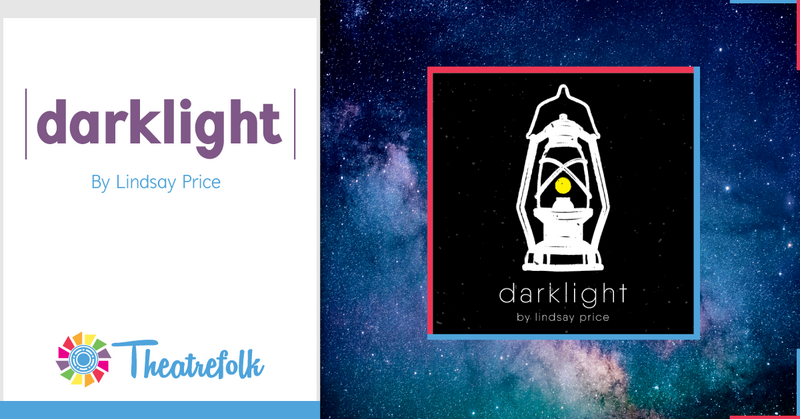
Theatrefolk Featured Play – darklight by Lindsay Price
Welcome to our Featured Play Spotlight. Sadness. Hopelessness. Irritability. Anger. Hostility. Angst. Doubt. With teenage depression and anxiety rates on the rise, plays like darklight by Lindsay Price are more relevant than ever.
darklight examines depression and anxiety in teens. Characters fight their inner thoughts, search for their truths, and have surreal conversations with death. Some fail, some find hope.
This is a relevant and necessary issue to explore.
Let’s hear from the author!
1. Why did you write this play?
It is becoming more and more evident that depression and anxiety are consuming students. That means it’s a topic that must be discussed – it’s vital that students know they are not alone in their struggle.
2. Describe the theme in one or two sentences.
A theatrical examination of depression and anxiety in teens.
3. What’s the most important visual for you in this play?
There is a character called Luz who searches for those in need. She carries a lantern throughout. Her job is not to solve issues, or offer neat and tidy solutions. Her purpose is simply to hold a light. To let those in struggle know that even in the darkest night there are stars.
4. If you could give one piece of advice for those producing the play, what would it be?
There are many sad moments in the play. It’s a sad topic. Don’t “play” the sadness. Don’t overdramatize the emotions, which is extremely hard to resist sometimes, for sure. For example there is a character who is everyone’s best friend, who appears happy, well adjusted and together but he suffers from terrible depression. But you can’t play the sadness because no one sees it in him.
5. Why is this play great for student performers?
It’s an opportunity for discussion, community and communication on a topic that is happening to them and around them every day.
Featured Plays
Life Lessons Learned: Hoodie
Middle schoolers face a tornado of questions every day. What do I wear? What if I wear the wrong thing? What is she wearing? What do I look like? Stop looking at me!
Hoodie by Lindsay Price examines image and appearance in the vignette style and poses what may be the most difficult question of all – Do I stay in the clump or do I stand alone?
The drama students at Washington Jr. High School in Manitowoc, WI asked and answered these tough questions in their performance of Hoodie. From the first read-through to the set design to opening night, it is obvious that this was a true labour of love.
Not only were the students able to gain experience and insight into the theatrical process, but they were able to truly relate to the theme and messaging throughout the play:
“You should learn how to be an individual and do what you want to do in your life.”
“You don’t always have to be in a certain group. Just be yourself. Be unique.”
Featured Plays
A Symphony of Sound Success: Stressed
A symphony of sound. A symphony of character. Vivid themes. Vivid characters. Stressed by Alan Haehnel is a true theatrical experience for any drama students looking for a bit of a challenge and a whole lot of fun.
For Alex, it’s school. For Josh, it’s his girlfriend. For Carmen, it’s dealing with her coach. And Mindy’s frustrated with her parents. Stress is driving this quartet crazy – so much so they can’t stop talking about it.
This play is a symphony of sound and character. A challenging but incredibly fun piece.
The incredibly talented group of student performers that make up the Stromness Drama Club off the northeastern coast of Scotland in Orkney , didn’t stress at all about their production of Stressed. In fact, they thrived!
“Every year we try to put on a youth production as part of the Scottish Community Drama Association’s one-act play competition. This year we were fortunate (or good!) enough to win the youth trophy and also to come 3rd overall. We also won the Northern Divisional Youth Final and will be competing at the Scottish Finals as well.”
Featured Plays
A Connection Across Cultures: Box
“This is the box my parents want for me. This is who my parents want me to be. A shining star… I don’t want to disappoint my parents, but this is not my box.”
How do we handle the boxes imposed upon us because of our gender? Our race? From peer pressure? From parent pressure? Do we have to live with our box for the rest of our lives? Can we change?
Box by Lindsay Price is a middle school vignette play with flexible casting. It can be expanded for a large cast or reduced to a cast of 10 with doubling. Excellent small scene and monologue opportunities.
Under the direction of Stephanie Brook the student performers at GEMS World Academy in Switzerland demonstrated that the challenges of choosing how the world sees us is shared by students worldwide.
“This was performed by my theatre class made up on only Grade 6 students (ages 11-12), from a variety of backgrounds and nationalities. We have Italian, Spanish, Swiss, Canadian, American, British, Scottish, Irish, Filipino, Dutch, Argentinian, Venezuelan, Brazilian, Israeli and Portuguese, to name a few.
I had to do a lot of unpacking of the material for them to understand what the play was speaking about, but this is a beautiful age to be addressing stereotypes and “boxes”, and they really connected with it. I have been receiving messages from parents all evening telling me how wonderful it was.
Several of the parents, kids and staff at school commented on how relevant, how real and how engaging the play was. One of the students really connected with it, and she was in Grade 4! She said it helped her to understand a lot of what goes on at school.
The school counsellor wants us to take this on as a Grade 6 play every year – she thinks it is so perfect.”
Congratulations GEMS World Academy!
Featured Plays
Theatrefolk Featured Play – Have You Heard? by Krista Boehnert
Welcome to our Featured Play Spotlight. If you’re ready to explore the power of the rumour, you’ll want to check out Have You Heard? by Krista Boehnert. This monologue-based one-act drama is extremely relatable and a great way to stretch your performers.
“Did you hear? Have you heard? Promise not to tell anybody?”
Everybody knows a secret. Some keep them quiet. Some let them loose. Some make them larger than life. Secrets, lies and rumours are the subject of Have You Heard?
This monologue-based play follows what happens in a school when rumours and secrets spin out of control. What makes a secret more powerful: When it’s the truth? Or when it’s a lie?
Why did we publish this play?
Have You Heard? not only presents a great acting challenge, but also a directing challenge. And to top it all off, it has a thought-provoking theme. It’s a one, two, three punch and that’s why we published it. If you’ve got a small program, or you’re doing multiple one acts, or you want to stretch your group in competition, have a look at this play.
Why is this play good for online platforms?
This play is monologue based – all the characters share the story through individual monologues. This makes it ideal for an online platform performance where students are in their own spaces.
Let’s hear from the author!
1. Why did you write this play?
I wanted to explore a couple of things with this piece. First was the power of rumour. Rumours grow and change and morph as more and more people breathe life into them. When rumours gain momentum it’s hard to find the truth. Things get murky. I wanted to look at all the various angles of that.
The other thing I wanted to present with the piece was a play where the two main characters never set foot on the stage. They don’t have any lines whatsoever. The characters you do meet are forced to speculate on the motivations and feelings of Josh and Mr. Pender, but the audience never hears from them directly. The audience is ultimately left to formulate their own opinions of what the truth is.
2. Describe the theme in one or two sentences.
A not-so-innocent lie is believed to be true. The ripple effect leaves no one untouched.
3. What’s the most important visual for you in this play?
The opening and closing scenes where the cast appears as an ensemble. For the majority of the play they appear individually, but in those opening and closing moments they’re united in their vulnerability and strength.
4. If you could give one piece of advice for those producing the play, what would it be?
It’s a monologue-based play, but don’t be shy about involving the cast throughout. There are many opportunities for the whole cast help bring the monologues to life through tableau, silently acting the story as a character tells it, small interactions with the speaking character like placing a comforting arm around their shoulders as they speak, etc. The script lends itself to collaborative staging despite its monologue-based structure.
5. Why is this play great for student performers?
On the content side, I think its extremely relatable. Openly talking about the impact of rumours is a good way to shine light on something we all grapple with.
On the performance side it’s a great opportunity to work with monologues. It allows students to really grow a character, and in a different way than they’re used to – through dialogue with other characters. With this play, they must build their character using the clues in the monologue and develop it for themselves from there.
In addition to character development, it’s also a great acting challenge for learning and performing long sections of text. The experience of performing a piece like this will help build skills for more complex performances in the future, like Shakespearian soliloquys.
6. Do you have any tips for those looking to perform this play online?
Both Have you Heard? and Puzzle Pieces? lend themselves nicely for online performance. As a monologue-based play, it allows for that intimate connection between the audience and a single performer. Settings in the performance space provider (such as Zoom) can be set to highlight the speaker, which results in the performer filling the whole screen, rather than the audience seeing all actors at once, if the director wishes to present it this way.
The plays are flexible, however, and do lend themselves to an ensemble performance as well. While actors are performing their monologues, the remaining actors can support the performances in a variety of ways. The director and cast can choose if all actors participate, or if only a select number do. If not all actors are participating in the scene, the director can ask them to simple turn and face their back to their camera, or walk out of frame thus “leaving the stage.”
The staging for Have you Heard? and Puzzle Pieces is flexible regardless of the staging environment – live, virtual, live-streamed. In their simplest form, each scene can be performed with only the actor(s) in the scene who are speaking being “on stage” (or on screen depending on the scenario). The bulk of both plays are monologues, so for the majority of the play, you could have a single actor on stage/screen.
To enrich the performance experience for the audience, I would recommend engaging cast members to enhance the monologues by employing tactics such as mime, tableaux, use of props and costume add-ons, virtual backgrounds and reaction buttons. This creates a space where the audience and the cast are all part of each “monologue moment” and heightens the impact of each characters’ story/experience by bringing it more fully to life.
Featured Plays
Theatrefolk Featured Play – We Are Masks by Lindsay Price
Welcome to our Featured Play Spotlight. We are excited to feature We Are Masks by Lindsay Price – a one-act dramedy that challenges performers and audiences alike to examine the masks we all wear every day.
We all wear a mask. Some hide for good reasons. Some for self preservation. Even when you’re ready to take off your mask, it’s a hard thing to do. What will happen when the world sees who you really are?
Four teenagers wear a variety of masks: Imposter Foster. Persona Paloma. Nolan No-Try. Macy Maintains. Each has to make a choice – show the world their true self, or stay behind their mask. Who will reveal themselves? Who will stay in the shadows?
Let’s hear from the author!
1. Why did you write this play?
The idea of public persona and private persona is a great one to explore on the stage because unlike real life, you can show both. Anytime we get to see “inside” a character is amazing theatre. It was fun to decide which mask each of the characters would wear, and whether or not they would shed their mask by the end of the play. Not all the characters do.
2. Describe the theme in one or two sentences.
We all wear masks. What will happen when the world sees who you really are?
3. What’s the most important visual for you in this play?
The masks! Both the ones that the ensemble wear that we can see and the ones the characters wear that are invisible.
4. If you could give one piece of advice for those producing the play, what would it be?
Discuss with your students the idea of public and private persona. Your students are going to be able to provide a lot of insight about how the people they see every day wear a mask. How can they take their real world experience and translate to their characters?
5. Why is this play great for student performers?
The theme is relevant, and there are awesome physical action possibilities with the ensemble. Everyone wears a mask – what’s yours?
Production
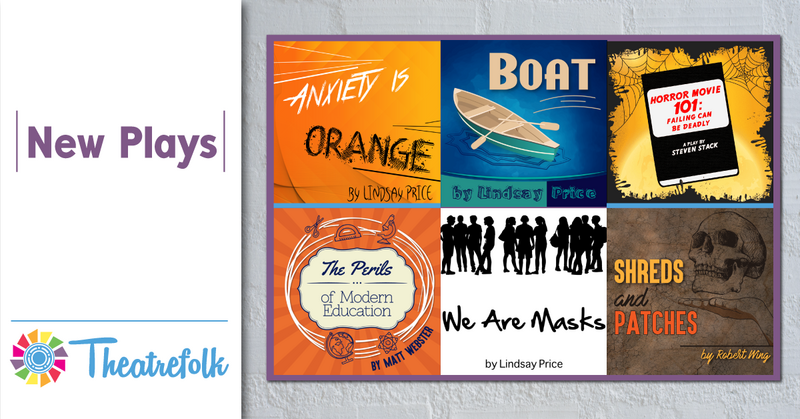
New Plays for the New Year!
Celebrate the new year with new plays!
Over the past few months we’ve added some new scripts to the Tfolk catalogue. So if you’re looking for some new and exciting material to bring to your students, you’ll definitely want to keep reading.
Explore themes of anxiety, empathy, expectations and surviving the teenage years – material your students can really understand and sink their teeth into.
Click the links to read free sample pages from each play. Explore, Engage, and Enjoy!
Featured Plays
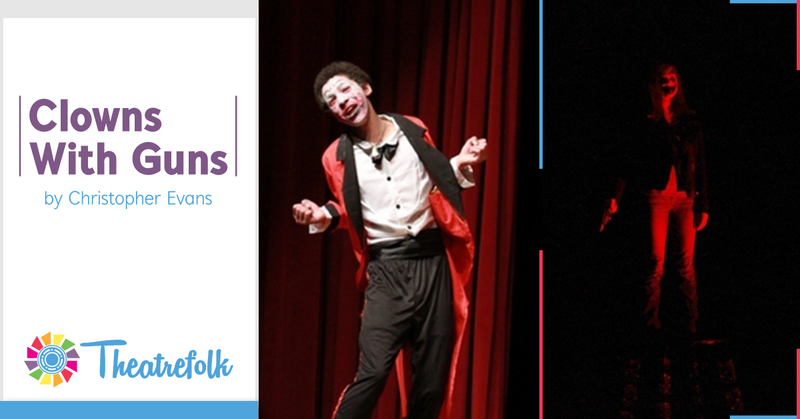
Theatrefolk Featured Play: Clowns with Guns by Christopher Evans
Welcome to our Featured Play Spotlight. If you’re looking for a play that takes a stand and gets people talking, then read on. This month we’re featuring Clowns with Guns by Christoper Evans – a play that both audiences and performers will never forget.
Step right up! Step right up! It’s the SCHOOL-SHOOT-O-RAMA! And the question everyone’s asking is “Am I walking out alive today?”
Clowns with Guns takes a theatrical and absurd look at the repeated and seemingly endless cycle of school violence. It happens, everyone is terribly upset, things continue on as normal, it happens again.
This story is mean. There are guns. The play puts school shooting violence out in the open and forces all of us to do the same. Read the play with this knowledge.
Why did we publish this play?
Clowns with Guns takes a theatrical and absurd look at the repeated and seemingly endless cycle of school violence. It happens, everyone is terribly upset, things continue on as normal, and it happens again. We wanted to publish this play because it puts school shooting violence out in the open and forces us to do the same. It’s not a gentle play, it’s mean. And we wanted a play out there on the topic that makes a stand.
Let’s hear from the author!
1. Why did you write this play?
This was my comment on the seeming acceptance of school and mass shootings. I was angry and wanted to be an angry voice that said “This is not okay. I do not accept this.”
2. Describe the theme in one or two sentences.
A cycle of violence will not stop unless we do something to stop it.
3. What’s the most important visual for you in this play?
The introduction of the silent clowns, Thoughts and Prayers, at the end of every stylized shooting. This was my comment that after every event all we would do is send Thoughts and Prayers. Nothing else. Nothing changed.
4. If you could give one piece of advice for those producing the play, what would it be?
Embrace the absurdity and the message. This isn’t a play to be enjoyed. It’s social satire and it’s going to make your audience very engaged, possibly angry. Some folks don’t like to be seen in a negative light.
5. Why is this play great for student performers?
It adds Absurd Theatre to their resume. It’s unlike any play they’ve done. It’s not safe. It’s mean and if you go as far with these characters as the script demands, you’ll never forget this play. Neither will your audience. That’s what theatre should be.
Featured Plays
Theatrefolk Featured Play: Anonymous by Allison Green
Welcome to our Featured Play Spotlight. Anonymous by Allison Green is the story of every teenager: trying to fit in, trying to belong, trying to fall in love. It’s hard to be an individual when you’re trying to survive.
We all have our stories. “New and old, complete and untold.” Anonymous is a story of every teenager: the new kid trying to fit in, the best friends, the love interests, the kid in the corner with their secret, the group of individuals each trying to belong.
The teenagers of Anonymous have no names because they are “Me” and “You.” They are everyone.
Why did we publish this play?
When you write an issue play it’s easy to become trapped beneath the issue. It’s easy to let the issue overwhelm the play. Audiences don’t want to be overwhelmed. Yes, they want to learn something about the issue. But they also want to be engaged.
Anonymous is a play that does just that. The issue here is something every high school student goes through: the feeling of being alone, anonymous to the point that their name doesn’t even matter. There are few things more difficult than standing out as an individual in high school, or fearing that if you told your secret you’d be shunned.
Anonymous engages an audience with this issue. The characters are trying to work the issue out, they are not overwhelmed. They struggle, yes. But they also fight. That’s what an audience needs to see. This is a play that shows hope at the end of the tunnel. It doesn’t lay out a “happiness for all” ending, but it does provide a light. For some students that’s all they need.
Let’s hear from the author!1. Why did you write this play?
I wanted to capture the feeling of the isolated/anonymous feeling that teenagers feel as they struggle to connect with others.
2. Describe the theme in one or two sentences.
Identity. Artistic Expression. Finding out who you are.
3 What’s the most important visual for you in this play?
Riding a teeter totter.
4. If you could give one piece of advice for those producing the play, what would it be?
Allow the student actors to find their own sense of anonymity. How can they all be the same (colour, mask etc) with their own individual style.
5. Why is this play great for student performers?
Students can find their own voices. The student who is searching to connect. Hates gym class. Struggles to express themselves. Remembers kindergarten embarrassments. Loves a kid in their class. Finds it hard to talk to the guidance counselor. This play is about about every teenager. It’s about Me and You.
Featured Plays
Spread the Love: Body Body
This week on Spread the Love we talk about Body Body. We also have a competition length version of the play.
Production
Spread the Love: The Pregnancy Project by Lindsay Price
This week we Spread the Love for The Pregnancy Project by Lindsay Price.
Featured Plays
Theatrefolk Featured Play: Drum Taps, adapted by Lindsay Price from Leaves of Grass by Walt Whitman
“The poems in Drum Taps represent Walt Whitman’s firsthand account of the Civil War. See the words, the emotion, the blood come to life in this theatrical adaptation. This is not your traditional readers theatre or poetry recital. This is flesh and bone words breathed to their fullest humanity. This is struggle and pain. This is confusion and contradiction. This is war.”
The primary danger in theatricalizing a series of poems is that such adaptations tend to be static – they amount to not much more than a poetry recital with lights and costumes. I’m not dissing poetry recitals, I’m just saying that they’re not inherently theatrical. By the way – can you believe “dissing” passed my spell checker but “theatricalizing” didn’t?
I wasn’t quite sure what I was expecting when Lindsay told me she was working on an adaptation of Leaves of Grass, a collection of US Civil War-era poems written, modified and rearranged over an entire lifetime by Walt Whitman. I wasn’t familiar with the poems at the time nor, being Canadian, did I have that much knowledge about the US Civil War. But my main concern was this: will it be theatrical?
I am proud to report that it is. Even just reading the script I could see the actors, hear the chaos, smell the gunpowder, feel the loss. I can’t wait to see a production of this!
Two versions are included in the same book: A small cast version (5 actors – 2M+3W) and a large cast version (20 actors – 6M+14W) . The casting is very flexible, however, and is limited only by the director’s imagination. Genders can be switched for many characters and the cast size can be expanded or contracted fairly easily. Both versions run about 35 minutes, ideal for most contest requirements.
Teaching Drama
Social Issue Plays for High Schools / Middle Schools
Our website lists all of our plays with social issue themes but it struck me that they’re only lumped as “issue plays” without a good guide to sorting out which title addresses which issue. So I’ve categorized them for you to hopefully give you a helping hand in your quest to find the perfect script for your school.
Check them out. As usual, all of the titles have extensive free sample pages for you to read. I think you’ll find the writing honest, fresh, and believable – three qualities sadly lacking from a lot of “teen-issue” plays out there in the world.
Alienation / Feeling Alone in the World• Anonymous by Allison Green
• The Art of Rejection: Two One Act Plays by Christian Kiley
• A Box of Puppies by Billy Houck
• Constantly, Incessantly, All The Time by Billy Houck
• Huge Hands by Billy Houck
Body Image• Body Body by Lindsay Price
• The Four Hags of the Apocalypse Eat Salad at their General Meeting by Lindsay Price
• The Battle of Image vs. Girl by Johanna Skoreyko
• Hoodie by Lindsay Price
• Breathless by Wendy-Marie Martin
Censorship• Censorbleep by Lindsay Price
Human Rights• Look Me in the Eye by Lindsay Price
• Sweep Under Rug by Lindsay Price
Racism• Flaky Lips by Lindsay Price
• With Liberty and Justice For All by Jeyna Lynn Gonzales
• Not Going Anywhere by Emma Fonseca Halverson
• The Burgundy Letter by Kirk Shimano
• Let Me In by Sholeh Wolpe
***
Rumours and Lies• Have You Heard? by Krista Boehnert
• The Redemption of Gertie Greene by Taryn Temple
Individuality• Hoodie by Lindsay Price
• Virtual Family by Christian Kiley
• The Happiness Shop by Lindsay Price
• A Deep, Poetic Journey Into Something by Forrest Musselman
• Carrying the Calf by Shirley Barrie
• Monster Problems by Lindsay Price
• Stereotype High by Jeffrey Harr
• Sixteen in 10 Minutes or Less by Bradley Hayward
• Nice Girl by Amanda Murray Cutalo
• Pressure by Lindsay Price
• They Eat Sunshine, Not Zebras by Dara Murphy
• The Super Non-Heroes by Taryn Temple
• Smarty Pants by Bradley Hayward
Identity• Box by Lindsay Price
• Labeled by Lindsay Price
• We Are Masks by Lindsay Price
• Stressed by Alan Haehnel
• Anonymous by Allison Green
• Constantly, Incessantly, All The Time by Billy Houck
• The Super Non-Heroes by Taryn Temple
School Violence• Huge Hands by Billy Houck
• Power Play by Lindsay Price
• Clowns with Guns (A Vaudeville) by Christopher Evans
• The Butterfly Queen by Christian Kiley
• Life and Death in an Empty Hallway by Christopher Evans
• Water. Gun. Argument. by Alan Haehnel
Sexual Abuse• The Waking Moment by Bradley Hayward
• Breathless by Wendy-Marie Martin
Substance (alcohol & drug) Abuse• Bottle Baby by Lindsay Price
• Floating on a Don’t Care Cloud by Lindsay Price
• One Beer Too Many by Billy Houck
Suicide• The Bright Blue Mailbox Suicide Note by Lindsay Price
• Chicken. Road. by Lindsay Price
• The Butterfly Queen by Christian Kiley
Teen Pregnancy• The Pregnancy Project by Lindsay Price
• Among Friends and Clutter (one scene) by Lindsay Price
Illness/Health• Chemo Girl by Christian Kiley
• The Other Room by Christian Kiley
• Red Rover by Christian Kiley
• Waiting Room by Christian Kiley
• Breathless by Wendy-Marie Martin
• Shreds and Patches by Robert Wing
• Inanimate by Christian Kiley
• Constantly, Incessantly, All The Time by Billy Houck
Depression/Anxiety• darklight by Lindsay Price
• Fidget by Bradley Hayward
• Among Friends and Clutter (one scene) by Lindsay Price
• Constantly, Incessantly, All The Time by Billy Houck
• who are we, who we are by Forrest Musselman
Bullying• Finishing Sentences by Scott Giessler
• Funhouse by Lindsay Price
• Power Play by Lindsay Price
• The Redemption of Gertie Greene by Taryn Temple
• Sixteen in 10 Minutes or Less by Bradley Hayward
• Carrying the Calf by Shirley Barrie
Divorce• Split by Bradley Hayward
Gender• Life, Off Book by Scott Giessler
• Anonymous by Allison Green
• Baalzebub by Rachel Atkins (Baalzebub – One-Act Version here)
• Completely, Absolutely Normal: Vignettes About LGBTQ+ Teens by Bradley Walton
• Finding Jo March by Laramie Dean
• Thought Traps by Lindsay Price
Empathy• Discovering Rogue by Christian Kiley
• Boat by Lindsay Price
• We Are Masks by Lindsay Price
• The Butterfly Queen by Christian Kiley
Dependence on Technology• Virtual Family by Christian Kiley
• Inanimate by Christian Kiley
Featured Plays
Floating On A Don’t Care Cloud
This is a longer version of my conversation with the cast and Leanna Neal, director of the Park Street Collegiate production of Floating On A Don’t Care Cloud. They’ve been touring the play to feeder schools and running extensive talk backs after each performance. Imagine that – talking about the issues youth face instead of pretending they don’t exist….
.png)

.png)

.png)