đŁSCRIPT SALE! Treat yourself to an easier Fall. Save 30% on 5+ perusal scripts with code SPRING30 before May 3 and head into summer stress-free.
Issue Based
Featured Plays
Theatrefolk Featured Play â Stressed by Alan Haehnel
*Welcome to our Featured Play Spotlight. * Stressed by Alan Haehnel is a symphony of sound and character that is a true theatrical experience. A challenging but incredibly fun piece, this vivid character play is an excellent competition piece.
For Alex, itâs school. For Josh, itâs his girlfriend. For Carmen, itâs dealing with her coach. And Mindyâs frustrated with her parents. Stress is driving this quartet crazy â so much so they canât stop talking about it.
Why did we publish this play?
Alan describes Stressed as a Teen Symphony. I love this description and itâs so accurate! Characters blend and crash, emotions swell like strings. Itâs a fantastic piece to teach students not only how to create a character but how to listen to each other. Add to that, the structure is monologue-based, so youâre also teaching students the craft of preparing multiple monologues. This play has gone on to great success in competitions and Iâm thrilled we were able to publish it.
Why is this play great for online platforms?
This play is written in monologue format, and each character is in their own space â so it easily transfers to an online format. There is some unison speaking and some sound exploration under text, so that will take some creative thinking and problem solving. But if thereâs anyone who can do it, itâs drama teachers and students!
Letâs hear from the author!1. Why did you write this play?
Because stress has been increasing lately for everyone, and I wanted to give students a humorous way to express their feelings about it.
2. Decribe the theme in one or two sentences.
Well, the theme is in the title. But an important sub-theme is that we are all in this stress-filled world together.
3. Whatâs the most important visual for you in this play?
This is more an exploration of rhythm and vocal variety than it is a visual play, but I think a creative director could have a lot of fun with costuming and lighting to enhance the different characters and the quick pace of the piece.
4. If you could give one piece of advice for those producing the play, what would it be?
Remember the sub-title of the play: âA Teen Symphony.â The vocal work has to be tight and musical. The voices should truly interplay like instruments in a quartet.
5. Why is this play great for student performers?
Besides relatable subject matter, this play gives four student performers a ton of juicy lines, lots of stage time, a full range of emotional states, and great chance to put together a tour de force entry for any drama contest.
Featured Plays
A Loud and Clear Message of Hope: darklight
Sadness. Hopelessness. Irritability. Anger. Hostility. Angst. Doubt. With teenage depression and anxiety rates on the rise, plays like darklight by Lindsay Price are more relevant than ever.
darklight examines depression and anxiety in teens. Characters fight their inner thoughts, search for their truths, and have surreal conversations with death. Some fail, some find hope.
This is a relevant and necessary issue to explore.
Under the direction of Debbie Hornback , the amazing drama team at Montesano Jr/Sr High School in Montesano, Washington had an incredibly successful journey with their production of darklight. Their journey was truly a springboard for discussions and sharing for both the cast and their audience:
âIt was a learning experience for both myself (director) and the cast. The issues prompted thoughtful conversations and some insight for those not familiar with all aspects of the illnesses. Hit home with many in the audience as well, and we had tears at the end. The cast really wanted to make sure the message of hope was loud and clear to all who saw it.â
Featured Plays
Power of Perception: Discovering Rogue
The issue-based high school drama, Discovering Rogue by Christian Kiley, is an awesome character piece with something extremely relevant to say to todayâs teen.
Rogue has the best beachfront property ever. Right on the ocean â location, location, location. Her home happens to be a cardboard box but she doesnât mind.
Others, though, mind very much. They want Rogue to leave the beach. Now. But she isnât budging. Rogue isnât just running away from home; sheâs running away from herself.
Director Michael Yoson and the incredible students from Piscataway High School in Piscataway, New Jersey enjoyed the messaging and the creative flexibility that is part of this play. As well, the students were able to explore their characters in depth, while being exposed to more abstract forms of storytelling:
âAs a teacher and director, I enjoyed working on this play. I think the play offers a positive message, and it allows for creative staging. Our production approach was inspired by the idea that with the power of the imagination, a cardboard box could become anything. So all of the scenic and prop pieces were made out of cardboard and recycled materials. This allowed students to think outside the box and challenged them creatively while working on the tech elements of the show.â
Featured Plays
Strong Subject, Stronger Performance: Clowns With Guns
If youâre looking for a play that takes a stand and gets people talking, Clowns with Guns by Christoper Evans is a play that both audiences and students will never forget.
Step right up! Step right up! Itâs the SCHOOL-SHOOT-O-RAMA! And the question everyoneâs asking is âAm I walking out alive today?â
Clowns with Guns takes a theatrical and absurd look at the repeated and seemingly endless cycle of school violence. It happens, everyone is terribly upset, things continue on as normal, it happens again.
This story is mean. There are guns. The play puts school shooting violence out in the open and forces all of us to do the same. Read the play with this knowledge.
Lori Zyla and the talented students at Parkersburg High School in Parkersburg, West Virginia were not afraid of the serious subject matter and proved that when students connect with and believe in the material, great things can happen:
âIt is always great to direct a play that your students are 100% behind. This issue matters to them, and that shows in their performance. Great choice for a competition piece!â
Featured Plays
A Unique Audition Experience: Hoodie
Relevant themes, easy-to-connect-to characters and fun, fun, fun! Hoodie by Lindsay Price examines appearance and image in middle school, allowing students to immerse themselves in subject matters and issues that they deal with every day.
Middle schoolers face a tornado of questions every day. What do I wear? What if I wear the wrong thing? What is she wearing? What do I look like? Stop looking at me!
Hoodie examines image and appearance in the vignette style and poses what may be the most difficult question of all â Do I stay in the clump or do I stand alone?
The incredible middle school student performers at Gill St. Bernardâs School in Gladstone, New Jersey had an amazing experience with their production of Hoodie. Director Todd Ross shared how the show and performance really resonated with the entire cast â starting with a unique casting experience that really started off things on the right foot:
âSome of the interesting and unique things I did with this show was to âauditionâ by having all 18 kids pick a character out of a hat. They were all like WHAT???? Are you serious??? To tell the truth, it is amazing how certain people got characters that were exactly like them, I donât think I could have cast it better that what happened randomly.
Several kids came to me after the show and told me that at first they didnât like the play but by the end they loved it. They felt awkward at first (too close to reality) but through the process gained the confidence and comfort to be in those type of places. Wow, we (you, me, the show) did our job. The head of the middle school thinks this show should be on tour at schools all the time.â
Featured Plays
Simple Set, Strong Message: Box
Vignettes. Flexible casting. Expandable cast size. Excellent small scene and monologue opportunities. If youâre looking for a middle school play for your students that truly has a bit of everything, look no further than Box by Lindsay Price.
Sometimes we choose the way the world sees us. Black box â indestructible. Jewelry box â plain on the outside, shiny on the inside. Sometimes our box is defined by others â our parents, our friends, our enemies. A box built by others can feel small, confined, impossible.
How do we handle the boxes imposed upon us because of our gender? Our race? From peer pressure? From parent pressure? Do we have to live with our box for the rest of our lives? Can we change?
The talented middle school group at Punta Gorda Middle School in Punta Gorda, Florida had an amazing experience with their own production of Box and director Rudi Wolfahrt was happy to share how the show struck a chord with everyone involved:
âVery simple to produce, but the greatest experience was how the message of Box resonates with cast members, students and adults. We received many positive comments after our production.
I recommend producing this show in front of the student body. The audience was engaged and related to the characters.â
Featured Plays
Theatrefolk Featured Play â Hoodie by Lindsay Price
*Welcome to our Featured Play Spotlight. * Hoodie by Lindsay Price is one of our most popular middle school plays that asks all of the tough questions that middle schoolers deal with every day.
Middle schoolers face a tornado of questions every day. What do I wear? What if I wear the wrong thing? What is she wearing? What do I look like? Stop looking at me!
Hoodie examines image and appearance in the vignette style and poses what may be the most difficult question of all â Do I stay in the clump or do I stand alone?
Why did we publish this play?
Hoodie was our first middle school specific play. We started solely focused on the high school market but as we went to more and more conferences, we started meeting more and more middle school teachers. And what middle schoolers didnât have a lot of was plays that had characters their age dealing with issues they were specifically going through. It was either fairy tales which are too young, or high school plays that arenât right either.
Iâm proud of Hoodie (and the other plays that weâve published that are middle school specific) and it remains one of our most popular plays to date.
Letâs hear from the author!1. Why did you write this play?
This was the first play I wrote specifically for middle school. We started going to middle school specific conferences and realized these students donât want to do fairy tales â they want characters and subjects that are relevant to their experience.
2. Describe the theme in one or two sentences.
This play examines appearance and image in middle school.
3. Whatâs the most important visual for you in this play?
The Clump. I love this group of characters and I feel for them!
4. If you could give one piece of advice for those producing the play, what would it be?
Donât give up on the Clump! This is the one group of characters that I get the most questions about. There are no shortcuts, it takes practice, practice and more practice both with movement and with dialogue. But when you get it, it will look and sound amazing.
5. Why is this play great for student performers?
The topic is relevant, the characters are easy to connect to, and itâs fun!
Featured Plays
Creativity, Chorus Work⌠and Cancer: Chemo Girl
Chemo Girl by Christian Kiley is part of a collection of plays that examine the impact of cancer as seen through the eyes of teenagers.
Camille is given a video game system from her mom as a form of recovery therapy for cancer. She prefers reading books. Video game worlds lack realism and she believes they will not help her fight against cancer. However, Camille is pulled into the video game world that mirrors her fight. She meets the Gamemaster and takes on the screen name Chemo Girl.
The drama group at Carine SHS in Carine, Western Australia mastered the theatricality and creative invention that is such a huge part of Chemo Girl and successfully worked as a team to deal with some new skills and some very serious issues:
âIt was a challenge for my students, as some of them had not performed in front of an audience before, and chorus work was a new concept for them. However, it was a great learning experience and it was really nice seeing them pull it together as a team.â
Featured Plays
Beyond the Battlefront: Letters
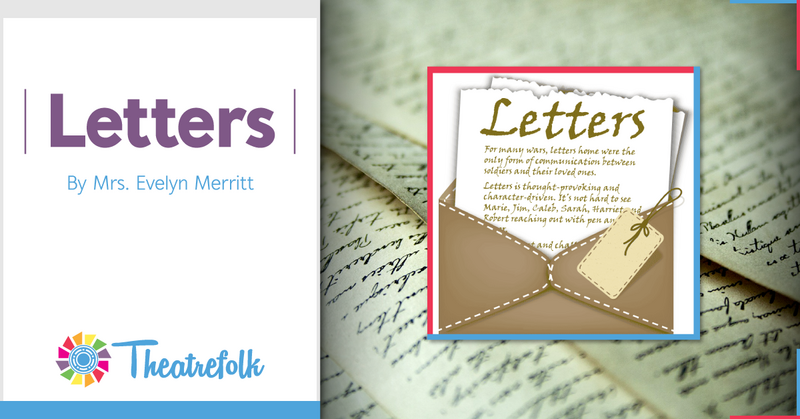
If youâre looking for an excellent and challenging Readerâs Theatre script that chronicles the correspondence between the battlefront and home, Letters by Mrs. Evelyn Merritt is one you wonât want to miss. Super simple to stage, the characters in this play are from the civil war, WWI and WWII all the way up to the Iraq War. It is a thought provoking look at what people say to each other in times of strife.
For many wars, letters home were the only form of communication between soldiers and their loved ones.
Letters is thought-provoking and character-driven. Itâs not hard to see Marie, Jim, Caleb, Sarah, Harriet and Robert reaching out with pen and paper.
Kristina Mercilliott and the talented student performers at VFW Auxiliary in Afton, New York had an emotional experience with their production that had an incredible impact on both students and their audience:
âThis was the first play I directed, I didnât know what to expect. I wanted to honor our veterans and teach the kids along the way for the understanding on why we stand for the flag, why we have Veterans Day off, why it was important to remember these men and women. This play was perfect â it was more than what I expected and it brought up questions that I had to answer. It was a very emotional play for our audience, and we are looking forward to doing this one again one day! It brought kids and our local veterans together so they could share stories.â
Featured Plays
Theatrefolk Featured Play â Drum Taps by Lindsay Price
*Welcome to our Featured Play Spotlight. * Drum Taps by Lindsay Price is a theatrical adaptation of a selection of Walt Whitmanâs civil war poems. Available in both large cast and small cast versions, student performers can bring a war-time experience to stage.
The poems in Drum Taps represent Walt Whitmanâs firsthand account of the Civil War. See the words, the emotion, the blood come to life in this theatrical adaptation. This is not your traditional readers theatre or poetry recital. This is flesh and bone words breathed to their fullest humanity. This is struggle and pain. This is confusion and contradiction. This is war.
Why did we publish this play?
Itâs one thing to read about war in a textbook. Itâs another thing to read an account by someone who was there, who can feel every word they write. And it takes on an entirely new meaning when you read a firsthand account of war through a creative genre.
Walt Whitmanâs Drum Taps poetry illuminates his experience of the Civil War â his passion for it at the beginning, his despair at Lincolnâs death, his visits to the wounded at hospitals, his change of attitude towards war as it drew on.
Poetry is hard to stage. Itâs a singular experience. I find Whitmanâs poetry extremely character-driven. Each poem tells a story. But one genre does not necessarily fit easily into another. A poem is not a play. That was my challenge with my adaptation of Drum Taps â to bring the characters to life and to make it make sense to an audience.
Our version of Drum Taps brings war to life in a unique way. Itâs a challenge, itâs cross-curricular, itâs a unique theatrical experience. All great reasons to publish a play.
Letâs hear from the author!1.Why did you write this play?
Adaptation is my favourite style of writing. I like taking something in one form and finding itâs theatricality. Iâve always been fond of Walt Whitman, and had the opportunity to study some poems in detail. And thatâs when I started seeing the possibilities. The vivid imagery of the poetry, and really, the first hand account of war really spoke to me.
2. Describe the theme in one or two sentences.
War brought to life.
3. Whatâs the most important visual for you in this play?
I think the two images that bookend the play, that also represent Whitmanâs changing view of war â the beginning of the war where there is excitement to see the young men in their clean uniforms going off to fight for right, and then the much different tone at the end, as the realities, the death, the anguish of war has been fully realized. Whereas at the beginning characters hold pieces of manuscript up high and proud, at the end (the poem is âTo a Certain Civilianâ) a character crumples pages of manuscript and throws them to the ground.
4. If you could give one piece of advice for those producing the play, what would it be?
Work with the text as is. Itâs all Whitman, there are no lines of dialogue that are my own. So donât change it, donât modernize it, figure it out. Itâs Whitman!
5. Why is this play great for student performers?
I think the source material is a vivid and vibrant first hand look at a war that doesnât have a lot of primary sources. This alone is important. And then the task to bring a theatricality to poetry is a valuable process. I loved writing it and I have loved seeing it in performance!
Featured Plays
An Ensemble Extravaganza: Box
Need a vignette play with flexible casting for your middle school performers? Box by Lindsay Price can be expanded or reduced to suit a variety of cast sizes, plus it offers excellent opportunities for small scenes and monologues.
Box is a middle school vignette play with flexible casting. It can be expanded for a large cast or reduced to a cast of 10 with doubling. Excellent small scene and monologue opportunities.
Sometimes we choose the way the world sees us. Black box â indestructible. Jewelry box â plain on the outside, shiny on the inside. Sometimes our box is defined by others â our parents, our friends, our enemies. A box built by others can feel small, confined, impossible.
How do we handle the boxes imposed upon us because of our gender? Our race? From peer pressure? From parent pressure? Do we have to live with our box for the rest of our lives? Can we change?
Under the direction of Kellybrooke Brown , the accomplished student performers at Albertville High School in Albertville, Alabama were able to work together to examine the boxes that we all find ourselves in. A truly successful ensemble experience for them all!
âBox was wonderful for my new actors! It gave everyone a chance to shine with no star vehicle!â
Featured Plays
Theatrefolk Featured Play â Sixteen in 10 Minutes or Less by Bradley Hayward
*Welcome to our Featured Play Spotlight. * Being sixteen isnât easy. Choosing a play collection that illustrates the ups and downs of being sixteen is. Sixteen in 10 Minutes or Less by Bradley Hayward is a collection of plays that can be performed as a full-length evening of entertainment, or as one or more stand-alone plays that stand perfectly well on their own.
The lives of seven teenagers become intertwined in this humorous and oftentimes bittersweet collection of ten minute plays. From extracting a gummy bear out of a new set of braces to coping with bullies, these characters share their innermost hopes and fears with each other, ten minutes at a time. As the audience drops in on these intimate moments, they will come to understand that being sixteen isnât always easy.
Why did we publish this play?
We adore a flexible play here at Theatrefolk. This play is a suite of 10 minute plays on what itâs like to be 16 that can be done individually or all together for a full evening of theatre. We also adore well written three dimensional characters which Bradley Hayward is exceptional at creating. Itâs so easy to short change or stereotype teen characters. Bradley offers a wealth of multi-faceted personalities who face the sweet and bittersweet of teen life.
Letâs hear from the author!1. Why did you write this play?
I wanted to write a character driven full length piece that would be accessible to a wide variety of performing groups. So I devised the idea of short plays that would work well independently, but also overlap enough to create a moving piece of theatre as a whole.
2. Describe the theme in one or two sentences.
Each of the plays has its own individual theme, but the overall theme is how sixteen year olds maneuver the challenges of making human connections while still in the process of discovering their own identities.
3. Whatâs the most important visual for you in this play?
In the first scene, Friend Request, the characters are all communicating through Facebook messages in a very static way. The dialogue is performed straight to the audience and none of the actors physically interact. But then in the final scene, Status Update: A Symphony, the actors are working together to create a fluid piece. The dialogue overlaps, the characters make eye contact, and the final image of the play is when all of the characters physically connect by holding hands. This visual gives me chills every time because it shows the overall theme of making connections and how that affects self identification.
4. If you could give one piece of advice for those producing the play, what would it be?
I highly recommend that actors sit in on rehearsals of the scenes they are not in at least once. Almost all of the characters are referenced in each of the individual plays, so hearing what perspective the other characters have of yours will help inform how you play the role.
5. Why is this play great for student performers?
First and foremost, this play is about allowing student actors to dig deep into the characters they are playing. Each character has a back story that is only hinted at, so it is up to the actors to discover and even create their own histories in order to enrich their performances. And because the play is broken up into a series of short plays, rehearsals are easier to schedule, which allows for more in-depth scene study.
6. Do you have any tips or suggestions for those who are performing this play online?
The plays would be perfect for online performances because they are all about teenagers talking to each other, and quarantine has forced us all to communicate via services like Zoom and Facetime, so young actors should be very comfortable with this already. Also, the plays Friend Request and Status Update: A Symphony are already written as online dialogues, so those plays in particular seem like they were tailor made to be virtually produced!
Featured Plays
Theatrefolk Featured Play â Finishing Sentences by Scott Giessler
Welcome to our Featured Play Spotlight. Are you ready for summer camp â and all of the ups and downs that go along with it? Then youâre ready for Finishing Sentences by Scott Giessler â an issue-based dramedy that your students wonât want to miss.
After being arrested for vandalizing a classmateâs car and perpetrating criminal harassment, Kendra serves her community service at a summer camp looking after a frequently bullied kid.
Her journey through this surreal summer camp exposes Kendra to her own raw underbelly. Taking the perspective of the bully, the play forces us to consider the human side of the people we often dismiss.
Why did we publish this play?
Awesome character play. Awesome character play. Awesome character play. Shall I say it again? Awesome, awesome character play. I love that we can look at teen life from unique and interesting perspectives and provide unique and interesting characters for student performers. (Did I mention this is an awesome character play?).
Letâs hear from the author!
1. Why did you write this play?
I have been an avid participant and supporter of Summer Camping since I was a kid. I wanted to write a show that captured the spirit of the experience both comedic and dramatic. Although our time at camp is short, we live lifetimes there.
2. Describe the theme in one or two sentences.
There are no such things as bullies. (Itâs a two-dimensional idea. We are all on a journey that are often filled with mistakes. )
3. Whatâs the most important visual for you in this play?
Transitioning from the stark real world to the colorful world of camp life.
4. If you could give one piece of advice for those producing the play, what would it be?
Let the world around Kendra be crazy. Camp is comedy and tragedy all at the same time.
5. Why is this play great for student performers?
It lets the actors tap into both ingredients: Comedy and Drama. It demands range, timing, and sheer fun.
Featured Plays
Theatrefolk Featured Play â The Art of Rejection: Two One-Act Plays by Christian Kiley
Welcome to our Featured Play Spotlight. The Art of Rejection: Two One-Act Plays by Christian Kiley consists of two one-act plays that expertly combine realism with the abstract, and include characters that high school students can really relate to.
R is the only letter in a sea of numbers. Potential sits in a chair. These two one acts â Art of Rejection and Chaired can be performed separately or together.
The Art of Rejection: R is the only letter in a sea of numbers. Always picked last for kickball, never part of the âinâ crowd, never gets the girl. What is a letter to do to get through life? An avant-garde look at the price of popularity.
Chaired: Potential sits centre stage in a chair. At times Potential is forced to remain seated by family, teachers and friends. At other times Potential will do anything not to stand. Itâs better to stay in place, not move, not reach out. Sometimes the hardest thing to do is just stand upâŚ
Why did we publish this play?There are two one acts in this fabulous collection. It could be something that you easily divide up in a large class. What I like about the plays is their tone â the dialogue is definitely realistic but the situations sway to absurd. If youâre looking for a transition piece for your students before they do something outside the realism box, pick up The Art of Rejection. Easy to stage, costume and both have little to no set! Who doesnât love that?
Letâs hear from the author!
1. Why did you write this play?This goes back to my junior high days when the school yard was the primary location for bullying. I wanted to capture the feeling of being bullied and rejected for the audience and then give the protagonist the opportunity to get a unique kind of revenge or have an epiphany (which I think R and Potential both experience in different ways). This is truly how I felt in junior high and parts of high school. It is an exaggerated version of it. But the plays grew from seeds of truth.
2. Describe the theme in one or two sentences.Is popularity worth it or is it just conformity with a prettier paint job? When you dig deeper, there is a special kind of courage it takes to be yourself, to discover your full potential and grow into it.
3. Whatâs the most important visual for you in this play?Definitely when R turns into a tree. It is so unexpected and outside the realm of anything I would have thought of normally. That physical transformation at the end of âThe Art of Rejectionâ is shocking and stunning.
4. If you could give one piece of advice for those producing the play, what would it be?Let the entire production spring forth from the actors. Let the actors represent as much of the world as you think they can. Turn it over to them. The piece is a celebration of minimalism in that way.
5. Why is this play great for student performers?It taps into an energy that I still feel today and I see and feel with the students I teach. Most Theatre students have been R or Potential for at least parts of their lives. And they have been around people like the other characters for so long that they have already engaged in the character study (everyday). I asked one of the actors who played a bully in both plays how he was able to do it (he is such a nice person) and he said, âthere are people like this everywhere, you donât even have to look for them, they are part of your daily life.â
Featured Plays
Theatrefolk Featured Play â Discovering Rogue by Christian Kiley
Welcome to our Featured Play Spotlight. Discovering Rogue by Christian Kiley is a showdown of stereotypes and self-identity and an issue-based drama that your high school performers can truly relate to and connect with.
Rogue has the best beachfront property ever. Right on the ocean â location, location, location. Her home happens to be a cardboard box but she doesnât mind.
Others, though, mind very much. They want Rogue to leave the beach. Now. But she isnât budging. Rogue isnât just runni
away from home; sheâs running away from herself.
Why did we publish this play?
I love how Christian writes for teens. He always opens theatrical doors that shed new light on to topics, and thatâs what we have here in Discovering Rogue. The play is about perception. How others perceive us and how we perceive ourselves. Rogue isnât just running away from others, sheâs running away from herself.
How many of you know teenagers who desperately want to run away from themselves? This is an awesome character piece with something extremely relevant to say to todayâs teen.
Letâs hear from the author!
1. Why did you write this play?
I have often felt like (and Iâm sure others have too) I am so far from perfect that I will never reach the magical place where unrealistic expectations dwell (imagine a high, high mountaintop). I wrote this for my daughters, in large part so that they could be proud of who they are without trying to obtain this unrealistic level of perfection that is present in spoken and unspoken forms throughout our lives. Rogue is a really thoughtful young person who has to come to terms with who she really is (and is ready to destroy the expectation of unobtainable perfection).
2. Describe the theme in one or two sentences.
At some point you are going to have to decide who you really are and in doing so, you are probably going to have to destroy the unrealistic expectations that are in the way.
3. Whatâs the most important visual for you in this play?
Part of it is the setting. The beach. More specifically, the box that Rogue calls her temporary home and the flag that she makes to put on it.
4. If you could give one piece of advice for those producing the play, what would it be?
Really investigate what unrealistic expectations can do to you, people in general, the members of your cast. I talk to students on a regular basis who feel immense pressure to do so much, achieve so much, accomplish so much. The staging is so simple because Rogue is running away from the crazy complexity of her life. I think the key is in the connection to the stress that comes from trying to be perfect. The comedy comes from that as well, because you can have fun overplaying many of the characters (Perfect, Teacher, Students 1-4, Dad, and Mom).
5. Why is this play great for student performers?
It comes from a very real energy I feel and experience with the students I teach. As a parent, I know I can do better in helping quiet those expectations for my children. And I hope as a playwright I have done that with this play. The characters are engaging and fun. And they are grappling with real stresses and problems that young people face today.
Featured Plays
How does the world see you?: Box
How do middle-schoolers deal with perception and the boxes that we all find ourselves in? Lindsay Priceâs vignette play, Box, examines these issues while providing great small scene and monologue opportunities.
Sometimes we choose the way the world sees us. Black box â indestructible. Jewelry box â plain on the outside, shiny on the inside. Sometimes our box is defined by others â our parents, our friends, our enemies. A box built by others can feel small, confined, impossible.
How do we handle the boxes imposed upon us because of our gender? Our race? From peer pressure? From parent pressure? Do we have to live with our box for the rest of our lives? Can we change?
Directed by Shannon Boatwright , the drama group at Chapin Middle School in Chapin, SC stepped out of their comfort zone and ensured their production of Box was a soaring success:
âMy 7th grade honors kids had a blast, learned valuable lessons, made connections and pleasantly surprised me in the end with an incredible performance. And despite losing internet access school wide the day of the show, having to connect to a fellow teacherâs iPhone hot spot to run my sound, and having a choir mic literally fall apart at the start of the performance, well, it all magically somehow came together and our audience LOVED it. (And so did my administration, which was super awesome!)
Having to work hard, focus, commit to something outside of their comfort zone and then reap the fantastic benefits of seeing the whole piece come together and be an important part of it created a priceless experience. They worked really hard and were VERY proud of their work in the end.â
Featured Plays
The Bullied, the Bully, and the Bystander: Funhouse
Funhouse by Lindsay Price looks at the bullied, the bully, and the bystander through mostly non-verbal vignettes. Life for the bullied is like a funhouse, but the funhouse is anything but fun.
How can you stand your ground when youâre on a falling floor? How can you move forward when youâre caught like a mouse in a maze? How can you win Whac-A-Mole when youâre the mole? How can you like yourself while standing in a distorted hall of mirrors?
There are no cotton candy answers here.
Directer Shannon McDowell shared an update on the student group at Pearl Junior High School in Pearl, MS and how the experiencing of performing Funhouse was truly a moving experience that impacted everyone involved:
âThank you for such a powerful script. While the cast received an Excellent rating â and their director was chosen as Best Director â I was prouder of the reaction we received from the audience. Students, teachers, parents, community members and administrators were all affected by the performance. I have started reading scripts for next year, and I am sure I will find something just as fantastic. Of course, Theatrefolk is my go to.â
Featured Plays
Theatrefolk Featured Play â Fidget by Bradley Hayward
Welcome to our Featured Play Spotlight. Why do kids find it so hard to stop moving? Check out the issue-based comedy, Fidget by Bradley Hayward to find out.
Kids are constantly being told to hold still. But thatâs impossible when all they want to do is move forward at warp speed.
From disputes with friends and troubles at home, to negative self-image and unfortunate sugar highs, this vignette play explores the need to fidget in a world that gets more stressful every day. Jam-packed with rich characters and unique theatricality, this entirely gender flexible play is sure to entertain audiences of all ages.
Why did we publish this play?
We are always looking for middle school specific material that focuses on middle school aged characters in the present dealing with middle school issues. Fidget is a perfect example of such a play.
Not only is it ideal for a middle school audience, itâs ideal for middle school performers. The actors and the audience will fully be able to relate and connect to this play. And with the vignette framework, you can work on the show in a class period with simple staging and costumes. Itâs a win-win.
Letâs hear from the author!
1. Why did you write this play?
I wanted to write a play for middle school performers because I am constantly inspired by how fearless young actors are about expressing themselves. The energy, the intelligence, and the heart they project in real life translates extremely well to the stage and so it was my goal to provide them with smart material that speaks to the fast-paced world they are living in today.
2. Describe the theme in one or two sentences.
Fidget is about how the need to move is what drives us forward, and the ability to hold still is what allows us to appreciate how far weâve come.
3. Whatâs the most important visual for you in this play?
I get goose bumps when Devin literally sees the many colours of his personality stretch across the entire stage. Itâs a visual representation of the moment when we step into the light and realize who we truly are inside.
4. If you could give one piece of advice for those producing the play, what would it be?
The actors should be in near-constant motion. Think of the many different ways people move, from large actions to barely detectible ticks, and show them all to the audience. This will give extra importance to the moments when the characters do hold still, so select these moments wisely.
5. Why is this play great for student performers?
Regardless if the actors have an abundance of acting experience or have never been on a stage before, there is something for everyone to do. There are so many opportunities for unusual movement, so even if someone is too shy to speak, they can still take part in telling the story. The gender neutral characters and flexible cast size allow the play to be produced by almost any group. It is also a great selection for student directors, as the script is split into smaller scenes for easy rehearsal.
Featured Plays
Why did the chicken cross the road?: Chicken.Road.
Why did the chicken cross the road? Why is the sky blue? Whatâs two plus two? Why did he kill himself? Find out with Lindsay Priceâs issue-based drama, Chicken.Road.
A group of teenagers grapple with unanswered questions as they struggle to understand why someone would run out on to the highway in front of semi. Especially when that someone seemed to have it all.
Hereâs a chicken. Hereâs the road. Thereâs the other side. What do you do when there is no answer?
Director Lynne Comartin led the talented student performers at Tecumseh Vista Secondary School in Tecumseh, Ontario to a multi-award-winning performance. The show received Outstanding Production at the District level for the National Theatre School Drama Festival and advanced to the Regional level, where they received Awards of Merit for Monologue work and Ensemble Work. They were also able to spend time with the playwright, Lindsay Price, to have all of their questions asked and answered:
âThe whole experience of participating in Regionals was so rewarding for these students. They will always remember this! Thank you for being a part of their day. I believe that meeting you and having the chance to ask you questions about their characters was a huge highlight for them that they will never forget.
Once again, a million thanks for coming to see our show. More importantly, thank you for writing such great plays for young people, especially a play like Chicken. Road. which engages the participants and the audience in a much-needed dialogue about suicide. We thoroughly enjoyed the process of talking about the text and exploring the implications of the words and actions even though we shed many tears in the process. The journey through the text allowed my students to open up about their feelings and share their stories with one another. I think they are better people for it.â
Featured Plays
Theatrefolk Featured Play â Baalzebub by Rachel Atkins
Welcome to our Featured Play Spotlight. A response to the classic novel, Lord of the Flies, Baalzebub by Rachel Atkins is a full-length or one-act ensemble piece that offers excellent inclusive, diverse and gender-expansive opportunities in casting.
What would a group of girls do if they were abandoned alone, at a refugee camp, in an unnamed war zone, away from adults and civilization? As time passes without rescue, the girls face the adult challenges of creating and maintaining a working society, as they struggle to cooperate, understand their differences, define themselves, and survive. Will they establish civility or fall back to savagery?
Why did we publish this play?
Rachel writes strong female characters with great emotional impact. That alone is a great reason to publish this play. But she goes further â the play clearly suggests inclusive, racially conscious and gender-expansive choices in casting. Having plays that welcome gender flexibility is a major initiative here at Theatrefolk. Lastly, itâs an adaptation, or more specifically a response to a classic work â _Lord of the Flies. _How does this tale of civility and savagery reflect through a gender flexible lens? It was not hard at all to accept _Baalzebub _for publication.
Letâs hear from the author!
1. Why did you write this play?
I was commissioned by Seattle Public Theater to write a play for their youth program. The director and I brainstormed a range of ideas that could serve their company of young actors. Our conversation covered both the current refugee crisis, and William Goldingâs quote about Lord of the Flies: "A group of little boys⌠are more like scaled-down society than a group of little girls would beâ â and putting those two ideas together just made sense. I wanted to write a play that would be both empowering and community-building for an ensemble of young women.
2. Describe the theme in one or two sentences.
Community vs. the individual
Identity
Power
Order vs. chaos, peace vs. war
And how all of the above relates to gender.
3. Whatâs the most important visual for you in this play?
The songâwhich isnât just a visual, so maybe this answers a different question, but their âperformanceâ of it is important: the way the characters personalize it, the ways they use it to bring themselves together and establish their community, and how it morphs through the play as the characters and their relationships change
4. If you could give one piece of advice for those producing the play, what would it be?
Be willing to think outside the box for inclusive casting. For example: the first production had 2 boys playing Sam and Isis as girls, 3 non-binary actors as Juno, Ali and Diamond, and younger (elementary and middle school age) actors playing Baby and Sister. This is an ensemble piece, which benefits from as diverse an ensemble as possibleâby whatever definition diversity holds in your community.
5. Why is this play great for student performers?
Opportunities to build ensemble both on and off the stage. The songs and rituals can come from your actorsâ own experiences, interests, abilities and strengths. Helping your cast develop their own community will serve the community within the play. Also, particularly if youâre working with a more homogenous or privileged population, this play provides a chance to connect with the world at large. Bring in members of your local refugee support organization to talk to the cast. Coordinate a donation drive during the production. This play has served as a jumping point for young actors to also become activists.


.png)


.png)