Facebook Pixel Skip to main content

📣SCRIPT SALE! Treat yourself to an easier Fall. Save 30% on 5+ perusal scripts with code SPRING30 before May 3 and head into summer stress-free.

Drum Taps

Drum Taps

adapted by Lindsay Price from Walt Whitman

The poems in Drum Taps represent Walt Whitman's firsthand account of the Civil War. See the words, the emotion, the blood come to life in this theatrical adaptation. This is not your traditional readers theatre or poetry recital. This is flesh and bone words breathed to their fullest humanity. This is struggle and pain. This is confusion and contradiction. This is war.

Drama Choral Work Classical Adaptation Experimental Form Issue-Based Movement-based

Recommended for High Schools

Running Time
About 35 minutes (for the full collection)
Approximate; excludes intermissions and scene changes
Set
Simple Set
Length
66 pages
Free Excerpt

This Book is a Collection of 2 Plays

2 M, 3 F · Approx. 35 minutes
6 M, 14 F · Approx. 35 minutes

What to order?

Not sure what you need to order? Check out our pricing and ordering guide.

Performance Royalty Fees

Royalty fees apply to all performances whether or not admission is charged. Any performance in front of an audience (e.g. an invited dress rehearsal) is considered a performance for royalty purposes.

Exemption details for scenes and monologues for competition.

Characters in this play are currently identified as male or female. Directors are welcome to assign any gender (binary or non-binary) to any character and modify pronouns accordingly.

The Poet [F] 5 lines
The Child [F] 10 lines
The One-Year Wife [F] 12 lines
The Lunatic [F] 18 lines
The School Teacher [F] 20 lines
The Factory Girl [F] 13 lines
The Beautiful Sister [F] 14 lines
The Widow [F] 20 lines
The Nurse [F] 13 lines
The Seamstress [F] 10 lines
The Night Watch-man’s Daughter [F] 14 lines
The Immigrant [F] 15 lines
The Pioneer [F] 14 lines
The Actress [F] 16 lines
The Soldier [M] 18 lines
The Farmer [M] 18 lines
The Clerk [M] 18 lines
The Tramp [M] 18 lines
The Grave Digger [M] 11 lines
The Lawyer [M] 14 lines

Extra Characters
The Sailor, The Carpenter, The Blacksmith, The Deacon, The Fare-Collector, The Printer, The Prisoner, The Gentleman, The Artist, The Innkeeper, The Father, The Camerado, The Mother, The Spinning Girl, The Maid, The Bride, The Young Sister, The Spinster, The Lady, The Governess, Mother of All, The Matron, The Peddler

Short Version:
LIZBETH [F] 63 lines
ALICE [F] 61 lines
MEG [F] 66 lines
THOMAS [M] 53 lines
HENRY [M] 47 lines
More Plays Like Drum Taps

Shuddersome: Tales of Poe

adapted by Lindsay Price from Edgar Allan Poe

A vivid and theatrical adaptation of some of Poe's best known works. Multi length versions to fit every performance need.

Letters

by Mrs. Evelyn Merritt

For many wars, letters home were the only form of communication between soldiers and their loved ones. This play brings those letters to life.

An emotional tug of war between a sister and brother and what really happens in the world of teenage marijuana use. A vivid personification of drugs.

Theseus is a young man on an adventure. As he makes his way to Athens to meet his father he must fight bandits, carnivorous pigs, and travel the underworld.

Tuna Fish Eulogy

by Lindsay Price

The tragedy of a young boy's death is examined. Written in the Ladder play format the text runs in vertical columns for fuller choral work.

Grim and Gruesome Grimm

adapted by Mrs. Evelyn Merritt from Jacob and Wilhelm Grimm

A playful and theatrical adaptation of Grimm's grimmest tales.

From the Drama Teacher Learning Centre

November Reading List
Featured Plays

November Reading List: Plays for Veterans/Remembrance Day

This month we turn our thoughts to Remembrance Day and Veterans Day. If you're looking for meaningful and impactful performances to mark this important time of remembrance, we have a curated list of plays that will help you do just that. Our November collection features plays designed not only to pay tribute but also to start and continue important discussions with your students - whether on the stage or in the classroom.
Using Plays for Classroom Study
Distance Learning

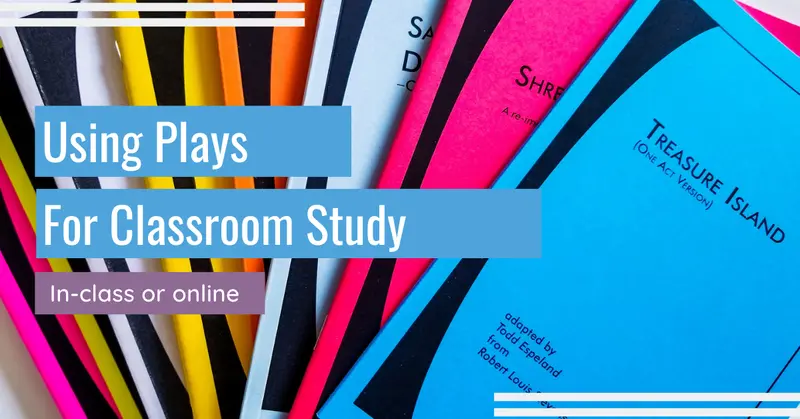
Using Plays for Classroom Study

During a busy school year, when your theatre program is juggling packed schedules, limited rehearsal time, and competing priorities, putting on a full production might not always be possible. Who has the time when you are balancing lesson planning, rehearsals, admin tasks, and, oh, actually teaching your classes? But if a performance isn’t possible, that doesn’t mean that plays can’t have a place in your program. Scripts are still powerful tools for learning, creativity, and connection in the drama classroom. Scene analysis, character analysis, monologue performance, and cross-curricular connections can all be explored in any classroom setting. Here are some examples for using plays for classroom study. *Close Reading *Close reading is an analysis tool. Students read a text multiple times for in-depth comprehension, striving to understand not only what is being said but how it’s being said and why. Close reading takes a student from story and character to drawing conclusions on author intention. Close reading prompts students to flex their thinking skills by: • Teaching students to engage with a text. • Teaching students to be selective. We can’t highlight everything in the text, only the most important elements. • Teaching students to make educated decisions. All conclusions and opinions must be backed up with a text example. Close reading does not have to be laborious. You can start quite small, for example, with a play title, and have students individually or in groups analyze the what , the how , and the why of the play title. Your virtual students can work together in break out rooms, and your in-person students can work in socially distanced groups. Click the link at the bottom for a Close Reading Title Exercise! You can also close read images. Find a picture of a set from a production of the play you are studying. What is happening in the image? How is it happening (analyze the lighting, whether or not the set is realistic or abstract)? Why have the director and set designer chosen the specific look for the set? Pre/Post Read ExercisesGive students exercises that explore themes and subject matter before they study the play. For example, if a major theme of the play is friendship, have students discuss what it means to be a friend. Have students create friendship scenes (written or performed) that demonstrate the value of friendship. Another option is to give students personality traits of a character (without telling them the specific character) and have them create a physical movement (standing if in person, sitting if virtual). If the play takes place in a specific era or location (e.g., on an army base), have students do some research. What is life like on an army base? Post-read exercises should focus on bringing the play to life. Have students create a costume for a character, or a basic set design (depending on the tools they have available). Have students create a music playlist for a specific character or scene. If the play has monologues, have students choose, rehearse, and present a monologue. If you can have students rehearse scenes in your particular environment, do that. Cross-Curricular ConnectionsRead a play with students and connect it to a subject outside the drama classroom. What you do has always had implications outside of the drama classroom and now is no exception. For example, the play Drum Taps uses Walt Whitman’s poetry and takes place during the civil war. Can you connect virtually with the English or History department? Check out our full list of recommended cross-curricular plays here. Student Assignment: Study Guide for a PlayStudy guides are often prepared by a theatre company before students come to see a production of a play. Have your students demonstrate their knowledge of a play by putting together their own study guide. This is a bigger group project and one that can culminate a unit on a play, particularly if a production or scene presentations aren’t possible. It’s also a project that can be divided up among virtual and in-person students. Each person in a group can be assigned a specific part of the study guide. Start by dividing your students into groups and have each group find a production study guide online. Then have the groups compare and contrast the guides. What are the similarities and differences? As a class, decide on the sections for your study guide and divide the work up among students. Have each group present their guide as a digital presentation. While we don’t have production study guides, we do have some free classroom study play guides designed to challenge students to deepen their understanding and connection to the plays they’re studying. Complete with pre-read questions and activities, close reading analysis, and post-read activities, these comprehensive, easy-to-use study guides allow you to provide an in-depth & theatrical learning experience. Check out our complete list of classroom study guides here. (Plus, keep checking back for more!)
Theatrefolk’s Top 10: Cross-Curricular Plays
Featured Plays

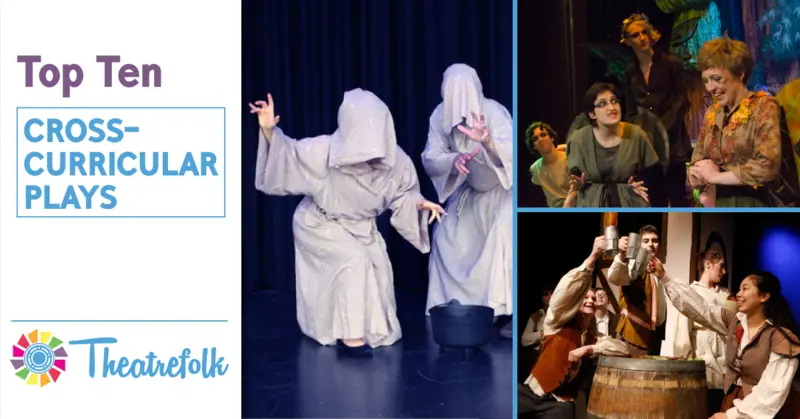
Theatrefolk’s Top 10: Cross-Curricular Plays

Time for a Tfolk Top Ten Plays For….Cross-curricular. Cross-curricular is a magic word for many admins and quite frankly there’s a good reason for that. Here in the 21st century we no longer live in an isolated world and students shouldn’t be taught in isolation. What we do in the drama classroom has always had implications outside of the drama classroom and it’s time to showcase that connection. If you want students to increase their critical thinking skills, their communication skills, and their collaboration skills, reach out across department lines! You can do plays that will interest your history department, english department, social studies, technology and more. Click the link and you’ll be taken to the webpage for each play. There you’ll get the details and read sample pages. Hand this list over to your student directors and see what they think. All the best with your search!
Theatrefolk Featured Play – Drum Taps by Lindsay Price
Featured Plays

Theatrefolk Featured Play – Drum Taps by Lindsay Price

*Welcome to our Featured Play Spotlight. * Drum Taps by Lindsay Price is a theatrical adaptation of a selection of Walt Whitman’s civil war poems. Available in both large cast and small cast versions, student performers can bring a war-time experience to stage. The poems in Drum Taps represent Walt Whitman’s firsthand account of the Civil War. See the words, the emotion, the blood come to life in this theatrical adaptation. This is not your traditional readers theatre or poetry recital. This is flesh and bone words breathed to their fullest humanity. This is struggle and pain. This is confusion and contradiction. This is war. Why did we publish this play? It’s one thing to read about war in a textbook. It’s another thing to read an account by someone who was there, who can feel every word they write. And it takes on an entirely new meaning when you read a firsthand account of war through a creative genre. Walt Whitman’s Drum Taps poetry illuminates his experience of the Civil War – his passion for it at the beginning, his despair at Lincoln’s death, his visits to the wounded at hospitals, his change of attitude towards war as it drew on. Poetry is hard to stage. It’s a singular experience. I find Whitman’s poetry extremely character-driven. Each poem tells a story. But one genre does not necessarily fit easily into another. A poem is not a play. That was my challenge with my adaptation of Drum Taps – to bring the characters to life and to make it make sense to an audience. Our version of Drum Taps brings war to life in a unique way. It’s a challenge, it’s cross-curricular, it’s a unique theatrical experience. All great reasons to publish a play. Let’s hear from the author!1.Why did you write this play? Adaptation is my favourite style of writing. I like taking something in one form and finding it’s theatricality. I’ve always been fond of Walt Whitman, and had the opportunity to study some poems in detail. And that’s when I started seeing the possibilities. The vivid imagery of the poetry, and really, the first hand account of war really spoke to me. 2. Describe the theme in one or two sentences. War brought to life. 3. What’s the most important visual for you in this play? I think the two images that bookend the play, that also represent Whitman’s changing view of war – the beginning of the war where there is excitement to see the young men in their clean uniforms going off to fight for right, and then the much different tone at the end, as the realities, the death, the anguish of war has been fully realized. Whereas at the beginning characters hold pieces of manuscript up high and proud, at the end (the poem is “To a Certain Civilian”) a character crumples pages of manuscript and throws them to the ground. 4. If you could give one piece of advice for those producing the play, what would it be? Work with the text as is. It’s all Whitman, there are no lines of dialogue that are my own. So don’t change it, don’t modernize it, figure it out. It’s Whitman! 5. Why is this play great for student performers? I think the source material is a vivid and vibrant first hand look at a war that doesn’t have a lot of primary sources. This alone is important. And then the task to bring a theatricality to poetry is a valuable process. I loved writing it and I have loved seeing it in performance!
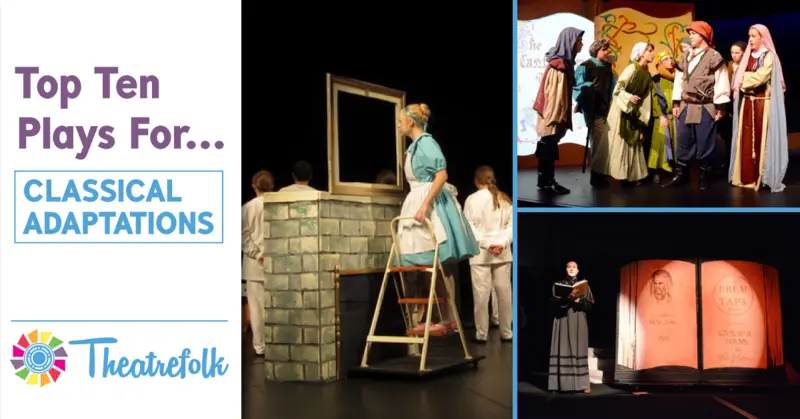
Theatrefolk’s Top 10: Classical Adaptations
Featured Plays

Theatrefolk’s Top 10: Classical Adaptations

Time for a Tfolk Top Ten Plays About…Classical Adaptations! Who’s looking for a little arts integration? How about some cross-curriculum? Or how about a great story turned into a great play. It’s time for ten classical adaptations. Adaptations are my favourite type of play to write. It’s an intriguing challenge to take a story in one form and determine what will make it a theatrical experience. Click the link and you’ll be taken to the webpage for each play. There you’ll get the details and read sample pages. All the best with your search! Shuddersome: Tales of Poe Original: Stories and Poems by Edgar Allan Poe Not only our most popular adaptations, but one of our most popular plays! Specters, ghosts and ghouls come alive in this vivid theatrical vision of Edgar Allan Poe’s best works including: The Tell-Tale Heart, The Raven, and The Masque of the Red Death. Hamlette/Mmmbeth Original: Hamlet & Macbeth by William Shakespeare The first of many of Shakespeare adaptations. We’ve paired Hamlette and Mmmbeth together because they make for a hilarious evening of theatre. Imagine if you will that “Hamlet” was not “Hamlet” at all, but “Hamlette” – a woman! Great for competitions. AND in Mmmbeth everything goes wrong. The witches take over the storytelling, Queen Duncan would rather open a donut franchise than die, Lady M’s a bloodthirsty June Cleaver, and the murderers are preoccupied with creating a commercial for their services. Introduce your students to the world of the Bard with these parodies. Will and Whimsy Original: Sonnets by William Shakespeare Shakespeare was meant to be performed, not read. This vignette play does that by bring his sonnets to life. Modern scenes play hand in hand with the original text. Mix and match the sonnets to your whimsy! Lord of the Pies Original: Lord of the Flies by William Golding In this parody piece a pie shop erupts into panic after Franny, a brash cat-lady, announces the arrival of the apocalypse. SHe starts to reconstruct society and takes out anyone who stands in her way with baby food and scotch tape. Drum Taps Original: Drum Taps by Walt Whitman The poems in Drum Taps represent Walt Whitman’s first hand account of the Civil War. See the words, the emotion, the blood come to life in this theatrical adaptation. This is not your typical poetry reading. This is war. Alice/Through The Looking Glass Original: Alice’s Adventures in Wonderland and Through the Looking Glass, and What Alice Found There by Lewis Carroll These two make excellent theatrical companion pieces. Both are one-act adaptations of the famous novels by Lewis Carroll. They follow Alice’s adventures down the rabbit hole and across the life-sized chess game. Fantastical physical journeys! The Canterbury Tales Original: *The Canterbury Tales by Chaucer* Chaucer’s classic collection of tales comes to life! A group of travelers set out for Canterbury on a pilgrimage. Each and every performer gets a chance to shine in this spirited, charming script. Text uses modern English. Pandora’s Fire Original: Pandora’s Box, Ancient Greek Myth Everybody knows the story of Pandora. Her curiosity got the better of her and she is to blame for releasing all the ills into the world. But is that the whole story? Pandora’s Fire is a wonderful mix of Ancient Greek choral storytelling with a modern twist. Hamlet, Zombie Killer of Denmark Original: Hamlet by William Shakespeare Denmark is plagued with zombies led by Hamlet’s uncle/step-father, the current king. Will Hamet become a zombie himself? A gruesomely comic adaptation of the Shakespeare’s classic tragedy, this version blends original text with new, zombified dialogue – written in iambic pentameter! The Tragicomedy of Julia Caesar Original: Julius Caesar by William Shakespeare Sarah and Dave think it would be fun to direct a play for drama club. And they both love Julius Caesar. What could go wrong? Oh, a post-death dance number, Brutus is allergic to peanut butter, Rome is now Georgia, and giant killer robots. That’s all….
Theatrefolk Podcast: Using Theatre in China
Podcast

Theatrefolk Podcast: Using Theatre in China

Episode 124: Using Theatre in ChinaNick Cala is a high school teacher in China. He’s putting up a play for the first time with Chinese students who are studying to attend American universities and fully believes in the importance of drama as part of their process.
Theatrefolk Podcast: Directing the Non-Traditional Play
Podcast

Theatrefolk Podcast: Directing the Non-Traditional Play

*Episode 93: Directing the Non-Traditional Play *High school director Ray Palasz talks about directing Drum Taps, a theatrical adaptation of Walt Whitman’s poetry. Why is struggle an important tool in his directing process?
Spread the Love: Drum Taps – adapted by Lindsay Price from Leaves of Grass by Walt Whitman
Featured Plays

Spread the Love: Drum Taps – adapted by Lindsay Price from Leaves of Grass by Walt Whitman

This week on Spread the Love we talk about Drum Taps – adapted by Lindsay Price from Leaves of Grass by Walt Whitman. Filmed live on location at Old Fort Erie.
New Play! – Drum Taps, adapted by Lindsay Price from Leaves of Grass by Walt Whitman
Featured Plays

Theatrefolk Featured Play: Drum Taps, adapted by Lindsay Price from Leaves of Grass by Walt Whitman

“The poems in Drum Taps represent Walt Whitman’s firsthand account of the Civil War. See the words, the emotion, the blood come to life in this theatrical adaptation. This is not your traditional readers theatre or poetry recital. This is flesh and bone words breathed to their fullest humanity. This is struggle and pain. This is confusion and contradiction. This is war.” The primary danger in theatricalizing a series of poems is that such adaptations tend to be static – they amount to not much more than a poetry recital with lights and costumes. I’m not dissing poetry recitals, I’m just saying that they’re not inherently theatrical. By the way – can you believe “dissing” passed my spell checker but “theatricalizing” didn’t? I wasn’t quite sure what I was expecting when Lindsay told me she was working on an adaptation of Leaves of Grass, a collection of US Civil War-era poems written, modified and rearranged over an entire lifetime by Walt Whitman. I wasn’t familiar with the poems at the time nor, being Canadian, did I have that much knowledge about the US Civil War. But my main concern was this: will it be theatrical? I am proud to report that it is. Even just reading the script I could see the actors, hear the chaos, smell the gunpowder, feel the loss. I can’t wait to see a production of this! Two versions are included in the same book: A small cast version (5 actors – 2M+3W) and a large cast version (20 actors – 6M+14W) . The casting is very flexible, however, and is limited only by the director’s imagination. Genders can be switched for many characters and the cast size can be expanded or contracted fairly easily. Both versions run about 35 minutes, ideal for most contest requirements.
We accept

In addition to the above payment methods, Purchase Orders are accepted from US and Canadian Schools.

Info for your purchasing department