


Facebook Pixel Skip to main content

📣SCRIPT SALE! Treat yourself to an easier Fall. Save 30% on 5+ perusal scripts with code SPRING30 before May 3 and head into summer stress-free.

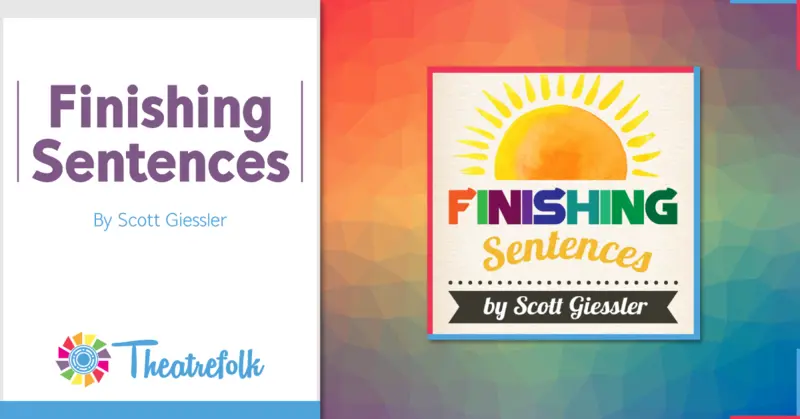
Finishing Sentences

Finishing Sentences

by Scott Giessler

After being arrested for vandalizing a classmate's car and perpetrating criminal harassment, Kendra serves her community service at a summer camp looking after a frequently bullied kid.

Her journey through this surreal summer camp exposes Kendra to her own raw underbelly. Taking the perspective of the bully, the play forces us to consider the human side of the people we often dismiss.

Dramedy Issue-Based

Recommended for High Schools and Middle Schools

Running Time
About 35 minutes
Approximate; excludes intermissions and scene changes
Cast
18 Characters
4 M6 F8 Any Gender, Easily expandable
Set
Simple set
Length
44 pages
Free Excerpt

What to order?

Not sure what you need to order? Check out our pricing and ordering guide.

Performance Royalty Fees

Royalty fees apply to all performances whether or not admission is charged. Any performance in front of an audience (e.g. an invited dress rehearsal) is considered a performance for royalty purposes.

Exemption details for scenes and monologues for competition.

18 Characters
4 M, 6 F, 8 Any Gender, Easily expandable

Women
Kendra [F] 195 lines
An unrepentant bully. Takes a shine to Isabelle.
Isabelle [F] 64 lines
A sunny kid with a wild imagination, and problem of her own.
Innocence [F] 11 lines
Kendra’s sense of truth and kindness.
Conscience [F] 16 lines
Kendra’s sense of right and wrong.
Denial [F] 17 lines
Kendra’s impulse to cover over her past.
Rage [F] 26 lines
Kendra’s anger and spite.

Men
Nat [M] 92 lines
Kendra’s uncle. Has an idea to help her straighten herself out.
Lucien [M] 42 lines
Another counsellor at camp. A kind soul.
Curmudgeon [M] 10 lines
Knows the exact right way to do everything at camp. Several Monologues.
Love [M] 18 lines
Kendra’s memories of her old boyfriend.

Either
Judge [A] 17 lines
Unimpressed with Kendra’s actions and attitude.
Red Warrior [A] 2 lines
The first challenger in Color War.
Frawley the Wise (Blue Warrior) [A] 9 lines
The second challenger in Color War.
Ref [A] 6 lines
Adjudicates the Burnball Match.
Kid [A]
Police Officer [A] 0 lines
Kitchen Worker [A] 0 lines
Blue Team Members [A] 2 lines
Red Team Members [A] 1 line
Campers (guys and girls) [A] 4 lines
Counselors [A] 15 lines

More Plays Like Finishing Sentences

Box

by Lindsay Price

A middle school vignette play about the boxes we find ourselves in.

The Pregnancy Project

by Lindsay Price

A pregnancy project turns real when Lucy's test turns pink. No statistics. No preaching. Just well-drawn characters and an engaging story.

Discovering Rogue

by Christian Kiley

Rogue lives in a cardboard box but she doesn’t mind. Others want Rogue to leave but she isn’t budging. It's a showdown of stereotypes and self-identity.

La Caja

by Lindsay Price

A Spanish translation of the middle school vignette play Box.

Boat

by Lindsay Price

In this one-act middle school vignette play, characters come face-to-face with the fact that there are other people in their boat. Some are different. Some only seem different.

Madeline has body issues. So much so that different body parts are coming to life and talking back. A shorter version of this body image play.

From the Drama Teacher Learning Centre

Theatrefolk Featured Play – Finishing Sentences by Scott Giessler
Featured Plays

Theatrefolk Featured Play – Finishing Sentences by Scott Giessler

Welcome to our Featured Play Spotlight. Are you ready for summer camp – and all of the ups and downs that go along with it? Then you’re ready for Finishing Sentences by Scott Giessler – an issue-based dramedy that your students won’t want to miss. After being arrested for vandalizing a classmate’s car and perpetrating criminal harassment, Kendra serves her community service at a summer camp looking after a frequently bullied kid. Her journey through this surreal summer camp exposes Kendra to her own raw underbelly. Taking the perspective of the bully, the play forces us to consider the human side of the people we often dismiss. Why did we publish this play? Awesome character play. Awesome character play. Awesome character play. Shall I say it again? Awesome, awesome character play. I love that we can look at teen life from unique and interesting perspectives and provide unique and interesting characters for student performers. (Did I mention this is an awesome character play?). Let’s hear from the author! 1. Why did you write this play? I have been an avid participant and supporter of Summer Camping since I was a kid. I wanted to write a show that captured the spirit of the experience both comedic and dramatic. Although our time at camp is short, we live lifetimes there. 2. Describe the theme in one or two sentences. There are no such things as bullies. (It’s a two-dimensional idea. We are all on a journey that are often filled with mistakes. ) 3. What’s the most important visual for you in this play? Transitioning from the stark real world to the colorful world of camp life. 4. If you could give one piece of advice for those producing the play, what would it be? Let the world around Kendra be crazy. Camp is comedy and tragedy all at the same time. 5. Why is this play great for student performers? It lets the actors tap into both ingredients: Comedy and Drama. It demands range, timing, and sheer fun.
Page to Stage: What can you learn in 48 hours?
Podcast

Page to Stage: What can you learn in 48 hours?

Episode 209: Page to Stage: What can you learn in 48 hours? What can you learn when you put up a show from page to stage in 48 hours? Teacher and playwright Scott Giessler shares his experience. If you want your students to have an immediate lesson in problem solving this is the conversation for you!
Theatrefolk’s Top 10: Plays About Empathy
Featured Plays

Theatrefolk’s Top 10: Plays About Empathy

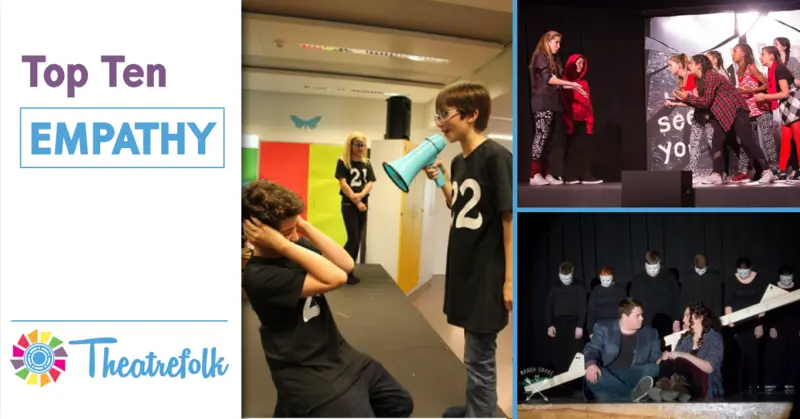
Time for a Tfolk Top Ten Plays About….Empathy. Based on the idea that empathy is the act understanding and sharing another person’s experience, these plays open the door to looking out to others rather than looking in. Use these plays to spark to an empathy discussion. Click the link and you’ll be taken to the webpage for each play. There you’ll get the details and read sample pages. Hand this list over to your student directors and see what they think. All the best with your search!
The Drama Classroom: A seat for everyone at the table
Acting

The Drama Classroom: A seat for everyone at the table

Drama Teacher Podcast.Scott Giessler is a teacher and a playwright. He went into theatre teaching without any training. Not only is he still doing it, but he has a strong philosophy for how to do it. He’s well aware that what you need as a teacher isn’t necessarily what your students need. Scott is adamant that there is a seat for everyone at the table in the drama classroom. Learn from his experience by incorporating these tips into your own program, from the Drama Teacher Podcast. 1. It’s not about YOU, it’s about THEM.What you get excited about is not necessarily what’s going to light their fire . Get to know the needs of each particular group of students. What do they bring in the door with them? Realize that every year, every semester, as the group changes, so will their needs. You’ve got to constantly learn and adapt. 2. Build trust.In a math classroom, trust is going to be built with “I’m going to show you how to do this and, when it works, you trust me.” With a theatre class, you’re asking them to dig down into themselves and take some social risks. Building a relationship with them is key. If you don’t have a relationship with them, you won’t have the type of trust you need for them to take those social risks. 3. Find a place for everyone – well beyond the actors who already love theatre class.You have the guy who is in the construction trades class who, for some reason, gets dragged in because his girlfriend is in the program. We send him over to the scene shop and we can’t live without him. We’ve got the kid who doesn’t want anything to do with the stage but just loves the costume room . We have the kid who is really great with Photoshop and wants to do all the posters for us . We have kids who just want to be a part of the magic and end up being our house crew or backstage crew. Find the place that each student is comfortable, and you’ll be on your way to building a great program. 4. Help them realize that they are ALL an important part of the team.In basketball, if the third-stringer player doesn’t show up, well, it’s not really a problem because we’ve got two other strings to send in. Whereas, in theatre, anyone that doesn’t show up, it throws a monkey-wrench into the whole works. Embrace the concept that there is no unimportant cog in the machine. We need every last piece to make it move. Instead of “the show must go on,” the proper phrase really is “the show will go on as long as the people running it are a concerted group of people who care a great deal about the outcome.” 5. Include everyone. Don’t cut anyone out.For the same reason that a math teacher doesn’t throw a kid out of math class because he can’t get the hang of math, don’t cut a kid from a high school theatre program because he’s not very good at theatre. The moment they make a commitment to be there, they’re there and we’re going to invest time in them. More importantly, though, they’re investing time in others. Click here to listen to the full podcast or read the transcript. Scott’s got lots more to share, including details of his play Finishing Sentences.
Theatrefolk’s Top 10: Ensemble Pieces
Featured Plays

Theatrefolk’s Top 10: Ensemble Pieces

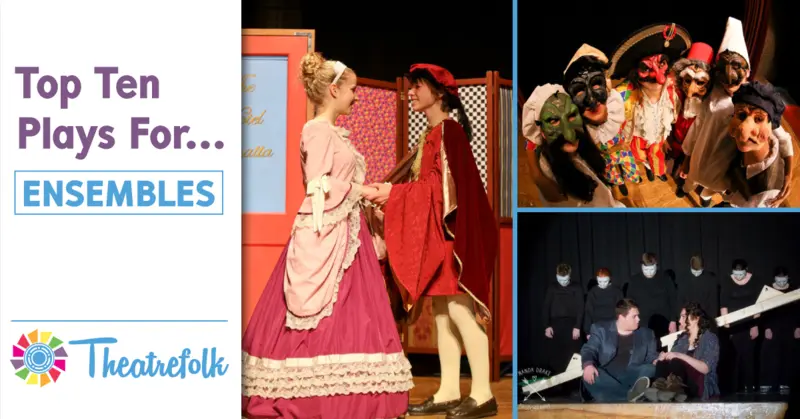
Time for a Tfolk Top Ten Plays For…Ensembles! It’s not about the leads and the chorus, it’s about the ensemble. The definition of the word ensemble is to have parts that come together as a whole and are only considered in relation to the whole. It’s all about working together to make a great production. Here are 10 plays that explore the concept of the ensemble. Click the link and you’ll be taken to the webpage for each play. There you’ll get the details and read sample pages. All the best with your search! The Blue and the Grey This play starts with the sound of drumming and the words of Walt Whitman. This sets the tone of the play and lets us know what to expect. This is the work of the ensemble. In this play of ghosts, the past, and those left behind – The ensemble creates the aural world in The Blue and the Grey – haunting, necessary. Finishing Sentences Sometimes an ensemble is needed to populate the world of the play. In Finishing Sentences Kendra finds herself surrounded by camp life – that’s what the ensemble provides. And besides, you can’t have a colour war without them! (even if the blue team can’t get their chant together) Storied Quite often, the world of the play is, well, out of this world. It’s built in the imagination of the playwright, and in order for the audience to buy in, they need to see characters who also buy into the world. Storied takes place in a magical dimension inhabited by characters from fiction. Everyone from Javert to Santa Claus to Elizabeth Bennett lives there. The ensemble is crucial to the audience leaving the real world behind as they watch the play. The Happiness Shop In this play an ensemble of “Roppets” – robot puppets litter the stage. They are on stage for the entire play. They visual demonstrate “happiness.” They smile, they laugh, they hi-five all the time. It isn’t creepy at all. Aren’t middle schoolers happy all the time? They’re too young to have problems…. The Scarlet Heart The Scarlet Heart is a commedia dell’arte piece which can be played as scripted or off of scenarios. To play off a scenario means a group really has to know each other, listen to each other, improv often together. They’ll have to become a true ensemble. Being Bianca: The Semi Complete Guide Being Bianca has a huge cast – it can include up to 50 actors. And that means everyone has to be on the same page and working toward the same goal. Bianca has to do some community service. She decides the best service is to teach the world what it’s like to be her. Who wouldn’t want to be Bianca? Ariadne’s Thread: The Adventures of Theseus and the Minotaur Ariadne’s Thread has an ensemble in the classical sense of the word – a greek chorus. Again it’s all about creating the world of the play and in this tale of Minotaur’s and mazes the greek chorus observes and comments. They are the voice of the audience and they share that voice in perfect unison. Stupid is Just 4 2day We can’t avoid stupidity. It happens. To everyone! But it’s just temporary. The characters in this vignette play are all named after orchestra instruments. And that’s because all the transition pieces are performed like music rather than theatre. Everyone speaks, and gestures in unison. Win the Best Ensemble award! Chemo Girl Camille is given a video game system from her mom as a form of recovery therapy for cancer. The ensemble creates the video game for Camille as she is drawn into the world and takes on the name “Chemo Girl.” Think video games can’t be done in the theatre? The ensemble makes it happen. Anonymous In Anonymous everyone is just trying to get along, get by, make themselves heard. It’s hard when you don’t have a face or a voice. The teens in this play have no names because they’re everyone. The ensemble brings this theme to life.
The Drama Classroom: There is a seat for everyone at the table
Podcast

The Drama Classroom: There is a seat for everyone at the table

Episode 175: The Drama Classroom: There is a seat for everyone at the table Scott Giessler is a teacher and a playwright. He went into theatre teaching without any training and not only is he still doing it, he has a strong philosophy for how to do it. He’s well aware that what you need as a teacher isn’t necessarily what your students need. And for Scott, he’s adamant that there is a seat for everyone at the table in the theatre classroom. Enjoy this conversation from the trenches of the drama classroom and the importance of what goes on there.
Drama Teachers: Tips For Travelling with Students
Podcast

Drama Teachers: Tips For Travelling with Students

Episode 162: Drama Teachers: Tips for Travelling with Students Does the thought of taking 30 or more students to New York or London sound exciting or like a nightmare? At some point in every teacher’s life where they are faced with the daunting task of planning a trip. Where do you start? How do you avoid issues? Lisa Houston is a pro at traveling with students. In this podcast she gives her tips, tricks, fundraising suggestions for making your next travel experience smooth sailing.
Social Issue Plays for High Schools / Middle Schools
Teaching Drama

Social Issue Plays for High Schools / Middle Schools

Our website lists all of our plays with social issue themes but it struck me that they’re only lumped as “issue plays” without a good guide to sorting out which title addresses which issue. So I’ve categorized them for you to hopefully give you a helping hand in your quest to find the perfect script for your school. Check them out. As usual, all of the titles have extensive free sample pages for you to read. I think you’ll find the writing honest, fresh, and believable – three qualities sadly lacking from a lot of “teen-issue” plays out there in the world. Alienation / Feeling Alone in the World• Anonymous by Allison Green • The Art of Rejection: Two One Act Plays by Christian Kiley • A Box of Puppies by Billy Houck • Constantly, Incessantly, All The Time by Billy Houck • Huge Hands by Billy Houck Body Image• Body Body by Lindsay Price • The Four Hags of the Apocalypse Eat Salad at their General Meeting by Lindsay Price • The Battle of Image vs. Girl by Johanna Skoreyko • Hoodie by Lindsay Price • Breathless by Wendy-Marie Martin Censorship• Censorbleep by Lindsay Price Human Rights• Look Me in the Eye by Lindsay Price • Sweep Under Rug by Lindsay Price Racism• Flaky Lips by Lindsay Price • With Liberty and Justice For All by Jeyna Lynn Gonzales • Not Going Anywhere by Emma Fonseca Halverson • The Burgundy Letter by Kirk Shimano • Let Me In by Sholeh Wolpe *** Rumours and Lies• Have You Heard? by Krista Boehnert • The Redemption of Gertie Greene by Taryn Temple Individuality• Hoodie by Lindsay Price • Virtual Family by Christian Kiley • The Happiness Shop by Lindsay Price • A Deep, Poetic Journey Into Something by Forrest Musselman • Carrying the Calf by Shirley Barrie • Monster Problems by Lindsay Price • Stereotype High by Jeffrey Harr • Sixteen in 10 Minutes or Less by Bradley Hayward • Nice Girl by Amanda Murray Cutalo • Pressure by Lindsay Price • They Eat Sunshine, Not Zebras by Dara Murphy • The Super Non-Heroes by Taryn Temple • Smarty Pants by Bradley Hayward Identity• Box by Lindsay Price • Labeled by Lindsay Price • We Are Masks by Lindsay Price • Stressed by Alan Haehnel • Anonymous by Allison Green • Constantly, Incessantly, All The Time by Billy Houck • The Super Non-Heroes by Taryn Temple School Violence• Huge Hands by Billy Houck • Power Play by Lindsay Price • Clowns with Guns (A Vaudeville) by Christopher Evans • The Butterfly Queen by Christian Kiley • Life and Death in an Empty Hallway by Christopher Evans • Water. Gun. Argument. by Alan Haehnel Sexual Abuse• The Waking Moment by Bradley Hayward • Breathless by Wendy-Marie Martin Substance (alcohol & drug) Abuse• Bottle Baby by Lindsay Price • Floating on a Don’t Care Cloud by Lindsay Price • One Beer Too Many by Billy Houck Suicide• The Bright Blue Mailbox Suicide Note by Lindsay Price • Chicken. Road. by Lindsay Price • The Butterfly Queen by Christian Kiley Teen Pregnancy• The Pregnancy Project by Lindsay Price • Among Friends and Clutter (one scene) by Lindsay Price Illness/Health• Chemo Girl by Christian Kiley • The Other Room by Christian Kiley • Red Rover by Christian Kiley • Waiting Room by Christian Kiley • Breathless by Wendy-Marie Martin • Shreds and Patches by Robert Wing • Inanimate by Christian Kiley • Constantly, Incessantly, All The Time by Billy Houck Depression/Anxiety• darklight by Lindsay Price • Fidget by Bradley Hayward • Among Friends and Clutter (one scene) by Lindsay Price • Constantly, Incessantly, All The Time by Billy Houck • who are we, who we are by Forrest Musselman Bullying• Finishing Sentences by Scott Giessler • Funhouse by Lindsay Price • Power Play by Lindsay Price • The Redemption of Gertie Greene by Taryn Temple • Sixteen in 10 Minutes or Less by Bradley Hayward • Carrying the Calf by Shirley Barrie Divorce• Split by Bradley Hayward Gender• Life, Off Book by Scott Giessler • Anonymous by Allison Green • Baalzebub by Rachel Atkins (Baalzebub – One-Act Version here) • Completely, Absolutely Normal: Vignettes About LGBTQ+ Teens by Bradley Walton • Finding Jo March by Laramie Dean • Thought Traps by Lindsay Price Empathy• Discovering Rogue by Christian Kiley • Boat by Lindsay Price • We Are Masks by Lindsay Price • The Butterfly Queen by Christian Kiley Dependence on Technology• Virtual Family by Christian Kiley • Inanimate by Christian Kiley
We accept

In addition to the above payment methods, Purchase Orders are accepted from US and Canadian Schools.

Info for your purchasing department