

Facebook Pixel Skip to main content

📣SCRIPT SALE! Treat yourself to an easier Fall. Save 30% on 5+ perusal scripts with code SPRING30 before May 3 and head into summer stress-free.

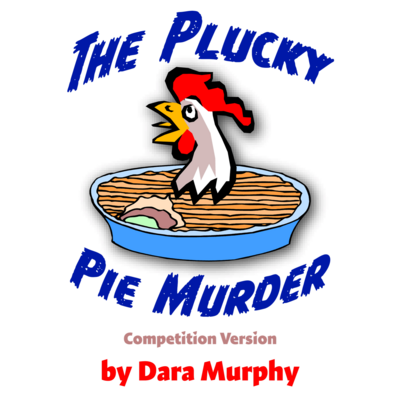
The Plucky Pie Murder

The Plucky Pie Murder

by Dara Murphy

The star quarterback of Riverview High School has been charged with murder most fowl! Rooster, to be precise.

Plucky the mascot has been done in and all fingers point to the football player - even his own.

A farce of a trial ensues featuring an inept judge, an unprepared defence lawyer, and an Egg-Girl.

The audience plays the jury in this hilarious black comedy. Two possible endings!

Black Comedy Mystery

Average Producer Rating:

Recommended for High Schools and Middle Schools

Running Time
About 45 minutes
Approximate; excludes intermissions and scene changes
Cast
12 Characters
8 M | 4 F
Set
Simple Set
Length
30 pages
Free Excerpt

What to order?

Not sure what you need to order? Check out our pricing and ordering guide.

Performance Royalty Fees

Royalty fees apply to all performances whether or not admission is charged. Any performance in front of an audience (e.g. an invited dress rehearsal) is considered a performance for royalty purposes.

Exemption details for scenes and monologues for competition.

12 Characters
8 M, 4 F

Characters in this play are currently identified as male or female. Directors are welcome to assign any gender (binary or non-binary) to any character and modify pronouns accordingly.

Chuck [M] 64 lines
The star quarterback of the Riverview Roosters. He’s being charged with murder.
Coach Wells [M] 39 lines
The football team’s coach. He’s tough, loud and dressed in a training suit. A whistle is tied around his neck.
Billy and Daren [M] 26, 28 lines
Chuck’s supportive football buddies. They’re dressed in football jerseys.
The Waterboy [M] 1 line
He carries a water bottle and is constantly squirting it into people’s mouths.
Mr. Teedle [M] 87 lines
Chuck’s defendant. He’s a weedy, fragile man with a low selfesteem.
Ms. Duncan [F] 67 lines
The cunning prosecutor. She is confident she will win this case.
Judge Green [M] 79 lines
A tough old judge who’s on the verge of retiring.
Assistant [F] 13 lines
She tries to aid Judge Green, but she’s rather forgetful.
Egg-girl [F] 13 lines
The dead mascot’s best friend. She is dressed like a giant egg.
Terry Winds [F] 13 lines
A forensic specialist.
Peach * [M] 13 lines
Bob Punt dressed up like a giant peach. A very bitter man. (*Should be played by same actor as Dr. Gregory)
Dr. Gregory * [M] 4 lines
Chuck’s doctor. He has a very high opinion of himself. (*Should be played by the same actor as Peach)

Praise for The Plucky Pie Murder

Lux Orr
Cleveland High School
I chose this play as my one-act and LOVED it! From the first time I read it, I instantly fell in love with the comedic aspects brought into a court-room setting. It was the perfect comedy; it had a great story line, fantastic character development, and an easy set. I rate this play very highly and definitely recommend it as a play choice.

More Plays Like The Plucky Pie Murder

When Riverview High’s star quarterback is accused of murdering the school mascot, a wildly incompetent trial unfolds, putting the audience in the jury box to decide the fate of a case that is as absurd as it is dark.

A collection of five hauntingly humorous tales.

Sara enjoys tea parties. But camel dung and cloves are two things that should never end up on the table. The twists never stop coming in this play.

A noir play featuring the ace detectives from the Broadly Speaking Detective Agency.

The Fried Kobassa

by J. Robert Wilkins

A girl-heavy wacky camp comedy that centres on some missing luncheon meat.

Tonight was going to be writer Alina Deveraux’s most important night, the unveiling of her memoirs. Until she ended up dead. Or not dead.

From the Drama Teacher Learning Centre

October Reading List: Mystery Plays
Featured Plays

October Reading List: Mystery Plays

Ready to add a little mystery to your drama classroom? We’ve put together a list of plays full of secrets, twists, and unexpected turns that are sure to captivate your students. Whether they’re uncovering hidden clues or piecing together the puzzle, these scripts will have your performers and the audience hooked. Ready to crack the case? Dive into our mystery play picks!
The Plucky Pie Murder
Featured Plays

Theatrefolk Featured Play - The Plucky Pie Murder

Welcome to our Featured Play Spotlight! The Plucky Pie Murder by Dara Murphy is an incredible way to challenge perspectives and find humour in unexpected places. A black comedy extraordinaire! The star quarterback of Riverview High School has been charged with murder most fowl! Rooster, to be precise. Plucky the mascot has been done in and all fingers point to the football player - even his own. A farce of a trial ensues featuring an inept judge, an unprepared defence lawyer, and an Egg-Girl. The audience plays the jury in this hilarious black comedy. Two possible endings! Why did we publish this play? The Plucky Pie Murder is a black comedy extraordinaire. It's the play to choose if you're in the rare position of having a lot of guys in your drama class or club. We love how Dara writes plays. Some may call it weird, which I would consider a compliment. She's said that she likes "finding humour in unexpected places." She also likes that humour can be used "to challenge people's perspectives." It's important to us to have plays that challenge people's perspectives! Sit back and enjoy the ride with this play. Fun fact: When we accepted The Plucky Pie Murder Dara was the youngest playwright in our catalogue. She had written the play for a high school assignment and her teacher submitted it to us. Let’s hear from the author!1. Why did you write this play? I wrote The Plucky Pie Murder when I was in grade 12. It was a drama class assignment that asked us to write a one-act play. I don't remember how I got the idea for the script, but at the time I enjoyed TV shows like Murder She Wrote and Matlock. My teacher liked my play, and at the end of the school year, she recommended that I submit it to Theatrefolk. I was very excited when Theatrefolk said they were interested in publishing it! My mom even flew us to California so we could watch the first performance. That experience cemented my love for writing and theatre. 2. Describe the theme in one or two sentences. This play is a courtroom drama and a football game rolled into one. I would say the theme is the importance of getting to know a person beyond simply looking at their mascot costume, job, reputation, or appearance. 3. What’s the most important visual for you in this play? My favorite visual is the waterboy keeping the defense team hydrated during the court proceedings. 4. If you could give one piece of advice for those producing the play, what would it be? If you produce this play, I would recommend keeping the pace of the dialogue very snappy. This will help the jokes land, and it will keep the energy high. People could even talk over one another. 5. Why is this play great for student performers? This play is great for student actors because it's a lot of fun. It's goofy and silly, and it would be perfect for an energetic group. The jokes come and go quickly, and there's never a dull moment. 6. Who is your favourite character in the play? If I were in this play, I would want to be Ms. Duncan because she's a serious lawyer who gets to pepper everyone with important questions. 7. What is your favourite line in the play? It's hard to pick my favorite line. I like the section when Mr. Teedle is questioning the forensic specialist on whether the mascot costume is a rooster or a chicken. I also like Mr. Teedle's hopeless opening statement: MR. TEEDLE: Okay, to begin I would like to say that my client is innocent. Very… innocent. So innocent, you could throw him into a lake and he would sink… Ha ha, little witch joke there. So, to close my opening statement I would like to repeat that the innocence of my client is very… ah… very big. Thank you.
5 Tips for Writing A Murder Mystery Play
Playwriting

5 Tips for Writing a Murder Mystery Play

Whodunnit? Murder mystery plays are a lot of fun for both performers and audiences. Audiences get to be detectives and discover throughout the show who committed the crime, while the actors get to embody all sorts of interesting characters, all with a similar goal: to get away with murder! Murder mysteries are like spiderwebs — there are tons of connecting threads that all come together to make one fascinating and beautiful creation. They require a slightly different kind of planning, but it’s worth it to create a fun and intriguing piece of theatre. Read on for five tips (and five accompanying tasks) for writing a murder mystery play. 1. Choose your subgenre.Despite the fierce title, murder mysteries can be tailored to the playwright’s liking. They can be bloody and gory thrillers, “cozy” mysteries (a lighter mystery with clean language, and all violence occurring off-stage), or anything in between. A murder mystery might involve ghosts and the supernatural, or meddling kids might solve it rather than a detective. It could be set in a courtroom with a judge and jury, or in an abandoned house in a spooky forest. It might even involve audience participation! Students will need to decide how dark they want their mystery, and who their target audience is. Task: Have students determine what subgenre of murder mystery they want their piece to be (thriller, horror, noir, courtroom drama, dark comedy, farce, cozy, supernatural, etc.) and who their target audience is (adults, teens, elementary school children, families). Note: This might change as they work through the tasks. That’s ok! This is a starting point. 2. Map out your work.Murder mysteries generally have lots of characters. First and foremost: the victim. Who dies? When, where, and how? Then, there’s the rest of the motley crew: the victim’s various family members, friends, confidantes, lovers, enemies, employees or colleagues, and of course that one seemingly random character with a mysterious connection that is revealed later in the play. These are the suspects — the characters who have been accused of committing the crime. Not only are these characters connected to the victim, but they’re generally connected to at least one other character somehow. Task: Students will create a map of their characters, showing their connections to each other. Put the victim in the middle and the rest of the characters around them. Draw a line between each connected character. Some characters will have more connections than others. Students can sketch this on paper or a whiteboard, make a digital version, or create the classic cork-board-and-yarn setup (also known as a “conspiracy board,” “evidence board,” or “murder map”). 3. Determine the motives.Every character, including the main character, the detective, and even the narrator if there is one, needs to have a motive for the murder. Why did they want the victim dead? What’s in it for them? What do they stand to gain (or lose) from the victim’s death? Do they have an alibi? An alibi is a reason why the suspect couldn’t have committed the crime. Task: Determine a motive for each character, and an alibi if they have one. Add it to the character map created in Task 2. 4. Work backwards.Writing a murder mystery takes a lot of planning. This is one genre where it’s useful to work backwards — start with the final outcome of the piece and move backwards, adding details and perplexity, rather than trying to unravel everything at the beginning. Determine the crucial moments of the story, including scenes like the introduction of the characters, the murder itself, the discovery of the murder, the gathering of the witnesses, the sharing of alibis, the final outcome of the murder mystery — Who actually committed the crime? How did they do it? — and work backwards to the beginning of the piece. Include any important details that are specific to the piece. If students want to add complexity, they might try to have two scenes occur at the same time. Task: Make a backwards outline of the murder mystery. Write each important moment on a separate index card and attach the cards to a board with pins or magnets, starting from the end of the play and working back to the beginning. This way you can shift around, adjust, or eliminate the moments as necessary. 5. Show and tell.With the solid work students have done creating the outlines for their murder mystery plays, they can get started writing scenes. It’s easy to get lost in dialogue with murder mysteries — there’s a lot of information you need to relay. Remind students that plays are a visual medium and that the action of the show must be shown as well as spoken about. What scenes could you include with more action than dialogue? What can you show the audience that the other characters don’t see? What clues will be discovered when, and by whom? What red herrings can you include? (A red herring is a clue or piece of information that is intended to mislead or distract from the real issue at hand, and is frequently used in murder mysteries.) Task: Get writing! Be sure to check out some of Theatrefolk’s awesome murder mystery plays, such as She Wrote, Died, Then Wrote Some More and The Plucky Pie Murder.
Happy International Women’s Day!
General

Happy International Women’s Day!

March 8th is International Women’s Day – and what better time to highlight some amazing women within the Theatrefolk community. Join us in celebrating these phenomenal playwrights and authors and their incredible contributions to the world of student theatre. Plus, keep reading to see our Top 10 Plays for Female Casts at the end of the post! Rachel Atkins • Baalzebub (and One Act Version)
Theatrefolk’s Top Program-Building Plays
New Drama Teachers

Theatrefolk’s Top Program-Building Plays

Time for a Tfolk Top Plays List For….Building a Theatre Program. You’ve had a large group of seniors graduate. You’re starting at a new school that doesn’t have a theatre program You’re taking over a program that needs some serious love. What plays should you choose to build your program? Click the link and you’ll be taken to the webpage for each play. There you’ll get the details and read sample pages. All the best with your search – and with building your program! Choose a play with a familiar link that people know. Use the familiar as your hook.
Playwright Dara Murphy
Podcast

Playwright Dara Murphy

Episode 82: Playwright Dara MurphyDara Murphy wrote her first play in high school for a class project and her teacher submitted it to us. At the time Dara was the youngest playwright in our catalogue but now she’s got three plays with Theatrefolk and is gearing up to embark on a teaching career. Dara gets the distinction of penning the “weirdest” plays in our catalogue, listen in to learn why.
We accept

In addition to the above payment methods, Purchase Orders are accepted from US and Canadian Schools.

Info for your purchasing department