
Facebook Pixel Skip to main content

📣SCRIPT SALE! Treat yourself to an easier Fall. Save 30% on 5+ perusal scripts with code SPRING30 before May 3 and head into summer stress-free.

Puzzle Pieces

Puzzle Pieces

by Krista Boehnert

Deciphering others and yourself can feel like putting together a puzzle. Everyone is a complex arrangement of parts that must be pieced together to reveal the full picture of who they are.

In Puzzle Pieces, teens try to understand themselves and those around them by exploring the different pieces that make them who they are. Through personal, revealing monologues, the characters share fears, dreams, and defining moments.

The result is a collection of complex, imperfect, and relatable individuals. Honest, emotional, and deeply human, Puzzle Pieces reminds us that everyone has a story worth listening to.

An excellent script for character study, monologue classwork, and competition use.

Dramedy Character Study Experimental Form Monologue-Friendly Plays Student Directors
Also available in a competition-length version here.

Recommended for High Schools

Running Time
About 45 minutes
Approximate; excludes intermissions and scene changes
Cast
5 Characters
1 F | 4 Any Gender, Optional Ensemble
Set
Simple Set
Length
20 pages
Free Excerpt

What to order?

Not sure what you need to order? Check out our pricing and ordering guide.

Performance Royalty Fees

Royalty fees apply to all performances whether or not admission is charged. Any performance in front of an audience (e.g. an invited dress rehearsal) is considered a performance for royalty purposes.

Exemption details for scenes and monologues for competition.

5 Characters
1 F, 4 Any Gender, Optional Ensemble

Characters in this play are currently identified as male or female. Directors are welcome to assign any gender (binary or non-binary) to any character and modify pronouns accordingly.

JAMIE [A] 8 lines
17 years old
VICKI [F] 8 lines
17 years old
TROI [A] 8 lines
16 years old
AERYN [A] 8 lines
17 years old
JOEY [A] 8 lines
16 years old
ENSEMBLE (Optional)

More Plays Like Puzzle Pieces

A group of teens piece together who they are and who they are becoming, revealing their fears, dreams, and defining moments through raw, interconnected monologues.

Have You Heard?

by Krista Boehnert

This monologue-based play explores what happens when rumours and secrets spin out of control. What makes a secret more powerful: when it's true or a lie?

A competition-length version of Chicken. Road. by Lindsay Price

A Box of Puppies

by Billy Houck

We can all relate to feeling small in a big world. The characters in A Box of Puppies share their insecurities, their frailties and how they cope.

Stressed

by Alan Haehnel

Stress is driving a teen quartet crazy - so much so they can't stop talking about it. This play is a symphony of sound and character.

This character-driven piece explores the most important relationships in life: friends, family, and love.

From the Drama Teacher Learning Centre

Happy International Women’s Day!
General

Happy International Women’s Day!

March 8th is International Women’s Day – and what better time to highlight some amazing women within the Theatrefolk community. Join us in celebrating these phenomenal playwrights and authors and their incredible contributions to the world of student theatre. Plus, keep reading to see our Top 10 Plays for Female Casts at the end of the post! Rachel Atkins • Baalzebub (and One Act Version)
Theatrefolk Featured Play – Puzzle Pieces by Krista Boehnert
Featured Plays

Theatrefolk Featured Play – Puzzle Pieces by Krista Boehnert

Welcome to our Featured Play Spotlight. Puzzle Pieces by Krista Boehnert is a monologue-based play that is a fantastic vehicle to introducing monologues to your student performers. Puzzle Pieces explores teen issues through a series of monologues. The characters speak frankly about their fears, their futures, and their day to day life. The serious dramatic scenes are balanced with humour, and the play is ultimately uplifting. The characters choose to embrace life and all its struggles, rather than shy away from it. Why did we publish this play? Monologues are a challenge. They are also inherently theatrical – they don’t often happen in real life. This is exactly why you should be tackling monologues in the classroom and in your theatre. Puzzle Pieces is an excellent play to introduce monologues to your student because the entire play is made up of monologues. Characters talk frankly about their fears, their futures and their day-to-day lives. I’ve loved this piece since I first read it for it’s characters, it’s structure, and it’s message. Why is this play good for online platforms? Because this play is written in monologue form, it adapts really well to a virtual performance format. Characters connect directly to the audience, and this will work whether they are on stage, or they are staring right into their computer camera. Let’s hear from the author!1. Why did you write this play? I wanted to experiment with format and write a monologue-based play. The characters in Puzzle Pieces each share their own story – the plotlines of the characters don’t intersect. This is both challenging and liberating for the director and actors when producing the play. Puzzle Pieces is instead woven around a common theme all characters are grappling with, which allowed me to explore a multitude of storylines rather than diving into just one topic. 2. Describe the theme in one or two sentences. Growing up is complicated. You can try to be picture perfect, but real life is messier than that. 3. What’s the most important visual for you in this play? Each character brings their own experience and story to the play. They each embody a puzzle piece for how a life can take shape, and for how to navigate life. The variety in their approaches is my favourite visual in the play. 4. If you could give one piece of advice for those producing the play, what would it be? Although the play is monologue-based, it should be a collaborative experience both in the rehearsal and performance. Because the characters’ worlds don’t intersect, there is lots of rooms for character development that can be tackled by the individual actors, or as a collective. The staging can also be more collaborative than solitary. Actors can support each other with the monologue performances whether that be direct contact, like holding their hand or comforting them while they speak, or acting out scenes they describe in their speech. It’s very open to experimentation and interpretation, so don’t be shy about trying different ways to bring the play to life. 5. Why is this play great for student performers? It’s a great opportunity for practising character development, for learning how to prepare and perform monologues, and for experimenting with creative staging – both with their own monologues, and in supporting their fellow cast members as they perform their pieces. 6. Do you have any tips for those looking to perform this play online? Both Have you Heard? and Puzzle Pieces? lend themselves nicely for online performance. As a monologue-based play, it allows for that intimate connection between the audience and a single performer. Settings in the performance space provider (such as Zoom) can be set to highlight the speaker, which results in the performer filling the whole screen, rather than the audience seeing all actors at once, if the director wishes to present it this way. The plays are flexible, however, and do lend themselves to an ensemble performance as well. While actors are performing their monologues, the remaining actors can support the performances in a variety of ways. The director and cast can choose if all actors participate, or if only a select number do. If not all actors are participating in the scene, the director can ask them to simple turn and face their back to their camera, or walk out of frame thus “leaving the stage.” Using the example of Jamie from Puzzle Pieces, talking about playing football, some staging options for supporting cast in a virtual environment include: • Mime – actors can silently act out playing football, crowd members cheering, etc. • Tableaux – actors can strike various poses that indicate a football game or game attendees • Props – actors can hold up football themed props – jerseys, pompoms, football, foam fingers, cowbells, popcorn buckets, etc. • Costume add-ons – team jackets, jerseys, ball caps – to help set the “game day” scene • Virtual Backgrounds – actors can turn on virtual backgrounds that mimic signs people hold up at football games to cheer the team on • Reaction Buttons – actors can engage their “applause” or “Thumbs up” reaction buttons to indicate crowd cheering the football team on The staging for Have you Heard? and Puzzle Pieces is flexible regardless of the staging environment – live, virtual, live-streamed. In their simplest form, each scene can be performed with only the actor(s) in the scene who are speaking being “on stage” (or on screen depending on the scenario). The bulk of both plays are monologues, so for the majority of the play, you could have a single actor on stage/screen. To enrich the performance experience for the audience, I would recommend engaging cast members to enhance the monologues by employing tactics such as mime, tableaux, use of props and costume add-ons, virtual backgrounds and reaction buttons. This creates a space where the audience and the cast are all part of each “monologue moment” and heightens the impact of each characters’ story/experience by bringing it more fully to life.
Monologue Competitions: How to compete confidently
Podcast

Monologue Competitions: How to compete confidently

Episode 206: Monologue Competitions: How to compete confidently How can you encourage your students to compete with confidence? Learn from the source! Student Kelsey Gilmore was chosen as critics choice for monologues and best in show in her district for her monologue performance. What did she do? How did she prepare?
Theatrefolk Featured Play – Have You Heard? by Krista Boehnert
Featured Plays

Theatrefolk Featured Play – Have You Heard? by Krista Boehnert

Welcome to our Featured Play Spotlight. If you’re ready to explore the power of the rumour, you’ll want to check out Have You Heard? by Krista Boehnert. This monologue-based one-act drama is extremely relatable and a great way to stretch your performers. “Did you hear? Have you heard? Promise not to tell anybody?” Everybody knows a secret. Some keep them quiet. Some let them loose. Some make them larger than life. Secrets, lies and rumours are the subject of Have You Heard? This monologue-based play follows what happens in a school when rumours and secrets spin out of control. What makes a secret more powerful: When it’s the truth? Or when it’s a lie? Why did we publish this play? Have You Heard? not only presents a great acting challenge, but also a directing challenge. And to top it all off, it has a thought-provoking theme. It’s a one, two, three punch and that’s why we published it. If you’ve got a small program, or you’re doing multiple one acts, or you want to stretch your group in competition, have a look at this play. Why is this play good for online platforms? This play is monologue based – all the characters share the story through individual monologues. This makes it ideal for an online platform performance where students are in their own spaces. Let’s hear from the author! 1. Why did you write this play? I wanted to explore a couple of things with this piece. First was the power of rumour. Rumours grow and change and morph as more and more people breathe life into them. When rumours gain momentum it’s hard to find the truth. Things get murky. I wanted to look at all the various angles of that. The other thing I wanted to present with the piece was a play where the two main characters never set foot on the stage. They don’t have any lines whatsoever. The characters you do meet are forced to speculate on the motivations and feelings of Josh and Mr. Pender, but the audience never hears from them directly. The audience is ultimately left to formulate their own opinions of what the truth is. 2. Describe the theme in one or two sentences. A not-so-innocent lie is believed to be true. The ripple effect leaves no one untouched. 3. What’s the most important visual for you in this play? The opening and closing scenes where the cast appears as an ensemble. For the majority of the play they appear individually, but in those opening and closing moments they’re united in their vulnerability and strength. 4. If you could give one piece of advice for those producing the play, what would it be? It’s a monologue-based play, but don’t be shy about involving the cast throughout. There are many opportunities for the whole cast help bring the monologues to life through tableau, silently acting the story as a character tells it, small interactions with the speaking character like placing a comforting arm around their shoulders as they speak, etc. The script lends itself to collaborative staging despite its monologue-based structure. 5. Why is this play great for student performers? On the content side, I think its extremely relatable. Openly talking about the impact of rumours is a good way to shine light on something we all grapple with. On the performance side it’s a great opportunity to work with monologues. It allows students to really grow a character, and in a different way than they’re used to – through dialogue with other characters. With this play, they must build their character using the clues in the monologue and develop it for themselves from there. In addition to character development, it’s also a great acting challenge for learning and performing long sections of text. The experience of performing a piece like this will help build skills for more complex performances in the future, like Shakespearian soliloquys. 6. Do you have any tips for those looking to perform this play online? Both Have you Heard? and Puzzle Pieces? lend themselves nicely for online performance. As a monologue-based play, it allows for that intimate connection between the audience and a single performer. Settings in the performance space provider (such as Zoom) can be set to highlight the speaker, which results in the performer filling the whole screen, rather than the audience seeing all actors at once, if the director wishes to present it this way. The plays are flexible, however, and do lend themselves to an ensemble performance as well. While actors are performing their monologues, the remaining actors can support the performances in a variety of ways. The director and cast can choose if all actors participate, or if only a select number do. If not all actors are participating in the scene, the director can ask them to simple turn and face their back to their camera, or walk out of frame thus “leaving the stage.” The staging for Have you Heard? and Puzzle Pieces is flexible regardless of the staging environment – live, virtual, live-streamed. In their simplest form, each scene can be performed with only the actor(s) in the scene who are speaking being “on stage” (or on screen depending on the scenario). The bulk of both plays are monologues, so for the majority of the play, you could have a single actor on stage/screen. To enrich the performance experience for the audience, I would recommend engaging cast members to enhance the monologues by employing tactics such as mime, tableaux, use of props and costume add-ons, virtual backgrounds and reaction buttons. This creates a space where the audience and the cast are all part of each “monologue moment” and heightens the impact of each characters’ story/experience by bringing it more fully to life.
Theatrefolk’s Top 10: Recommended High School Plays
Featured Plays

Theatrefolk’s Top 10: Recommended High School Plays

Time for a Tfolk Top Ten Plays For….High School. We’re a company that focuses on high school performers so the majority of our scripts are high school plays. But we know the score: you want a play that is just right for your students. You want work that is specific to your students, and yet is something that can sink their teeth into. And you don’t want to search forever and a day for that play. We’ve got a great list of 10 to get you started. Comedies, Dramas, unique formats. A little bit of everything! Click the link and you’ll be taken to the webpage for each play. There you’ll get the details and read sample pages. All the best with your search! Sixteen in 10 Minutes or Less The lives of seven teenagers become intertwined in this humorous and oftentimes bittersweet collection of ten minute plays. They plays can be performed individually or together. Split Teenagers navigate the winding road of divorce in this honest and theatrical look at the day to day reality of growing up in a family that’s been torn apart. The ending always makes me cry. Anonymous Anonymous is the story of every teenager: the new kid trying to fit in, the best friends, the love interests, the kid in the corner with their secret, individuals trying to belong. The characters are You, Me and Them. They are all of us. Look Me in the Eye Teenagers in the future are obedient, polite, and respectful. Everything about their life is black and white, right or wrong. This is due in large part to the government-required “Observation Sessions.” But there is a dark underside to this utopian vision. Sometimes life is grey. Ashland Falls The students of Herbert Hoover High are too wrapped up in miscues, awful accents, and stolen boyfriends to notice strange things happening around them. Revenge is coming. Each actor must play two vastly different roles in this spine-tingling comedy thriller. This easy to stage and intense theatrical experience will keep your audience on their edge of their seats. And the twist ending will make them question everything they’ve witnessed… Puzzle Pieces This play explores teen issues through a series of monologues. The characters speak frankly about their fears, their futures, and how to embrace the day to day. Somewhere, Nowhere A small town is a place to leave for some, a place to call home for others. The teenagers in Somewhere, Nowhere face a dilemma: Do they stay close to home at the end of high school, or do they get as far away as possible? What if they want to do both at the same time? What then? The Art of Rejection Two plays that look at being alone – whether it’s the only letter in a sea of numbers, or alone in making the right decision to sit or stand. A combination of humanity and the avant-garde the two together make for a great competition piece. The Perils of Modern Education The Perils of Modern Education are many! A comedic romp through the stresses and struggles of making it through the average, or not so average, school day. Gender flexible casting, doubling possibilities, and easy to stage. neeT Teen Teen life – backwards, forwards and inside-out. In every form from kitchen sink, to absurd, to movement, to audience participation, to song, to adding your own scene.
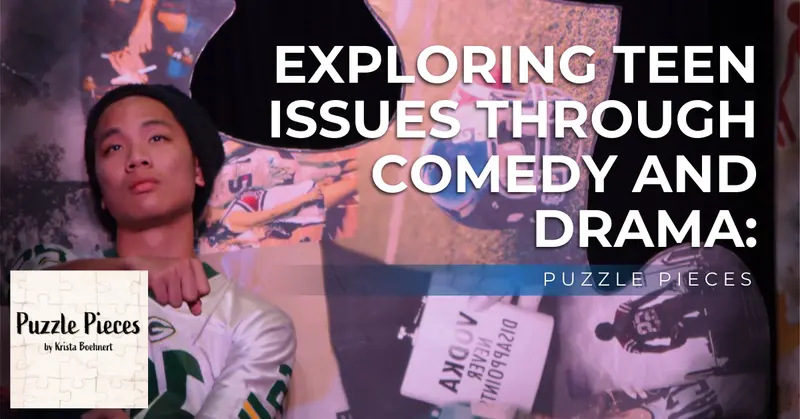
Exploring Teen Issues Through Comedy and Drama: Puzzle Pieces
Production

Exploring Teen Issues Through Comedy and Drama: Puzzle Pieces

_Puzzle Pieces _by Krista Boehnert mixes humour and and drama to help high school students explore teen issues through a series of monologues. Keigan Page ‘s students at The American School in Vietnam performed the play and were able to truly connect with the characters they portrayed. “We launched a new senior level drama class this year called Advanced Performance Production. The purpose of this class was to become a theatre company. We are quite a small school, the class itself was only 6 students. With a student director we chose to perform Puzzle Pieces. The students connected with their roles in a way I have never seen high school students connect. The whole show was student run with the actors/director doubling as set designers, costumes, advertising etc. This was so important, it is not just about teen issues but speaks to people of all ages. – Keigan Page” Great stuff, American School!
Theatrefolk’s Top 10: Teen Life
Featured Plays

Theatrefolk’s Top 10: Teen Life

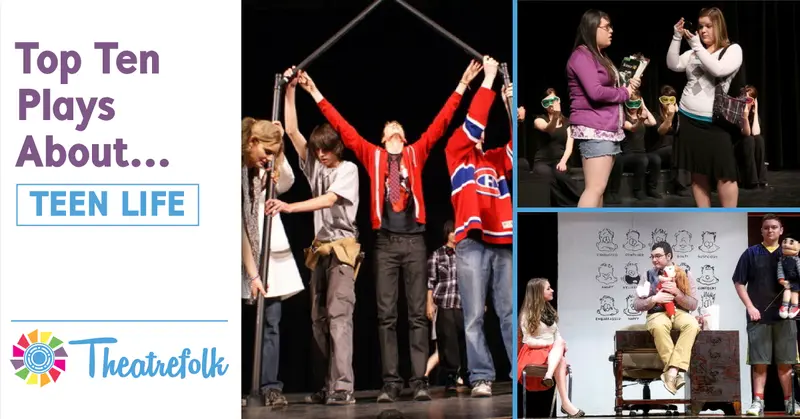
Time for a Tfolk Top Ten Plays About…Teen Life! These are not your typical teen-angst-woe-is-me stuff. Three dimensional characters. Relevant stories. Each one offers a unique theatrical take. Read one, read them all! Click the link and you’ll be taken to the webpage for each play. There you’ll get the details and read sample pages. All the best with your search! Sixteen In 10 Minutes Or Less The lives of seven teenagers become intertwined in this humorous and oftentimes bittersweet collection of ten minute plays. Puzzle Pieces This play explores teen issues through a series of monologues. The characters speak frankly about their fears, their futures, and how to embrace the day to day. Stereotype High High school is full of stereotypes – or is it? Told in a series of interlaced vignettes, these “stereotypical” teens fight tooth and nail to reinvent themselves. A Deep Poetic Journey Into Something Jane wants to break out of her box. The problem is she has no idea where to start. Will Jane choose to hide inside or change her life? Stressed Stress is driving this quartet crazy – so much so they can’t stop talking about it. This play is a symphony of sound and character. Pressure Alex is a refugee. Tera is faced with an unpopular decision. Penny is getting up at five every morning and Kyle can’t live up to expectations. Candid and uncompromising, with no easy answers. A Box of Puppies We can all relate to feeling small in a big world. These characters share their insecurities, their frailties and their coping mechanisms. Just Girls Talking What starts as a meeting to finalize graduation ceremony details ends with one young woman faced with a life-changing decision. A head-on collision of values that leaves the viewer asking: What would I do? Split Teenagers navigate the winding road of divorce in this honest and theatrical look at the day to day reality of growing up in a family that’s been torn apart. Neet Teen Teen life – backwards, forwards and inside-out. In every form from kitchen sink, to absurd, to movement, to audience participation, to song, to adding your own scene.
Theatrefolk Podcast: Krista Boehnert
Podcast

Theatrefolk Podcast: Krista Boehnert

Episode 71: Krista BoehnertKrista Boehnert is the author of two distinct plays in our catalogue – Have You Heard? and Puzzle Pieces. Both plays are completely written in monologue form. Listen to Krista talk about her writing process and how her sister was a big help in the development of her plays!
We accept

In addition to the above payment methods, Purchase Orders are accepted from US and Canadian Schools.

Info for your purchasing department