Facebook Pixel Skip to main content

📣SCRIPT SALE! Treat yourself to an easier Fall. Save 30% on 5+ perusal scripts with code SPRING30 before May 3 and head into summer stress-free.

Stereotype High

Stereotype High

by Jeffrey Harr

The geek. The freak. The stoner. The dumb jock. The mean girl. The thespian. The slut. The lonely girl. High school is full of stereotypes – or is it? Told in a series of interlaced vignettes, these "stereotypical" teens fight tooth and nail to reinvent themselves. There's nothing more powerful than the teen who stands alone, proud of who they are.

This play contains real situations, real feelings, and real thoughts about all the mature topics. Yes, that means sex, drugs and retainers.

Comedy

Average Producer Rating:

Recommended for High Schools

Running Time
About 105 minutes
Approximate; excludes intermissions and scene changes
Cast
22 Characters
9 M9 F4 Any Gender, Plus onstage crew
Set
Simple set
Length
107 pages
Free Excerpt

What to order?

Not sure what you need to order? Check out our pricing and ordering guide.

Performance Royalty Fees

Royalty fees apply to all performances whether or not admission is charged. Any performance in front of an audience (e.g. an invited dress rehearsal) is considered a performance for royalty purposes.

Exemption details for scenes and monologues for competition.

22 Characters
9 M, 9 F, 4 Any Gender, Plus onstage crew

Characters in this play are currently identified as male or female. Directors are welcome to assign any gender (binary or non-binary) to any character and modify pronouns accordingly.

CHUCK [M] 76 lines
The stereotypical jersey-and-jeans-wearing jock, the kind of guy who’s taken a few too many shots to the head (the same head featuring golden hair, perfect bone structure, and lips every girl in the school wants to test for softness) which may explain why the first word out of his mouth every time he speaks is “uh…”. One monologue
JEANIE [F] 138 lines
The stereotypical designer-clothes-wearing-over-accessorized mean girl, the kind of girl who can send pictures of her former BFF making out with her other former BFF’s boyfriend in the school bathroom to half the school while texting the guy with her other hand, omg—u r so hot! One monolouge
RONALD [M] 127 lines
The stereotypical button-down-half-sleeve-shirt-wearing geek, the kind of guy who’s going to score a 35 on his ACT (and tell his parents that he’s retaking it to get the extra point) and a negative five with the ladies (assuming, of course, that a lack of prowess with the opposite sex is not limited to being measured strictly by whole numbers). One monologue
ANNAROSAROSEMARIE [F] 148 lines
The stereotypical unmatched-shirt-pants-and-socks-wearing thespian, the kind of girl everyone refers to as “weird,” not so much because of her apparent need to over-inflect everything she says, but because she knows the words to every song from Rent and isn’t afraid to let you hear them. Like, all day long.
ALEX [M] 141 lines
The stereotypical old-school-rock-concert-black-T-shirt-wearing stoner, the kind of guy whose most important decision of the day is when to smoke his pot—before homeroom in the school parking lot, during school in the bathrooms of the career ed wing, or after school in the basement that his parents converted into his bedroom. Or all three. One monologue
RITA [F] 125 lines
The stereotypical wool-sweater-long-skirt-and-wide-glasses-wearing lonely girl, the kind of girl whose hair is bound as tight as her braces, except when she snorts after her friends tell her the one about the blonde who turns the lights on after sex by kicking open the car door—not because it’s funny, so much, but because she knows that her chances of ever having such an encounter range somewhere between being voted prom queen (other than as the victim of a cruel joke) and being asked out on a date. By a boy. Any boy. One monologue
ANDREW [M] 134 lines
The stereotypical plain-sweatshirt-and-black-sweatpants-with-white-sockswearing freak, the kind of guy who walks down the hall grazing the lockers as he goes, talking to himself the whole way and whatever voices are calling him that particular day—H.P. Lovecraft, Dr. Demento, or the mother he is almost positive isn’t his mother at all, but a hellhound spawned by the evil lord Mesmerizo on planet Crazyasbatcrap. One monologue
SKYE [F] 101 lines
The stereotypical miniskirt-low-cut-blouse-too-much-makeup-wearing bad girl, the kind of girl whose three favorite places are dark busses on nighttime school trips, houses hosting parties with plenty of drunk boys, available bedrooms, and no parental supervision, and well, anywhere dark where there’s a guy with a free five minutes. One monologue
MRS. SLATTIMORE [F] 55 lines
The stereotypical high school guidance counselor, the kind of woman who really wants to help kids but is, herself, so conspicuously hanging on the slippery edge of reality that when she does actually help someone, it’s either completely accidental or by an unverifiable act of God.
MISS JOHNSON [F] 44 lines
The stereotypical first-year teacher, the kind of woman who was blackmailed by administrators to have to advise an extracurricular for which she is completely unqualified, leaving her susceptible to the inevitable doubts that she already has about working with children which she can tack on to the pressure of finding a husband, moving out of her parent’s house, and paying off college loans totaling more than she’ll make in her first five years of teaching.
DISGRUNTLED MOVIEGOER [A] 18 lines
The stereotypical guy who goes to movies by himself, the kind of guy who thinks the movie theater is his living room and takes it upon himself to crucify other patrons—teens, especially—for every excessively loud popcorn crunch, cell phone vibration, and bathroom break that interrupts his personal movie-going experience.
POWER RANGERS 1 & 2 [A] 0 lines
The stereotypical kids who dress up as cartoon characters and go to Cosplaying conventions to hang out with other socially inept youngsters who watch way too much T.V.
LADY IN A WAITING ROOM [F] 0 lines
The stereotypical fifty-something lady, the kind of woman who eavesdrops on the conversations of nearby teens, taking everything they say as a sign that the world is, indeed, going straight to hell on a Harley.
LIFEGUARD [M] 0 lines
The stereotypical guy who got his lifeguard license so he could work at the local water park to sit in the sun, check out girls, and completely abuse the power to sit atop his lumber tower and blow his whistle every time a kid has the audacity to splash someone. TEEN BOYS 1 & 2 TEEN GIRLS 1 & 2 TWEEN BOY
EARLY TWENTIES GUY [M] 11 lines
The stereotypical guy who went to college to study the ways that constant drug use keeps someone from accomplishing anything worthwhile— like completing a reasonably intelligent sentence.
FRANKENSTEIN [A] 2 lines
The stereotypical retail employee who’s seen his share of Joe public—and has been completely horrified.
TEEN BOYS (x2) [M] 1 line
TEEN GIRLS (x2) [F] 1 line
TWEEN BOY [M] 1 line
STAGE CREW: (as many as necessary)
Dressed like the actors for specific set changes between scenes, a part of the action of the show.

Praise for Stereotype High

Heather Ashton
Sacred Heart Girls' College New Plymouth
Great content for teenage students - they could relate to it and felt it was relevant to their lives. The audience was intrigued with the storyline.

More Plays Like Stereotype High

who are we, who we are

by Forrest Musselman

Addresses anxiety and depression in teens.

Power Play

by Lindsay Price

The realities and the stereotypes of school violence. Not just the school shooting, but harassment and bullying. Violence is about power. So is high school.

Red Tee

by Lindsay Price

It’s time for role call. Who are you?

Passing Period Purgatory

by Christian Kiley

Sometimes the hardest part of school is getting from one class to the next.

La Caja

by Lindsay Price

A Spanish translation of the middle school vignette play Box.

Box

by Lindsay Price

A middle school vignette play about the boxes we find ourselves in.

From the Drama Teacher Learning Centre

September Reading List
Featured Plays

September Reading List: School-Themed Plays

September has arrived and it's time to hit the books - but with a twist! This month, we're showcasing a wonderful assortment of plays, all set within the hallowed halls of education. It's time to build your September reading list! So grab a cup of tea, find your favourite reading spot, and cozy up with these fantastic perusal plays. Celebrate these plays on the stage or in the classroom!
Theatrefolk Featured Play – Stereotype High by Jeffrey Harr
Featured Plays

Theatrefolk Featured Play – Stereotype High by Jeffrey Harr

*Welcome to our Featured Play Spotlight. * High school is full of stereotypes – or is it? Told in a series of interlaced vignettes, Stereotype High by Jeffrey Harr examines these “stereotypical” teens and how they fight tooth and nail to reinvent themselves. The geek. The freak. The stoner. The dumb jock. The mean girl. The thespian. The slut. The lonely girl. High school is full of stereotypes – or is it? Told in a series of interlaced vignettes, these “stereotypical” teens fight tooth and nail to reinvent themselves. There’s nothing more powerful than the teen who stands alone, proud of who they are. This play contains real situations, real feelings, and real thoughts about all the mature topics. Yes, that means sex, drugs and retainers. Why did we publish this play? This play will not be for everyone. It shows that teenagers are not sunshine and rainbows. They have real feelings, go through real situations, and have real thoughts on mature subjects, which is exactly why you should pick it up and you should do it. Stereotype High shows what happens when teenagers try to break out of the box they’ve been placed in. And we’re not talking a cry fest, angst fest, “why does no one love” pity party. We’re talking three-dimensional characters who make decisions, make mistakes, and try to change. I think it’s a lovely, lovely play. We’re so proud to include it in our catalogue. If you want an intro to this larger work, we publish some of the vignettes as smaller pieces – specifically check out You’re Cosplaying My Song and Master of Puppets. Let’s hear from the author!1. Why did you write this play? I wanted to put a bunch of different kinds of kids together–kids who had no business relating to one another–and let them work it out. Let them work to find a way to relate to one another on a level that goes beyond the stereotypes. As a teacher of 27 years, I have a deep respect for kids–every kind of kid–and this play allowed me to showcase a variety of them in funny, tender, painfully honest moments. 2. Describe the theme in one or two sentences. Chimamanda Adichie once said that the problem with stereotypes isn’t that they’re not true, it’s that they’re incomplete. Kids are so much more than the labels we pin on them. 3. What’s the most important visual for you in this play? The most important visual in the play is at the beginning, seeing the eight main characters, each a different stereotype, stretched across the stage, their costumes defining them in their roles as they recite their mantra–that the great teenage high school social scene gods grant them the serenity to accept their stereotypes–and then, again, at the end of the play, only, this time, they’re in pairs, changed, enlightened, with a new mantra: they’re going to be who they want to be and if people don’t like it, they’ll have to get over it. 4. If you could give one piece of advice for those producing the play, what would it be? Keep it simple–the set pieces, the scene transitions, the flow of the show. Let the characters tell the story and keep it moving. 5. Why is this play great for student performers? For one thing, it’s so much fun. A blind date gone wrong, an audition from hell, a cosplay battle between Obi Wan and an elf queen, an awkward encounter in a gynecologist’s office? You can’t ask for better scenes. And there are monologues – juicy monologues that actors can sink their teeth into, one for each main character. Lastly, these characters have depth–they give student performers the chance to play a realistic, relatable teen with real-life issues. They’re a wonderful challenge for young actors.
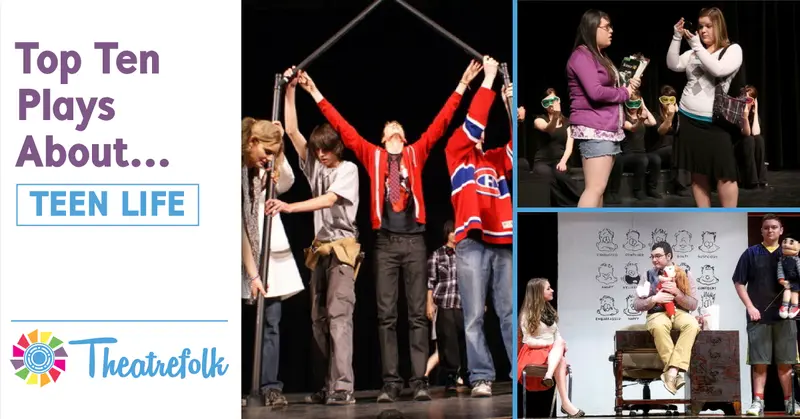
Theatrefolk’s Top 10: Teen Life
Featured Plays

Theatrefolk’s Top 10: Teen Life

Time for a Tfolk Top Ten Plays About…Teen Life! These are not your typical teen-angst-woe-is-me stuff. Three dimensional characters. Relevant stories. Each one offers a unique theatrical take. Read one, read them all! Click the link and you’ll be taken to the webpage for each play. There you’ll get the details and read sample pages. All the best with your search! Sixteen In 10 Minutes Or Less The lives of seven teenagers become intertwined in this humorous and oftentimes bittersweet collection of ten minute plays. Puzzle Pieces This play explores teen issues through a series of monologues. The characters speak frankly about their fears, their futures, and how to embrace the day to day. Stereotype High High school is full of stereotypes – or is it? Told in a series of interlaced vignettes, these “stereotypical” teens fight tooth and nail to reinvent themselves. A Deep Poetic Journey Into Something Jane wants to break out of her box. The problem is she has no idea where to start. Will Jane choose to hide inside or change her life? Stressed Stress is driving this quartet crazy – so much so they can’t stop talking about it. This play is a symphony of sound and character. Pressure Alex is a refugee. Tera is faced with an unpopular decision. Penny is getting up at five every morning and Kyle can’t live up to expectations. Candid and uncompromising, with no easy answers. A Box of Puppies We can all relate to feeling small in a big world. These characters share their insecurities, their frailties and their coping mechanisms. Just Girls Talking What starts as a meeting to finalize graduation ceremony details ends with one young woman faced with a life-changing decision. A head-on collision of values that leaves the viewer asking: What would I do? Split Teenagers navigate the winding road of divorce in this honest and theatrical look at the day to day reality of growing up in a family that’s been torn apart. Neet Teen Teen life – backwards, forwards and inside-out. In every form from kitchen sink, to absurd, to movement, to audience participation, to song, to adding your own scene.
Plays and the Common Core – a Perfect Fit
Teaching Drama

Plays and the Common Core – a Perfect Fit

In an age of seemingly endless assessments of our students’ ability to critically read and analyze literature, there is a dire need for them to experience a variety of texts in a variety of formats in order for educators to better train them to get at the heart of what a writer is doing. Because of this, dramatic works fit perfectly into any curriculum attempting to tie the Common Core standards to what the students, at the end of the day, know and are able to do. Of course, dramatic works are already mentioned in the Common Core as one genre with which our students should be interacting. But educators don’t always see them in the same light as more traditionally taught formats, like novels. It’s true that plays generally offer less student face-time with words than novels. However, they offer much more in the way of student engagement, unlike any other text-based medium. This significantly increases the likelihood of success in teaching them to see the literary techniques and authorial tricks-of-the-trade that the Common Core requires. “It’s one thing to read about something; it’s an entirely different thing to perform it.” The act of reading aloud, hearing the words, and portraying the ideas on the page makes clear what mere words cannot. It’s one thing to read about something; it’s an entirely different thing to perform it. Tone, theme, mood, inference, denotation/connotation, language use, structure, plot—all of this is present in plays and, to be sure, more easily seen by a “reader” because it’s literally seen by the reader. With our school’s work with my play Stereotype High, we hit every single one of these elements during our production. We had on-going discussions about theme, character motivations, word choice, the interrelatedness of the scenes, allusions to other works, teen language, and any number of other text specific issues wherein understanding the work was at the core of the discussion. As much as Stereotype High created multiple opportunities for students to explore all the standards of the Common Core, it’s not something specific to that particular play – it’s impossible to perform the words without interpreting them (and the characters saying them). And this is exactly why plays are a perfect fit with the Common Core. With regard to the general reading of dramatic works in the classroom, the following Common Core standards apply (grade nine standards, although there is little difference between these standards and the ones two grade levels above and below): Reading: Literary TextCCSS.ELA-LITERACY.RL.9-10.1 Cite strong and thorough textual evidence to support analysis of what the text says explicitly, as well as inferences drawn from the text. CCSS.ELA-LITERACY.RL.9-10.2 Determine the theme or central idea of a text and analyze in detail its development over the course of the text, including how it emerges and is shaped or refined by specific details; provide an objective summary of the text. CCSS.ELA-LITERACY.RL.9-10.3 Analyze how complex characters (e.g., those with multiple or conflicting motivations) develop over the course of a text, interact with other characters, and advance the plot or develop the theme. CCSS.ELA-LITERACY.RL.9-10.4 Determine the meaning of words and phrases as they are used in the text, including figurative and connotative meanings; analyze the cumulative impact of specific word choices on meaning and tone (e.g., how the language evokes a sense of time and place; how it sets a formal or informal tone). CCSS.ELA-LITERACY.RL.9-10.5 Analyze how an author’s choices concerning how to structure a text, order events within it (e.g., parallel plots), and manipulate time (e.g., pacing, flashbacks) create such effects as mystery, tension, or surprise. * CCSS.ELA-LITERACY.RL.9-10.7 * Analyze the representation of a subject or a key scene in two different artistic mediums, including what is emphasized or absent in each treatment. * CCSS.ELA-LITERACY.RL.9-10.9 * Analyze how an author draws on and transforms source material in a specific work (e.g., how Shakespeare treats a theme or topic from Ovid or the Bible or how a later author draws on a play by Shakespeare). **These two are of particular importance as, since most teachers are already incorporating Shakespeare and Greek drama into their classrooms, these standards completely apply to modern adaptations.* WritingUnlike most classical prose, plays inspire students to write plays. They’re shorter, more accessible, and tap into their authentic language so much more directly than any sort of prose can. CCSS.ELA-LITERACY.W.9-10.3 Write narratives to develop real or imagined experiences or events using effective techniques, well-chosen details, and well-structured event sequences. CCSS.ELA-LITERACY.W.9-10.3.A Engage and orient the reader by setting out a problem, situation, or observation, establishing one or multiple point(s) of view, and introducing a narrator and/or characters; create a smooth progression of experiences or events. CCSS.ELA-LITERACY.W.9-10.3.B Use narrative techniques, such as dialogue, pacing, description, reflection, and multiple plot lines, to develop experiences, events, and/or characters. CCSS.ELA-LITERACY.W.9-10.3.C Use a variety of techniques to sequence events so that they build on one another to create a coherent whole. CCSS.ELA-LITERACY.W.9-10.3.D Use precise words and phrases, telling details, and sensory language to convey a vivid picture of the experiences, events, setting, and/or characters. CCSS.ELA-LITERACY.W.9-10.3.E Provide a conclusion that follows from and reflects on what is experienced, observed, or resolved over the course of the narrative. LanguageUnlike the printed word, plays provide a spoken tone (and, possibly, a physical action) to a word that may further help a student understand new language. CCSS.ELA-LITERACY.L.9-10.4 Determine or clarify the meaning of unknown and multiple-meaning words and phrases based on grades 9-10 reading and content, choosing flexibly from a range of strategies. CCSS.ELA-LITERACY.L.9-10.4.A Use context (e.g., the overall meaning of a sentence, paragraph, or text; a word’s position or function in a sentence) as a clue to the meaning of a word or phrase. CCSS.ELA-LITERACY.L.9-10.4.B Identify and correctly use patterns of word changes that indicate different meanings or parts of speech (e.g., analyze, analysis, analytical; advocate, advocacy). CCSS.ELA-LITERACY.L.9-10.4.C Consult general and specialized reference materials (e.g., dictionaries, glossaries, thesauruses), both print and digital, to find the pronunciation of a word or to determine or clarify its precise meaning, its part of speech, or its etymology. CCSS.ELA-LITERACY.L.9-10.4.D Verify the preliminary determination of the meaning of a word or phrase (e.g., by checking the inferred meaning in context or in a dictionary). CCSS.ELA-LITERACY.L.9-10.5 Demonstrate understanding of figurative language, word relationships, and nuances in word meanings. CCSS.ELA-LITERACY.L.9-10.5.A Interpret figures of speech (e.g., euphemism, oxymoron) in context and analyze their role in the text. CCSS.ELA-LITERACY.L.9-10.5.B Analyze nuances in the meaning of words with similar denotations.
Theatrefolk Podcast: Playwright Jeffrey Harr
Podcast

Theatrefolk Podcast: Playwright Jeffrey Harr

Episode 79: Playwright Jeffrey Harr Jeffrey Harr is a English Teacher with a sparse theatre background. He was handed the student one act play festival with no guide or instruction. How did he turn the festival into a mostly student-written venture? We also talk about the universal and relevant high school themes explored in his play Stereotype High.
Social Issue Plays for High Schools / Middle Schools
Teaching Drama

Social Issue Plays for High Schools / Middle Schools

Our website lists all of our plays with social issue themes but it struck me that they’re only lumped as “issue plays” without a good guide to sorting out which title addresses which issue. So I’ve categorized them for you to hopefully give you a helping hand in your quest to find the perfect script for your school. Check them out. As usual, all of the titles have extensive free sample pages for you to read. I think you’ll find the writing honest, fresh, and believable – three qualities sadly lacking from a lot of “teen-issue” plays out there in the world. Alienation / Feeling Alone in the World• Anonymous by Allison Green • The Art of Rejection: Two One Act Plays by Christian Kiley • A Box of Puppies by Billy Houck • Constantly, Incessantly, All The Time by Billy Houck • Huge Hands by Billy Houck Body Image• Body Body by Lindsay Price • The Four Hags of the Apocalypse Eat Salad at their General Meeting by Lindsay Price • The Battle of Image vs. Girl by Johanna Skoreyko • Hoodie by Lindsay Price • Breathless by Wendy-Marie Martin Censorship• Censorbleep by Lindsay Price Human Rights• Look Me in the Eye by Lindsay Price • Sweep Under Rug by Lindsay Price Racism• Flaky Lips by Lindsay Price • With Liberty and Justice For All by Jeyna Lynn Gonzales • Not Going Anywhere by Emma Fonseca Halverson • The Burgundy Letter by Kirk Shimano • Let Me In by Sholeh Wolpe *** Rumours and Lies• Have You Heard? by Krista Boehnert • The Redemption of Gertie Greene by Taryn Temple Individuality• Hoodie by Lindsay Price • Virtual Family by Christian Kiley • The Happiness Shop by Lindsay Price • A Deep, Poetic Journey Into Something by Forrest Musselman • Carrying the Calf by Shirley Barrie • Monster Problems by Lindsay Price • Stereotype High by Jeffrey Harr • Sixteen in 10 Minutes or Less by Bradley Hayward • Nice Girl by Amanda Murray Cutalo • Pressure by Lindsay Price • They Eat Sunshine, Not Zebras by Dara Murphy • The Super Non-Heroes by Taryn Temple • Smarty Pants by Bradley Hayward Identity• Box by Lindsay Price • Labeled by Lindsay Price • We Are Masks by Lindsay Price • Stressed by Alan Haehnel • Anonymous by Allison Green • Constantly, Incessantly, All The Time by Billy Houck • The Super Non-Heroes by Taryn Temple School Violence• Huge Hands by Billy Houck • Power Play by Lindsay Price • Clowns with Guns (A Vaudeville) by Christopher Evans • The Butterfly Queen by Christian Kiley • Life and Death in an Empty Hallway by Christopher Evans • Water. Gun. Argument. by Alan Haehnel Sexual Abuse• The Waking Moment by Bradley Hayward • Breathless by Wendy-Marie Martin Substance (alcohol & drug) Abuse• Bottle Baby by Lindsay Price • Floating on a Don’t Care Cloud by Lindsay Price • One Beer Too Many by Billy Houck Suicide• The Bright Blue Mailbox Suicide Note by Lindsay Price • Chicken. Road. by Lindsay Price • The Butterfly Queen by Christian Kiley Teen Pregnancy• The Pregnancy Project by Lindsay Price • Among Friends and Clutter (one scene) by Lindsay Price Illness/Health• Chemo Girl by Christian Kiley • The Other Room by Christian Kiley • Red Rover by Christian Kiley • Waiting Room by Christian Kiley • Breathless by Wendy-Marie Martin • Shreds and Patches by Robert Wing • Inanimate by Christian Kiley • Constantly, Incessantly, All The Time by Billy Houck Depression/Anxiety• darklight by Lindsay Price • Fidget by Bradley Hayward • Among Friends and Clutter (one scene) by Lindsay Price • Constantly, Incessantly, All The Time by Billy Houck • who are we, who we are by Forrest Musselman Bullying• Finishing Sentences by Scott Giessler • Funhouse by Lindsay Price • Power Play by Lindsay Price • The Redemption of Gertie Greene by Taryn Temple • Sixteen in 10 Minutes or Less by Bradley Hayward • Carrying the Calf by Shirley Barrie Divorce• Split by Bradley Hayward Gender• Life, Off Book by Scott Giessler • Anonymous by Allison Green • Baalzebub by Rachel Atkins (Baalzebub – One-Act Version here) • Completely, Absolutely Normal: Vignettes About LGBTQ+ Teens by Bradley Walton • Finding Jo March by Laramie Dean • Thought Traps by Lindsay Price Empathy• Discovering Rogue by Christian Kiley • Boat by Lindsay Price • We Are Masks by Lindsay Price • The Butterfly Queen by Christian Kiley Dependence on Technology• Virtual Family by Christian Kiley • Inanimate by Christian Kiley
We accept

In addition to the above payment methods, Purchase Orders are accepted from US and Canadian Schools.

Info for your purchasing department