Facebook Pixel Skip to main content

📣SCRIPT SALE! Treat yourself to an easier Fall. Save 30% on 5+ perusal scripts with code SPRING30 before May 3 and head into summer stress-free.

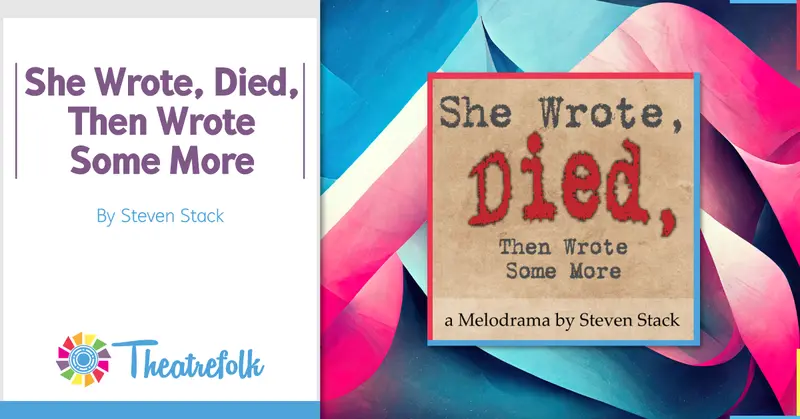
She Wrote, Died, Then Wrote Some More

She Wrote, Died, Then Wrote Some More

by Steven Stack

Tonight was going to be writer Alina Deveraux’s most important night, the unveiling of her memoirs: a non-fiction fictional retelling of Alina’s life moment by moment up until three hours ago when she finished it.

Until she ended up dead. Or not dead.

The comedic, melodramatic one-act mystery, She Wrote, Died, Then Wrote Some More, is an hilarious romp that features betrayals, broken hearts, a rather odd but beautiful love story, and many twists. The play features a cast of eccentric and unique characters, who may or may not at some point end up dying themselves. Or appearing murdered because of a rare fainting when frightened disorder…

Melodrama Mystery

Average Producer Rating:

Recommended for High Schools and Middle Schools

Running Time
About 40 minutes
Approximate; excludes intermissions and scene changes
Cast
10 Characters
1 M | 7 F | 2 Any Gender
Set
Simple Set
Length
43 pages
Free Excerpt

What to order?

Not sure what you need to order? Check out our pricing and ordering guide.

Performance Royalty Fees

Royalty fees apply to all performances whether or not admission is charged. Any performance in front of an audience (e.g. an invited dress rehearsal) is considered a performance for royalty purposes.

Exemption details for scenes and monologues for competition.

10 Characters
1 M, 7 F, 2 Any Gender

Characters in this play are currently identified as male or female. Directors are welcome to assign any gender (binary or non-binary) to any character and modify pronouns accordingly.

ALINA DEVERAUX [F] 260 lines
The Writer. One Monologue.
MARIAN [F] 88 lines
The Maid
MINNIE MATTHEWS [F] 80 lines
The Agent. One Monologue.
VIVIAN DEVERAUX [F] 36 lines
The Sister. One Monologue.
BARNABAS BUCKLEY [M] 30 lines
The Boyfriend. One Monologue.
ANNA MARIE SILVERSTREET [F] 39 lines
The Actress
DEANNA FARNSWORTH [F] 15 lines
The Neighbor
SUZANNE SPRINGFIELD [A] 43 lines
The Reporter. Nicholas Springfield if male.
ELIZABETH MONTGOMERY [F] 27 lines
The Other Writer
STEPHANIE SWANSON [A] 33 lines
The Detective. Stefan Stade if male. One Monologue.

Praise for She Wrote, Died, Then Wrote Some More

Jennifer Wagner
Prince of Wales Secondary
We had so much fun working on "She Wrote, Died, Then Wrote Some More" by Stephen Stack. It was a piece that we showcased as part of a grouping of short scenes and One Acts at Prince of Wales. The show got BIG laughs thanks (in part) to the witty dialogue and farcical nature of the various scenes and circumstances. It was a real crowd pleaser. Highly recommend this piece for high school productions.
Jennifer Wagner
Prince of Wales Secondary
A wonderful show! Great fun. Highly recommend for high school productions. Students loved the "over the top" characters and really had fun with the physicality and overall silliness.

More Plays Like She Wrote, Died, Then Wrote Some More

Frankenstein Among the Dead

adapted by Laramie Dean from the novel by Mary Wollstonecraft Shelley

Thunder and lightning tear apart the night sky while two young women explore the story of Frankenstein

Grim and Gruesome Grimm

adapted by Mrs. Evelyn Merritt from Jacob and Wilhelm Grimm

A playful and theatrical adaptation of Grimm's grimmest tales.

A competition-length cutting of The House. The house doesn’t just hold stories… it hungers to tell them.

A shorter version of our hilarious gender-bending take on the Scottish play. Updated version.

Mmmbeth

by Allison Williams

An hilarious gender-bending take on the Scottish play! Updated Version.

A noir play featuring the ace detectives from the Broadly Speaking Detective Agency.

From the Drama Teacher Learning Centre

October Reading List: Mystery Plays
Featured Plays

October Reading List: Mystery Plays

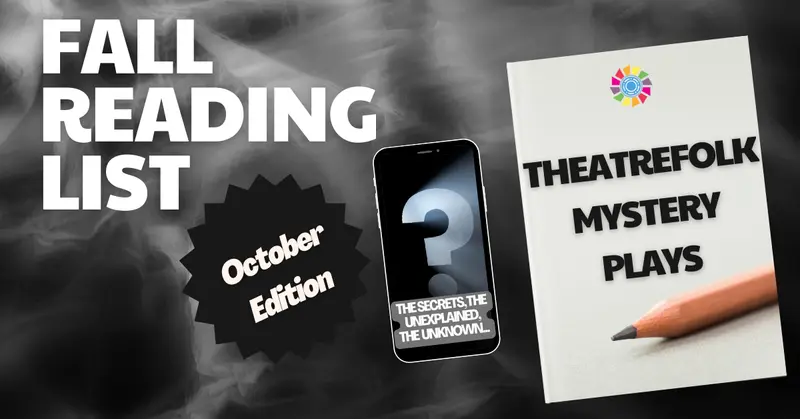
Ready to add a little mystery to your drama classroom? We’ve put together a list of plays full of secrets, twists, and unexpected turns that are sure to captivate your students. Whether they’re uncovering hidden clues or piecing together the puzzle, these scripts will have your performers and the audience hooked. Ready to crack the case? Dive into our mystery play picks!
5 Tips for Writing A Murder Mystery Play
Playwriting

5 Tips for Writing a Murder Mystery Play

Whodunnit? Murder mystery plays are a lot of fun for both performers and audiences. Audiences get to be detectives and discover throughout the show who committed the crime, while the actors get to embody all sorts of interesting characters, all with a similar goal: to get away with murder! Murder mysteries are like spiderwebs — there are tons of connecting threads that all come together to make one fascinating and beautiful creation. They require a slightly different kind of planning, but it’s worth it to create a fun and intriguing piece of theatre. Read on for five tips (and five accompanying tasks) for writing a murder mystery play. 1. Choose your subgenre.Despite the fierce title, murder mysteries can be tailored to the playwright’s liking. They can be bloody and gory thrillers, “cozy” mysteries (a lighter mystery with clean language, and all violence occurring off-stage), or anything in between. A murder mystery might involve ghosts and the supernatural, or meddling kids might solve it rather than a detective. It could be set in a courtroom with a judge and jury, or in an abandoned house in a spooky forest. It might even involve audience participation! Students will need to decide how dark they want their mystery, and who their target audience is. Task: Have students determine what subgenre of murder mystery they want their piece to be (thriller, horror, noir, courtroom drama, dark comedy, farce, cozy, supernatural, etc.) and who their target audience is (adults, teens, elementary school children, families). Note: This might change as they work through the tasks. That’s ok! This is a starting point. 2. Map out your work.Murder mysteries generally have lots of characters. First and foremost: the victim. Who dies? When, where, and how? Then, there’s the rest of the motley crew: the victim’s various family members, friends, confidantes, lovers, enemies, employees or colleagues, and of course that one seemingly random character with a mysterious connection that is revealed later in the play. These are the suspects — the characters who have been accused of committing the crime. Not only are these characters connected to the victim, but they’re generally connected to at least one other character somehow. Task: Students will create a map of their characters, showing their connections to each other. Put the victim in the middle and the rest of the characters around them. Draw a line between each connected character. Some characters will have more connections than others. Students can sketch this on paper or a whiteboard, make a digital version, or create the classic cork-board-and-yarn setup (also known as a “conspiracy board,” “evidence board,” or “murder map”). 3. Determine the motives.Every character, including the main character, the detective, and even the narrator if there is one, needs to have a motive for the murder. Why did they want the victim dead? What’s in it for them? What do they stand to gain (or lose) from the victim’s death? Do they have an alibi? An alibi is a reason why the suspect couldn’t have committed the crime. Task: Determine a motive for each character, and an alibi if they have one. Add it to the character map created in Task 2. 4. Work backwards.Writing a murder mystery takes a lot of planning. This is one genre where it’s useful to work backwards — start with the final outcome of the piece and move backwards, adding details and perplexity, rather than trying to unravel everything at the beginning. Determine the crucial moments of the story, including scenes like the introduction of the characters, the murder itself, the discovery of the murder, the gathering of the witnesses, the sharing of alibis, the final outcome of the murder mystery — Who actually committed the crime? How did they do it? — and work backwards to the beginning of the piece. Include any important details that are specific to the piece. If students want to add complexity, they might try to have two scenes occur at the same time. Task: Make a backwards outline of the murder mystery. Write each important moment on a separate index card and attach the cards to a board with pins or magnets, starting from the end of the play and working back to the beginning. This way you can shift around, adjust, or eliminate the moments as necessary. 5. Show and tell.With the solid work students have done creating the outlines for their murder mystery plays, they can get started writing scenes. It’s easy to get lost in dialogue with murder mysteries — there’s a lot of information you need to relay. Remind students that plays are a visual medium and that the action of the show must be shown as well as spoken about. What scenes could you include with more action than dialogue? What can you show the audience that the other characters don’t see? What clues will be discovered when, and by whom? What red herrings can you include? (A red herring is a clue or piece of information that is intended to mislead or distract from the real issue at hand, and is frequently used in murder mysteries.) Task: Get writing! Be sure to check out some of Theatrefolk’s awesome murder mystery plays, such as She Wrote, Died, Then Wrote Some More and The Plucky Pie Murder.
Theatrefolk Featured Play - She Wrote, Died, Then Wrote Some More
Featured Plays

Theatrefolk Featured Play - She Wrote, Died, Then Wrote Some More

Welcome to our Featured Play Spotlight. She Wrote, Died, Then Wrote Some More by Steven Stack is a fast-paced quirky melodrama that would definitely be a showstopper for any school! Tonight was going to be writer Alina Deveraux’s most important night, the unveiling of her memoirs: a non-fiction fictional retelling of Alina’s life moment by moment up until three hours ago when she finished it. Until she ended up dead. Or not dead. The comedic, melodramatic one-act mystery, She Wrote, Died, Then Wrote Some More, is a hilarious romp that features betrayals, broken hearts, a rather odd but beautiful love story, and many twists. The play features a cast of eccentric and unique characters, who may or may not at some point end up dying themselves. Or appearing murdered because of a rare fainting when frightened disorder… Why did we publish this play? I don't write melodrama well and I so admire those who do. What I love about Steven's play is the way it brings the form to vivid life with characters who are great to watch. It's amazing to see how far a character will go in this play to get what they want, with hilarious results in equal parts verbal and physical humour. Steven has said that "melodrama can be realistic - just not the way we know reality in our day-to-day life" which is a great perspective. He knows how to set up the world for his characters and then push the limit of the reality of the world to the extreme. It’s a fast-paced and fun romp of a play featuring quirky and distinct characters in a world that is bizarre, but still close enough to reality to be believed. This would be a showstopper play for any school! Let’s hear from the author! 1. Why did you write this play? I love writing melodramas and I wanted to write a murder mystery where almost everyone died but, spoiler alert, they weren’t actually dead. 2. Describe the theme in one or two sentences. The themes of She Wrote, Died, Then Wrote Some More are that nothing is ever really what it seems and that people will go to whatever length necessary to get what they want. 3. What’s the most important visual for you in this play? When Minnie’s plot is revealed by Alina, who rose from the dead from her fake death to save Marian while all the while the stage is littered with “dead” bodies. It’s such a fun and striking visual especially when you consider what’s about to happen. 4. If you could give one piece of advice for those producing the play, what would it be? Remember that these characters are real to themselves and should be created and performed as so. They are ridiculous to us and what they experience perhaps even more so but to them, it’s their actual life and they are not in on the joke. 5. Why is this play great for student performers? Because the characters are complex and super fun to play. It also forces actors to create the truth of their characters and not simply play “the jokes.” Doing this allows the audience to believe what they are seeing while also making the play funnier. Plus, they get to die on stage in odd ways and that’s always awesome. Get your copy of She Wrote, Died, Then Wrote Some More, right here, right now!Not right for your group right now? Search our play catalogue to find one that your performers will love!
Theatrefolk’s Top 10: Comedies
Production

Theatrefolk’s Top 10: Comedies

Time for a Tfolk Top Ten Plays for…Comedies. Read one, read them all! Click the link and you’ll be taken to the webpage for each play. There you’ll get the details and read sample pages. All the best with your search! The Baloney, The Pickle, The Zombie, and Other Things I Hide From My Mother Trevor is bringing food to life with experiments he hopes will lead to the creation of zombies he can sell as cheap laborers. He may discover that his food may actually be smarter than he is… Apostrophe’s Are you sometime’s amazed at how many apostrophe’s s’ome people manage to fi’t into s’entence’s? Then you’re not the only one. That’s just the problem that needs to be solved in this outrageous comedy. Lord of the Pies A pie shop erupts into panic after Franny announces the arrival of the apocalypse. She starts to reconstruct society and takes out anyone who stands in her way with baby food and scotch tape. Is the apocalypse real? Will the bathroom serve as an adequate prison? Why is there a muffin tin in a pie shop? Hamlet, Zombie Killer of Denmark Denmark is plagued with zombies led by Hamlet’s uncle/step-father, the current king. When Hamlet learns from his zombified father that his uncle plans to turn Denmark into a land of the undead – Hamlet knows he must stop him! Or not. If he could only be sure… A gruesomely comic adaptation! Original text with new zombified dialogue. A Lighter Shade of Noir Trent Trowel is your typical gumshoe. Searching the mean streets for crimes to solve and dames to fall for. He joins some of the world’s most famous detectives at the International PD gala. But is this all a plot for the world’s most dastardly villains to foil them with a fiendish master plan? A fabulously funny and high styling take on film noir – it’s a lighter shade of noir after all! Close Encounters of the Undead Kind Wendy walks into a typical teen support group. Claire thinks Halloween is going to be humdrum as usual. Rachel wants her parents to be nice to her new boyfriend. Three ordinary scenarios… or are they? Is that a werewolf at the support group? A vampire at the door? A zombie boyfriend? With some close encounters of the undead kind, these plays are far from typical and humdrum! Epic Adventures in a Rinky Dink Art Museum High school students reluctantly visit a small town art museum to complete a creative writing project. But there’s more to the eye than a couple of paintings: Vanishing Valerie! Love-struck Kaitlin! Duncan… trying to eat a clay apple! A wonderfully sweet character driven comedy. Drop Dead, Juliet Juliet has had enough! Enough with the poison, enough with the stabbing, and especially enough with the dying. She wants a new story and she wants it now. _ Romeo and Juliet_ will never be the same – or will it? She Wrote, Died, Then Wrote Some More This comedic, melodramatic one-act mystery is an hilarious romp that features betrayals, broken hearts, a rather odd but beautiful love story, and many twists. Like the main character ending up dead. Or not dead… Lose Not Thy Head Joan pleads for life, Death waits for death, a severed Head says beheading isn’t so bad, a doctor tries to convince everyone that you can’t sew a head back on a body, and then things get weird. Shakespeare, Monty Python, a little love, a little death, a lot of laughs and a talking head. Planning on performing one of these or another Theatrefolk play? Let us know all about it with pictures and highlights – we might even feature you on our site! Click here to submit your story.
A Gender conversation….and Pirates: Creating a safe enviroment for youth in your theatre program
Podcast

A Gender conversation….and Pirates: Creating a safe enviroment for youth in your theatre program

Episode 146: A Gender conversation….and PiratesSteven is a long time Theatrefolk playwright, and in his latest play The Dread Pirate Sadie, the majority of characters are girl pirates. And in the world of the play, this is the norm. In this podcast we talk gender and how we can create a safe environment for students to own who they are, embrace who they are and stand up for who they are. Being human is challenging and uncomfortable at times. How do you create a communicative accepting community?
Playwright Dara Murphy
Podcast

Playwright Dara Murphy

Episode 82: Playwright Dara MurphyDara Murphy wrote her first play in high school for a class project and her teacher submitted it to us. At the time Dara was the youngest playwright in our catalogue but now she’s got three plays with Theatrefolk and is gearing up to embark on a teaching career. Dara gets the distinction of penning the “weirdest” plays in our catalogue, listen in to learn why.
A Melodramatic Look at Melodramatic Comedies
Acting

A Melodramatic Look at Melodramatic Comedies

This is a Guest Post from Alina Deveraux, famed author (or so she tells us). See the bottom of the post for a free printable PDF melodrama activity including two monologues and a scene from the play. So you’re looking into doing a melodramatic comedy, but you’re afraid. No doubt you’re afraid of venturing into a new genre that’s only been around since the 1770s. Perhaps you’re also afraid of performing a form of theatre that is actually quite challenging to do correctly. I understand your fears, as I consider myself to be the leading player in my own melodramatic comedy. Because I am. Let me introduce myself. My name is Alina Deveraux, famed author of The Secret Life of a Secret Whose Sharing Shall Remain Secret: A Love Story and the forthcoming She Writes With Quill: A Moment by Moment Recollection of the Life of Alina Deveraux Up Until Now. I must also add that I’m also a character in playwright Steven Stack’s one-act melodramatic comedy mystery She Wrote, Died, and Then Wrote Some More, which is based on the events that unfolded on the night of my book’s unveiling. Steven asked me to write a few words on why directors should pick a melodramatic comedy for their next performance rather than any other type, and as a writor myself, I was of course more than happy to oblige. Let’s be frank: he wants you to do his play, my story, which of course I do as well – it is the story of my life’s work, after all, and has been called “The Our Town and Hamlet of melodramatic comedies” by . . . no one . . . aloud. But I digress. I am here is to convince you that the next play that you perform in your school theatre, community theatre, college theatre, professional theatre, outdoor theatre, dinner theatre, or living room should be a melodramatic comedy. So without further ado, I shall now convince you. First and foremost, melodramatic comedies are simply fun to do. They take a normal, everyday situation and throw in absurd twists – fake murders, bizarre disorders, ridiculous betrayals, ludicrous love stories, the list goes on and on – all of which conspire to render the normal abnormal in a fun and relatable way. With realism, this wouldn’t be feasible. What enables such outlandish constructs to fully transport the audience, whether into my life or into the world of the play, is that within the parameters of the melodramatic world, such eccentricities are normal and expected. Thus, the characters are never shocked when something ridiculous takes place – while the audience, not inhabiting the same world we characters do, will not expect it and will thoroughly enjoy the absurdity of it. Your audiences will rave that what they enjoy most about a riveting evening of melodrama is how over the top everything is! Melodramatic comedies will also bring happiness and lifelong fulfillment to your actors. Characters in these types of plays tend to be exaggerated, full of extreme emotions and forced to be very active. For example, they may be asked to destroy a pillow because they have a rare fainting-when-frightened disorder that causes them to attack the first thing they see when waking up from a fainting spell because they believe that the thing that woke them up is said pillow. Hypothetically speaking. Actors are excited to create roles that verge on the farcical, and as a director, you will also be able to teach them the importance of not being “in on the joke.” When students act in a comedy, they tend to forget that the characters they’re playing are not aware of how funny they and their situation are. To the characters, the situation is quite serious, as with the situation where no one wanted to publish my 1701-page masterpiece written only with quill. But the number one reason to do a melodramatic comedy is because it’s the right thing to do. For yourself, your actors, and your audience. For the world, really. I can imagine what your non-character lives are like – full of the expected, the routine, and the mundane – while my life, and the lives of all melodramatic characters, are swimming in exciting, controlled chaos. So when you do a melodramatic comedy, you give all those involved – actors, set designers, audience – a certain freedom from reality. An escape, if you will. A festively fun, exhilarating, absurd escape. So there you have it: that’s why you should choose to perform a melodramatic comedy the next time you’re looking for a play. And yes, I would be delighted to step upon your stage with my quill and nine of my eccentric and esteemed character-mates. It will make for a delightful evening, I assure you. Click here to get a copy of Don’t Be In On the Melodramatic Joke, a guide to performing melodrama. Includes two monologues and a scene from the play.
We accept

In addition to the above payment methods, Purchase Orders are accepted from US and Canadian Schools.

Info for your purchasing department